BASIC PR and THE PORTRAIT OF A PROFESSIONAL PR PRACTITIONER Version Vietnamese
BMG International Eduacation  training programs have been registered  There must be approval document of BMG for external usage of this material For further information about this license, please contact via  [email_address] Hotline: (08) 2244 6267
LECTURER INTRODUCTION MS DENISE THI M.A IN PUBLIC RELATIONS (NEWSCATTLE UNIVERSITY – UK)   EMERALD – A DIGITAL BASE COMMUNICATION AGENCY  ( www.digitalmarketing.vn )  Account Director  PR jobs: Kaspersky Digital based communications projects: PNJ, Netgame Asia, Milo, Beeline, Bless You, Spray, Intel.  CSR VIETNAM – CONSULTANCY SERVICE Director of CSR Vietnam  Clients: Holcim, Goodyear, Vinamilk,Kaspersky VN, etc.  Partners: Vietnam CSR Awards 2009, AFCSR, Global Compact Network VN (UN), SDB – VCCI
ESSENTIAL SIGNS No smoking Keep silence when neccessary No mobile in classroom Toilet on the right side of classroom
LECTURING RULES Listen – No need to write Understand the lecture – No need to memorize the lecture Keep silence – While lecturer is saying Discuss – While the class are in discussion Students are centric – Lecturers are instructors No need high records – Practice and Application are essential Learn practically, work professionally  TM
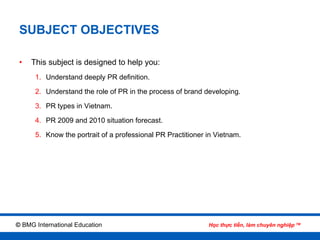
SUBJECT OBJECTIVES This subject is designed to help you: Understand deeply PR definition. Understand the role of PR in the process of brand developing.  PR types in Vietnam.  PR 2009 and 2010 situation forecast.  Know the portrait of a professional PR Practitioner in Vietnam.
CONTENTS PR Theories  PR as an element of an organization PR types in Vietnam PR 2009 and PR 2010 Forecast Wrap-up and discussion session
Lecturing time at BMG 2 classes = 4 hours
PR Theories
What is PR? PR is……………………………………………………………………….. Key terminology – interaction, co-operation, dialogue, foster goodwill, minimize conflict, valued relations, mutually beneficial, ongoing, responsible, reputation, image, communication, optimism, effectiveness all about  relations  and  reputation
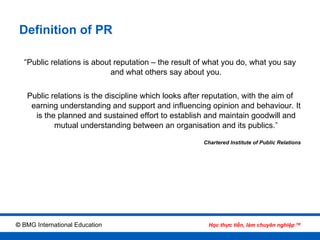
Definition of PR “ Public relations is about reputation – the result of what you do, what you say and what others say about you.   Public relations is the discipline which looks after reputation, with the aim of earning understanding and support and influencing opinion and behaviour. It is the planned and sustained effort to establish and maintain goodwill and mutual understanding between an organisation and its publics. ” Chartered Institute of Public Relations
The purposes of PR Corporate  communication/pr can be divided into three categories (van Riel,1995) Management communication -  involves all levels of management internally plus external roles such as chairmen and chief execs who perform a symbolic role Marketing communication -  all those activities that come under promotion including advertising, direct sales, direct marketing and sales promotion Organisation communication  - includes the non-marketing elements of PR and internal communication both between employees and to the outside world Ask yourself: Total communication needs of an organization, what are they?
PR vs MKT PR MKT Focus relationships — reducing conflict and improving cooperation the market — consumers and demand Values recognition by decreasing the expenses that are necessary when issues are ignored – Qualitative  by increasing income – Quantitative  Comm.  M odel 2 way comm 1 way Jobs Promote good things & control bad things – Understanding Connect products or services to a particular group or audience – Awareness  Involvers Organization's internal and external stakeholders Product/Services – its market/ audience Creativeness Less More Measure More difficult Easier
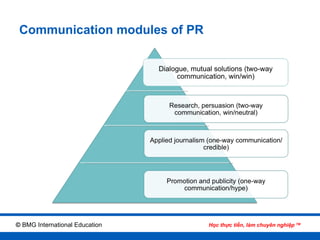
Communication modules of PR
PR people, who are they and what they do? Help clients understand what is newsworthy and what is not. Spend a lot of time with editors pitching ideas, sending memos and following-up with phone calls about the client, their services or products.  Call editors to place news, business, lifestyle and feature articles in newspapers, magazines, trade journals and industry publications.  Get television and radio producers to do stories on clients. Write articles about clients themselves, issues and innovations in their field.  Create, copy write and maintain websites and website blogs, like this one. Copy write and oversee email alerts, newsletters and marketing materials such as reprints of articles and brochures.
PR people, who are they and what they do? Create fact sheets and press kits, when necessary. Copy write and oversee production of print and broadcast advertising. Copy write and oversee internal materials such as employee handbooks, how-tos and training videos.  Track publication of articles, news stories, etc. Arrange introductions to the media for clients so they can be used as sources in future articles. Arrange publicity for client events such as seminars, speaking engagements and fund-raisers.
Must-have things of a standard PR practioner Know how to collect Press Information Know how to give a speech, to be an MC Know how to write a Press Release Know how to create and maintain a relationship Know how to build a PR strategy and plan Know how to organize an event, press conference, conference. Know to to manage a crisis Know how to write, read, speak and listen to Vietnamese.
PR principles  Biggest rule: Relations!!! Medium: It is about the story Approach: Honesty is the best policy Method: Dialogue, Conversation, Communication not Propaganda!  Play role: Understand your role as a common party  Implementation: Research & Prepare
PR in relations of an organization
Types of relationships
PR Publics Customers/Consumers Employees  Journalists Shareholders  Government,  Local Community Suppliers/ Contractors Business partners/ Distributors  Special Interest Groups, Pressure Groups International, Potential Opinion Leaders Formers
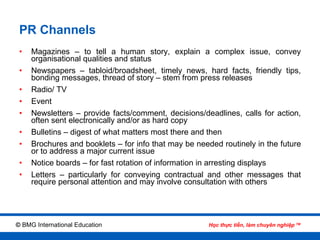
PR Channels Magazines – to tell a human story, explain a complex issue, convey organisational qualities and status Newspapers – tabloid/broadsheet, timely news, hard facts, friendly tips, bonding messages, thread of story – stem from press releases  Radio/ TV Event  Newsletters – provide facts/comment, decisions/deadlines, calls for action, often sent electronically and/or as hard copy Bulletins – digest of what matters most there and then Brochures and booklets – for info that may be needed routinely in the future or to address a major current issue Notice boards – for fast rotation of information in arresting displays Letters – particularly for conveying contractual and other messages that require personal attention and may involve consultation with others
PR Channels Pay-slip notices – for short messages that need to read Annual reports – to share the corporate message as a whole, to reflect on year past or look to year ahead Telephone/email/text ‘hot lines’ – for immediate enquiries and contributions Displays and exhibitions – for more complex or visual messages, three dimensional interpretations, opportunities to linger and ready access to answers Advertisements – either hard copy or filmed to convey message or reiterate brand identity Campaigns – usually take place over set course of weeks, months or on occasion years, meant to target specific audience group with a specific set of targets and goals to work to Website/new media – immediate, most growing area of PR in current climate
PR Channels What else?
Discussion & Activities  Which media for which public? 7 min
PR types
Ground of Classification Subject of PR activities Object of PR activities Organizational PR
Subject of PR activities – Brand Centric  Classes: Corporate PR  Product/Services PR People PR Tools/Media: Traditional tools  Marketing tools
Subject of PR activities – Brand Centric  Features of supplied info.: Depend on subject of PR activities  Along with traditional mindset  Disadvantages: Limited in usage of tools  Easy to get into 1-way comm.
Object of PR activities – Customers/Public Centric  Classes: Customers PR Government Lobby (GR) Community Relations Etc.  Tools/Media: Traditional tools  Marketing tools New developed tools (thanks to the development of technology)
Features of supplied info.: Messages are build upon the needs of objective public.  Along with new approaches. Media Traditional media New media NON-commercial tools    Social plaforms Object of PR activities – Customers/Public Centric
Organizational PR  Internal PR Staff Managerial level  Etc. External PR Community Press & Media Government  Etc.
PR situation 2010
Media & PR 2009 Media: Commercialization & Tabloidization  Quantity raise over 600 Niche market of specialized magazines/newspapers PR Blooming in various PR and PR-related services  Increase tools & techniques  Influence of financial crisis  Blurring borders between Pro PR and capable PR people Violate the nature of “news” and media industry
Media & PR 2010  Media: Bigger blooming in numbers of publications Change in professional skills of journalists PR: Return to reserve the core nature of “news” Customer centric vs Brand centric  Social media platforms study and apply
Thank you for your listening. Any further inquiries about lecturers and training program,  please contact via below channels  Email: info@bmg.edu.vn  Hotline: 2244 6267 www.bmg.edu.vn

Basic PR - BMG training

  • 1.
    BASIC PR andTHE PORTRAIT OF A PROFESSIONAL PR PRACTITIONER Version Vietnamese
  • 2.
    BMG International Eduacation training programs have been registered There must be approval document of BMG for external usage of this material For further information about this license, please contact via [email_address] Hotline: (08) 2244 6267
  • 3.
    LECTURER INTRODUCTION MSDENISE THI M.A IN PUBLIC RELATIONS (NEWSCATTLE UNIVERSITY – UK) EMERALD – A DIGITAL BASE COMMUNICATION AGENCY ( www.digitalmarketing.vn ) Account Director PR jobs: Kaspersky Digital based communications projects: PNJ, Netgame Asia, Milo, Beeline, Bless You, Spray, Intel. CSR VIETNAM – CONSULTANCY SERVICE Director of CSR Vietnam Clients: Holcim, Goodyear, Vinamilk,Kaspersky VN, etc. Partners: Vietnam CSR Awards 2009, AFCSR, Global Compact Network VN (UN), SDB – VCCI
  • 4.
    ESSENTIAL SIGNS Nosmoking Keep silence when neccessary No mobile in classroom Toilet on the right side of classroom
  • 5.
    LECTURING RULES Listen– No need to write Understand the lecture – No need to memorize the lecture Keep silence – While lecturer is saying Discuss – While the class are in discussion Students are centric – Lecturers are instructors No need high records – Practice and Application are essential Learn practically, work professionally TM
  • 6.
    SUBJECT OBJECTIVES Thissubject is designed to help you: Understand deeply PR definition. Understand the role of PR in the process of brand developing. PR types in Vietnam. PR 2009 and 2010 situation forecast. Know the portrait of a professional PR Practitioner in Vietnam.
  • 7.
    CONTENTS PR Theories PR as an element of an organization PR types in Vietnam PR 2009 and PR 2010 Forecast Wrap-up and discussion session
  • 8.
    Lecturing time atBMG 2 classes = 4 hours
  • 9.
  • 10.
    What is PR?PR is……………………………………………………………………….. Key terminology – interaction, co-operation, dialogue, foster goodwill, minimize conflict, valued relations, mutually beneficial, ongoing, responsible, reputation, image, communication, optimism, effectiveness all about relations and reputation
  • 11.
    Definition of PR“ Public relations is about reputation – the result of what you do, what you say and what others say about you.   Public relations is the discipline which looks after reputation, with the aim of earning understanding and support and influencing opinion and behaviour. It is the planned and sustained effort to establish and maintain goodwill and mutual understanding between an organisation and its publics. ” Chartered Institute of Public Relations
  • 12.
    The purposes ofPR Corporate communication/pr can be divided into three categories (van Riel,1995) Management communication - involves all levels of management internally plus external roles such as chairmen and chief execs who perform a symbolic role Marketing communication - all those activities that come under promotion including advertising, direct sales, direct marketing and sales promotion Organisation communication - includes the non-marketing elements of PR and internal communication both between employees and to the outside world Ask yourself: Total communication needs of an organization, what are they?
  • 13.
    PR vs MKTPR MKT Focus relationships — reducing conflict and improving cooperation the market — consumers and demand Values recognition by decreasing the expenses that are necessary when issues are ignored – Qualitative by increasing income – Quantitative Comm. M odel 2 way comm 1 way Jobs Promote good things & control bad things – Understanding Connect products or services to a particular group or audience – Awareness Involvers Organization's internal and external stakeholders Product/Services – its market/ audience Creativeness Less More Measure More difficult Easier
  • 14.
  • 15.
    PR people, whoare they and what they do? Help clients understand what is newsworthy and what is not. Spend a lot of time with editors pitching ideas, sending memos and following-up with phone calls about the client, their services or products. Call editors to place news, business, lifestyle and feature articles in newspapers, magazines, trade journals and industry publications. Get television and radio producers to do stories on clients. Write articles about clients themselves, issues and innovations in their field. Create, copy write and maintain websites and website blogs, like this one. Copy write and oversee email alerts, newsletters and marketing materials such as reprints of articles and brochures.
  • 16.
    PR people, whoare they and what they do? Create fact sheets and press kits, when necessary. Copy write and oversee production of print and broadcast advertising. Copy write and oversee internal materials such as employee handbooks, how-tos and training videos. Track publication of articles, news stories, etc. Arrange introductions to the media for clients so they can be used as sources in future articles. Arrange publicity for client events such as seminars, speaking engagements and fund-raisers.
  • 17.
    Must-have things ofa standard PR practioner Know how to collect Press Information Know how to give a speech, to be an MC Know how to write a Press Release Know how to create and maintain a relationship Know how to build a PR strategy and plan Know how to organize an event, press conference, conference. Know to to manage a crisis Know how to write, read, speak and listen to Vietnamese.
  • 18.
    PR principles Biggest rule: Relations!!! Medium: It is about the story Approach: Honesty is the best policy Method: Dialogue, Conversation, Communication not Propaganda! Play role: Understand your role as a common party Implementation: Research & Prepare
  • 19.
    PR in relationsof an organization
  • 20.
  • 21.
    PR Publics Customers/ConsumersEmployees Journalists Shareholders Government, Local Community Suppliers/ Contractors Business partners/ Distributors Special Interest Groups, Pressure Groups International, Potential Opinion Leaders Formers
  • 22.
    PR Channels Magazines– to tell a human story, explain a complex issue, convey organisational qualities and status Newspapers – tabloid/broadsheet, timely news, hard facts, friendly tips, bonding messages, thread of story – stem from press releases Radio/ TV Event Newsletters – provide facts/comment, decisions/deadlines, calls for action, often sent electronically and/or as hard copy Bulletins – digest of what matters most there and then Brochures and booklets – for info that may be needed routinely in the future or to address a major current issue Notice boards – for fast rotation of information in arresting displays Letters – particularly for conveying contractual and other messages that require personal attention and may involve consultation with others
  • 23.
    PR Channels Pay-slipnotices – for short messages that need to read Annual reports – to share the corporate message as a whole, to reflect on year past or look to year ahead Telephone/email/text ‘hot lines’ – for immediate enquiries and contributions Displays and exhibitions – for more complex or visual messages, three dimensional interpretations, opportunities to linger and ready access to answers Advertisements – either hard copy or filmed to convey message or reiterate brand identity Campaigns – usually take place over set course of weeks, months or on occasion years, meant to target specific audience group with a specific set of targets and goals to work to Website/new media – immediate, most growing area of PR in current climate
  • 24.
  • 25.
    Discussion & Activities Which media for which public? 7 min
  • 26.
  • 27.
    Ground of ClassificationSubject of PR activities Object of PR activities Organizational PR
  • 28.
    Subject of PRactivities – Brand Centric Classes: Corporate PR Product/Services PR People PR Tools/Media: Traditional tools Marketing tools
  • 29.
    Subject of PRactivities – Brand Centric Features of supplied info.: Depend on subject of PR activities Along with traditional mindset Disadvantages: Limited in usage of tools Easy to get into 1-way comm.
  • 30.
    Object of PRactivities – Customers/Public Centric Classes: Customers PR Government Lobby (GR) Community Relations Etc. Tools/Media: Traditional tools Marketing tools New developed tools (thanks to the development of technology)
  • 31.
    Features of suppliedinfo.: Messages are build upon the needs of objective public. Along with new approaches. Media Traditional media New media NON-commercial tools  Social plaforms Object of PR activities – Customers/Public Centric
  • 32.
    Organizational PR Internal PR Staff Managerial level Etc. External PR Community Press & Media Government Etc.
  • 33.
  • 34.
    Media & PR2009 Media: Commercialization & Tabloidization Quantity raise over 600 Niche market of specialized magazines/newspapers PR Blooming in various PR and PR-related services Increase tools & techniques Influence of financial crisis Blurring borders between Pro PR and capable PR people Violate the nature of “news” and media industry
  • 35.
    Media & PR2010 Media: Bigger blooming in numbers of publications Change in professional skills of journalists PR: Return to reserve the core nature of “news” Customer centric vs Brand centric Social media platforms study and apply
  • 36.
    Thank you foryour listening. Any further inquiries about lecturers and training program, please contact via below channels Email: info@bmg.edu.vn Hotline: 2244 6267 www.bmg.edu.vn

Editor's Notes

  • #15 One: press, agentry, or publicity – heavily criticised form of practice, based on credo of ‘there’s no such thing as bad publicity’, relies on and limited research or academic grounding Two: public information – purpose of public info is to disseminate truthful facts, figures and advice on behalf of organisations, it is a one way process, quite dry and not creative Three: two-way asymmetric – scientific persuasion, involves message going in both directions but imbalance in favour of the sender – doesn’t take into account the needs of an audience Four: two-way symmetric – based on mutual understanding and respect, both parties are engaged in a dialogue and communication is relatively equal and mutually respectful (seldom practiced-ideal)
  • #19 Story = facts + emotion