High Electron Mobility Transistor
Arpan Deyasi
RCCIIT, India
5/23/2021 1
Arpan Deyasi, India
5/23/2021 2
Arpan Deyasi, India
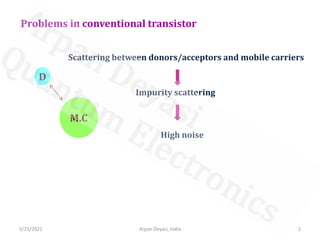
Problems in conventional transistor
D
Scattering between donors/acceptors and mobile carriers
Impurity scattering
High noise
M.C
5/23/2021 3
Arpan Deyasi, India
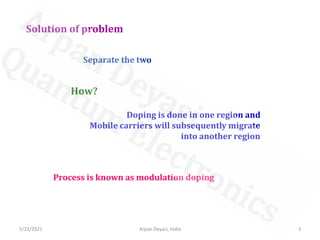
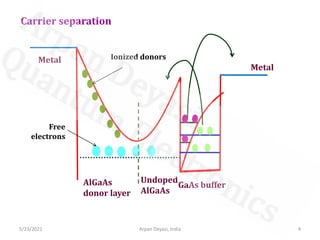
Solution of problem
Separate the two
How?
Doping is done in one region and
Mobile carriers will subsequently migrate
into another region
Process is known as modulation doping
5/23/2021 4
Arpan Deyasi, India
Carrier separation
Metal
GaAs buffer
AlGaAs
donor layer
Undoped
AlGaAs
Metal Ionized donors
Free
electrons
5/23/2021 5
Arpan Deyasi, India
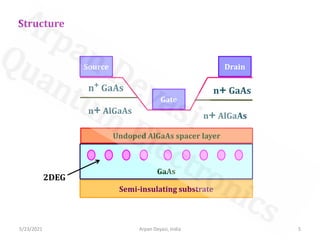
Structure
Semi-insulating substrate
GaAs
2DEG
Undoped AlGaAs spacer layer
n+ GaAs n+ GaAs
n+ AlGaAs
n+ AlGaAs
Source Drain
Gate
Characteristics of HEMT
mobility of free carriers are very high due to suppressed
ionized impurity scattering which makes very low
gate-to-source resistance
carrier freezeout problem is not present at extremely
low temperature because of electrons presence in a
region of energy below donor levels in high bandgap
material. So the device is treated as high-gain, low-noise one
5/23/2021 6
Arpan Deyasi, India
Characteristics of HEMT
Using materials with higher conduction band discontinuity,
large device transconductance can be obtained
Because of smaller active channel, it can be operated at
lower temperature
5/23/2021 7
Arpan Deyasi, India
5/23/2021 Arpan Deyasi, India 8
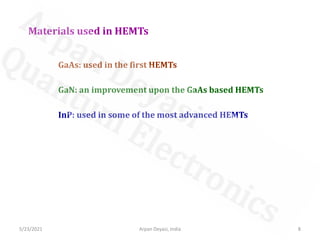
Materials used in HEMTs
InP: used in some of the most advanced HEMTs
GaAs: used in the first HEMTs
GaN: an improvement upon the GaAs based HEMTs
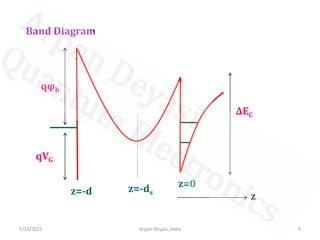
Band Diagram
qφb
qVG
z
z=0
z=-ds
z=-d
ΔEC
5/23/2021 9
Arpan Deyasi, India
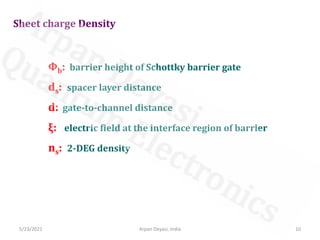
Φb: barrier height of Schottky barrier gate
ds: spacer layer distance
d: gate-to-channel distance
ξ: electric field at the interface region of barrier
ns: 2-DEG density
Sheet charge Density
5/23/2021 10
Arpan Deyasi, India
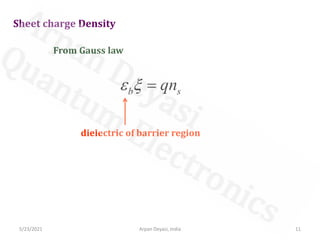
Sheet charge Density
From Gauss law
b s
qn
  =
dielectric of barrier region
5/23/2021 11
Arpan Deyasi, India
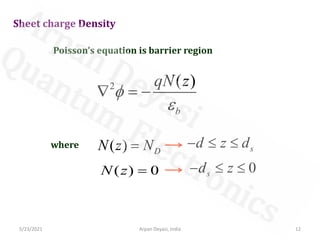
Sheet charge Density
Poisson’s equation is barrier region
2 ( )
b
qN z


 = −
where ( ) D
N z N
= s
d z d
−  
( ) 0
N z = 0
s
d z
−  
5/23/2021 12
Arpan Deyasi, India
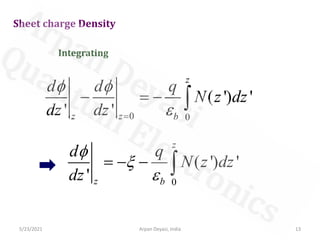
Sheet charge Density
Integrating
0 0
( ') '
' '
z
z z b
d d q
N z dz
dz dz
 

=
− = − 
0
( ') '
'
z
z b
d q
N z dz
dz



= − − 
5/23/2021 13
Arpan Deyasi, India
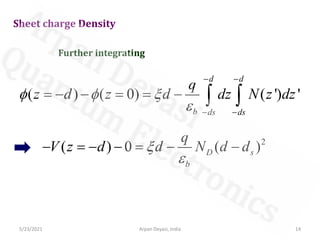
Sheet charge Density
Further integrating
( ) ( 0) ( ') '
d d
b ds ds
q
z d z d dz N z dz
  

− −
− −
= − − = = −  
2
( ) 0 ( )
D s
b
q
V z d d N d d


− = − − = − −
5/23/2021 14
Arpan Deyasi, India
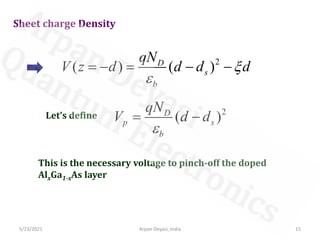
Sheet charge Density
2
( ) ( )
D
s
b
qN
V z d d d d


= − = − −
Let’s define 2
( )
D
p s
b
qN
V d d

= −
This is the necessary voltage to pinch-off the doped
AlxGa1-xAs layer
5/23/2021 15
Arpan Deyasi, India
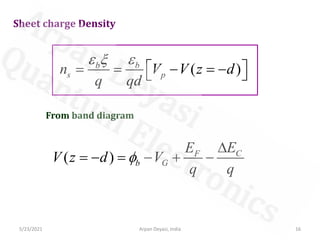
Sheet charge Density
( )
b b
s p
n V V z d
q qd
  
 
= = − = −
 
From band diagram
( ) C
F
b G
E
E
V z d V
q q


= − = − + −
5/23/2021 16
Arpan Deyasi, India
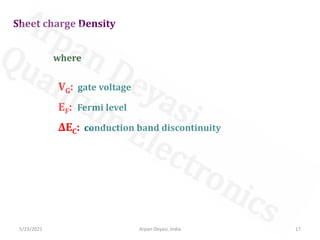
Sheet charge Density
where
VG: gate voltage
EF: Fermi level
ΔEC: conduction band discontinuity
5/23/2021 17
Arpan Deyasi, India
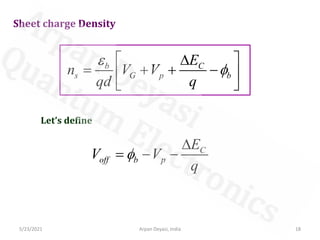
Sheet charge Density
b C
s G p b
E
n V V
qd q


 

= + + −
 
 
Let’s define
C
off b p
E
V V
q


= − −
5/23/2021 18
Arpan Deyasi, India
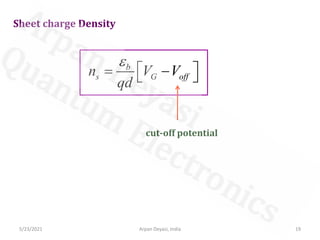
Sheet charge Density
b
s G off
n V V
qd

 
= −
 
cut-off potential
5/23/2021 19
Arpan Deyasi, India
5/23/2021 Arpan Deyasi, India 20
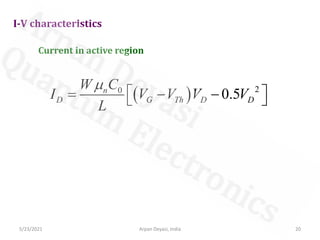
I-V characteristics
Current in active region
( ) 2
0
0.5
n
D G Th D D
W C
I V V V V
L

 
= − −
 
5/23/2021 Arpan Deyasi, India 21
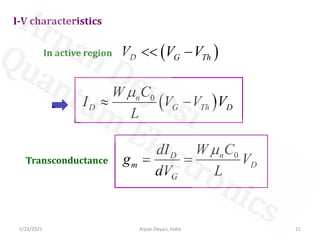
I-V characteristics
In active region ( )
D G Th
V V V
 −
( )
0
n
D G Th D
W C
I V V V
L

 −
Transconductance
0
n
D
m D
G
W C
dI
g V
dV L

= =
5/23/2021 Arpan Deyasi, India 22
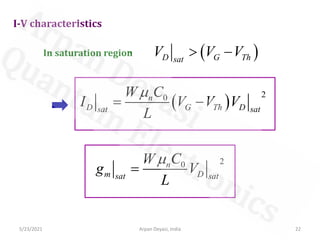
I-V characteristics
In saturation region ( )
D G Th
sat
V V V
 −
( )
2
0
n
D G Th D
sat sat
W C
I V V V
L

= −
2
0
n
m D
sat sat
W C
g V
L

=
5/23/2021 Arpan Deyasi, India 23
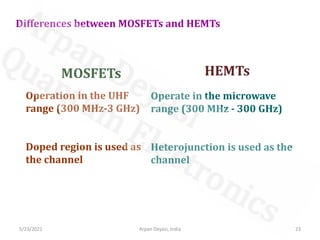
Differences between MOSFETs and HEMTs
MOSFETs
Operation in the UHF
range (300 MHz-3 GHz)
Doped region is used as
the channel
HEMTs
Operate in the microwave
range (300 MHz - 300 GHz)
Heterojunction is used as the
channel
5/23/2021 Arpan Deyasi, India 24
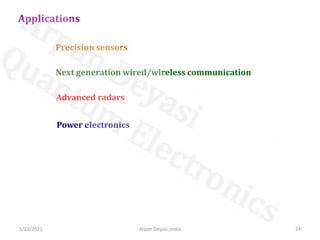
Applications
Power electronics
Precision sensors
Next generation wired/wireless communication
Advanced radars
5/23/2021 Arpan Deyasi, India 25
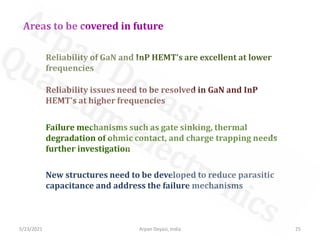
Areas to be covered in future
New structures need to be developed to reduce parasitic
capacitance and address the failure mechanisms
Reliability of GaN and InP HEMT’s are excellent at lower
frequencies
Reliability issues need to be resolved in GaN and InP
HEMT’s at higher frequencies
Failure mechanisms such as gate sinking, thermal
degradation of ohmic contact, and charge trapping needs
further investigation

High Electron Mobility Transistor

  • 1.
    High Electron MobilityTransistor Arpan Deyasi RCCIIT, India 5/23/2021 1 Arpan Deyasi, India
  • 2.
    5/23/2021 2 Arpan Deyasi,India Problems in conventional transistor D Scattering between donors/acceptors and mobile carriers Impurity scattering High noise M.C
  • 3.
    5/23/2021 3 Arpan Deyasi,India Solution of problem Separate the two How? Doping is done in one region and Mobile carriers will subsequently migrate into another region Process is known as modulation doping
  • 4.
    5/23/2021 4 Arpan Deyasi,India Carrier separation Metal GaAs buffer AlGaAs donor layer Undoped AlGaAs Metal Ionized donors Free electrons
  • 5.
    5/23/2021 5 Arpan Deyasi,India Structure Semi-insulating substrate GaAs 2DEG Undoped AlGaAs spacer layer n+ GaAs n+ GaAs n+ AlGaAs n+ AlGaAs Source Drain Gate
  • 6.
    Characteristics of HEMT mobilityof free carriers are very high due to suppressed ionized impurity scattering which makes very low gate-to-source resistance carrier freezeout problem is not present at extremely low temperature because of electrons presence in a region of energy below donor levels in high bandgap material. So the device is treated as high-gain, low-noise one 5/23/2021 6 Arpan Deyasi, India
  • 7.
    Characteristics of HEMT Usingmaterials with higher conduction band discontinuity, large device transconductance can be obtained Because of smaller active channel, it can be operated at lower temperature 5/23/2021 7 Arpan Deyasi, India
  • 8.
    5/23/2021 Arpan Deyasi,India 8 Materials used in HEMTs InP: used in some of the most advanced HEMTs GaAs: used in the first HEMTs GaN: an improvement upon the GaAs based HEMTs
  • 9.
  • 10.
    Φb: barrier heightof Schottky barrier gate ds: spacer layer distance d: gate-to-channel distance ξ: electric field at the interface region of barrier ns: 2-DEG density Sheet charge Density 5/23/2021 10 Arpan Deyasi, India
  • 11.
    Sheet charge Density FromGauss law b s qn   = dielectric of barrier region 5/23/2021 11 Arpan Deyasi, India
  • 12.
    Sheet charge Density Poisson’sequation is barrier region 2 ( ) b qN z    = − where ( ) D N z N = s d z d −   ( ) 0 N z = 0 s d z −   5/23/2021 12 Arpan Deyasi, India
  • 13.
    Sheet charge Density Integrating 00 ( ') ' ' ' z z z b d d q N z dz dz dz    = − = −  0 ( ') ' ' z z b d q N z dz dz    = − −  5/23/2021 13 Arpan Deyasi, India
  • 14.
    Sheet charge Density Furtherintegrating ( ) ( 0) ( ') ' d d b ds ds q z d z d dz N z dz     − − − − = − − = = −   2 ( ) 0 ( ) D s b q V z d d N d d   − = − − = − − 5/23/2021 14 Arpan Deyasi, India
  • 15.
    Sheet charge Density 2 () ( ) D s b qN V z d d d d   = − = − − Let’s define 2 ( ) D p s b qN V d d  = − This is the necessary voltage to pinch-off the doped AlxGa1-xAs layer 5/23/2021 15 Arpan Deyasi, India
  • 16.
    Sheet charge Density () b b s p n V V z d q qd      = = − = −   From band diagram ( ) C F b G E E V z d V q q   = − = − + − 5/23/2021 16 Arpan Deyasi, India
  • 17.
    Sheet charge Density where VG:gate voltage EF: Fermi level ΔEC: conduction band discontinuity 5/23/2021 17 Arpan Deyasi, India
  • 18.
    Sheet charge Density bC s G p b E n V V qd q      = + + −     Let’s define C off b p E V V q   = − − 5/23/2021 18 Arpan Deyasi, India
  • 19.
    Sheet charge Density b sG off n V V qd    = −   cut-off potential 5/23/2021 19 Arpan Deyasi, India
  • 20.
    5/23/2021 Arpan Deyasi,India 20 I-V characteristics Current in active region ( ) 2 0 0.5 n D G Th D D W C I V V V V L    = − −  
  • 21.
    5/23/2021 Arpan Deyasi,India 21 I-V characteristics In active region ( ) D G Th V V V  − ( ) 0 n D G Th D W C I V V V L   − Transconductance 0 n D m D G W C dI g V dV L  = =
  • 22.
    5/23/2021 Arpan Deyasi,India 22 I-V characteristics In saturation region ( ) D G Th sat V V V  − ( ) 2 0 n D G Th D sat sat W C I V V V L  = − 2 0 n m D sat sat W C g V L  =
  • 23.
    5/23/2021 Arpan Deyasi,India 23 Differences between MOSFETs and HEMTs MOSFETs Operation in the UHF range (300 MHz-3 GHz) Doped region is used as the channel HEMTs Operate in the microwave range (300 MHz - 300 GHz) Heterojunction is used as the channel
  • 24.
    5/23/2021 Arpan Deyasi,India 24 Applications Power electronics Precision sensors Next generation wired/wireless communication Advanced radars
  • 25.
    5/23/2021 Arpan Deyasi,India 25 Areas to be covered in future New structures need to be developed to reduce parasitic capacitance and address the failure mechanisms Reliability of GaN and InP HEMT’s are excellent at lower frequencies Reliability issues need to be resolved in GaN and InP HEMT’s at higher frequencies Failure mechanisms such as gate sinking, thermal degradation of ohmic contact, and charge trapping needs further investigation