IMC 2017, Blagoevgrad, Bulgaria
Day 1, August 2, 2017
Problem 1. Determine all complex numbers λ for which there exist a positive integer n and
a real n × n matrix A such that A2
= AT
and λ is an eigenvalue of A.
(Proposed by Alexandr Bolbot, Novosibirsk State University)
Solution. By taking squares,
A4
= (A2
)2
= (AT
)2
= (A2
)T
= (AT
)T
= A,
so
A4
− A = 0;
it follows that all eigenvalues of A are roots of the polynomial X4
− X.
The roots of X4
− X = X(X3
− 1) are 0, 1 and −1±
√
3i
2
. In order to verify that these values
are possible, consider the matrices
A0 = 0 , A1 = 1 , A2 =
−1
2
√
3
2
−
√
3
2
−1
2
, A4 =




0 0 0 0
0 1 0 0
0 0 −1
2
√
3
2
0 0 −
√
3
2
−1
2



 .
The numbers 0 and 1 are the eigenvalues of the 1 × 1 matrices A0 and A1, respectively. The
numbers −1±
√
3i
2
are the eigenvalues of A2; it is easy to check that
A2
2 =
−1
2
−
√
3
2√
3
2
−1
2
= AT
2 .
The matrix A4 establishes all the four possible eigenvalues in a single matrix.
Remark. The matrix A2 represents a rotation by 2π/3.
Problem 2. Let f : R → (0, ∞) be a dierentiable function, and suppose that there exists
a constant L  0 such that
f (x) − f (y) ≤ L x − y
for all x, y. Prove that
f (x)
2
 2Lf(x)
holds for all x.
(Proposed by Jan ’ustek, University of Ostrava)
1
Solution. Notice that f satises the Lipschitz-property, so f is continuous and therefore
locally integrable.
Consider an arbitrary x ∈ R and let d = f (x). We need to prove f(x)  d2
2L
.
If d = 0 then the statement is trivial.
If d  0 then the condition provides f (x−t) ≥ d−Lt; this estimate is positive for 0 ≤ t  d
L
.
By integrating over that interval,
f(x)  f(x) − f(x − d
L
) =
d
L
0
f x − t dt ≥
d
L
0
(d − Lt)dt =
d2
2L
.
If d  0 then apply f (x + t) ≤ d + Lt = −|d| + Lt and repeat the same argument as
f(x)  f(x) − f(x + |d|
L
) =
|d|
L
0
− f (x + t) dt ≥
|d|
L
0
(|d| − Lt)dt =
d2
2L
.
Problem 3. For any positive integer m, denote by P (m) the product of positive divisors of m
(e.g. P(6) = 36). For every positive integer n dene the sequence
a1(n) = n, ak+1(n) = P(ak(n)) (k = 1, 2, . . . , 2016).
Determine whether for every set S ⊆ {1, 2, . . . , 2017}, there exists a positive integer n such
that the following condition is satised:
For every k with 1 ≤ k ≤ 2017, the number ak(n) is a perfect square if and only if k ∈ S.
(Proposed by Matko Ljulj , University of Zagreb)
Solution. We prove that the answer is yes; for every S ⊂ {1, 2, . . . , 2017} there exists a
suitable n. Specially, n can be a power of 2: n = 2w1
with some nonnegative integer w1. Write
ak(n) = 2wk ; then
2wk+1
= ak+1(n) = P(ak(n)) = P(2wk
) = 1 · 2 · 4 · · · 2wk
= 2
wk(wk+1)
2 ,
so
wk+1 =
wk(wk + 1)
2
.
The proof will be completed if we prove that for each choice of S there exists an initial value
w1 such that wk is even if and only if k ∈ S.
Lemma. Suppose that the sequences (b1, b2, . . .) and (c1, c2, . . .) satisfy bk+1 = bk(bk+1)
2
and
ck+1 = ck(ck+1)
2
for k ≥ 1, and c1 = b1 +2m
. Then for each k = 1, . . . m we have ck ≡ bk +2m−k+1
(mod 2m−k+2
).
As an immediate corollary, we have bk ≡ ck (mod 2) for 1 ≤ k ≤ m and bm+1 ≡ cm+1 + 1
(mod 2).
Proof. We prove the by induction. For k = 1 we have c1 = b1 + 2m
so the statement holds.
Suppose the statement is true for some k  m, then for k + 1 we have
ck+1 =
ck (ck + 1)
2
≡
bk + 2m−k+1
bk + 2m−k+1
+ 1
2
=
b2
k + 2m−k+2
bk + 22m−2k+2
+ bk + 2m−k+1
2
=
=
bk(bk + 1)
2
+ 2m−k
+ 2m−k+1
bk + 22m−2k+1
≡
bk(bk + 1)
2
+ 2m−k
(mod 2m−k+1
),
therefore ck+1 ≡ bk+1 + 2m−(k+1)+1
(mod 2m−(k+1)+2
).
2
Going back to the solution of the problem, for every 1 ≤ m ≤ 2017 we construct inductively
a sequence (v1, v2, . . .) such that vk+1 = vk(vk+1)
2
, and for every 1 ≤ k ≤ m, vk is even if and
only if k ∈ S.
For m = 1 we can choose v1 = 0 if 1 ∈ S or v1 = 1 if 1 /∈ S. If we already have such a
sequence (v1, v2, . . .) for a positive integer m, we can choose either the same sequence or choose
v1 = v1 + 2m
and apply the same recurrence vk+1 =
vk(vk+1)
2
. By the Lemma, we have vk ≡ vk
(mod 2) for k ≤ m, but vm+1 and vm+1 have opposite parities; hence, either the sequence (vk)
or the sequence (vk) satises the condition for m + 1.
Repeating this process for m = 1, 2, . . . , 2017, we obtain a suitable sequence (wk).
Problem 4. There are n people in a city, and each of them has exactly 1000 friends (friendship
is always symmetric). Prove that it is possible to select a group S of people such that at least
n/2017 persons in S have exactly two friends in S.
(Proposed by Rooholah Majdodin and Fedor Petrov, St. Petersburg State University)
Solution. Let d = 1000 and let 0  p  1. Choose the set S randomly such that each people
is selected with probability p, independently from the others.
The probability that a certain person is selected for S and knows exactly two members of
S is
q =
d
2
p3
(1 − p)d−2
.
Choose p = 3/(d + 1) (this is the value of p for which q is maximal); then
q =
d
2
3
d + 1
3
d − 2
d + 1
d−2
=
=
27d(d − 1)
2(d + 1)3
1 +
3
d − 2
−(d−2)

27d(d − 1)
2(d + 1)3
· e−3

1
2017
.
Hence, E |S| = nq  n
2017
, so there is a choice for S when |S|  n
2017
.
Problem 5. Let k and n be positive integers with n ≥ k2
− 3k + 4, and let
f(z) = zn−1
+ cn−2zn−2
+ . . . + c0
be a polynomial with complex coecients such that
c0cn−2 = c1cn−3 = . . . = cn−2c0 = 0.
Prove that f(z) and zn
− 1 have at most n − k common roots.
(Proposed by Vsevolod Lev and Fedor Petrov, St. Petersburg State University)
Solution. Let M = {z : zn
= 1}, A = {z ∈ M : f(z) = 0} and A−1
= {z−1
: z ∈ A}. We have
to prove |A| ≥ k.
Claim.
A · A−1
= M.
That is, for any η ∈ M, there exist some elements a, b ∈ A such that ab−1
= η.
Proof. As is well-known, for every integer m,
z∈M
zm
=
n if n|m
0 otherwise.
3
Dene cn−1 = 1 and consider
z∈M
z2
f(z)f(ηz) =
z∈M
z2
n−1
j=0
cjzj
n−1
=0
c (ηz) =
n−1
j=0
n−1
=0
cjc η
z∈M
zj+ +2
=
=
n−1
j=0
n−1
=0
cjc η
z∈M
n if n|j + + 2
0 otherwise
= c2
n−1n +
n−2
j=0
cjcn−2−jηn−2−j
n = n = 0.
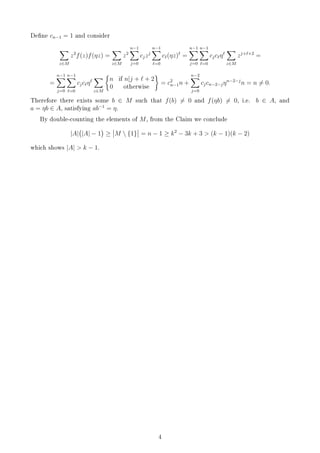
Therefore there exists some b ∈ M such that f(b) = 0 and f(ηb) = 0, i.e. b ∈ A, and
a = ηb ∈ A, satisfying ab−1
= η.
By double-counting the elements of M, from the Claim we conclude
|A| |A| − 1 ≥ M  {1} = n − 1 ≥ k2
− 3k + 3  (k − 1)(k − 2)
which shows |A|  k − 1.
4

Imc2017 day1-solutions

  • 1.
    IMC 2017, Blagoevgrad,Bulgaria Day 1, August 2, 2017 Problem 1. Determine all complex numbers λ for which there exist a positive integer n and a real n × n matrix A such that A2 = AT and λ is an eigenvalue of A. (Proposed by Alexandr Bolbot, Novosibirsk State University) Solution. By taking squares, A4 = (A2 )2 = (AT )2 = (A2 )T = (AT )T = A, so A4 − A = 0; it follows that all eigenvalues of A are roots of the polynomial X4 − X. The roots of X4 − X = X(X3 − 1) are 0, 1 and −1± √ 3i 2 . In order to verify that these values are possible, consider the matrices A0 = 0 , A1 = 1 , A2 = −1 2 √ 3 2 − √ 3 2 −1 2 , A4 =     0 0 0 0 0 1 0 0 0 0 −1 2 √ 3 2 0 0 − √ 3 2 −1 2     . The numbers 0 and 1 are the eigenvalues of the 1 × 1 matrices A0 and A1, respectively. The numbers −1± √ 3i 2 are the eigenvalues of A2; it is easy to check that A2 2 = −1 2 − √ 3 2√ 3 2 −1 2 = AT 2 . The matrix A4 establishes all the four possible eigenvalues in a single matrix. Remark. The matrix A2 represents a rotation by 2π/3. Problem 2. Let f : R → (0, ∞) be a dierentiable function, and suppose that there exists a constant L 0 such that f (x) − f (y) ≤ L x − y for all x, y. Prove that f (x) 2 2Lf(x) holds for all x. (Proposed by Jan ’ustek, University of Ostrava) 1
  • 2.
    Solution. Notice thatf satises the Lipschitz-property, so f is continuous and therefore locally integrable. Consider an arbitrary x ∈ R and let d = f (x). We need to prove f(x) d2 2L . If d = 0 then the statement is trivial. If d 0 then the condition provides f (x−t) ≥ d−Lt; this estimate is positive for 0 ≤ t d L . By integrating over that interval, f(x) f(x) − f(x − d L ) = d L 0 f x − t dt ≥ d L 0 (d − Lt)dt = d2 2L . If d 0 then apply f (x + t) ≤ d + Lt = −|d| + Lt and repeat the same argument as f(x) f(x) − f(x + |d| L ) = |d| L 0 − f (x + t) dt ≥ |d| L 0 (|d| − Lt)dt = d2 2L . Problem 3. For any positive integer m, denote by P (m) the product of positive divisors of m (e.g. P(6) = 36). For every positive integer n dene the sequence a1(n) = n, ak+1(n) = P(ak(n)) (k = 1, 2, . . . , 2016). Determine whether for every set S ⊆ {1, 2, . . . , 2017}, there exists a positive integer n such that the following condition is satised: For every k with 1 ≤ k ≤ 2017, the number ak(n) is a perfect square if and only if k ∈ S. (Proposed by Matko Ljulj , University of Zagreb) Solution. We prove that the answer is yes; for every S ⊂ {1, 2, . . . , 2017} there exists a suitable n. Specially, n can be a power of 2: n = 2w1 with some nonnegative integer w1. Write ak(n) = 2wk ; then 2wk+1 = ak+1(n) = P(ak(n)) = P(2wk ) = 1 · 2 · 4 · · · 2wk = 2 wk(wk+1) 2 , so wk+1 = wk(wk + 1) 2 . The proof will be completed if we prove that for each choice of S there exists an initial value w1 such that wk is even if and only if k ∈ S. Lemma. Suppose that the sequences (b1, b2, . . .) and (c1, c2, . . .) satisfy bk+1 = bk(bk+1) 2 and ck+1 = ck(ck+1) 2 for k ≥ 1, and c1 = b1 +2m . Then for each k = 1, . . . m we have ck ≡ bk +2m−k+1 (mod 2m−k+2 ). As an immediate corollary, we have bk ≡ ck (mod 2) for 1 ≤ k ≤ m and bm+1 ≡ cm+1 + 1 (mod 2). Proof. We prove the by induction. For k = 1 we have c1 = b1 + 2m so the statement holds. Suppose the statement is true for some k m, then for k + 1 we have ck+1 = ck (ck + 1) 2 ≡ bk + 2m−k+1 bk + 2m−k+1 + 1 2 = b2 k + 2m−k+2 bk + 22m−2k+2 + bk + 2m−k+1 2 = = bk(bk + 1) 2 + 2m−k + 2m−k+1 bk + 22m−2k+1 ≡ bk(bk + 1) 2 + 2m−k (mod 2m−k+1 ), therefore ck+1 ≡ bk+1 + 2m−(k+1)+1 (mod 2m−(k+1)+2 ). 2
  • 3.
    Going back tothe solution of the problem, for every 1 ≤ m ≤ 2017 we construct inductively a sequence (v1, v2, . . .) such that vk+1 = vk(vk+1) 2 , and for every 1 ≤ k ≤ m, vk is even if and only if k ∈ S. For m = 1 we can choose v1 = 0 if 1 ∈ S or v1 = 1 if 1 /∈ S. If we already have such a sequence (v1, v2, . . .) for a positive integer m, we can choose either the same sequence or choose v1 = v1 + 2m and apply the same recurrence vk+1 = vk(vk+1) 2 . By the Lemma, we have vk ≡ vk (mod 2) for k ≤ m, but vm+1 and vm+1 have opposite parities; hence, either the sequence (vk) or the sequence (vk) satises the condition for m + 1. Repeating this process for m = 1, 2, . . . , 2017, we obtain a suitable sequence (wk). Problem 4. There are n people in a city, and each of them has exactly 1000 friends (friendship is always symmetric). Prove that it is possible to select a group S of people such that at least n/2017 persons in S have exactly two friends in S. (Proposed by Rooholah Majdodin and Fedor Petrov, St. Petersburg State University) Solution. Let d = 1000 and let 0 p 1. Choose the set S randomly such that each people is selected with probability p, independently from the others. The probability that a certain person is selected for S and knows exactly two members of S is q = d 2 p3 (1 − p)d−2 . Choose p = 3/(d + 1) (this is the value of p for which q is maximal); then q = d 2 3 d + 1 3 d − 2 d + 1 d−2 = = 27d(d − 1) 2(d + 1)3 1 + 3 d − 2 −(d−2) 27d(d − 1) 2(d + 1)3 · e−3 1 2017 . Hence, E |S| = nq n 2017 , so there is a choice for S when |S| n 2017 . Problem 5. Let k and n be positive integers with n ≥ k2 − 3k + 4, and let f(z) = zn−1 + cn−2zn−2 + . . . + c0 be a polynomial with complex coecients such that c0cn−2 = c1cn−3 = . . . = cn−2c0 = 0. Prove that f(z) and zn − 1 have at most n − k common roots. (Proposed by Vsevolod Lev and Fedor Petrov, St. Petersburg State University) Solution. Let M = {z : zn = 1}, A = {z ∈ M : f(z) = 0} and A−1 = {z−1 : z ∈ A}. We have to prove |A| ≥ k. Claim. A · A−1 = M. That is, for any η ∈ M, there exist some elements a, b ∈ A such that ab−1 = η. Proof. As is well-known, for every integer m, z∈M zm = n if n|m 0 otherwise. 3
  • 4.
    Dene cn−1 =1 and consider z∈M z2 f(z)f(ηz) = z∈M z2 n−1 j=0 cjzj n−1 =0 c (ηz) = n−1 j=0 n−1 =0 cjc η z∈M zj+ +2 = = n−1 j=0 n−1 =0 cjc η z∈M n if n|j + + 2 0 otherwise = c2 n−1n + n−2 j=0 cjcn−2−jηn−2−j n = n = 0. Therefore there exists some b ∈ M such that f(b) = 0 and f(ηb) = 0, i.e. b ∈ A, and a = ηb ∈ A, satisfying ab−1 = η. By double-counting the elements of M, from the Claim we conclude |A| |A| − 1 ≥ M {1} = n − 1 ≥ k2 − 3k + 3 (k − 1)(k − 2) which shows |A| k − 1. 4