BRUSHLESS DC MOTOR
Biplab Nayak
Regd. No.- 0901321003
Branch-EEE, 7th semester
Bhubaneswar Institute of Technology
WHAT IS BRUSHLESS DC
MOTOR ?
Brushless DC motors
are synchronous motors which
are powered by a DC electric
source via an integrated
inverter, which produces an
AC electric signal to drive the
motor.
HISTORY OF BRUSHLESS DC
MOTOR
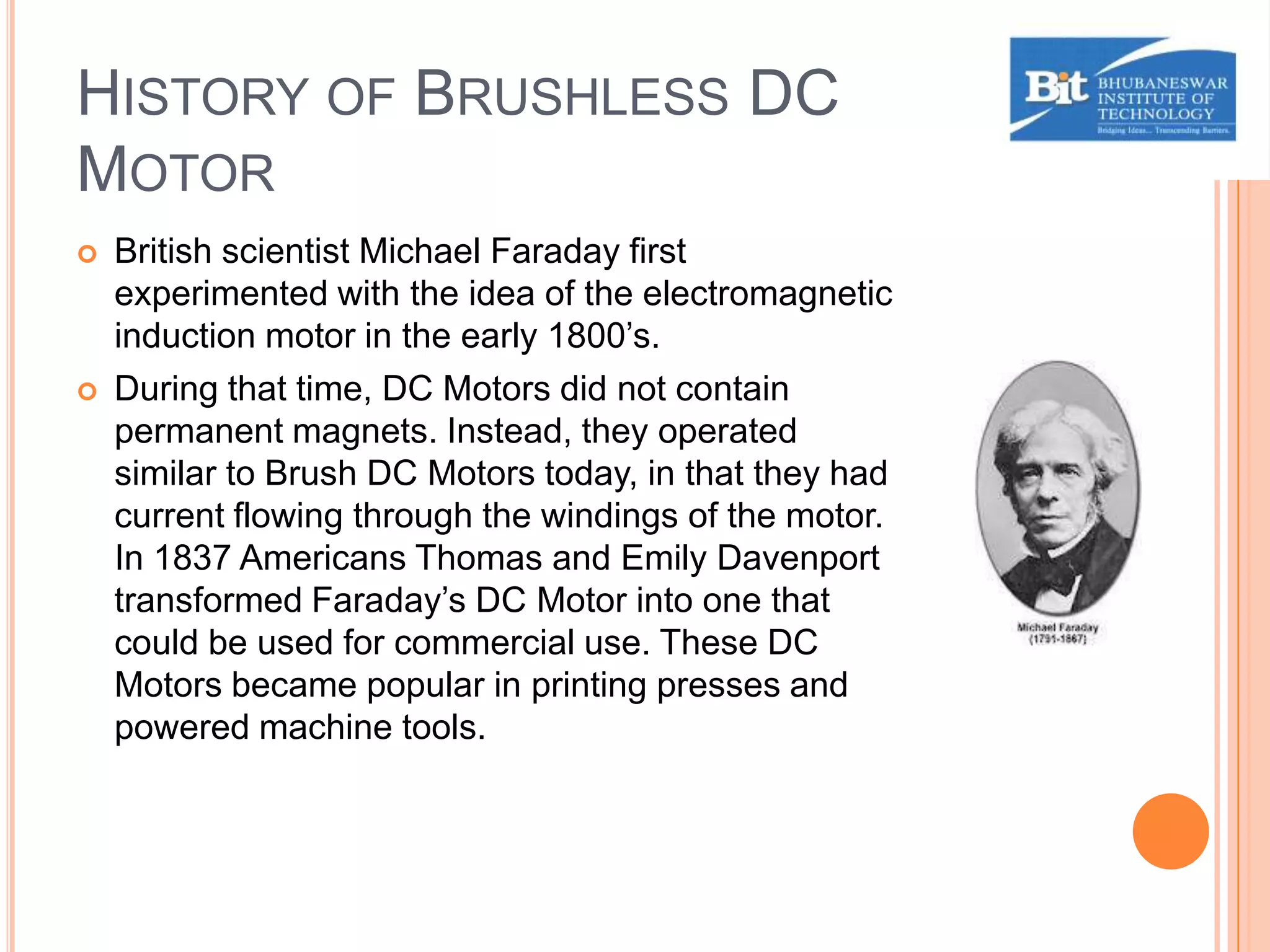
 British scientist Michael Faraday first
experimented with the idea of the electromagnetic
induction motor in the early 1800’s.
 During that time, DC Motors did not contain
permanent magnets. Instead, they operated
similar to Brush DC Motors today, in that they had
current flowing through the windings of the motor.
In 1837 Americans Thomas and Emily Davenport
transformed Faraday’s DC Motor into one that
could be used for commercial use. These DC
Motors became popular in printing presses and
powered machine tools.
EQUIVALENT BLOCK DIAGRAM OF
BRUSHLESS DC MOTOR
ADVANTAGES OF BRUSHLESS DC
MOTOR
No maintenance.
Much longer operating life.
No risk of explosion or possibility of RF
radiation due to arcing, higher
efficiency, rapid response etc.
DISASSEMBLED VIEW OF
BRUSHLESS DC MOTOR
CONSTRUCTION OF BRUSHLESS DC
MOTOR
 Brushless motors can be constructed in several
different physical configurations.
 In the 'conventional' configuration, the permanent
magnets are part of the rotor.
COMPARISON OF
CONVENTIONAL AND
BRUSHLESS DC MOTOR
BRUSHLESS DC MOTOR MAY
BE CONTROLLED BY
 Voltage-Fed Inverter
Current-Fed Inverter
BLOCK DIAGRAM OF VOLTAGE-FED
CONTROL
BLOCK DIAGRAM OF CURRENT-
FED CONTROL
IF THE BRUSHLESS DC MOTOR
RUNS IN IMPROPER WAY OR
STOPS RUNNING, THEN HOW
CAN THIS PROBLEM BE
SOLVED?
BRUSHLESS DC MOTORS
APPLICATIONS OF BRUSHLESS DC
MOTOR
 Instrumentation
 Medical
 Appliances
 Automotive
 Factory Automation Equipment
 Aerospace
 Military
CONCLUSION
 Although Brushless DC Motors are more expensive
of the same kW rating than conventional DC Motor
but there are many advantages.
 Brushless DC Motors can run when submerged in
fluids.
 Brushless DC Motor does not produce brush or
commutator particles or gases as by-products of
operation.
REFERENCE
 J.B. Gupta 2011. Theory & Performance of
Electrical Machines. 14th Ed. Katson Books
 Dr. P.S. Bimbhra 2011. Power Electronics. 4th Ed.
Khanna Publishers
 http://www.anaheimautomation.com
THANK YOU

Brushless dc motor

  • 1.
    BRUSHLESS DC MOTOR BiplabNayak Regd. No.- 0901321003 Branch-EEE, 7th semester Bhubaneswar Institute of Technology
  • 2.
    WHAT IS BRUSHLESSDC MOTOR ? Brushless DC motors are synchronous motors which are powered by a DC electric source via an integrated inverter, which produces an AC electric signal to drive the motor.
  • 3.
    HISTORY OF BRUSHLESSDC MOTOR  British scientist Michael Faraday first experimented with the idea of the electromagnetic induction motor in the early 1800’s.  During that time, DC Motors did not contain permanent magnets. Instead, they operated similar to Brush DC Motors today, in that they had current flowing through the windings of the motor. In 1837 Americans Thomas and Emily Davenport transformed Faraday’s DC Motor into one that could be used for commercial use. These DC Motors became popular in printing presses and powered machine tools.
  • 4.
    EQUIVALENT BLOCK DIAGRAMOF BRUSHLESS DC MOTOR
  • 5.
    ADVANTAGES OF BRUSHLESSDC MOTOR No maintenance. Much longer operating life. No risk of explosion or possibility of RF radiation due to arcing, higher efficiency, rapid response etc.
  • 6.
  • 7.
    CONSTRUCTION OF BRUSHLESSDC MOTOR  Brushless motors can be constructed in several different physical configurations.  In the 'conventional' configuration, the permanent magnets are part of the rotor.
  • 8.
  • 9.
    BRUSHLESS DC MOTORMAY BE CONTROLLED BY  Voltage-Fed Inverter Current-Fed Inverter
  • 10.
    BLOCK DIAGRAM OFVOLTAGE-FED CONTROL
  • 11.
    BLOCK DIAGRAM OFCURRENT- FED CONTROL
  • 12.
    IF THE BRUSHLESSDC MOTOR RUNS IN IMPROPER WAY OR STOPS RUNNING, THEN HOW CAN THIS PROBLEM BE SOLVED?
  • 13.
  • 14.
    APPLICATIONS OF BRUSHLESSDC MOTOR  Instrumentation  Medical  Appliances  Automotive  Factory Automation Equipment  Aerospace  Military
  • 15.
    CONCLUSION  Although BrushlessDC Motors are more expensive of the same kW rating than conventional DC Motor but there are many advantages.  Brushless DC Motors can run when submerged in fluids.  Brushless DC Motor does not produce brush or commutator particles or gases as by-products of operation.
  • 16.
    REFERENCE  J.B. Gupta2011. Theory & Performance of Electrical Machines. 14th Ed. Katson Books  Dr. P.S. Bimbhra 2011. Power Electronics. 4th Ed. Khanna Publishers  http://www.anaheimautomation.com
  • 17.