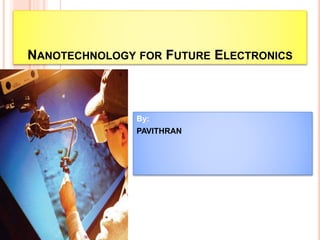
NANOTECHNOLOGY FOR FUTURE ELECTRONICS
By:
PAVITHRAN
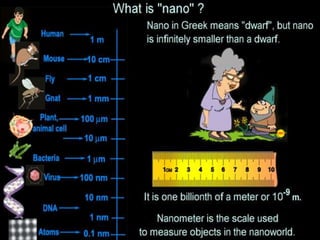
WHAT IS NANOSCALE?
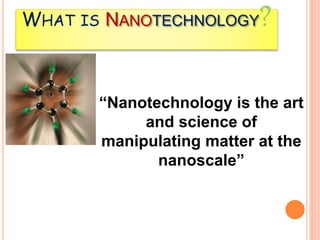
WHAT IS NANOTECHNOLOGY?
“Nanotechnology is the art
and science of
manipulating matter at the
nanoscale”
WHY ONLY NANOTECHNOLOGY FOR
FUTURE ELECTRONICS?
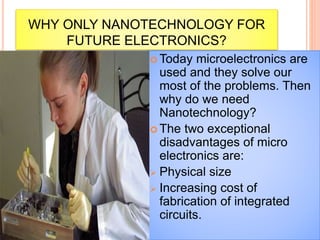
 Today microelectronics are
used and they solve our
most of the problems. Then
why do we need
Nanotechnology?
 The two exceptional
disadvantages of micro
electronics are:
 Physical size
 Increasing cost of
fabrication of integrated
circuits.
FUTURE SCOPE IN
NANOTECHNOLOGY
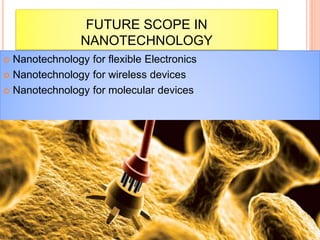
 Nanotechnology for flexible Electronics
 Nanotechnology for wireless devices
 Nanotechnology for molecular devices
NANOTECHNOLOGY FOR FLEXIBLE
ELECTRONICS
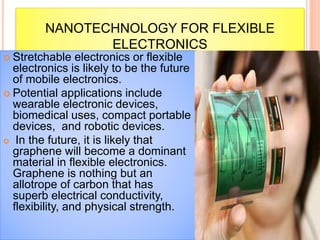
 Stretchable electronics or flexible
electronics is likely to be the future
of mobile electronics.
 Potential applications include
wearable electronic devices,
biomedical uses, compact portable
devices, and robotic devices.
 In the future, it is likely that
graphene will become a dominant
material in flexible electronics.
Graphene is nothing but an
allotrope of carbon that has
superb electrical conductivity,
flexibility, and physical strength.
NANOTECHNOLOGY FOR WIRELESS
DEVICES
 Visions of the wireless industry aims at ambient
intelligence: computation and communication always
available and ready to serve the user in an intelligent
way.
 All these requirements combined lead to a situation which
cannot be resolved with current technologies.
Nanotechnology could provide solutions for these new
technologies.
 SENSORS- Micromechanical sensors became an
elementary part of automotive technologies in mid 1990,
Within next ten years the development of truly embedded
sensors based on nanostructures will become a part of
our everyday intelligent environments. Nanotechnologies
will enable new materials and new sensing elements for
sensors. Nanosensors will have applications in many
industries, among them transportation, communications,
building and facilities, safety, and national security,
including both homeland defense and military operations.
NANOTECHNOLOGY FOR WIRELESS
DEVICES
 MORE MEMORY- Already today mobile phones require a considerable
amount of storage capacity to retain pictures, video, music, and data from a
number of different applications. mobile phones will require up to 10 GB
internal mass memory for short term and 50- 100GB for mid and long terms.
Today flash memory is dominant and has been most reliable for portable
devices. But it is predicted that in near future nanotechnology will help
increasing the memory storage capacity to a phenomenal level by inventions
like atomic holographic optical storage nanotechnology memory, etc where
terabytes and petabytes of data could be stored.
 MORE POSSIBILITIES WITH NEW MATERIALS- The wish to have
transformable devices (easy to carry and use) leads the way from foldable,
sliding, and bendable devices towards more wearable electronics. A major
challenge is however, how to protect the core electronics and achieve good
reliability, i.e., “washable electronics”. Nanotech research has already
resulted in, e.g., super-tough carbon nanotube fibres suitable weaving , and
coatings with anti-microbial or super hydrophobic properties , but still much
more is expected to be seen in near future.
NANOTECHNOLOGY FOR MOLECULAR
DEVICES
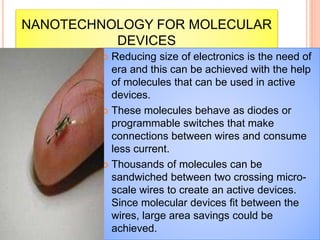
 Reducing size of electronics is the need of
era and this can be achieved with the help
of molecules that can be used in active
devices.
 These molecules behave as diodes or
programmable switches that make
connections between wires and consume
less current.
 Thousands of molecules can be
sandwiched between two crossing micro-
scale wires to create an active devices.
Since molecular devices fit between the
wires, large area savings could be
achieved.
CONCLUSION
 Nano-electronics show promise as a technology to
continue the miniaturization of ICs.
 Flexibility is also a major breakthrough in the world
of electronics, which will enable a new paradigm in
design and functionality for the devices which our
modern lives depend upon. Flexible devices have
already begun to make their way into the
commercial realm, and the next few years are
bound to see huge changes brought on by this
additional dimension which is now available to
electronics manufacturers. Nanotechnologies also
promise a future in development and enhancement
of mobile devices and wearable devices.
THANK YOU..

Nanotechnology

  • 1.
    NANOTECHNOLOGY FOR FUTUREELECTRONICS By: PAVITHRAN
  • 2.
  • 4.
    WHAT IS NANOTECHNOLOGY? “Nanotechnologyis the art and science of manipulating matter at the nanoscale”
  • 5.
    WHY ONLY NANOTECHNOLOGYFOR FUTURE ELECTRONICS?  Today microelectronics are used and they solve our most of the problems. Then why do we need Nanotechnology?  The two exceptional disadvantages of micro electronics are:  Physical size  Increasing cost of fabrication of integrated circuits.
  • 6.
    FUTURE SCOPE IN NANOTECHNOLOGY Nanotechnology for flexible Electronics  Nanotechnology for wireless devices  Nanotechnology for molecular devices
  • 7.
    NANOTECHNOLOGY FOR FLEXIBLE ELECTRONICS Stretchable electronics or flexible electronics is likely to be the future of mobile electronics.  Potential applications include wearable electronic devices, biomedical uses, compact portable devices, and robotic devices.  In the future, it is likely that graphene will become a dominant material in flexible electronics. Graphene is nothing but an allotrope of carbon that has superb electrical conductivity, flexibility, and physical strength.
  • 8.
    NANOTECHNOLOGY FOR WIRELESS DEVICES Visions of the wireless industry aims at ambient intelligence: computation and communication always available and ready to serve the user in an intelligent way.  All these requirements combined lead to a situation which cannot be resolved with current technologies. Nanotechnology could provide solutions for these new technologies.  SENSORS- Micromechanical sensors became an elementary part of automotive technologies in mid 1990, Within next ten years the development of truly embedded sensors based on nanostructures will become a part of our everyday intelligent environments. Nanotechnologies will enable new materials and new sensing elements for sensors. Nanosensors will have applications in many industries, among them transportation, communications, building and facilities, safety, and national security, including both homeland defense and military operations.
  • 9.
    NANOTECHNOLOGY FOR WIRELESS DEVICES MORE MEMORY- Already today mobile phones require a considerable amount of storage capacity to retain pictures, video, music, and data from a number of different applications. mobile phones will require up to 10 GB internal mass memory for short term and 50- 100GB for mid and long terms. Today flash memory is dominant and has been most reliable for portable devices. But it is predicted that in near future nanotechnology will help increasing the memory storage capacity to a phenomenal level by inventions like atomic holographic optical storage nanotechnology memory, etc where terabytes and petabytes of data could be stored.  MORE POSSIBILITIES WITH NEW MATERIALS- The wish to have transformable devices (easy to carry and use) leads the way from foldable, sliding, and bendable devices towards more wearable electronics. A major challenge is however, how to protect the core electronics and achieve good reliability, i.e., “washable electronics”. Nanotech research has already resulted in, e.g., super-tough carbon nanotube fibres suitable weaving , and coatings with anti-microbial or super hydrophobic properties , but still much more is expected to be seen in near future.
  • 10.
    NANOTECHNOLOGY FOR MOLECULAR DEVICES Reducing size of electronics is the need of era and this can be achieved with the help of molecules that can be used in active devices.  These molecules behave as diodes or programmable switches that make connections between wires and consume less current.  Thousands of molecules can be sandwiched between two crossing micro- scale wires to create an active devices. Since molecular devices fit between the wires, large area savings could be achieved.
  • 11.
    CONCLUSION  Nano-electronics showpromise as a technology to continue the miniaturization of ICs.  Flexibility is also a major breakthrough in the world of electronics, which will enable a new paradigm in design and functionality for the devices which our modern lives depend upon. Flexible devices have already begun to make their way into the commercial realm, and the next few years are bound to see huge changes brought on by this additional dimension which is now available to electronics manufacturers. Nanotechnologies also promise a future in development and enhancement of mobile devices and wearable devices.
  • 12.