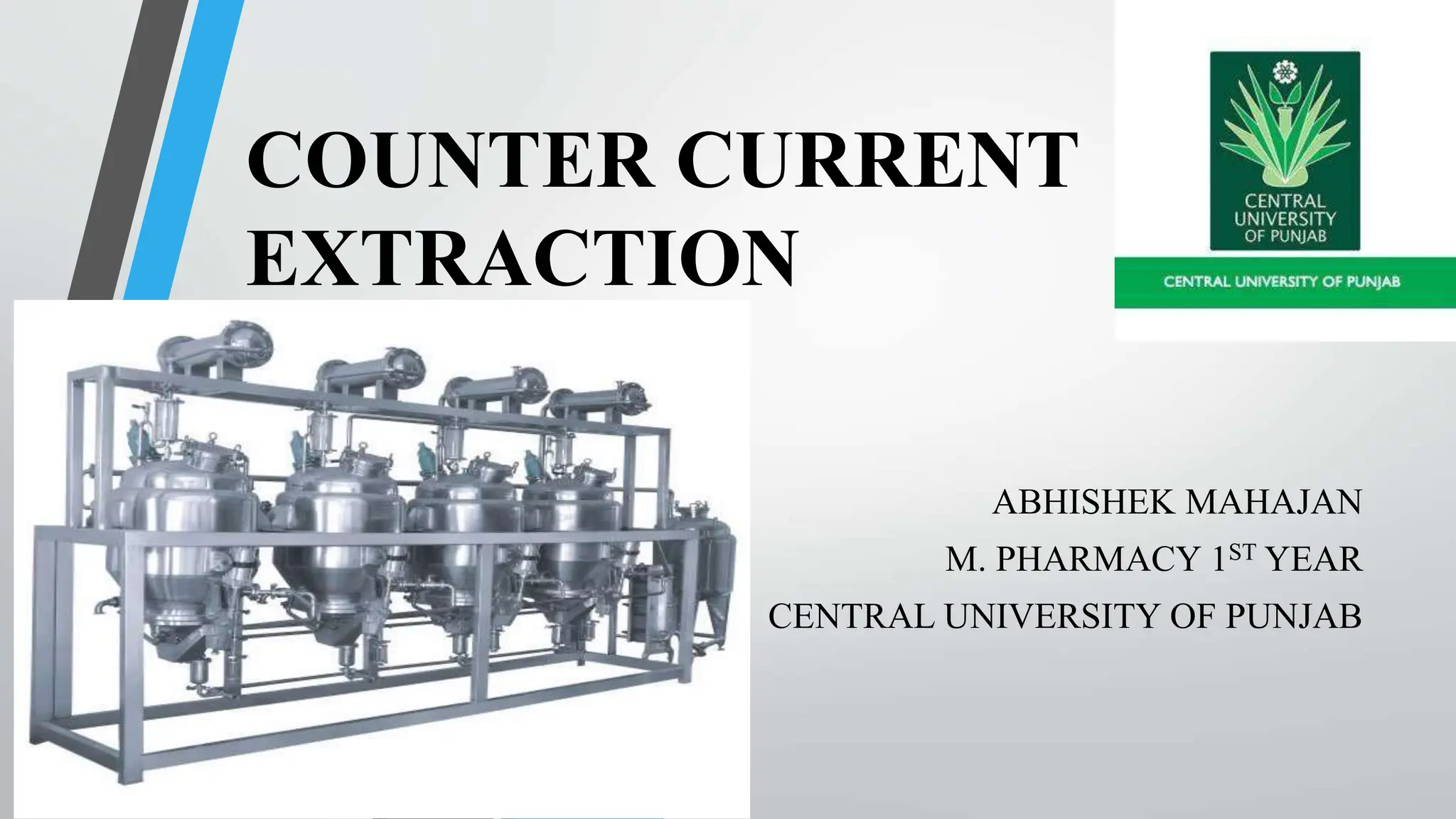
COUNTER CURRENT
EXTRACTION
ABHISHEK MAHAJAN
M. PHARMACY 1ST YEAR
CENTRAL UNIVERSITY OF PUNJAB
COUNTER CURRENT EXTRACTION
• Counter current extraction is a method of multiple liquid- liquid
extraction
• Separation of components having variable solubility in two immiscible
liquid phases is achieved
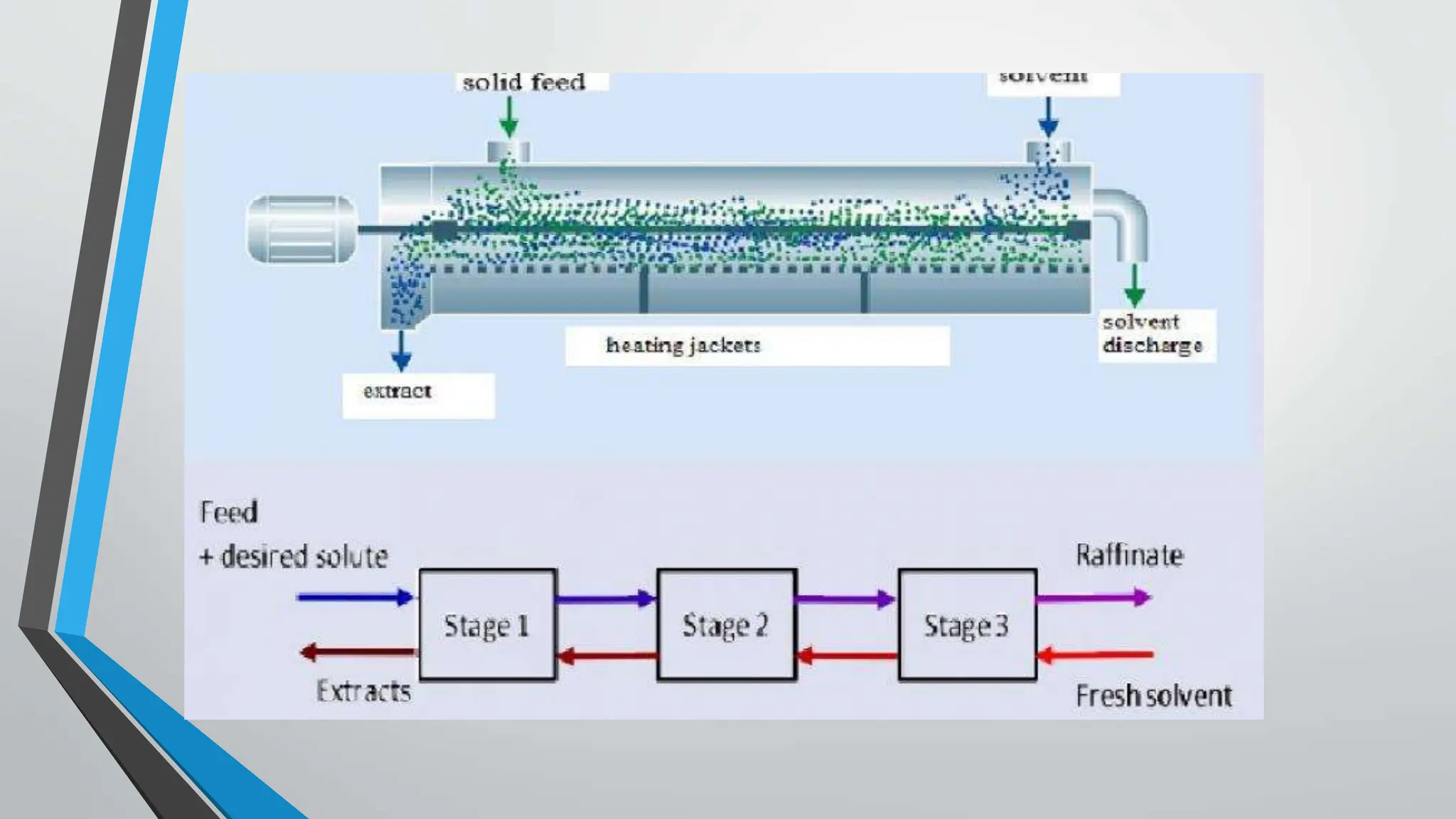
• In the counter current extraction two immiscible solvents flow in an
opposite direction in multiple stages, (after several stages pure A and B
solvents can be obtained)
• In liquid- liquid extraction the solvent is used to extract another liquid
phase
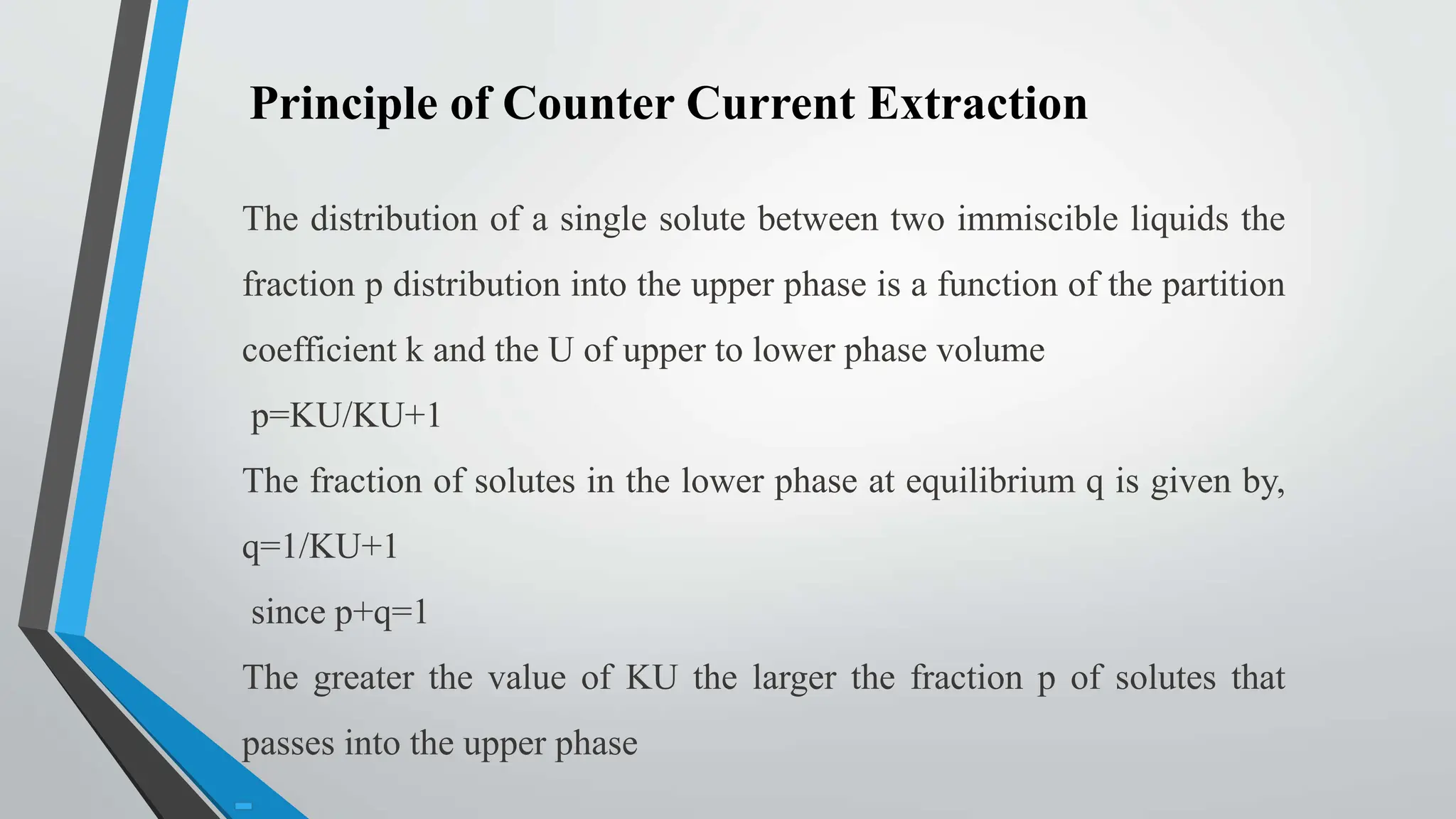
• To distribution of active principles between water and organic
solvent depends on the hydrophilic groups present in the constituent
molecules
• If hydrophilic groups are ionisable , pH will be an important factor
Principle of Counter Current Extraction
The distribution of a single solute between two immiscible liquids the
fraction p distribution into the upper phase is a function of the partition
coefficient k and the U of upper to lower phase volume
p=KU/KU+1
The fraction of solutes in the lower phase at equilibrium q is given by,
q=1/KU+1
since p+q=1
The greater the value of KU the larger the fraction p of solutes that
passes into the upper phase
Process of Counter- Current Extraction
• In these extraction wet raw material is pulverised using toothed disc
disintegrators to produce the fine slurry
• The material to be extacted is moved in the one direction (generally in
the form of fine slurry) within a cylindrical extractor where it comes in
contact with extraction solvent
• The further the starting material moves the more concentrated the
extract becomes
• Finally, sufficiently concentrated extract comes out at one end of the
extractor while the marc falls out the other end
Theory
• A method of multiple liquid-liquid extractions is countercurrent extraction,
which permits the separation of substances with different distribution
coefficients (ratios).
• A clever design known as Craig apparatus is used for this purpose.
• Craig apparatus consists of a series of glass tubes (r: 0, 1, 2..) that are
designed and arranged such that the lighter liquid phase is transferred from
one tube to the next.
• The liquid-liquid extractions are taking place simultaneously in all tubes of
the apparatus which is usually driven electromechanically. In the following
animated picture of a single glass tube the typical "extraction/transfer" cycle
is shown.
• The lower (heavier) phase of the two-phase solvent system (e.g. water, blue
layer in the picture) is the "stationary phase", whereas the upper (lighter)
phase (e.g. hexane, red layer in the picture) is the "mobile phase".
• It is interesting to examine the distribution of a substance A in each tube after
a given number of equilibration/transfer cycles.
• In the beginning, tube #0 contains the mixture of substances to be separated in
the heavier solvent and all the other tubes contain equal volumes of the same
solvent.
• The lighter solvent is added to tube #0, extraction (equilibration) takes place
and the phases are allowed to separate.
• The upper phase of tube #0 is then transferred to tube #1 and fresh solvent is
added to tube #0, and the phases are equilibrated again.
• The upper layers of tubes #0 and #1 are simultaneously transferred to tubes #1
and #2 respectively. This cycle is repeated to carry on the process through the
other tubes of the apparatus.
• Obviously, substances with higher distribution ratio move faster than those with
a lower distribution ratio.
Advantages
• CCE is a commonly done at room temperature which spare the thermolabile
constituent from exposure to heat which is employed in most other techniques
• As the pulverization of the drug is done under wet conditions the heat
generated during communication is neutralized by water this again spares the
thermolabile constituent from exposure to heat
• The extraction procedure has been related be more efficient and effective than
continuous hot extraction
• Isolation of antibiotics (penicillin G) from the aqueous fermentation broth
using immiscible solvent (amyl acetate or butyl acetate)
• Isolation of chemical compounds from the aqueous systems using small
quantities of organic solvents in the production of synthetic drugs and
intermediates.
• In petroleum industry products having different chemical structure but about
the same boiling range are separated.
• Separation of components from synthetic mixtures.
• Separation of components from plant extract.
• Purification of compounds (removal of impurities)
Application
• Counter Current Extraction has great merits of eliminating the
irreversible adsorption or chemical reaction that occur in solid absorbents
based conventional column chromatography
• The yield and recovery of target compounds are superior to those of solid
support based column chromatography
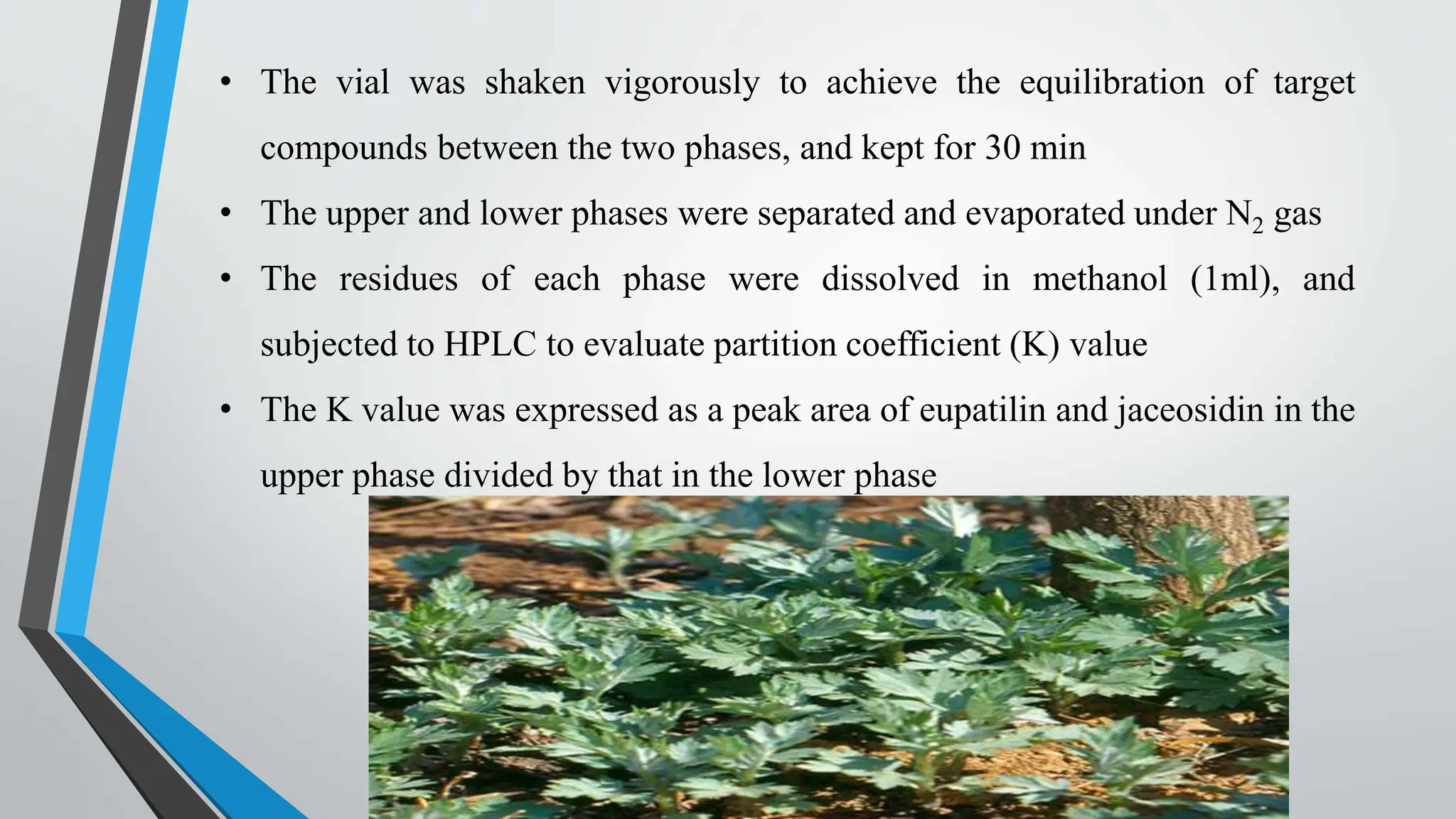
• In the present study, HSCCC was applied to separate two anti ulceric
compounds, eupatilin and jaceosidin from Artemisia extracts
• The aerial parts of A. princeps (600 g) were extracted with ethanol (4.5 l)
and evaporated under reduced pressure to give ethanol extract(Et-Fr)
• Et-Fr was suspended in water (1.5 l) and partitioned with n-hexane and
ethyl acetate sequentially
• The ethyl acetate layer was concentrated to dryness in reduced pressure by
rotatory evaporator to afford ethyl acetate soluble extract (Ea-Fr)
• Et-Fr was subjected to Sephadex LH-20 column chromatography to obtain
two subfractions (S1 and S2)
• Subfractions S2 were combined and concentrated to give of semi-purified
ethanol extract (Se-Fr)
• The coefficient (K) values of eupatilin and jaceosidin from Se-Fr were
estimated at different volume ratio of n-hexane– chloroform–methanol–
water system (1:5:5:2, 2:5:5:2, 3:5:5:2, v/v/v/v)
• Two milliliters of the each phase of equilibrated two-phase solvent systems
was prepared in a vial, and then 1 mg of Se-Fr was added
• The vial was shaken vigorously to achieve the equilibration of target
compounds between the two phases, and kept for 30 min
• The upper and lower phases were separated and evaporated under N2 gas
• The residues of each phase were dissolved in methanol (1ml), and
subjected to HPLC to evaluate partition coefficient (K) value
• The K value was expressed as a peak area of eupatilin and jaceosidin in the
upper phase divided by that in the lower phase
• Solvent for HSCCC separation was thoroughly equilibrated in a separatory
funnel, and upper and lower phases were separated before use
• The column was fully filled with upper stationary phase at a flow rate of
10 ml/min by a fluid metering pump and rotated at 800 rpm
• In the meantime, the lower mobile phase was eluted in a descending mode
at a flow rate of 1.3–2.0 ml/min
• The Et-Fr. (150 mg), Ea-Fr. (100 mg) and Se-Fr. (50 mg) were dissolved in
4 ml lower mobile phase and subjected to HSCCC
• The monitoring of HSCCC peak fractions was performed by combining
effluent line of the HSCCC apparatus to UV detector (wavelength at 340
nm)
Procedure
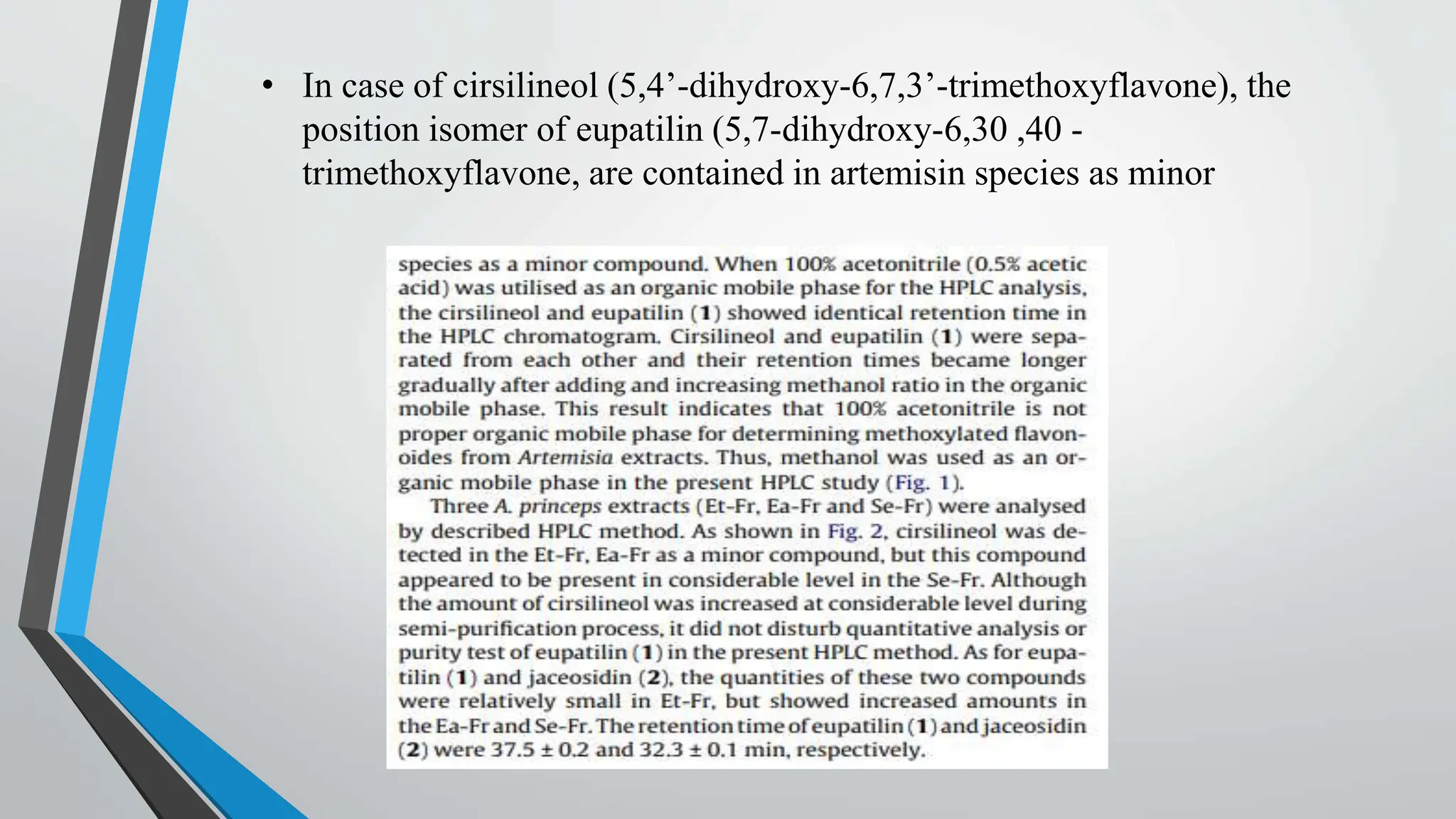
• In case of cirsilineol (5,4’-dihydroxy-6,7,3’-trimethoxyflavone), the
position isomer of eupatilin (5,7-dihydroxy-6,30 ,40 -
trimethoxyflavone, are contained in artemisin species as minor
Conclusion
• In the present study, two anti-ulcer flavonoids, eupatilin and jaceosidin,
were separated by HSCCC method.
• Two-phase solvent system composed of n-hexane–chloroform–methanol–
water was utilized and the optimal separation condition was evaluated to
achieve successful separation.
• The yield, recovery and purity of eupatilin and jaceosidin separated by
HSCCC were superior to those of conventional chromatography methods
• Thus, HSCCC separation of Et-Fr, Ea-Fr and Se-Fr were performed
utilising n-hexane–chloroform–methanol–water (2:5:5:2, v/v/v/v, 1.3
ml/min) conditions
COUNTER CURRENT EXTRACTION by Abhishek .pptx

COUNTER CURRENT EXTRACTION by Abhishek .pptx

  • 1.
    COUNTER CURRENT EXTRACTION ABHISHEK MAHAJAN M.PHARMACY 1ST YEAR CENTRAL UNIVERSITY OF PUNJAB
  • 2.
    COUNTER CURRENT EXTRACTION •Counter current extraction is a method of multiple liquid- liquid extraction • Separation of components having variable solubility in two immiscible liquid phases is achieved • In the counter current extraction two immiscible solvents flow in an opposite direction in multiple stages, (after several stages pure A and B solvents can be obtained) • In liquid- liquid extraction the solvent is used to extract another liquid phase
  • 3.
    • To distributionof active principles between water and organic solvent depends on the hydrophilic groups present in the constituent molecules • If hydrophilic groups are ionisable , pH will be an important factor
  • 4.
    Principle of CounterCurrent Extraction The distribution of a single solute between two immiscible liquids the fraction p distribution into the upper phase is a function of the partition coefficient k and the U of upper to lower phase volume p=KU/KU+1 The fraction of solutes in the lower phase at equilibrium q is given by, q=1/KU+1 since p+q=1 The greater the value of KU the larger the fraction p of solutes that passes into the upper phase
  • 5.
    Process of Counter-Current Extraction • In these extraction wet raw material is pulverised using toothed disc disintegrators to produce the fine slurry • The material to be extacted is moved in the one direction (generally in the form of fine slurry) within a cylindrical extractor where it comes in contact with extraction solvent • The further the starting material moves the more concentrated the extract becomes • Finally, sufficiently concentrated extract comes out at one end of the extractor while the marc falls out the other end
  • 6.
    Theory • A methodof multiple liquid-liquid extractions is countercurrent extraction, which permits the separation of substances with different distribution coefficients (ratios). • A clever design known as Craig apparatus is used for this purpose. • Craig apparatus consists of a series of glass tubes (r: 0, 1, 2..) that are designed and arranged such that the lighter liquid phase is transferred from one tube to the next. • The liquid-liquid extractions are taking place simultaneously in all tubes of the apparatus which is usually driven electromechanically. In the following animated picture of a single glass tube the typical "extraction/transfer" cycle is shown.
  • 7.
    • The lower(heavier) phase of the two-phase solvent system (e.g. water, blue layer in the picture) is the "stationary phase", whereas the upper (lighter) phase (e.g. hexane, red layer in the picture) is the "mobile phase". • It is interesting to examine the distribution of a substance A in each tube after a given number of equilibration/transfer cycles.
  • 8.
    • In thebeginning, tube #0 contains the mixture of substances to be separated in the heavier solvent and all the other tubes contain equal volumes of the same solvent. • The lighter solvent is added to tube #0, extraction (equilibration) takes place and the phases are allowed to separate. • The upper phase of tube #0 is then transferred to tube #1 and fresh solvent is added to tube #0, and the phases are equilibrated again. • The upper layers of tubes #0 and #1 are simultaneously transferred to tubes #1 and #2 respectively. This cycle is repeated to carry on the process through the other tubes of the apparatus. • Obviously, substances with higher distribution ratio move faster than those with a lower distribution ratio.
  • 10.
    Advantages • CCE isa commonly done at room temperature which spare the thermolabile constituent from exposure to heat which is employed in most other techniques • As the pulverization of the drug is done under wet conditions the heat generated during communication is neutralized by water this again spares the thermolabile constituent from exposure to heat • The extraction procedure has been related be more efficient and effective than continuous hot extraction
  • 11.
    • Isolation ofantibiotics (penicillin G) from the aqueous fermentation broth using immiscible solvent (amyl acetate or butyl acetate) • Isolation of chemical compounds from the aqueous systems using small quantities of organic solvents in the production of synthetic drugs and intermediates. • In petroleum industry products having different chemical structure but about the same boiling range are separated. • Separation of components from synthetic mixtures. • Separation of components from plant extract. • Purification of compounds (removal of impurities) Application
  • 13.
    • Counter CurrentExtraction has great merits of eliminating the irreversible adsorption or chemical reaction that occur in solid absorbents based conventional column chromatography • The yield and recovery of target compounds are superior to those of solid support based column chromatography • In the present study, HSCCC was applied to separate two anti ulceric compounds, eupatilin and jaceosidin from Artemisia extracts • The aerial parts of A. princeps (600 g) were extracted with ethanol (4.5 l) and evaporated under reduced pressure to give ethanol extract(Et-Fr) • Et-Fr was suspended in water (1.5 l) and partitioned with n-hexane and ethyl acetate sequentially
  • 14.
    • The ethylacetate layer was concentrated to dryness in reduced pressure by rotatory evaporator to afford ethyl acetate soluble extract (Ea-Fr) • Et-Fr was subjected to Sephadex LH-20 column chromatography to obtain two subfractions (S1 and S2) • Subfractions S2 were combined and concentrated to give of semi-purified ethanol extract (Se-Fr) • The coefficient (K) values of eupatilin and jaceosidin from Se-Fr were estimated at different volume ratio of n-hexane– chloroform–methanol– water system (1:5:5:2, 2:5:5:2, 3:5:5:2, v/v/v/v) • Two milliliters of the each phase of equilibrated two-phase solvent systems was prepared in a vial, and then 1 mg of Se-Fr was added
  • 15.
    • The vialwas shaken vigorously to achieve the equilibration of target compounds between the two phases, and kept for 30 min • The upper and lower phases were separated and evaporated under N2 gas • The residues of each phase were dissolved in methanol (1ml), and subjected to HPLC to evaluate partition coefficient (K) value • The K value was expressed as a peak area of eupatilin and jaceosidin in the upper phase divided by that in the lower phase
  • 16.
    • Solvent forHSCCC separation was thoroughly equilibrated in a separatory funnel, and upper and lower phases were separated before use • The column was fully filled with upper stationary phase at a flow rate of 10 ml/min by a fluid metering pump and rotated at 800 rpm • In the meantime, the lower mobile phase was eluted in a descending mode at a flow rate of 1.3–2.0 ml/min • The Et-Fr. (150 mg), Ea-Fr. (100 mg) and Se-Fr. (50 mg) were dissolved in 4 ml lower mobile phase and subjected to HSCCC • The monitoring of HSCCC peak fractions was performed by combining effluent line of the HSCCC apparatus to UV detector (wavelength at 340 nm) Procedure
  • 17.
    • In caseof cirsilineol (5,4’-dihydroxy-6,7,3’-trimethoxyflavone), the position isomer of eupatilin (5,7-dihydroxy-6,30 ,40 - trimethoxyflavone, are contained in artemisin species as minor
  • 18.
    Conclusion • In thepresent study, two anti-ulcer flavonoids, eupatilin and jaceosidin, were separated by HSCCC method. • Two-phase solvent system composed of n-hexane–chloroform–methanol– water was utilized and the optimal separation condition was evaluated to achieve successful separation. • The yield, recovery and purity of eupatilin and jaceosidin separated by HSCCC were superior to those of conventional chromatography methods • Thus, HSCCC separation of Et-Fr, Ea-Fr and Se-Fr were performed utilising n-hexane–chloroform–methanol–water (2:5:5:2, v/v/v/v, 1.3 ml/min) conditions