SUPPLY CHAIN AND
INVENTORY CONTROL
Archana B. Chavhan
M.Pharm (QA)
KYDSCT college of
pharmacy Sakegaon
1
SUPPLY
CHAIN
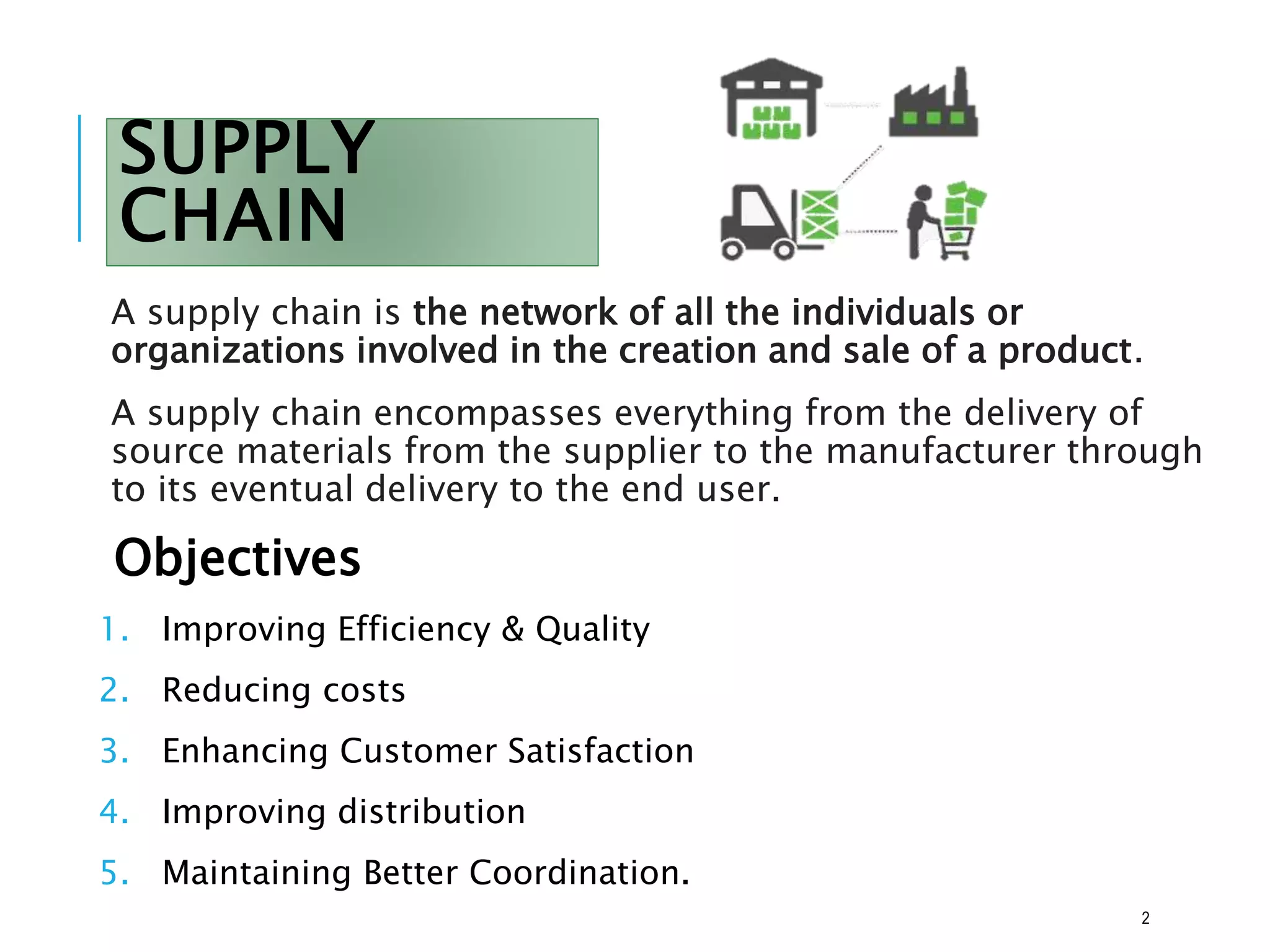
A supply chain is the network of all the individuals or
organizations involved in the creation and sale of a product.
A supply chain encompasses everything from the delivery of
source materials from the supplier to the manufacturer through
to its eventual delivery to the end user.
Objectives
1. Improving Efficiency & Quality
2. Reducing costs
3. Enhancing Customer Satisfaction
4. Improving distribution
5. Maintaining Better Coordination.
2
3 elements of supply
chain
1. Purchasing
2. Planning
3. Delivering
it has 7 primary
functional areas:
1. Purchasing,
2. Manufacturing,
3. Inventory
Management,
4. Demand Planning,
5. Warehousing,
6. Transportation, and
7. Customer Service.
3
SUPPLY
CHAIN
MANAGEMEN
T
ANALYSI
S LOGISTI
CS
MANAGEMEN
T
PROFIT
PROCUREMEN
DISTRIBUTI
ON
PLAN 4
PREPARATION OF DRUG
LIST
The list of drugs guides to detect medications
that require special precautions to reduce risk of
errors
Precautions may include limiting access to certain
drugs.
The list of drugs categorised into
High risk drugs
Emergency drugs
Schedule H1 drugs
NDPS drugs
Reserved antibiotics 5
HIGH RISK DRUGS
High risk medications are drugs that have a heightened risk of causing
significant patient harm when they are misused.
List of high risk drugs
Adrenaline 1mg/ml inj
Cobra antivenom inj
Dextrose 30% and 50% inj
Digoxin 0.5 mg inj
Dopamine 200mg/ 20ml inj
Heparin 5000unit/ml inj
Actrapid1000 unit/10ml inj
Morphine 10mg/ml inj
Noradrenaline inj
6
All high medication containers or loose
vials/ampoules stored must be labelled as high risk
medicines
Use TALL-man lettering to emphasize difference in
medication name e.g. DOPamine abd DOButamine
Prescribing: do not use abbreviations when
prescribing
Do not use trailing zero when prescribing e.g. 5.0mg
can be mistaken as 50mg
Administration: the following particulars shall be
checked before administration;
•Patient’s name
•Strength of medication
•Dose
•Route and expiry 7
EMERGENCY
DRUGS
Emergency medicines are used in patient
during life danger conditions arised so that
the symptoms can be controlled and the
life of patient can be saved
Purpose of emergency drugs
To control the symptoms of patient
To save the life of patient
To reach the site of action as soon as
To normalize the vital functions
8
LIST OF EMERGENCY
DRUGS
Atropine (cardiac arrest)
Amiodarone (antiarrythmatics)
Aminophylline (asthama)
Hydrocortisone
Diazepam (antiepileptics)
Hydralazine (antihypertensive)
Metclopramide (antiemetic)
Digoxin
Dextrose 50% IV
Thiopentone (sedative)
9
SCHEDULE H1
DRUGS
These drugs are to be dispensed only when
prescription is given by RMP(REGISTERED
MEDICINAL PRACTIONER)
List of drugs are;
All range higher antibiotics
All range CNS related drugs like alprazolam,
zolpidem, diazepam
All Narcotic drugs
10
RESERVED
ANTIBIOTICS
This group of antibiotics includes classes of antibiotic that
should be reserved for treatment of confirmed or suspected
infections due to multi-drug-resistant organisms.
Antibiotics in reserve group should be treated as ‘last resort’
option which should be accessible, but their use should be
tailored to highly specific patient, when all alternatives have
failed.
WHO AWaRe classification of antibiotics
11
NDPS
DRUGS
NDPS means ‘ Narcotic Drugs and Psychotropic
Substances’
Narcotic drugs are made from or derived synthetically from
opium and include all manufactures
E.g. opium, morphine, heroine, codeine, tramadol, charas,
ganja etc.
Psychotropic drugs are non-narcotic drugs which effect
the mental state of the abuser by producing
depressant/stimulant effect on the CNS
E.g barbiturates, tranquilizers, amphetamine, cocaine etc.
12
13
14
PROCEDURES OF DRUG
PURCHASES
PURCHASE“ It’s an act of obtaining an article by making
payment in terms of money or its equivalent ,to buy for a price”.
WHO SHOULD PURCHASE DRUGS AND
PHARMACEUTICALS-PHARMACIST OR PURCHASING
OFFICER?
The pharmaceuticals and related items form a specialty which
requires technical skills of a properly trained individuals for
their proper selection and purchase. Considering this pharmacist
should carry the purchasing of drugs.
But In large hospitals with centralized purchasing unit, the
pharmacist and the purchasing officer should work in
collaboration with each other and each recognizing the
importance of the function if the other.
15
PROCEDURE FOR PURCHASING
DRUGS
16
Purchase Request Form
Quotation Invitation
Purchase Order Form
Return of Goods
PURCHASE REQUEST FORM
The pharmacist or a person authorized by him should complete a
purchase request form.
This form provides the purchase department with the data
concerning description specifications, packing, price quantity
needed and also information about the inventory balance and
anticipated monthly use.
QUOTATION INVITATION
On receipt of “request for purchase”, invites competitive rates
(quotations) from different suppliers. To prevent delay in supply,
an annual rate contract can also be undertaken.
17
PURCHASE ORDER FORM
The purchase officer scrutinizes quotations received, checks the quality expected to be
supplied in consultation with pharmacists and prepares a purchase order.
Purchase order give detailed description, specifications, quantity required and terms and
conditions of contract.
The seven copies of purchase order are prepared and to whom to send is given below
1. First copy send to supplier by post
2. Second copy send to account department where it will be retained for accounting
3. Third copy retained by purchasing officer
4. Fourth copy send to department from where requisition slip is received
5. Fifth and sixth copy for concerned receiving department
6. Seventh copy is kept as a history by purchase officer for other use
18
RETURN OF GOODS
When ordered goods received the quantities and prices are checked
If for any reason, any portion of the articles receivedare to be
returned to the suppliera “Returned Goods Memorandum” must be
prepared because it is by its means that the hospital can be assured
of receivingcredit for the goods.
This form is of the snap out type and provides four copies first to
account department,second to the purchasing officer, third to the
store room, fourth to the pharmacy and the supplier.
19
Tender
Tender is a process whereby hospital
invites bids for drugs that must be
submitted within the given limit.
Tenders are broadly advertised to offer
opportunities to a different supplier,
encourage competitions and make
available greater pool of offer to select
forms.
20
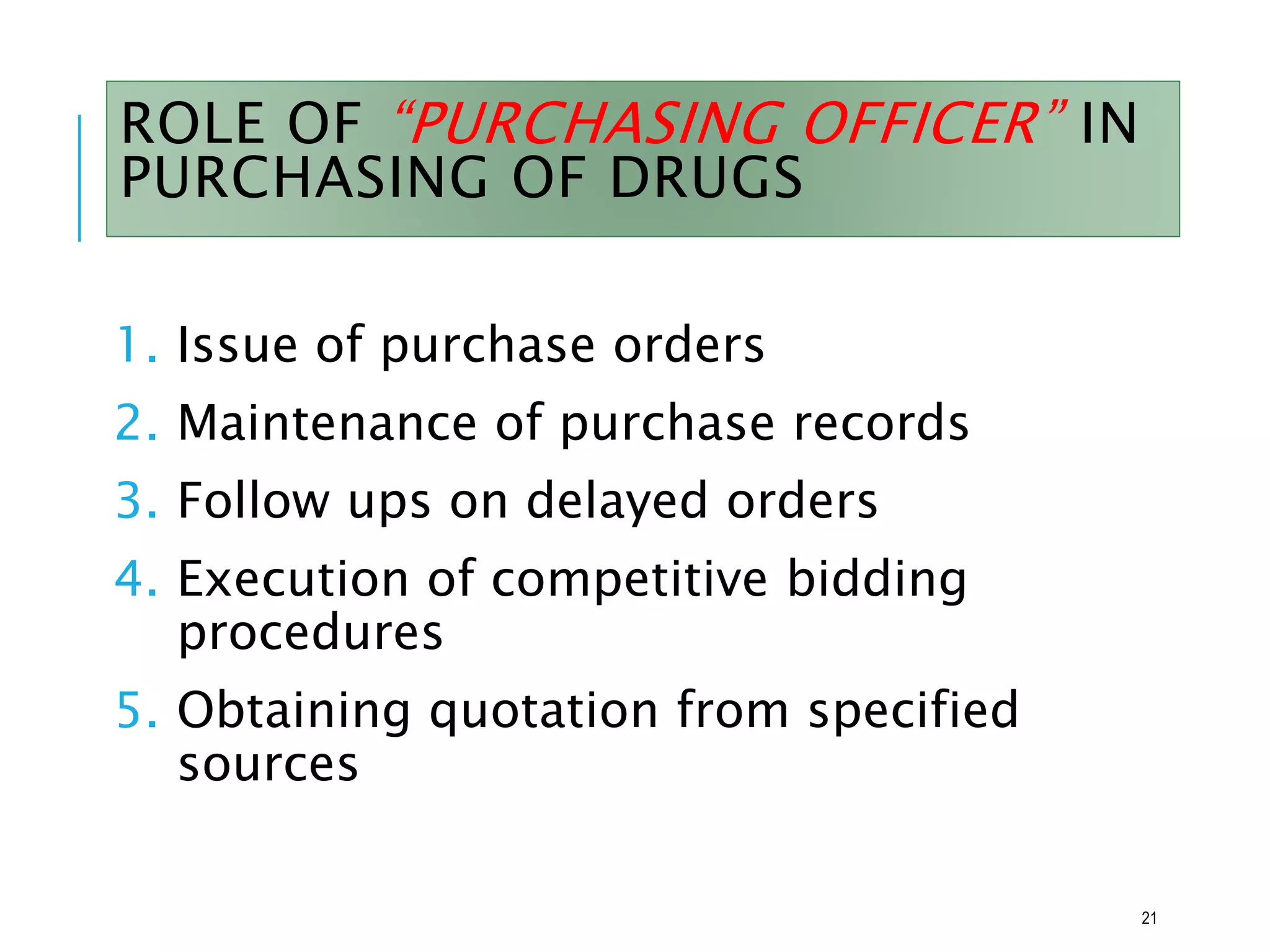
ROLE OF “PURCHASING OFFICER” IN
PURCHASING OF DRUGS
1. Issue of purchase orders
2. Maintenance of purchase records
3. Follow ups on delayed orders
4. Execution of competitive bidding
procedures
5. Obtaining quotation from specified
sources
21
22

SUPPLY CHAIN & INVENTORY CONTROL.pptx

  • 1.
    SUPPLY CHAIN AND INVENTORYCONTROL Archana B. Chavhan M.Pharm (QA) KYDSCT college of pharmacy Sakegaon 1
  • 2.
    SUPPLY CHAIN A supply chainis the network of all the individuals or organizations involved in the creation and sale of a product. A supply chain encompasses everything from the delivery of source materials from the supplier to the manufacturer through to its eventual delivery to the end user. Objectives 1. Improving Efficiency & Quality 2. Reducing costs 3. Enhancing Customer Satisfaction 4. Improving distribution 5. Maintaining Better Coordination. 2
  • 3.
    3 elements ofsupply chain 1. Purchasing 2. Planning 3. Delivering it has 7 primary functional areas: 1. Purchasing, 2. Manufacturing, 3. Inventory Management, 4. Demand Planning, 5. Warehousing, 6. Transportation, and 7. Customer Service. 3
  • 4.
  • 5.
    PREPARATION OF DRUG LIST Thelist of drugs guides to detect medications that require special precautions to reduce risk of errors Precautions may include limiting access to certain drugs. The list of drugs categorised into High risk drugs Emergency drugs Schedule H1 drugs NDPS drugs Reserved antibiotics 5
  • 6.
    HIGH RISK DRUGS Highrisk medications are drugs that have a heightened risk of causing significant patient harm when they are misused. List of high risk drugs Adrenaline 1mg/ml inj Cobra antivenom inj Dextrose 30% and 50% inj Digoxin 0.5 mg inj Dopamine 200mg/ 20ml inj Heparin 5000unit/ml inj Actrapid1000 unit/10ml inj Morphine 10mg/ml inj Noradrenaline inj 6
  • 7.
    All high medicationcontainers or loose vials/ampoules stored must be labelled as high risk medicines Use TALL-man lettering to emphasize difference in medication name e.g. DOPamine abd DOButamine Prescribing: do not use abbreviations when prescribing Do not use trailing zero when prescribing e.g. 5.0mg can be mistaken as 50mg Administration: the following particulars shall be checked before administration; •Patient’s name •Strength of medication •Dose •Route and expiry 7
  • 8.
    EMERGENCY DRUGS Emergency medicines areused in patient during life danger conditions arised so that the symptoms can be controlled and the life of patient can be saved Purpose of emergency drugs To control the symptoms of patient To save the life of patient To reach the site of action as soon as To normalize the vital functions 8
  • 9.
    LIST OF EMERGENCY DRUGS Atropine(cardiac arrest) Amiodarone (antiarrythmatics) Aminophylline (asthama) Hydrocortisone Diazepam (antiepileptics) Hydralazine (antihypertensive) Metclopramide (antiemetic) Digoxin Dextrose 50% IV Thiopentone (sedative) 9
  • 10.
    SCHEDULE H1 DRUGS These drugsare to be dispensed only when prescription is given by RMP(REGISTERED MEDICINAL PRACTIONER) List of drugs are; All range higher antibiotics All range CNS related drugs like alprazolam, zolpidem, diazepam All Narcotic drugs 10
  • 11.
    RESERVED ANTIBIOTICS This group ofantibiotics includes classes of antibiotic that should be reserved for treatment of confirmed or suspected infections due to multi-drug-resistant organisms. Antibiotics in reserve group should be treated as ‘last resort’ option which should be accessible, but their use should be tailored to highly specific patient, when all alternatives have failed. WHO AWaRe classification of antibiotics 11
  • 12.
    NDPS DRUGS NDPS means ‘Narcotic Drugs and Psychotropic Substances’ Narcotic drugs are made from or derived synthetically from opium and include all manufactures E.g. opium, morphine, heroine, codeine, tramadol, charas, ganja etc. Psychotropic drugs are non-narcotic drugs which effect the mental state of the abuser by producing depressant/stimulant effect on the CNS E.g barbiturates, tranquilizers, amphetamine, cocaine etc. 12
  • 13.
  • 14.
  • 15.
    PROCEDURES OF DRUG PURCHASES PURCHASE“It’s an act of obtaining an article by making payment in terms of money or its equivalent ,to buy for a price”. WHO SHOULD PURCHASE DRUGS AND PHARMACEUTICALS-PHARMACIST OR PURCHASING OFFICER? The pharmaceuticals and related items form a specialty which requires technical skills of a properly trained individuals for their proper selection and purchase. Considering this pharmacist should carry the purchasing of drugs. But In large hospitals with centralized purchasing unit, the pharmacist and the purchasing officer should work in collaboration with each other and each recognizing the importance of the function if the other. 15
  • 16.
    PROCEDURE FOR PURCHASING DRUGS 16 PurchaseRequest Form Quotation Invitation Purchase Order Form Return of Goods
  • 17.
    PURCHASE REQUEST FORM Thepharmacist or a person authorized by him should complete a purchase request form. This form provides the purchase department with the data concerning description specifications, packing, price quantity needed and also information about the inventory balance and anticipated monthly use. QUOTATION INVITATION On receipt of “request for purchase”, invites competitive rates (quotations) from different suppliers. To prevent delay in supply, an annual rate contract can also be undertaken. 17
  • 18.
    PURCHASE ORDER FORM Thepurchase officer scrutinizes quotations received, checks the quality expected to be supplied in consultation with pharmacists and prepares a purchase order. Purchase order give detailed description, specifications, quantity required and terms and conditions of contract. The seven copies of purchase order are prepared and to whom to send is given below 1. First copy send to supplier by post 2. Second copy send to account department where it will be retained for accounting 3. Third copy retained by purchasing officer 4. Fourth copy send to department from where requisition slip is received 5. Fifth and sixth copy for concerned receiving department 6. Seventh copy is kept as a history by purchase officer for other use 18
  • 19.
    RETURN OF GOODS Whenordered goods received the quantities and prices are checked If for any reason, any portion of the articles receivedare to be returned to the suppliera “Returned Goods Memorandum” must be prepared because it is by its means that the hospital can be assured of receivingcredit for the goods. This form is of the snap out type and provides four copies first to account department,second to the purchasing officer, third to the store room, fourth to the pharmacy and the supplier. 19
  • 20.
    Tender Tender is aprocess whereby hospital invites bids for drugs that must be submitted within the given limit. Tenders are broadly advertised to offer opportunities to a different supplier, encourage competitions and make available greater pool of offer to select forms. 20
  • 21.
    ROLE OF “PURCHASINGOFFICER” IN PURCHASING OF DRUGS 1. Issue of purchase orders 2. Maintenance of purchase records 3. Follow ups on delayed orders 4. Execution of competitive bidding procedures 5. Obtaining quotation from specified sources 21
  • 22.