Eeng 360 1
Lecture 5
Superheterodyne Receivers.
Transmitters and Receivers
 Generalized Transmitters
 AM PM Generation
 Inphase and Quadrature Generation
 Superheterodyne Receiver
 Frequency Division Multiplexing
Eeng 360 2
Generalized Transmitters
   
     
     
     
   
Re cos
cos sin
Where
c
j t
c
c c
j t
v t g t e R t t t
v t x t t y t t
g t R t e x t jy t


 
 
  
 
 
 
  
Any type of modulated signal can be represented by
The complex envelope g(t) is a function of the modulating signal m(t)
Transmitter
Modulating
signal
Modulated
signal
Example:
( )
Type of Modulation g(m)
AM : [1 ( )]
PM : p
c
jD m t
c
A m t
A e

Eeng 360 3
Generalized Transmitters
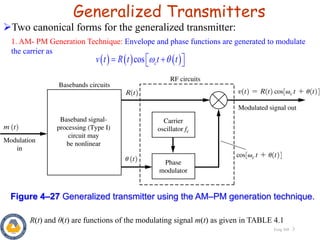
R(t) and θ(t) are functions of the modulating signal m(t) as given in TABLE 4.1
Two canonical forms for the generalized transmitter:
     
cos c
v t R t t t
 
 
 
 
1. AM- PM Generation Technique: Envelope and phase functions are generated to modulate
the carrier as
Figure 4–27 Generalized transmitter using the AM–PM generation technique.
Eeng 360 4
Generalized Transmitters
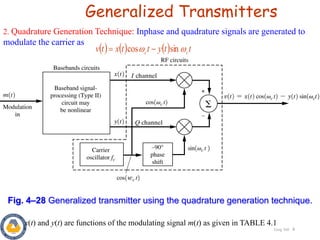
x(t) and y(t) are functions of the modulating signal m(t) as given in TABLE 4.1
      t
t
y
t
t
x
t
v c
c 
 sin
cos 

2. Quadrature Generation Technique: Inphase and quadrature signals are generated to
modulate the carrier as
Fig. 4–28 Generalized transmitter using the quadrature generation technique.
Eeng 360 5
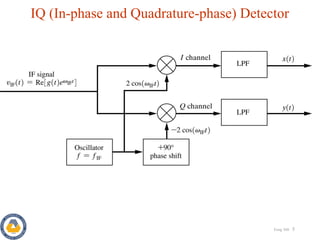
IQ (In-phase and Quadrature-phase) Detector
Eeng 360 6
Generalized Receivers
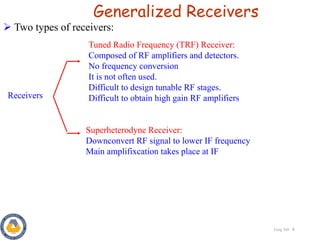
Receivers
Tuned Radio Frequency (TRF) Receiver:
Composed of RF amplifiers and detectors.
No frequency conversion
It is not often used.
Difficult to design tunable RF stages.
Difficult to obtain high gain RF amplifiers
Superheterodyne Receiver:
Downconvert RF signal to lower IF frequency
Main amplifixcation takes place at IF
 Two types of receivers:
Eeng 360 7
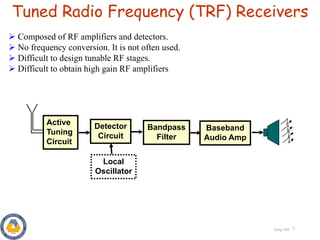
Tuned Radio Frequency (TRF) Receivers
Active
Tuning
Circuit
Detector
Circuit
Local
Oscillator
Bandpass
Filter
Baseband
Audio Amp
 Composed of RF amplifiers and detectors.
 No frequency conversion. It is not often used.
 Difficult to design tunable RF stages.
 Difficult to obtain high gain RF amplifiers
Eeng 360 8
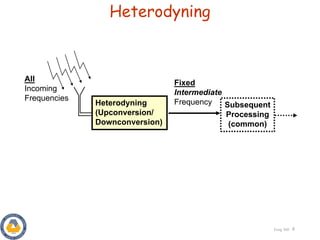
Heterodyning
(Upconversion/
Downconversion)
Subsequent
Processing
(common)
All
Incoming
Frequencies
Fixed
Intermediate
Frequency
Heterodyning
Eeng 360 9
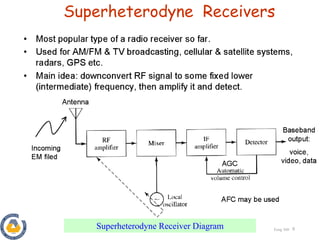
Superheterodyne Receivers
Superheterodyne Receiver Diagram
Eeng 360 10
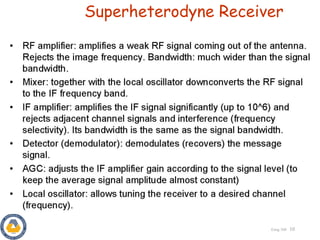
Superheterodyne Receiver
Eeng 360 11
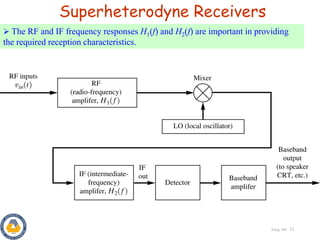
Superheterodyne Receivers
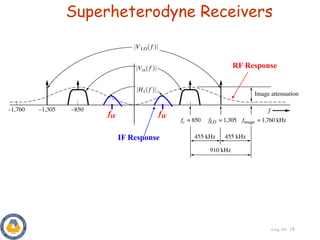
 The RF and IF frequency responses H1(f) and H2(f) are important in providing
the required reception characteristics.
The Mixer
Eeng 360 12
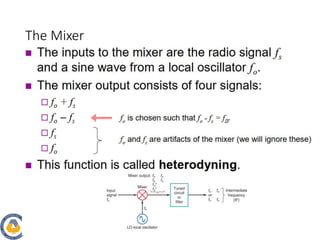
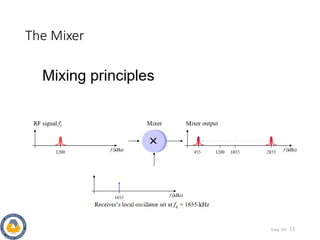
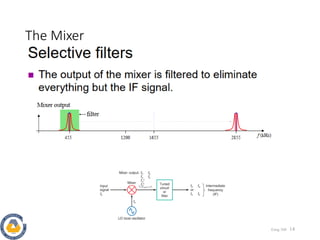
The Mixer
Eeng 360 13
The Mixer
Eeng 360 14
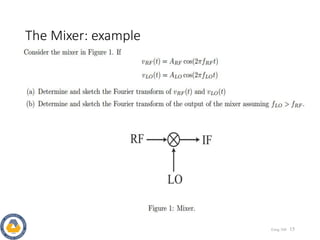
The Mixer: example
Eeng 360 15
Eeng 360 16
Eeng 360 17
Eeng 360 18
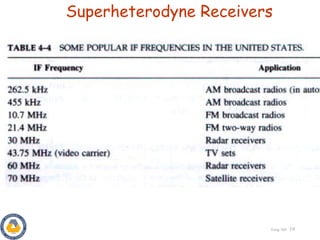
Superheterodyne Receivers
fIF fIF
RF Response
IF Response
Eeng 360 19
Superheterodyne Receivers
Eeng 360 20
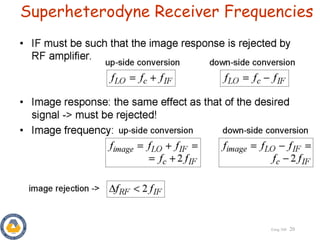
Superheterodyne Receiver Frequencies
Eeng 360 21
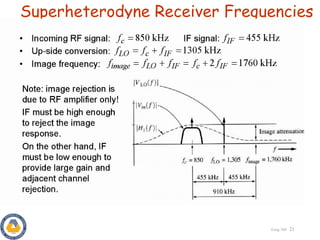
Superheterodyne Receiver Frequencies
Eeng 360 22
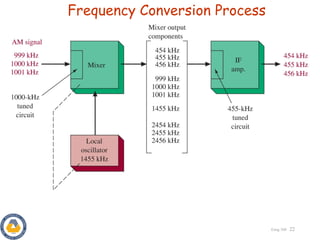
Frequency Conversion Process
Image frequency not a problem.
Eeng 360 23
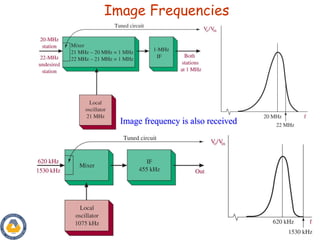
Image Frequencies
Image frequency is also received
Eeng 360 24
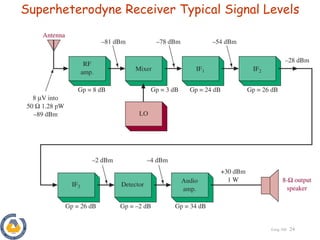
Superheterodyne Receiver Typical Signal Levels

Lecture 5 - Superheterodyne Receivers.pdf

  • 1.
    Eeng 360 1 Lecture5 Superheterodyne Receivers. Transmitters and Receivers  Generalized Transmitters  AM PM Generation  Inphase and Quadrature Generation  Superheterodyne Receiver  Frequency Division Multiplexing
  • 2.
    Eeng 360 2 GeneralizedTransmitters                           Re cos cos sin Where c j t c c c j t v t g t e R t t t v t x t t y t t g t R t e x t jy t                   Any type of modulated signal can be represented by The complex envelope g(t) is a function of the modulating signal m(t) Transmitter Modulating signal Modulated signal Example: ( ) Type of Modulation g(m) AM : [1 ( )] PM : p c jD m t c A m t A e 
  • 3.
    Eeng 360 3 GeneralizedTransmitters R(t) and θ(t) are functions of the modulating signal m(t) as given in TABLE 4.1 Two canonical forms for the generalized transmitter:       cos c v t R t t t         1. AM- PM Generation Technique: Envelope and phase functions are generated to modulate the carrier as Figure 4–27 Generalized transmitter using the AM–PM generation technique.
  • 4.
    Eeng 360 4 GeneralizedTransmitters x(t) and y(t) are functions of the modulating signal m(t) as given in TABLE 4.1       t t y t t x t v c c   sin cos   2. Quadrature Generation Technique: Inphase and quadrature signals are generated to modulate the carrier as Fig. 4–28 Generalized transmitter using the quadrature generation technique.
  • 5.
    Eeng 360 5 IQ(In-phase and Quadrature-phase) Detector
  • 6.
    Eeng 360 6 GeneralizedReceivers Receivers Tuned Radio Frequency (TRF) Receiver: Composed of RF amplifiers and detectors. No frequency conversion It is not often used. Difficult to design tunable RF stages. Difficult to obtain high gain RF amplifiers Superheterodyne Receiver: Downconvert RF signal to lower IF frequency Main amplifixcation takes place at IF  Two types of receivers:
  • 7.
    Eeng 360 7 TunedRadio Frequency (TRF) Receivers Active Tuning Circuit Detector Circuit Local Oscillator Bandpass Filter Baseband Audio Amp  Composed of RF amplifiers and detectors.  No frequency conversion. It is not often used.  Difficult to design tunable RF stages.  Difficult to obtain high gain RF amplifiers
  • 8.
  • 9.
    Eeng 360 9 SuperheterodyneReceivers Superheterodyne Receiver Diagram
  • 10.
  • 11.
    Eeng 360 11 SuperheterodyneReceivers  The RF and IF frequency responses H1(f) and H2(f) are important in providing the required reception characteristics.
  • 12.
  • 13.
  • 14.
  • 15.
  • 16.
  • 17.
  • 18.
    Eeng 360 18 SuperheterodyneReceivers fIF fIF RF Response IF Response
  • 19.
  • 20.
    Eeng 360 20 SuperheterodyneReceiver Frequencies
  • 21.
    Eeng 360 21 SuperheterodyneReceiver Frequencies
  • 22.
    Eeng 360 22 FrequencyConversion Process
  • 23.
    Image frequency nota problem. Eeng 360 23 Image Frequencies Image frequency is also received
  • 24.
    Eeng 360 24 SuperheterodyneReceiver Typical Signal Levels