1
Relationships Among EVM,
BER and SNR
+
WiFi minimum SNR
consideration
Jay Chang
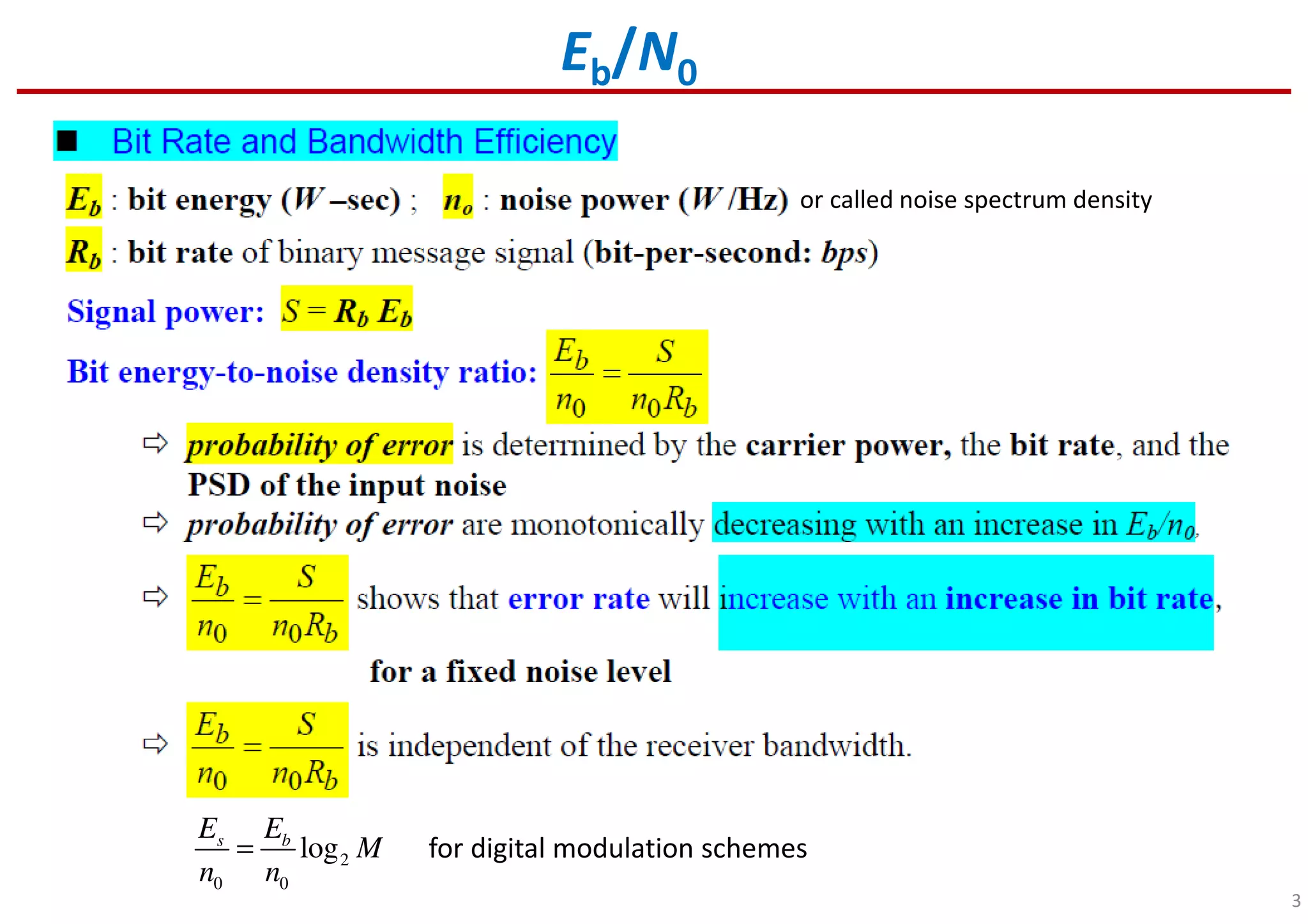
Eb/N0 summery
the energy per bit to noise power spectral density ratio, dimensionless.
It is a normalized signal-to-noise ratio (SNR) measure, also known as the "SNR per bit".
Eb/N0 directly indicates the power efficiency of the system without regard to modulation type,
error correction coding or signal bandwidth.
But when the signal bandwidth is well defined, Eb/N0 is also equal to the signal-to-noise ratio (SNR)
in that bandwidth divided by the "gross" link spectral efficiency in [bps/Hz], where the bits in this
context refer to user data bits, irrespective of error correction information and modulation type.
Eb/N0 must be used with care on interference-limited channels since additive white noise (with
constant noise density N0) is assumed, and interference is not always noise-like.
Eb/N0 SNR relation
Eb/N0 Es/N0 relation P.S. (Es/N0) energy per symbol to noise power spectral density
2
0 0
M is the # of alternative modulation symbols, e.g. M 4 for QPSK and M 64
log
for 64-QAM.
s bE E
M
n n
= =
=
https://en.wikipedia.org/wiki/Eb/N02
Eb/N0
2
0 0
logs bE E
M
n n
= for digital modulation schemes
or called noise spectrum density
3
Eb/N0
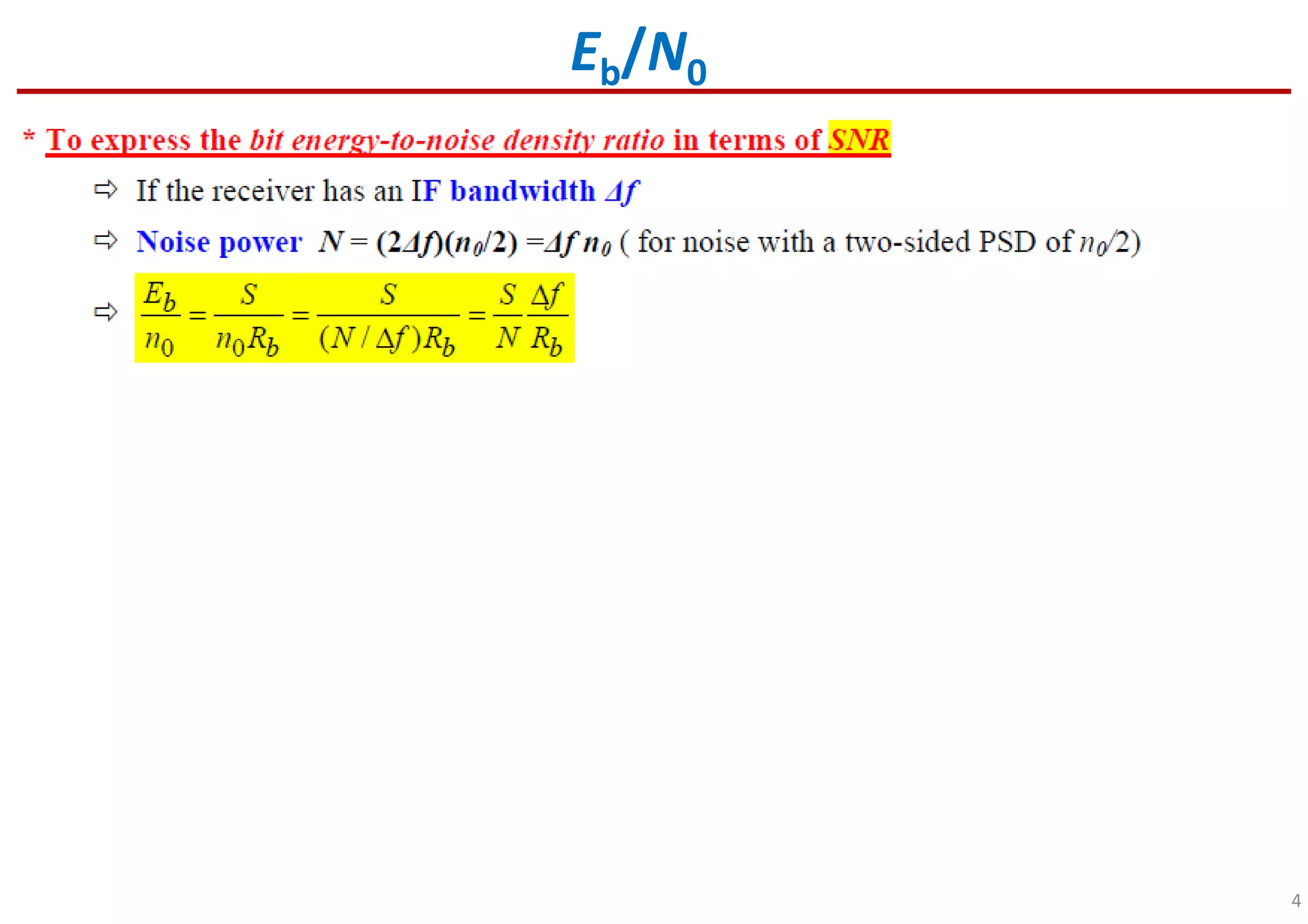
4
Relationships Among EVM, BER and SNR as Performance Metrics
2
0
2
0
M is the # of alternative modulation symbols,
e.g. M 4 for QPSK and M 64 for 64-QAM.
log in
l
above equatio
o
n.
gs bE E
M
N
L M
N
= =
=
=
For high SNR BER of M-ary QAM can be
approximated by neglecting some of the higher order terms
same
1
( )
2 2
x
Q x erfc
 
=  
 
http://ieeexplore.ieee.org/document/4178493/
http://ieeexplore.ieee.org/document/883298/
2
0 0 0
10 10 2 10 2
0 0
now , and log
or SNR [in dB] 10log 10log log 10log ( log )
in above equations.
b s b
s b
E E E
r M
N N N
E E
M r M
N N
= =
   
= = =   
   
5https://www.keysight.com/main/editorial.jspx?ckey=847674&id=847674&nid=-11143.0.00&lc=eng&cc=UG
6
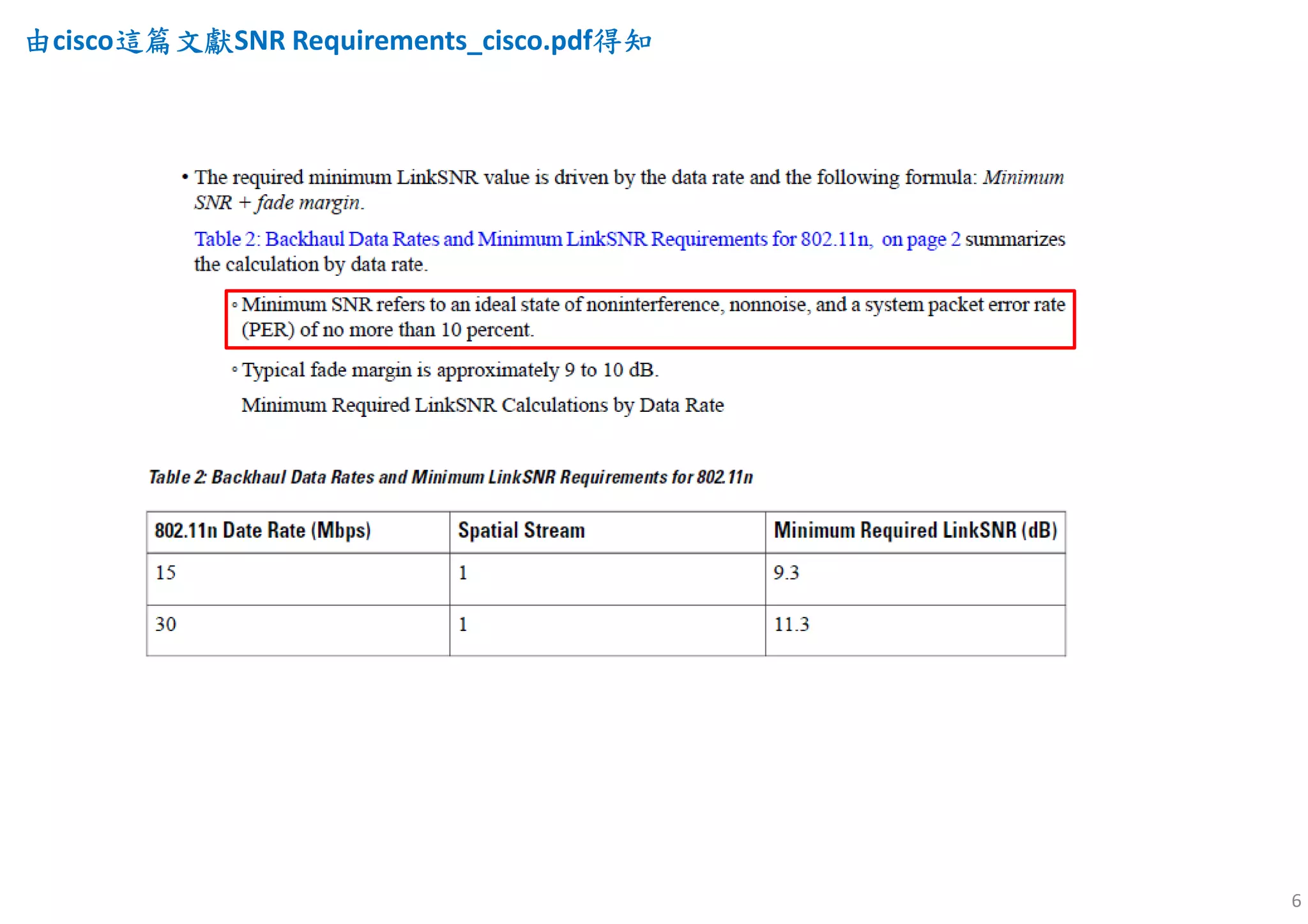
由由由由cisco這篇文獻這篇文獻這篇文獻這篇文獻SNR Requirements_cisco.pdf得知得知得知得知
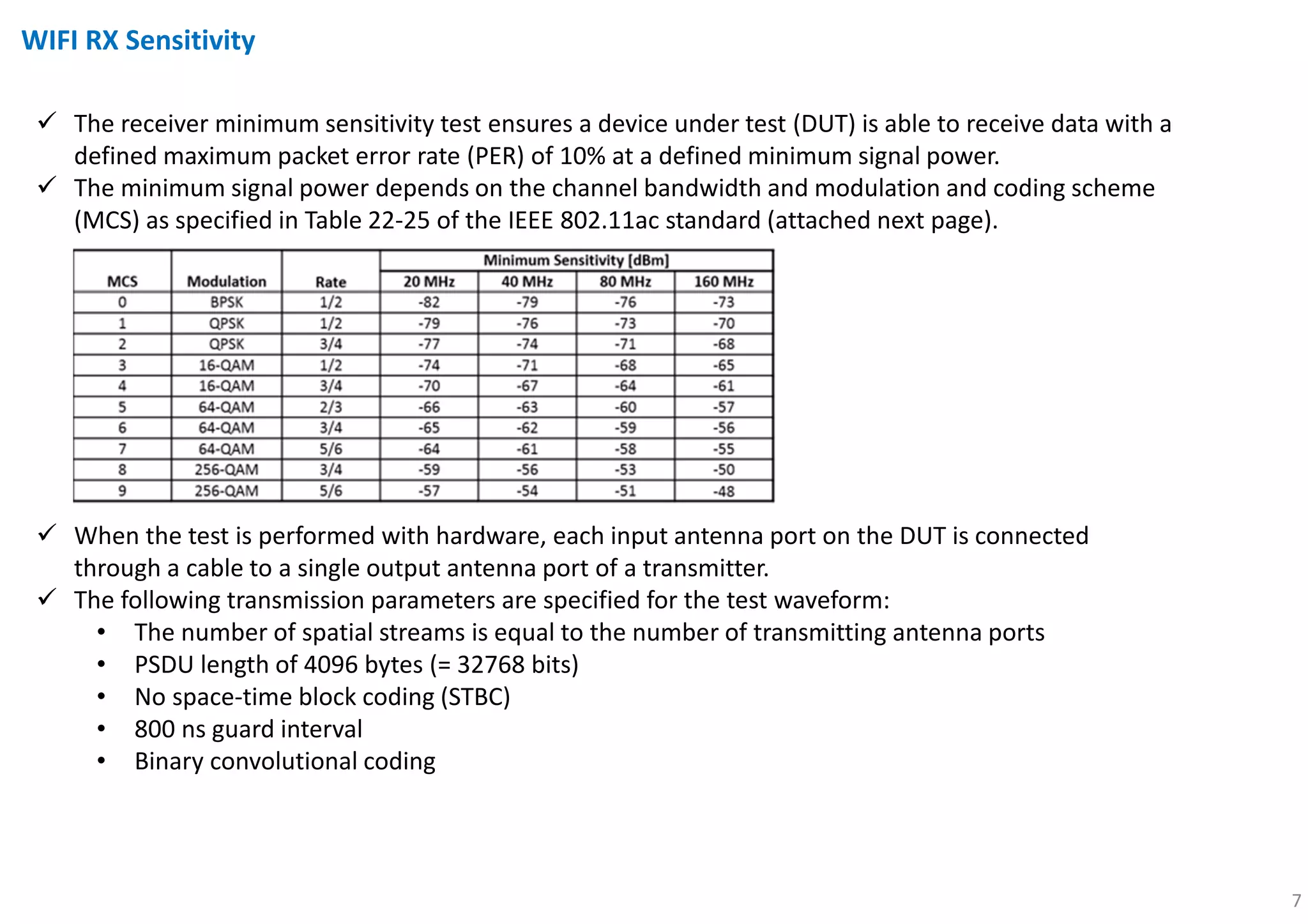
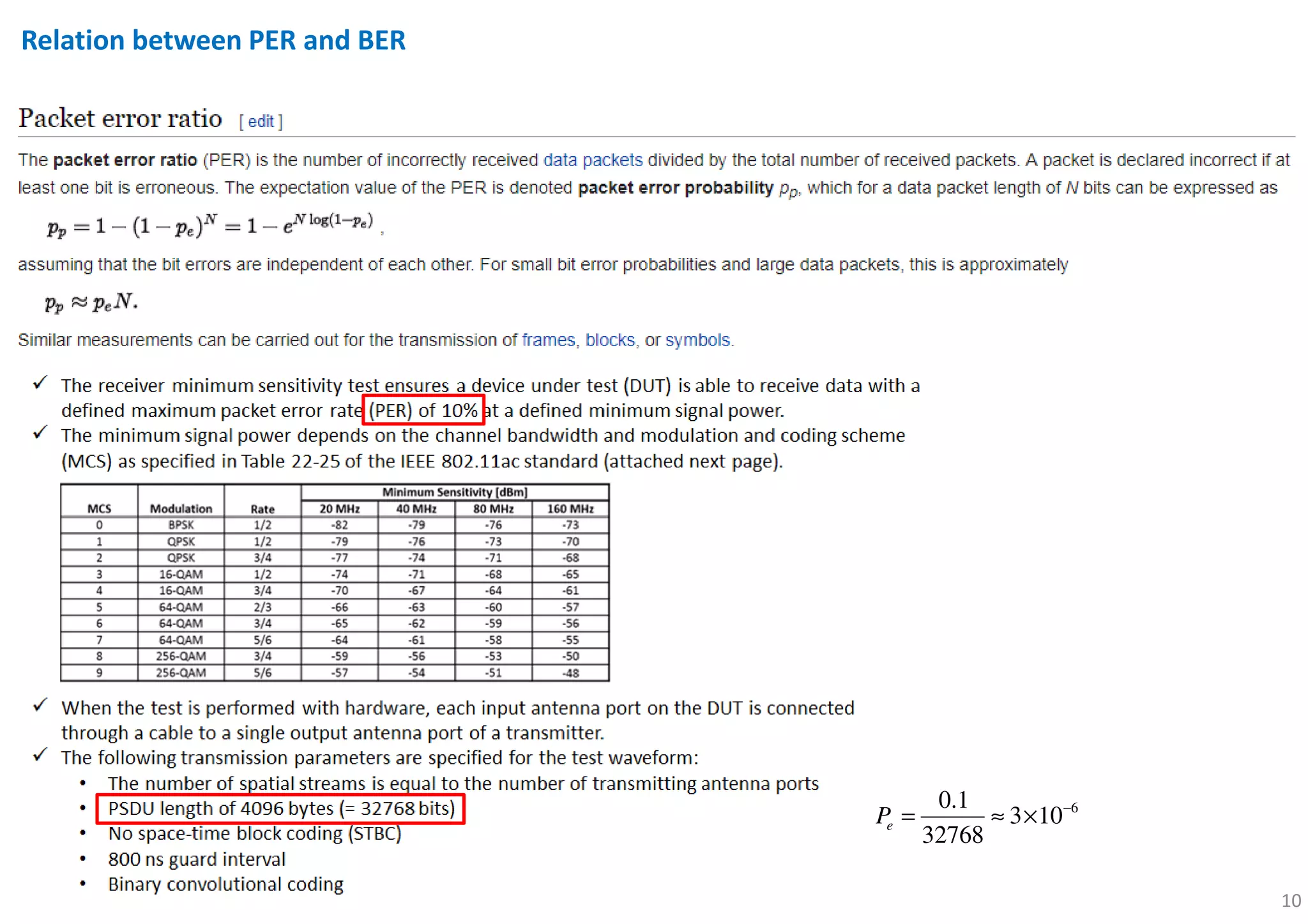
The receiver minimum sensitivity test ensures a device under test (DUT) is able to receive data with a
defined maximum packet error rate (PER) of 10% at a defined minimum signal power.
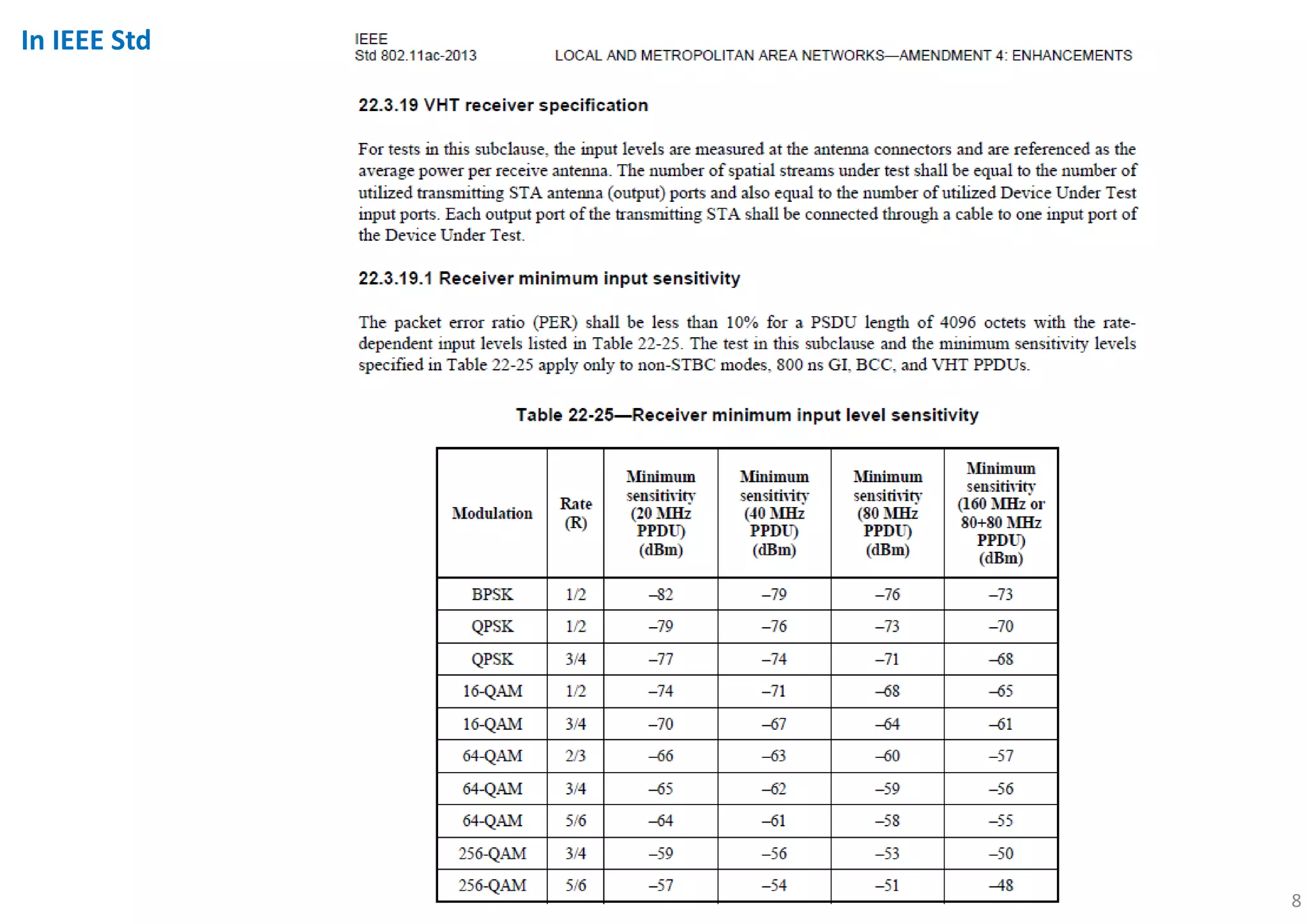
The minimum signal power depends on the channel bandwidth and modulation and coding scheme
(MCS) as specified in Table 22-25 of the IEEE 802.11ac standard (attached next page).
When the test is performed with hardware, each input antenna port on the DUT is connected
through a cable to a single output antenna port of a transmitter.
The following transmission parameters are specified for the test waveform:
• The number of spatial streams is equal to the number of transmitting antenna ports
• PSDU length of 4096 bytes (= 32768 bits)
• No space-time block coding (STBC)
• 800 ns guard interval
• Binary convolutional coding
WIFI RX Sensitivity
7
In IEEE Std
8
Error Vector Magnitude, EVM = Relative Constellation Error, RCE
SNR [in dB] EVM [in power dB]= −
RCE [in power dB]
9
Relation between PER and BER
60.1
3 10
32768
eP −
= ≈ ×
10
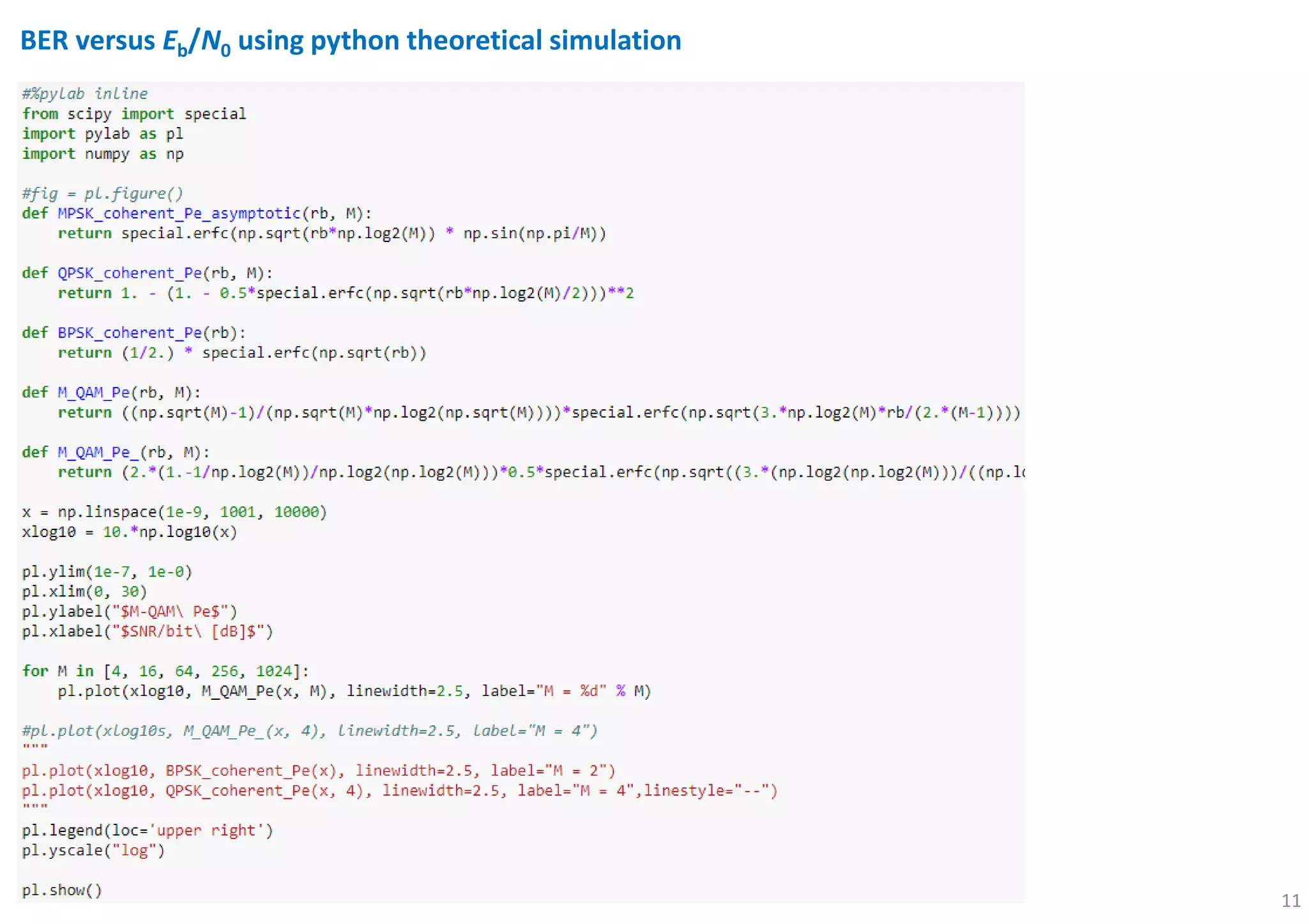
BER versus Eb/N0 using python theoretical simulation
11
60.1
3 10
32768
eP −
= ≈ ×
BER versus Eb/N0 using python compare Figure 3. in paper
http://ieeexplore.ieee.org/document/883298/
12
WIFI的SNR min =
抓上面Pe~3E-6時對
應的SNR/bit + 3-5
dB 不同coder ate的
margin.
Std 802.11ac
13
Thank you for your attention

Relationships Among EVM, BER and SNR + WiFi minimum SNR consideration

  • 1.
    1 Relationships Among EVM, BERand SNR + WiFi minimum SNR consideration Jay Chang
  • 2.
    Eb/N0 summery the energyper bit to noise power spectral density ratio, dimensionless. It is a normalized signal-to-noise ratio (SNR) measure, also known as the "SNR per bit". Eb/N0 directly indicates the power efficiency of the system without regard to modulation type, error correction coding or signal bandwidth. But when the signal bandwidth is well defined, Eb/N0 is also equal to the signal-to-noise ratio (SNR) in that bandwidth divided by the "gross" link spectral efficiency in [bps/Hz], where the bits in this context refer to user data bits, irrespective of error correction information and modulation type. Eb/N0 must be used with care on interference-limited channels since additive white noise (with constant noise density N0) is assumed, and interference is not always noise-like. Eb/N0 SNR relation Eb/N0 Es/N0 relation P.S. (Es/N0) energy per symbol to noise power spectral density 2 0 0 M is the # of alternative modulation symbols, e.g. M 4 for QPSK and M 64 log for 64-QAM. s bE E M n n = = = https://en.wikipedia.org/wiki/Eb/N02
  • 3.
    Eb/N0 2 0 0 logs bEE M n n = for digital modulation schemes or called noise spectrum density 3
  • 4.
  • 5.
    Relationships Among EVM,BER and SNR as Performance Metrics 2 0 2 0 M is the # of alternative modulation symbols, e.g. M 4 for QPSK and M 64 for 64-QAM. log in l above equatio o n. gs bE E M N L M N = = = = For high SNR BER of M-ary QAM can be approximated by neglecting some of the higher order terms same 1 ( ) 2 2 x Q x erfc   =     http://ieeexplore.ieee.org/document/4178493/ http://ieeexplore.ieee.org/document/883298/ 2 0 0 0 10 10 2 10 2 0 0 now , and log or SNR [in dB] 10log 10log log 10log ( log ) in above equations. b s b s b E E E r M N N N E E M r M N N = =     = = =        5https://www.keysight.com/main/editorial.jspx?ckey=847674&id=847674&nid=-11143.0.00&lc=eng&cc=UG
  • 6.
  • 7.
    The receiver minimumsensitivity test ensures a device under test (DUT) is able to receive data with a defined maximum packet error rate (PER) of 10% at a defined minimum signal power. The minimum signal power depends on the channel bandwidth and modulation and coding scheme (MCS) as specified in Table 22-25 of the IEEE 802.11ac standard (attached next page). When the test is performed with hardware, each input antenna port on the DUT is connected through a cable to a single output antenna port of a transmitter. The following transmission parameters are specified for the test waveform: • The number of spatial streams is equal to the number of transmitting antenna ports • PSDU length of 4096 bytes (= 32768 bits) • No space-time block coding (STBC) • 800 ns guard interval • Binary convolutional coding WIFI RX Sensitivity 7
  • 8.
  • 9.
    Error Vector Magnitude,EVM = Relative Constellation Error, RCE SNR [in dB] EVM [in power dB]= − RCE [in power dB] 9
  • 10.
    Relation between PERand BER 60.1 3 10 32768 eP − = ≈ × 10
  • 11.
    BER versus Eb/N0using python theoretical simulation 11
  • 12.
    60.1 3 10 32768 eP − =≈ × BER versus Eb/N0 using python compare Figure 3. in paper http://ieeexplore.ieee.org/document/883298/ 12 WIFI的SNR min = 抓上面Pe~3E-6時對 應的SNR/bit + 3-5 dB 不同coder ate的 margin. Std 802.11ac
  • 13.
    13 Thank you foryour attention