UNIVERSAL
VACCINATION
PROGRAMME
BY, PAAVANA
CONTENTS
 INTRODUCTION
 HISTORY
 AIMS
 OBJECTIVE
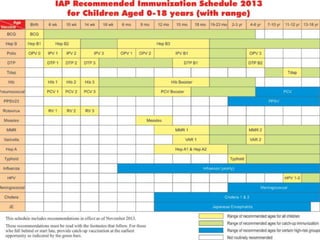
 IAP IMMUNISATION SCHEDULE
 UIP SCHEDULE FOR PREGNANT WOMEN
 VACCINATION PROGRAMME
 PROGRAMME ACHIEVEMENTS
 CONCLUSION
INTRODUCTION
 Also known as “UNIVERSAL IMMUNIZATION
PROGRAMME”
 It is a vaccine programme launched by Government of India
on November 19, 1985 as a part of Child Survival and Safe
Motherhood Programme in 1992 and is currently one of the
key areas under National Rural Health Mission(NRHM) since
2005
 The program consists of vaccination for seven diseases
which includes-
 Tuberculosis
 Diphtheria
 Pertussis (whooping cough),
 Tetanus
 Poliomyelitis
 Measles
 Hepatitis B
 On 2014 it was announced that four vaccines will be
added to the program, namely rotavirus, rubella and
Japanese encephalitis, as well as the injectable polio
vaccine
HISTORY
 It was introduced as a part of “EXPANDED
PROGRAMME ON IMMUNIZATION”(EPI) launched by
the Government of India in 1978 with the objective of
reducing mortality and morbidity resulting from vaccine
preventable diseases of childhood
 This primary health care concept was introduced in a
manner similar to that launched by World Health
Organization(WHO) In 1974
AIMS
 To achieve 100% coverage of pregnant women with
two doses of tetanus toxoid and atleast 85%
coverage of infants with 3 doses of DPT, OPV ,one
dose of BCG and measles vaccine.
OBJECTIVES
 Rapidly increase immunization coverage
 Improve the quality of services
 Establish a reliable cold chain system to the health
facility level
 Introduce a district-wise system for monitoring of
performance
 Achieve self-sufficiency in vaccine production
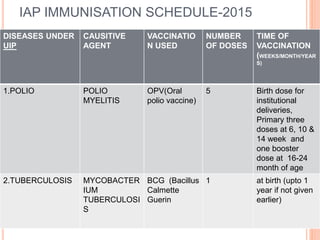
IAP IMMUNISATION SCHEDULE-2015
DISEASES UNDER
UIP
CAUSITIVE
AGENT
VACCINATIO
N USED
NUMBER
OF DOSES
TIME OF
VACCINATION
(WEEKS/MONTH/YEAR
S)
1.POLIO POLIO
MYELITIS
OPV(Oral
polio vaccine)
5 Birth dose for
institutional
deliveries,
Primary three
doses at 6, 10 &
14 week and
one booster
dose at 16-24
month of age
2.TUBERCULOSIS MYCOBACTER
IUM
TUBERCULOSI
S
BCG (Bacillus
Calmette
Guerin
1 at birth (upto 1
year if not given
earlier)
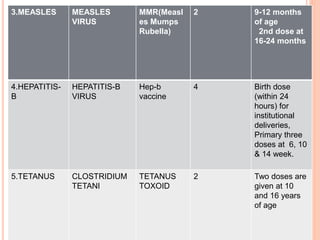
3.MEASLES MEASLES
VIRUS
MMR(Measl
es Mumps
Rubella)
2 9-12 months
of age
2nd dose at
16-24 months
4.HEPATITIS-
B
HEPATITIS-B
VIRUS
Hep-b
vaccine
4 Birth dose
(within 24
hours) for
institutional
deliveries,
Primary three
doses at 6, 10
& 14 week.
5.TETANUS CLOSTRIDIUM
TETANI
TETANUS
TOXOID
2 Two doses are
given at 10
and 16 years
of age
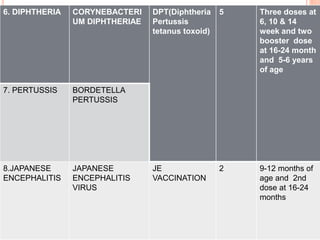
6. DIPHTHERIA CORYNEBACTERI
UM DIPHTHERIAE
DPT(Diphtheria
Pertussis
tetanus toxoid)
5 Three doses at
6, 10 & 14
week and two
booster dose
at 16-24 month
and 5-6 years
of age
7. PERTUSSIS BORDETELLA
PERTUSSIS
8.JAPANESE
ENCEPHALITIS
JAPANESE
ENCEPHALITIS
VIRUS
JE
VACCINATION
2 9-12 months of
age and 2nd
dose at 16-24
months
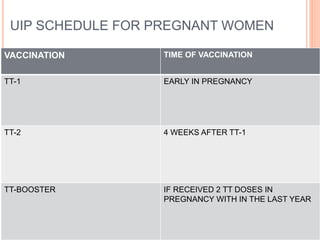
UIP SCHEDULE FOR PREGNANT WOMEN
VACCINATION TIME OF VACCINATION
TT-1 EARLY IN PREGNANCY
TT-2 4 WEEKS AFTER TT-1
TT-BOOSTER IF RECEIVED 2 TT DOSES IN
PREGNANCY WITH IN THE LAST YEAR
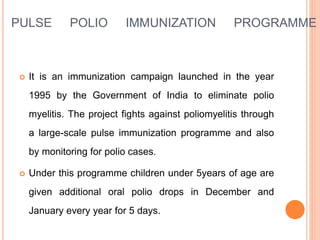
PULSE POLIO IMMUNIZATION PROGRAMME
 It is an immunization campaign launched in the year
1995 by the Government of India to eliminate polio
myelitis. The project fights against poliomyelitis through
a large-scale pulse immunization programme and also
by monitoring for polio cases.
 Under this programme children under 5years of age are
given additional oral polio drops in December and
January every year for 5 days.
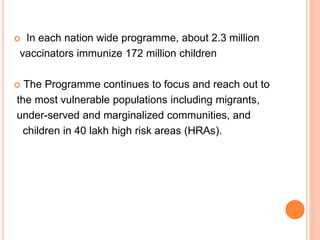
 In each nation wide programme, about 2.3 million
vaccinators immunize 172 million children
 The Programme continues to focus and reach out to
the most vulnerable populations including migrants,
under-served and marginalized communities, and
children in 40 lakh high risk areas (HRAs).
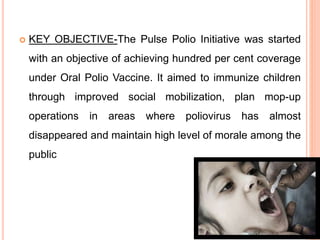
 KEY OBJECTIVE-The Pulse Polio Initiative was started
with an objective of achieving hundred per cent coverage
under Oral Polio Vaccine. It aimed to immunize children
through improved social mobilization, plan mop-up
operations in areas where poliovirus has almost
disappeared and maintain high level of morale among the
public
 STEPS UNDERTAKEN-
 Setting up of booths in all parts of the country.
 Initializing walk-in cold rooms, freezer rooms, deep
freezers, ice-lined refrigerators and cold boxes for
ensuring steady supply of vaccine to booths.
 Arranging employees, volunteers and vaccines.
 Ensuring vaccine vial monitor on each vaccine vial.
 Immunizing children with OPV on National Immunization
Days.
 Identifying missing children from immunisation process.
 Surveillance of efficacy.
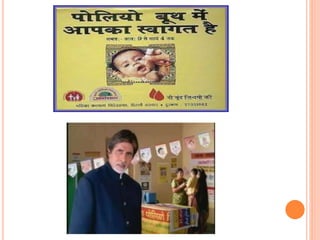
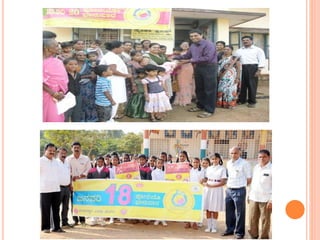
Publicity is usually extensive, and it includs replacing the
national telecoms authority ringtone with a vaccination day
awareness message, posters, TV and cinema spots,
parades, rallies, and one-to-one communication from
volunteers. Vaccination booths were set up, with a house-
to-house campaign for remote communities
 To mitigate the risk of polio virus importation through
travellers, continuous polio immunization posts have
been set up along the international borders with
Pakistan,Nepal, Bangladesh, Myanmar and Bhutan in
order to vaccinate all children upto age of 5years
crossing the border into India.
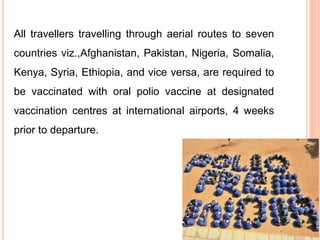
All travellers travelling through aerial routes to seven
countries viz.,Afghanistan, Pakistan, Nigeria, Somalia,
Kenya, Syria, Ethiopia, and vice versa, are required to
be vaccinated with oral polio vaccine at designated
vaccination centres at international airports, 4 weeks
prior to departure.
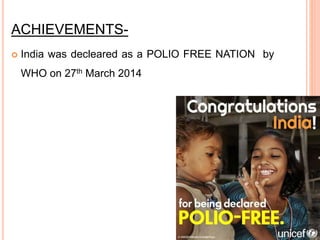
ACHIEVEMENTS-
 India was decleared as a POLIO FREE NATION by
WHO on 27th March 2014
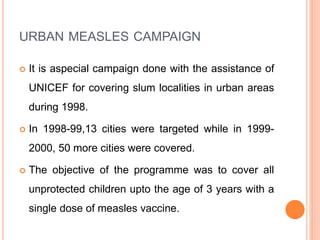
URBAN MEASLES CAMPAIGN
 It is aspecial campaign done with the assistance of
UNICEF for covering slum localities in urban areas
during 1998.
 In 1998-99,13 cities were targeted while in 1999-
2000, 50 more cities were covered.
 The objective of the programme was to cover all
unprotected children upto the age of 3 years with a
single dose of measles vaccine.
NEONATAL TETANUS ELIMINATION
 In order to achieve early elimination of neo natal
tetanus, efforts are made to cover all women in
reproductive age group with three doses of tetanus
toxoid vaccine.
 These were implemented in Rajasthan and Madhya
pradesh during 1998-99 and 1999-2000.In
Rajasthan only married women upto 30 years were
targeted.
ACHIEVEMENTS-On 15 May 2015, The World
HealthOrganization(WHO) declared India free from
maternal and neonatal tetanus.
ACHIEVEMENTS OF UNIVERSAL
IMMUNIZATION PROGRAMME
 There has been a steady reduction in the total number of
cases reported in the diseases included in this programme.
 The major achievement of this programme is the total
elimination of poliomyelitis and neonatal tetanus from the
country.
CONCLUSION
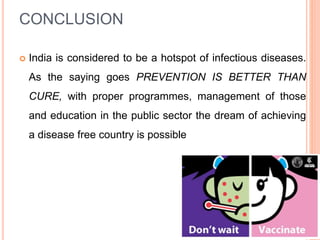
 India is considered to be a hotspot of infectious diseases.
As the saying goes PREVENTION IS BETTER THAN
CURE, with proper programmes, management of those
and education in the public sector the dream of achieving
a disease free country is possible
Universal  vaccination programme

Universal vaccination programme

  • 1.
  • 2.
    CONTENTS  INTRODUCTION  HISTORY AIMS  OBJECTIVE  IAP IMMUNISATION SCHEDULE  UIP SCHEDULE FOR PREGNANT WOMEN  VACCINATION PROGRAMME  PROGRAMME ACHIEVEMENTS  CONCLUSION
  • 3.
    INTRODUCTION  Also knownas “UNIVERSAL IMMUNIZATION PROGRAMME”  It is a vaccine programme launched by Government of India on November 19, 1985 as a part of Child Survival and Safe Motherhood Programme in 1992 and is currently one of the key areas under National Rural Health Mission(NRHM) since 2005  The program consists of vaccination for seven diseases which includes-
  • 4.
     Tuberculosis  Diphtheria Pertussis (whooping cough),  Tetanus  Poliomyelitis  Measles  Hepatitis B  On 2014 it was announced that four vaccines will be added to the program, namely rotavirus, rubella and Japanese encephalitis, as well as the injectable polio vaccine
  • 5.
    HISTORY  It wasintroduced as a part of “EXPANDED PROGRAMME ON IMMUNIZATION”(EPI) launched by the Government of India in 1978 with the objective of reducing mortality and morbidity resulting from vaccine preventable diseases of childhood  This primary health care concept was introduced in a manner similar to that launched by World Health Organization(WHO) In 1974
  • 6.
    AIMS  To achieve100% coverage of pregnant women with two doses of tetanus toxoid and atleast 85% coverage of infants with 3 doses of DPT, OPV ,one dose of BCG and measles vaccine.
  • 7.
    OBJECTIVES  Rapidly increaseimmunization coverage  Improve the quality of services  Establish a reliable cold chain system to the health facility level  Introduce a district-wise system for monitoring of performance  Achieve self-sufficiency in vaccine production
  • 9.
    IAP IMMUNISATION SCHEDULE-2015 DISEASESUNDER UIP CAUSITIVE AGENT VACCINATIO N USED NUMBER OF DOSES TIME OF VACCINATION (WEEKS/MONTH/YEAR S) 1.POLIO POLIO MYELITIS OPV(Oral polio vaccine) 5 Birth dose for institutional deliveries, Primary three doses at 6, 10 & 14 week and one booster dose at 16-24 month of age 2.TUBERCULOSIS MYCOBACTER IUM TUBERCULOSI S BCG (Bacillus Calmette Guerin 1 at birth (upto 1 year if not given earlier)
  • 10.
    3.MEASLES MEASLES VIRUS MMR(Measl es Mumps Rubella) 29-12 months of age 2nd dose at 16-24 months 4.HEPATITIS- B HEPATITIS-B VIRUS Hep-b vaccine 4 Birth dose (within 24 hours) for institutional deliveries, Primary three doses at 6, 10 & 14 week. 5.TETANUS CLOSTRIDIUM TETANI TETANUS TOXOID 2 Two doses are given at 10 and 16 years of age
  • 11.
    6. DIPHTHERIA CORYNEBACTERI UMDIPHTHERIAE DPT(Diphtheria Pertussis tetanus toxoid) 5 Three doses at 6, 10 & 14 week and two booster dose at 16-24 month and 5-6 years of age 7. PERTUSSIS BORDETELLA PERTUSSIS 8.JAPANESE ENCEPHALITIS JAPANESE ENCEPHALITIS VIRUS JE VACCINATION 2 9-12 months of age and 2nd dose at 16-24 months
  • 12.
    UIP SCHEDULE FORPREGNANT WOMEN VACCINATION TIME OF VACCINATION TT-1 EARLY IN PREGNANCY TT-2 4 WEEKS AFTER TT-1 TT-BOOSTER IF RECEIVED 2 TT DOSES IN PREGNANCY WITH IN THE LAST YEAR
  • 13.
    PULSE POLIO IMMUNIZATIONPROGRAMME  It is an immunization campaign launched in the year 1995 by the Government of India to eliminate polio myelitis. The project fights against poliomyelitis through a large-scale pulse immunization programme and also by monitoring for polio cases.  Under this programme children under 5years of age are given additional oral polio drops in December and January every year for 5 days.
  • 14.
     In eachnation wide programme, about 2.3 million vaccinators immunize 172 million children  The Programme continues to focus and reach out to the most vulnerable populations including migrants, under-served and marginalized communities, and children in 40 lakh high risk areas (HRAs).
  • 15.
     KEY OBJECTIVE-ThePulse Polio Initiative was started with an objective of achieving hundred per cent coverage under Oral Polio Vaccine. It aimed to immunize children through improved social mobilization, plan mop-up operations in areas where poliovirus has almost disappeared and maintain high level of morale among the public
  • 16.
     STEPS UNDERTAKEN- Setting up of booths in all parts of the country.  Initializing walk-in cold rooms, freezer rooms, deep freezers, ice-lined refrigerators and cold boxes for ensuring steady supply of vaccine to booths.  Arranging employees, volunteers and vaccines.  Ensuring vaccine vial monitor on each vaccine vial.  Immunizing children with OPV on National Immunization Days.
  • 17.
     Identifying missingchildren from immunisation process.  Surveillance of efficacy. Publicity is usually extensive, and it includs replacing the national telecoms authority ringtone with a vaccination day awareness message, posters, TV and cinema spots, parades, rallies, and one-to-one communication from volunteers. Vaccination booths were set up, with a house- to-house campaign for remote communities
  • 18.
     To mitigatethe risk of polio virus importation through travellers, continuous polio immunization posts have been set up along the international borders with Pakistan,Nepal, Bangladesh, Myanmar and Bhutan in order to vaccinate all children upto age of 5years crossing the border into India.
  • 19.
    All travellers travellingthrough aerial routes to seven countries viz.,Afghanistan, Pakistan, Nigeria, Somalia, Kenya, Syria, Ethiopia, and vice versa, are required to be vaccinated with oral polio vaccine at designated vaccination centres at international airports, 4 weeks prior to departure.
  • 22.
    ACHIEVEMENTS-  India wasdecleared as a POLIO FREE NATION by WHO on 27th March 2014
  • 23.
    URBAN MEASLES CAMPAIGN It is aspecial campaign done with the assistance of UNICEF for covering slum localities in urban areas during 1998.  In 1998-99,13 cities were targeted while in 1999- 2000, 50 more cities were covered.  The objective of the programme was to cover all unprotected children upto the age of 3 years with a single dose of measles vaccine.
  • 24.
    NEONATAL TETANUS ELIMINATION In order to achieve early elimination of neo natal tetanus, efforts are made to cover all women in reproductive age group with three doses of tetanus toxoid vaccine.  These were implemented in Rajasthan and Madhya pradesh during 1998-99 and 1999-2000.In Rajasthan only married women upto 30 years were targeted.
  • 25.
    ACHIEVEMENTS-On 15 May2015, The World HealthOrganization(WHO) declared India free from maternal and neonatal tetanus.
  • 26.
    ACHIEVEMENTS OF UNIVERSAL IMMUNIZATIONPROGRAMME  There has been a steady reduction in the total number of cases reported in the diseases included in this programme.  The major achievement of this programme is the total elimination of poliomyelitis and neonatal tetanus from the country.
  • 27.
    CONCLUSION  India isconsidered to be a hotspot of infectious diseases. As the saying goes PREVENTION IS BETTER THAN CURE, with proper programmes, management of those and education in the public sector the dream of achieving a disease free country is possible