Revised national Tuberculosis
Control programme (RNTCP)
Dr. Shubhangi S. Kshirsagar
Assistant professor
Department of Swasthavritta &Yoga
drssksagar@gmail.com
• National Tuberculosis Programme (NTP) launched in
1962.
• However, the treatment success rates were
unacceptably low and the death and default rates
remained high. Spread of multidrug resistant TB was
threatening to further worsen the situation.
• In view of this, in 1992 Government of India along
with WHO and SIDA reviewed the TB situation in the
country and came up with following conclusions :
✓ NTP, though technically sound, suffered from
managerial weaknesses
✓ Inadequate funding,
✓ Over-reliance on X-ray for diagnosis
✓ Frequent interrupted supplies of drugs
2
▪ 1993 - Revised National TB Control Programme
(RNTCP)
▪ Adopted the internationally recommended
Directly Observed Treatment Short-course (DOTs)
strategy
▪ 1st Jan 2020 – rename - National tuberculosis
elimination programme
3
Objective of RNTCP
▪ To achieve at least 85% cure rate of infectious
cases of tuberculosis through DOTs involving
peripheral health functionaries.
▪ To achieve case finding activities through quality
sputum microscopy to detect at least 70% of
estimated cases.
4
▪ The revised strategy was introduced in the country
in a phased manner as Pilot Phase I, Pilot Phase II
and Pilot, Phase III.
▪ By the end of 1998, only 2 per cent of the total
population of India was covered by RNTCP.
▪ Large-scale implementation began in late 1998.
▪ The RNTCP has expanded rapidly over the years
and since March 2006, it covers the whole country.
5
Components of DOTs strategy
adopted by RNTCP
1. Diagnosis by quality assured sputum smear
microscopy.
2. Adequate supply of quality assured short course
chemotherapy drugs
3. Directly observed treatment (DOTs).
4. Systemic monitoring and accountability.
5. Political will and administrative commitment
6
STOP TB strategy – announced by
WHO & adopted by RNTCP (2006)
1. Pursuing quality DOTs – expansion &
enhancement.
2. AddressingTB/HIV and MDR-TB.
3. Contributing to health system strengthening
4. Engaging all care provides.
5. Empowering patient and communities.
6. Enabling and promoting research.
7
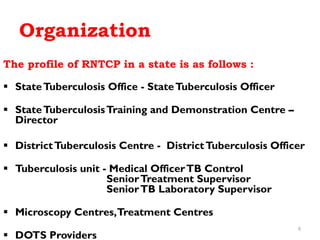
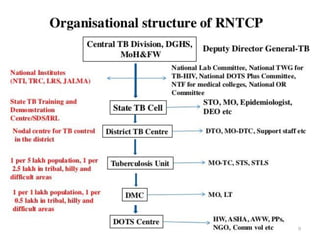
Organization
The profile of RNTCP in a state is as follows :
▪ StateTuberculosis Office - StateTuberculosis Officer
▪ StateTuberculosisTraining and Demonstration Centre –
Director
▪ DistrictTuberculosis Centre - DistrictTuberculosis Officer
▪ Tuberculosis unit - Medical OfficerTB Control
SeniorTreatment Supervisor
SeniorTB Laboratory Supervisor
▪ Microscopy Centres,Treatment Centres
▪ DOTS Providers
8
9
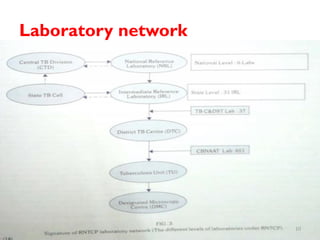
Laboratory network
10
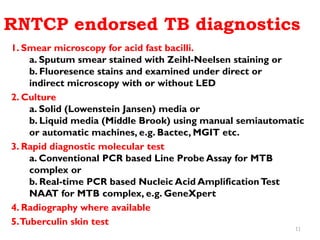
RNTCP endorsed TB diagnostics
1. Smear microscopy for acid fast bacilli.
a. Sputum smear stained with Zeihl-Neelsen staining or
b. Fluoresence stains and examined under direct or
indirect microscopy with or without LED
2. Culture
a. Solid (Lowenstein Jansen) media or
b. Liquid media (Middle Brook) using manual semiautomatic
or automatic machines, e.g. Bactec, MGIT etc.
3. Rapid diagnostic molecular test
a. Conventional PCR based Line Probe Assay for MTB
complex or
b. Real-time PCR based Nucleic Acid AmplificationTest
NAAT for MTB complex, e.g. GeneXpert
4. Radiography where available
5.Tuberculin skin test
11
12
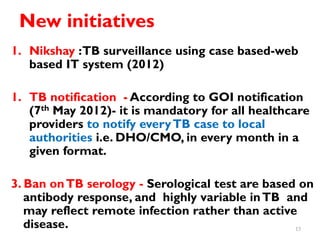
New initiatives
1. Nikshay :TB surveillance using case based-web
based IT system (2012)
1. TB notification - According to GOI notification
(7th May 2012)- it is mandatory for all healthcare
providers to notify everyTB case to local
authorities i.e. DHO/CMO, in every month in a
given format.
3. Ban onTB serology - Serological test are based on
antibody response, and highly variable inTB and
may reflect remote infection rather than active
disease. 13
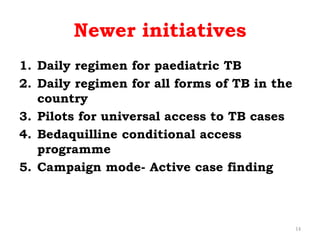
Newer initiatives
1. Daily regimen for paediatric TB
2. Daily regimen for all forms of TB in the
country
3. Pilots for universal access to TB cases
4. Bedaquilline conditional access
programme
5. Campaign mode- Active case finding
14
15
16
17
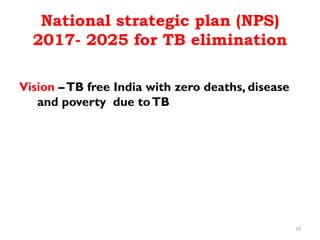
National strategic plan (NPS)
2017- 2025 for TB elimination
Vision –TB free India with zero deaths, disease
and poverty due toTB
18
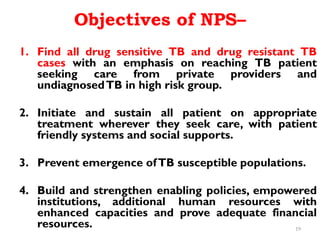
Objectives of NPS–
1. Find all drug sensitive TB and drug resistant TB
cases with an emphasis on reaching TB patient
seeking care from private providers and
undiagnosedTB in high risk group.
2. Initiate and sustain all patient on appropriate
treatment wherever they seek care, with patient
friendly systems and social supports.
3. Prevent emergence ofTB susceptible populations.
4. Build and strengthen enabling policies, empowered
institutions, additional human resources with
enhanced capacities and prove adequate financial
resources. 19
Strategies
1. Private sector engagement
2. Active case finding
3. Drug resistantTB case management
4. Addressing social determinants including
nutrition
5. Robust surveillance system
6. Community engagement and multisectoral
approach
20
Expected outcome
▪ Aim of NSP –To achieve elimination ofTB by
2025 .
▪ During plan period, targets forTB are
1. 80% reduction inTB incidence
2. 90% reduction inTB mortality
3. 0% patient having catastrophic expenditure
due toTB.
21
Thank You
22

RNTCP programme.pdf

  • 1.
    Revised national Tuberculosis Controlprogramme (RNTCP) Dr. Shubhangi S. Kshirsagar Assistant professor Department of Swasthavritta &Yoga drssksagar@gmail.com
  • 2.
    • National TuberculosisProgramme (NTP) launched in 1962. • However, the treatment success rates were unacceptably low and the death and default rates remained high. Spread of multidrug resistant TB was threatening to further worsen the situation. • In view of this, in 1992 Government of India along with WHO and SIDA reviewed the TB situation in the country and came up with following conclusions : ✓ NTP, though technically sound, suffered from managerial weaknesses ✓ Inadequate funding, ✓ Over-reliance on X-ray for diagnosis ✓ Frequent interrupted supplies of drugs 2
  • 3.
    ▪ 1993 -Revised National TB Control Programme (RNTCP) ▪ Adopted the internationally recommended Directly Observed Treatment Short-course (DOTs) strategy ▪ 1st Jan 2020 – rename - National tuberculosis elimination programme 3
  • 4.
    Objective of RNTCP ▪To achieve at least 85% cure rate of infectious cases of tuberculosis through DOTs involving peripheral health functionaries. ▪ To achieve case finding activities through quality sputum microscopy to detect at least 70% of estimated cases. 4
  • 5.
    ▪ The revisedstrategy was introduced in the country in a phased manner as Pilot Phase I, Pilot Phase II and Pilot, Phase III. ▪ By the end of 1998, only 2 per cent of the total population of India was covered by RNTCP. ▪ Large-scale implementation began in late 1998. ▪ The RNTCP has expanded rapidly over the years and since March 2006, it covers the whole country. 5
  • 6.
    Components of DOTsstrategy adopted by RNTCP 1. Diagnosis by quality assured sputum smear microscopy. 2. Adequate supply of quality assured short course chemotherapy drugs 3. Directly observed treatment (DOTs). 4. Systemic monitoring and accountability. 5. Political will and administrative commitment 6
  • 7.
    STOP TB strategy– announced by WHO & adopted by RNTCP (2006) 1. Pursuing quality DOTs – expansion & enhancement. 2. AddressingTB/HIV and MDR-TB. 3. Contributing to health system strengthening 4. Engaging all care provides. 5. Empowering patient and communities. 6. Enabling and promoting research. 7
  • 8.
    Organization The profile ofRNTCP in a state is as follows : ▪ StateTuberculosis Office - StateTuberculosis Officer ▪ StateTuberculosisTraining and Demonstration Centre – Director ▪ DistrictTuberculosis Centre - DistrictTuberculosis Officer ▪ Tuberculosis unit - Medical OfficerTB Control SeniorTreatment Supervisor SeniorTB Laboratory Supervisor ▪ Microscopy Centres,Treatment Centres ▪ DOTS Providers 8
  • 9.
  • 10.
  • 11.
    RNTCP endorsed TBdiagnostics 1. Smear microscopy for acid fast bacilli. a. Sputum smear stained with Zeihl-Neelsen staining or b. Fluoresence stains and examined under direct or indirect microscopy with or without LED 2. Culture a. Solid (Lowenstein Jansen) media or b. Liquid media (Middle Brook) using manual semiautomatic or automatic machines, e.g. Bactec, MGIT etc. 3. Rapid diagnostic molecular test a. Conventional PCR based Line Probe Assay for MTB complex or b. Real-time PCR based Nucleic Acid AmplificationTest NAAT for MTB complex, e.g. GeneXpert 4. Radiography where available 5.Tuberculin skin test 11
  • 12.
  • 13.
    New initiatives 1. Nikshay:TB surveillance using case based-web based IT system (2012) 1. TB notification - According to GOI notification (7th May 2012)- it is mandatory for all healthcare providers to notify everyTB case to local authorities i.e. DHO/CMO, in every month in a given format. 3. Ban onTB serology - Serological test are based on antibody response, and highly variable inTB and may reflect remote infection rather than active disease. 13
  • 14.
    Newer initiatives 1. Dailyregimen for paediatric TB 2. Daily regimen for all forms of TB in the country 3. Pilots for universal access to TB cases 4. Bedaquilline conditional access programme 5. Campaign mode- Active case finding 14
  • 15.
  • 16.
  • 17.
  • 18.
    National strategic plan(NPS) 2017- 2025 for TB elimination Vision –TB free India with zero deaths, disease and poverty due toTB 18
  • 19.
    Objectives of NPS– 1.Find all drug sensitive TB and drug resistant TB cases with an emphasis on reaching TB patient seeking care from private providers and undiagnosedTB in high risk group. 2. Initiate and sustain all patient on appropriate treatment wherever they seek care, with patient friendly systems and social supports. 3. Prevent emergence ofTB susceptible populations. 4. Build and strengthen enabling policies, empowered institutions, additional human resources with enhanced capacities and prove adequate financial resources. 19
  • 20.
    Strategies 1. Private sectorengagement 2. Active case finding 3. Drug resistantTB case management 4. Addressing social determinants including nutrition 5. Robust surveillance system 6. Community engagement and multisectoral approach 20
  • 21.
    Expected outcome ▪ Aimof NSP –To achieve elimination ofTB by 2025 . ▪ During plan period, targets forTB are 1. 80% reduction inTB incidence 2. 90% reduction inTB mortality 3. 0% patient having catastrophic expenditure due toTB. 21
  • 22.