Dr. Vineetha.k
Department of Public Health Dentistry
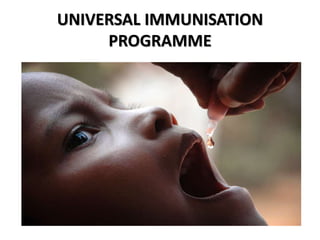
UNIVERSAL
IMMUNISATION
PROGRAMME
NATIONAL PROGRAMME
FOR CONTROL OF
BLINDNESS
“Those who would benefit most from a service
are least likely to obtain it”
NATIONAL PROGRAMME FOR
CONTROL OF BLINDNESS
CONTENTS
• INTRODUCTION
• BURDEN OF DISEASE
• THE PROGRAM
• GOALS AND OBJECTIVES
• BUDGET
• ELEVENTH FIVE YEAR PLAN
• STRATEGIES
• ACTIVITES
• ORGANIZATIONAL STRUCTURE
• EXTERNALLY AIDED PROJECTS
• RIGHT TO SIGHT
• ACHEIVEMENTS
INTRODUCTION
One of the basic human right is the right to see.
We have to ensure that no citizen goes blind
needlessly , or being blind , does not remain so,
if by reasonable deployment of skill and
resources, his eyesight can be prevented from
deterioration or if already lost can be restored.
npcb.nic.in
• BLINDNESS – Visual acquity of less than
3/60 snellan
• Avoidable blindness has been defined as
blindness that could reasonably be prevented or
cured within the limits of resources
BLINDNESS
Approximately 80% of all blindness is considered to be avoidable
WORLD
314 million - Visually impaired 45 million - Of them are
blind
• 1990- ranged from 0.08% of children to 4.4% of persons
aged over 60 years, with an overall global prevalence of
0.7%.
• 7 million people become blind each year and that the
number of blind people worldwide was increasing by 1–
2 million per year.
BURDEN OF DISEASE
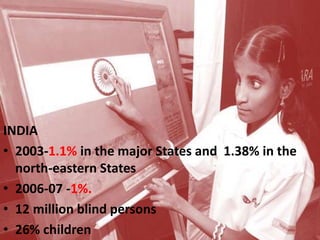
INDIA
• 2003-1.1% in the major States and 1.38% in the
north-eastern States
• 2006-07 -1%.
• 12 million blind persons
• 26% children
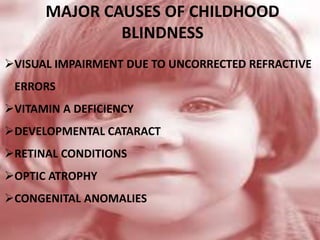
MAJOR CAUSES OF CHILDHOOD
BLINDNESS
VISUAL IMPAIRMENT DUE TO UNCORRECTED REFRACTIVE
ERRORS
VITAMIN A DEFICIENCY
DEVELOPMENTAL CATARACT
RETINAL CONDITIONS
OPTIC ATROPHY
CONGENITAL ANOMALIES
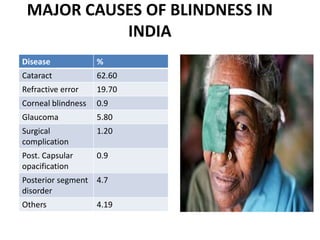
MAJOR CAUSES OF BLINDNESS IN
INDIA
Disease %
Cataract 62.60
Refractive error 19.70
Corneal blindness 0.9
Glaucoma 5.80
Surgical
complication
1.20
Post. Capsular
opacification
0.9
Posterior segment
disorder
4.7
Others 4.19
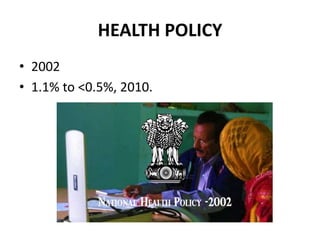
HEALTH POLICY
• 2002
• 1.1% to <0.5%, 2010.
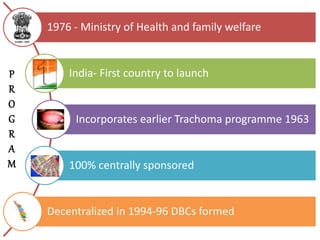
1976 - Ministry of Health and family welfare
India- First country to launch
Incorporates earlier Trachoma programme 1963
100% centrally sponsored
Decentralized in 1994-96 DBCs formed
P
R
O
G
R
A
M
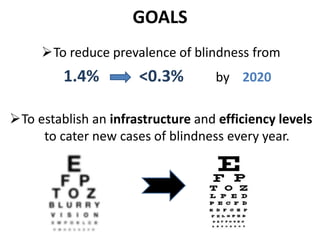
GOALS
To reduce prevalence of blindness from
1.4% <0.3% by 2020
To establish an infrastructure and efficiency levels
to cater new cases of blindness every year.
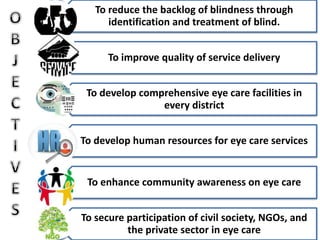
To reduce the backlog of blindness through
identification and treatment of blind.
To improve quality of service delivery
To develop comprehensive eye care facilities in
every district
To develop human resources for eye care services
To enhance community awareness on eye care
To secure participation of civil society, NGOs, and
the private sector in eye care
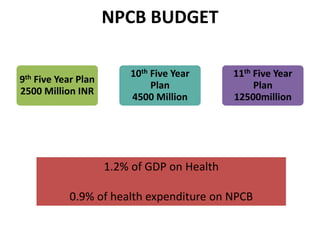
NPCB BUDGET
9th Five Year Plan
2500 Million INR
10th Five Year
Plan
4500 Million
11th Five Year
Plan
12500million
1.2% of GDP on Health
0.9% of health expenditure on NPCB
TARGETS FOR ELEVENTH FIVE YEAR
PLAN
• Prevention, control, management- diabetes retinopathy.
• Hospital based screening of glaucoma and prevention of childhood
blindness.
• Improve visual outcome of cataract surgery by IOL implantation.
• Paediatric opthalmology units.
• Vision centres in rural areas.
• Fully functional eye bank networks.
• Human resource and institutional capacity.
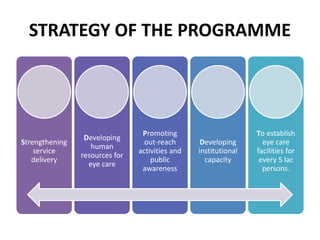
STRATEGY OF THE PROGRAMME
Strengthening
service
delivery
Developing
human
resources for
eye care
Promoting
out-reach
activities and
public
awareness
Developing
institutional
capacity
To establish
eye care
facilities for
every 5 lac
persons.
REVISED STRATEGIES
To make NPCB more comprehensive-corneal blindness,
refractive error, post op cataract, glaucoma.
To shift eye camp approach to a fixed facility surgical
approach.
To expand world bank project activities like construction of
dedicated eye operation theatres
To strengthen participation of voluntary organization in
programme.
To enhance eye care services in tribal and other under
served areas.
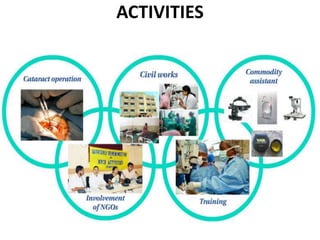
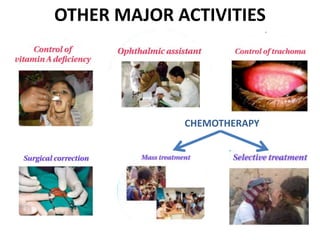
ACTIVITIES
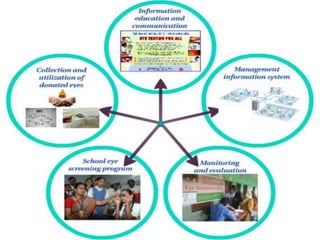
OTHER MAJOR ACTIVITIES
CHEMOTHERAPY
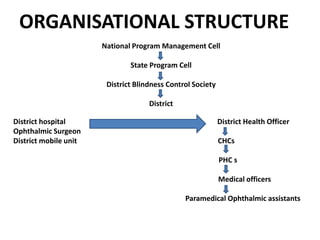
ORGANISATIONAL STRUCTURE
National Program Management Cell
State Program Cell
District Blindness Control Society
District
District hospital District Health Officer
Ophthalmic Surgeon
District mobile unit CHCs
PHC s
Medical officers
Paramedical Ophthalmic assistants
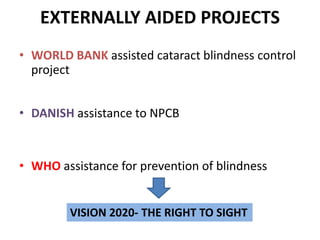
EXTERNALLY AIDED PROJECTS
• WORLD BANK assisted cataract blindness control
project
• DANISH assistance to NPCB
• WHO assistance for prevention of blindness
VISION 2020- THE RIGHT TO SIGHT
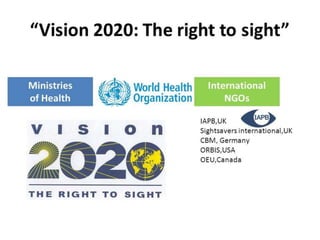
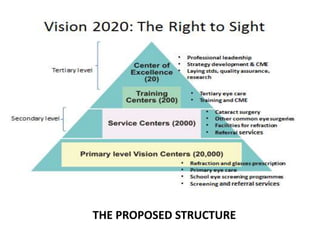
Vision 2020 : The right to sight
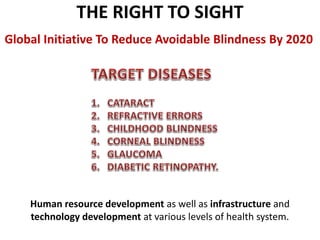
THE RIGHT TO SIGHT
Global Initiative To Reduce Avoidable Blindness By 2020
Human resource development as well as infrastructure and
technology development at various levels of health system.
THE PROPOSED STRUCTURE
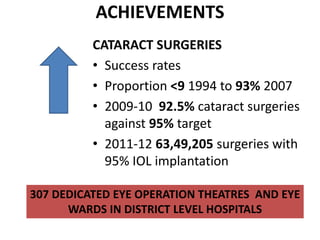
ACHIEVEMENTS
CATARACT SURGERIES
• Success rates
• Proportion <9 1994 to 93% 2007
• 2009-10 92.5% cataract surgeries
against 95% target
• 2011-12 63,49,205 surgeries with
95% IOL implantation
307 DEDICATED EYE OPERATION THEATRES AND EYE
WARDS IN DISTRICT LEVEL HOSPITALS
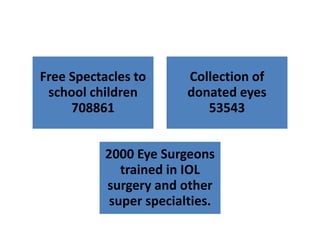
Free Spectacles to
school children
708861
Collection of
donated eyes
53543
2000 Eye Surgeons
trained in IOL
surgery and other
super specialties.
UNIVERSAL IMMUNISATION
PROGRAMME
CONTENTS
• INTRODUCTION
• EVOLUTION
• OBJECTIVES
• VACCINES UNDER UIP
• IMMUNIZATION SCHEDULE
• VACCINATION PROGRAMMES
• PROGRAMME ACHEIVEMENTS
INTRODUCTION
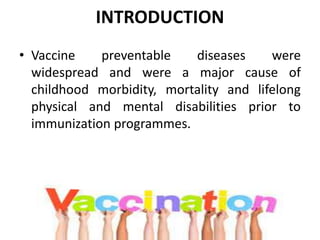
• Vaccine preventable diseases were
widespread and were a major cause of
childhood morbidity, mortality and lifelong
physical and mental disabilities prior to
immunization programmes.
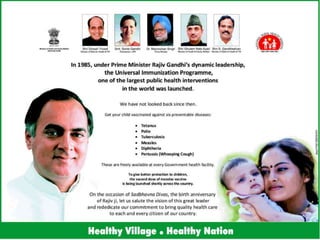
UNIVERSAL IMMUNIZATION PROGRAM
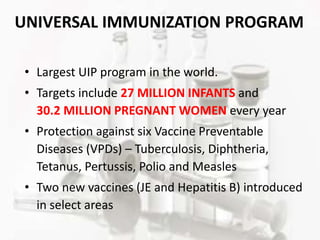
• Largest UIP program in the world.
• Targets include 27 MILLION INFANTS and
30.2 MILLION PREGNANT WOMEN every year
• Protection against six Vaccine Preventable
Diseases (VPDs) – Tuberculosis, Diphtheria,
Tetanus, Pertussis, Polio and Measles
• Two new vaccines (JE and Hepatitis B) introduced
in select areas
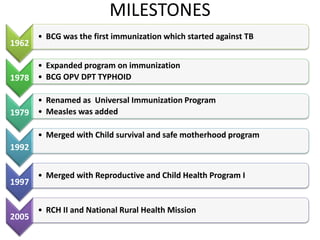
MILESTONES
1962
• BCG was the first immunization which started against TB
1978
• Expanded program on immunization
• BCG OPV DPT TYPHOID
1979
• Renamed as Universal Immunization Program
• Measles was added
1992
• Merged with Child survival and safe motherhood program
1997
• Merged with Reproductive and Child Health Program I
2005
• RCH II and National Rural Health Mission
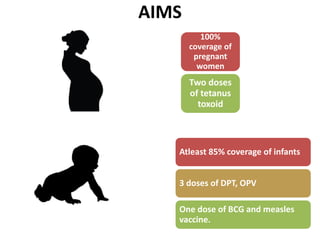
AIMS
100%
coverage of
pregnant
women
Two doses
of tetanus
toxoid
Atleast 85% coverage of infants
3 doses of DPT, OPV
One dose of BCG and measles
vaccine.
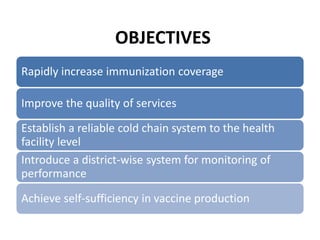
OBJECTIVES
Rapidly increase immunization coverage
Improve the quality of services
Establish a reliable cold chain system to the health
facility level
Introduce a district-wise system for monitoring of
performance
Achieve self-sufficiency in vaccine production
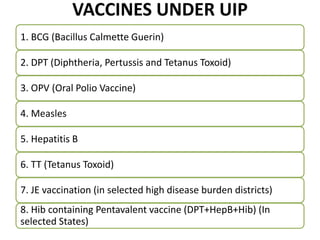
VACCINES UNDER UIP
1. BCG (Bacillus Calmette Guerin)
2. DPT (Diphtheria, Pertussis and Tetanus Toxoid)
3. OPV (Oral Polio Vaccine)
4. Measles
5. Hepatitis B
6. TT (Tetanus Toxoid)
7. JE vaccination (in selected high disease burden districts)
8. Hib containing Pentavalent vaccine (DPT+HepB+Hib) (In
selected States)
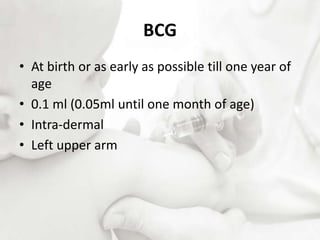
BCG
• At birth or as early as possible till one year of
age
• 0.1 ml (0.05ml until one month of age)
• Intra-dermal
• Left upper arm
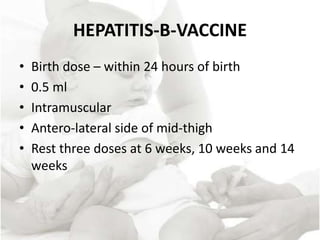
HEPATITIS-B-VACCINE
• Birth dose – within 24 hours of birth
• 0.5 ml
• Intramuscular
• Antero-lateral side of mid-thigh
• Rest three doses at 6 weeks, 10 weeks and 14
weeks
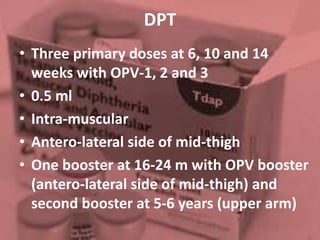
DPT
• Three primary doses at 6, 10 and 14
weeks with OPV-1, 2 and 3
• 0.5 ml
• Intra-muscular
• Antero-lateral side of mid-thigh
• One booster at 16-24 m with OPV booster
(antero-lateral side of mid-thigh) and
second booster at 5-6 years (upper arm)
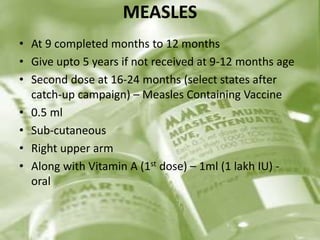
MEASLES
• At 9 completed months to 12 months
• Give upto 5 years if not received at 9-12 months age
• Second dose at 16-24 months (select states after
catch-up campaign) – Measles Containing Vaccine
• 0.5 ml
• Sub-cutaneous
• Right upper arm
• Along with Vitamin A (1st dose) – 1ml (1 lakh IU) -
oral
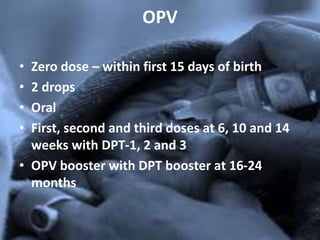
OPV
• Zero dose – within first 15 days of birth
• 2 drops
• Oral
• First, second and third doses at 6, 10 and 14
weeks with DPT-1, 2 and 3
• OPV booster with DPT booster at 16-24
months
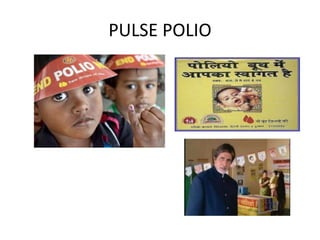
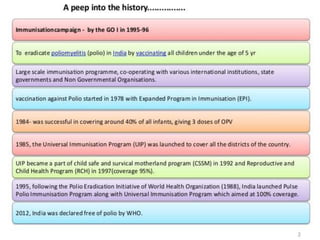
PULSE POLIO
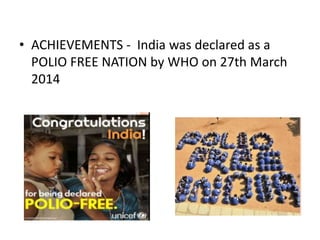
• ACHIEVEMENTS - India was declared as a
POLIO FREE NATION by WHO on 27th March
2014
TETANUS TOXOID
• Intramuscular – upper arm – 0.5 ml
• Pregnancy – 2 doses - 1st dose as early as possible
and second dose after 4 weeks of first dose and
before 36 weeks of pregnancy
• Pregnancy – booster dose (before 36 weeks of pregnancy) – If
received 2 TT doses in a pregnancy within last three
years. Give TT to woman in labour, if she has not
received TT previously
• TT booster for both boys and girls at 10 years and 16
years
• No TT required between two doses in case of injury
VITAMIN A
• 1st dose – 1 ml (1 IU) - along-with Measles
first dose - Oral
• Subsequent 8 doses (2 ml or 2 lakh IU) every
six months till 5 years of age starting with
DPT first booster at 16-24 months
• Use only plastic spoon provided with Vitamin
A solution
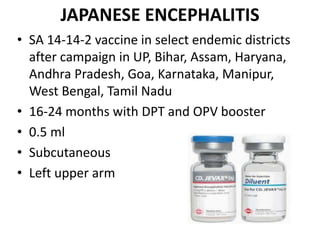
JAPANESE ENCEPHALITIS
• SA 14-14-2 vaccine in select endemic districts
after campaign in UP, Bihar, Assam, Haryana,
Andhra Pradesh, Goa, Karnataka, Manipur,
West Bengal, Tamil Nadu
• 16-24 months with DPT and OPV booster
• 0.5 ml
• Subcutaneous
• Left upper arm
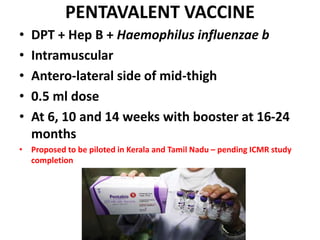
PENTAVALENT VACCINE
• DPT + Hep B + Haemophilus influenzae b
• Intramuscular
• Antero-lateral side of mid-thigh
• 0.5 ml dose
• At 6, 10 and 14 weeks with booster at 16-24
months
• Proposed to be piloted in Kerala and Tamil Nadu – pending ICMR study
completion
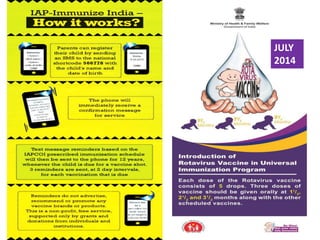
JULY
2014
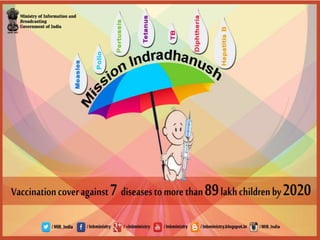
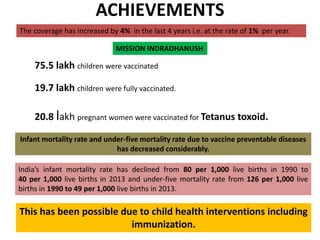
The coverage has increased by 4% in the last 4 years i.e. at the rate of 1% per year.
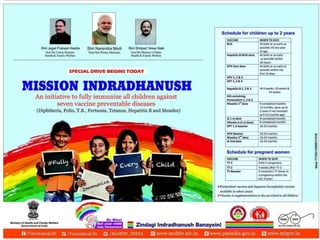
MISSION INDRADHANUSH
75.5 lakh children were vaccinated
19.7 lakh children were fully vaccinated.
20.8 lakh pregnant women were vaccinated for Tetanus toxoid.
Infant mortality rate and under-five mortality rate due to vaccine preventable diseases
has decreased considerably.
ACHIEVEMENTS
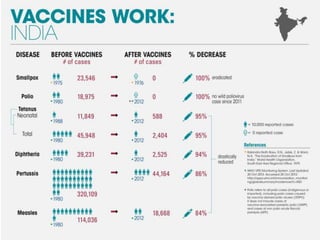
India’s infant mortality rate has declined from 80 per 1,000 live births in 1990 to
40 per 1,000 live births in 2013 and under-five mortality rate from 126 per 1,000 live
births in 1990 to 49 per 1,000 live births in 2013.
This has been possible due to child health interventions including
immunization.
REFERENCES
1)Park K. Park’s Textbook of Preventive and Social Medicine. 23rd ed.
Jabalpur: Bhanot; 2016: 439 – 444
2)Kishore J. National Programs of India. 9th ed. New Delhi: Century
Publications; 2011.
3)Ministry of Health and Family Welfare, Government of India.Universal
immunization programme.
www.mohfw.nic.in/WriteReadData/l892s/Immunization_UIP.pdf Accessed on
July 23rd, 2016.
4)Ministry of Health and Family Welfare, Government of India. National
programme for control of blindness.
http://npcb.nic.in/index1.asp?linkid=29&langid=1
Accessed on July 23rd, 2016.
5) Verma R, Khanna P, Prinja S, Rajput M, Arora V. The National Programme
for Control of Blindness in India. The Australasian Medical Journal.
2011;4(1):1-3. doi:10.4066/AMJ.2011.505.
THANK YOU

National health programmes
  • 1.
    Dr. Vineetha.k Department ofPublic Health Dentistry UNIVERSAL IMMUNISATION PROGRAMME NATIONAL PROGRAMME FOR CONTROL OF BLINDNESS
  • 2.
    “Those who wouldbenefit most from a service are least likely to obtain it”
  • 3.
  • 4.
    CONTENTS • INTRODUCTION • BURDENOF DISEASE • THE PROGRAM • GOALS AND OBJECTIVES • BUDGET • ELEVENTH FIVE YEAR PLAN • STRATEGIES • ACTIVITES • ORGANIZATIONAL STRUCTURE • EXTERNALLY AIDED PROJECTS • RIGHT TO SIGHT • ACHEIVEMENTS
  • 5.
    INTRODUCTION One of thebasic human right is the right to see. We have to ensure that no citizen goes blind needlessly , or being blind , does not remain so, if by reasonable deployment of skill and resources, his eyesight can be prevented from deterioration or if already lost can be restored. npcb.nic.in
  • 6.
    • BLINDNESS –Visual acquity of less than 3/60 snellan • Avoidable blindness has been defined as blindness that could reasonably be prevented or cured within the limits of resources BLINDNESS Approximately 80% of all blindness is considered to be avoidable
  • 7.
    WORLD 314 million -Visually impaired 45 million - Of them are blind • 1990- ranged from 0.08% of children to 4.4% of persons aged over 60 years, with an overall global prevalence of 0.7%. • 7 million people become blind each year and that the number of blind people worldwide was increasing by 1– 2 million per year. BURDEN OF DISEASE
  • 8.
    INDIA • 2003-1.1% inthe major States and 1.38% in the north-eastern States • 2006-07 -1%. • 12 million blind persons • 26% children
  • 9.
    MAJOR CAUSES OFCHILDHOOD BLINDNESS VISUAL IMPAIRMENT DUE TO UNCORRECTED REFRACTIVE ERRORS VITAMIN A DEFICIENCY DEVELOPMENTAL CATARACT RETINAL CONDITIONS OPTIC ATROPHY CONGENITAL ANOMALIES
  • 10.
    MAJOR CAUSES OFBLINDNESS IN INDIA Disease % Cataract 62.60 Refractive error 19.70 Corneal blindness 0.9 Glaucoma 5.80 Surgical complication 1.20 Post. Capsular opacification 0.9 Posterior segment disorder 4.7 Others 4.19
  • 11.
    HEALTH POLICY • 2002 •1.1% to <0.5%, 2010.
  • 12.
    1976 - Ministryof Health and family welfare India- First country to launch Incorporates earlier Trachoma programme 1963 100% centrally sponsored Decentralized in 1994-96 DBCs formed P R O G R A M
  • 13.
    GOALS To reduce prevalenceof blindness from 1.4% <0.3% by 2020 To establish an infrastructure and efficiency levels to cater new cases of blindness every year.
  • 14.
    To reduce thebacklog of blindness through identification and treatment of blind. To improve quality of service delivery To develop comprehensive eye care facilities in every district To develop human resources for eye care services To enhance community awareness on eye care To secure participation of civil society, NGOs, and the private sector in eye care
  • 15.
    NPCB BUDGET 9th FiveYear Plan 2500 Million INR 10th Five Year Plan 4500 Million 11th Five Year Plan 12500million 1.2% of GDP on Health 0.9% of health expenditure on NPCB
  • 16.
    TARGETS FOR ELEVENTHFIVE YEAR PLAN • Prevention, control, management- diabetes retinopathy. • Hospital based screening of glaucoma and prevention of childhood blindness. • Improve visual outcome of cataract surgery by IOL implantation. • Paediatric opthalmology units. • Vision centres in rural areas. • Fully functional eye bank networks. • Human resource and institutional capacity.
  • 17.
    STRATEGY OF THEPROGRAMME Strengthening service delivery Developing human resources for eye care Promoting out-reach activities and public awareness Developing institutional capacity To establish eye care facilities for every 5 lac persons.
  • 18.
    REVISED STRATEGIES To makeNPCB more comprehensive-corneal blindness, refractive error, post op cataract, glaucoma. To shift eye camp approach to a fixed facility surgical approach. To expand world bank project activities like construction of dedicated eye operation theatres To strengthen participation of voluntary organization in programme. To enhance eye care services in tribal and other under served areas.
  • 19.
  • 21.
  • 22.
    ORGANISATIONAL STRUCTURE National ProgramManagement Cell State Program Cell District Blindness Control Society District District hospital District Health Officer Ophthalmic Surgeon District mobile unit CHCs PHC s Medical officers Paramedical Ophthalmic assistants
  • 23.
    EXTERNALLY AIDED PROJECTS •WORLD BANK assisted cataract blindness control project • DANISH assistance to NPCB • WHO assistance for prevention of blindness VISION 2020- THE RIGHT TO SIGHT
  • 24.
    Vision 2020 :The right to sight
  • 25.
    THE RIGHT TOSIGHT Global Initiative To Reduce Avoidable Blindness By 2020 Human resource development as well as infrastructure and technology development at various levels of health system.
  • 26.
  • 27.
    ACHIEVEMENTS CATARACT SURGERIES • Successrates • Proportion <9 1994 to 93% 2007 • 2009-10 92.5% cataract surgeries against 95% target • 2011-12 63,49,205 surgeries with 95% IOL implantation 307 DEDICATED EYE OPERATION THEATRES AND EYE WARDS IN DISTRICT LEVEL HOSPITALS
  • 28.
    Free Spectacles to schoolchildren 708861 Collection of donated eyes 53543 2000 Eye Surgeons trained in IOL surgery and other super specialties.
  • 29.
  • 30.
    CONTENTS • INTRODUCTION • EVOLUTION •OBJECTIVES • VACCINES UNDER UIP • IMMUNIZATION SCHEDULE • VACCINATION PROGRAMMES • PROGRAMME ACHEIVEMENTS
  • 31.
    INTRODUCTION • Vaccine preventablediseases were widespread and were a major cause of childhood morbidity, mortality and lifelong physical and mental disabilities prior to immunization programmes.
  • 32.
    UNIVERSAL IMMUNIZATION PROGRAM •Largest UIP program in the world. • Targets include 27 MILLION INFANTS and 30.2 MILLION PREGNANT WOMEN every year • Protection against six Vaccine Preventable Diseases (VPDs) – Tuberculosis, Diphtheria, Tetanus, Pertussis, Polio and Measles • Two new vaccines (JE and Hepatitis B) introduced in select areas
  • 33.
    MILESTONES 1962 • BCG wasthe first immunization which started against TB 1978 • Expanded program on immunization • BCG OPV DPT TYPHOID 1979 • Renamed as Universal Immunization Program • Measles was added 1992 • Merged with Child survival and safe motherhood program 1997 • Merged with Reproductive and Child Health Program I 2005 • RCH II and National Rural Health Mission
  • 34.
    AIMS 100% coverage of pregnant women Two doses oftetanus toxoid Atleast 85% coverage of infants 3 doses of DPT, OPV One dose of BCG and measles vaccine.
  • 35.
    OBJECTIVES Rapidly increase immunizationcoverage Improve the quality of services Establish a reliable cold chain system to the health facility level Introduce a district-wise system for monitoring of performance Achieve self-sufficiency in vaccine production
  • 36.
    VACCINES UNDER UIP 1.BCG (Bacillus Calmette Guerin) 2. DPT (Diphtheria, Pertussis and Tetanus Toxoid) 3. OPV (Oral Polio Vaccine) 4. Measles 5. Hepatitis B 6. TT (Tetanus Toxoid) 7. JE vaccination (in selected high disease burden districts) 8. Hib containing Pentavalent vaccine (DPT+HepB+Hib) (In selected States)
  • 38.
    BCG • At birthor as early as possible till one year of age • 0.1 ml (0.05ml until one month of age) • Intra-dermal • Left upper arm
  • 39.
    HEPATITIS-B-VACCINE • Birth dose– within 24 hours of birth • 0.5 ml • Intramuscular • Antero-lateral side of mid-thigh • Rest three doses at 6 weeks, 10 weeks and 14 weeks
  • 40.
    DPT • Three primarydoses at 6, 10 and 14 weeks with OPV-1, 2 and 3 • 0.5 ml • Intra-muscular • Antero-lateral side of mid-thigh • One booster at 16-24 m with OPV booster (antero-lateral side of mid-thigh) and second booster at 5-6 years (upper arm)
  • 41.
    MEASLES • At 9completed months to 12 months • Give upto 5 years if not received at 9-12 months age • Second dose at 16-24 months (select states after catch-up campaign) – Measles Containing Vaccine • 0.5 ml • Sub-cutaneous • Right upper arm • Along with Vitamin A (1st dose) – 1ml (1 lakh IU) - oral
  • 42.
    OPV • Zero dose– within first 15 days of birth • 2 drops • Oral • First, second and third doses at 6, 10 and 14 weeks with DPT-1, 2 and 3 • OPV booster with DPT booster at 16-24 months
  • 43.
  • 45.
    • ACHIEVEMENTS -India was declared as a POLIO FREE NATION by WHO on 27th March 2014
  • 46.
    TETANUS TOXOID • Intramuscular– upper arm – 0.5 ml • Pregnancy – 2 doses - 1st dose as early as possible and second dose after 4 weeks of first dose and before 36 weeks of pregnancy • Pregnancy – booster dose (before 36 weeks of pregnancy) – If received 2 TT doses in a pregnancy within last three years. Give TT to woman in labour, if she has not received TT previously • TT booster for both boys and girls at 10 years and 16 years • No TT required between two doses in case of injury
  • 47.
    VITAMIN A • 1stdose – 1 ml (1 IU) - along-with Measles first dose - Oral • Subsequent 8 doses (2 ml or 2 lakh IU) every six months till 5 years of age starting with DPT first booster at 16-24 months • Use only plastic spoon provided with Vitamin A solution
  • 48.
    JAPANESE ENCEPHALITIS • SA14-14-2 vaccine in select endemic districts after campaign in UP, Bihar, Assam, Haryana, Andhra Pradesh, Goa, Karnataka, Manipur, West Bengal, Tamil Nadu • 16-24 months with DPT and OPV booster • 0.5 ml • Subcutaneous • Left upper arm
  • 49.
    PENTAVALENT VACCINE • DPT+ Hep B + Haemophilus influenzae b • Intramuscular • Antero-lateral side of mid-thigh • 0.5 ml dose • At 6, 10 and 14 weeks with booster at 16-24 months • Proposed to be piloted in Kerala and Tamil Nadu – pending ICMR study completion
  • 53.
  • 54.
    The coverage hasincreased by 4% in the last 4 years i.e. at the rate of 1% per year. MISSION INDRADHANUSH 75.5 lakh children were vaccinated 19.7 lakh children were fully vaccinated. 20.8 lakh pregnant women were vaccinated for Tetanus toxoid. Infant mortality rate and under-five mortality rate due to vaccine preventable diseases has decreased considerably. ACHIEVEMENTS India’s infant mortality rate has declined from 80 per 1,000 live births in 1990 to 40 per 1,000 live births in 2013 and under-five mortality rate from 126 per 1,000 live births in 1990 to 49 per 1,000 live births in 2013. This has been possible due to child health interventions including immunization.
  • 56.
    REFERENCES 1)Park K. Park’sTextbook of Preventive and Social Medicine. 23rd ed. Jabalpur: Bhanot; 2016: 439 – 444 2)Kishore J. National Programs of India. 9th ed. New Delhi: Century Publications; 2011. 3)Ministry of Health and Family Welfare, Government of India.Universal immunization programme. www.mohfw.nic.in/WriteReadData/l892s/Immunization_UIP.pdf Accessed on July 23rd, 2016. 4)Ministry of Health and Family Welfare, Government of India. National programme for control of blindness. http://npcb.nic.in/index1.asp?linkid=29&langid=1 Accessed on July 23rd, 2016. 5) Verma R, Khanna P, Prinja S, Rajput M, Arora V. The National Programme for Control of Blindness in India. The Australasian Medical Journal. 2011;4(1):1-3. doi:10.4066/AMJ.2011.505.
  • 57.