Immunization
PRESENTED BY:
SONALI
M.SC. (NSG.) 1ST
YEAR
CON, AIIMS NEW DELHI
OBJECTIVES
At the end of the session, you will be able to:
• Define immunization
• Explain in brief the history of immunization in India
• Discuss about immunity and types of immunizing agents
• Enlist the types of vaccines
• Discuss national immunization schedule
• Enlist new vaccines
• Explain importance of immunization
• Explain in brief about pulse polio programme in India
INTRODUCTION
• Immunization is the process of making a person
immune or resistant to an infectious disease. It is
one of the most effective ways to protect
yourself and your community from serious
illnesses.
• The immune system is designed to recognize and
fight off foreign invaders, such as viruses and
bacteria. Immunization works by introducing a
small amount of a weakened or dead virus or
bacteria into the body, which triggers the
immune system to produce antibodies. These
antibodies help the body fight off the real virus
or bacteria if it is encountered in the future.
INTRODUCTION
• Immunization is a proven tool for controlling
and eliminating life-threatening infectious
diseases and is estimated to avert between 2
and 3 million deaths each year.
• India’s UIP provide free vaccines against 11 life
threatening diseases - Tuberculosis, Diphtheria,
Pertussis, Tetanus, Polio, Hepatitis B, Pneumonia
and Meningitis due to Haemophilus Influenzae
type b (Hib), Measles, Rubella, Japanese
Encephalitis (JE) and Rotavirus diarrhoea.
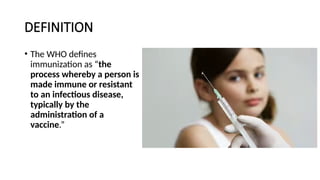
DEFINITION
• The WHO defines
immunization as “the
process whereby a person is
made immune or resistant
to an infectious disease,
typically by the
administration of a
vaccine.”
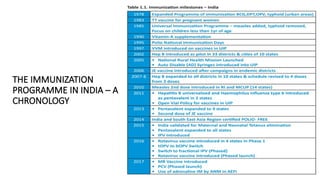
THE IMMUNIZATION
PROGRAMME IN INDIA – A
CHRONOLOGY
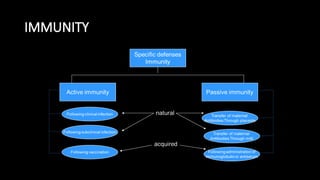
IMMUNITY
IMMUNITY
Active immunity
• Resistance developed in
response to stimulus by an
antigen (infecting agent or
vaccine) and is characterized by
the production of antibodies by
the host.
Passive immunity
• Immunity conferred by an
antibody produced in another
host. It may be acquired
naturally or artificially (through
an antibody-containing
preparation).
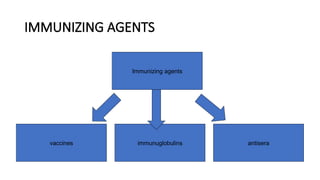
IMMUNIZING AGENTS
Immunizing agents
antisera
immunuglobulins
vaccines
IMMUNOGLOBULINS
• There are 5 major classes: IgM, IgA, IgG, IgE, IgD.
• Two types of immunoglobulin preparations are available for passive
immunization:
• Normal human immunoglobulin
• Specific (hyper-immune) human immunoglobulin
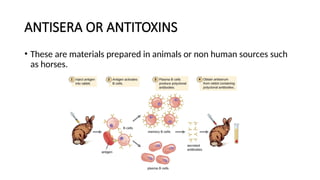
ANTISERA OR ANTITOXINS
• These are materials prepared in animals or non human sources such
as horses.
TYPES OF VACCINES
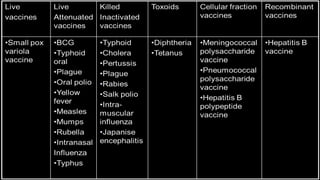
• There are several types of vaccines, including
live attenuated vaccines, inactivated vaccines,
subunit, recombinant, and conjugate vaccines,
toxoid vaccines, and DNA vaccines.
• Live attenuated vaccines contain a weakened
form of the virus or bacteria, while inactivated
vaccines contain a dead version of the virus or
bacteria. Subunit, recombinant, and conjugate
vaccines use pieces of the virus or bacteria to
trigger an immune response. Toxoid vaccines
use a toxin produced by the bacteria to create
immunity. DNA vaccines use genetic material
from the virus or bacteria to stimulate the
immune system.
SCHEME OF IMMUNIZATION
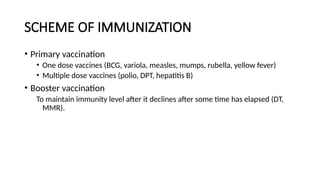
• Primary vaccination
• One dose vaccines (BCG, variola, measles, mumps, rubella, yellow fever)
• Multiple dose vaccines (polio, DPT, hepatitis B)
• Booster vaccination
To maintain immunity level after it declines after some time has elapsed (DT,
MMR).
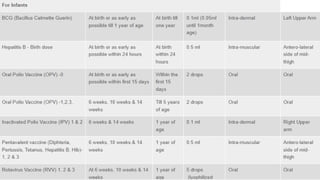
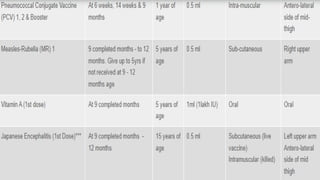
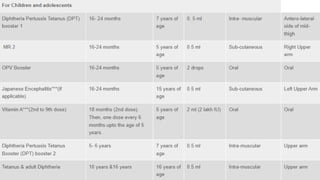
NATIONAL
IMMUNIZATION
SCHEDULE
NEW VACCINES
• Inactivated Polio Vaccine (IPV): IPV has been introduced in UIP as
part of Global Polio end-game strategy, to mitigate the risk associated
with tOPV to bOPV switch. IPV was introduced in November 2015
initially in 6 states, which was expanded across the country by April
2016.
• Rotavirus vaccine (RVV): RVV has been introduced to reduce
mortality and morbidity caused by Rotavirus diarrhoea in March 2016.
It has been introduced in 11 states (Andhra Pradesh, Haryana,
Himachal Pradesh, Jharkhand, Odisha, Assam, Tripura, Rajasthan,
Tamil Nadu, Madhya Pradesh and Uttar Pradesh).
• Measles Rubella (MR) vaccine: India is committed to the goal of measles
elimination and rubella control and to achieve the goal MR vaccine was
introduced in the country through a campaign mode in a phased manner in
2017.
• Pneumococcal Conjugate Vaccine (PCV): PCV has been launched in May 2017 for
reducing Infant mortality and morbidity caused by pneumococcal pneumonia. It
has been introduced in Bihar, Himachal Pradesh, Madhya Pradesh, 19 districts of
Uttar Pradesh and 18 districts of Rajasthan.
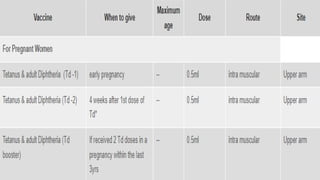
• Tetanus and adult diphtheria (Td) vaccine: TT vaccine has been replaced with Td
vaccine in UIP to limit the waning immunity against diphtheria in older age
groups. Td vaccine to be administered to adolescents at 10 and 16 years of age
and to pregnant women.
IMPORTANCE OF VACCINATION
• Vaccination is the most effective method of preventing
highly infectious diseases.
• Extensive immunity due to vaccination is mostly
responsible for the world-wide eradication of small pox
and the restraint of diseases like Polio, Measles and
Tetanus from a large part of the world.
• According to the World Health
Organisation, immunisation is a proven tool for
controlling and eliminating life-threatening infectious
diseases.
• The benefits of immunisation are not limited to
improvements in health and life expectancy but also
have the social and economic impacts at both the
community as well as national level.
PULSE POLIO PROGRAMME IN INDIA
• India committed to the resolution passed by World Health Assembly
for global polio eradication in 1988.
• At present in routine immunization, bivalent oral polio vaccine(bOPV)
drops are being provided to all children less than five years of age and
Inactivated Polio Vaccine (IPV) to children less than one year of age.
• National Immunization Days (NIDs) commonly known as Pulse Polio
Immunization programme was launched in India in 1995, and is
conducted twice in early part of each year.
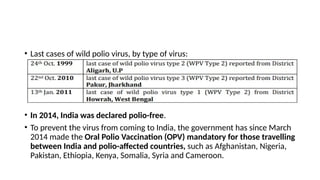
• Last cases of wild polio virus, by type of virus:
• In 2014, India was declared polio-free.
• To prevent the virus from coming to India, the government has since March
2014 made the Oral Polio Vaccination (OPV) mandatory for those travelling
between India and polio-affected countries, such as Afghanistan, Nigeria,
Pakistan, Ethiopia, Kenya, Somalia, Syria and Cameroon.
IMMUNIZATION AGENDA 2030
• The UN agencies like WHO and UNICEF, with the support of countries
and partners, have endorsed a new global vision and strategy, called
the Immunization Agenda 2030 (IA2030), to address the challenges
with immunization and vaccines over the next decade and save over
50 million lives.
World Immunization Week
• World Immunization Week is celebrated in the last week of April every
year. It aims to promote the use of vaccines to protect people of all ages
against disease.
National Immunization day
• On March 16, 2023, India observed the National Immunization day/
Vaccination day.
• On March 16th every year, India observes National Vaccination day,
also known as Immunization day. It was on this day in 1995 that the first
dose of Oral Polio vaccine was given in India.
SUMMARY
• Immunization
• History of immunization in India
• Immunity and types of immunizing agents
• Types of vaccines
• National immunization schedule
• New vaccines
• Importance of immunization
• Pulse polio programme in India
CONCLUSION
• Immunization is a global health and development success story,
saving millions of lives every year. Vaccines reduce risks of getting a
disease by working with your body’s natural defences to build
protection.
• Immunization is a key component of primary health care and an
indisputable human right. It’s also one of the best health investments
money can buy. Vaccines are also critical to the prevention and
control of infectious disease outbreaks.
REFERENCES
• Immunization [Internet]. Vikaspedia.in. [cited 2023 Apr 14]. Available from:
https://vikaspedia.in/health/child-health/immunization
• Booster Dose. Table 2: Summary of WHO position papers - recommended routine immunizations for children [Internet].
Who.int. [cited 2023 Apr 14]. Available from:
https://cdn.who.int/media/docs/default-source/immunization/immunization_schedules/table_2_feb_2023_english.pdf?sfvrs
n=3e27ab48_11&download=true
• Request Rejected [Internet]. Gov.in. [cited 2023 Apr 14]. Available from:
https://main.mohfw.gov.in/Organisation/Departments-of-Health-and-Family-Welfare/immunization
• Ministry of Health, Family Welfare-Government of India. Guidelines- immunization :: National Health mission [Internet].
Gov.in. [cited 2023 Apr 14]. Available from: https://nhm.gov.in/index1.php?lang=1&level=3&sublinkid=944&lid=378
• Ministry of Health, Family Welfare-Government of India. Immunization :: National Health Mission [Internet]. Gov.in. [cited
2023 Apr 14]. Available from: https://nhm.gov.in/index1.php?lang=1&level=2&sublinkid=824&lid=220
• Immunisation Drive in India - Universal Immunization Programme [Internet]. BYJUS. BYJU’S; 2016 [cited 2023 Apr 14].
Available from: https://byjus.com/free-ias-prep/boost-for-immunisation-drive-in-india/
• Immunization Agenda 2030 [Internet]. BYJUS. BYJU’S; 2021 [cited 2023 Apr 14]. Available from:
https://byjus.com/current-affairs/immunization-agenda-2030/
• National Immunisation Day: RSTV - In Depth, discussion on National Immunisation Day for UPSC [Internet]. BYJUS. BYJU’S;
2020 [cited 2023 Apr 14]. Available from: https://byjus.com/free-ias-prep/national-immunisation-day-rstv-indepth/
THANK
YOU

Immunization and immunization programmes of India

  • 1.
  • 2.
    OBJECTIVES At the endof the session, you will be able to: • Define immunization • Explain in brief the history of immunization in India • Discuss about immunity and types of immunizing agents • Enlist the types of vaccines • Discuss national immunization schedule • Enlist new vaccines • Explain importance of immunization • Explain in brief about pulse polio programme in India
  • 3.
    INTRODUCTION • Immunization isthe process of making a person immune or resistant to an infectious disease. It is one of the most effective ways to protect yourself and your community from serious illnesses. • The immune system is designed to recognize and fight off foreign invaders, such as viruses and bacteria. Immunization works by introducing a small amount of a weakened or dead virus or bacteria into the body, which triggers the immune system to produce antibodies. These antibodies help the body fight off the real virus or bacteria if it is encountered in the future.
  • 4.
    INTRODUCTION • Immunization isa proven tool for controlling and eliminating life-threatening infectious diseases and is estimated to avert between 2 and 3 million deaths each year. • India’s UIP provide free vaccines against 11 life threatening diseases - Tuberculosis, Diphtheria, Pertussis, Tetanus, Polio, Hepatitis B, Pneumonia and Meningitis due to Haemophilus Influenzae type b (Hib), Measles, Rubella, Japanese Encephalitis (JE) and Rotavirus diarrhoea.
  • 5.
    DEFINITION • The WHOdefines immunization as “the process whereby a person is made immune or resistant to an infectious disease, typically by the administration of a vaccine.”
  • 6.
    THE IMMUNIZATION PROGRAMME ININDIA – A CHRONOLOGY
  • 7.
  • 8.
    IMMUNITY Active immunity • Resistancedeveloped in response to stimulus by an antigen (infecting agent or vaccine) and is characterized by the production of antibodies by the host. Passive immunity • Immunity conferred by an antibody produced in another host. It may be acquired naturally or artificially (through an antibody-containing preparation).
  • 9.
  • 10.
    IMMUNOGLOBULINS • There are5 major classes: IgM, IgA, IgG, IgE, IgD. • Two types of immunoglobulin preparations are available for passive immunization: • Normal human immunoglobulin • Specific (hyper-immune) human immunoglobulin
  • 11.
    ANTISERA OR ANTITOXINS •These are materials prepared in animals or non human sources such as horses.
  • 12.
    TYPES OF VACCINES •There are several types of vaccines, including live attenuated vaccines, inactivated vaccines, subunit, recombinant, and conjugate vaccines, toxoid vaccines, and DNA vaccines. • Live attenuated vaccines contain a weakened form of the virus or bacteria, while inactivated vaccines contain a dead version of the virus or bacteria. Subunit, recombinant, and conjugate vaccines use pieces of the virus or bacteria to trigger an immune response. Toxoid vaccines use a toxin produced by the bacteria to create immunity. DNA vaccines use genetic material from the virus or bacteria to stimulate the immune system.
  • 14.
    SCHEME OF IMMUNIZATION •Primary vaccination • One dose vaccines (BCG, variola, measles, mumps, rubella, yellow fever) • Multiple dose vaccines (polio, DPT, hepatitis B) • Booster vaccination To maintain immunity level after it declines after some time has elapsed (DT, MMR).
  • 15.
  • 20.
    NEW VACCINES • InactivatedPolio Vaccine (IPV): IPV has been introduced in UIP as part of Global Polio end-game strategy, to mitigate the risk associated with tOPV to bOPV switch. IPV was introduced in November 2015 initially in 6 states, which was expanded across the country by April 2016. • Rotavirus vaccine (RVV): RVV has been introduced to reduce mortality and morbidity caused by Rotavirus diarrhoea in March 2016. It has been introduced in 11 states (Andhra Pradesh, Haryana, Himachal Pradesh, Jharkhand, Odisha, Assam, Tripura, Rajasthan, Tamil Nadu, Madhya Pradesh and Uttar Pradesh).
  • 21.
    • Measles Rubella(MR) vaccine: India is committed to the goal of measles elimination and rubella control and to achieve the goal MR vaccine was introduced in the country through a campaign mode in a phased manner in 2017. • Pneumococcal Conjugate Vaccine (PCV): PCV has been launched in May 2017 for reducing Infant mortality and morbidity caused by pneumococcal pneumonia. It has been introduced in Bihar, Himachal Pradesh, Madhya Pradesh, 19 districts of Uttar Pradesh and 18 districts of Rajasthan. • Tetanus and adult diphtheria (Td) vaccine: TT vaccine has been replaced with Td vaccine in UIP to limit the waning immunity against diphtheria in older age groups. Td vaccine to be administered to adolescents at 10 and 16 years of age and to pregnant women.
  • 22.
    IMPORTANCE OF VACCINATION •Vaccination is the most effective method of preventing highly infectious diseases. • Extensive immunity due to vaccination is mostly responsible for the world-wide eradication of small pox and the restraint of diseases like Polio, Measles and Tetanus from a large part of the world. • According to the World Health Organisation, immunisation is a proven tool for controlling and eliminating life-threatening infectious diseases. • The benefits of immunisation are not limited to improvements in health and life expectancy but also have the social and economic impacts at both the community as well as national level.
  • 23.
    PULSE POLIO PROGRAMMEIN INDIA • India committed to the resolution passed by World Health Assembly for global polio eradication in 1988. • At present in routine immunization, bivalent oral polio vaccine(bOPV) drops are being provided to all children less than five years of age and Inactivated Polio Vaccine (IPV) to children less than one year of age. • National Immunization Days (NIDs) commonly known as Pulse Polio Immunization programme was launched in India in 1995, and is conducted twice in early part of each year.
  • 24.
    • Last casesof wild polio virus, by type of virus: • In 2014, India was declared polio-free. • To prevent the virus from coming to India, the government has since March 2014 made the Oral Polio Vaccination (OPV) mandatory for those travelling between India and polio-affected countries, such as Afghanistan, Nigeria, Pakistan, Ethiopia, Kenya, Somalia, Syria and Cameroon.
  • 25.
    IMMUNIZATION AGENDA 2030 •The UN agencies like WHO and UNICEF, with the support of countries and partners, have endorsed a new global vision and strategy, called the Immunization Agenda 2030 (IA2030), to address the challenges with immunization and vaccines over the next decade and save over 50 million lives.
  • 26.
    World Immunization Week •World Immunization Week is celebrated in the last week of April every year. It aims to promote the use of vaccines to protect people of all ages against disease. National Immunization day • On March 16, 2023, India observed the National Immunization day/ Vaccination day. • On March 16th every year, India observes National Vaccination day, also known as Immunization day. It was on this day in 1995 that the first dose of Oral Polio vaccine was given in India.
  • 27.
    SUMMARY • Immunization • Historyof immunization in India • Immunity and types of immunizing agents • Types of vaccines • National immunization schedule • New vaccines • Importance of immunization • Pulse polio programme in India
  • 28.
    CONCLUSION • Immunization isa global health and development success story, saving millions of lives every year. Vaccines reduce risks of getting a disease by working with your body’s natural defences to build protection. • Immunization is a key component of primary health care and an indisputable human right. It’s also one of the best health investments money can buy. Vaccines are also critical to the prevention and control of infectious disease outbreaks.
  • 29.
    REFERENCES • Immunization [Internet].Vikaspedia.in. [cited 2023 Apr 14]. Available from: https://vikaspedia.in/health/child-health/immunization • Booster Dose. Table 2: Summary of WHO position papers - recommended routine immunizations for children [Internet]. Who.int. [cited 2023 Apr 14]. Available from: https://cdn.who.int/media/docs/default-source/immunization/immunization_schedules/table_2_feb_2023_english.pdf?sfvrs n=3e27ab48_11&download=true • Request Rejected [Internet]. Gov.in. [cited 2023 Apr 14]. Available from: https://main.mohfw.gov.in/Organisation/Departments-of-Health-and-Family-Welfare/immunization • Ministry of Health, Family Welfare-Government of India. Guidelines- immunization :: National Health mission [Internet]. Gov.in. [cited 2023 Apr 14]. Available from: https://nhm.gov.in/index1.php?lang=1&level=3&sublinkid=944&lid=378 • Ministry of Health, Family Welfare-Government of India. Immunization :: National Health Mission [Internet]. Gov.in. [cited 2023 Apr 14]. Available from: https://nhm.gov.in/index1.php?lang=1&level=2&sublinkid=824&lid=220 • Immunisation Drive in India - Universal Immunization Programme [Internet]. BYJUS. BYJU’S; 2016 [cited 2023 Apr 14]. Available from: https://byjus.com/free-ias-prep/boost-for-immunisation-drive-in-india/ • Immunization Agenda 2030 [Internet]. BYJUS. BYJU’S; 2021 [cited 2023 Apr 14]. Available from: https://byjus.com/current-affairs/immunization-agenda-2030/ • National Immunisation Day: RSTV - In Depth, discussion on National Immunisation Day for UPSC [Internet]. BYJUS. BYJU’S; 2020 [cited 2023 Apr 14]. Available from: https://byjus.com/free-ias-prep/national-immunisation-day-rstv-indepth/
  • 30.