U.S. Healthcare System:  How it works and How it doesn’t J. B. Silvers, PhD Wm. & Elizabeth Treuhaft Professor of Health Systems Management WEATHERHEAD SCHOOL OF MANAGEMENT/School of Medicine CASE WESTERN RESERVE UNIVERSITY
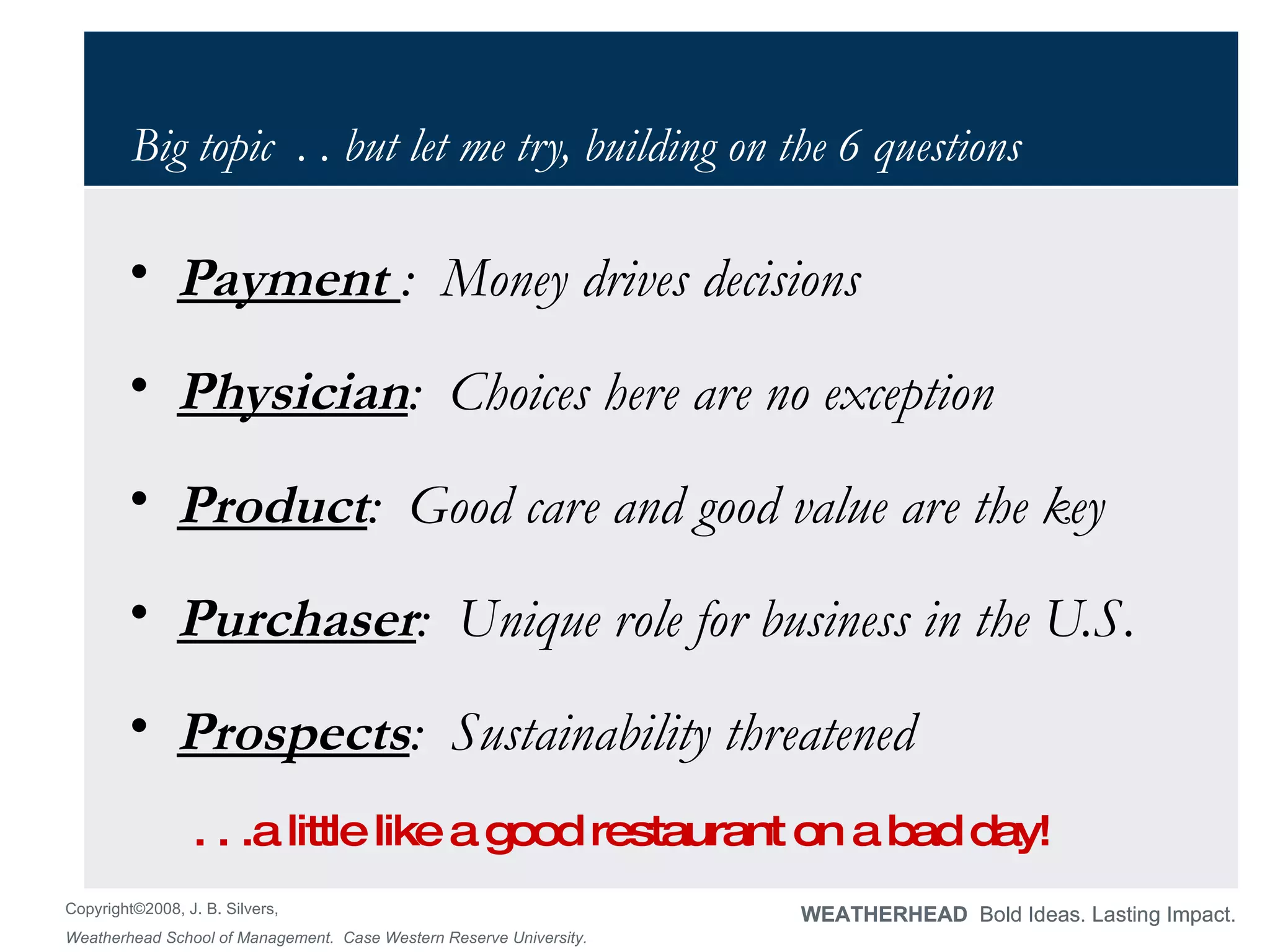
Big topic  . . but let me try, building on the 6 questions Payment  :  Money drives decisions  Physician :  Choices here are no exception Product :  Good care and good value are the key Purchaser :  Unique role for business in the U.S. Prospects :  Sustainability threatened . . .a little like a good restaurant on a bad day!
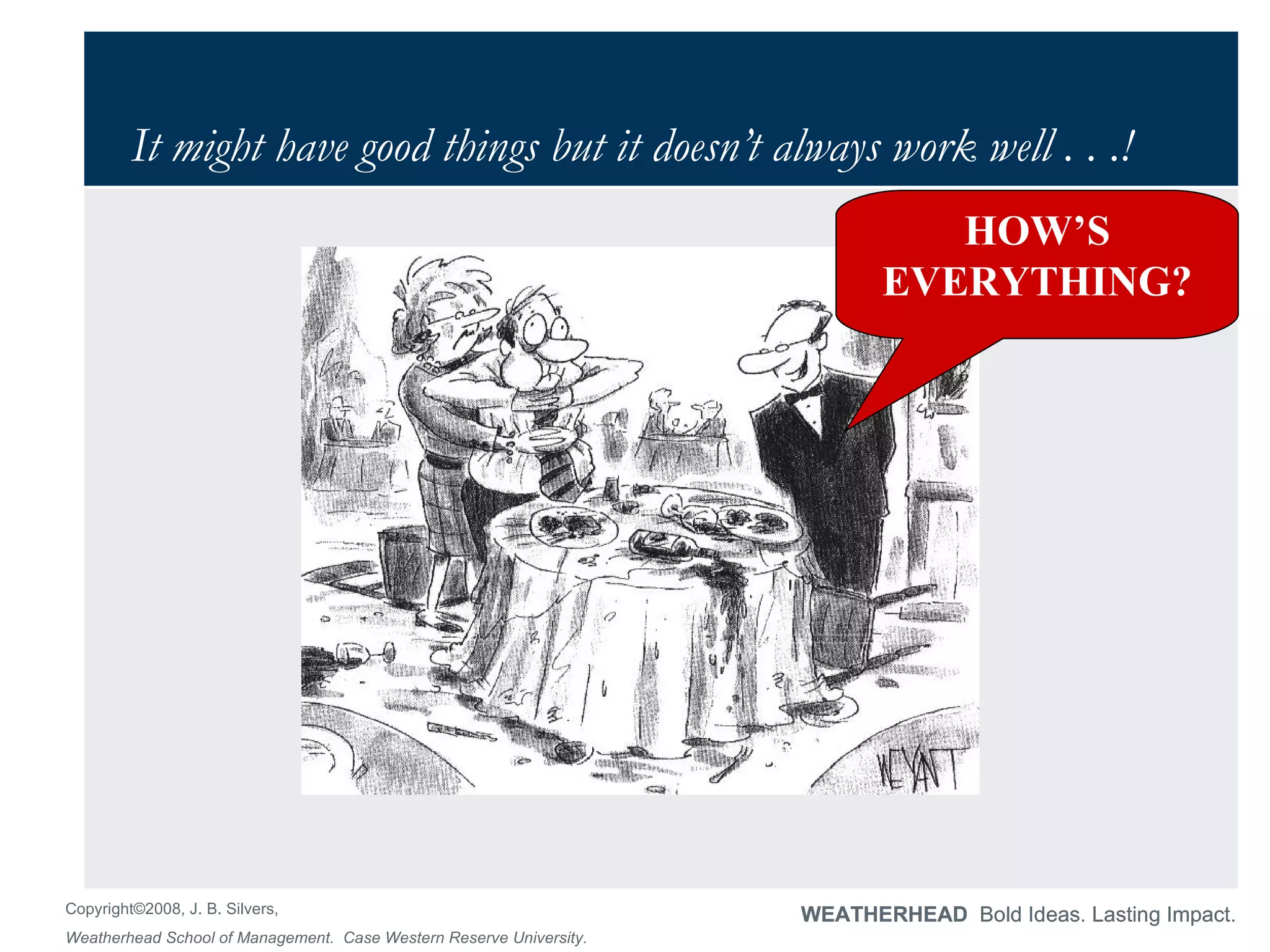
It might have good things but it doesn’t always work well . . .! HOW’S EVERYTHING?
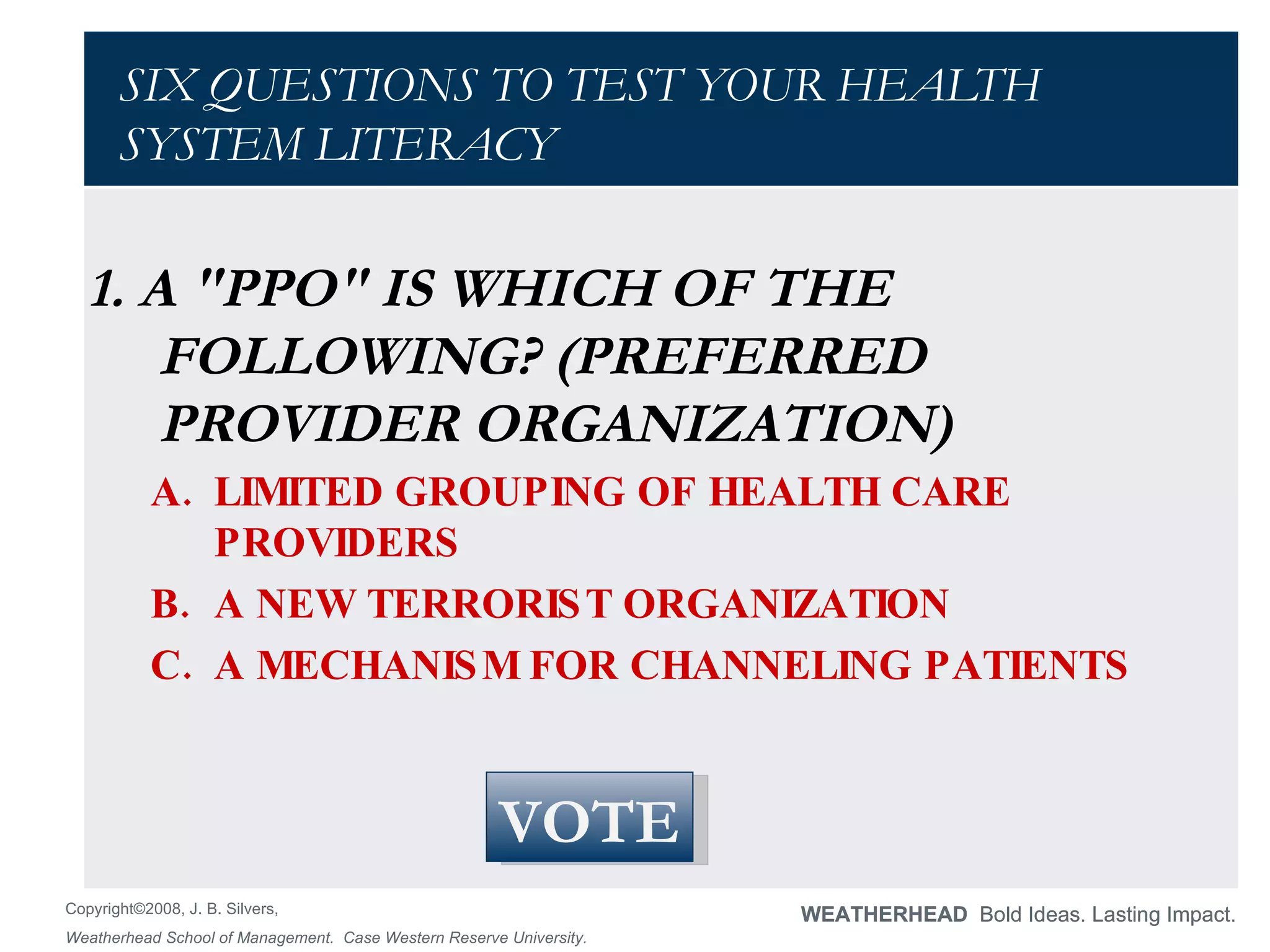
SIX QUESTIONS TO TEST YOUR HEALTH SYSTEM LITERACY 1. A "PPO" IS WHICH OF THE FOLLOWING? (PREFERRED PROVIDER ORGANIZATION)  LIMITED GROUPING OF HEALTH CARE PROVIDERS  A NEW TERRORIST ORGANIZATION  A MECHANISM FOR CHANNELING PATIENTS VOTE
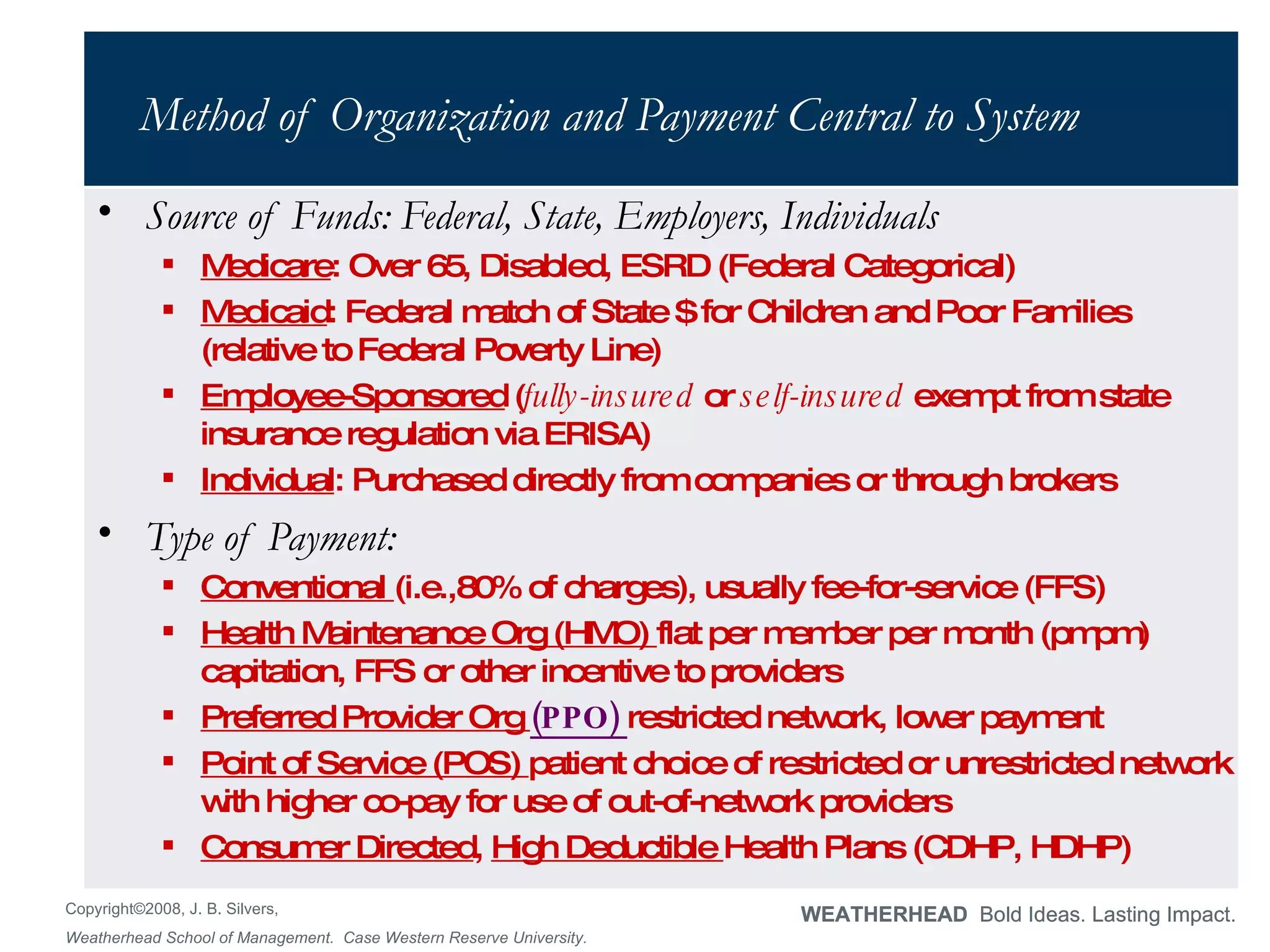
Method of Organization and Payment Central to System Source of Funds: Federal, State, Employers, Individuals Medicare : Over 65, Disabled, ESRD (Federal Categorical) Medicaid : Federal match of State $ for Children and Poor Families (relative to Federal Poverty Line) Employee-Sponsored  ( fully-insured  or  self-insured  exempt from state insurance regulation via ERISA) Individual : Purchased directly from companies or through brokers Type of Payment:  Conventional  (i.e.,80% of charges), usually fee-for-service (FFS) Health Maintenance Org (HMO)  flat per member per month (pmpm) capitation, FFS or other incentive to providers Preferred Provider Org  (PPO)  restricted network, lower payment Point of Service (POS)  patient choice of restricted or unrestricted network with higher co-pay for use of out-of-network providers Consumer Directed ,  High Deductible  Health Plans (CDHP, HDHP)
Two things you need to know about the money side Medicare dominates everything on payment Sets prices for hospital stays & physician services Others copy them (i.e., pay X “percent of Medicare”) Hires managed care as option (Medicare Advantage) Capitated payment at higher rate (+11%) for more services Even higher rate (+17%) for rural plans (Private Payment Medicare Advantage) . . .  these are the target for cuts to finance physician incomes Employer-Sponsored Health Plans dominate otherwise Smaller employers buy regular insurance (90%) Typically through brokers who get 5-10% of the premium Larger employers self insure (80%) Hire insurance co. as agents, admin services only (ASO) Most (82%) of employees are in ERISA plans exempt from state insurance regulation
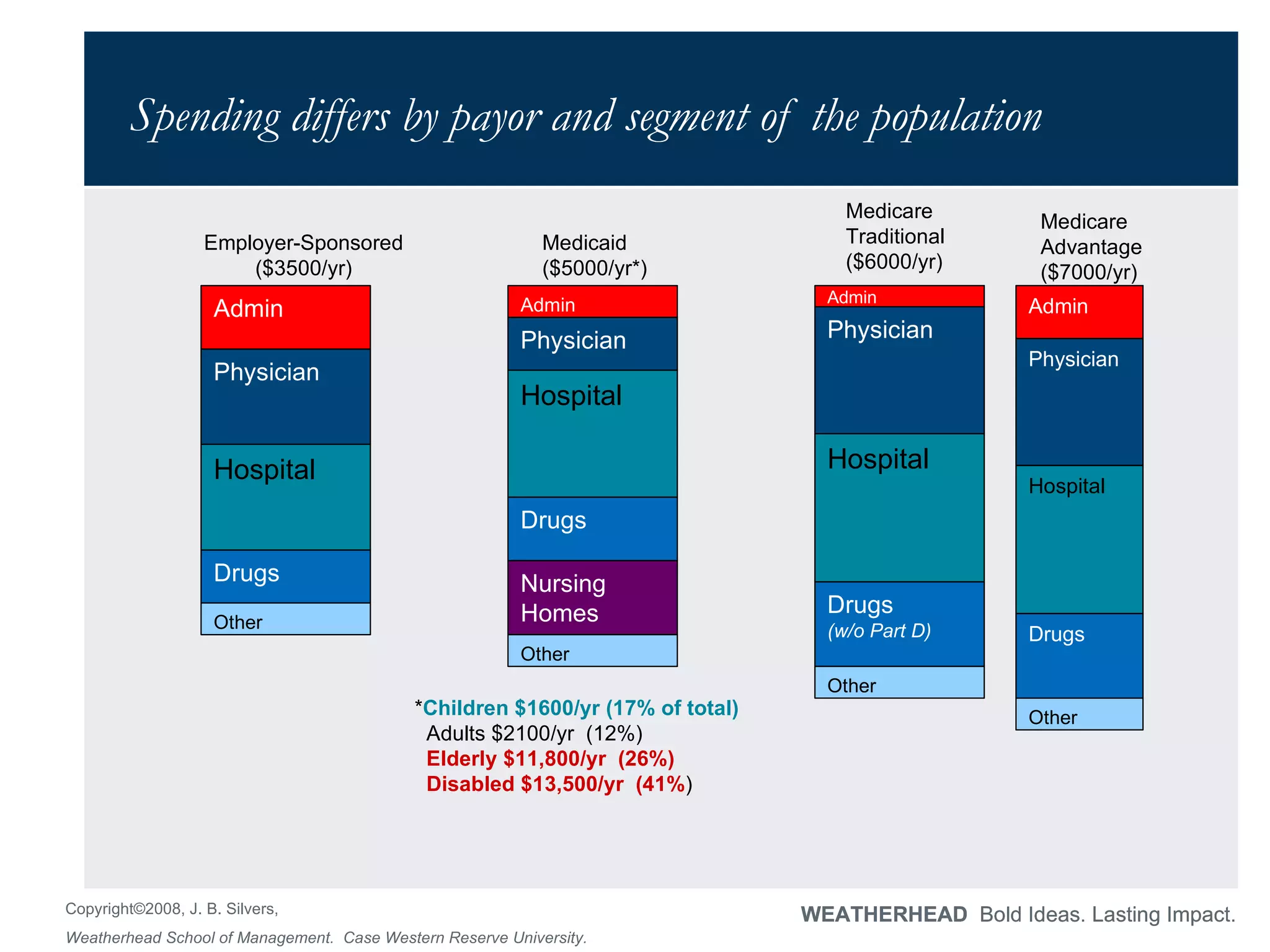
Spending differs by payor and segment of the population Drugs  (w/o Part D) Hospital Physician Admin Drugs Hospital Physician Admin Medicaid ($5000/yr*) * Children $1600/yr (17% of total) Adults $2100/yr  (12%) Elderly $11,800/yr  (26%) Disabled $13,500/yr  (41% ) Medicare Traditional  ($6000/yr) Nursing Homes Drugs Hospital Physician Admin Drugs Hospital Physician Admin Medicare Advantage ($7000/yr) Employer-Sponsored ($3500/yr) Other Other Other Other
SIX QUESTIONS TO TEST YOUR HEALTH SYSTEM LITERACY 2. A "DRG" IS WHICH OF THE FOLLOWING? (DIAGNOSIS RELATED GROUP)  A WAY TO DESCRIBE A HOSPITAL ADMISSION  A WAY TO GROUP SIMILAR CASES  A WAY TO CREATE PAYMENT INCENTIVES VOTE
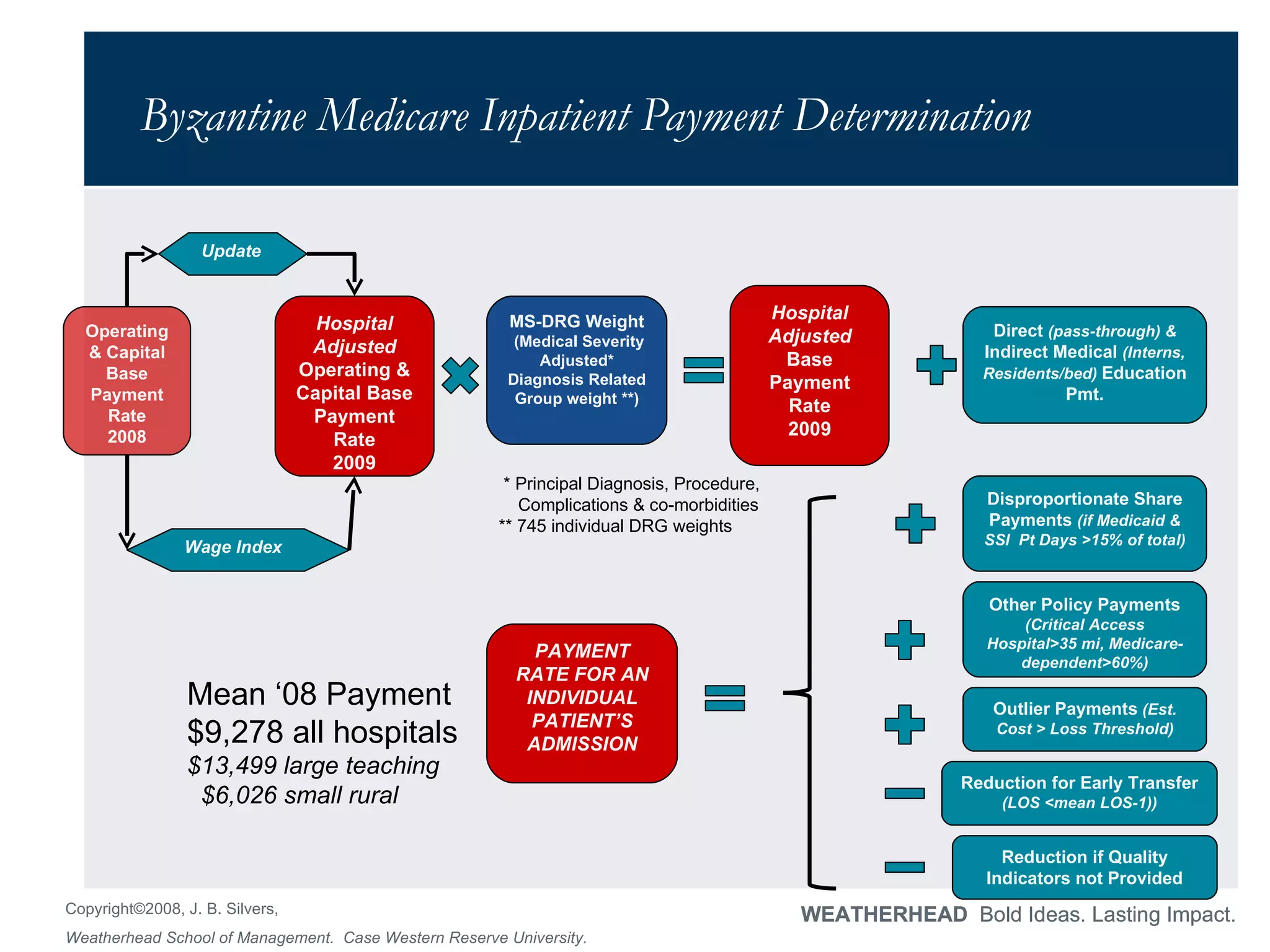
Byzantine Medicare Inpatient Payment Determination Hospital Adjusted Operating & Capital Base Payment Rate 2009 Operating & Capital Base Payment Rate 2008 Update  Wage Index  MS-DRG Weight (Medical Severity Adjusted* Diagnosis Related Group weight **) Hospital Adjusted Base Payment Rate 2009 * Principal Diagnosis, Procedure,  Complications & co-morbidities ** 745 individual DRG weights  Direct  (pass-through) &  Indirect Medical  (Interns, Residents/bed)  Education Pmt. Disproportionate Share Payments  (if Medicaid & SSI  Pt Days >15% of total) Other Policy Payments  (Critical Access Hospital>35 mi, Medicare-dependent>60%) Outlier Payments  (Est. Cost > Loss Threshold) Reduction for Early Transfer  (LOS <mean LOS-1)) Reduction if Quality Indicators not Provided PAYMENT RATE FOR AN INDIVIDUAL PATIENT’S ADMISSION Mean ‘08 Payment $9,278 all hospitals $13,499 large teaching $6,026 small rural
Look at some Sample Medicare Payments for 2008 MS-DRG #001: Heart transplant or implant of heart assist system w MCC  DRG Weight=23.1117 x  $13,499  large teaching hospital = $312,000 Geometric Length of Stay ~30.8 days (Arith Length of Stay ~45.6) MS-DRG #063: Acute ischemic stroke w use of thrombolytic agent w/o CC/MCC  DRG Weight=1.8642 x $9,278  average hospital = $17,300 Geometric Length of Stay ~3.9 (Length of Stay LOS~4.5 ) MS-DRG #063: 90 Concussion w/o CC/MCC  DRG Weight=0.7405 x  $6,026  small rural hospital  =$4,462 Geometric Length of Stay ~2.0 (Length of Stay LOS~2.5)
SIX QUESTIONS TO TEST YOUR HEALTH SYSTEM LITERACY 3. PHYSICIANS GENERALLY ARE PAID WELL BECAUSE IT COSTS A LOT OF MONEY TO TRAIN THEM  PATIENTS LOVE AND ARE LOYAL TO THEIR DOCTORS  THEY PROVIDE VALUABLE SERVICES TO PATIENTS IN NEED VOTE
Complicated Medicare Physician Payment Determination Adjusted for geographical cost factors Conversion Factor 2009 Conversion Factor 2008 Update  Relative Value Units (RVU)* -work -practice expense -malpractice expense Physician  Payment Rates by procedure 2009 * Determined for 10,000 procedures as defined by  Healthcare Common Procedure Coding System (HCPCS)  UPDATE ADJUSTMENT FACTOR (UAF) SUSTAINABLE GROWTH RATE (SGR) Growth rate that reflects inflation, enrollment,  real GDP per capita and policy changes Change required to recoup (or pay extra) the  cumulative difference between actual changes and max allowable under SGR (=< 7%) Limitation
And these changes are followed by all other payers!! Private payers follow Medicare but pay about 25% more. When the Medicare Fee Schedule [MFS] changes everything shifts with it.
SIX QUESTIONS TO TEST YOUR HEALTH SYSTEM LITERACY 4. &quot;GOOD&quot; PRACTICE PATTERNS LEADING TO HIGH QUALITY USUALLY ARE BASED ON WHICH OF THE FOLLOWING?  THE AVERAGE OF SIMILAR PHYSICIAN CHOICES  THE EXPERT OPINION OF A CONSENSUS PANEL OF PHYSICIANS  THE RESULTS OF OUTCOMES RESEARCH COMPARING ALTERNATIVES VOTE
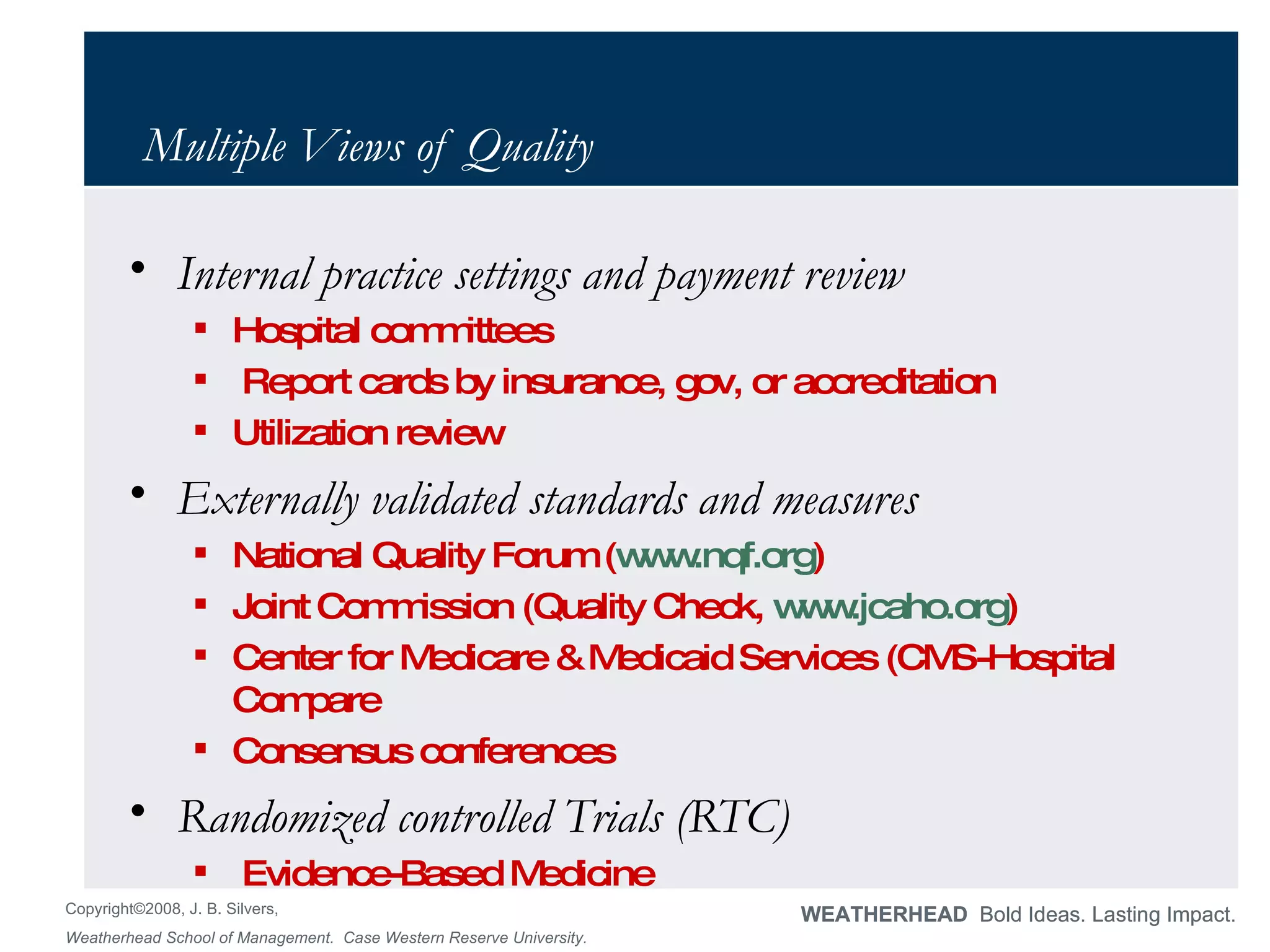
Multiple Views of Quality Internal practice settings and payment review Hospital committees Report cards by insurance, gov, or accreditation Utilization review Externally validated standards and measures National Quality Forum ( www.nqf.org ) Joint Commission (Quality Check,  www.jcaho.org ) Center for Medicare & Medicaid Services (CMS-Hospital Compare Consensus conferences Randomized controlled Trials (RTC)  Evidence-Based Medicine
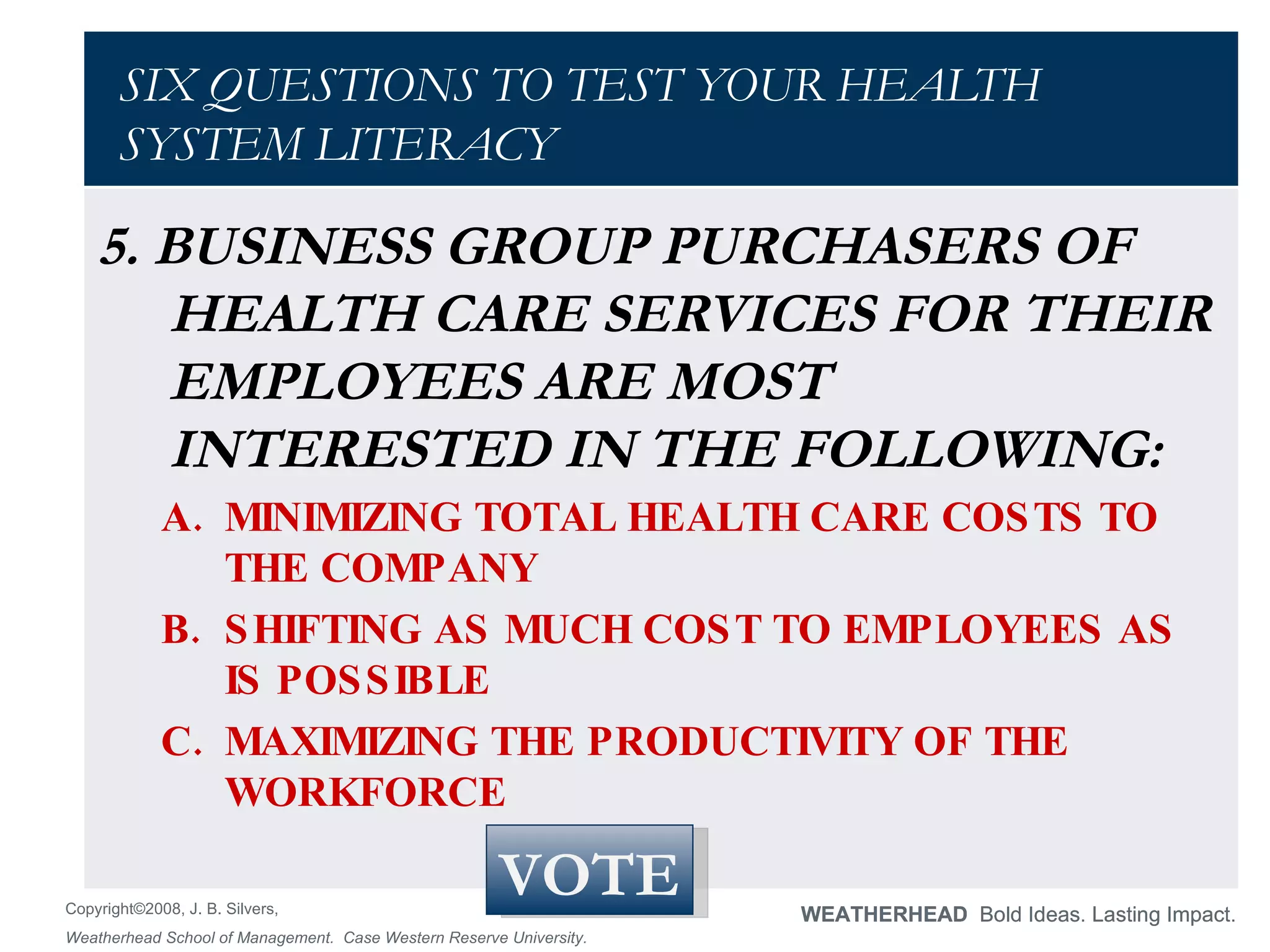
SIX QUESTIONS TO TEST YOUR HEALTH SYSTEM LITERACY 5. BUSINESS GROUP PURCHASERS OF HEALTH CARE SERVICES FOR THEIR EMPLOYEES ARE MOST INTERESTED IN THE FOLLOWING:  MINIMIZING TOTAL HEALTH CARE COSTS TO THE COMPANY  SHIFTING AS MUCH COST TO EMPLOYEES AS IS POSSIBLE  MAXIMIZING THE PRODUCTIVITY OF THE WORKFORCE  VOTE
Remarkably Stable Coverage of Employees – declining Retirees Percentage of Employers (3-199 employees) Offering Health Benefits, 1996-2007 Steady at around 60% Percentage of Employers (500+ employees) Offering Retiree Health Benefits, 1993-2007 Constant decline from almost half to a quarter Large impact of accounting change that made them recognize this obligation [FAS 106] Government is about to have same accounting shock under GASB 45
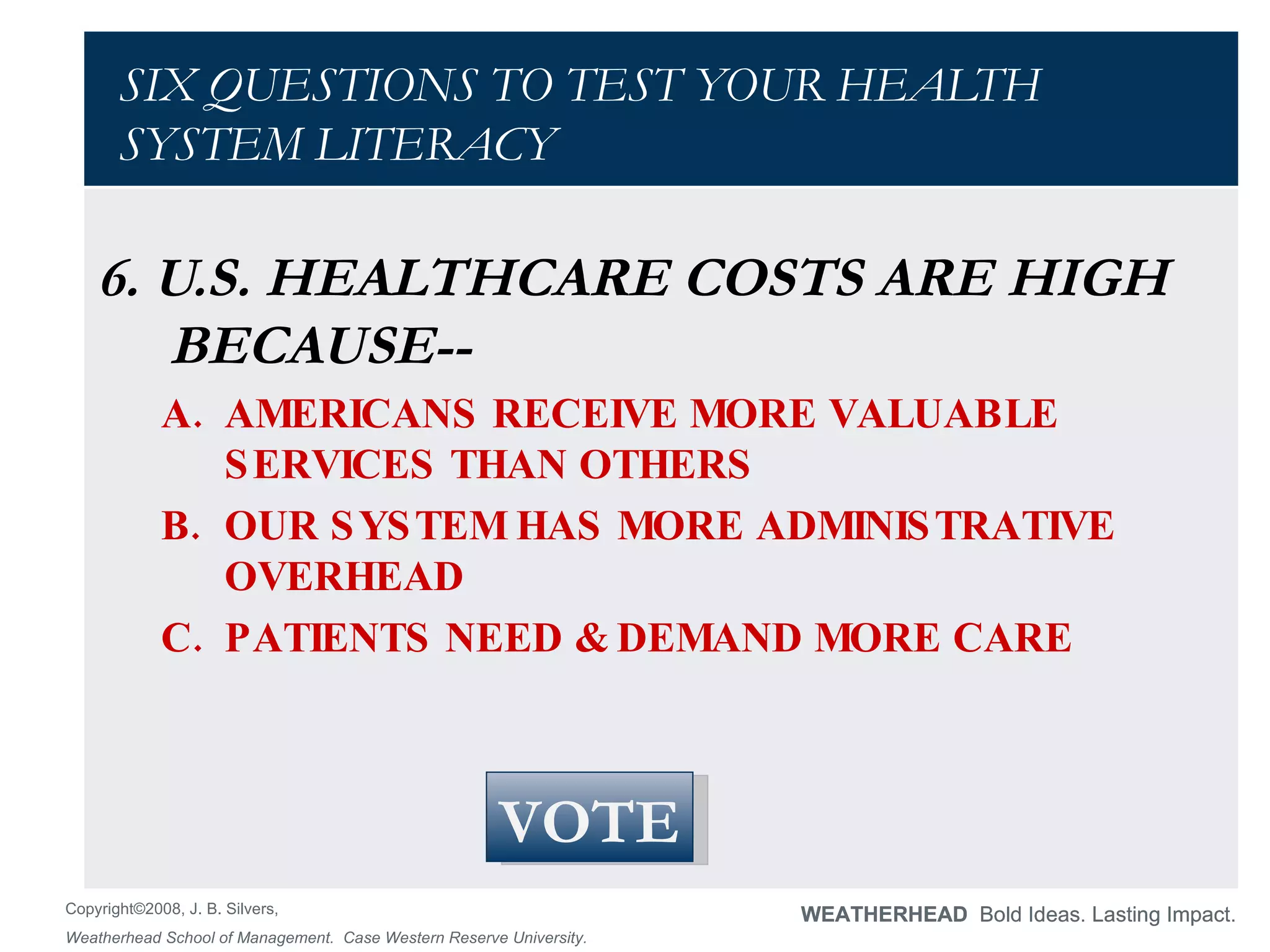
SIX QUESTIONS TO TEST YOUR HEALTH SYSTEM LITERACY 6. U.S. HEALTHCARE COSTS ARE HIGH BECAUSE-- AMERICANS RECEIVE MORE VALUABLE SERVICES THAN OTHERS  OUR SYSTEM HAS MORE ADMINISTRATIVE OVERHEAD  PATIENTS NEED & DEMAND MORE CARE  VOTE
KaiserEDU.org Reading on U.S. Healthcare Costs $2.1 trillion/yr(16% of GDP) =$6 billion/day =$7000 per person/yr =$20/person/day $22,000/yr/ave family $60/ave family/day 20% non-physician 80% Physician Directed Cost too high?
Factors Driving Costs INTENSITY OF SERVICES PRESCRIPTION DRUGS & TECHNOLOGY AGING OF POPULATION ADMINISTRATIVE COSTS . . . But what is driving these? BAD PAYMENT SYSTEM – Perverse incentives EXCESSIVE DEMAND– Patient & marketing GOVERNMENT REGULATION– Inefficiency, mandates POOR QUALITY– Process, outcome, liability
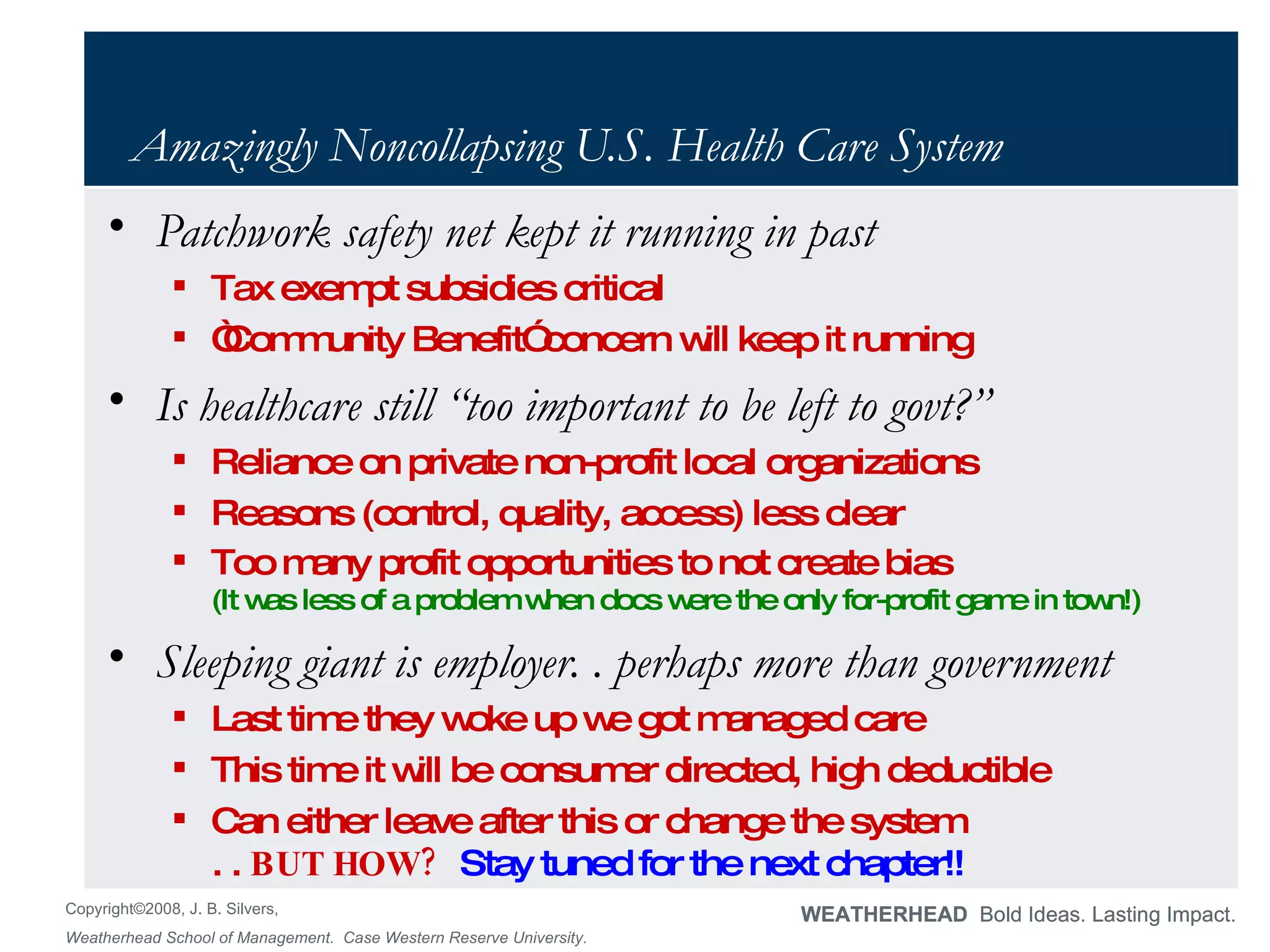
Amazingly Noncollapsing U.S. Health Care System Patchwork safety net kept it running in past Tax exempt subsidies critical “ Community Benefit” concern will keep it running Is healthcare still “too important to be left to govt?” Reliance on private non-profit local organizations Reasons (control, quality, access) less clear Too many profit opportunities to not create bias (It was less of a problem when docs were the only for-profit game in town!) Sleeping giant is employer. . perhaps more than government Last time they woke up we got managed care This time it will be consumer directed, high deductible Can either leave after this or change the system  . .  BUT HOW?  Stay tuned for the next chapter!!
Thank you! [email_address]

Us Health System Ppt

  • 1.
    U.S. Healthcare System: How it works and How it doesn’t J. B. Silvers, PhD Wm. & Elizabeth Treuhaft Professor of Health Systems Management WEATHERHEAD SCHOOL OF MANAGEMENT/School of Medicine CASE WESTERN RESERVE UNIVERSITY
  • 2.
    Big topic . . but let me try, building on the 6 questions Payment : Money drives decisions Physician : Choices here are no exception Product : Good care and good value are the key Purchaser : Unique role for business in the U.S. Prospects : Sustainability threatened . . .a little like a good restaurant on a bad day!
  • 3.
    It might havegood things but it doesn’t always work well . . .! HOW’S EVERYTHING?
  • 4.
    SIX QUESTIONS TOTEST YOUR HEALTH SYSTEM LITERACY 1. A &quot;PPO&quot; IS WHICH OF THE FOLLOWING? (PREFERRED PROVIDER ORGANIZATION) LIMITED GROUPING OF HEALTH CARE PROVIDERS A NEW TERRORIST ORGANIZATION A MECHANISM FOR CHANNELING PATIENTS VOTE
  • 5.
    Method of Organizationand Payment Central to System Source of Funds: Federal, State, Employers, Individuals Medicare : Over 65, Disabled, ESRD (Federal Categorical) Medicaid : Federal match of State $ for Children and Poor Families (relative to Federal Poverty Line) Employee-Sponsored ( fully-insured or self-insured exempt from state insurance regulation via ERISA) Individual : Purchased directly from companies or through brokers Type of Payment: Conventional (i.e.,80% of charges), usually fee-for-service (FFS) Health Maintenance Org (HMO) flat per member per month (pmpm) capitation, FFS or other incentive to providers Preferred Provider Org (PPO) restricted network, lower payment Point of Service (POS) patient choice of restricted or unrestricted network with higher co-pay for use of out-of-network providers Consumer Directed , High Deductible Health Plans (CDHP, HDHP)
  • 6.
    Two things youneed to know about the money side Medicare dominates everything on payment Sets prices for hospital stays & physician services Others copy them (i.e., pay X “percent of Medicare”) Hires managed care as option (Medicare Advantage) Capitated payment at higher rate (+11%) for more services Even higher rate (+17%) for rural plans (Private Payment Medicare Advantage) . . . these are the target for cuts to finance physician incomes Employer-Sponsored Health Plans dominate otherwise Smaller employers buy regular insurance (90%) Typically through brokers who get 5-10% of the premium Larger employers self insure (80%) Hire insurance co. as agents, admin services only (ASO) Most (82%) of employees are in ERISA plans exempt from state insurance regulation
  • 7.
    Spending differs bypayor and segment of the population Drugs (w/o Part D) Hospital Physician Admin Drugs Hospital Physician Admin Medicaid ($5000/yr*) * Children $1600/yr (17% of total) Adults $2100/yr (12%) Elderly $11,800/yr (26%) Disabled $13,500/yr (41% ) Medicare Traditional ($6000/yr) Nursing Homes Drugs Hospital Physician Admin Drugs Hospital Physician Admin Medicare Advantage ($7000/yr) Employer-Sponsored ($3500/yr) Other Other Other Other
  • 8.
    SIX QUESTIONS TOTEST YOUR HEALTH SYSTEM LITERACY 2. A &quot;DRG&quot; IS WHICH OF THE FOLLOWING? (DIAGNOSIS RELATED GROUP) A WAY TO DESCRIBE A HOSPITAL ADMISSION A WAY TO GROUP SIMILAR CASES A WAY TO CREATE PAYMENT INCENTIVES VOTE
  • 9.
    Byzantine Medicare InpatientPayment Determination Hospital Adjusted Operating & Capital Base Payment Rate 2009 Operating & Capital Base Payment Rate 2008 Update Wage Index MS-DRG Weight (Medical Severity Adjusted* Diagnosis Related Group weight **) Hospital Adjusted Base Payment Rate 2009 * Principal Diagnosis, Procedure, Complications & co-morbidities ** 745 individual DRG weights Direct (pass-through) & Indirect Medical (Interns, Residents/bed) Education Pmt. Disproportionate Share Payments (if Medicaid & SSI Pt Days >15% of total) Other Policy Payments (Critical Access Hospital>35 mi, Medicare-dependent>60%) Outlier Payments (Est. Cost > Loss Threshold) Reduction for Early Transfer (LOS <mean LOS-1)) Reduction if Quality Indicators not Provided PAYMENT RATE FOR AN INDIVIDUAL PATIENT’S ADMISSION Mean ‘08 Payment $9,278 all hospitals $13,499 large teaching $6,026 small rural
  • 10.
    Look at someSample Medicare Payments for 2008 MS-DRG #001: Heart transplant or implant of heart assist system w MCC DRG Weight=23.1117 x $13,499 large teaching hospital = $312,000 Geometric Length of Stay ~30.8 days (Arith Length of Stay ~45.6) MS-DRG #063: Acute ischemic stroke w use of thrombolytic agent w/o CC/MCC DRG Weight=1.8642 x $9,278 average hospital = $17,300 Geometric Length of Stay ~3.9 (Length of Stay LOS~4.5 ) MS-DRG #063: 90 Concussion w/o CC/MCC DRG Weight=0.7405 x $6,026 small rural hospital =$4,462 Geometric Length of Stay ~2.0 (Length of Stay LOS~2.5)
  • 11.
    SIX QUESTIONS TOTEST YOUR HEALTH SYSTEM LITERACY 3. PHYSICIANS GENERALLY ARE PAID WELL BECAUSE IT COSTS A LOT OF MONEY TO TRAIN THEM PATIENTS LOVE AND ARE LOYAL TO THEIR DOCTORS THEY PROVIDE VALUABLE SERVICES TO PATIENTS IN NEED VOTE
  • 12.
    Complicated Medicare PhysicianPayment Determination Adjusted for geographical cost factors Conversion Factor 2009 Conversion Factor 2008 Update Relative Value Units (RVU)* -work -practice expense -malpractice expense Physician Payment Rates by procedure 2009 * Determined for 10,000 procedures as defined by Healthcare Common Procedure Coding System (HCPCS) UPDATE ADJUSTMENT FACTOR (UAF) SUSTAINABLE GROWTH RATE (SGR) Growth rate that reflects inflation, enrollment, real GDP per capita and policy changes Change required to recoup (or pay extra) the cumulative difference between actual changes and max allowable under SGR (=< 7%) Limitation
  • 13.
    And these changesare followed by all other payers!! Private payers follow Medicare but pay about 25% more. When the Medicare Fee Schedule [MFS] changes everything shifts with it.
  • 14.
    SIX QUESTIONS TOTEST YOUR HEALTH SYSTEM LITERACY 4. &quot;GOOD&quot; PRACTICE PATTERNS LEADING TO HIGH QUALITY USUALLY ARE BASED ON WHICH OF THE FOLLOWING? THE AVERAGE OF SIMILAR PHYSICIAN CHOICES THE EXPERT OPINION OF A CONSENSUS PANEL OF PHYSICIANS THE RESULTS OF OUTCOMES RESEARCH COMPARING ALTERNATIVES VOTE
  • 15.
    Multiple Views ofQuality Internal practice settings and payment review Hospital committees Report cards by insurance, gov, or accreditation Utilization review Externally validated standards and measures National Quality Forum ( www.nqf.org ) Joint Commission (Quality Check, www.jcaho.org ) Center for Medicare & Medicaid Services (CMS-Hospital Compare Consensus conferences Randomized controlled Trials (RTC) Evidence-Based Medicine
  • 16.
    SIX QUESTIONS TOTEST YOUR HEALTH SYSTEM LITERACY 5. BUSINESS GROUP PURCHASERS OF HEALTH CARE SERVICES FOR THEIR EMPLOYEES ARE MOST INTERESTED IN THE FOLLOWING: MINIMIZING TOTAL HEALTH CARE COSTS TO THE COMPANY SHIFTING AS MUCH COST TO EMPLOYEES AS IS POSSIBLE MAXIMIZING THE PRODUCTIVITY OF THE WORKFORCE VOTE
  • 17.
    Remarkably Stable Coverageof Employees – declining Retirees Percentage of Employers (3-199 employees) Offering Health Benefits, 1996-2007 Steady at around 60% Percentage of Employers (500+ employees) Offering Retiree Health Benefits, 1993-2007 Constant decline from almost half to a quarter Large impact of accounting change that made them recognize this obligation [FAS 106] Government is about to have same accounting shock under GASB 45
  • 18.
    SIX QUESTIONS TOTEST YOUR HEALTH SYSTEM LITERACY 6. U.S. HEALTHCARE COSTS ARE HIGH BECAUSE-- AMERICANS RECEIVE MORE VALUABLE SERVICES THAN OTHERS OUR SYSTEM HAS MORE ADMINISTRATIVE OVERHEAD PATIENTS NEED & DEMAND MORE CARE VOTE
  • 19.
    KaiserEDU.org Reading onU.S. Healthcare Costs $2.1 trillion/yr(16% of GDP) =$6 billion/day =$7000 per person/yr =$20/person/day $22,000/yr/ave family $60/ave family/day 20% non-physician 80% Physician Directed Cost too high?
  • 20.
    Factors Driving CostsINTENSITY OF SERVICES PRESCRIPTION DRUGS & TECHNOLOGY AGING OF POPULATION ADMINISTRATIVE COSTS . . . But what is driving these? BAD PAYMENT SYSTEM – Perverse incentives EXCESSIVE DEMAND– Patient & marketing GOVERNMENT REGULATION– Inefficiency, mandates POOR QUALITY– Process, outcome, liability
  • 21.
    Amazingly Noncollapsing U.S.Health Care System Patchwork safety net kept it running in past Tax exempt subsidies critical “ Community Benefit” concern will keep it running Is healthcare still “too important to be left to govt?” Reliance on private non-profit local organizations Reasons (control, quality, access) less clear Too many profit opportunities to not create bias (It was less of a problem when docs were the only for-profit game in town!) Sleeping giant is employer. . perhaps more than government Last time they woke up we got managed care This time it will be consumer directed, high deductible Can either leave after this or change the system . . BUT HOW? Stay tuned for the next chapter!!
  • 22.