COMMON TERMS
❏ Immunity:Protection from an infectious disease. If you are immune to a
disease, you can be exposed to it without becoming infected.
❏ Vaccine: A product that stimulates a person’s immune system to produce
immunity to a specific disease, protecting the person from that disease.
Vaccines are usually administered through needle injections, but can
also be administered by mouth or sprayed into the nose.
❏ Vaccination: The act of introducing a vaccine into the body to produce
immunity to a specific disease.
❏ Immunization: A process by which a person becomes protected against a
disease through vaccination.
3.
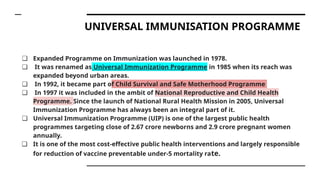
UNIVERSAL IMMUNISATION PROGRAMME
❏Expanded Programme on Immunization was launched in 1978.
❏ It was renamed as Universal Immunization Programme in 1985 when its reach was
expanded beyond urban areas.
❏ In 1992, it became part of Child Survival and Safe Motherhood Programme
❏ In 1997 it was included in the ambit of National Reproductive and Child Health
Programme. Since the launch of National Rural Health Mission in 2005, Universal
Immunization Programme has always been an integral part of it.
❏ Universal Immunization Programme (UIP) is one of the largest public health
programmes targeting close of 2.67 crore newborns and 2.9 crore pregnant women
annually.
❏ It is one of the most cost-effective public health interventions and largely responsible
for reduction of vaccine preventable under-5 mortality rate.
4.
cont...
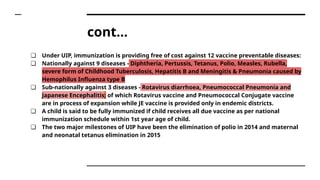
❏ Under UIP,immunization is providing free of cost against 12 vaccine preventable diseases:
❏ Nationally against 9 diseases - Diphtheria, Pertussis, Tetanus, Polio, Measles, Rubella,
severe form of Childhood Tuberculosis, Hepatitis B and Meningitis & Pneumonia caused by
Hemophilus Influenza type B
❏ Sub-nationally against 3 diseases - Rotavirus diarrhoea, Pneumococcal Pneumonia and
Japanese Encephalitis; of which Rotavirus vaccine and Pneumococcal Conjugate vaccine
are in process of expansion while JE vaccine is provided only in endemic districts.
❏ A child is said to be fully immunized if child receives all due vaccine as per national
immunization schedule within 1st year age of child.
❏ The two major milestones of UIP have been the elimination of polio in 2014 and maternal
and neonatal tetanus elimination in 2015
5.
OBJECTIVE OF UIP
1.Toincrease immunisation coverage
2.To improve quality of services
3.To achieve self sufficiency in vaccine production and manufacturing of cold chain
equipments.
4.To establish good surveillance network and district wise monitoring and evaluation
5. To train health personnel
TARGET GROUP-
1.Immunisation to pregnant women against tetanus
2.Immunisation of children in their first year of life
8.
MISSION INDRADHANUSH
❏ MissionIndradhanush (MI) was launched in December 2014 and aims at increasing the full
immunization coverage to children to 90%.
❏ Under this drive focus is given on pockets of low immunization coverage and hard to reach
areas where the proportion of unvaccinated and partially vaccinated children is highest.
❏ A total of six phases of Mission Indradhanush have been completed covering 554 districts
across the country.
❏ It was also identified as one of the flagship schemes under Gram Swaraj Abhiyan (16,850
villages across 541 districts) and Extended Gram Swaraj Abhiyan (48,929 villages across 117
aspirational districts).
❏ While the first two phases of Mission Indradhanush resulted in 6.7% increase in full
immunization coverage in a year, a recent survey carried out in 190 districts covered in
Intensified Mission Indradhanush (5th phase of Mission Indradhanush) shows 18.5% points
increase in full immunization coverage as compared to NFHS-4 survey carried out in 2015-16.




![National programs dr jason [autosaved]](https://cdn.slidesharecdn.com/ss_thumbnails/nationalprograms-drjasonautosaved-210917011725-thumbnail.jpg?width=640&height=640&fit=bounds)


