Checklists for Vaccines and
      Immunization
        Dr. Carsten Mantel
        WHO/FWC/IVB/EPI
Why immunization?


One of the most successful
                                 2 to 3 million deaths averted
 and cost-effective health
                                    annually by vaccination
       interventions
  .


                                   Excellent immunization
19.3 million infants not fully      services can increase
     immunized in 2010           confidence in the health care
                                        system overall
Immunization accelerates child mortality reduction


                         “Over half of the
                         (30%) drop in child mortality since
                         1990 is attributable to immunization.”

                         Dr Margaret Chan,
                         Director-General,
                         World Health Organization


                          Source: Levels & Trends in Child Mortality Report 2011.
                          Estimates developed by the UN Inter-agency Group
                          for Child Mortality Estimation.
Why immunization session checklist?


 Checklist for health care worker / vaccinator, supported by m-Health
  tool for caregiver to:

    –   increase quality of vaccination services;
    –   ensure completion of vaccine schedules;
    –   increase vaccine effectiveness;
    –   reduce threats to programme from adverse events (AEFI);
    –   improve client confidence in the health care system overall.
Checklist to improve programme performance

 Embedded in package of increasing quality and safety
  awareness, behavior change for health-care workers and empowerment
  of clients

 Checklist programme may include:

       SMS            Information on
                                          Broader disease
    reminders to          vaccines
                                             prevention
  clients when the   given, alerts on
                                              messages       Feedback from
  next vaccination    adverse events
                                               e.g., for       clients on
  is due based on    and connection
                                           rotavirus, pneu   service quality
      electronic     to health facility
                                          mococcal, HPV-
     vaccination      if these should
                                          related diseases
      schedule              occur
Checklist to improve vaccine effectiveness

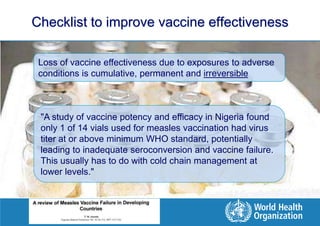
 Loss of vaccine effectiveness due to exposures to adverse
 conditions is cumulative, permanent and irreversible


 "A study of vaccine potency and efficacy in Nigeria found
 only 1 of 14 vials used for measles vaccination had virus
 titer at or above minimum WHO standard, potentially
 leading to inadequate seroconversion and vaccine failure.
 This usually has to do with cold chain management at
 lower levels."
Checklist to reduce adverse events

Tamil Nadu

Four deaths in children following inoculation
with measles vaccine due to re-constitution
error (not related to vaccine quality)


All vaccination sites instructed to stop use of
measles vaccine from this manufacturer


Several million doses of vaccine recalled and
State EPI programme interrupted for months
Checklist to reduce adverse events

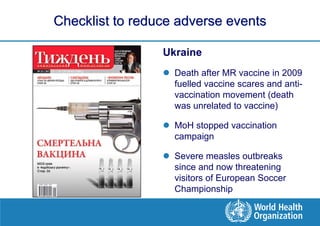
                 Ukraine
                  Death after MR vaccine in 2009
                   fuelled vaccine scares and anti-
                   vaccination movement (death
                   was unrelated to vaccine)

                  MoH stopped vaccination
                   campaign

                  Severe measles outbreaks
                   since and now threatening
                   visitors of European Soccer
                   Championship
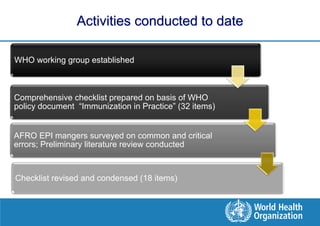
Activities conducted to date

WHO working group established


Comprehensive checklist prepared on basis of WHO
policy document “Immunization in Practice” (32 items)


AFRO EPI mangers surveyed on common and critical
errors; Preliminary literature review conducted


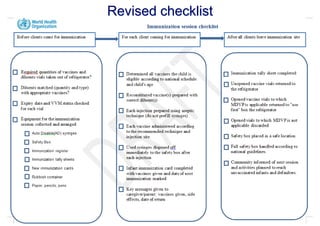
Checklist revised and condensed (18 items)
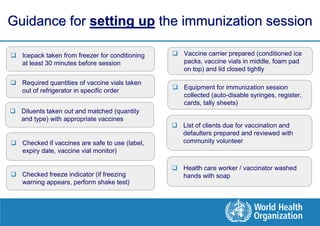
Guidance for setting up the immunization session

 Icepack taken from freezer for conditioning    Vaccine carrier prepared (conditioned ice
  at least 30 minutes before session              packs, vaccine vials in middle, foam pad
                                                  on top) and lid closed tightly

 Required quantities of vaccine vials taken
  out of refrigerator in specific order          Equipment for immunization session
                                                  collected (auto-disable syringes, register,
                                                  cards, tally sheets)
 Diluents taken out and matched (quantity
  and type) with appropriate vaccines
                                                 List of clients due for vaccination and
                                                  defaulters prepared and reviewed with
 Checked if vaccines are safe to use (label,     community volunteer
  expiry date, vaccine vial monitor)

                                                 Health care worker / vaccinator washed
 Checked freeze indicator (if freezing           hands with soap
  warning appears, perform shake test)
Guidance for conduct of the immunization session


 Caretaker and vaccinee greeted and
                                                 Contraindications checked
  seated


 Vaccinee’s date of birth and age
                                                 Immunization register completed
  determined


 Determined which vaccine(s) have               Vaccines prepared safely
  previously been received                        (reconstituted with correct diluent, not
                                                  contaminated during preparation
                                                  vaccine, in correct quantity)
 Determined all vaccines the client is
  eligible for according to national schedule
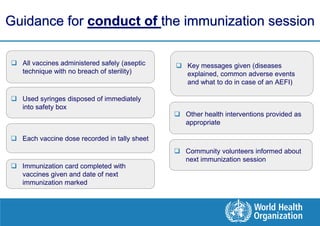
Guidance for conduct of the immunization session

 All vaccines administered safely (aseptic    Key messages given (diseases
  technique with no breach of sterility)        explained, common adverse events
                                                and what to do in case of an AEFI)

 Used syringes disposed of immediately
  into safety box
                                               Other health interventions provided as
                                                appropriate

 Each vaccine dose recorded in tally sheet
                                               Community volunteers informed about
                                                next immunization session
 Immunization card completed with
  vaccines given and date of next
  immunization marked
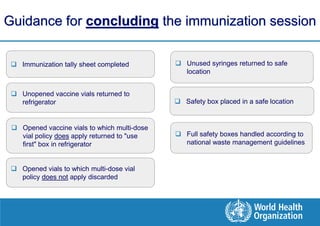
Guidance for concluding the immunization session


  Immunization tally sheet completed          Unused syringes returned to safe
                                                location


  Unopened vaccine vials returned to
   refrigerator                                Safety box placed in a safe location


  Opened vaccine vials to which multi-dose
   vial policy does apply returned to "use     Full safety boxes handled according to
   first" box in refrigerator                   national waste management guidelines


  Opened vials to which multi-dose vial
   policy does not apply discarded
Survey of EPI managers


 Survey among EPI managers' meetings in Africa: 29 country responses
  Questions asked:

 What are most frequent errors (commonly overlooked, forgotten or poorly
  executed) and
 What are the most critical or consequential errors
       by health care workers / vaccinators
       before, during and after an immunization session
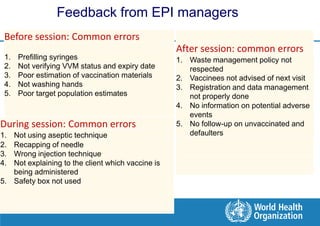
Feedback from EPI managers
 Before session: Common errors
                                                   After session: common errors
 1.   Prefilling syringes                          1. Waste management policy not
 2.   Not verifying VVM status and expiry date        respected
 3.   Poor estimation of vaccination materials     2. Vaccinees not advised of next visit
 4.   Not washing hands                            3. Registration and data management
 5.   Poor target population estimates                not properly done
                                                   4. No information on potential adverse
                                                      events
During session: Common errors                      5. No follow-up on unvaccinated and
1. Not using aseptic technique                        defaulters
2. Recapping of needle
3. Wrong injection technique
4. Not explaining to the client which vaccine is
   being administered
5. Safety box not used
Revised checklist
Next steps

 Literature review on key issues related to vaccine administration and
  preparation of background document

 Usability testing in 10 to 15 sites

 Pilot testing and evaluation in 2 to 3 countries (SEA countries
  showing interest)

 Presentation to WHO Immunization Practices Advisory Committee in
  October 2012 for comments and subsequent endorsement

 Review potential for setting up databases to link local immunization
  registries with vaccination schedules and m-Health SMS messages
  to health care workers, clients and caregivers
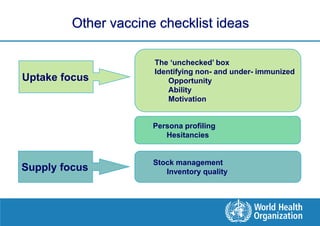
Other vaccine checklist ideas

                      The ‘unchecked’ box
                      Identifying non- and under- immunized
Uptake focus              Opportunity
                          Ability
                          Motivation


                      Persona profiling
                         Hesitancies


                      Stock management
Supply focus             Inventory quality
Acknowledgements

 Jhilmil Bahl

 Hemanthi Dassanayake-Nicolas

 Angela Lashoher

 Rudi Eggers

 Thomas Cherian

 Diana Chang-Blanc

 Franklin Apfel                 Thank You

Checklists for Vaccines and Immunization

  • 1.
    Checklists for Vaccinesand Immunization Dr. Carsten Mantel WHO/FWC/IVB/EPI
  • 2.
    Why immunization? One ofthe most successful 2 to 3 million deaths averted and cost-effective health annually by vaccination interventions . Excellent immunization 19.3 million infants not fully services can increase immunized in 2010 confidence in the health care system overall
  • 3.
    Immunization accelerates childmortality reduction “Over half of the (30%) drop in child mortality since 1990 is attributable to immunization.” Dr Margaret Chan, Director-General, World Health Organization Source: Levels & Trends in Child Mortality Report 2011. Estimates developed by the UN Inter-agency Group for Child Mortality Estimation.
  • 4.
    Why immunization sessionchecklist?  Checklist for health care worker / vaccinator, supported by m-Health tool for caregiver to: – increase quality of vaccination services; – ensure completion of vaccine schedules; – increase vaccine effectiveness; – reduce threats to programme from adverse events (AEFI); – improve client confidence in the health care system overall.
  • 5.
    Checklist to improveprogramme performance  Embedded in package of increasing quality and safety awareness, behavior change for health-care workers and empowerment of clients  Checklist programme may include: SMS Information on Broader disease reminders to vaccines prevention clients when the given, alerts on messages Feedback from next vaccination adverse events e.g., for clients on is due based on and connection rotavirus, pneu service quality electronic to health facility mococcal, HPV- vaccination if these should related diseases schedule occur
  • 6.
    Checklist to improvevaccine effectiveness Loss of vaccine effectiveness due to exposures to adverse conditions is cumulative, permanent and irreversible "A study of vaccine potency and efficacy in Nigeria found only 1 of 14 vials used for measles vaccination had virus titer at or above minimum WHO standard, potentially leading to inadequate seroconversion and vaccine failure. This usually has to do with cold chain management at lower levels."
  • 7.
    Checklist to reduceadverse events Tamil Nadu Four deaths in children following inoculation with measles vaccine due to re-constitution error (not related to vaccine quality) All vaccination sites instructed to stop use of measles vaccine from this manufacturer Several million doses of vaccine recalled and State EPI programme interrupted for months
  • 8.
    Checklist to reduceadverse events Ukraine  Death after MR vaccine in 2009 fuelled vaccine scares and anti- vaccination movement (death was unrelated to vaccine)  MoH stopped vaccination campaign  Severe measles outbreaks since and now threatening visitors of European Soccer Championship
  • 9.
    Activities conducted todate WHO working group established Comprehensive checklist prepared on basis of WHO policy document “Immunization in Practice” (32 items) AFRO EPI mangers surveyed on common and critical errors; Preliminary literature review conducted Checklist revised and condensed (18 items)
  • 10.
    Guidance for settingup the immunization session  Icepack taken from freezer for conditioning  Vaccine carrier prepared (conditioned ice at least 30 minutes before session packs, vaccine vials in middle, foam pad on top) and lid closed tightly  Required quantities of vaccine vials taken out of refrigerator in specific order  Equipment for immunization session collected (auto-disable syringes, register, cards, tally sheets)  Diluents taken out and matched (quantity and type) with appropriate vaccines  List of clients due for vaccination and defaulters prepared and reviewed with  Checked if vaccines are safe to use (label, community volunteer expiry date, vaccine vial monitor)  Health care worker / vaccinator washed  Checked freeze indicator (if freezing hands with soap warning appears, perform shake test)
  • 11.
    Guidance for conductof the immunization session  Caretaker and vaccinee greeted and  Contraindications checked seated  Vaccinee’s date of birth and age  Immunization register completed determined  Determined which vaccine(s) have  Vaccines prepared safely previously been received (reconstituted with correct diluent, not contaminated during preparation vaccine, in correct quantity)  Determined all vaccines the client is eligible for according to national schedule
  • 12.
    Guidance for conductof the immunization session  All vaccines administered safely (aseptic  Key messages given (diseases technique with no breach of sterility) explained, common adverse events and what to do in case of an AEFI)  Used syringes disposed of immediately into safety box  Other health interventions provided as appropriate  Each vaccine dose recorded in tally sheet  Community volunteers informed about next immunization session  Immunization card completed with vaccines given and date of next immunization marked
  • 13.
    Guidance for concludingthe immunization session  Immunization tally sheet completed  Unused syringes returned to safe location  Unopened vaccine vials returned to refrigerator  Safety box placed in a safe location  Opened vaccine vials to which multi-dose vial policy does apply returned to "use  Full safety boxes handled according to first" box in refrigerator national waste management guidelines  Opened vials to which multi-dose vial policy does not apply discarded
  • 14.
    Survey of EPImanagers  Survey among EPI managers' meetings in Africa: 29 country responses Questions asked:  What are most frequent errors (commonly overlooked, forgotten or poorly executed) and  What are the most critical or consequential errors by health care workers / vaccinators before, during and after an immunization session
  • 15.
    Feedback from EPImanagers Before session: Common errors After session: common errors 1. Prefilling syringes 1. Waste management policy not 2. Not verifying VVM status and expiry date respected 3. Poor estimation of vaccination materials 2. Vaccinees not advised of next visit 4. Not washing hands 3. Registration and data management 5. Poor target population estimates not properly done 4. No information on potential adverse events During session: Common errors 5. No follow-up on unvaccinated and 1. Not using aseptic technique defaulters 2. Recapping of needle 3. Wrong injection technique 4. Not explaining to the client which vaccine is being administered 5. Safety box not used
  • 16.
  • 17.
    Next steps  Literaturereview on key issues related to vaccine administration and preparation of background document  Usability testing in 10 to 15 sites  Pilot testing and evaluation in 2 to 3 countries (SEA countries showing interest)  Presentation to WHO Immunization Practices Advisory Committee in October 2012 for comments and subsequent endorsement  Review potential for setting up databases to link local immunization registries with vaccination schedules and m-Health SMS messages to health care workers, clients and caregivers
  • 18.
    Other vaccine checklistideas The ‘unchecked’ box Identifying non- and under- immunized Uptake focus Opportunity Ability Motivation Persona profiling Hesitancies Stock management Supply focus Inventory quality
  • 19.
    Acknowledgements  Jhilmil Bahl Hemanthi Dassanayake-Nicolas  Angela Lashoher  Rudi Eggers  Thomas Cherian  Diana Chang-Blanc  Franklin Apfel Thank You

Editor's Notes

  • #6 .
  • #21  The “unchecked” box-Identifying reasons for non- or under -vaccination A variety of structural and behavioral obstacles can lead to non- and under- vaccination. Effective interventions require proper diagnosis.Target group for use- First line health workers doing routine checks for any health problemIdentify whether obstacle relates to:Opportunity (costs, supply availability, etc) Ability (information, social networks) Motivation – (self-interest, hesitancy etc) ,This can serve as an individual and system diagnostic tool Could trigger health worker action /referrals Possible m-Health application for data collection and transmitting to EPI managerPersona profilingCan identify cause of hesitencies?Can be linked with communications training and delivertySupply focusStock Management Improved stock management is vital for vaccine delivery Targeted to EPI Managers; LogisticiansQuarterly reviewVaccine supply; transport; cold chain storage; distribution; utilization; data collection, interpretation and management; regular reviewsReduced stock-outs of vaccines; increased acceptability of the immunization programme  Supply inventory – quality checks Rationale- Inconsistent availability of supplies, lack of proper cold chain undermines vaccination capacities Target - Community clinics-PHC centres- Supply and quality managers/ Daily checks – refrigerator Weekly supply inventory 10 key vaccines and delivery supplies