DESIGNING AN EFFECTIVE AND
EQUITABLE MTSS FOR ALL
STUDENTS THROUGH UNIVERSAL
DESIGN FOR LEARNING
Clark Dorman, University of South Florida
David Davis, University of South Florida
Dr. Jon Mundorf, PK Yonge Developmental
Research School, University of Florida
Objectives
• Make Connections to NASP & FASP
• Multi-tiered System of Supports
• Universal Design for Learning – Basics
• Universal Design for Learning –
Implementation
• Resources
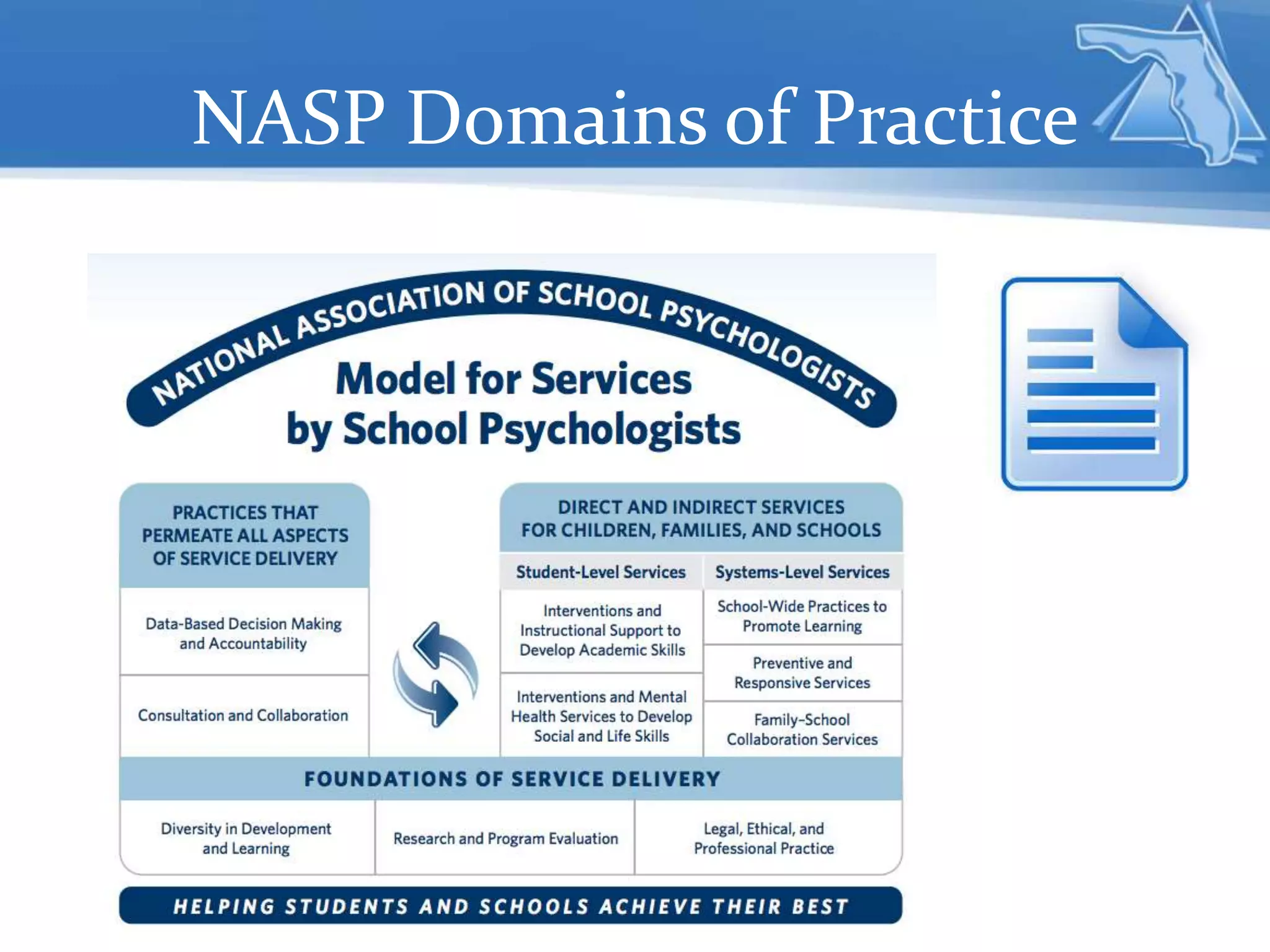
NASP Domains of Practice
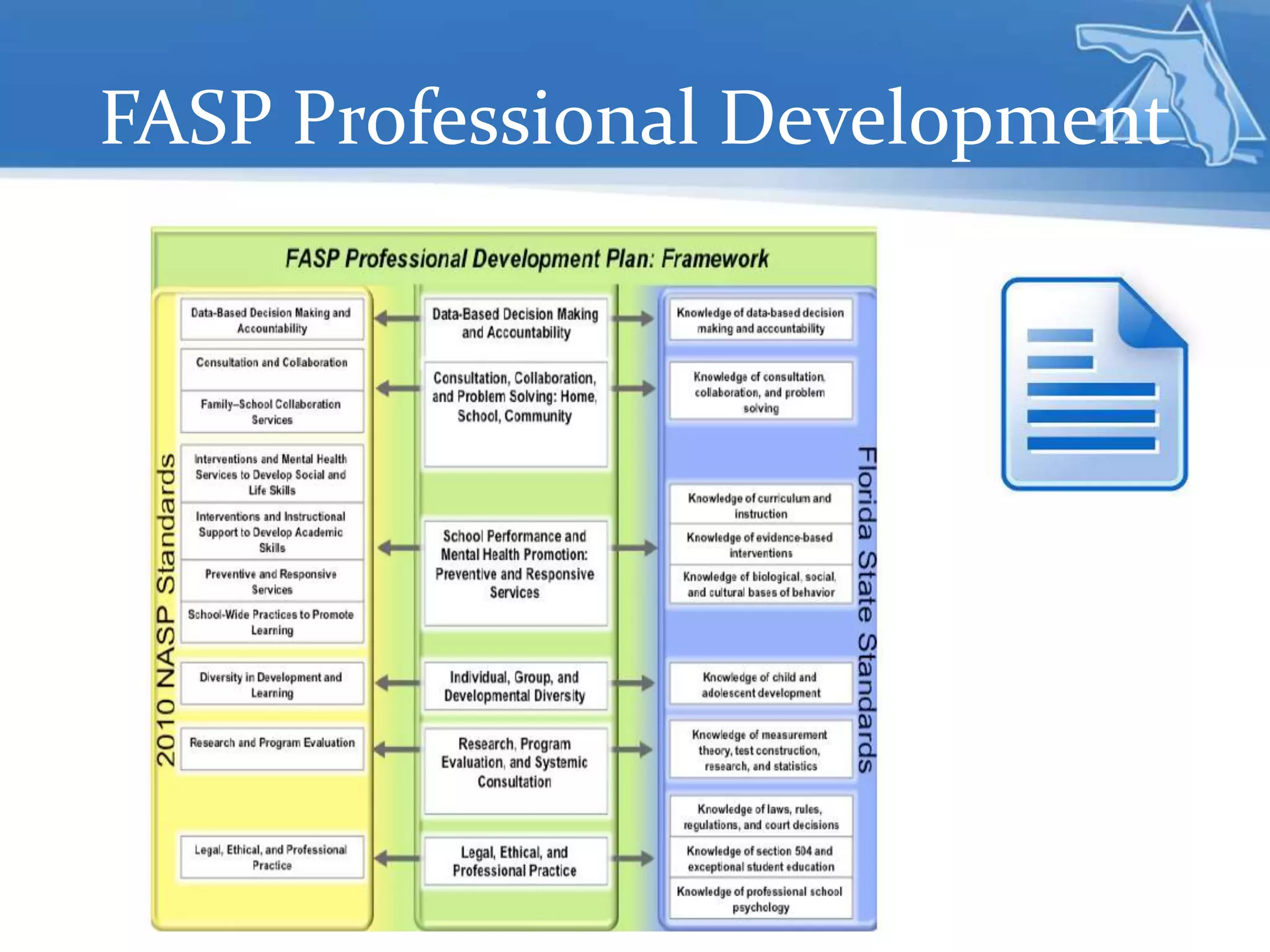
FASP Professional Development
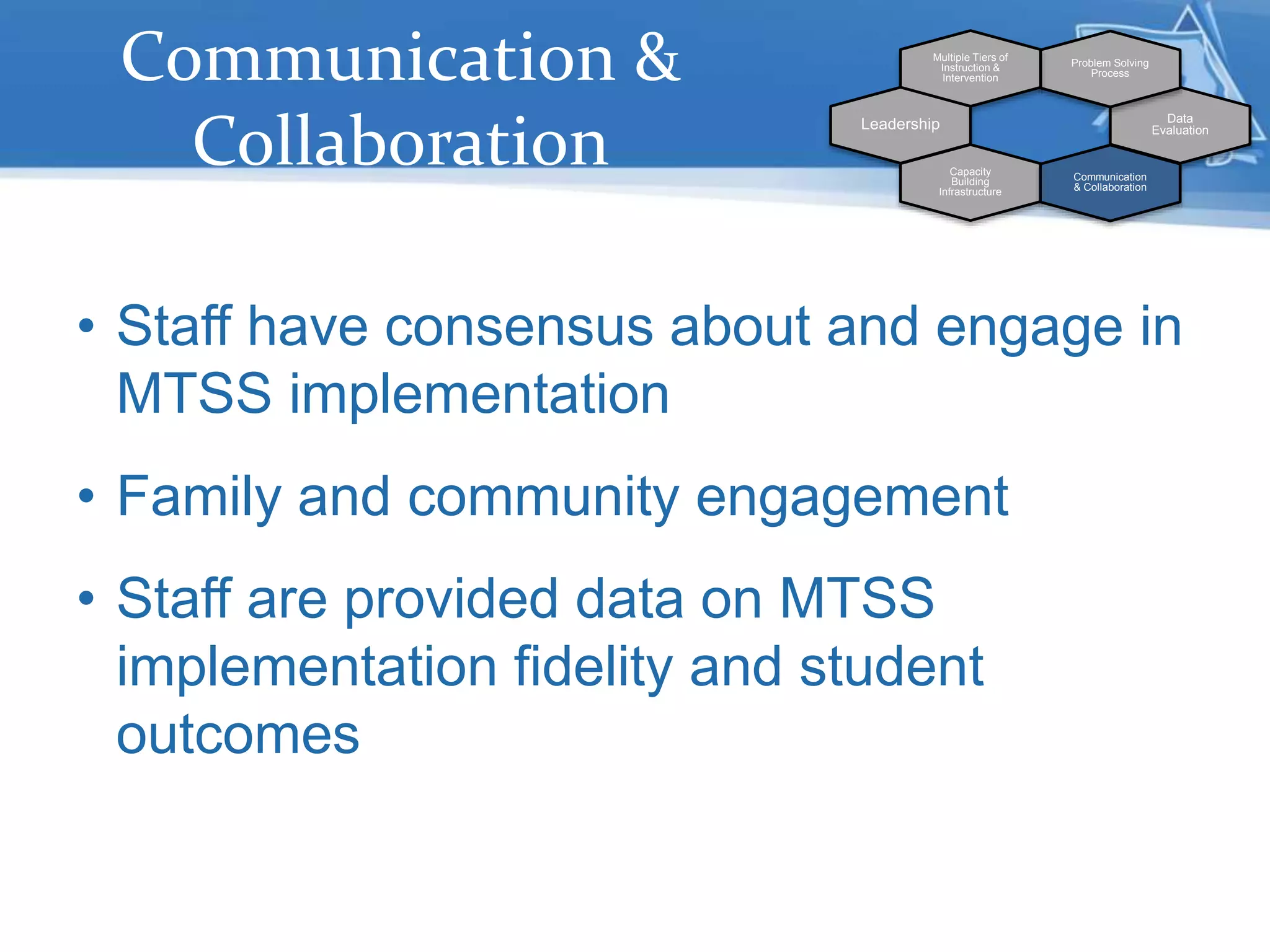
Critical Components of MTSS
Data
Evaluation
Problem
Solving
Process
Multiple Tiers
of Instruction
& Intervention
Leadership
Capacity
Building
Infrastructure
Communicatio
n &
Collaboration
MTSS is a framework to ensure successful education outcomes for ALL students by using a
data-based problem solving process to provide, and evaluate the effectiveness of multiple
tiers of integrated academic, behavior, and social-emotional instruction/intervention
supports matched to student need in alignment with educational standards.
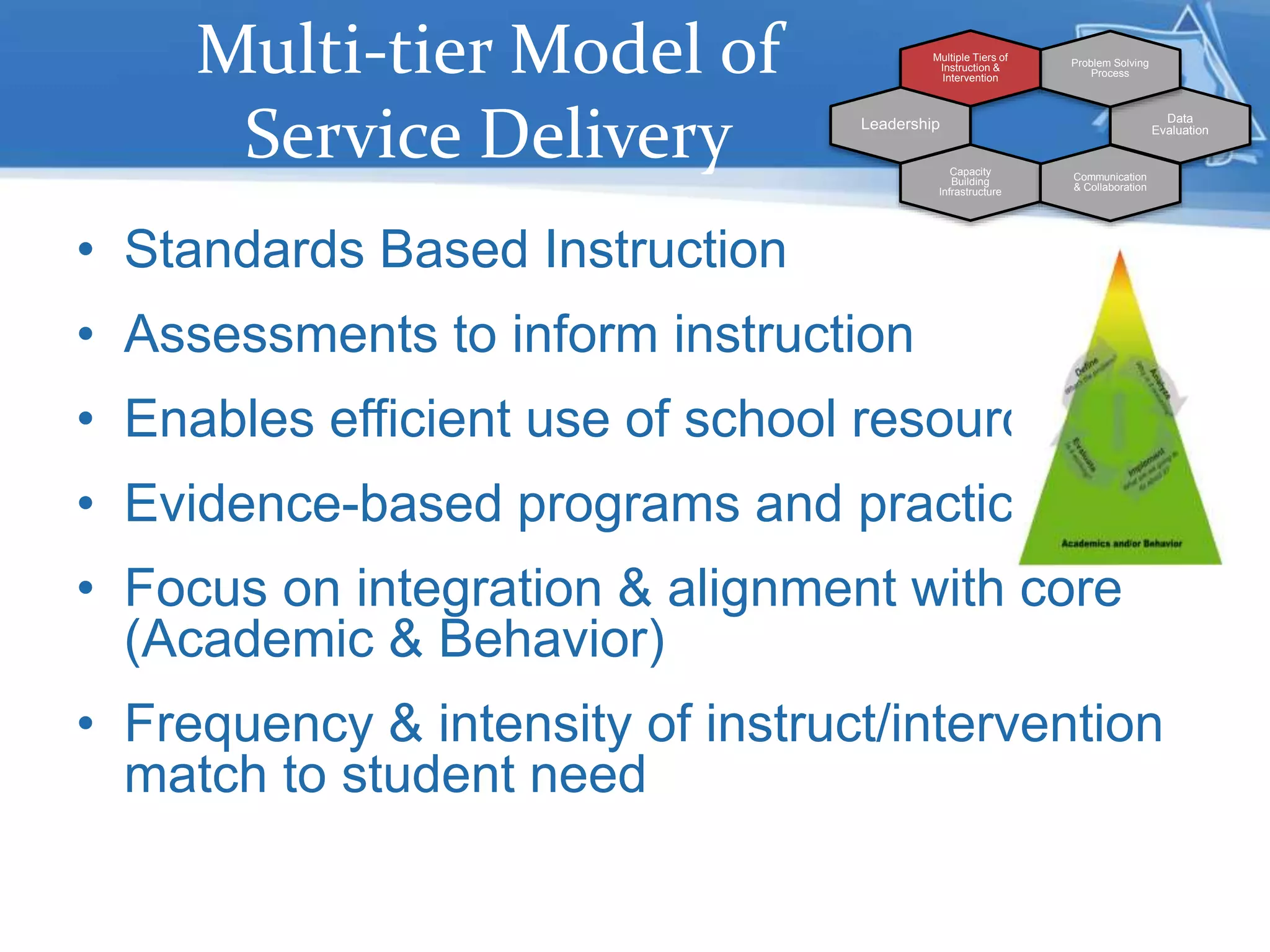
Multi-tier Model of
Service Delivery
• Standards Based Instruction
• Assessments to inform instruction
• Enables efficient use of school resources
• Evidence-based programs and practice
• Focus on integration & alignment with core
(Academic & Behavior)
• Frequency & intensity of instruct/intervention
match to student need
Data
Evaluation
Problem Solving
Process
Multiple Tiers of
Instruction &
Intervention
Leadership
Capacity
Building
Infrastructure
Communication
& Collaboration
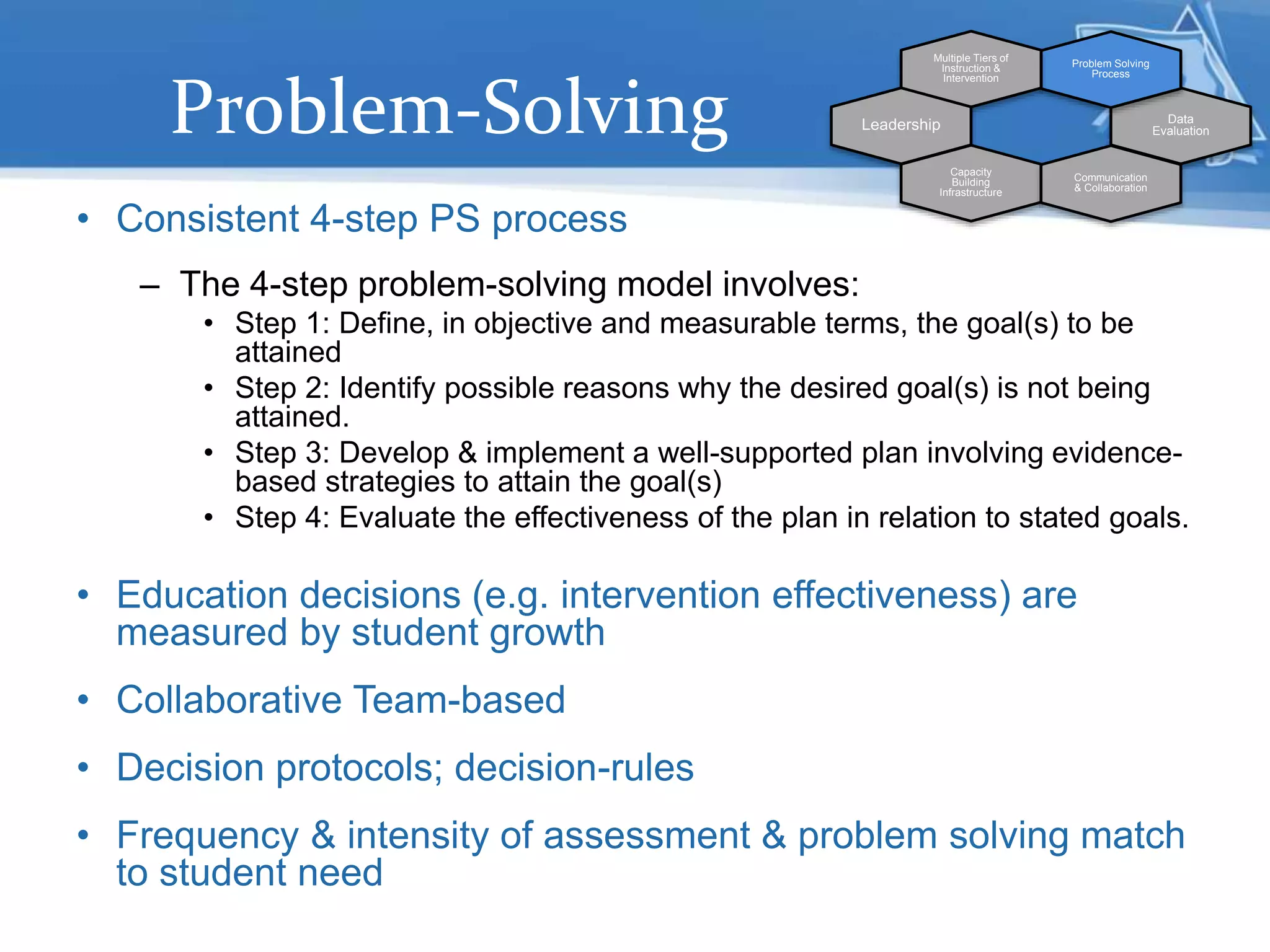
Problem-Solving
• Consistent 4-step PS process
– The 4-step problem-solving model involves:
• Step 1: Define, in objective and measurable terms, the goal(s) to be
attained
• Step 2: Identify possible reasons why the desired goal(s) is not being
attained.
• Step 3: Develop & implement a well-supported plan involving evidence-
based strategies to attain the goal(s)
• Step 4: Evaluate the effectiveness of the plan in relation to stated goals.
• Education decisions (e.g. intervention effectiveness) are
measured by student growth
• Collaborative Team-based
• Decision protocols; decision-rules
• Frequency & intensity of assessment & problem solving match
to student need
Data
Evaluation
Problem Solving
Process
Multiple Tiers of
Instruction &
Intervention
Leadership
Capacity
Building
Infrastructure
Communication
& Collaboration
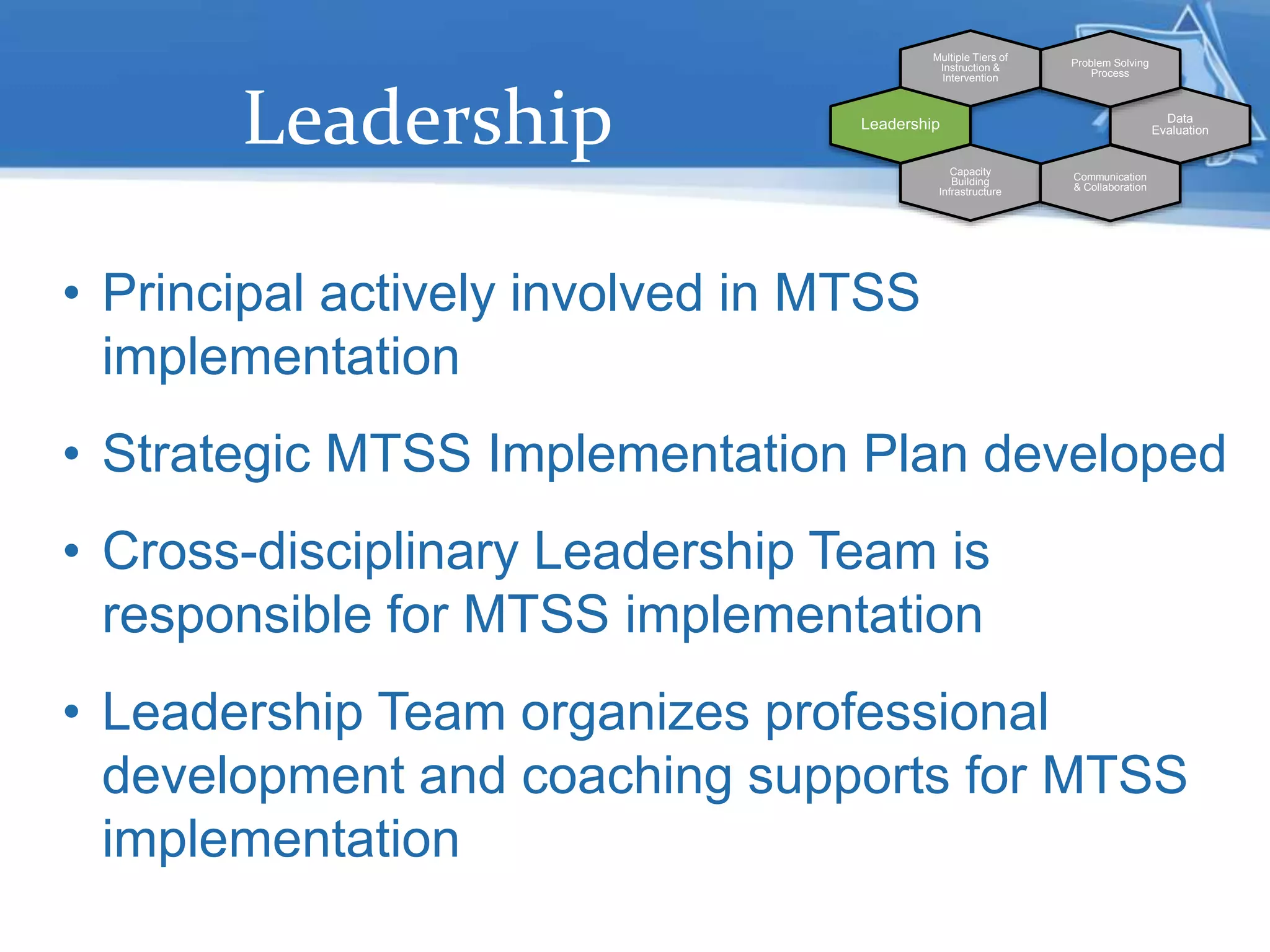
Leadership
• Principal actively involved in MTSS
implementation
• Strategic MTSS Implementation Plan developed
• Cross-disciplinary Leadership Team is
responsible for MTSS implementation
• Leadership Team organizes professional
development and coaching supports for MTSS
implementation
Data
Evaluation
Problem Solving
Process
Multiple Tiers of
Instruction &
Intervention
Leadership
Capacity
Building
Infrastructure
Communication
& Collaboration
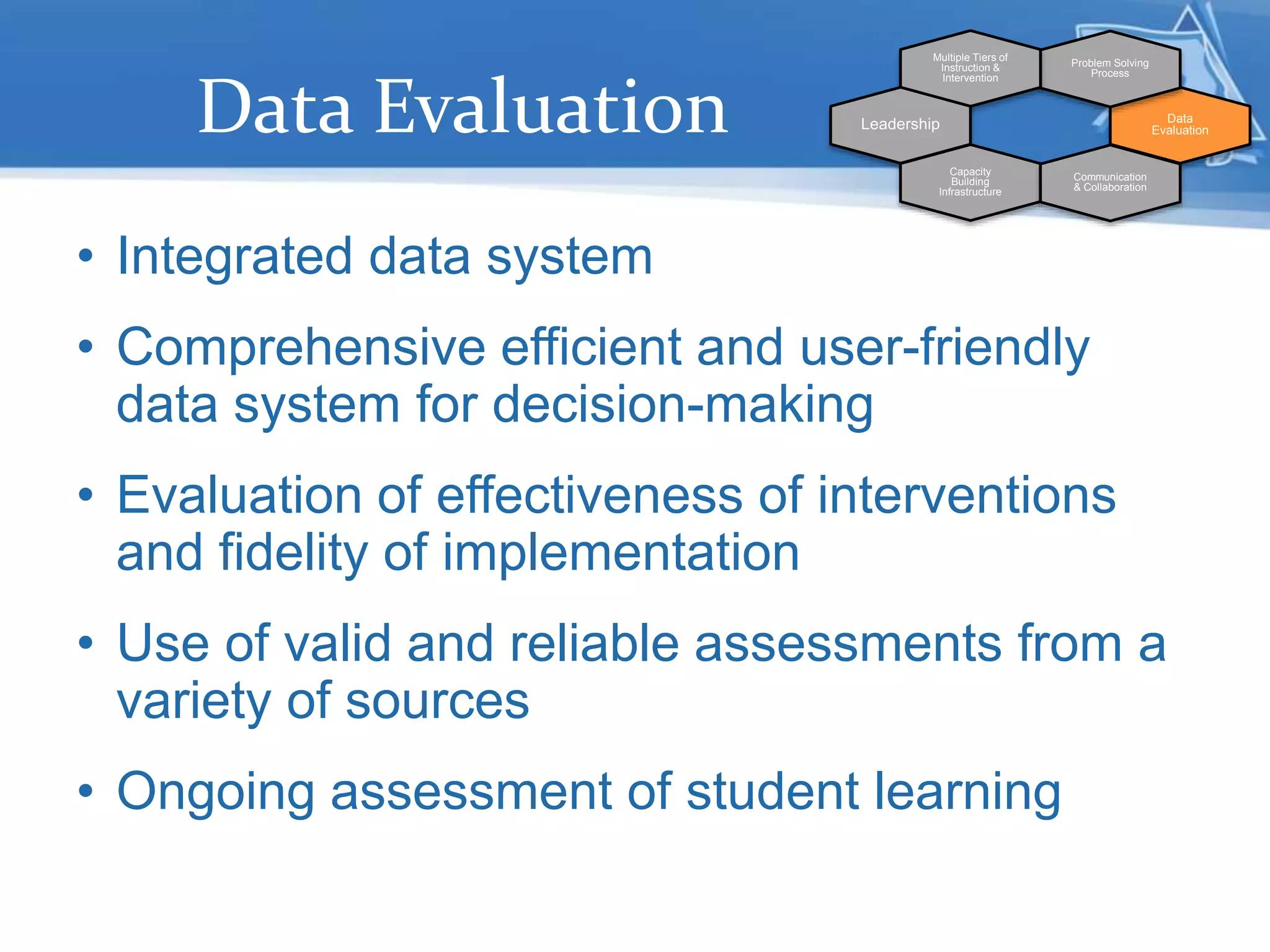
Data Evaluation
• Integrated data system
• Comprehensive efficient and user-friendly
data system for decision-making
• Evaluation of effectiveness of interventions
and fidelity of implementation
• Use of valid and reliable assessments from a
variety of sources
• Ongoing assessment of student learning
Data
Evaluation
Problem Solving
Process
Multiple Tiers of
Instruction &
Intervention
Leadership
Capacity
Building
Infrastructure
Communication
& Collaboration
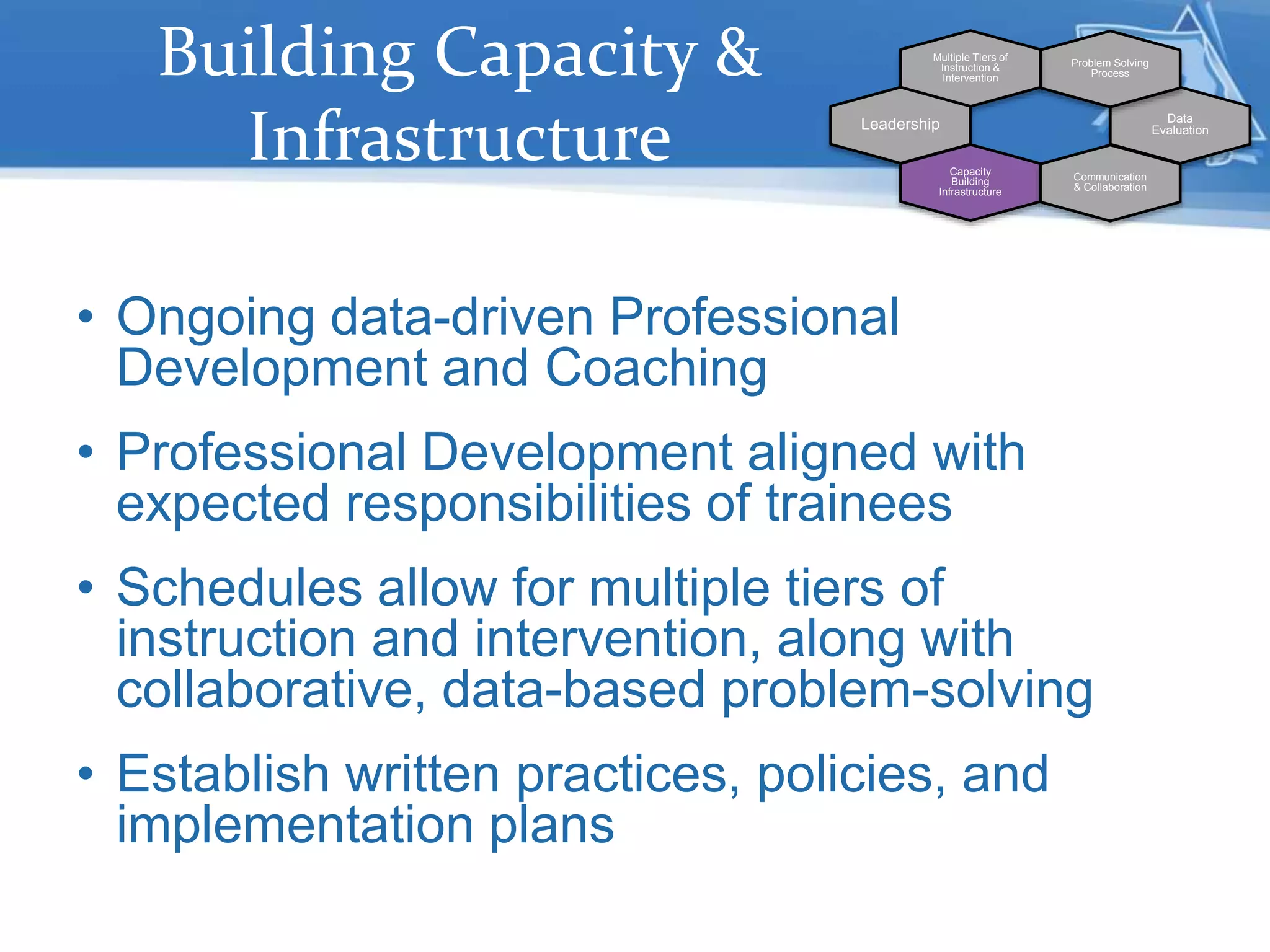
Building Capacity &
Infrastructure
• Ongoing data-driven Professional
Development and Coaching
• Professional Development aligned with
expected responsibilities of trainees
• Schedules allow for multiple tiers of
instruction and intervention, along with
collaborative, data-based problem-solving
• Establish written practices, policies, and
implementation plans
Data
Evaluation
Problem Solving
Process
Multiple Tiers of
Instruction &
Intervention
Leadership
Capacity
Building
Infrastructure
Communication
& Collaboration
Communication &
Collaboration
• Staff have consensus about and engage in
MTSS implementation
• Family and community engagement
• Staff are provided data on MTSS
implementation fidelity and student
outcomes
Data
Evaluation
Problem Solving
Process
Multiple Tiers of
Instruction &
Intervention
Leadership
Capacity
Building
Infrastructure
Communication
& Collaboration
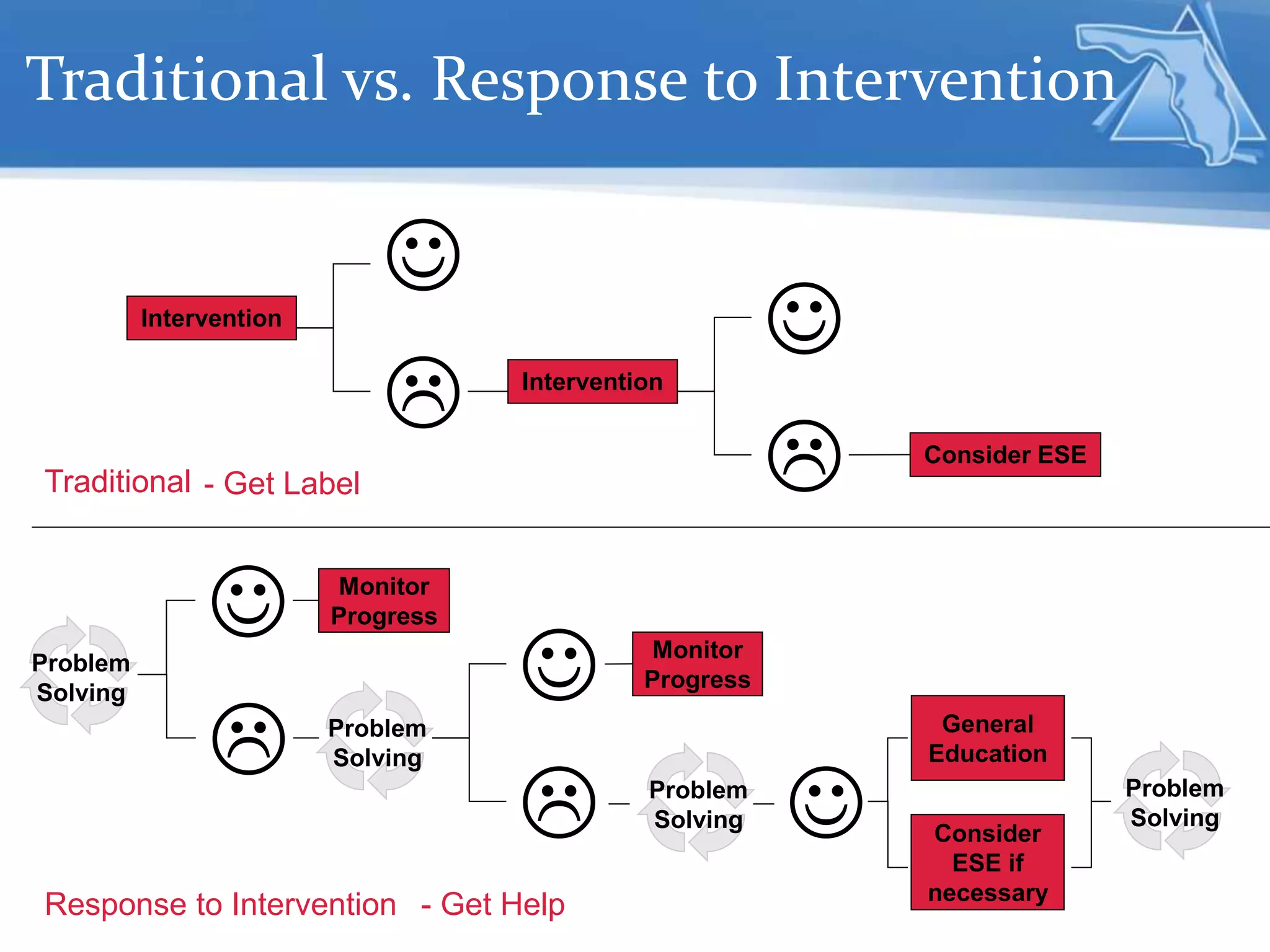
Traditional vs. Response to Intervention
Intervention
J
L
J
L
Intervention
Consider ESE
Traditional
J
L
J
L J
Response to Intervention
Consider
ESE if
necessary
General
Education
Monitor
Progress
Monitor
Progress
Problem
Solving
Problem
Solving
Problem
Solving
Problem
Solving
- Get Label
- Get Help
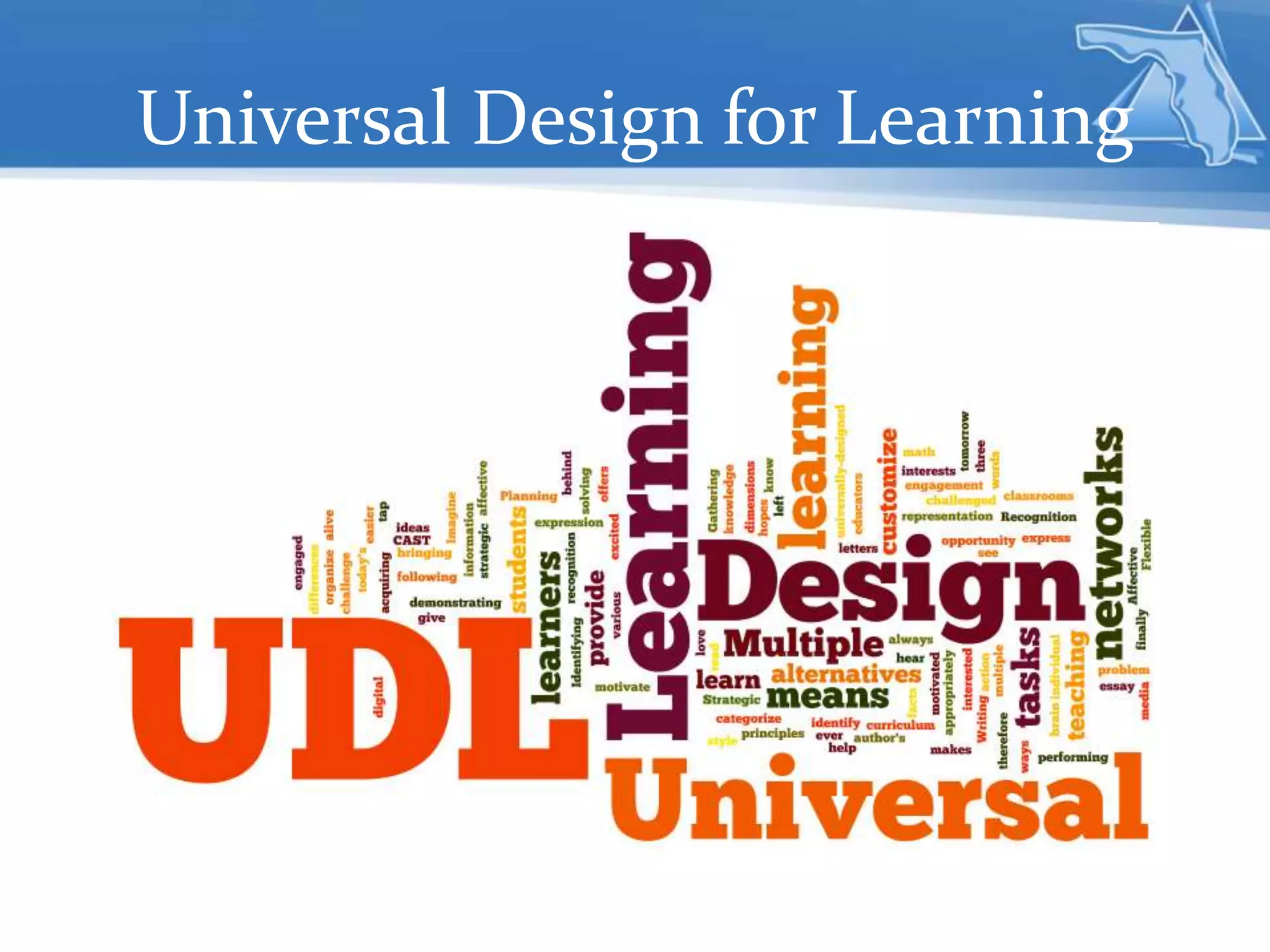
Universal Design for Learning
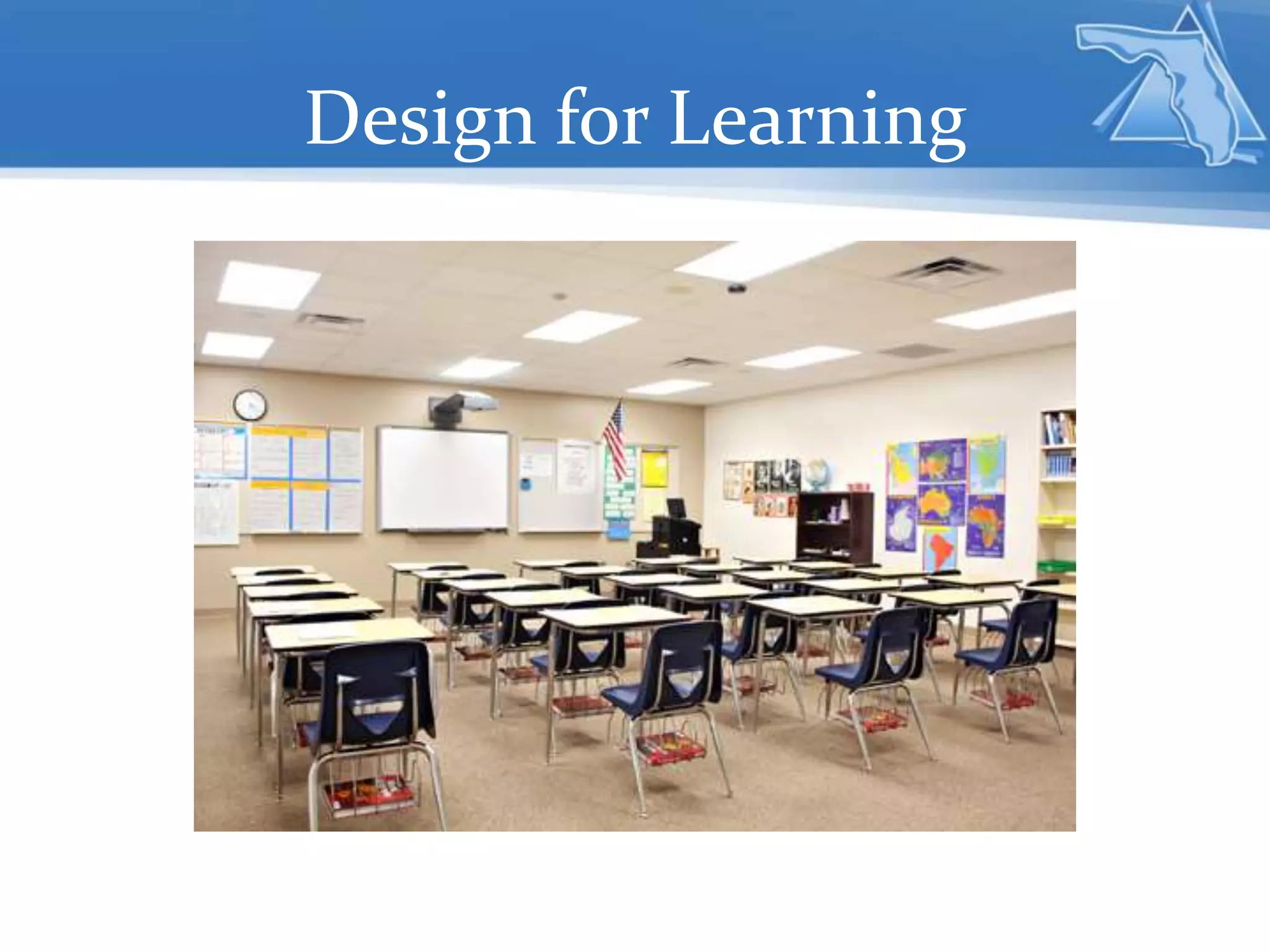
Design for Learning
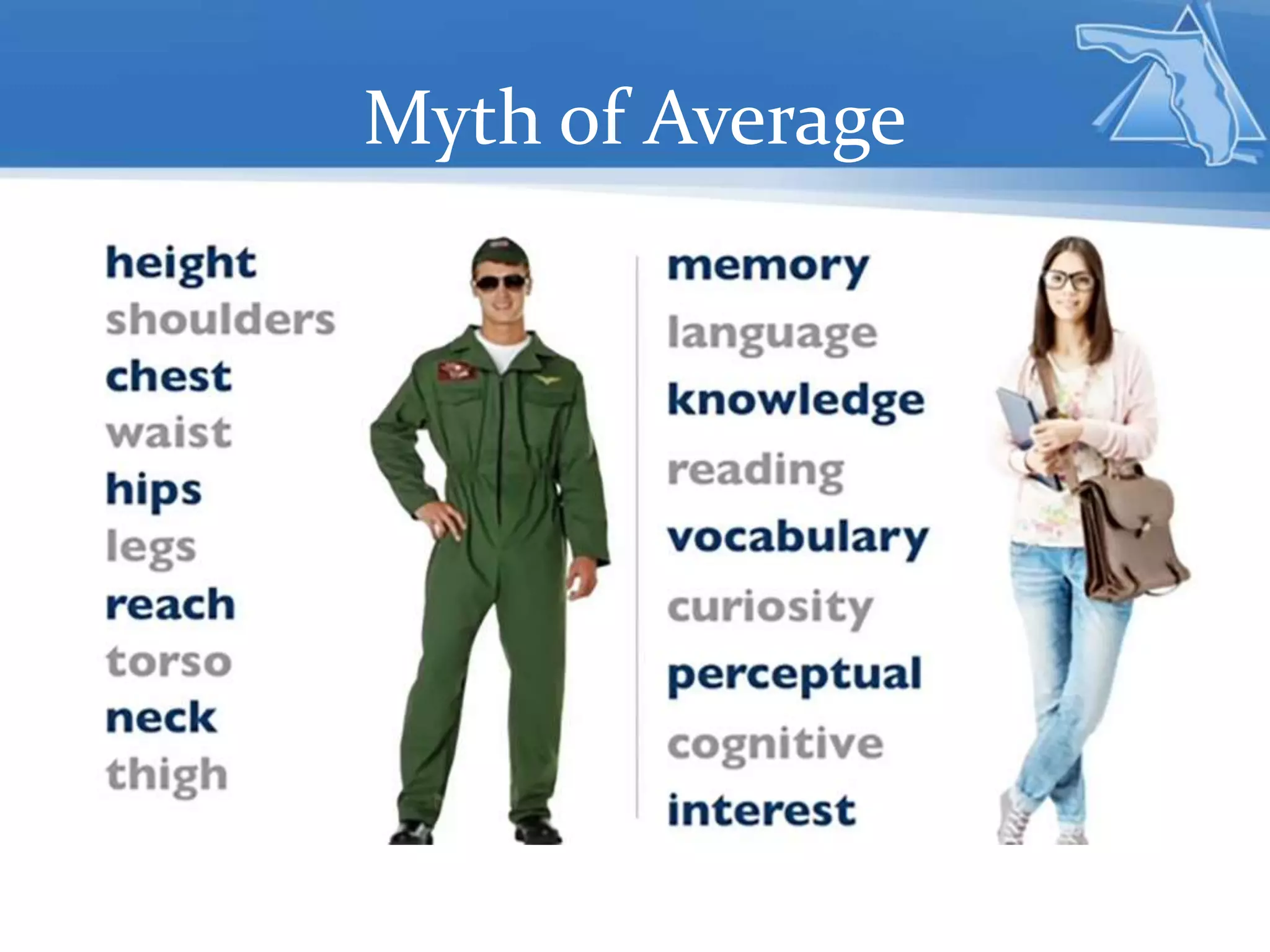
Myth of Average
Myth of Average
Myth of Average
Myth of Average
Myth of Average
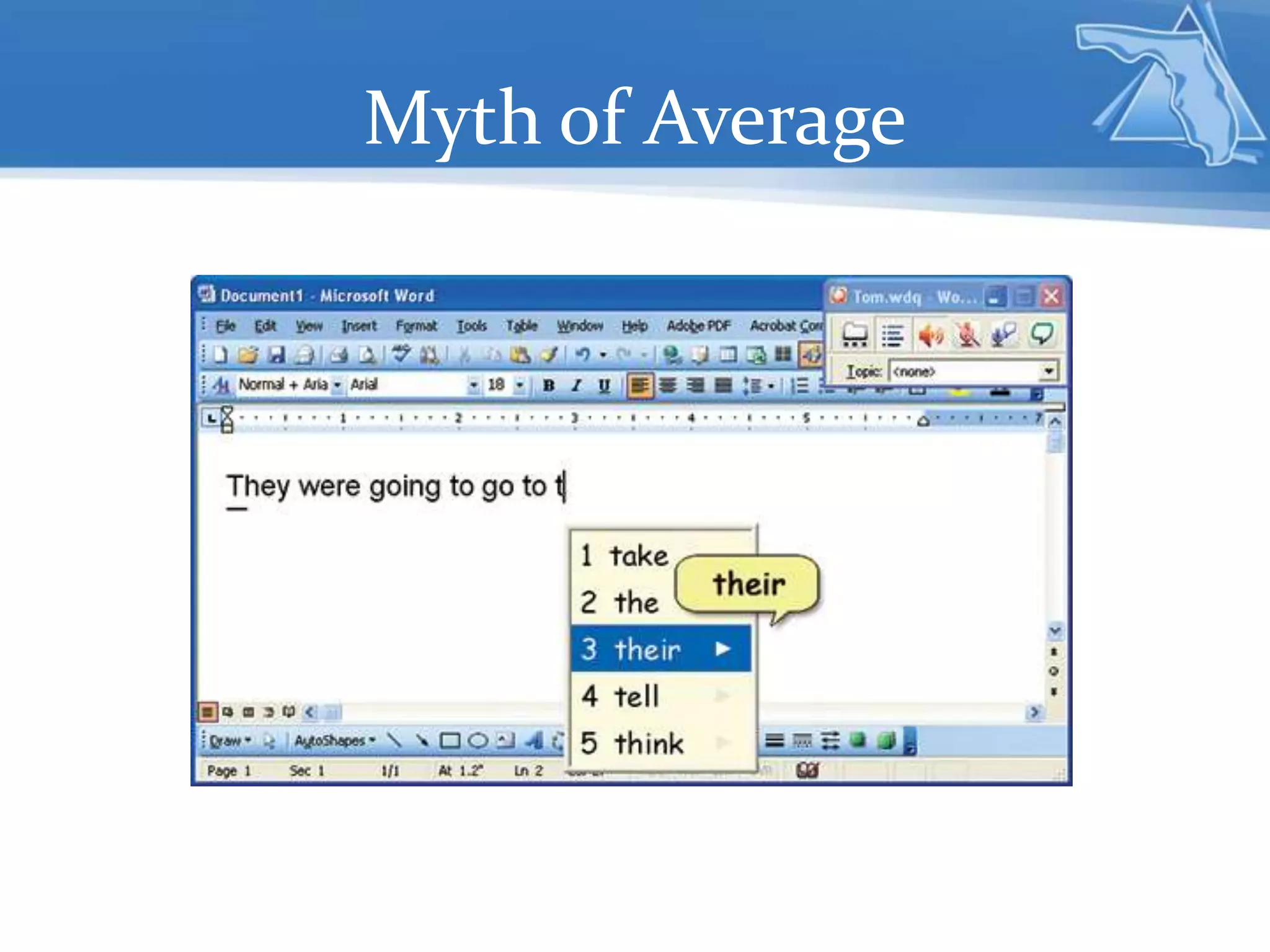
• Readability
Myth of Average
Neuroscience
Neuroscience
UDL Principles
UDL Principles
• Key Ideas
– Providing options can help students focus on
the same learning goal
– Providing options can increase student
independence
– Providing options enables diverse students to
work together, developing student
communities of practice
UDL Principles
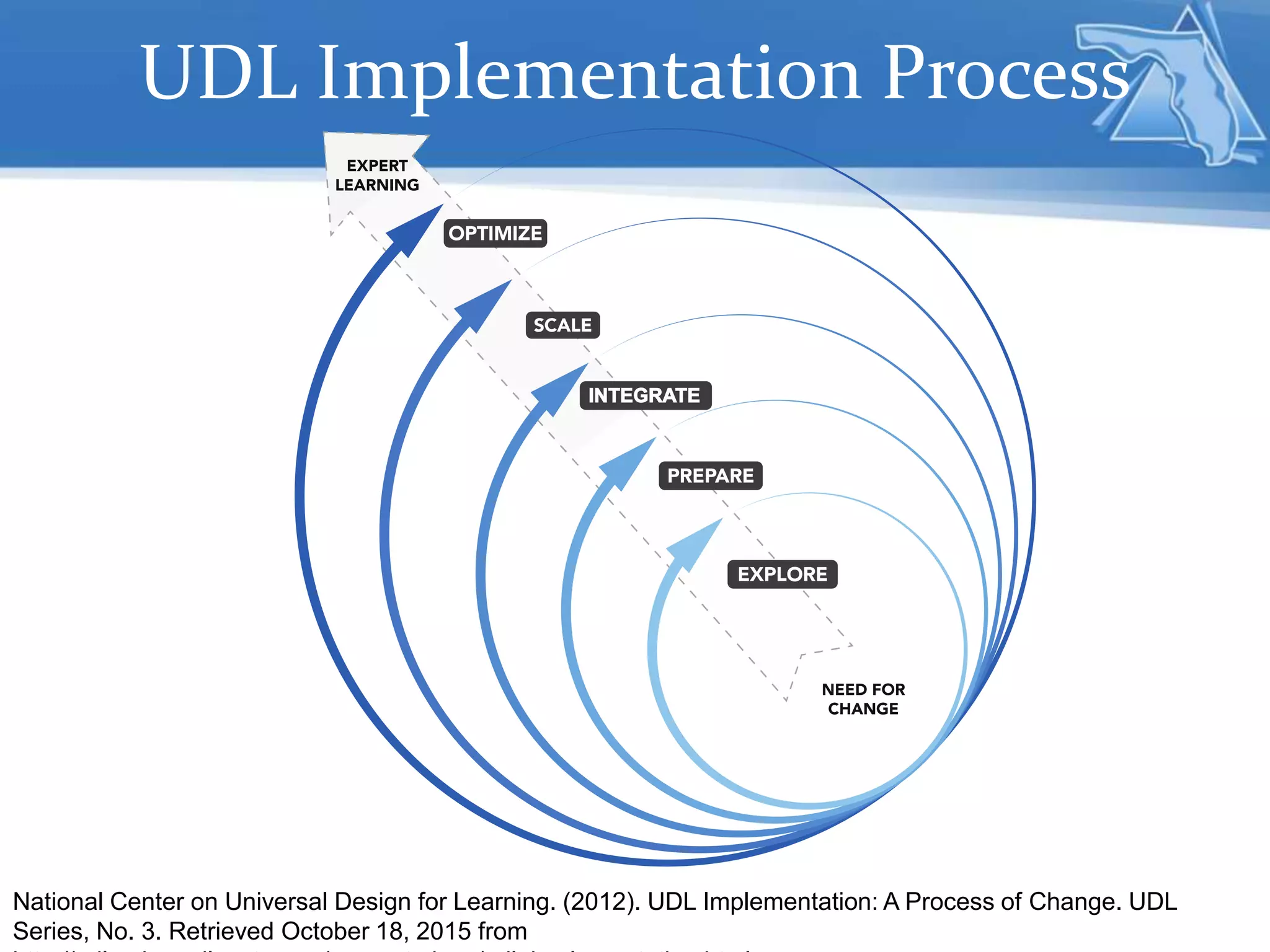
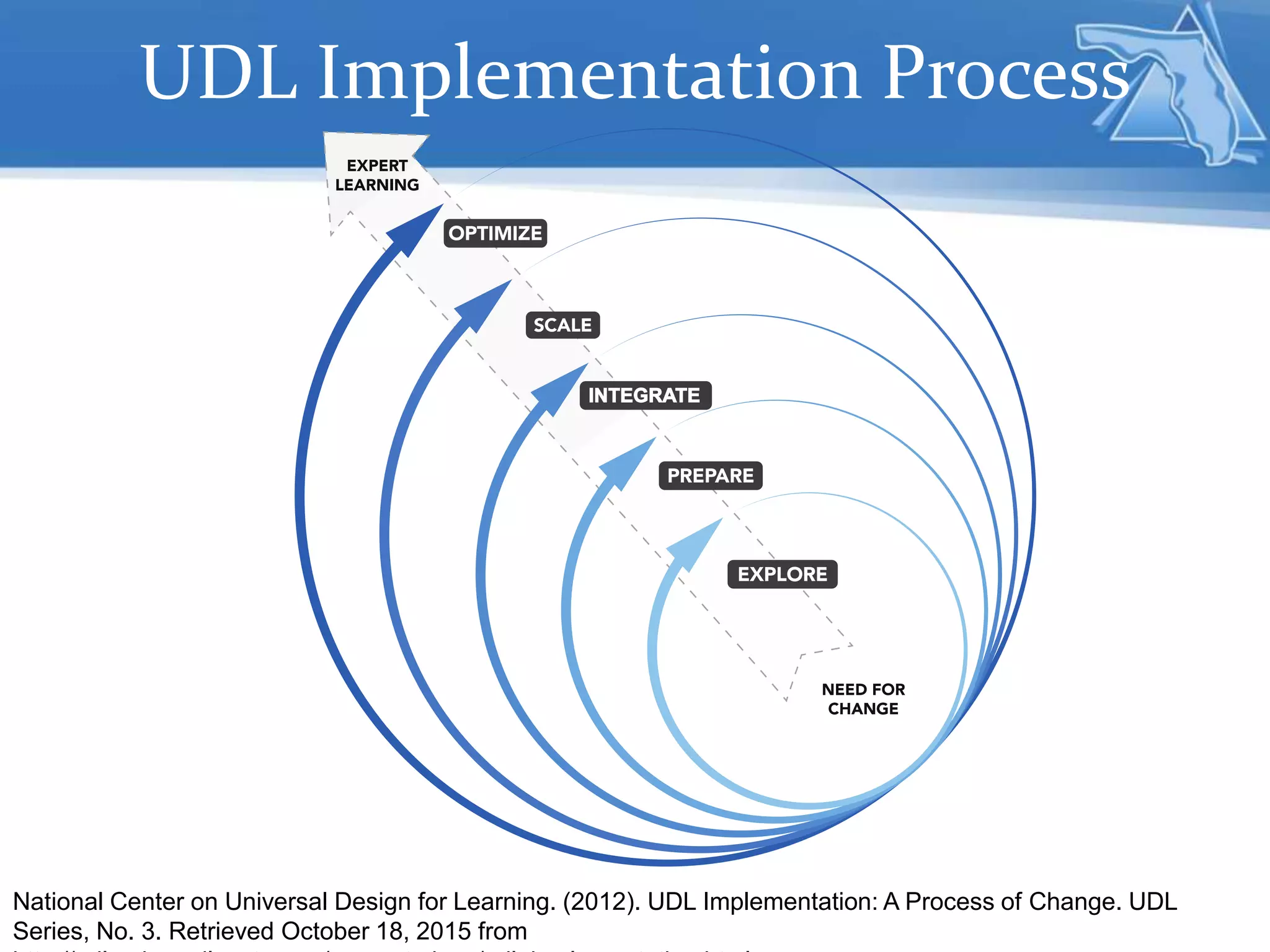
UDL Implementation Process
• UDL implementation is a process of change that
tends to occur in a recursive, continuously
improving cycle of learning and progressing
(Ganley & Ralabate, 2013). While the change
that occurs during the process of systemic UDL
implementation is predictable, it is also flexible.
• Importantly, the five UDL implementation
phases may exist as discretely separate,
sequential periods of focus for some
schools/districts or they may overlap or repeat
in a recursive manner for other schools/districts.
Ganley, P. & Ralabate, P. (2013). A Tale of Four Districts. Retrieved June 11,
2013 from http://www.udlcenter.org/implementation/ fourdistricts
National Center on Universal Design for Learning. (2012). UDL Implementation: A Process of Change. UDL
Series, No. 3. Retrieved October 18, 2015 from
UDL Implementation Process
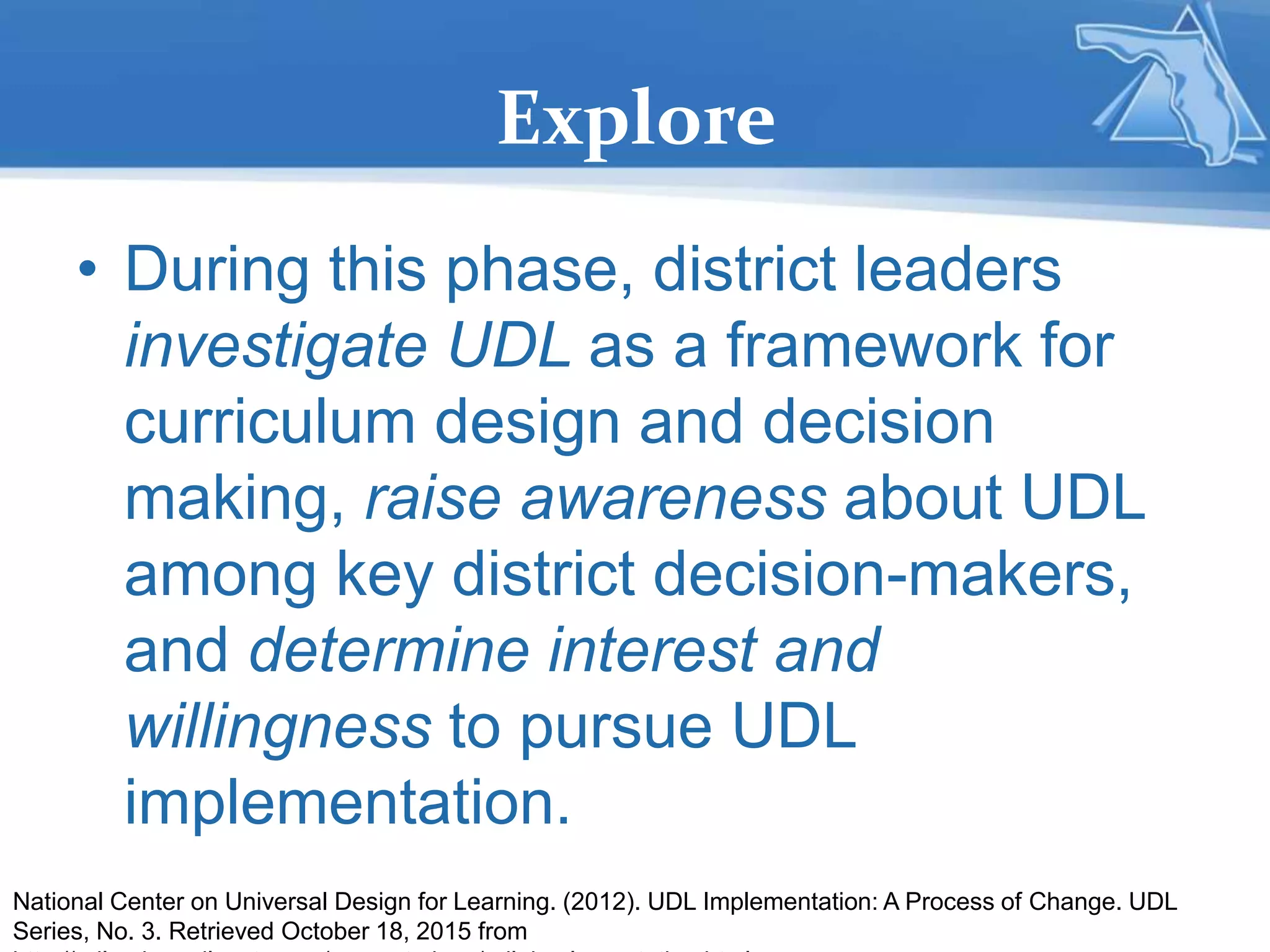
Explore
• During this phase, district leaders
investigate UDL as a framework for
curriculum design and decision
making, raise awareness about UDL
among key district decision-makers,
and determine interest and
willingness to pursue UDL
implementation.
National Center on Universal Design for Learning. (2012). UDL Implementation: A Process of Change. UDL
Series, No. 3. Retrieved October 18, 2015 from
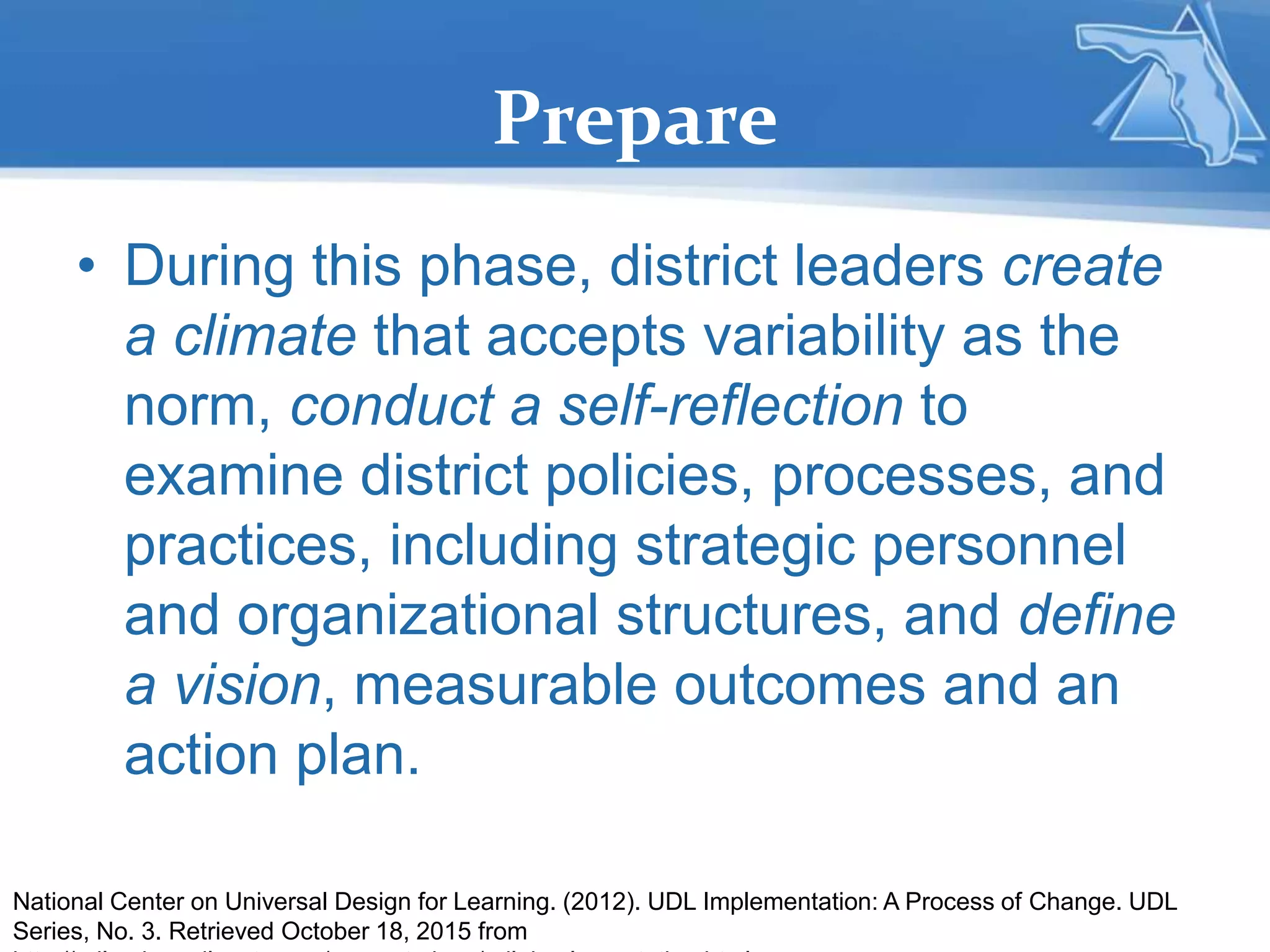
Prepare
• During this phase, district leaders create
a climate that accepts variability as the
norm, conduct a self-reflection to
examine district policies, processes, and
practices, including strategic personnel
and organizational structures, and define
a vision, measurable outcomes and an
action plan.
National Center on Universal Design for Learning. (2012). UDL Implementation: A Process of Change. UDL
Series, No. 3. Retrieved October 18, 2015 from
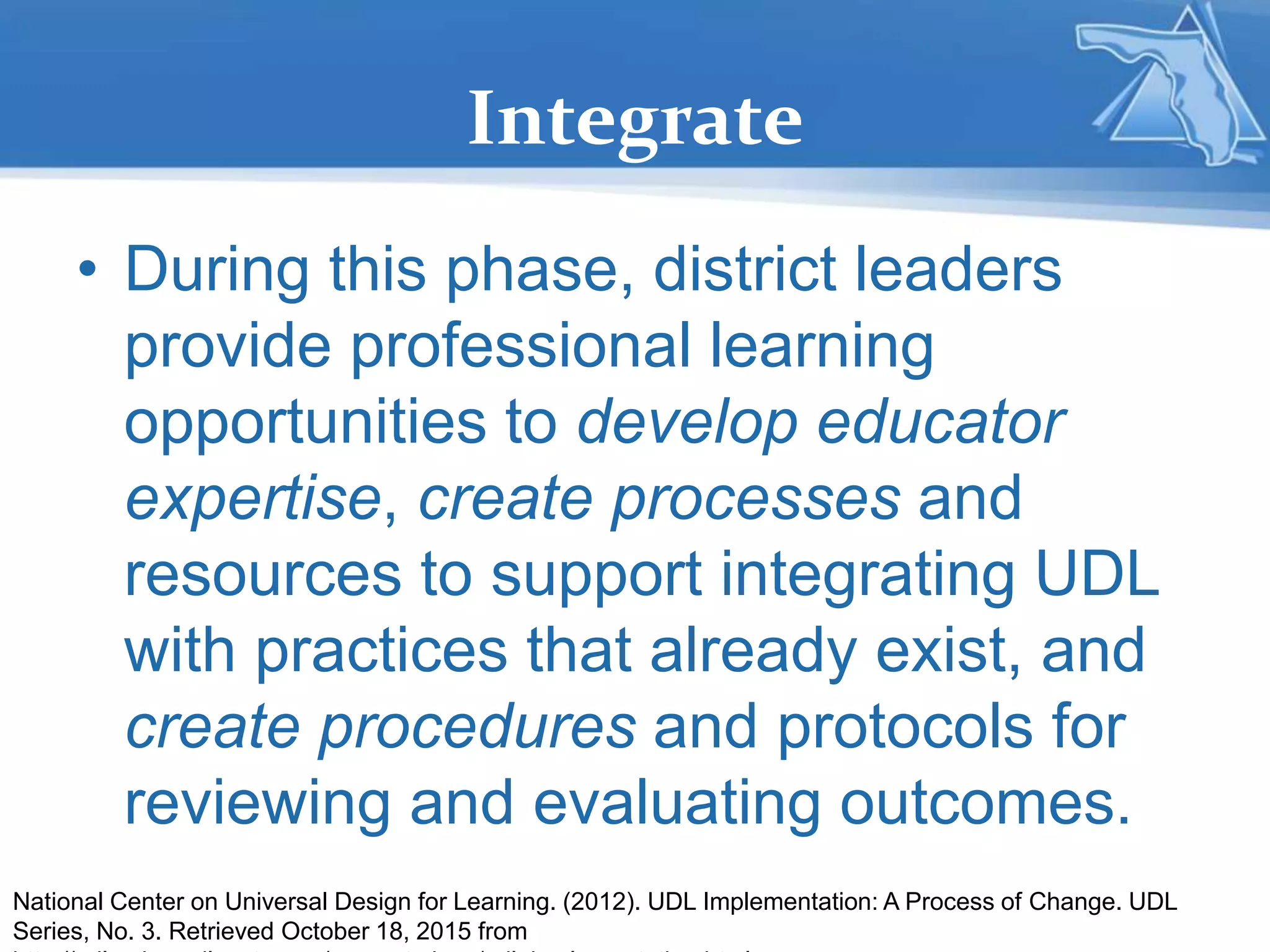
Integrate
• During this phase, district leaders
provide professional learning
opportunities to develop educator
expertise, create processes and
resources to support integrating UDL
with practices that already exist, and
create procedures and protocols for
reviewing and evaluating outcomes.
National Center on Universal Design for Learning. (2012). UDL Implementation: A Process of Change. UDL
Series, No. 3. Retrieved October 18, 2015 from
Scale
• During this phase, district leaders
enhance effective processes and
organizational supports, expand
practices throughout the system, and
promote a community of practice to
support shared learning across the
system.
National Center on Universal Design for Learning. (2012). UDL Implementation: A Process of Change. UDL
Series, No. 3. Retrieved October 18, 2015 from
Optimize
• During this phase, district leaders
strategically predict and plan for
internal and external change that
could impact UDL implementation,
embed processes that allow for
innovation while maximizing
continuous improvement, and
cultivate and enhance a UDL culture.
National Center on Universal Design for Learning. (2012). UDL Implementation: A Process of Change. UDL
Series, No. 3. Retrieved October 18, 2015 from
National Center on Universal Design for Learning. (2012). UDL Implementation: A Process of Change. UDL
Series, No. 3. Retrieved October 18, 2015 from
UDL Implementation Process
Resources
Hattie, J., Yates, G. (2014). Visible Learning and the Science of
How We Learn. Routledge, NY http://amzn.to/1knntJY
Rose, D., Meyer, A. (2002). Teaching Every Student in the Digital
Age: Universal Design for Learning. ASCD Retrieved from
http://bit.ly/1QPSRLt
Rose, D., Meyer, A., Gordon, D. (2014). Universal Design for
Learning: Theory and Practice. CAST Retrieved from
http://bit.ly/1ZVkZmG
Specially designed instruction for students with disabilities within
a multi-tiered system of supports. (n.d.). Retrieved from
http://bit.ly/1QPT0i0
Handouts on Conference Flash Drive
Contacts
• Clark Dorman - Project Leader, PS/RtI Project
– University of South Florida
– Dorman@usf.edu
• David Davis - Technology & Learning Connections,
PS/RtI Project
– University of South Florida
– david@tlc-mtss.com
• Dr. Jon Mundorf – Teacher, P.K. Yonge
Developmental Research School
– University of Florida
– UDL Summer Institute Faculty, Harvard Graduate School
of Education
– jmundorf@yahoo.com
DESIGNING AN EFFECTIVE AND
EQUITABLE MTSS FOR ALL
STUDENTS THROUGH UNIVERSAL
DESIGN FOR LEARNING
Clark Dorman, University of South Florida
David Davis, University of South Florida
Dr. Jon Mundorf, PK Yonge Developmental
Research School, University of Florida

Universal Design for Learning

  • 1.
    DESIGNING AN EFFECTIVEAND EQUITABLE MTSS FOR ALL STUDENTS THROUGH UNIVERSAL DESIGN FOR LEARNING Clark Dorman, University of South Florida David Davis, University of South Florida Dr. Jon Mundorf, PK Yonge Developmental Research School, University of Florida
  • 2.
    Objectives • Make Connectionsto NASP & FASP • Multi-tiered System of Supports • Universal Design for Learning – Basics • Universal Design for Learning – Implementation • Resources
  • 3.
  • 4.
  • 5.
    Critical Components ofMTSS Data Evaluation Problem Solving Process Multiple Tiers of Instruction & Intervention Leadership Capacity Building Infrastructure Communicatio n & Collaboration MTSS is a framework to ensure successful education outcomes for ALL students by using a data-based problem solving process to provide, and evaluate the effectiveness of multiple tiers of integrated academic, behavior, and social-emotional instruction/intervention supports matched to student need in alignment with educational standards.
  • 6.
    Multi-tier Model of ServiceDelivery • Standards Based Instruction • Assessments to inform instruction • Enables efficient use of school resources • Evidence-based programs and practice • Focus on integration & alignment with core (Academic & Behavior) • Frequency & intensity of instruct/intervention match to student need Data Evaluation Problem Solving Process Multiple Tiers of Instruction & Intervention Leadership Capacity Building Infrastructure Communication & Collaboration
  • 7.
    Problem-Solving • Consistent 4-stepPS process – The 4-step problem-solving model involves: • Step 1: Define, in objective and measurable terms, the goal(s) to be attained • Step 2: Identify possible reasons why the desired goal(s) is not being attained. • Step 3: Develop & implement a well-supported plan involving evidence- based strategies to attain the goal(s) • Step 4: Evaluate the effectiveness of the plan in relation to stated goals. • Education decisions (e.g. intervention effectiveness) are measured by student growth • Collaborative Team-based • Decision protocols; decision-rules • Frequency & intensity of assessment & problem solving match to student need Data Evaluation Problem Solving Process Multiple Tiers of Instruction & Intervention Leadership Capacity Building Infrastructure Communication & Collaboration
  • 8.
    Leadership • Principal activelyinvolved in MTSS implementation • Strategic MTSS Implementation Plan developed • Cross-disciplinary Leadership Team is responsible for MTSS implementation • Leadership Team organizes professional development and coaching supports for MTSS implementation Data Evaluation Problem Solving Process Multiple Tiers of Instruction & Intervention Leadership Capacity Building Infrastructure Communication & Collaboration
  • 9.
    Data Evaluation • Integrateddata system • Comprehensive efficient and user-friendly data system for decision-making • Evaluation of effectiveness of interventions and fidelity of implementation • Use of valid and reliable assessments from a variety of sources • Ongoing assessment of student learning Data Evaluation Problem Solving Process Multiple Tiers of Instruction & Intervention Leadership Capacity Building Infrastructure Communication & Collaboration
  • 10.
    Building Capacity & Infrastructure •Ongoing data-driven Professional Development and Coaching • Professional Development aligned with expected responsibilities of trainees • Schedules allow for multiple tiers of instruction and intervention, along with collaborative, data-based problem-solving • Establish written practices, policies, and implementation plans Data Evaluation Problem Solving Process Multiple Tiers of Instruction & Intervention Leadership Capacity Building Infrastructure Communication & Collaboration
  • 11.
    Communication & Collaboration • Staffhave consensus about and engage in MTSS implementation • Family and community engagement • Staff are provided data on MTSS implementation fidelity and student outcomes Data Evaluation Problem Solving Process Multiple Tiers of Instruction & Intervention Leadership Capacity Building Infrastructure Communication & Collaboration
  • 12.
    Traditional vs. Responseto Intervention Intervention J L J L Intervention Consider ESE Traditional J L J L J Response to Intervention Consider ESE if necessary General Education Monitor Progress Monitor Progress Problem Solving Problem Solving Problem Solving Problem Solving - Get Label - Get Help
  • 13.
  • 14.
  • 15.
  • 16.
  • 17.
  • 18.
  • 19.
  • 20.
  • 21.
  • 22.
  • 23.
  • 24.
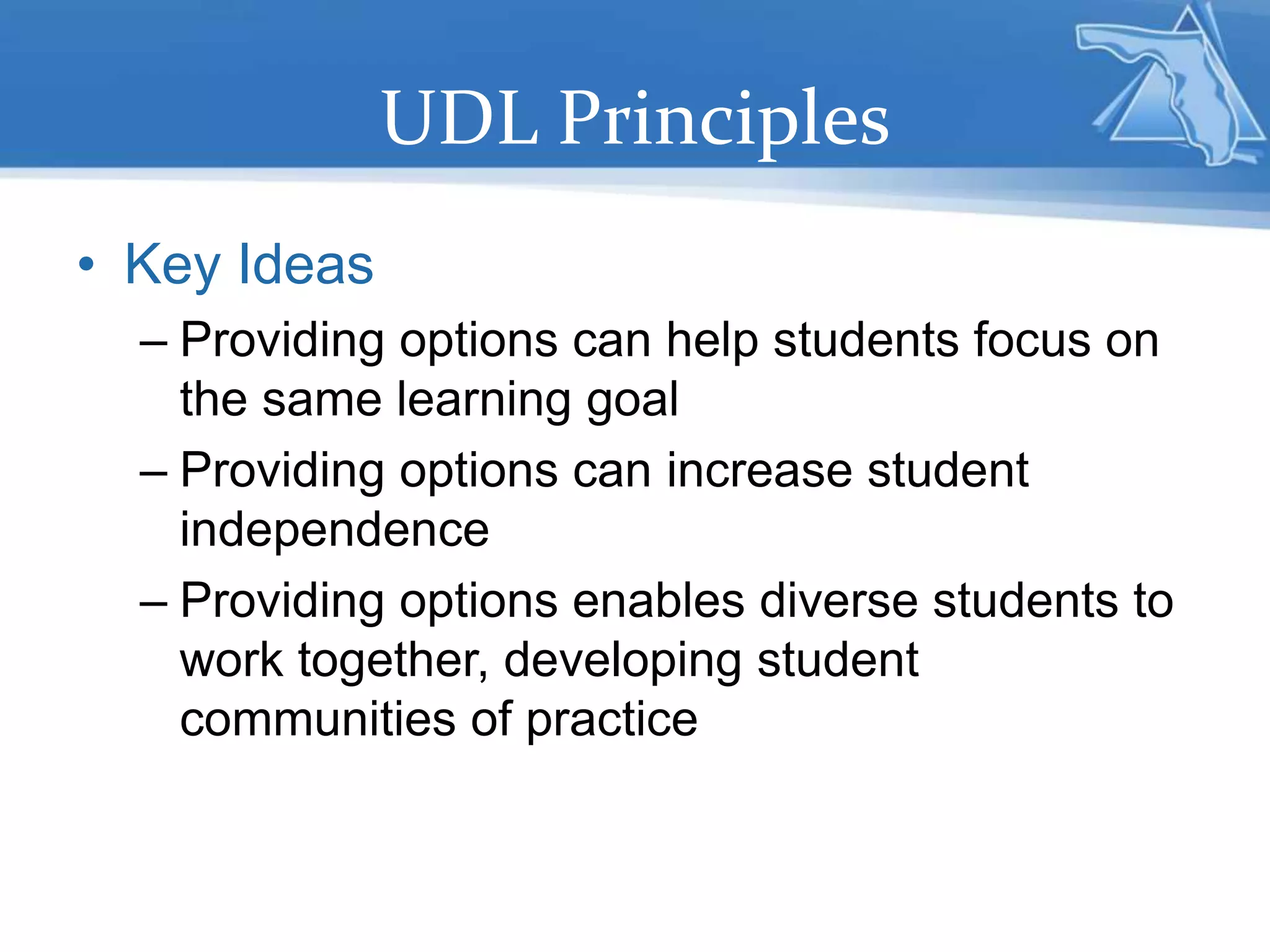
    UDL Principles • KeyIdeas – Providing options can help students focus on the same learning goal – Providing options can increase student independence – Providing options enables diverse students to work together, developing student communities of practice
  • 25.
  • 26.
    UDL Implementation Process •UDL implementation is a process of change that tends to occur in a recursive, continuously improving cycle of learning and progressing (Ganley & Ralabate, 2013). While the change that occurs during the process of systemic UDL implementation is predictable, it is also flexible. • Importantly, the five UDL implementation phases may exist as discretely separate, sequential periods of focus for some schools/districts or they may overlap or repeat in a recursive manner for other schools/districts. Ganley, P. & Ralabate, P. (2013). A Tale of Four Districts. Retrieved June 11, 2013 from http://www.udlcenter.org/implementation/ fourdistricts
  • 27.
    National Center onUniversal Design for Learning. (2012). UDL Implementation: A Process of Change. UDL Series, No. 3. Retrieved October 18, 2015 from UDL Implementation Process
  • 28.
    Explore • During thisphase, district leaders investigate UDL as a framework for curriculum design and decision making, raise awareness about UDL among key district decision-makers, and determine interest and willingness to pursue UDL implementation. National Center on Universal Design for Learning. (2012). UDL Implementation: A Process of Change. UDL Series, No. 3. Retrieved October 18, 2015 from
  • 29.
    Prepare • During thisphase, district leaders create a climate that accepts variability as the norm, conduct a self-reflection to examine district policies, processes, and practices, including strategic personnel and organizational structures, and define a vision, measurable outcomes and an action plan. National Center on Universal Design for Learning. (2012). UDL Implementation: A Process of Change. UDL Series, No. 3. Retrieved October 18, 2015 from
  • 30.
    Integrate • During thisphase, district leaders provide professional learning opportunities to develop educator expertise, create processes and resources to support integrating UDL with practices that already exist, and create procedures and protocols for reviewing and evaluating outcomes. National Center on Universal Design for Learning. (2012). UDL Implementation: A Process of Change. UDL Series, No. 3. Retrieved October 18, 2015 from
  • 31.
    Scale • During thisphase, district leaders enhance effective processes and organizational supports, expand practices throughout the system, and promote a community of practice to support shared learning across the system. National Center on Universal Design for Learning. (2012). UDL Implementation: A Process of Change. UDL Series, No. 3. Retrieved October 18, 2015 from
  • 32.
    Optimize • During thisphase, district leaders strategically predict and plan for internal and external change that could impact UDL implementation, embed processes that allow for innovation while maximizing continuous improvement, and cultivate and enhance a UDL culture. National Center on Universal Design for Learning. (2012). UDL Implementation: A Process of Change. UDL Series, No. 3. Retrieved October 18, 2015 from
  • 33.
    National Center onUniversal Design for Learning. (2012). UDL Implementation: A Process of Change. UDL Series, No. 3. Retrieved October 18, 2015 from UDL Implementation Process
  • 34.
    Resources Hattie, J., Yates,G. (2014). Visible Learning and the Science of How We Learn. Routledge, NY http://amzn.to/1knntJY Rose, D., Meyer, A. (2002). Teaching Every Student in the Digital Age: Universal Design for Learning. ASCD Retrieved from http://bit.ly/1QPSRLt Rose, D., Meyer, A., Gordon, D. (2014). Universal Design for Learning: Theory and Practice. CAST Retrieved from http://bit.ly/1ZVkZmG Specially designed instruction for students with disabilities within a multi-tiered system of supports. (n.d.). Retrieved from http://bit.ly/1QPT0i0 Handouts on Conference Flash Drive
  • 35.
    Contacts • Clark Dorman- Project Leader, PS/RtI Project – University of South Florida – Dorman@usf.edu • David Davis - Technology & Learning Connections, PS/RtI Project – University of South Florida – david@tlc-mtss.com • Dr. Jon Mundorf – Teacher, P.K. Yonge Developmental Research School – University of Florida – UDL Summer Institute Faculty, Harvard Graduate School of Education – jmundorf@yahoo.com
  • 36.
    DESIGNING AN EFFECTIVEAND EQUITABLE MTSS FOR ALL STUDENTS THROUGH UNIVERSAL DESIGN FOR LEARNING Clark Dorman, University of South Florida David Davis, University of South Florida Dr. Jon Mundorf, PK Yonge Developmental Research School, University of Florida

Editor's Notes

  • #6 There are key components that form the foundation of the MTSS framework. These are…. (read list). Each will be briefly discussed in the following slides.
  • #7 The Mult-tiered model of service delivery is based upon a three tiered structure of support where by students receive support based on their needs. Tier One (the lowest level) is directed at all students while tiers two and three are directed towards groups and individuals who require additional or supplemental support. This three-tiered model will be described in more detail later in the presentation.
  • #8 Problem-Solving - MTSS is driven by a 4 step problem-solving model. This model is an iterative, self-correcting approach to treatment of educational problems. Through the four steps: problem identification, problem analysis, intervention development and evaluation, this model provides a thinking structure which framing school-based problems, for analyzing etiologies of these problems and for testing and determining effective solutions (Tilly, 2008).
  • #13 Before click 1: This slide contains a pair of graphics that characterize two different systems within which I’ve worked – a traditional system and an RtI system. Let’s look at some of the foundational differences. Click 1: Under a traditional system we would intervene and get one of two potential outcomes Click 2: Smiley face or Click 3: Frowny face. And if we got a frowny face we would Click 4: Intervene again (because we have to have two interventions) with two potential outcomes Click 5: Smiley face or Click 6: Frowny face. Click 7: And after we’d stacked up enough frowny faces we would consider special education. We had created a system that viewed special education the only mechanism for access to student assistance, so folks would relentlessly pursue that. The central question at the table was, “Are we or are we not going to test this child?” The mindset was that a label = help. The problem was that the adults in the system viewed smiley face as a barrier to obtaining help and at times would get quite upset if there was a smiley face. In fact, I’ve heard people at the table say things like, “The only reason he’s doing well is because I’m helping him!” – and the logic almost seemed sound at the time. So this system was built and sustained on the discovery of student failure rather than student success. The more failure that was discovered, the more the adults in the system were reinforced. At the point of eligibility, we would hand the student over to the special education teacher and say something that was, in essence, “We had lots of meetings with lots of people and tried lots of things, but none of them worked so…. do the best you can.” - and for us, that was where it ended. Click 8: In a response to intervention system we intervene – with interventions that are designed/developed through a structured problem solving process – again with two possible outcomes. Click 9: Smiley face or Click 10: Frowny face. Click 11: If we get a smiley face, we monitor progress, at a frequency appropriate to the level of resource, to assure that we sustain the smile. Click 12: If we get a frowny face, we’ll intervene again, still through the structured, self-correcting, problem solving process – with, once again, two potential outcomes Click 13: Smiley face or Click 14: Frowny face. Click 15: If we get a smiley face we’ll monitor progress and Click 16: if we get a frowny face, we’ll continue to intervene, until…. Click 17: we get a smiley face. We don’t stop until we get a smiley face and there is no payoff for frowny face. Click 18: At this point we can then answer the question, “Can we sustain this smile with the resources available in general education (If so, great), or is the amount of resource needed to sustain this smile so intense that we’ll need the services of special education to provide it?” Also at this point, we have the answers to the two most fundamental instructional questions, “What to teach?” and “How to teach it?” We’ve always had a two pronged set of criteria for special education eligibility – a student must 1) display the characteristics of a disability, and 2) must need special education. Traditionally, we’ve spent a lot of time and developed sophisticated ways to determine whether a child is a child with a disability, but we’ve not paid as much attention to the discovery of need. If a child was referred, we’ve sort of accepted that as evidence of need. So, in the traditional system, we first demonstrate characteristics of the disability and then assume need. In a PS/RtI system that’s flipped. First we discover what the need is, and then, if necessary explore the existence of a disability. So, it’s need first, then disability. In the words of Dave Tilly, “The change seems subtle… It ain’t!” When the target at the student assistance team table is the discovery of ‘what to teach’ and ‘how to teach it’ in order to maximize student outcomes, the activities that occur at that table and the questions asked are much different. In the words of Ken Howell, “The central question is not: ‘What about the students is causing the performance discrepancy?’ but ‘What about the interaction of the curriculum, instruction, learners and learning environment should be altered so that the students will learn?’ This shift alters everything else.” Whether exceptional education is considered, or not, the student comes to the classroom with a huge body of information gathered all along the way, focused on student success. The entire process targets understanding what instructional, curricular, and environmental variables we can alter to maximize student success. The target is always student success. Click 19: Regardless of the mechanism for instructional delivery (Gen ed/SPED) problem solving continues in order to maximize the positive impact of our instructional decisions.
  • #16 1952 – air force has a problem – good planes and good pilots but problems with the results so eventually they decided to look at the relationship between the pilot and the cockpit. The cockpits were designed for “average” pilots so they did some research to see how many pilots were average. They checked for average on a range of indicators. 0% were average. So they banned the average and demanded the companies design cockpits for the margins, or the edges. They didn’t want to, said it would be too expensive, but eventually they did it.
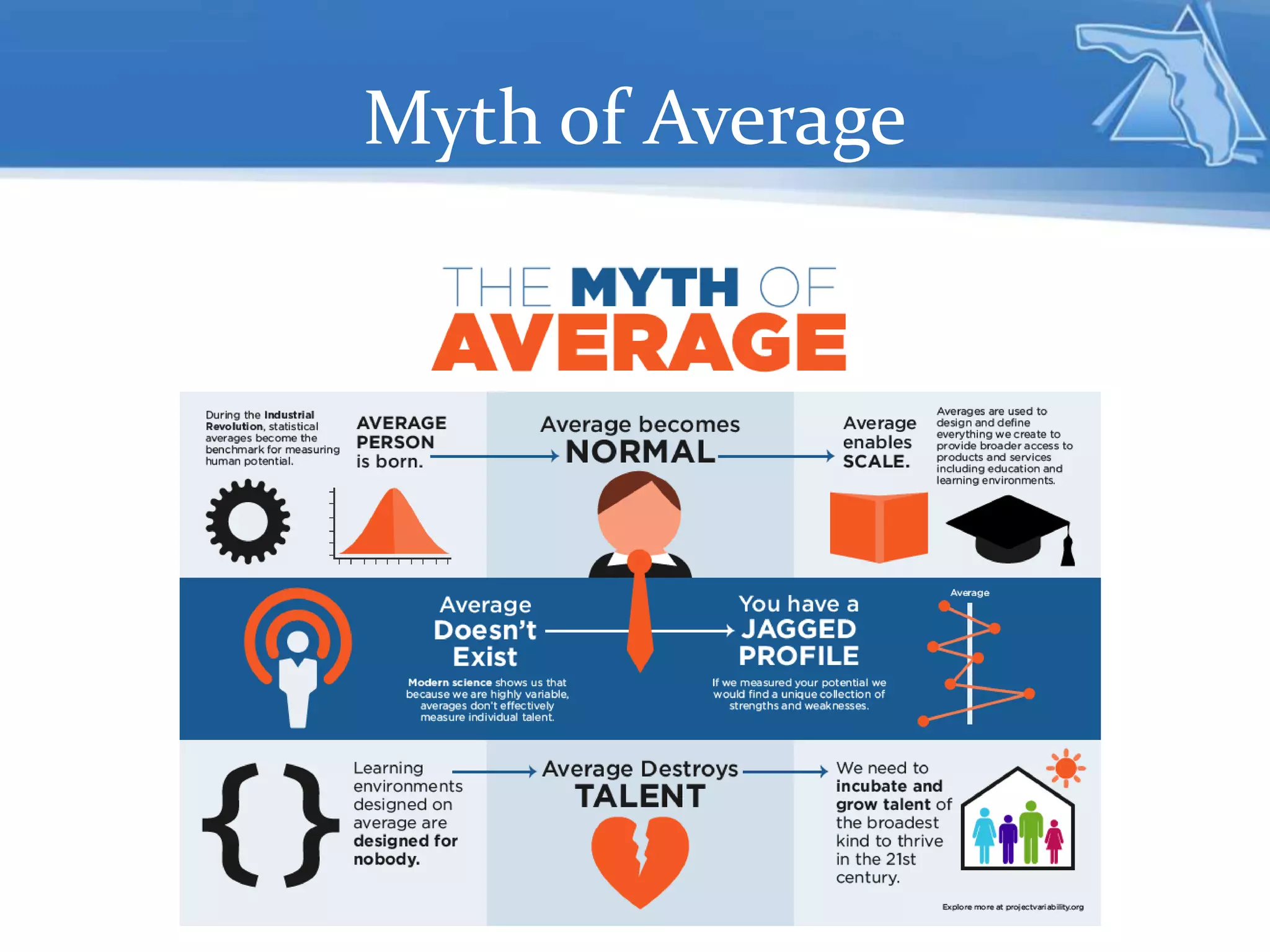
  • #18 There is no such thing as an average student yet our curriculum is designed for a mythical “average” with other students being considered gifted or struggling. Yet we have a lot of adjustable tools today.
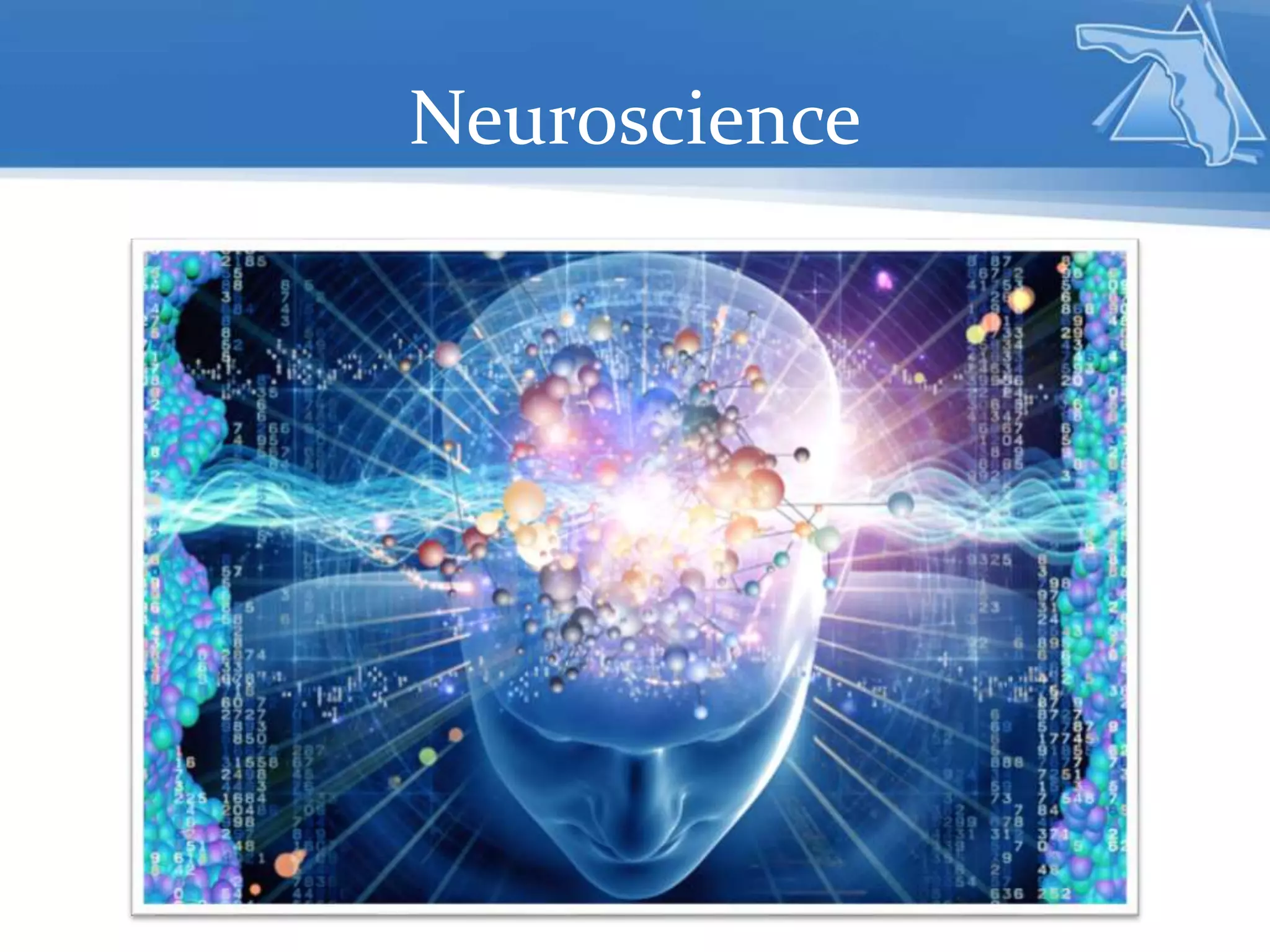
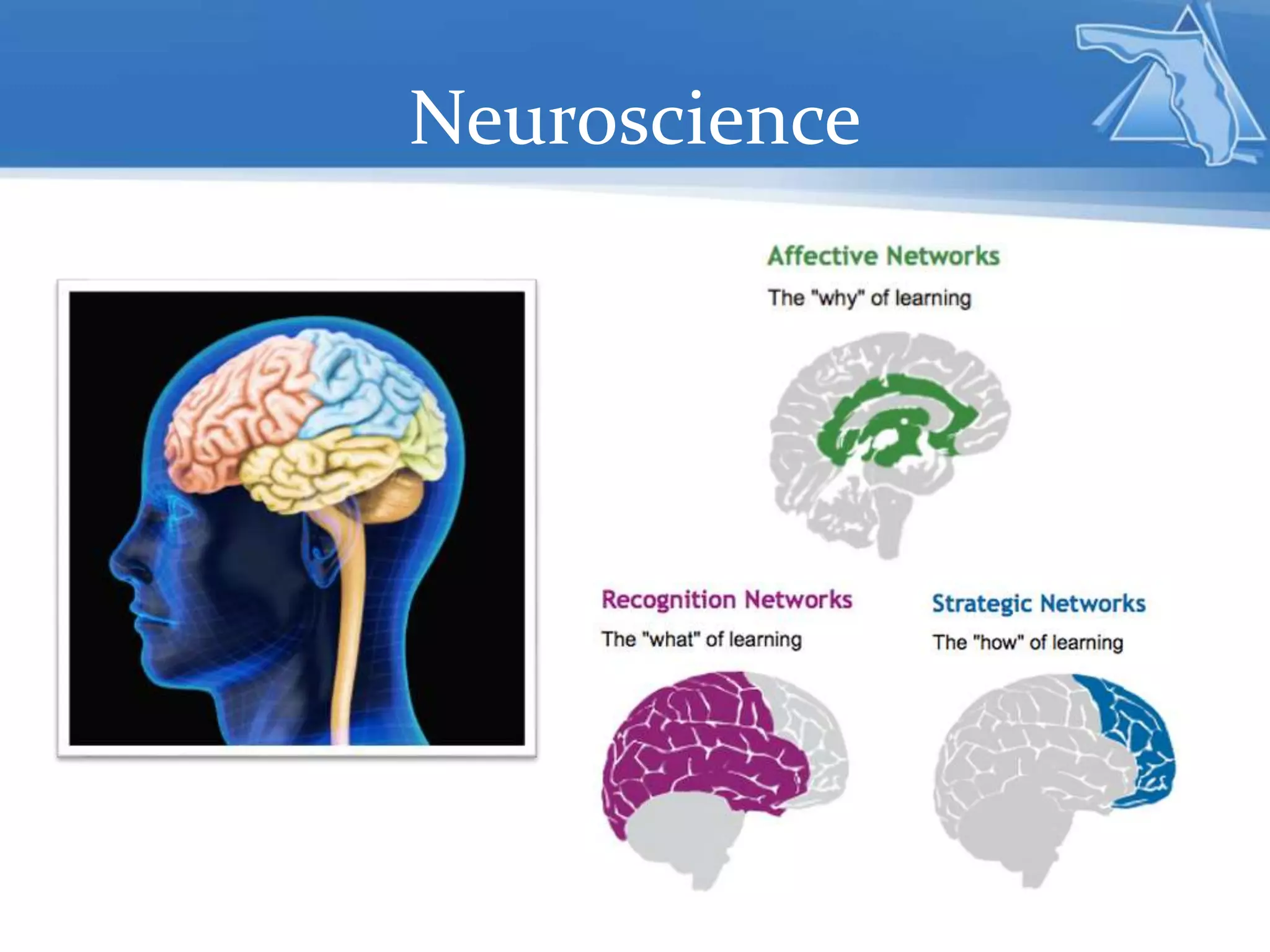
  • #22 Discussion includes Complexity of neural networks Predictability of variations in neural networks Addressing feelings and emotions, motivation and behavior, and how emotion organizes, drives, amplifies, and attenuates thinking and reasoning.
  • #23 The simplicity of this model does not take away from the complexity of what is going on. Rather, it provides predictable systemic variability.
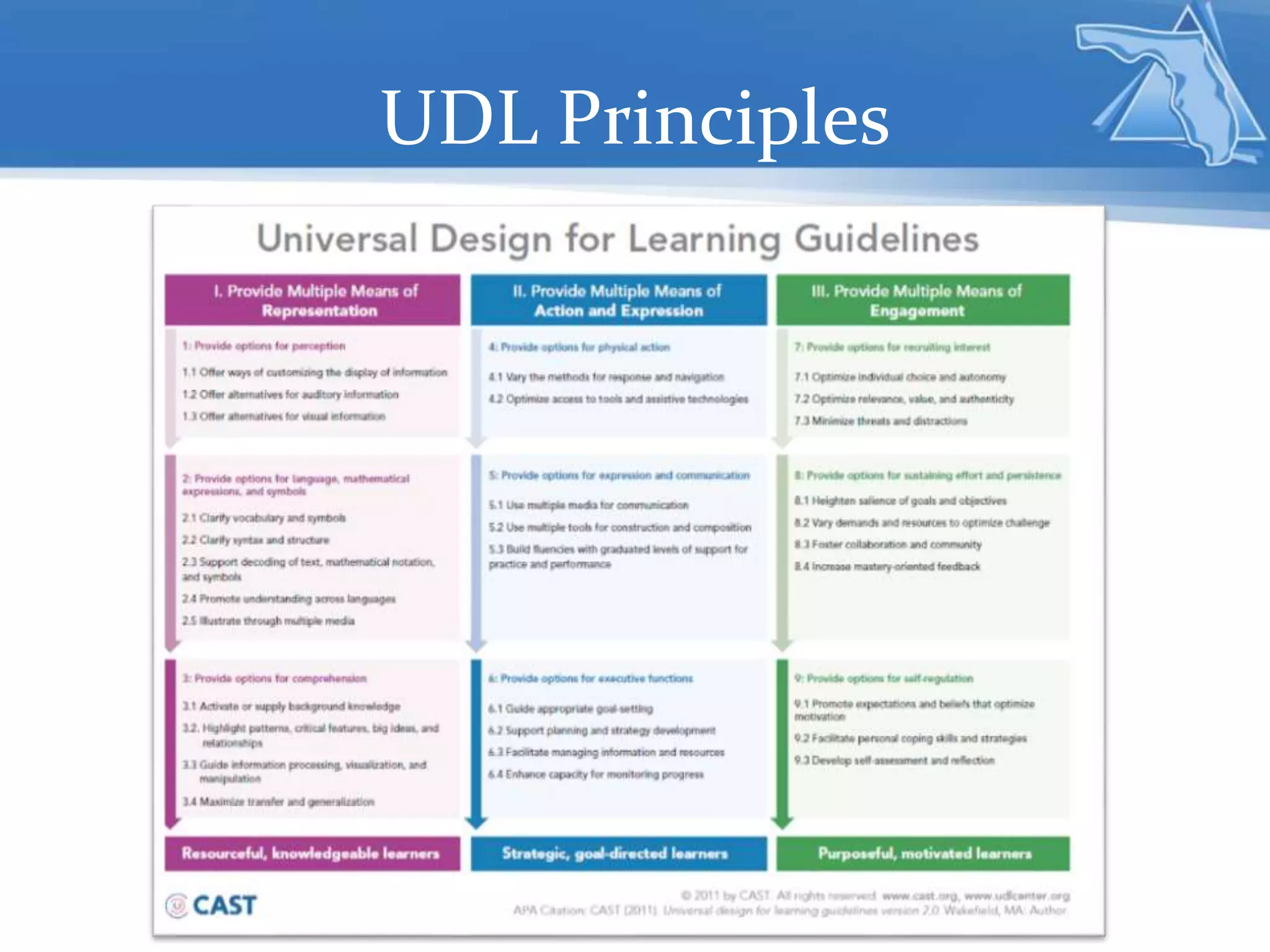
  • #24 The top is the UDL Principles The first section addresses removing barriers The middle section highlights strategies to move towards high-level expertise The bottom section emphasize the learning expertise that is the goal of UDL