Concept, Scope
Objectives,Principles
CONCEPT
 An educational program or service designed to meet
the needs of children with special needs who cannot
profit from general or regular education because of
disabilities or exceptional abilities.
 Special education refers to the education of persons
who are GIFTED OR TALENTED and those who have
PHYSICAL,MENTAL,SOCIAL OR SENSORY AND CULTURAL
DIFFERENCES so as to require modifications to
develop to their maximum capacities.
 Special education is a specially designed instruction
which meets the special needs of an exceptional child.
Special or Exceptional
children
 Special children are those who need separate settings as
compared to a normal school child. These children may be
classified on the basis of:
 Visual impairment.
 Hearing impairment.
 Speech or Language Impairment.
 Serious Emotional disturbance.
 Orthopedic impairment (bone and muscle problems)
 Educationally Exceptional (educationally bright , educationally
backward , learning disabled, mentally retarded)
 Socially Exceptional (maladjusted ,problematic, juvenile
delinquent, emotionally disturbed)
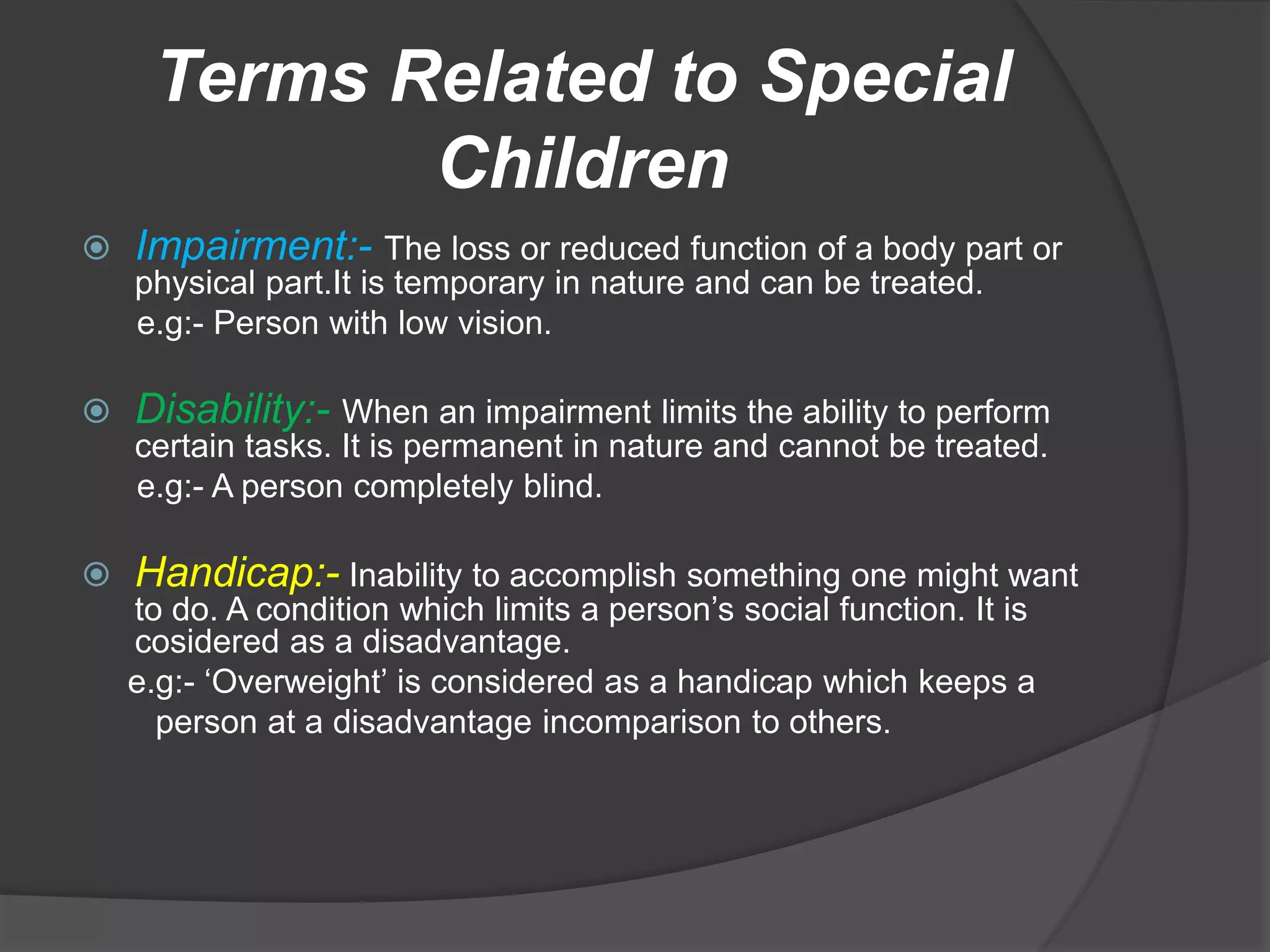
Terms Related to Special
Children
 Impairment:- The loss or reduced function of a body part or
physical part.It is temporary in nature and can be treated.
e.g:- Person with low vision.
 Disability:- When an impairment limits the ability to perform
certain tasks. It is permanent in nature and cannot be treated.
e.g:- A person completely blind.
 Handicap:- Inability to accomplish something one might want
to do. A condition which limits a person’s social function. It is
cosidered as a disadvantage.
e.g:- ‘Overweight’ is considered as a handicap which keeps a
person at a disadvantage incomparison to others.
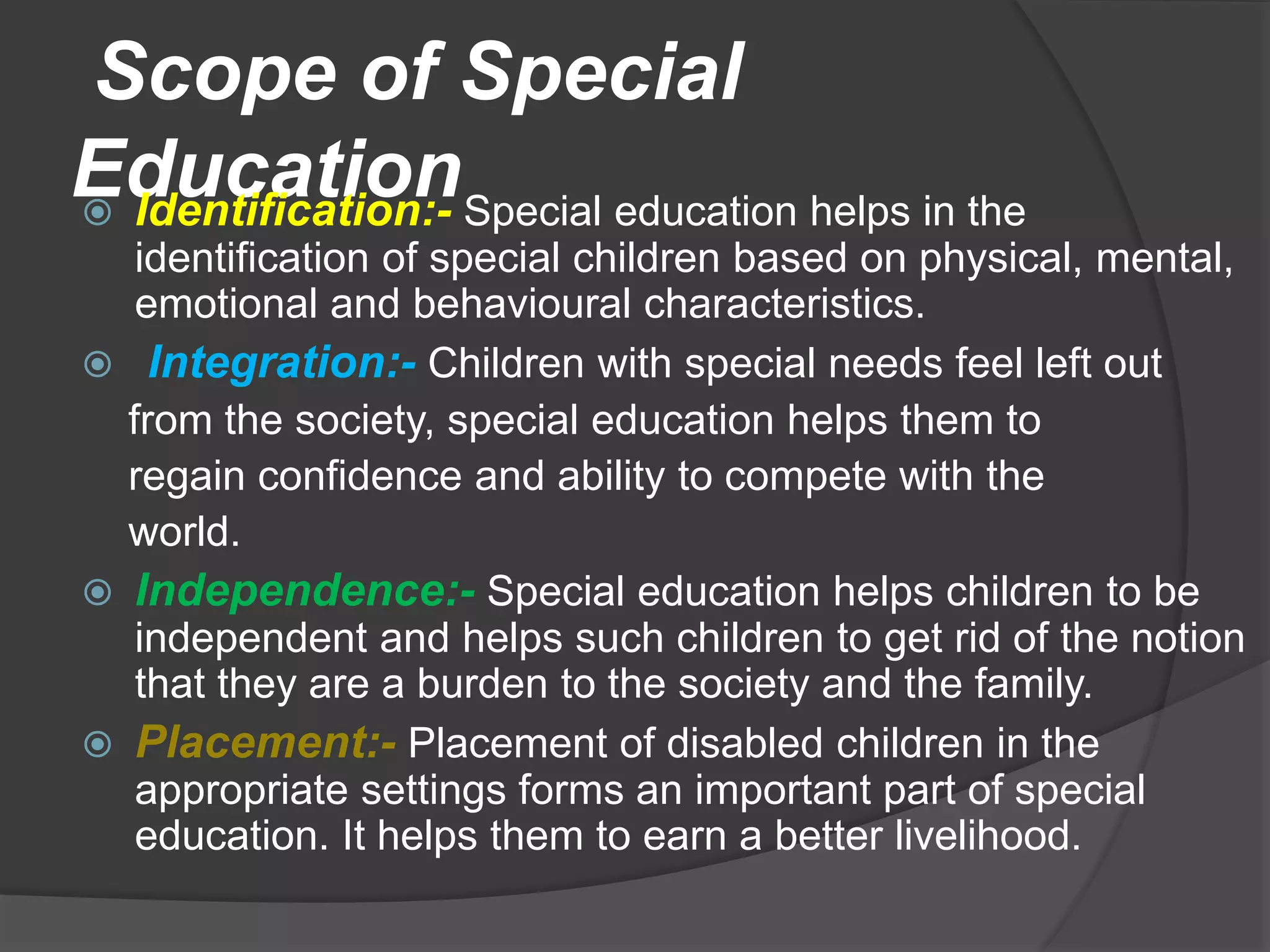
Scope of Special
Education
 Identification:- Special education helps in the
identification of special children based on physical, mental,
emotional and behavioural characteristics.
 Integration:- Children with special needs feel left out
from the society, special education helps them to
regain confidence and ability to compete with the
world.
 Independence:- Special education helps children to be
independent and helps such children to get rid of the notion
that they are a burden to the society and the family.
 Placement:- Placement of disabled children in the
appropriate settings forms an important part of special
education. It helps them to earn a better livelihood.
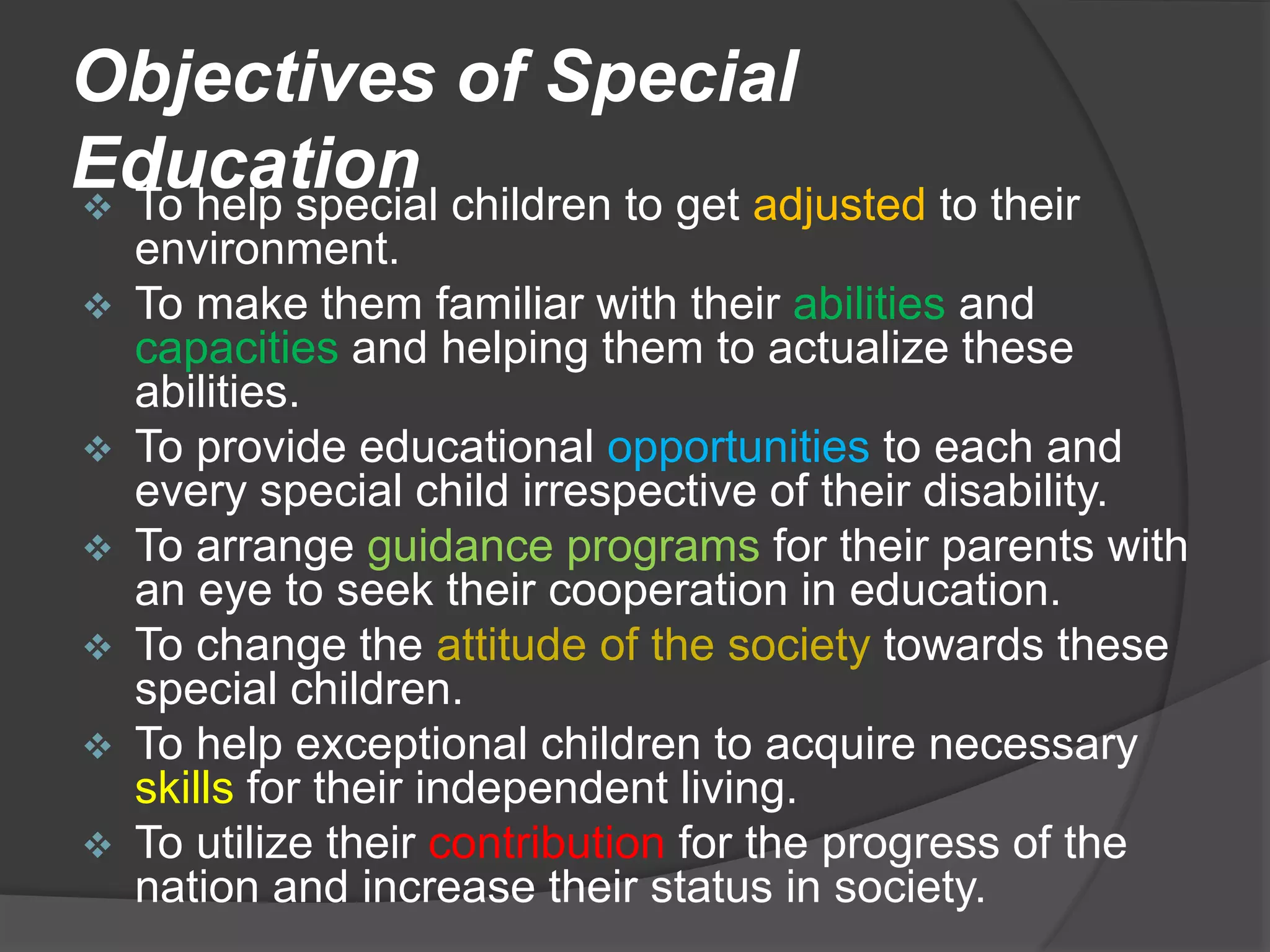
Objectives of Special
Education
 To help special children to get adjusted to their
environment.
 To make them familiar with their abilities and
capacities and helping them to actualize these
abilities.
 To provide educational opportunities to each and
every special child irrespective of their disability.
 To arrange guidance programs for their parents with
an eye to seek their cooperation in education.
 To change the attitude of the society towards these
special children.
 To help exceptional children to acquire necessary
skills for their independent living.
 To utilize their contribution for the progress of the
nation and increase their status in society.
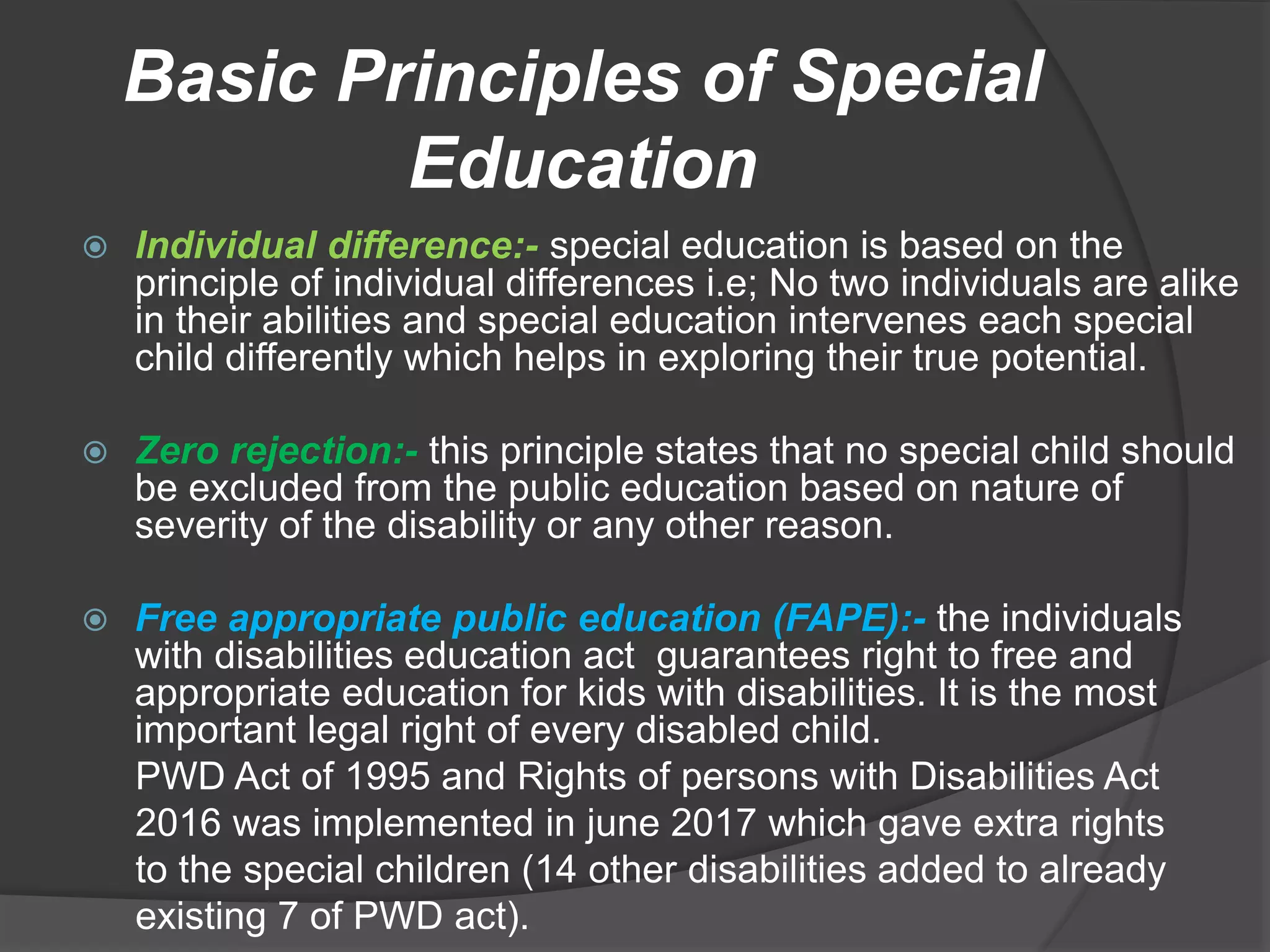
Basic Principles of Special
Education
 Individual difference:- special education is based on the
principle of individual differences i.e; No two individuals are alike
in their abilities and special education intervenes each special
child differently which helps in exploring their true potential.
 Zero rejection:- this principle states that no special child should
be excluded from the public education based on nature of
severity of the disability or any other reason.
 Free appropriate public education (FAPE):- the individuals
with disabilities education act guarantees right to free and
appropriate education for kids with disabilities. It is the most
important legal right of every disabled child.
PWD Act of 1995 and Rights of persons with Disabilities Act
2016 was implemented in june 2017 which gave extra rights
to the special children (14 other disabilities added to already
existing 7 of PWD act).
 Least restrictive environment (LRE):- least restrictive
environment is a rule of educating the students with
other normal students so that they don’t feel a sense of
self inadequacy.
 Non-discriminatory identification and evaluation:- this
principle helps to determine whether the student has a
disability and if so, what is the degree of exceptionality
and is there a need of special school or normal school.
 Parent and student participation:- special education
can be made effective if parents participate actively in
the educational programme designated for
handicapped children.
THANK YOU

Special edcation concept,scope,objectives,principles ppt

  • 1.
  • 3.
    CONCEPT  An educationalprogram or service designed to meet the needs of children with special needs who cannot profit from general or regular education because of disabilities or exceptional abilities.  Special education refers to the education of persons who are GIFTED OR TALENTED and those who have PHYSICAL,MENTAL,SOCIAL OR SENSORY AND CULTURAL DIFFERENCES so as to require modifications to develop to their maximum capacities.  Special education is a specially designed instruction which meets the special needs of an exceptional child.
  • 4.
    Special or Exceptional children Special children are those who need separate settings as compared to a normal school child. These children may be classified on the basis of:  Visual impairment.  Hearing impairment.  Speech or Language Impairment.  Serious Emotional disturbance.  Orthopedic impairment (bone and muscle problems)  Educationally Exceptional (educationally bright , educationally backward , learning disabled, mentally retarded)  Socially Exceptional (maladjusted ,problematic, juvenile delinquent, emotionally disturbed)
  • 5.
    Terms Related toSpecial Children  Impairment:- The loss or reduced function of a body part or physical part.It is temporary in nature and can be treated. e.g:- Person with low vision.  Disability:- When an impairment limits the ability to perform certain tasks. It is permanent in nature and cannot be treated. e.g:- A person completely blind.  Handicap:- Inability to accomplish something one might want to do. A condition which limits a person’s social function. It is cosidered as a disadvantage. e.g:- ‘Overweight’ is considered as a handicap which keeps a person at a disadvantage incomparison to others.
  • 6.
    Scope of Special Education Identification:- Special education helps in the identification of special children based on physical, mental, emotional and behavioural characteristics.  Integration:- Children with special needs feel left out from the society, special education helps them to regain confidence and ability to compete with the world.  Independence:- Special education helps children to be independent and helps such children to get rid of the notion that they are a burden to the society and the family.  Placement:- Placement of disabled children in the appropriate settings forms an important part of special education. It helps them to earn a better livelihood.
  • 7.
    Objectives of Special Education To help special children to get adjusted to their environment.  To make them familiar with their abilities and capacities and helping them to actualize these abilities.  To provide educational opportunities to each and every special child irrespective of their disability.  To arrange guidance programs for their parents with an eye to seek their cooperation in education.  To change the attitude of the society towards these special children.  To help exceptional children to acquire necessary skills for their independent living.  To utilize their contribution for the progress of the nation and increase their status in society.
  • 8.
    Basic Principles ofSpecial Education  Individual difference:- special education is based on the principle of individual differences i.e; No two individuals are alike in their abilities and special education intervenes each special child differently which helps in exploring their true potential.  Zero rejection:- this principle states that no special child should be excluded from the public education based on nature of severity of the disability or any other reason.  Free appropriate public education (FAPE):- the individuals with disabilities education act guarantees right to free and appropriate education for kids with disabilities. It is the most important legal right of every disabled child. PWD Act of 1995 and Rights of persons with Disabilities Act 2016 was implemented in june 2017 which gave extra rights to the special children (14 other disabilities added to already existing 7 of PWD act).
  • 9.
     Least restrictiveenvironment (LRE):- least restrictive environment is a rule of educating the students with other normal students so that they don’t feel a sense of self inadequacy.  Non-discriminatory identification and evaluation:- this principle helps to determine whether the student has a disability and if so, what is the degree of exceptionality and is there a need of special school or normal school.  Parent and student participation:- special education can be made effective if parents participate actively in the educational programme designated for handicapped children.
  • 10.