A SAMPLING OF FLDOE/BEESS’
DISCRETIONARY PROJECTS WHICH
SUPPORT DISTRICT INITIATIVES
An Overview of Services, 2017
A complete listing of all discretionary projects and contacts is available at
http://www.fldoe.org/core/fileparse.php/7567/urlt/projectslisting.pdf
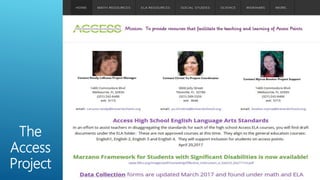
The
Access
Project
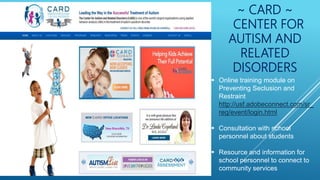
~ CARD ~
CENTER FOR
AUTISM AND
RELATED
DISORDERS
 Online training module on
Preventing Seclusion and
Restraint
http://usf.adobeconnect.com/sr_
reg/event/login.html
 Consultation with school
personnel about students
 Resource and information for
school personnel to connect to
community services
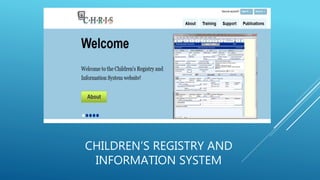
CHILDREN’S REGISTRY AND
INFORMATION SYSTEM
FLORIDA DIAGNOSTIC AND
LEARNING RESOURCES SYSTEM
(FDLRS)
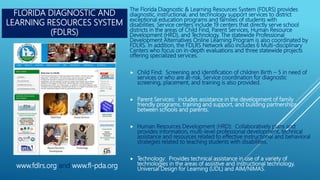
The Florida Diagnostic & Learning Resources System (FDLRS) provides
diagnostic, instructional, and technology support services to district
exceptional education programs and families of students with
disabilities. Service centers include 19 centers that directly serve school
districts in the areas of Child Find, Parent Services, Human Resource
Development (HRD), and Technology. The statewide Professional
Development Alternatives Online Learning Program is also coordinated by
FDLRS. In addition, the FDLRS Network also includes 6 Multi-disciplinary
Centers who focus on in-depth evaluations and three statewide projects
offering specialized services.
 Child Find: Screening and identification of children Birth – 5 in need of
services or who are at-risk. Service coordination for diagnostic
screening, placement, and training is also provided.
 Parent Services: Includes assistance in the development of family
friendly programs, training and support, and building partnerships
between schools and parents.
 Human Resources Development (HRD): Collaboratively plans and
provides information, multi-level professional development, technical
assistance and resources related to effective instructional and behavioral
strategies related to teaching students with disabilities.
 Technology: Provides technical assistance in use of a variety of
technologies in the areas of assistive and instructional technology,
Universal Design for Learning (UDL) and AIM/NIMAS.
www.fdlrs.org and www.fl-pda.org
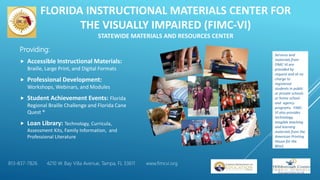
FLORIDA INSTRUCTIONAL MATERIALS CENTER FOR
THE VISUALLY IMPAIRED (FIMC-VI)
STATEWIDE MATERIALS AND RESOURCES CENTER
Providing:
 Accessible Instructional Materials:
Braille, Large Print, and Digital Formats
 Professional Development:
Workshops, Webinars, and Modules
 Student Achievement Events: Florida
Regional Braille Challenge and Florida Cane
Quest ®
 Loan Library: Technology, Curricula,
Assessment Kits, Family Information, and
Professional Literature
Services and
materials from
FIMC-VI are
provided by
request and at no
charge to
registered
students in public
or private schools
or home school
and agency
programs. FIMC-
VI also provides
technology,
tangible teaching
and learning
materials from the
American Printing
House for the
Blind.
813-837-7826 4210 W. Bay Villa Avenue, Tampa, FL 33611 www.fimcvi.org
Providing:
● Professional Development
● On-Site Observation & Consultation
● On-Site Training & Technical Assistance
● Free-Loan Media & Materials Library
○ Captioned and Signed Videos for Students and Staff
○ Professional Development Resources and Materials
● Language Evaluations/Assessments
● Information & Referral
● Resources! Resources! Resources!
Statewide Resource Center
Services and Materials from RMTC-D/HH are provided by request and at no charge
FDLRS MULTIDISCIPLINARY CENTERS
FDLRS FSU
http://mdc.fsu.edu/
FDLRS Keiser University
http://kumc.keiseruniversity.edu/
FDLRS UF (Gainesville)
http://www.peds.ufl.edu/mdtp/
FDLRS UF (Jacksonville)
http://www.hscj.ufl.edu/pediatrics/
diagnostic-and-learning-resources/
FDLRS UM
http://www.fdlrs-um.org/
FDLRS USF
http://cfs.cbcs.usf.edu/news-events/detail.cfm?id=637
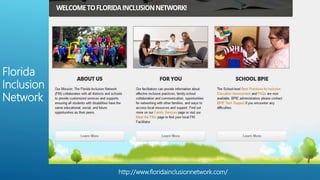
http://www.floridainclusionnetwork.com/
Florida
Inclusion
Network
Mission
• Increase the capacity of Florida’s school districts to use team based planning
and problem-solving to implement positive behavior support within a Multi-Tiered
System of Support (MTSS).
What We Do
• Provide training and technical assistance to districts in the development and
implementation of positive behavior supports at the Tier 1, classroom, targeted
group (Tier 2), and individual student (Tier 3) levels.
FLPBIS:MTSS Project
•Phone: (813) 974-6440 Fax: (813) 974-6115 E-mail: flpbs@fmhi.usf.edu Website: http://flpbs.fmhi.usf.edu
•Facebook: www.facebook.com/flpbs FLPBIS on Twitter: www.twitter.com@flpbs YouTube: https://www.youtube.com/user/flpbs1
FLORIDA PROBLEM
SOLVING/RESPONSE TO
INTERVENTION PROJECT
(PS/RTI PROJECT)
 Statewide Professional Development and
Technical Assistance to support MTSS
Implementation
 Pre-K through Grade 12 Alignment
 Differentiated Accountability Support for MTSS
 Technology to Support Improved Outcomes for
All Students
 Integrated MTSS Model for Academic and
Behavior Supports
 Provision of a universal education system, with
curriculum and instruction designed to meet the
needs of all students.
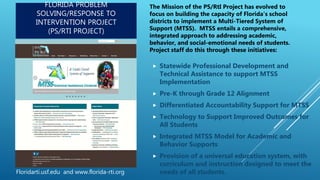
Picture of Website and URL
Floridarti.usf.edu and www.florida-rti.org
The Mission of the PS/RtI Project has evolved to
focus on building the capacity of Florida’s school
districts to implement a Multi-Tiered System of
Support (MTSS). MTSS entails a comprehensive,
integrated approach to addressing academic,
behavior, and social-emotional needs of students.
Project staff do this through these initiatives:
FLORIDA’S PROBLEM SOLVING/RESPONSE TO INTERVENTION PROJECT
 Professional development and technical assistance on using
MTSS to address district identified needs
 Development and refinement of tools to support districts’
 MTSS use
 Evaluation of outcomes
 Using processes and strategies designed to improve
instructional and student supports within a district’s MTSS
Project website:
www.floridarti.usf.edu
FDOE MTSS website:
http://www.florida-rti.org/
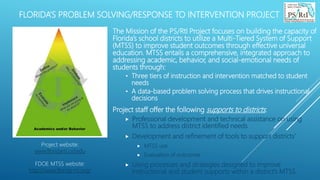
The Mission of the PS/RtI Project focuses on building the capacity of
Florida’s school districts to utilize a Multi-Tiered System of Support
(MTSS) to improve student outcomes through effective universal
education. MTSS entails a comprehensive, integrated approach to
addressing academic, behavior, and social-emotional needs of
students through:
• Three tiers of instruction and intervention matched to student
needs
• A data-based problem solving process that drives instructional
decisions
Project staff offer the following supports to districts:
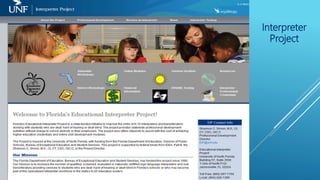
Interpreter
Project
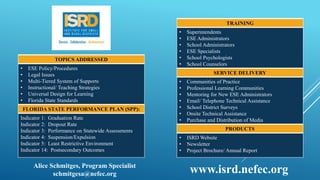
TRAINING
• Superintendents
• ESE Administrators
• School Administrators
• ESE Specialists
• School Psychologists
• School Counselors
SERVICE DELIVERY
• Communities of Practice
• Professional Learning Communities
• Mentoring for New ESE Administrators
• Email/ Telephone Technical Assistance
• School District Surveys
• Onsite Technical Assistance
• Purchase and Distribution of Media
PRODUCTS
• ISRD Website
• Newsletter
• Project Brochure/ Annual Report
www.isrd.nefec.org
TOPICS ADDRESSED
• ESE Policy/Procedures
• Legal Issues
• Multi-Tiered System of Supports
• Instructional/ Teaching Strategies
• Universal Design for Learning
• Florida State Standards
FLORIDA STATE PERFORMANCE PLAN (SPP):
Indicator 1: Graduation Rate
Indicator 2: Dropout Rate
Indicator 3: Performance on Statewide Assessments
Indicator 4: Suspension/Expulsion
Indicator 5: Least Restrictive Environment
Indicator 14: Postsecondary Outcomes
Alice Schmitges, Program Specialist
schmitgesa@nefec.org
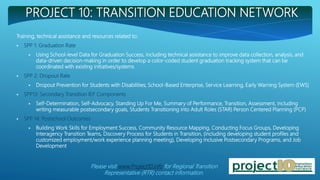
Training, technical assistance and resources related to:
 SPP 1: Graduation Rate
 Using School-level Data for Graduation Success, including technical assistance to improve data collection, analysis, and
data-driven decision-making in order to develop a color-coded student graduation tracking system that can be
coordinated with existing initiatives/systems
 SPP 2: Dropout Rate
 Dropout Prevention for Students with Disabilities; School-Based Enterprise, Service Learning, Early Warning System (EWS)
 SPP13: Secondary Transition IEP Components
 Self-Determination, Self-Advocacy, Standing Up For Me, Summary of Performance, Transition, Assessment, including
writing measurable postsecondary goals, Students Transitioning into Adult Roles (STAR) Person Centered Planning (PCP)
 SPP 14: Postschool Outcomes
 Building Work Skills for Employment Success, Community Resource Mapping, Conducting Focus Groups, Developing
Interagency Transition Teams, Discovery Process for Students in Transition, (including developing student profiles and
customized employment/work experience planning meeting), Developing Inclusive Postsecondary Programs, and Job
Development
PROJECT 10: TRANSITION EDUCATION NETWORK
Please visit www.Project10.info for Regional Transition
Representative (RTR) contact information.
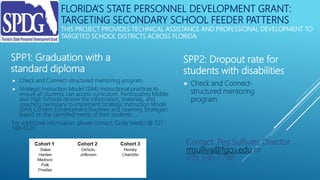
FLORIDA’S STATE PERSONNEL DEVELOPMENT GRANT:
TARGETING SECONDARY SCHOOL FEEDER PATTERNS
THIS PROJECT PROVIDES TECHNICAL ASSISTANCE AND PROFESSIONAL DEVELOPMENT TO
TARGETED SCHOOL DISTRICTS ACROSS FLORIDA.
 Check and Connect-structured mentoring program
 Strategic Instruction Model (SIM)-instructional practices to
ensure all students can access curriculum. Participating Middle
and High Schools receive the information, materials, and
coaching necessary to implement Strategic Instruction Model
(SIM) Content Enhancement Routines and Learning Strategies
based on the identified needs of their students.
For additional information, please contact: Cindy Medici @ 727-
588-6523
SPP2: Dropout rate for
students with disabilities
 Check and Connect-
structured mentoring
program
SPP1: Graduation with a
standard diploma
Contact: Peg Sullivan, Director
msulliva@fgcu.edu or
239 590-7748
http://specialolympicsflorida.org/
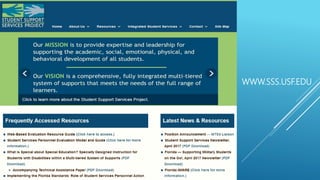
WWW.SSS.USF.EDU
http://www.floridatransitionproject.ucf.edu/
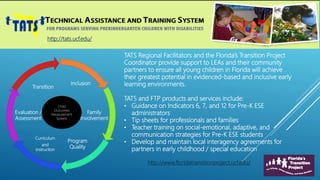
http://tats.ucf.edu/
Inclusion
Family
Involvement
Program
Quality
Curriculum
and
Instruction
Evaluation /
Assessment
Transition
Child
Outcomes
Measurement
System
TATS Regional Facilitators and the Florida’s Transition Project
Coordinator provide support to LEAs and their community
partners to ensure all young children in Florida will achieve
their greatest potential in evidenced-based and inclusive early
learning environments.
TATS and FTP products and services include:
• Guidance on Indicators 6, 7, and 12 for Pre-K ESE
administrators
• Tip sheets for professionals and families
• Teacher training on social-emotional, adaptive, and
communication strategies for Pre-K ESE students
• Develop and maintain local interagency agreements for
partners in early childhood / special education
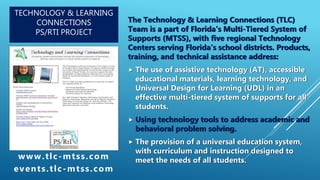
TECHNOLOGY & LEARNING
CONNECTIONS
PS/RTI PROJECT
The Technology & Learning Connections (TLC)
Team is a part of Florida’s Multi-Tiered System of
Supports (MTSS), with five regional Technology
Centers serving Florida’s school districts. Products,
training, and technical assistance address:
 The use of assistive technology (AT), accessible
educational materials, learning technology, and
Universal Design for Learning (UDL) in an
effective multi-tiered system of supports for all
students.
 Using technology tools to address academic and
behavioral problem solving.
 The provision of a universal education system,
with curriculum and instruction designed to
meet the needs of all students.www.tlc-mtss.com
events.tlc-mtss.com
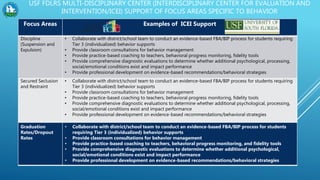
USF FDLRS MULTI-DISCIPLINARY CENTER (INTERDISCIPLINARY CENTER FOR EVALUATION AND
INTERVENTION/ICEI) SUPPORT OF FOCUS AREAS SPECIFIC TO BEHAVIOR
Focus Areas Examples of ICEI Support
Discipline
(Suspension and
Expulsion)
• Collaborate with district/school team to conduct an evidence-based FBA/BIP process for students requiring
Tier 3 (individualized) behavior supports
• Provide classroom consultations for behavior management
• Provide practice-based coaching to teachers, behavioral progress monitoring, fidelity tools
• Provide comprehensive diagnostic evaluations to determine whether additional psychological, processing,
social/emotional conditions exist and impact performance
• Provide professional development on evidence-based recommendations/behavioral strategies
Secured Seclusion
and Restraint
• Collaborate with district/school team to conduct an evidence-based FBA/BIP process for students requiring
Tier 3 (individualized) behavior supports
• Provide classroom consultations for behavior management
• Provide practice-based coaching to teachers, behavioral progress monitoring, fidelity tools
• Provide comprehensive diagnostic evaluations to determine whether additional psychological, processing,
social/emotional conditions exist and impact performance
• Provide professional development on evidence-based recommendations/behavioral strategies
Graduation
Rates/Dropout
Rates
• Collaborate with district/school team to conduct an evidence-based FBA/BIP process for students
requiring Tier 3 (individualized) behavior supports
• Provide classroom consultations for behavior management
• Provide practice-based coaching to teachers, behavioral progress monitoring, and fidelity tools
• Provide comprehensive diagnostic evaluations to determine whether additional psychological,
social/emotional conditions exist and impact performance
• Provide professional development on evidence-based recommendations/behavioral strategies
WWW.VSAFL.ORG
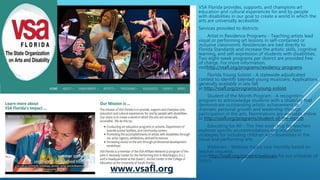
VSA Florida provides, supports, and champions art
education and cultural experiences for and by people
with disabilities in our goal to create a world in which the
arts are universally accessible.
Services provided to districts:
· Artist in Residence Programs - Teaching artists lead
visual or performing art lessons in self-contained or
inclusive classrooms. Residencies are tied directly to
Florida Standards and increase the artistic skills, cognitive
learning, and self-expression of students with disabilities.
Two eight-week programs per district are provided free
of charge. For more information,
visithttp://vsafl.org/programs/residency-programs
· Florida Young Soloist - A statewide adjudicated
contest to identify talented young musicians. Applications
generally available in late fall
at http://vsafl.org/programs/young-soloist
· Student of the Month Program - A recognition
program to acknowledge students with a disability that
demonstrate outstanding artistic achievement or
dramatic personal growth and leadership through
participation in the arts. Nominations are available online
at http://vsafl.org/programs/student-of-the-month
· Educating for All - This free workshop for teachers
explores specific accommodations and instruction
strategies for including children with disabilities in the
visual and performing arts.
· Webinars - Webinar topics vary monthly based on
teacher requests.
Visit http://vsafl.org/content/webinars for our schedule of
topics.
www.vsafl.org
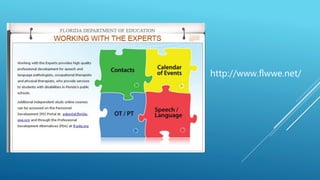
http://www.flwwe.net/

2017 BEESS Discretionary Projects

  • 1.
    A SAMPLING OFFLDOE/BEESS’ DISCRETIONARY PROJECTS WHICH SUPPORT DISTRICT INITIATIVES An Overview of Services, 2017 A complete listing of all discretionary projects and contacts is available at http://www.fldoe.org/core/fileparse.php/7567/urlt/projectslisting.pdf
  • 2.
  • 3.
    ~ CARD ~ CENTERFOR AUTISM AND RELATED DISORDERS  Online training module on Preventing Seclusion and Restraint http://usf.adobeconnect.com/sr_ reg/event/login.html  Consultation with school personnel about students  Resource and information for school personnel to connect to community services
  • 4.
  • 5.
    FLORIDA DIAGNOSTIC AND LEARNINGRESOURCES SYSTEM (FDLRS) The Florida Diagnostic & Learning Resources System (FDLRS) provides diagnostic, instructional, and technology support services to district exceptional education programs and families of students with disabilities. Service centers include 19 centers that directly serve school districts in the areas of Child Find, Parent Services, Human Resource Development (HRD), and Technology. The statewide Professional Development Alternatives Online Learning Program is also coordinated by FDLRS. In addition, the FDLRS Network also includes 6 Multi-disciplinary Centers who focus on in-depth evaluations and three statewide projects offering specialized services.  Child Find: Screening and identification of children Birth – 5 in need of services or who are at-risk. Service coordination for diagnostic screening, placement, and training is also provided.  Parent Services: Includes assistance in the development of family friendly programs, training and support, and building partnerships between schools and parents.  Human Resources Development (HRD): Collaboratively plans and provides information, multi-level professional development, technical assistance and resources related to effective instructional and behavioral strategies related to teaching students with disabilities.  Technology: Provides technical assistance in use of a variety of technologies in the areas of assistive and instructional technology, Universal Design for Learning (UDL) and AIM/NIMAS. www.fdlrs.org and www.fl-pda.org
  • 6.
    FLORIDA INSTRUCTIONAL MATERIALSCENTER FOR THE VISUALLY IMPAIRED (FIMC-VI) STATEWIDE MATERIALS AND RESOURCES CENTER Providing:  Accessible Instructional Materials: Braille, Large Print, and Digital Formats  Professional Development: Workshops, Webinars, and Modules  Student Achievement Events: Florida Regional Braille Challenge and Florida Cane Quest ®  Loan Library: Technology, Curricula, Assessment Kits, Family Information, and Professional Literature Services and materials from FIMC-VI are provided by request and at no charge to registered students in public or private schools or home school and agency programs. FIMC- VI also provides technology, tangible teaching and learning materials from the American Printing House for the Blind. 813-837-7826 4210 W. Bay Villa Avenue, Tampa, FL 33611 www.fimcvi.org
  • 7.
    Providing: ● Professional Development ●On-Site Observation & Consultation ● On-Site Training & Technical Assistance ● Free-Loan Media & Materials Library ○ Captioned and Signed Videos for Students and Staff ○ Professional Development Resources and Materials ● Language Evaluations/Assessments ● Information & Referral ● Resources! Resources! Resources! Statewide Resource Center Services and Materials from RMTC-D/HH are provided by request and at no charge
  • 8.
    FDLRS MULTIDISCIPLINARY CENTERS FDLRSFSU http://mdc.fsu.edu/ FDLRS Keiser University http://kumc.keiseruniversity.edu/ FDLRS UF (Gainesville) http://www.peds.ufl.edu/mdtp/ FDLRS UF (Jacksonville) http://www.hscj.ufl.edu/pediatrics/ diagnostic-and-learning-resources/ FDLRS UM http://www.fdlrs-um.org/ FDLRS USF http://cfs.cbcs.usf.edu/news-events/detail.cfm?id=637
  • 9.
  • 10.
    Mission • Increase thecapacity of Florida’s school districts to use team based planning and problem-solving to implement positive behavior support within a Multi-Tiered System of Support (MTSS). What We Do • Provide training and technical assistance to districts in the development and implementation of positive behavior supports at the Tier 1, classroom, targeted group (Tier 2), and individual student (Tier 3) levels. FLPBIS:MTSS Project •Phone: (813) 974-6440 Fax: (813) 974-6115 E-mail: flpbs@fmhi.usf.edu Website: http://flpbs.fmhi.usf.edu •Facebook: www.facebook.com/flpbs FLPBIS on Twitter: www.twitter.com@flpbs YouTube: https://www.youtube.com/user/flpbs1
  • 11.
    FLORIDA PROBLEM SOLVING/RESPONSE TO INTERVENTIONPROJECT (PS/RTI PROJECT)  Statewide Professional Development and Technical Assistance to support MTSS Implementation  Pre-K through Grade 12 Alignment  Differentiated Accountability Support for MTSS  Technology to Support Improved Outcomes for All Students  Integrated MTSS Model for Academic and Behavior Supports  Provision of a universal education system, with curriculum and instruction designed to meet the needs of all students. Picture of Website and URL Floridarti.usf.edu and www.florida-rti.org The Mission of the PS/RtI Project has evolved to focus on building the capacity of Florida’s school districts to implement a Multi-Tiered System of Support (MTSS). MTSS entails a comprehensive, integrated approach to addressing academic, behavior, and social-emotional needs of students. Project staff do this through these initiatives:
  • 12.
    FLORIDA’S PROBLEM SOLVING/RESPONSETO INTERVENTION PROJECT  Professional development and technical assistance on using MTSS to address district identified needs  Development and refinement of tools to support districts’  MTSS use  Evaluation of outcomes  Using processes and strategies designed to improve instructional and student supports within a district’s MTSS Project website: www.floridarti.usf.edu FDOE MTSS website: http://www.florida-rti.org/ The Mission of the PS/RtI Project focuses on building the capacity of Florida’s school districts to utilize a Multi-Tiered System of Support (MTSS) to improve student outcomes through effective universal education. MTSS entails a comprehensive, integrated approach to addressing academic, behavior, and social-emotional needs of students through: • Three tiers of instruction and intervention matched to student needs • A data-based problem solving process that drives instructional decisions Project staff offer the following supports to districts:
  • 13.
  • 14.
    TRAINING • Superintendents • ESEAdministrators • School Administrators • ESE Specialists • School Psychologists • School Counselors SERVICE DELIVERY • Communities of Practice • Professional Learning Communities • Mentoring for New ESE Administrators • Email/ Telephone Technical Assistance • School District Surveys • Onsite Technical Assistance • Purchase and Distribution of Media PRODUCTS • ISRD Website • Newsletter • Project Brochure/ Annual Report www.isrd.nefec.org TOPICS ADDRESSED • ESE Policy/Procedures • Legal Issues • Multi-Tiered System of Supports • Instructional/ Teaching Strategies • Universal Design for Learning • Florida State Standards FLORIDA STATE PERFORMANCE PLAN (SPP): Indicator 1: Graduation Rate Indicator 2: Dropout Rate Indicator 3: Performance on Statewide Assessments Indicator 4: Suspension/Expulsion Indicator 5: Least Restrictive Environment Indicator 14: Postsecondary Outcomes Alice Schmitges, Program Specialist schmitgesa@nefec.org
  • 15.
    Training, technical assistanceand resources related to:  SPP 1: Graduation Rate  Using School-level Data for Graduation Success, including technical assistance to improve data collection, analysis, and data-driven decision-making in order to develop a color-coded student graduation tracking system that can be coordinated with existing initiatives/systems  SPP 2: Dropout Rate  Dropout Prevention for Students with Disabilities; School-Based Enterprise, Service Learning, Early Warning System (EWS)  SPP13: Secondary Transition IEP Components  Self-Determination, Self-Advocacy, Standing Up For Me, Summary of Performance, Transition, Assessment, including writing measurable postsecondary goals, Students Transitioning into Adult Roles (STAR) Person Centered Planning (PCP)  SPP 14: Postschool Outcomes  Building Work Skills for Employment Success, Community Resource Mapping, Conducting Focus Groups, Developing Interagency Transition Teams, Discovery Process for Students in Transition, (including developing student profiles and customized employment/work experience planning meeting), Developing Inclusive Postsecondary Programs, and Job Development PROJECT 10: TRANSITION EDUCATION NETWORK Please visit www.Project10.info for Regional Transition Representative (RTR) contact information.
  • 17.
    FLORIDA’S STATE PERSONNELDEVELOPMENT GRANT: TARGETING SECONDARY SCHOOL FEEDER PATTERNS THIS PROJECT PROVIDES TECHNICAL ASSISTANCE AND PROFESSIONAL DEVELOPMENT TO TARGETED SCHOOL DISTRICTS ACROSS FLORIDA.  Check and Connect-structured mentoring program  Strategic Instruction Model (SIM)-instructional practices to ensure all students can access curriculum. Participating Middle and High Schools receive the information, materials, and coaching necessary to implement Strategic Instruction Model (SIM) Content Enhancement Routines and Learning Strategies based on the identified needs of their students. For additional information, please contact: Cindy Medici @ 727- 588-6523 SPP2: Dropout rate for students with disabilities  Check and Connect- structured mentoring program SPP1: Graduation with a standard diploma Contact: Peg Sullivan, Director msulliva@fgcu.edu or 239 590-7748
  • 18.
  • 19.
  • 20.
    http://www.floridatransitionproject.ucf.edu/ http://tats.ucf.edu/ Inclusion Family Involvement Program Quality Curriculum and Instruction Evaluation / Assessment Transition Child Outcomes Measurement System TATS RegionalFacilitators and the Florida’s Transition Project Coordinator provide support to LEAs and their community partners to ensure all young children in Florida will achieve their greatest potential in evidenced-based and inclusive early learning environments. TATS and FTP products and services include: • Guidance on Indicators 6, 7, and 12 for Pre-K ESE administrators • Tip sheets for professionals and families • Teacher training on social-emotional, adaptive, and communication strategies for Pre-K ESE students • Develop and maintain local interagency agreements for partners in early childhood / special education
  • 21.
    TECHNOLOGY & LEARNING CONNECTIONS PS/RTIPROJECT The Technology & Learning Connections (TLC) Team is a part of Florida’s Multi-Tiered System of Supports (MTSS), with five regional Technology Centers serving Florida’s school districts. Products, training, and technical assistance address:  The use of assistive technology (AT), accessible educational materials, learning technology, and Universal Design for Learning (UDL) in an effective multi-tiered system of supports for all students.  Using technology tools to address academic and behavioral problem solving.  The provision of a universal education system, with curriculum and instruction designed to meet the needs of all students.www.tlc-mtss.com events.tlc-mtss.com
  • 22.
    USF FDLRS MULTI-DISCIPLINARYCENTER (INTERDISCIPLINARY CENTER FOR EVALUATION AND INTERVENTION/ICEI) SUPPORT OF FOCUS AREAS SPECIFIC TO BEHAVIOR Focus Areas Examples of ICEI Support Discipline (Suspension and Expulsion) • Collaborate with district/school team to conduct an evidence-based FBA/BIP process for students requiring Tier 3 (individualized) behavior supports • Provide classroom consultations for behavior management • Provide practice-based coaching to teachers, behavioral progress monitoring, fidelity tools • Provide comprehensive diagnostic evaluations to determine whether additional psychological, processing, social/emotional conditions exist and impact performance • Provide professional development on evidence-based recommendations/behavioral strategies Secured Seclusion and Restraint • Collaborate with district/school team to conduct an evidence-based FBA/BIP process for students requiring Tier 3 (individualized) behavior supports • Provide classroom consultations for behavior management • Provide practice-based coaching to teachers, behavioral progress monitoring, fidelity tools • Provide comprehensive diagnostic evaluations to determine whether additional psychological, processing, social/emotional conditions exist and impact performance • Provide professional development on evidence-based recommendations/behavioral strategies Graduation Rates/Dropout Rates • Collaborate with district/school team to conduct an evidence-based FBA/BIP process for students requiring Tier 3 (individualized) behavior supports • Provide classroom consultations for behavior management • Provide practice-based coaching to teachers, behavioral progress monitoring, and fidelity tools • Provide comprehensive diagnostic evaluations to determine whether additional psychological, social/emotional conditions exist and impact performance • Provide professional development on evidence-based recommendations/behavioral strategies
  • 23.
    WWW.VSAFL.ORG VSA Florida provides,supports, and champions art education and cultural experiences for and by people with disabilities in our goal to create a world in which the arts are universally accessible. Services provided to districts: · Artist in Residence Programs - Teaching artists lead visual or performing art lessons in self-contained or inclusive classrooms. Residencies are tied directly to Florida Standards and increase the artistic skills, cognitive learning, and self-expression of students with disabilities. Two eight-week programs per district are provided free of charge. For more information, visithttp://vsafl.org/programs/residency-programs · Florida Young Soloist - A statewide adjudicated contest to identify talented young musicians. Applications generally available in late fall at http://vsafl.org/programs/young-soloist · Student of the Month Program - A recognition program to acknowledge students with a disability that demonstrate outstanding artistic achievement or dramatic personal growth and leadership through participation in the arts. Nominations are available online at http://vsafl.org/programs/student-of-the-month · Educating for All - This free workshop for teachers explores specific accommodations and instruction strategies for including children with disabilities in the visual and performing arts. · Webinars - Webinar topics vary monthly based on teacher requests. Visit http://vsafl.org/content/webinars for our schedule of topics. www.vsafl.org
  • 24.