INCLUSIVITY IN EDUCATION
Dr. Jagannath K. Dange
Associate Professor
Department of Education
Kuvempu University
Shankaraghatta
Dist: Shimoga,Karnataka
jkdange@gmail.com
http://jkdange.blogspot.com
There is a quantitative expansion of Education after
Independence…. From Primary to Higher Education;
Budget allocations, Human resource, plans and projects.
Now it is a time to check its quality; there are different
dimensions to measure the quality education.
Indian society is highly segregated and diversified.
Components of segregation are Caste, gender, creed,
religion, class, SES, Regional, and also emotionally,
psychologically, physically, morally, culturally,
sociologically and many other.
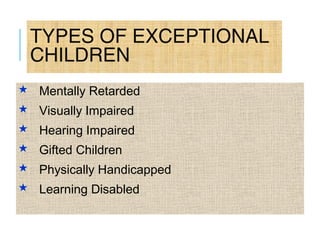
TYPES OF EXCEPTIONAL
CHILDREN
 Mentally Retarded
 Visually Impaired
 Hearing Impaired
 Gifted Children
 Physically Handicapped
 Learning Disabled
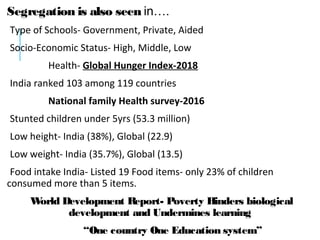
Segregation is also seen in….
Type of Schools- Government, Private, Aided
Socio-Economic Status- High, Middle, Low
Health- Global Hunger Index-2018
India ranked 103 among 119 countries
National family Health survey-2016
Stunted children under 5yrs (53.3 million)
Low height- India (38%), Global (22.9)
Low weight- India (35.7%), Global (13.5)
Food intake India- Listed 19 Food items- only 23% of children
consumed more than 5 items.
World Development Report- Poverty Hinders biological
development and Undermines learning
“One country One Education system”
It’s a hard need to provide the space for inclusion under one
umbrella…
Education is one such… Which should provide equal
opportunities and freedom to all.
We all know that, students with specially challenged have
received their education in special schools, but many a times
special schools do not fulfill the objectives of education.
Obviously the main purpose of education is to prepare the
students to face the challenges of life and that happen more
effectively when there is a social interaction among the
students.
But in special schools the children with challenges will not get
much exposure of social interaction with normal children.
To solve this problem the concept of Inclusive education was
introduced in which normal children with challenged children
get education under one roof.
MEANING OF
INCLUSIVE
EDUCATION
Inclusive education implies all young learners,
young people-with or without disabilities being able
to learn together through access to common
education with an appropriate network of support
services.
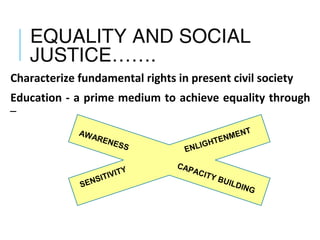
EQUALITY AND SOCIAL
JUSTICE…….
Characterize fundamental rights in present civil society
Education - a prime medium to achieve equality through
–
AWARENESS ENLIGHTENMENT
SENSITIVITY
CAPACITY BUILDING
Every child has the right to education according
to the limits of his capacity, whether that
capacity be small or great.
Indian Constitution provides this…..
Education without discrimination: It is unlawful
for any education provider, including a private or
independent provider, to discriminate between
pupils on grounds of race, sex, disability, sexual
orientation, gender reassignment, pregnancy and
maternity, and religion or belief in admissions,
access to benefits or services, exclusions, and in
the employment of staff. 
 
WHY INCLUSION?
Valuing some people more than others is unethical.
Maintaining barriers to some students’ participation in the
cultures, curricula and communities of local schools is unacceptable.
Thinking that inclusion mostly concerns disabled learners is
misleading. (discrimination on any ground is illegal)
Thinking that school changes made for some will not benefit
others is short-sighted.
Segregated schooling for disabled learners violates their basic
human right to education without discrimination.
Identifying academic achievement as the main aim of schooling
detracts from the importance of personal and moral development.
Perceiving inclusion in education as a separate issue from inclusion
in society is illogical.
Inclusion in education is an approach to educating students
with special educational needs.
Under the inclusion model, students with special needs
spend most or all of their time with non-special needs
students.
Inclusion rejects the use of special schools or classrooms to
separate students with disabilities from students without
disabilities.
Feeling included is not limited to physical and cognitive
disabilities, but also includes the full range of human
diversity with respect to ability, language, culture, gender,
age and of other forms of human differences.
Inclusion is about the child’s right to participate and the
school’s duty to accept the child.
Inclusion is an effort to improve quality in education.
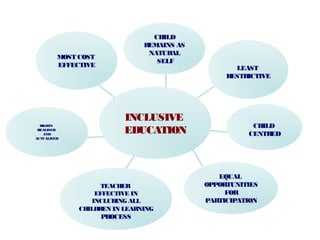
MOST COST
EFFECTIVE
RIGHTS
REALISED
AND
ACTUALISED
TEACHER
EFFECTIVE IN
INCLUDING ALL
CHILDREN IN LEARNING
PROCESS
EQUAL
OPPORTUNITIES
FOR
PARTICIPATION
CHILD
CENTRED
LEAST
RESTRICTIVE
CHILD
REMAINS AS
NATURAL
SELF
INCLUSIVE
EDUCATION
LEGAL ISSUES: EDUCATION LAW AND
DISABILITY LAWS
The anti-discriminatory climate has to be provided the basis for much
change in policy and statute, nationally and internationally.
Inclusion has been enshrined at the same time that segregation and
discrimination have been rejected.
Articulations of the new developments in ways of thinking, in policy and in
law include:
The UN Convention on the Rights of the Child (1989) which sets out
children’s rights in respect of freedom from discrimination and in respect of
the representation of their wishes and views.
The Convention against Discrimination in Education of UNESCO prohibits
any discrimination, exclusion or segregation in education.
The UNESCO Salamanca Statement (1994) which calls on all governments to
give the highest priority to inclusive education.
The UN Convention on the Rights of Persons with Disabilities (2006) which
calls on all States Parties to ensure an inclusive education system at all
The right to education for all:
access and quality
• 1989 UN Convention on the Rights of the Child
• 1990 World Conference on Education for All (EFA)
by the year 2000, Jomtien, Thailand
• 1993 UN Standard Rules (on Disability)
• 1994 Salamanca Statement – on Special Needs
Education: access and quality
• 2000 World Education Forum, Dakar, Senegal,
Review of progress on EFA Conference
Millennium Development Goals (Goal 2 UPE)
• 2006 UN Convention on the Rights of people with
Disabilities (Article 24: Education)
THE UN CONVENTION ON THE
RIGHTS OF THE CHILD, 1989
Article 2 Non-discrimination
Regardless of race, colour, sex, language, religion, political or
other opinion, property, disability, birth
Article 28/29 The right to quality education
develop the child’s personality, talents and mental and physical
abilities, develop respect for the child’s own cultural and
national values
Article 23 Disabled children’s education
ensure disabled children have access to education while
recognising their need for special care and assistance
Inclusion requires some changes in how
teachers teach, as well as changes in how
students with and without special needs
interact with and relate to one another.
Inclusive education practices frequently rely
on active learning,
authentic assessment practices,
applied curriculum,
multi-level instructional approaches,
and
increased attention to diverse student needs
and individualization
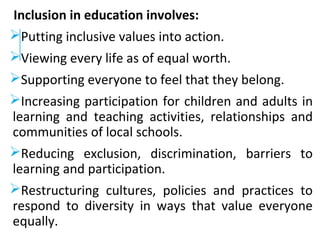
Inclusion in education involves:
Putting inclusive values into action.
Viewing every life as of equal worth.
Supporting everyone to feel that they belong.
Increasing participation for children and adults in
learning and teaching activities, relationships and
communities of local schools.
Reducing exclusion, discrimination, barriers to
learning and participation.
Restructuring cultures, policies and practices to
respond to diversity in ways that value everyone
equally.
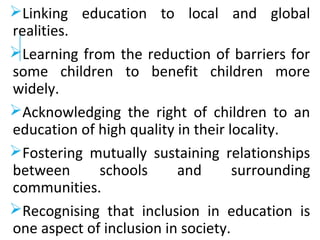
Linking education to local and global
realities.
Learning from the reduction of barriers for
some children to benefit children more
widely.
Acknowledging the right of children to an
education of high quality in their locality.
Fostering mutually sustaining relationships
between schools and surrounding
communities.
Recognising that inclusion in education is
one aspect of inclusion in society.
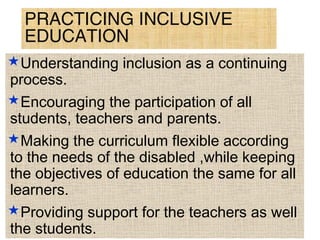
PRACTICING INCLUSIVE
EDUCATION
Understanding inclusion as a continuing
process.
Encouraging the participation of all
students, teachers and parents.
Making the curriculum flexible according
to the needs of the disabled ,while keeping
the objectives of education the same for all
learners.
Providing support for the teachers as well
the students.
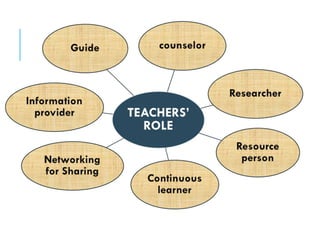
COMPETENCIES NEEDED FOR AN
INCLUSIVE TEACHER
Should have the ability to solve problems.
Should know about the interest, aptitude and abilities
of the disabled children and use them to develop
various skills in them.
Have the ability to set high targets for disabled
children.
Have the ability to provide success experiences to the
disabled children.
Should have the knowledge of special instructional
material and how to use them.
Should be highly patient, welcoming, polite and
devoted.
Should work as team with parents and special
Inclusivity in education