Inclusion
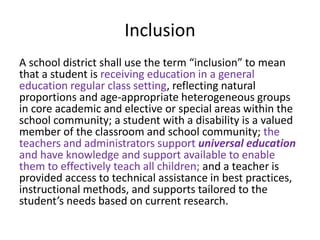
A school district shall use the term “inclusion” to mean
that a student is receiving education in a general
education regular class setting, reflecting natural
proportions and age-appropriate heterogeneous groups
in core academic and elective or special areas within the
school community; a student with a disability is a valued
member of the classroom and school community; the
teachers and administrators support universal education
and have knowledge and support available to enable
them to effectively teach all children; and a teacher is
provided access to technical assistance in best practices,
instructional methods, and supports tailored to the
student’s needs based on current research.
Inclusion
Contributing Factors to the Performance Gap
Students in non-inclusive settings can experience:
• reduced instructional time, up to 35 percent less
instructional time than in a general classroom
• a reduction in instruction rigor, with academic
activities not addressing the expectations of the
grade level standards
• immaturity in the areas of social, emotional, and
communication skills
• the lack of a growth mindset regarding the ability to
learn and achieve the grade level standards
Inclusion
In secondary grades students are expected to start
exhibiting skills and behaviors needed for post
secondary success. Having opportunities to model
students without disabilities throughout each day and
being able to participate in peer tutoring can result in
significant increases in spelling, social studies, and
other academic indicators. Daily engagement in
general classrooms can result in fewer absences from
school, fewer referrals for behavior, and better post
secondary outcomes. The lack of these opportunities
increases the skill and academic behavior gap between
students with disabilities and students without
disabilities.
Inclusion
In Inclusive Schools:
• school administrators advocate for all SWDs to have
the same school choice options as students without
disabilities to ensure all SWDs receive educational
services in their neighborhood school or school of
choice
• a multi-tiered system of student supports (MTSS) and
problem-solving process is consistently used by school
personnel to ensure progress in the general education
curriculum, across all grades and settings, for all
students with and without disabilities
Inclusion
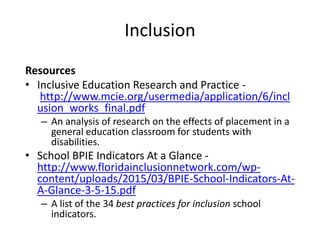
Resources
• Inclusive Education Research and Practice -
http://www.mcie.org/usermedia/application/6/incl
usion_works_final.pdf
– An analysis of research on the effects of placement in a
general education classroom for students with
disabilities.
• School BPIE Indicators At a Glance -
http://www.floridainclusionnetwork.com/wp-
content/uploads/2015/03/BPIE-School-Indicators-At-
A-Glance-3-5-15.pdf
– A list of the 34 best practices for inclusion school
indicators.
Inclusion
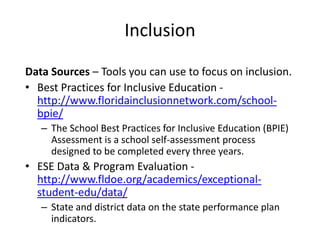
Data Sources – Tools you can use to focus on inclusion.
• Best Practices for Inclusive Education -
http://www.floridainclusionnetwork.com/school-
bpie/
– The School Best Practices for Inclusive Education (BPIE)
Assessment is a school self-assessment process
designed to be completed every three years.
• ESE Data & Program Evaluation -
http://www.fldoe.org/academics/exceptional-
student-edu/data/
– State and district data on the state performance plan
indicators.
Inclusion
Hypothesis - The problem is occurring
because:
–students in non-inclusive classrooms are
receiving less instruction time than students in
general classrooms
–students in non-inclusive classrooms are
receiving instruction that is less rigorous than
instruction in general classrooms
–students do not have daily opportunities to
work collaboratively with non-disabled peers

Inclusion

  • 1.
    Inclusion A school districtshall use the term “inclusion” to mean that a student is receiving education in a general education regular class setting, reflecting natural proportions and age-appropriate heterogeneous groups in core academic and elective or special areas within the school community; a student with a disability is a valued member of the classroom and school community; the teachers and administrators support universal education and have knowledge and support available to enable them to effectively teach all children; and a teacher is provided access to technical assistance in best practices, instructional methods, and supports tailored to the student’s needs based on current research.
  • 2.
    Inclusion Contributing Factors tothe Performance Gap Students in non-inclusive settings can experience: • reduced instructional time, up to 35 percent less instructional time than in a general classroom • a reduction in instruction rigor, with academic activities not addressing the expectations of the grade level standards • immaturity in the areas of social, emotional, and communication skills • the lack of a growth mindset regarding the ability to learn and achieve the grade level standards
  • 3.
    Inclusion In secondary gradesstudents are expected to start exhibiting skills and behaviors needed for post secondary success. Having opportunities to model students without disabilities throughout each day and being able to participate in peer tutoring can result in significant increases in spelling, social studies, and other academic indicators. Daily engagement in general classrooms can result in fewer absences from school, fewer referrals for behavior, and better post secondary outcomes. The lack of these opportunities increases the skill and academic behavior gap between students with disabilities and students without disabilities.
  • 4.
    Inclusion In Inclusive Schools: •school administrators advocate for all SWDs to have the same school choice options as students without disabilities to ensure all SWDs receive educational services in their neighborhood school or school of choice • a multi-tiered system of student supports (MTSS) and problem-solving process is consistently used by school personnel to ensure progress in the general education curriculum, across all grades and settings, for all students with and without disabilities
  • 5.
    Inclusion Resources • Inclusive EducationResearch and Practice - http://www.mcie.org/usermedia/application/6/incl usion_works_final.pdf – An analysis of research on the effects of placement in a general education classroom for students with disabilities. • School BPIE Indicators At a Glance - http://www.floridainclusionnetwork.com/wp- content/uploads/2015/03/BPIE-School-Indicators-At- A-Glance-3-5-15.pdf – A list of the 34 best practices for inclusion school indicators.
  • 6.
    Inclusion Data Sources –Tools you can use to focus on inclusion. • Best Practices for Inclusive Education - http://www.floridainclusionnetwork.com/school- bpie/ – The School Best Practices for Inclusive Education (BPIE) Assessment is a school self-assessment process designed to be completed every three years. • ESE Data & Program Evaluation - http://www.fldoe.org/academics/exceptional- student-edu/data/ – State and district data on the state performance plan indicators.
  • 7.
    Inclusion Hypothesis - Theproblem is occurring because: –students in non-inclusive classrooms are receiving less instruction time than students in general classrooms –students in non-inclusive classrooms are receiving instruction that is less rigorous than instruction in general classrooms –students do not have daily opportunities to work collaboratively with non-disabled peers