Supporting Student Success:
Universal Design for Learning
(UDL) and Your Library
Claire Holmes, Sarah Gilchrist, Sarah Espinosa
Albert S. Cook Library, Towson University
2015 Joint Library Conference, MLA/DLA, May 8, 2015
All
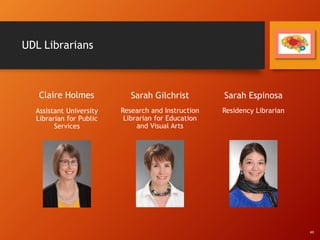
UDL Librarians
Claire Holmes
Assistant University
Librarian for Public
Services
Sarah Gilchrist
Research and Instruction
Librarian for Education
and Visual Arts
Sarah Espinosa
Residency Librarian
All
SlideShare Link to Supporting Student Success
http://tinyurl.com/UDLSupportingStudentSuccess
CH
Learning Outcomes
• List the three main principles of UDL in order to
integrate them into information literacy instruction planning
• Recognize learner variability in all classrooms in order to
plan information literacy instruction activities that:
• engage all learners,
• reduce barriers,
• optimize levels of support, and
• challenge personal instruction experiences or scenarios
• Build a toolkit of UDL instructional design activities in order to
apply UDL principles to teaching and learning
CH
“
”
The UDL framework offers
flexible instructional materials,
techniques, and strategies to
help us differentiate instruction
to meet students’ varied needs.
CAST
CH
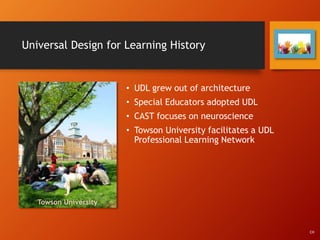
Universal Design for Learning History
• UDL grew out of architecture
• Special Educators adopted UDL
• CAST focuses on neuroscience
• Towson University facilitates a UDL
Professional Learning Network
Towson University
CH
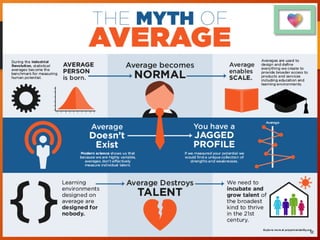
The Myth of the Average: Todd Rose
Rose, T. (2012, January 18). Todd Rose: Variability Matters.
Address at the Cyberlearning Research Summit, National
Geographic Society, Washington, DC. Retrieved from
https://youtu.be/8WClnVjCEVM
SE
SE
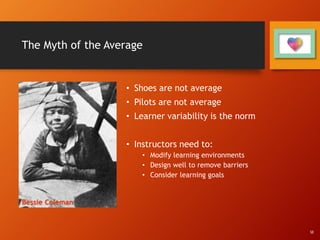
The Myth of the Average
• Shoes are not average
• Pilots are not average
• Learner variability is the norm
• Instructors need to:
• Modify learning environments
• Design well to remove barriers
• Consider learning goals
Bessie Coleman
SE
Reflect and Share
• Where have you encountered the
Myth of Average?
• Do you see your environment aiding or
discouraging diversity?
• What role do librarians play in the
development of talent?
Thinking
SE
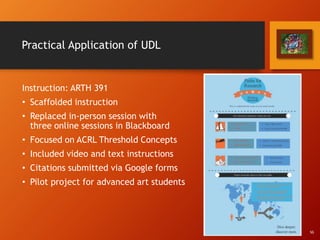
Practical Application of UDL
Instruction: ARTH 391
• Scaffolded instruction
• Replaced in-person session with
three online sessions in Blackboard
• Focused on ACRL Threshold Concepts
• Included video and text instructions
• Citations submitted via Google forms
• Pilot project for advanced art students
SG
Practical Application of UDL
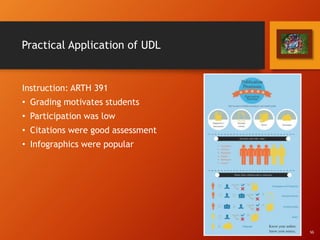
Instruction: ARTH 391
• Grading motivates students
• Participation was low
• Citations were good assessment
• Infographics were popular
SG
Practical Application of UDL
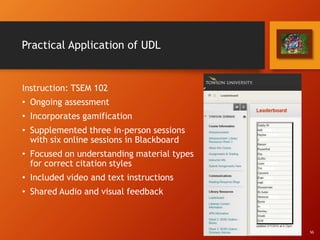
Instruction: TSEM 102
• Ongoing assessment
• Incorporates gamification
• Supplemented three in-person sessions
with six online sessions in Blackboard
• Focused on understanding material types
for correct citation styles
• Included video and text instructions
• Shared Audio and visual feedback
SG
Practical Application of UDL
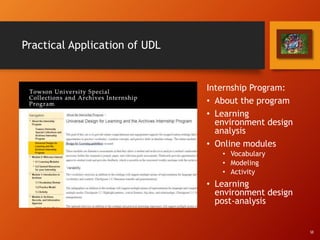
Internship Program:
• About the program
• Learning
environment design
analysis
• Online modules
• Vocabulary
• Modeling
• Activity
• Learning
environment design
post-analysis
SE
UDL at a Glance
CAST. (2010, January 6). UDL at a Glance [Video file].
Retrieved from https://youtu.be/bDvKnY0g6e4
SG
Networks of the Brain
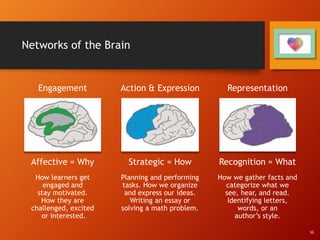
Affective = Why
How learners get
engaged and
stay motivated.
How they are
challenged, excited
or interested.
Strategic = How
Planning and performing
tasks. How we organize
and express our ideas.
Writing an essay or
solving a math problem.
Recognition = What
How we gather facts and
categorize what we
see, hear, and read.
Identifying letters,
words, or an
author’s style.
SG
Engagement Action & Expression Representation
SG
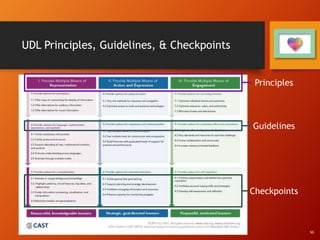
UDL Principles, Guidelines, & Checkpoints
Principles
Guidelines
Checkpoints
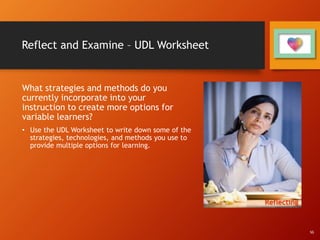
Reflect and Examine – UDL Worksheet
What strategies and methods do you
currently incorporate into your
instruction to create more options for
variable learners?
• Use the UDL Worksheet to write down some of the
strategies, technologies, and methods you use to
provide multiple options for learning.
Reflecting
SG
Group Activity
SE
Share Ideas about UDL
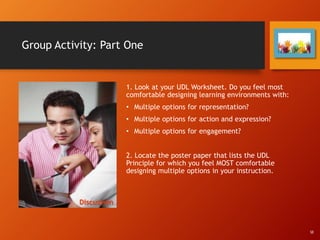
Group Activity: Part One
1. Look at your UDL Worksheet. Do you feel most
comfortable designing learning environments with:
• Multiple options for representation?
• Multiple options for action and expression?
• Multiple options for engagement?
2. Locate the poster paper that lists the UDL
Principle for which you feel MOST comfortable
designing multiple options in your instruction.
Discussion
SE
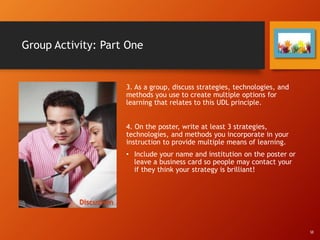
Group Activity: Part One
3. As a group, discuss strategies, technologies, and
methods you use to create multiple options for
learning that relates to this UDL principle.
4. On the poster, write at least 3 strategies,
technologies, and methods you incorporate in your
instruction to provide multiple means of learning.
• Include your name and institution on the poster or
leave a business card so people may contact your
if they think your strategy is brilliant!
Discussion
SE
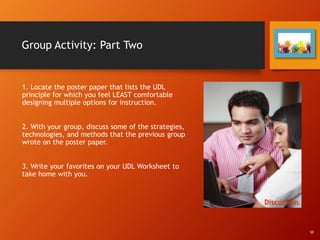
Group Activity: Part Two
1. Locate the poster paper that lists the UDL
principle for which you feel LEAST comfortable
designing multiple options for instruction.
2. With your group, discuss some of the strategies,
technologies, and methods that the previous group
wrote on the poster paper.
3. Write your favorites on your UDL Worksheet to
take home with you.
Discussion
SE
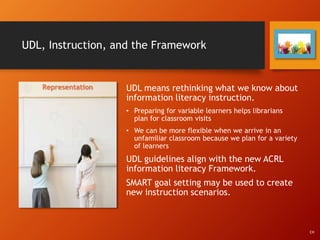
UDL, Instruction, and the Framework
UDL means rethinking what we know about
information literacy instruction.
• Preparing for variable learners helps librarians
plan for classroom visits
• We can be more flexible when we arrive in an
unfamiliar classroom because we plan for a variety
of learners
UDL guidelines align with the new ACRL
information literacy Framework.
SMART goal setting may be used to create
new instruction scenarios.
Representation
CH
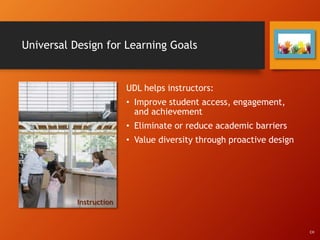
Universal Design for Learning Goals
UDL helps instructors:
• Improve student access, engagement,
and achievement
• Eliminate or reduce academic barriers
• Value diversity through proactive design
Instruction
CH
Learning Outcomes
• List the three main principles of UDL in order to
integrate them into information literacy instruction planning
• Recognize learner variability in all classrooms in order to
plan information literacy instruction activities that:
• engage all learners,
• reduce barriers,
• optimize levels of support, and
• challenge personal instruction experiences or scenarios
• Build a toolkit of UDL instructional design activities in order to
apply UDL principles to teaching and learning
CH
Two Stars and a Wish
Please share two things you liked and one opportunity for improvement.
Resources
• Burgstahler, S., & Cory, R. (2008). Universal Design in higher education: From
principles to practice. Cambridge, MA: Harvard Education Press.
• CAST. (2015a, April 24). CAST UDL bookbuilder. Retrieved from
http://udlexchange.cast.org/home
• CAST. (2015b, April 24). CAST UDL exchange. Retrieved from
http://udlexchange.cast.org/home
• CAST. (2015c, April 24). CAST website. Retrieved from http://www.cast.org/
• CAST. (2010, January 6). UDL at a Glance [Video file]. Retrieved from
https://youtu.be/bDvKnY0g6e4
• Center for Individual Opportunity. (2015, April 28). The myth of average.
[Infographic]. Retrieved from http://www.individualopportunity.org/infographic/
• Christie, B. (2015, April 24). UDL-Universe: A comprehensive Universal Design for
Learning faculty development guide. Retrieved from
http://enact.sonoma.edu/content.php?pid=218878&sid=2028805
All
Resources
• Dweck, C. (2006). Mindset: The new psychology of success. New York, NY: Random
House.
• Maryland State Department of Education. (2011. December 16). UDLinks. Retrieved
from iTunes and Google.
• Medina, J. (2008). Brain rules: 12 principles for surviving and thriving at work,
home, and school. Seattle, WA: Pear Press.
• Meyer, A., Rose, D.H., & Gordon, D. (2014). Universal Design for Learning: Theory
and practice. Wakefield, MA: CAST Professional Publishing. Retrieved from
http://udltheorypractice.cast.org
• National Center on Universal Design for Learning. (2015, April 24). UDL connect.
Retrieved from http://community.udlcenter.org/
• National Center on Universal Design for Learning. (2015, May 4). UDL guidelines –
Version 2.0: Download the UDL guidelines!. Retrieved from
http://www.udlcenter.org/aboutudl/udlguidelines/downloads
All
Resources
• Rose, T. (2012, January 18). Todd Rose: Variability Matters. Address at the
Cyberlearning Research Summit, National Geographic Society, Washington, DC.
Retrieved from https://youtu.be/8WClnVjCEVM
• Wolf, M., & Stoodley, C.J. (2007). Proust and the squid: The story and science of
the reading brain. New York, NY: Harper Collins.
All

Supporting Student Success: UDL and Your Library

  • 1.
    Supporting Student Success: UniversalDesign for Learning (UDL) and Your Library Claire Holmes, Sarah Gilchrist, Sarah Espinosa Albert S. Cook Library, Towson University 2015 Joint Library Conference, MLA/DLA, May 8, 2015 All
  • 2.
    UDL Librarians Claire Holmes AssistantUniversity Librarian for Public Services Sarah Gilchrist Research and Instruction Librarian for Education and Visual Arts Sarah Espinosa Residency Librarian All
  • 3.
    SlideShare Link toSupporting Student Success http://tinyurl.com/UDLSupportingStudentSuccess CH
  • 4.
    Learning Outcomes • Listthe three main principles of UDL in order to integrate them into information literacy instruction planning • Recognize learner variability in all classrooms in order to plan information literacy instruction activities that: • engage all learners, • reduce barriers, • optimize levels of support, and • challenge personal instruction experiences or scenarios • Build a toolkit of UDL instructional design activities in order to apply UDL principles to teaching and learning CH
  • 5.
    “ ” The UDL frameworkoffers flexible instructional materials, techniques, and strategies to help us differentiate instruction to meet students’ varied needs. CAST CH
  • 6.
    Universal Design forLearning History • UDL grew out of architecture • Special Educators adopted UDL • CAST focuses on neuroscience • Towson University facilitates a UDL Professional Learning Network Towson University CH
  • 7.
    The Myth ofthe Average: Todd Rose Rose, T. (2012, January 18). Todd Rose: Variability Matters. Address at the Cyberlearning Research Summit, National Geographic Society, Washington, DC. Retrieved from https://youtu.be/8WClnVjCEVM SE
  • 8.
  • 9.
    The Myth ofthe Average • Shoes are not average • Pilots are not average • Learner variability is the norm • Instructors need to: • Modify learning environments • Design well to remove barriers • Consider learning goals Bessie Coleman SE
  • 10.
    Reflect and Share •Where have you encountered the Myth of Average? • Do you see your environment aiding or discouraging diversity? • What role do librarians play in the development of talent? Thinking SE
  • 11.
    Practical Application ofUDL Instruction: ARTH 391 • Scaffolded instruction • Replaced in-person session with three online sessions in Blackboard • Focused on ACRL Threshold Concepts • Included video and text instructions • Citations submitted via Google forms • Pilot project for advanced art students SG
  • 12.
    Practical Application ofUDL Instruction: ARTH 391 • Grading motivates students • Participation was low • Citations were good assessment • Infographics were popular SG
  • 13.
    Practical Application ofUDL Instruction: TSEM 102 • Ongoing assessment • Incorporates gamification • Supplemented three in-person sessions with six online sessions in Blackboard • Focused on understanding material types for correct citation styles • Included video and text instructions • Shared Audio and visual feedback SG
  • 14.
    Practical Application ofUDL Internship Program: • About the program • Learning environment design analysis • Online modules • Vocabulary • Modeling • Activity • Learning environment design post-analysis SE
  • 15.
    UDL at aGlance CAST. (2010, January 6). UDL at a Glance [Video file]. Retrieved from https://youtu.be/bDvKnY0g6e4 SG
  • 16.
    Networks of theBrain Affective = Why How learners get engaged and stay motivated. How they are challenged, excited or interested. Strategic = How Planning and performing tasks. How we organize and express our ideas. Writing an essay or solving a math problem. Recognition = What How we gather facts and categorize what we see, hear, and read. Identifying letters, words, or an author’s style. SG Engagement Action & Expression Representation
  • 17.
    SG UDL Principles, Guidelines,& Checkpoints Principles Guidelines Checkpoints
  • 18.
    Reflect and Examine– UDL Worksheet What strategies and methods do you currently incorporate into your instruction to create more options for variable learners? • Use the UDL Worksheet to write down some of the strategies, technologies, and methods you use to provide multiple options for learning. Reflecting SG
  • 19.
  • 20.
    Group Activity: PartOne 1. Look at your UDL Worksheet. Do you feel most comfortable designing learning environments with: • Multiple options for representation? • Multiple options for action and expression? • Multiple options for engagement? 2. Locate the poster paper that lists the UDL Principle for which you feel MOST comfortable designing multiple options in your instruction. Discussion SE
  • 21.
    Group Activity: PartOne 3. As a group, discuss strategies, technologies, and methods you use to create multiple options for learning that relates to this UDL principle. 4. On the poster, write at least 3 strategies, technologies, and methods you incorporate in your instruction to provide multiple means of learning. • Include your name and institution on the poster or leave a business card so people may contact your if they think your strategy is brilliant! Discussion SE
  • 22.
    Group Activity: PartTwo 1. Locate the poster paper that lists the UDL principle for which you feel LEAST comfortable designing multiple options for instruction. 2. With your group, discuss some of the strategies, technologies, and methods that the previous group wrote on the poster paper. 3. Write your favorites on your UDL Worksheet to take home with you. Discussion SE
  • 23.
    UDL, Instruction, andthe Framework UDL means rethinking what we know about information literacy instruction. • Preparing for variable learners helps librarians plan for classroom visits • We can be more flexible when we arrive in an unfamiliar classroom because we plan for a variety of learners UDL guidelines align with the new ACRL information literacy Framework. SMART goal setting may be used to create new instruction scenarios. Representation CH
  • 24.
    Universal Design forLearning Goals UDL helps instructors: • Improve student access, engagement, and achievement • Eliminate or reduce academic barriers • Value diversity through proactive design Instruction CH
  • 25.
    Learning Outcomes • Listthe three main principles of UDL in order to integrate them into information literacy instruction planning • Recognize learner variability in all classrooms in order to plan information literacy instruction activities that: • engage all learners, • reduce barriers, • optimize levels of support, and • challenge personal instruction experiences or scenarios • Build a toolkit of UDL instructional design activities in order to apply UDL principles to teaching and learning CH
  • 26.
    Two Stars anda Wish Please share two things you liked and one opportunity for improvement.
  • 27.
    Resources • Burgstahler, S.,& Cory, R. (2008). Universal Design in higher education: From principles to practice. Cambridge, MA: Harvard Education Press. • CAST. (2015a, April 24). CAST UDL bookbuilder. Retrieved from http://udlexchange.cast.org/home • CAST. (2015b, April 24). CAST UDL exchange. Retrieved from http://udlexchange.cast.org/home • CAST. (2015c, April 24). CAST website. Retrieved from http://www.cast.org/ • CAST. (2010, January 6). UDL at a Glance [Video file]. Retrieved from https://youtu.be/bDvKnY0g6e4 • Center for Individual Opportunity. (2015, April 28). The myth of average. [Infographic]. Retrieved from http://www.individualopportunity.org/infographic/ • Christie, B. (2015, April 24). UDL-Universe: A comprehensive Universal Design for Learning faculty development guide. Retrieved from http://enact.sonoma.edu/content.php?pid=218878&sid=2028805 All
  • 28.
    Resources • Dweck, C.(2006). Mindset: The new psychology of success. New York, NY: Random House. • Maryland State Department of Education. (2011. December 16). UDLinks. Retrieved from iTunes and Google. • Medina, J. (2008). Brain rules: 12 principles for surviving and thriving at work, home, and school. Seattle, WA: Pear Press. • Meyer, A., Rose, D.H., & Gordon, D. (2014). Universal Design for Learning: Theory and practice. Wakefield, MA: CAST Professional Publishing. Retrieved from http://udltheorypractice.cast.org • National Center on Universal Design for Learning. (2015, April 24). UDL connect. Retrieved from http://community.udlcenter.org/ • National Center on Universal Design for Learning. (2015, May 4). UDL guidelines – Version 2.0: Download the UDL guidelines!. Retrieved from http://www.udlcenter.org/aboutudl/udlguidelines/downloads All
  • 29.
    Resources • Rose, T.(2012, January 18). Todd Rose: Variability Matters. Address at the Cyberlearning Research Summit, National Geographic Society, Washington, DC. Retrieved from https://youtu.be/8WClnVjCEVM • Wolf, M., & Stoodley, C.J. (2007). Proust and the squid: The story and science of the reading brain. New York, NY: Harper Collins. All