Universal
Design for
Learning
(UDL)
AJAY MAINI
Introduction to UDL; Creating
Inclusive Learning Environments
Universal Design for Learning, or UDL, is an
educational framework that aims to make
learning accessible to all students by
accommodating their diverse needs and
learning styles.
It is rooted in the idea that one-size-fits-all
education does not work, and instead, we
should design instruction to be flexible and
inclusive.
Importance of Inclusive Education: Inclusive
education ensures that all students, regardless
of their abilities, backgrounds, or learning
differences, have equal access to high-quality
learning experiences.
UDL helps us achieve this goal by providing a
blueprint for creating classrooms and learning
environments where every student can thrive.
Presentation Overview: In this presentation, we
will explore the core principles of UDL, including
including Multiple Means of Representation,
Multiple Means of Engagement, and Multiple
Means of Expression.
We will also delve into practical strategies for
teaching, learning, and evaluation that align
with UDL principles, ultimately aiming to
empower both educators and students in the
pursuit of effective and equitable education.
UDL principles: Representation,
Engagement, and Expression.
Universal Design for Learning (UDL) is built on
three fundamental principles that guide the
creation of inclusive and accessible learning
environments.
These principles are designed to address the
diverse needs of all learners and foster
educational equity.
Multiple Means of Representation (The
"What" of Learning):
• This principle focuses on providing learners
with various ways to access information. It
recognizes that students have different
learning preferences and abilities.
• Strategies include offering content in multiple
formats such as text, images, audio, and
video.
• It involves providing clear instructions and
diverse learning materials to cater to various
learning styles.
Multiple Means of Engagement (The
"Why" of Learning):
• This principle aims to engage learners by
making learning experiences relevant and
motivating. It acknowledges that students
may have different interests, backgrounds,
and readiness levels.
• Strategies encompass offering choices and
autonomy in assignments, varying the
complexity of tasks, and creating a positive
and inclusive classroom climate that
encourages active participation.
Multiple Means of Expression (The "How"
of Learning):
• This principle emphasizes allowing students
to demonstrate their understanding and
knowledge in various ways. It recognizes that
students have different strengths and
preferences in how they communicate their
ideas.
• Strategies involve offering flexible assessment
options, allowing students to choose how
they express their learning (e.g., written
essays, oral presentations, creative projects),
and providing clear assessment criteria and
feedback.
By applying these principles, educators
can design learning experiences that
accommodate the diverse needs and
preferences of all students, leading to
more effective and equitable education.
Strategies for Teaching with Universal
Design for Learning (UDL)
UDL is not a one-size-fits-all approach but a
flexible framework that empowers educators to
create inclusive and effective learning
experiences for all students.
Key Strategies:
• Varied Content Presentation: Offer content in
multiple formats (text, audio, video, visuals)
to accommodate diverse learning styles.
• Choice and Autonomy: Give students choices
in assignments and activities to cater to their
interests and strengths.
• Scaffolded Learning: Break down complex
concepts into manageable steps and provide
support as needed.
• Differentiated Instruction: Adapt materials
and tasks to meet individual student needs
and readiness levels.
• Collaborative Learning: Encourage peer
collaboration and group work to enhance
engagement and social learning.
• Continuous Feedback: Provide regular,
constructive feedback to guide student
improvement.
• Flexible Assessment Options: Allow students
to demonstrate understanding in various
ways (e.g., written, oral, visual) and offer
alternative assessment methods.
• Inclusive Language: Use language that
respects diversity and avoids stereotypes.
Benefits of Teaching with Universal Design for
Learning (UDL) :
• Increased student engagement and
motivation.
• Improved comprehension and retention of
information.
• Greater accessibility and inclusivity in the
classroom.
• Enhanced individualized learning
experiences.
• Higher achievement and success rates for
all students.
Strategies for Learning with Universal
Design for Learning (UDL)
Universal Design for Learning (UDL) doesn't just
impact teaching; it also offers a set of strategies
that students can use to enhance their learning
experiences.
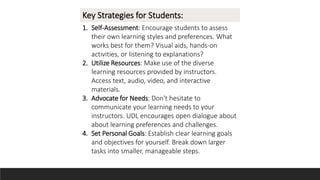
1. Self-Assessment: Encourage students to assess
their own learning styles and preferences. What
works best for them? Visual aids, hands-on
activities, or listening to explanations?
2. Utilize Resources: Make use of the diverse
learning resources provided by instructors.
Access text, audio, video, and interactive
materials.
3. Advocate for Needs: Don't hesitate to
communicate your learning needs to your
instructors. UDL encourages open dialogue about
about learning preferences and challenges.
4. Set Personal Goals: Establish clear learning goals
and objectives for yourself. Break down larger
tasks into smaller, manageable steps.
Key Strategies for Students:
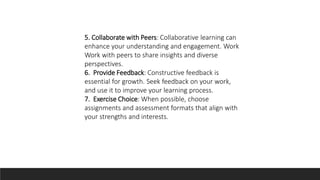
5. Collaborate with Peers: Collaborative learning can
enhance your understanding and engagement. Work
Work with peers to share insights and diverse
perspectives.
6. Provide Feedback: Constructive feedback is
essential for growth. Seek feedback on your work,
and use it to improve your learning process.
7. Exercise Choice: When possible, choose
assignments and assessment formats that align with
your strengths and interests.
Benefits for Students:
• Enhanced self-awareness and learning
effectiveness.
• Increased motivation and engagement.
• Improved ability to advocate for personal
learning needs.
• Better time management and goal-setting
skills.
• A sense of ownership over your learning
journey.
Strategies for Evaluation with Universal
Design for Learning (UDL)
Assessment and evaluation are critical
components of the learning process. When
aligned with UDL principles, they ensure that
assessments are fair, inclusive, and meaningful
for all students.
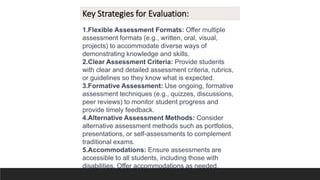
Key Strategies for Evaluation:
1.Flexible Assessment Formats: Offer multiple
assessment formats (e.g., written, oral, visual,
projects) to accommodate diverse ways of
demonstrating knowledge and skills.
2.Clear Assessment Criteria: Provide students
with clear and detailed assessment criteria, rubrics,
or guidelines so they know what is expected.
3.Formative Assessment: Use ongoing, formative
assessment techniques (e.g., quizzes, discussions,
peer reviews) to monitor student progress and
provide timely feedback.
4.Alternative Assessment Methods: Consider
alternative assessment methods such as portfolios,
presentations, or self-assessments to complement
traditional exams.
5.Accommodations: Ensure assessments are
accessible to all students, including those with
disabilities. Offer accommodations as needed.
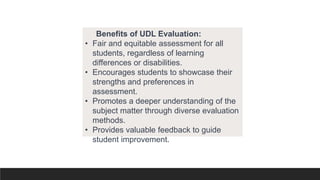
Benefits of UDL Evaluation:
• Fair and equitable assessment for all
students, regardless of learning
differences or disabilities.
• Encourages students to showcase their
strengths and preferences in
assessment.
• Promotes a deeper understanding of the
subject matter through diverse evaluation
methods.
• Provides valuable feedback to guide
student improvement.
Continuous Improvement in Universal
Design for Learning (UDL)
Universal Design for Learning (UDL) is not a
static concept; it's a journey of continuous
improvement. It involves ongoing reflection,
adaptation, and refinement to create the best
possible learning experiences.
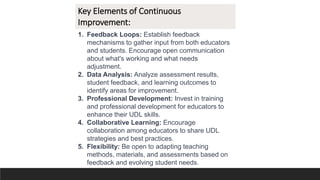
Key Elements of Continuous
Improvement:
1. Feedback Loops: Establish feedback
mechanisms to gather input from both educators
and students. Encourage open communication
about what's working and what needs
adjustment.
2. Data Analysis: Analyze assessment results,
student feedback, and learning outcomes to
identify areas for improvement.
3. Professional Development: Invest in training
and professional development for educators to
enhance their UDL skills.
4. Collaborative Learning: Encourage
collaboration among educators to share UDL
strategies and best practices.
5. Flexibility: Be open to adapting teaching
methods, materials, and assessments based on
feedback and evolving student needs.
Benefits of Continuous Improvement
in UDL:
• Allows for the refinement of teaching
methods to better cater to diverse student
needs.
• Promotes a culture of lifelong learning
among educators.
• Increases the effectiveness and impact of
UDL in the classroom.
• Supports ongoing growth and
development for both students and
educators.
In this presentation, we've
explored Universal Design for
Learning (UDL) and its principles,
strategies for teaching, learning,
and evaluation, as well as the
importance of continuous
improvement.
Thank you for your attention!
9086210009
ajeaymaini@gmail.com

Universal Design for Learning (Inclusive Education)(UDL).pptx

  • 1.
  • 2.
    Introduction to UDL;Creating Inclusive Learning Environments
  • 3.
    Universal Design forLearning, or UDL, is an educational framework that aims to make learning accessible to all students by accommodating their diverse needs and learning styles. It is rooted in the idea that one-size-fits-all education does not work, and instead, we should design instruction to be flexible and inclusive.
  • 4.
    Importance of InclusiveEducation: Inclusive education ensures that all students, regardless of their abilities, backgrounds, or learning differences, have equal access to high-quality learning experiences. UDL helps us achieve this goal by providing a blueprint for creating classrooms and learning environments where every student can thrive.
  • 5.
    Presentation Overview: Inthis presentation, we will explore the core principles of UDL, including including Multiple Means of Representation, Multiple Means of Engagement, and Multiple Means of Expression. We will also delve into practical strategies for teaching, learning, and evaluation that align with UDL principles, ultimately aiming to empower both educators and students in the pursuit of effective and equitable education.
  • 6.
  • 7.
    Universal Design forLearning (UDL) is built on three fundamental principles that guide the creation of inclusive and accessible learning environments. These principles are designed to address the diverse needs of all learners and foster educational equity.
  • 8.
    Multiple Means ofRepresentation (The "What" of Learning): • This principle focuses on providing learners with various ways to access information. It recognizes that students have different learning preferences and abilities. • Strategies include offering content in multiple formats such as text, images, audio, and video. • It involves providing clear instructions and diverse learning materials to cater to various learning styles.
  • 9.
    Multiple Means ofEngagement (The "Why" of Learning): • This principle aims to engage learners by making learning experiences relevant and motivating. It acknowledges that students may have different interests, backgrounds, and readiness levels. • Strategies encompass offering choices and autonomy in assignments, varying the complexity of tasks, and creating a positive and inclusive classroom climate that encourages active participation.
  • 10.
    Multiple Means ofExpression (The "How" of Learning): • This principle emphasizes allowing students to demonstrate their understanding and knowledge in various ways. It recognizes that students have different strengths and preferences in how they communicate their ideas. • Strategies involve offering flexible assessment options, allowing students to choose how they express their learning (e.g., written essays, oral presentations, creative projects), and providing clear assessment criteria and feedback.
  • 11.
    By applying theseprinciples, educators can design learning experiences that accommodate the diverse needs and preferences of all students, leading to more effective and equitable education.
  • 12.
    Strategies for Teachingwith Universal Design for Learning (UDL) UDL is not a one-size-fits-all approach but a flexible framework that empowers educators to create inclusive and effective learning experiences for all students.
  • 13.
    Key Strategies: • VariedContent Presentation: Offer content in multiple formats (text, audio, video, visuals) to accommodate diverse learning styles. • Choice and Autonomy: Give students choices in assignments and activities to cater to their interests and strengths. • Scaffolded Learning: Break down complex concepts into manageable steps and provide support as needed. • Differentiated Instruction: Adapt materials and tasks to meet individual student needs and readiness levels.
  • 14.
    • Collaborative Learning:Encourage peer collaboration and group work to enhance engagement and social learning. • Continuous Feedback: Provide regular, constructive feedback to guide student improvement. • Flexible Assessment Options: Allow students to demonstrate understanding in various ways (e.g., written, oral, visual) and offer alternative assessment methods. • Inclusive Language: Use language that respects diversity and avoids stereotypes.
  • 15.
    Benefits of Teachingwith Universal Design for Learning (UDL) : • Increased student engagement and motivation. • Improved comprehension and retention of information. • Greater accessibility and inclusivity in the classroom. • Enhanced individualized learning experiences. • Higher achievement and success rates for all students.
  • 16.
    Strategies for Learningwith Universal Design for Learning (UDL) Universal Design for Learning (UDL) doesn't just impact teaching; it also offers a set of strategies that students can use to enhance their learning experiences.
  • 17.
    1. Self-Assessment: Encouragestudents to assess their own learning styles and preferences. What works best for them? Visual aids, hands-on activities, or listening to explanations? 2. Utilize Resources: Make use of the diverse learning resources provided by instructors. Access text, audio, video, and interactive materials. 3. Advocate for Needs: Don't hesitate to communicate your learning needs to your instructors. UDL encourages open dialogue about about learning preferences and challenges. 4. Set Personal Goals: Establish clear learning goals and objectives for yourself. Break down larger tasks into smaller, manageable steps. Key Strategies for Students:
  • 18.
    5. Collaborate withPeers: Collaborative learning can enhance your understanding and engagement. Work Work with peers to share insights and diverse perspectives. 6. Provide Feedback: Constructive feedback is essential for growth. Seek feedback on your work, and use it to improve your learning process. 7. Exercise Choice: When possible, choose assignments and assessment formats that align with your strengths and interests.
  • 19.
    Benefits for Students: •Enhanced self-awareness and learning effectiveness. • Increased motivation and engagement. • Improved ability to advocate for personal learning needs. • Better time management and goal-setting skills. • A sense of ownership over your learning journey.
  • 20.
    Strategies for Evaluationwith Universal Design for Learning (UDL) Assessment and evaluation are critical components of the learning process. When aligned with UDL principles, they ensure that assessments are fair, inclusive, and meaningful for all students.
  • 21.
    Key Strategies forEvaluation: 1.Flexible Assessment Formats: Offer multiple assessment formats (e.g., written, oral, visual, projects) to accommodate diverse ways of demonstrating knowledge and skills. 2.Clear Assessment Criteria: Provide students with clear and detailed assessment criteria, rubrics, or guidelines so they know what is expected. 3.Formative Assessment: Use ongoing, formative assessment techniques (e.g., quizzes, discussions, peer reviews) to monitor student progress and provide timely feedback. 4.Alternative Assessment Methods: Consider alternative assessment methods such as portfolios, presentations, or self-assessments to complement traditional exams. 5.Accommodations: Ensure assessments are accessible to all students, including those with disabilities. Offer accommodations as needed.
  • 22.
    Benefits of UDLEvaluation: • Fair and equitable assessment for all students, regardless of learning differences or disabilities. • Encourages students to showcase their strengths and preferences in assessment. • Promotes a deeper understanding of the subject matter through diverse evaluation methods. • Provides valuable feedback to guide student improvement.
  • 23.
    Continuous Improvement inUniversal Design for Learning (UDL) Universal Design for Learning (UDL) is not a static concept; it's a journey of continuous improvement. It involves ongoing reflection, adaptation, and refinement to create the best possible learning experiences.
  • 24.
    Key Elements ofContinuous Improvement: 1. Feedback Loops: Establish feedback mechanisms to gather input from both educators and students. Encourage open communication about what's working and what needs adjustment. 2. Data Analysis: Analyze assessment results, student feedback, and learning outcomes to identify areas for improvement. 3. Professional Development: Invest in training and professional development for educators to enhance their UDL skills. 4. Collaborative Learning: Encourage collaboration among educators to share UDL strategies and best practices. 5. Flexibility: Be open to adapting teaching methods, materials, and assessments based on feedback and evolving student needs.
  • 25.
    Benefits of ContinuousImprovement in UDL: • Allows for the refinement of teaching methods to better cater to diverse student needs. • Promotes a culture of lifelong learning among educators. • Increases the effectiveness and impact of UDL in the classroom. • Supports ongoing growth and development for both students and educators.
  • 26.
    In this presentation,we've explored Universal Design for Learning (UDL) and its principles, strategies for teaching, learning, and evaluation, as well as the importance of continuous improvement.
  • 27.
    Thank you foryour attention! 9086210009 ajeaymaini@gmail.com