1
DC- AC CONVERTER-
INVERTER
References:
Power Electronics
Chapter 5 CW Lander or
Chapter 10 MH Rashid
2
Inverter
• Single phase half bridge
• Single phase full bridge
• Three Phase
– 180 degree Conduction mode
– 120 degree Conduction mode
3
DC-to-AC converters are known as inverters. The function of an
inverter is to change a dc input voltage to a symmetrical ac
output voltage of desired magnitude and frequency.
•The output voltage could be fixed or variable at a fixed or
variable frequency.
• A variable output voltage can be obtained by varying the input
dc voltage and maintaining the gain of the inverter constant.
•For low- and medium-power applications, square-wave or
quasi- square-wave voltages may be acceptable; and for high-
power applications, low distorted sinusoidal waveforms are
required.
•With the availability of high-speed power semiconductor
devices, the harmonic contents of output voltage can be
minimized or reduced significantly by switching techniques.
4
• Inverters are widely used in industrial
applications
• Variable-speed ac motor drives, induction
heating, standby power supplies,
uninterruptible power supplies and also
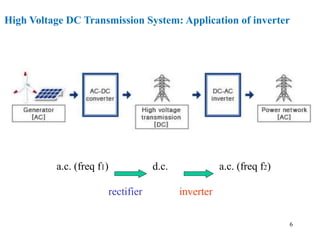
in HVDC (high voltage DC transmission)
systems.
• The input may be a battery, fuel cell,
solar cell, or other dc source.
5
a.c. (freq f1) d.c. a.c. (freq f2)
rectifier inverter
Induction Motor speed control- Application of inverter
6
a.c. (freq f1) d.c. a.c. (freq f2)
rectifier inverter
High Voltage DC Transmission System: Application of inverter
7
Inverters can be broadly classified into two types:
(I) Single-phase Inverters
(2) Three-phase Inverters
•Each type can use controlled turn-on and turn-
off devices (e.g., BJTs, MOSFETs, IGBTs, GTOs) or
forced-commutated thyristors depending on
applications.
•These inverters generally use PWM control
signals for producing an ac output voltage. An
inverter is called a voltage- Source inverter (VSI)
if the input voltage remains constant, a current-
Source inverter ( CSI) if the input current is
maintained constant, and a variable dc linked
inverter if the input voltage is controllable.
8
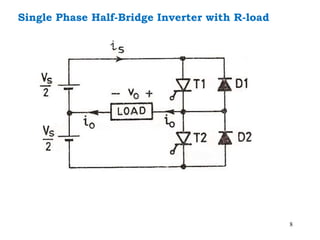
Single Phase Half-Bridge Inverter with R-load
9
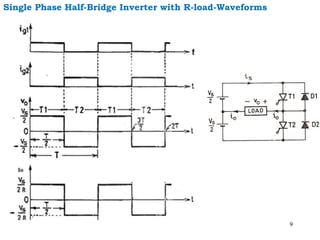
Single Phase Half-Bridge Inverter with R-load-Waveforms
10
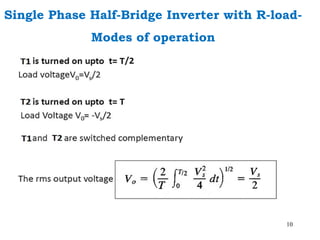
Single Phase Half-Bridge Inverter with R-load-
Modes of operation
11
Single-phase half-bridge inverter –RL load
12
Single Phase Half-Bridge Inverter with RL load-
Modes of operation
13
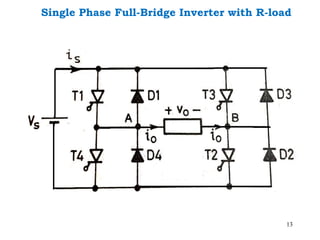
Single Phase Full-Bridge Inverter with R-load
14
Single Phase Full-Bridge Inverter with R-load
At t=T/2
T1 and T2 are ON then Vo= Vs
At t=T
T3 and T4 are ON then Vo=-Vs
The rms output voltage
15
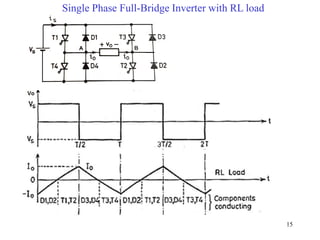
Single Phase Full-Bridge Inverter with RL load
16
• Though T1, T2 are gated at t = 0, these SCRs will not turn on as these are reverse biased by
voltage drops across diodes D1 and D2.
• When load current through D1, D2 falls to zero, T1 and T2 become forward biased by source
voltage VS , T1 and T2 therefore get turned on as these are gated for a period T /2 sec .
• Now load current io flows in the positive direction from A to B .
• At t = T/ 2 ; T1, T2 are turned off by forced commutation and as load current cannot reverse
immediately, diodes D3, D4 come into conduction to allow the flow of current io after T/ 2.
• Thyristors T3, T4, though gated, will not turn on as these are reverse biased by the voltage
drop in diodes D3, D4. When current in diodes D3, D4 drops to zero; T3, T4 are turned on
as these are already gated.
• In the waveform of io, Before t = 0, thyristors T3,T4 are conducting and load current io is
flowing from B to A, i.e . in the re versed direction, This current is shown as - Io at t = 0.
• After T3, T4 are turned off at t = 0, current i o cannot change its direction immediately
because of the nature of load. As a result, diodes D1, D2 start conducting after t = 0 and
allow io to flow against the supply voltage Vs . As soon as D1, D2 begin to conduct, load
is subjected to Vs as shown.
Single Phase Full-Bridge Inverter with RL load
17
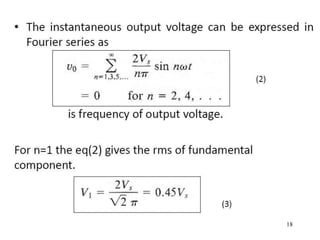
Fourier Analysis Of Single-phase Inverter Output Voltage
Output Voltage waves can be resolved into Fourier series equation as
follows:
Single-phase half-bridge inverter
Single-phase Full-bridge inverter
n is the order of the harmonic and 𝜔 = 2𝜋f is the frequency of the output voltage in rad/s
18
19
20
21
22

Inverter PPT.ppt

  • 1.
    1 DC- AC CONVERTER- INVERTER References: PowerElectronics Chapter 5 CW Lander or Chapter 10 MH Rashid
  • 2.
    2 Inverter • Single phasehalf bridge • Single phase full bridge • Three Phase – 180 degree Conduction mode – 120 degree Conduction mode
  • 3.
    3 DC-to-AC converters areknown as inverters. The function of an inverter is to change a dc input voltage to a symmetrical ac output voltage of desired magnitude and frequency. •The output voltage could be fixed or variable at a fixed or variable frequency. • A variable output voltage can be obtained by varying the input dc voltage and maintaining the gain of the inverter constant. •For low- and medium-power applications, square-wave or quasi- square-wave voltages may be acceptable; and for high- power applications, low distorted sinusoidal waveforms are required. •With the availability of high-speed power semiconductor devices, the harmonic contents of output voltage can be minimized or reduced significantly by switching techniques.
  • 4.
    4 • Inverters arewidely used in industrial applications • Variable-speed ac motor drives, induction heating, standby power supplies, uninterruptible power supplies and also in HVDC (high voltage DC transmission) systems. • The input may be a battery, fuel cell, solar cell, or other dc source.
  • 5.
    5 a.c. (freq f1)d.c. a.c. (freq f2) rectifier inverter Induction Motor speed control- Application of inverter
  • 6.
    6 a.c. (freq f1)d.c. a.c. (freq f2) rectifier inverter High Voltage DC Transmission System: Application of inverter
  • 7.
    7 Inverters can bebroadly classified into two types: (I) Single-phase Inverters (2) Three-phase Inverters •Each type can use controlled turn-on and turn- off devices (e.g., BJTs, MOSFETs, IGBTs, GTOs) or forced-commutated thyristors depending on applications. •These inverters generally use PWM control signals for producing an ac output voltage. An inverter is called a voltage- Source inverter (VSI) if the input voltage remains constant, a current- Source inverter ( CSI) if the input current is maintained constant, and a variable dc linked inverter if the input voltage is controllable.
  • 8.
    8 Single Phase Half-BridgeInverter with R-load
  • 9.
    9 Single Phase Half-BridgeInverter with R-load-Waveforms
  • 10.
    10 Single Phase Half-BridgeInverter with R-load- Modes of operation
  • 11.
  • 12.
    12 Single Phase Half-BridgeInverter with RL load- Modes of operation
  • 13.
    13 Single Phase Full-BridgeInverter with R-load
  • 14.
    14 Single Phase Full-BridgeInverter with R-load At t=T/2 T1 and T2 are ON then Vo= Vs At t=T T3 and T4 are ON then Vo=-Vs The rms output voltage
  • 15.
    15 Single Phase Full-BridgeInverter with RL load
  • 16.
    16 • Though T1,T2 are gated at t = 0, these SCRs will not turn on as these are reverse biased by voltage drops across diodes D1 and D2. • When load current through D1, D2 falls to zero, T1 and T2 become forward biased by source voltage VS , T1 and T2 therefore get turned on as these are gated for a period T /2 sec . • Now load current io flows in the positive direction from A to B . • At t = T/ 2 ; T1, T2 are turned off by forced commutation and as load current cannot reverse immediately, diodes D3, D4 come into conduction to allow the flow of current io after T/ 2. • Thyristors T3, T4, though gated, will not turn on as these are reverse biased by the voltage drop in diodes D3, D4. When current in diodes D3, D4 drops to zero; T3, T4 are turned on as these are already gated. • In the waveform of io, Before t = 0, thyristors T3,T4 are conducting and load current io is flowing from B to A, i.e . in the re versed direction, This current is shown as - Io at t = 0. • After T3, T4 are turned off at t = 0, current i o cannot change its direction immediately because of the nature of load. As a result, diodes D1, D2 start conducting after t = 0 and allow io to flow against the supply voltage Vs . As soon as D1, D2 begin to conduct, load is subjected to Vs as shown. Single Phase Full-Bridge Inverter with RL load
  • 17.
    17 Fourier Analysis OfSingle-phase Inverter Output Voltage Output Voltage waves can be resolved into Fourier series equation as follows: Single-phase half-bridge inverter Single-phase Full-bridge inverter n is the order of the harmonic and 𝜔 = 2𝜋f is the frequency of the output voltage in rad/s
  • 18.
  • 19.
  • 20.
  • 21.
  • 22.