20EE014 POWER ELECTRONICS
UNIT 5 - AC to AC Converters
D.Poornima,
Assistant Professor (Sr.Gr),
Department of EEE,
Sri Ramakrishna Institute of Technology,
Coimbatore
INTRODUCTION
▰ Power flow through ac system can be controlled by adding series impedance
▰ This will cause unwanted voltage drop across the impedance and some power is dissipated
▰ Auto-transformers or variacs are used to control the voltage across load, but is inefficient.
▰ Nowadays silicon controlled rectifiers (SCRs) are used as ac voltage controller, equivalent to
auto transformer.
▰ This method is very efficient
▰ Ac voltage controller blocks the unwanted power flow rather than dissipate at the control device
2
3
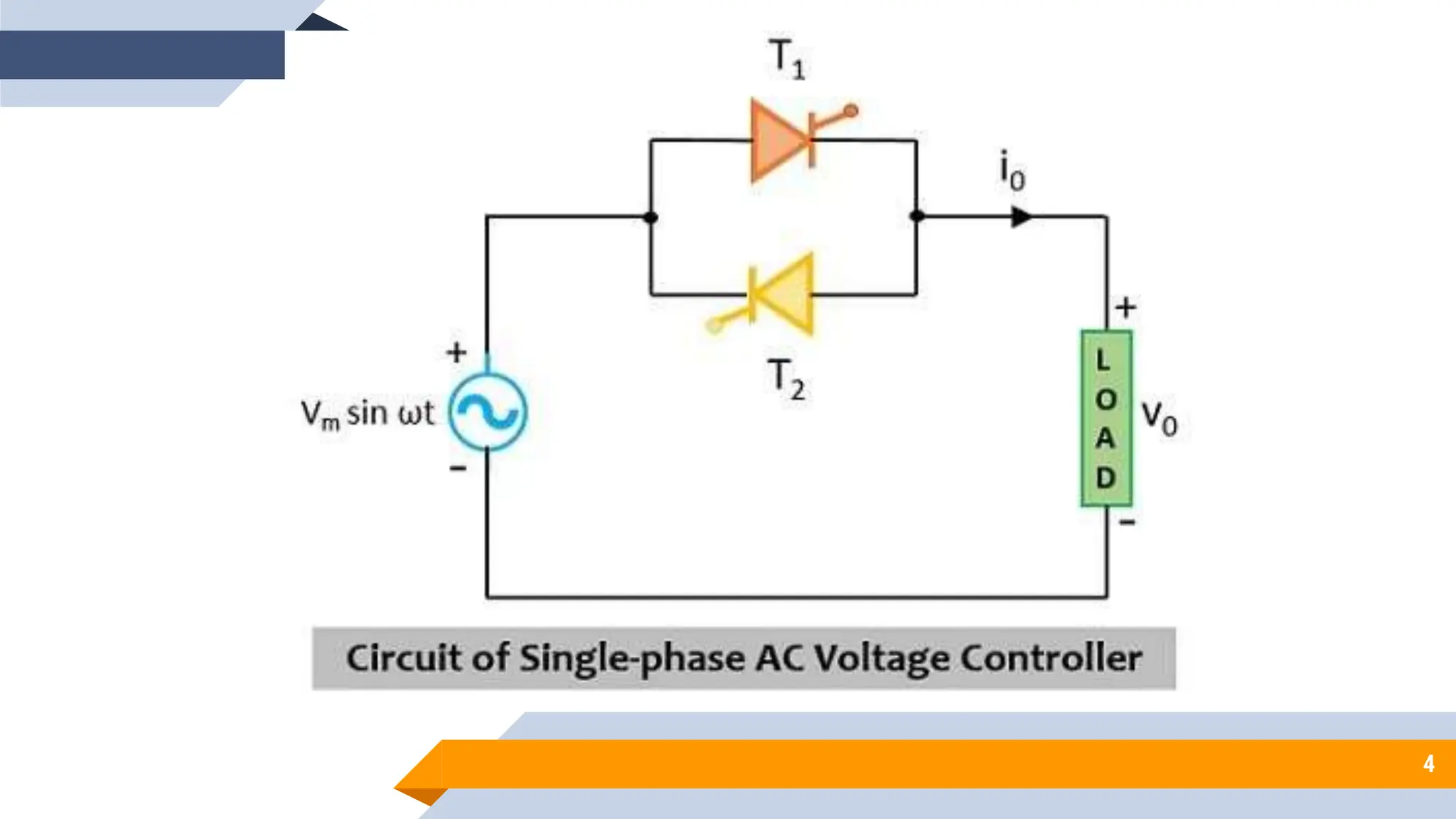
 SCRs have capability to flow current in one direction only.
 When two SCRs are connected back to back, it is possible to flow
current in bidirectional and is used in ac circuits
 Ac-to-ac converters are used to vary the RMS output voltage at load at
constant frequency and these converters are called as ac voltage
controllers or ac voltage regulators.
 When ac-to-ac converters converts a fixed frequency and voltage
system into another ac system at different frequency with variable
voltage, these converters are known as cycloconverters.
 In cycloconverter, there is no intermediate converter stage.
4
5
 Semiconductor switches such as thyristors or triacs are used in ac voltage controllers.
 Thyristors or triacs are natural or line commutated - no requirement of commutation circuit
 Disadvantage - introduction of harmonics in the ac supply voltage and output voltage
Applications of Cycloconverters
• area of high-power low speed induction motor
drives applications specially used in cement
mills, rolling mills
Applications of AC Voltage Controllers
• Lighting control system
• Temperature and heating control system
• Speed control of induction motors
• On line tap changing of transformers, etc.
.
CONTROL STRATEGIES IN AC VOLTAGE CONTROLLERS
6
Integral cycle control (On-Off Control)
• Load power can be controlled by
connecting the source to the load for a
few complete cycles and then
disconnecting the source from the load
for another number of cycles
• This controller is also know as burst-
firing or cycle selection or cycle
syncopation.
• Harmonics and radio frequency
interference are very low in this controller.
7
Integral cycle control (On-Off Control)
▰ Suitable for systems with large time constants
▰ Average power to the load can be varied from 0% to 100%
▰ Used for heating loads and motor speed control
8
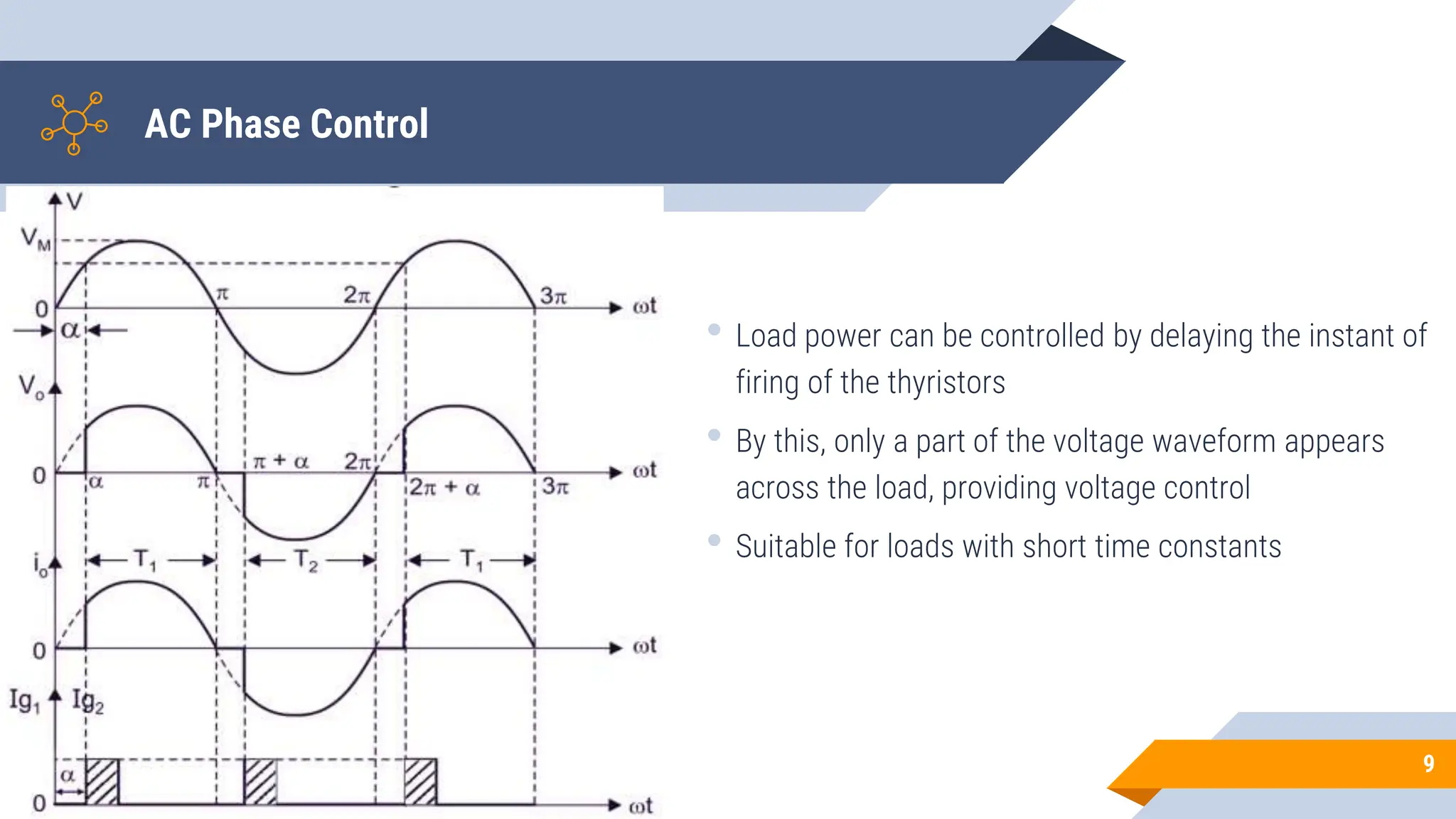
AC Phase Control
• Load power can be controlled by delaying the instant of
firing of the thyristors
• By this, only a part of the voltage waveform appears
across the load, providing voltage control
• Suitable for loads with short time constants
9
Single Phase Voltage Controller with R Load
10
Single Phase Voltage Controller with R Load
▰ RMS output voltage across load at firing angle α
11
• RMS output voltage can be controlled from V to 0 by changing
firing angle from 0° to 180°.
• The rms value of load current is I0 = V0/R
• The average value of output voltage over any complete cycle is
zero
• The average value of output voltage for half cycle duration is
given by
Single Phase Voltage Controller with RL Load
12
Three Phase AC
Voltage Controllers
▰ Single-phase ac voltage controllers in high power load applications, the distorted
waveform of line current creates the unbalance in three phase line current.
▰ This unbalance line current flows through neutral which must be always avoided.
▰ Therefore, three phase ac voltage controllers should be used in high power
applications in place of single phase ac voltage controllers.
▰ There are different circuit configurations of three phase Ac voltage controllers
14
15
Three Phase Voltage Controller with Y
Connected R Load
16
17
▰ In three phase ac voltage controller, two or three thyristors of different phases must conduct at
a time.
▰ Single pulse gate signal cannot be used, a train of gate trigger signal is used for the whole
conduction period.
▰ In R load, thyristor conduction starts at ωt = 30° and stops at ωt =180°.
▰ Range of firing angle is 150° only i.e 0° ≤ α ≤ 150°
▰ To get a balanced line current, the thyristors must be triggered symmetrically.
▰ Triggering sequence will be α, α + 120°, α + 240° for thyristor T1, T3 and T5 respectively.
▰ Thyristors T2, T4 and T6 are triggered at α + 180°, α + 300°, α + 420° respectively
▰ The operation of converter can be divided into 6 modes of operation
18
19
20
21
22
23
24
25
Performance Control
of AC Voltage
Controllers
Power Factor Control in AC Voltage Controllers
▰ Power factor control, is the process of reducing the amount of reactive power.
▰ The device used in this case is called a power factor controller PFC
▰ From the power triangle, the reactive power is at right angle (90°) to the true power
and is used to energize the magnetic field.
▰ Although reactive power does not have a real value in electronic equipment, the bill
for electricity comprises real and reactive power costs.
27
Power Factor Control in AC Voltage Controllers
▰ Power factor - ratio of the real power in kW to the reactive power in kVAr
▰ Value ranges from 0 to 1.
▰ If power factor is 0.8 and above, device is said to be using power efficiently.
▰ Incorporating a PFC ensures the power factor ranges from 0.95 to 0.99.
▰ Power factor controllers (PFC) are mainly used in industrial equipment to minimize
reactive power generated by fluorescent lighting and electric motors.
▰ To ensure power factor is improved without causing harmonic distortion, the
conventional capacitors should not be used.
▰ Instead, filters combination of capacitors and reactors for harmonic suppression are
used. 28
Power Factor Control in AC Voltage Controllers
▰ This type of harmonic filter is referred to as a
single tuned filter.
▰ A quality factor Q of this filter is defined as quality
factor of its reactance (XL) at Q tuning frequency
where Q is given by (nXL/R).
29
Sequence Control of AC Voltage Controllers
▰ Sequence control is employed for the improvement of system performance and for
the reduction of harmonics in the input current and output voltage.
▰ Sequence control means the use of two or more stages of voltage controllers in
parallel for the regulation of output voltage.
▰ The term ‘sequence control’ means that the stages of voltage controllers in parallel
are triggered in a proper sequence one after the other so as to obtain a variable
output with low harmonic content.
▰ There are two stage and multistage sequence controllers 30
Multistage Sequence Control
▰ Multistage sequence control is employed when it is
desired to have harmonic content lower than that in
a two-stage sequence control.
▰ The transformer has n secondary windings.
▰ Each secondary is rated for vs/n where vs is the
source voltage.
▰ Voltage of terminal a with respect to 0 is vs
▰ Voltage of terminal b is (n — 1)vs/n and so on. 31
Multistage Sequence Control
▰ If voltage control from vdo = (n — 3) vs/n to
vco = (n — 2) vs/n is required, then thyristor
pair 4 is fired at α= 0° and the firing angle of
thyristor pair 3 is controlled from α = 0° to
180° whereas all other thyristor pairs are
kept off.
▰ .
32
Multistage Sequence Control
▰ For controlling the voltage from vbo = (n.— 1)
vs/n to vao = vs thyristor pair 2 is triggered at α
= 0° whereas for pair 1, α is varied from 0° to
180° by keeping the remaining (n — 2) SCR
pairs off.
▰ Thus, the load voltage can be controlled from
vs/n to vs by control of triggering the adjacent
thyristor pairs. 33
Multistage Sequence Control
▰ The presence of harmonics in the output voltage depends upon the magnitude of
voltage variation.
▰ If the voltage variation is a small fraction of the total output voltage, the harmonic
content in the output voltage is small.
34
Cycloconverter
Introduction
▰ Cycloconverter is a direct frequency converter which converts ac power at fixed frequency to ac
power at variable frequency.
▰ It is also called as one-stage frequency changer.
▰ In cycloconverter frequency changes in steps.
▰ Usually it is a SCR based converter with natural or line commutation.
▰ To reduce harmonic current and to improve efficiency and power factor, cycloconverter based
on forced-commutation devices are used.
36
37
Applications of Cyclo-converters
• HVDC transmission systems.
• Static Var Generation.
• Aircraft or shipboard power supplies.
• Speed control of high power AC drives.
• Grinding mills.
• Cement mill drives.
• Mine winders.
• high power low-speed induction motor drive,
• low-frequency three phase/single phase induction or traction motor drives
Types of Cycloconverters
▰ In general, cycloconverter are classified as
1. Step-down cycloconverter
2. Step-up cycloconverter
▰ Depending upon the phases, there are three types of cycloconverters such as
1. Single-phase to single-phase cycloconverters
2. Three-phase to single-phase cycloconverters
3. Three-phase to three-phase cycloconverters
▰ The single phase to single phase cycloconverters are two types namely
1. Mid-point-type cycloconverters
2. Bridge -type cycloconverters 38
1. Step-down cycloconverter
▰ Output frequency fo is less than the supply (input) frequency fs, i.e., fo < fs.
▰ Naturally commutated and the output frequency is limited to a value that is a fraction of input frequency.
▰ Commonly used in low speed ac motor drives up to 15 MW with frequencies from 0 to 20 Hz.
2. Step-up cycloconverter
▰ Output frequency fo is greater than the supply (input) frequency fs, i.e., fo > fs.
▰ Forced commutated and the output frequency is limited to a value that is a multiple of input frequency.
▰ Fast switching devices and microprocessors are used to implement advanced conversion strategies.
▰ Also known as forced commutated direct frequency changers..
39
Single-phase To Single-phase
Step-up Cycloconverters
Bridge-type Cycloconverters
41
Working
▰ Two single-phase controlled converters are operated as bridge rectifiers.
▰ Their delay angles are such that the output voltage of one converter is equal and opposite to that of
the other converter.
▰ If αp is the delay angle of positive converter, the delay angle of the negative converter is: αn = π – αp
▰ First, During +ve half cycle, P1,P2 and N1 and N2 are forward biased
▰ At ωt=0°, P1 and P2 are triggered
▰ Load voltage follows the input voltage, +ve voltage
▰ At ωt= ωt1, P1, P2 are force commutated and N1,N2 are triggered
▰ The output voltage reverses direction, load voltage is –ve
▰ At ωt= ωt2, after π P3, P4 are triggered and N3,N4 are force commutated
▰ High frequency turning and force commutation of thyristor pairs gives frequency modulated wave
42
43
Single-phase To Single-phase
Step-Down Cycloconverters
Bridge-type
▰ Does not require forced commutation
▰ P1,P2 is triggered at ωt= α,+ve output voltage
▰ At ωt=π, voltage and current is zero
▰ P1, P2 is reversed biased when –ve voltage appears
▰ P3,P4 is triggered at ωt=π + α, and output voltage is again positive
▰ After a certain number of pulses, the same is done with N1, N2 and N3, N4
45
46
Three-phase Cycloconverters
Types of Three Phase Cycloconverters
▰ Single-phase to single-phase cycloconverters are commonly used in low power
industrial applications
▰ These converters are not suitable for medium and high power applications.
▰ Three-phase cycloconverters are developed for medium and high power applications
▰ Three phase cycloconverter are classified as
▻ Three phase to single phase cycloconverters
▻ Three phase to three phase cycloconverters
48
Three Phase to Single Phase Cycloconverters
49
Working
▰ The converter circuit that allows the current during positive half cycle of load current is called
positive converter group, group permitting flow of current during negative half cycle of load
current is know as negative group converter.
▰ The basic principle is to vary progressively the firing angle of three thyristor of three phase half-
wave circuit.
▰ Firing angle at A, 𝛼 is 90°, At B, 𝛼 is somewhat less then 90°, at C it is still further reduced and
so on.
▰ At G 𝛼 is zero and the mean output voltage , given by 𝑉𝑜=𝑉𝑑𝑜cos𝛼, is maximum at G.
▰ At A, the mean output voltage is zero as 𝛼=90°
50
Working
▰ After point G, a small delay in firing angle is further introduced progressively at points H,I,J,K,L
and M.
▰ Change in firing angle = frequency reduction factor × 120°
▰ At M, the firing angle is again 90° and the value of mean output voltage is zero.
▰ Mean output voltage is obtained by joining point pertaining to average voltage values.
▰ In one half cycle of fundamental frequency output voltage, there are eight half cycles of supply
frequency voltage.
▰ Output frequency 𝑓𝑜= 1/8𝑓𝑠 where fs is the supply frequency.
51
52
three-PhaSe to three-PhaSe CyCloConverter
Three Phase to Three Phase Cycloconverters
53
54
Working
▰ Out of several configuration of 3 phase to 3 phase cycloconverter, this is the most
important scheme, used for large industrial drive.
▰ This scheme employs 36 thyristor and is called 6 pulse, 3 phase to 3 phase
cycloconverter.
▰ Each phase group consist of 3 phase dual-converter with two IGR
▰ The load phase, must not be interconnected
▰ The magnitude of output voltage in 3 phase bridge circuit is doubled of that in the 18
thyristor circuit.
▰ Three phase bridge circuit gives a smooth variations of output voltage, but its control
circuit is complex and expensive. 55
Matrix Converters
Working
▰ Matrix converters (MCs) are AC-AC power conversion topologies widely explored and applied in
the industry for their attractive features of sinusoidal input and output currents, considerable
size reduction, and reliable operation due to the omission of bulky passive components.
▰ A matrix converter consists of a matrix of 9 switches connecting the three input phases to the
three output phases directly.
▰ Any input phase can be connected to any output phase at any time depending on the control.
▰ No two switches from the same phase should be on at the same time, otherwise this will cause
a short circuit of the input phases.
▰ Usually controlled by PWM to produce three-phase variable voltages at variable frequency.
57
58
• The input terminals of the
converter are connected
to the grid, the output
terminal are connected to
a three phase current-fed
system, like an induction
motor.
• The capacitive filter on the
voltage-fed side and the
inductive filter on the
current-fed side are
necessary.
• Their size is inversely
proportional to the
switching frequency
Working
▰ There are three methods of matrix converter control −
▻Space vector modulation
▻Pulse width modulation
▻Venturi - analysis of function transfer.
▰ With nine bi-directional switches the matrix converter can theoretically assume 512 (29) different switching
states combinations.
▰ But not all of them can be usefully employed.
▰ Regardless to the control method used, the choice of the matrix converter switching state combinations
must comply with two basic rules.
▻ The input phases should never be short-circuited and
▻ The output currents should not be interrupted.
▰ These rules imply that one and only one bi-directional switch per output phase must be switched on at any
instant.
▰ By this constraint, there are 27 permitted switching combinations.
59
60
61

Power Electronics- AC -AC Converters.pptx

  • 1.
    20EE014 POWER ELECTRONICS UNIT5 - AC to AC Converters D.Poornima, Assistant Professor (Sr.Gr), Department of EEE, Sri Ramakrishna Institute of Technology, Coimbatore
  • 2.
    INTRODUCTION ▰ Power flowthrough ac system can be controlled by adding series impedance ▰ This will cause unwanted voltage drop across the impedance and some power is dissipated ▰ Auto-transformers or variacs are used to control the voltage across load, but is inefficient. ▰ Nowadays silicon controlled rectifiers (SCRs) are used as ac voltage controller, equivalent to auto transformer. ▰ This method is very efficient ▰ Ac voltage controller blocks the unwanted power flow rather than dissipate at the control device 2
  • 3.
    3  SCRs havecapability to flow current in one direction only.  When two SCRs are connected back to back, it is possible to flow current in bidirectional and is used in ac circuits  Ac-to-ac converters are used to vary the RMS output voltage at load at constant frequency and these converters are called as ac voltage controllers or ac voltage regulators.  When ac-to-ac converters converts a fixed frequency and voltage system into another ac system at different frequency with variable voltage, these converters are known as cycloconverters.  In cycloconverter, there is no intermediate converter stage.
  • 4.
  • 5.
    5  Semiconductor switchessuch as thyristors or triacs are used in ac voltage controllers.  Thyristors or triacs are natural or line commutated - no requirement of commutation circuit  Disadvantage - introduction of harmonics in the ac supply voltage and output voltage Applications of Cycloconverters • area of high-power low speed induction motor drives applications specially used in cement mills, rolling mills Applications of AC Voltage Controllers • Lighting control system • Temperature and heating control system • Speed control of induction motors • On line tap changing of transformers, etc. .
  • 6.
    CONTROL STRATEGIES INAC VOLTAGE CONTROLLERS 6
  • 7.
    Integral cycle control(On-Off Control) • Load power can be controlled by connecting the source to the load for a few complete cycles and then disconnecting the source from the load for another number of cycles • This controller is also know as burst- firing or cycle selection or cycle syncopation. • Harmonics and radio frequency interference are very low in this controller. 7
  • 8.
    Integral cycle control(On-Off Control) ▰ Suitable for systems with large time constants ▰ Average power to the load can be varied from 0% to 100% ▰ Used for heating loads and motor speed control 8
  • 9.
    AC Phase Control •Load power can be controlled by delaying the instant of firing of the thyristors • By this, only a part of the voltage waveform appears across the load, providing voltage control • Suitable for loads with short time constants 9
  • 10.
    Single Phase VoltageController with R Load 10
  • 11.
    Single Phase VoltageController with R Load ▰ RMS output voltage across load at firing angle α 11 • RMS output voltage can be controlled from V to 0 by changing firing angle from 0° to 180°. • The rms value of load current is I0 = V0/R • The average value of output voltage over any complete cycle is zero • The average value of output voltage for half cycle duration is given by
  • 12.
    Single Phase VoltageController with RL Load 12
  • 13.
  • 14.
    ▰ Single-phase acvoltage controllers in high power load applications, the distorted waveform of line current creates the unbalance in three phase line current. ▰ This unbalance line current flows through neutral which must be always avoided. ▰ Therefore, three phase ac voltage controllers should be used in high power applications in place of single phase ac voltage controllers. ▰ There are different circuit configurations of three phase Ac voltage controllers 14
  • 15.
  • 16.
    Three Phase VoltageController with Y Connected R Load 16
  • 17.
  • 18.
    ▰ In threephase ac voltage controller, two or three thyristors of different phases must conduct at a time. ▰ Single pulse gate signal cannot be used, a train of gate trigger signal is used for the whole conduction period. ▰ In R load, thyristor conduction starts at ωt = 30° and stops at ωt =180°. ▰ Range of firing angle is 150° only i.e 0° ≤ α ≤ 150° ▰ To get a balanced line current, the thyristors must be triggered symmetrically. ▰ Triggering sequence will be α, α + 120°, α + 240° for thyristor T1, T3 and T5 respectively. ▰ Thyristors T2, T4 and T6 are triggered at α + 180°, α + 300°, α + 420° respectively ▰ The operation of converter can be divided into 6 modes of operation 18
  • 19.
  • 20.
  • 21.
  • 22.
  • 23.
  • 24.
  • 25.
  • 26.
    Performance Control of ACVoltage Controllers
  • 27.
    Power Factor Controlin AC Voltage Controllers ▰ Power factor control, is the process of reducing the amount of reactive power. ▰ The device used in this case is called a power factor controller PFC ▰ From the power triangle, the reactive power is at right angle (90°) to the true power and is used to energize the magnetic field. ▰ Although reactive power does not have a real value in electronic equipment, the bill for electricity comprises real and reactive power costs. 27
  • 28.
    Power Factor Controlin AC Voltage Controllers ▰ Power factor - ratio of the real power in kW to the reactive power in kVAr ▰ Value ranges from 0 to 1. ▰ If power factor is 0.8 and above, device is said to be using power efficiently. ▰ Incorporating a PFC ensures the power factor ranges from 0.95 to 0.99. ▰ Power factor controllers (PFC) are mainly used in industrial equipment to minimize reactive power generated by fluorescent lighting and electric motors. ▰ To ensure power factor is improved without causing harmonic distortion, the conventional capacitors should not be used. ▰ Instead, filters combination of capacitors and reactors for harmonic suppression are used. 28
  • 29.
    Power Factor Controlin AC Voltage Controllers ▰ This type of harmonic filter is referred to as a single tuned filter. ▰ A quality factor Q of this filter is defined as quality factor of its reactance (XL) at Q tuning frequency where Q is given by (nXL/R). 29
  • 30.
    Sequence Control ofAC Voltage Controllers ▰ Sequence control is employed for the improvement of system performance and for the reduction of harmonics in the input current and output voltage. ▰ Sequence control means the use of two or more stages of voltage controllers in parallel for the regulation of output voltage. ▰ The term ‘sequence control’ means that the stages of voltage controllers in parallel are triggered in a proper sequence one after the other so as to obtain a variable output with low harmonic content. ▰ There are two stage and multistage sequence controllers 30
  • 31.
    Multistage Sequence Control ▰Multistage sequence control is employed when it is desired to have harmonic content lower than that in a two-stage sequence control. ▰ The transformer has n secondary windings. ▰ Each secondary is rated for vs/n where vs is the source voltage. ▰ Voltage of terminal a with respect to 0 is vs ▰ Voltage of terminal b is (n — 1)vs/n and so on. 31
  • 32.
    Multistage Sequence Control ▰If voltage control from vdo = (n — 3) vs/n to vco = (n — 2) vs/n is required, then thyristor pair 4 is fired at α= 0° and the firing angle of thyristor pair 3 is controlled from α = 0° to 180° whereas all other thyristor pairs are kept off. ▰ . 32
  • 33.
    Multistage Sequence Control ▰For controlling the voltage from vbo = (n.— 1) vs/n to vao = vs thyristor pair 2 is triggered at α = 0° whereas for pair 1, α is varied from 0° to 180° by keeping the remaining (n — 2) SCR pairs off. ▰ Thus, the load voltage can be controlled from vs/n to vs by control of triggering the adjacent thyristor pairs. 33
  • 34.
    Multistage Sequence Control ▰The presence of harmonics in the output voltage depends upon the magnitude of voltage variation. ▰ If the voltage variation is a small fraction of the total output voltage, the harmonic content in the output voltage is small. 34
  • 35.
  • 36.
    Introduction ▰ Cycloconverter isa direct frequency converter which converts ac power at fixed frequency to ac power at variable frequency. ▰ It is also called as one-stage frequency changer. ▰ In cycloconverter frequency changes in steps. ▰ Usually it is a SCR based converter with natural or line commutation. ▰ To reduce harmonic current and to improve efficiency and power factor, cycloconverter based on forced-commutation devices are used. 36
  • 37.
    37 Applications of Cyclo-converters •HVDC transmission systems. • Static Var Generation. • Aircraft or shipboard power supplies. • Speed control of high power AC drives. • Grinding mills. • Cement mill drives. • Mine winders. • high power low-speed induction motor drive, • low-frequency three phase/single phase induction or traction motor drives
  • 38.
    Types of Cycloconverters ▰In general, cycloconverter are classified as 1. Step-down cycloconverter 2. Step-up cycloconverter ▰ Depending upon the phases, there are three types of cycloconverters such as 1. Single-phase to single-phase cycloconverters 2. Three-phase to single-phase cycloconverters 3. Three-phase to three-phase cycloconverters ▰ The single phase to single phase cycloconverters are two types namely 1. Mid-point-type cycloconverters 2. Bridge -type cycloconverters 38
  • 39.
    1. Step-down cycloconverter ▰Output frequency fo is less than the supply (input) frequency fs, i.e., fo < fs. ▰ Naturally commutated and the output frequency is limited to a value that is a fraction of input frequency. ▰ Commonly used in low speed ac motor drives up to 15 MW with frequencies from 0 to 20 Hz. 2. Step-up cycloconverter ▰ Output frequency fo is greater than the supply (input) frequency fs, i.e., fo > fs. ▰ Forced commutated and the output frequency is limited to a value that is a multiple of input frequency. ▰ Fast switching devices and microprocessors are used to implement advanced conversion strategies. ▰ Also known as forced commutated direct frequency changers.. 39
  • 40.
  • 41.
  • 42.
    Working ▰ Two single-phasecontrolled converters are operated as bridge rectifiers. ▰ Their delay angles are such that the output voltage of one converter is equal and opposite to that of the other converter. ▰ If αp is the delay angle of positive converter, the delay angle of the negative converter is: αn = π – αp ▰ First, During +ve half cycle, P1,P2 and N1 and N2 are forward biased ▰ At ωt=0°, P1 and P2 are triggered ▰ Load voltage follows the input voltage, +ve voltage ▰ At ωt= ωt1, P1, P2 are force commutated and N1,N2 are triggered ▰ The output voltage reverses direction, load voltage is –ve ▰ At ωt= ωt2, after π P3, P4 are triggered and N3,N4 are force commutated ▰ High frequency turning and force commutation of thyristor pairs gives frequency modulated wave 42
  • 43.
  • 44.
  • 45.
    Bridge-type ▰ Does notrequire forced commutation ▰ P1,P2 is triggered at ωt= α,+ve output voltage ▰ At ωt=π, voltage and current is zero ▰ P1, P2 is reversed biased when –ve voltage appears ▰ P3,P4 is triggered at ωt=π + α, and output voltage is again positive ▰ After a certain number of pulses, the same is done with N1, N2 and N3, N4 45
  • 46.
  • 47.
  • 48.
    Types of ThreePhase Cycloconverters ▰ Single-phase to single-phase cycloconverters are commonly used in low power industrial applications ▰ These converters are not suitable for medium and high power applications. ▰ Three-phase cycloconverters are developed for medium and high power applications ▰ Three phase cycloconverter are classified as ▻ Three phase to single phase cycloconverters ▻ Three phase to three phase cycloconverters 48
  • 49.
    Three Phase toSingle Phase Cycloconverters 49
  • 50.
    Working ▰ The convertercircuit that allows the current during positive half cycle of load current is called positive converter group, group permitting flow of current during negative half cycle of load current is know as negative group converter. ▰ The basic principle is to vary progressively the firing angle of three thyristor of three phase half- wave circuit. ▰ Firing angle at A, 𝛼 is 90°, At B, 𝛼 is somewhat less then 90°, at C it is still further reduced and so on. ▰ At G 𝛼 is zero and the mean output voltage , given by 𝑉𝑜=𝑉𝑑𝑜cos𝛼, is maximum at G. ▰ At A, the mean output voltage is zero as 𝛼=90° 50
  • 51.
    Working ▰ After pointG, a small delay in firing angle is further introduced progressively at points H,I,J,K,L and M. ▰ Change in firing angle = frequency reduction factor × 120° ▰ At M, the firing angle is again 90° and the value of mean output voltage is zero. ▰ Mean output voltage is obtained by joining point pertaining to average voltage values. ▰ In one half cycle of fundamental frequency output voltage, there are eight half cycles of supply frequency voltage. ▰ Output frequency 𝑓𝑜= 1/8𝑓𝑠 where fs is the supply frequency. 51
  • 52.
  • 53.
    Three Phase toThree Phase Cycloconverters 53
  • 54.
  • 55.
    Working ▰ Out ofseveral configuration of 3 phase to 3 phase cycloconverter, this is the most important scheme, used for large industrial drive. ▰ This scheme employs 36 thyristor and is called 6 pulse, 3 phase to 3 phase cycloconverter. ▰ Each phase group consist of 3 phase dual-converter with two IGR ▰ The load phase, must not be interconnected ▰ The magnitude of output voltage in 3 phase bridge circuit is doubled of that in the 18 thyristor circuit. ▰ Three phase bridge circuit gives a smooth variations of output voltage, but its control circuit is complex and expensive. 55
  • 56.
  • 57.
    Working ▰ Matrix converters(MCs) are AC-AC power conversion topologies widely explored and applied in the industry for their attractive features of sinusoidal input and output currents, considerable size reduction, and reliable operation due to the omission of bulky passive components. ▰ A matrix converter consists of a matrix of 9 switches connecting the three input phases to the three output phases directly. ▰ Any input phase can be connected to any output phase at any time depending on the control. ▰ No two switches from the same phase should be on at the same time, otherwise this will cause a short circuit of the input phases. ▰ Usually controlled by PWM to produce three-phase variable voltages at variable frequency. 57
  • 58.
    58 • The inputterminals of the converter are connected to the grid, the output terminal are connected to a three phase current-fed system, like an induction motor. • The capacitive filter on the voltage-fed side and the inductive filter on the current-fed side are necessary. • Their size is inversely proportional to the switching frequency
  • 59.
    Working ▰ There arethree methods of matrix converter control − ▻Space vector modulation ▻Pulse width modulation ▻Venturi - analysis of function transfer. ▰ With nine bi-directional switches the matrix converter can theoretically assume 512 (29) different switching states combinations. ▰ But not all of them can be usefully employed. ▰ Regardless to the control method used, the choice of the matrix converter switching state combinations must comply with two basic rules. ▻ The input phases should never be short-circuited and ▻ The output currents should not be interrupted. ▰ These rules imply that one and only one bi-directional switch per output phase must be switched on at any instant. ▰ By this constraint, there are 27 permitted switching combinations. 59
  • 60.
  • 61.