Disasters

Made by- Avyakth Challa (6F)
Disasters
 Disasters are hazards that cause destruction or
  environmental changes.
     The types are
      Natural disasters
      Man made disasters
Natural Disasters
 A natural disaster is the effect of a
natural hazard (e.g., flood, tornado,
    hurricane, volcanic eruption,
     earthquake, or landslide)
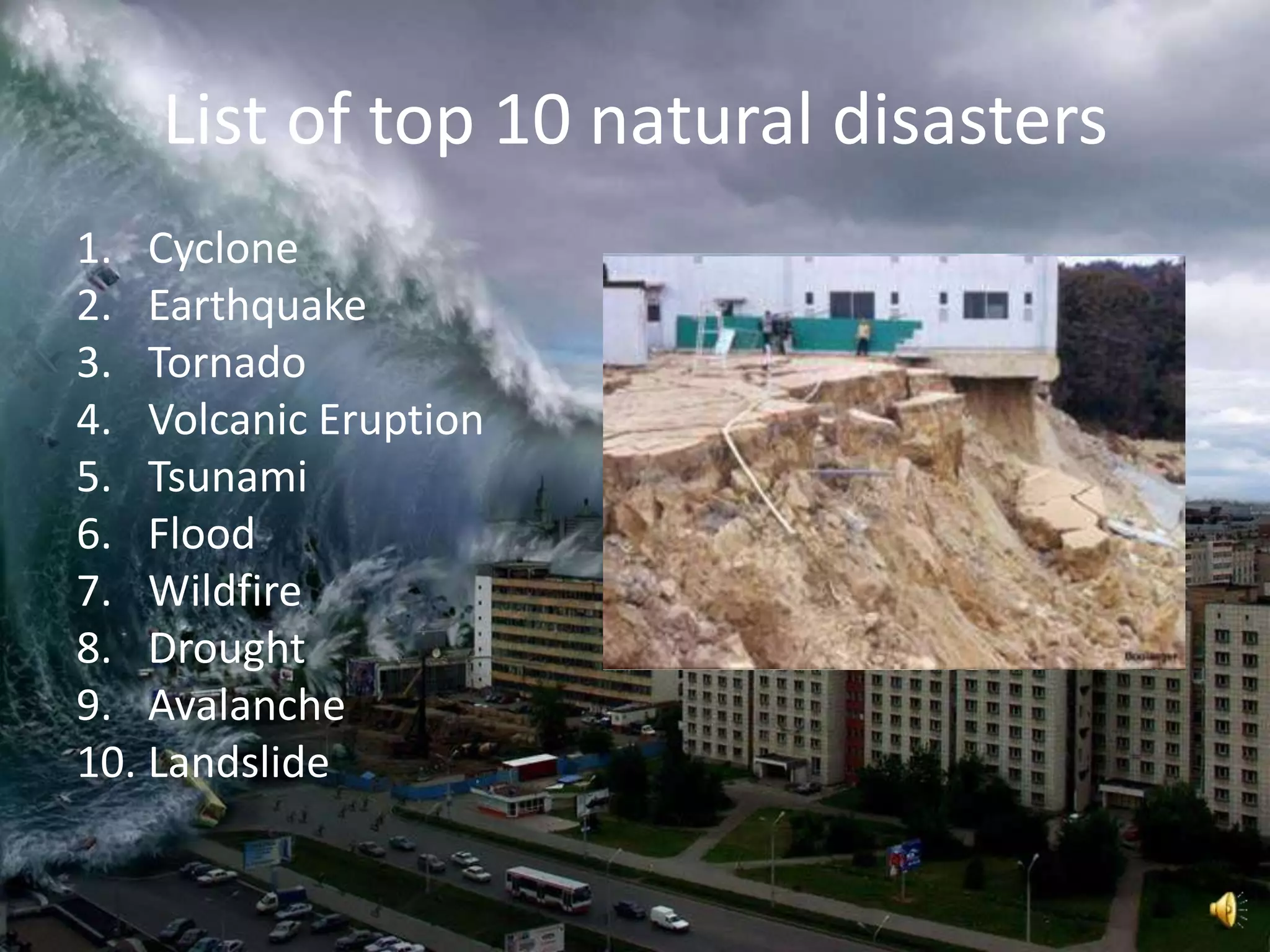
List of top 10 natural disasters
1. Cyclone
2. Earthquake
3. Tornado
4. Volcanic Eruption
5. Tsunami
6. Flood
7. Wildfire
8. Drought
9. Avalanche
10. Landslide
Cyclones
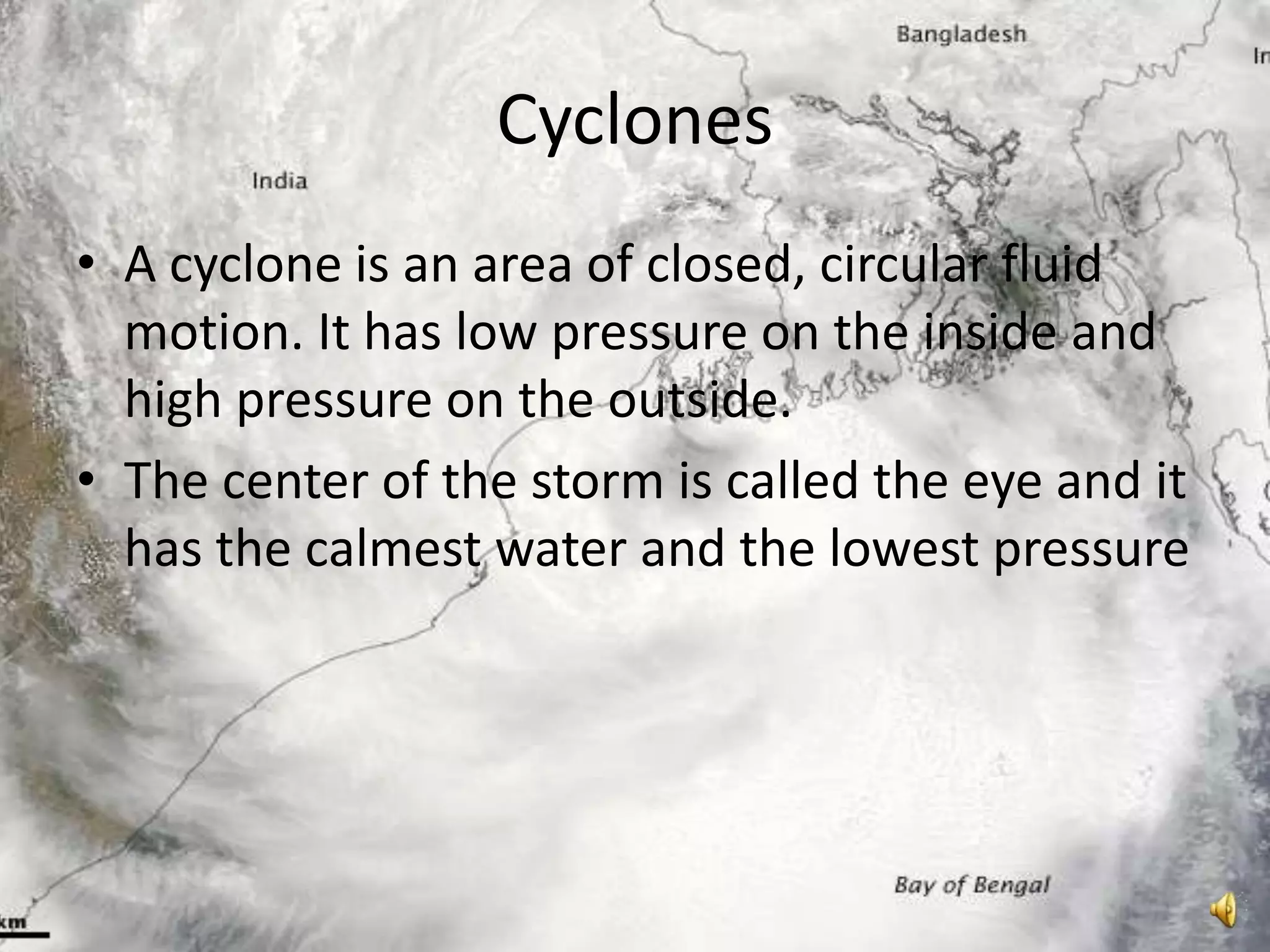
• A cyclone is an area of closed, circular fluid
  motion. It has low pressure on the inside and
  high pressure on the outside.
• The center of the storm is called the eye and it
  has the calmest water and the lowest pressure
Cyclones
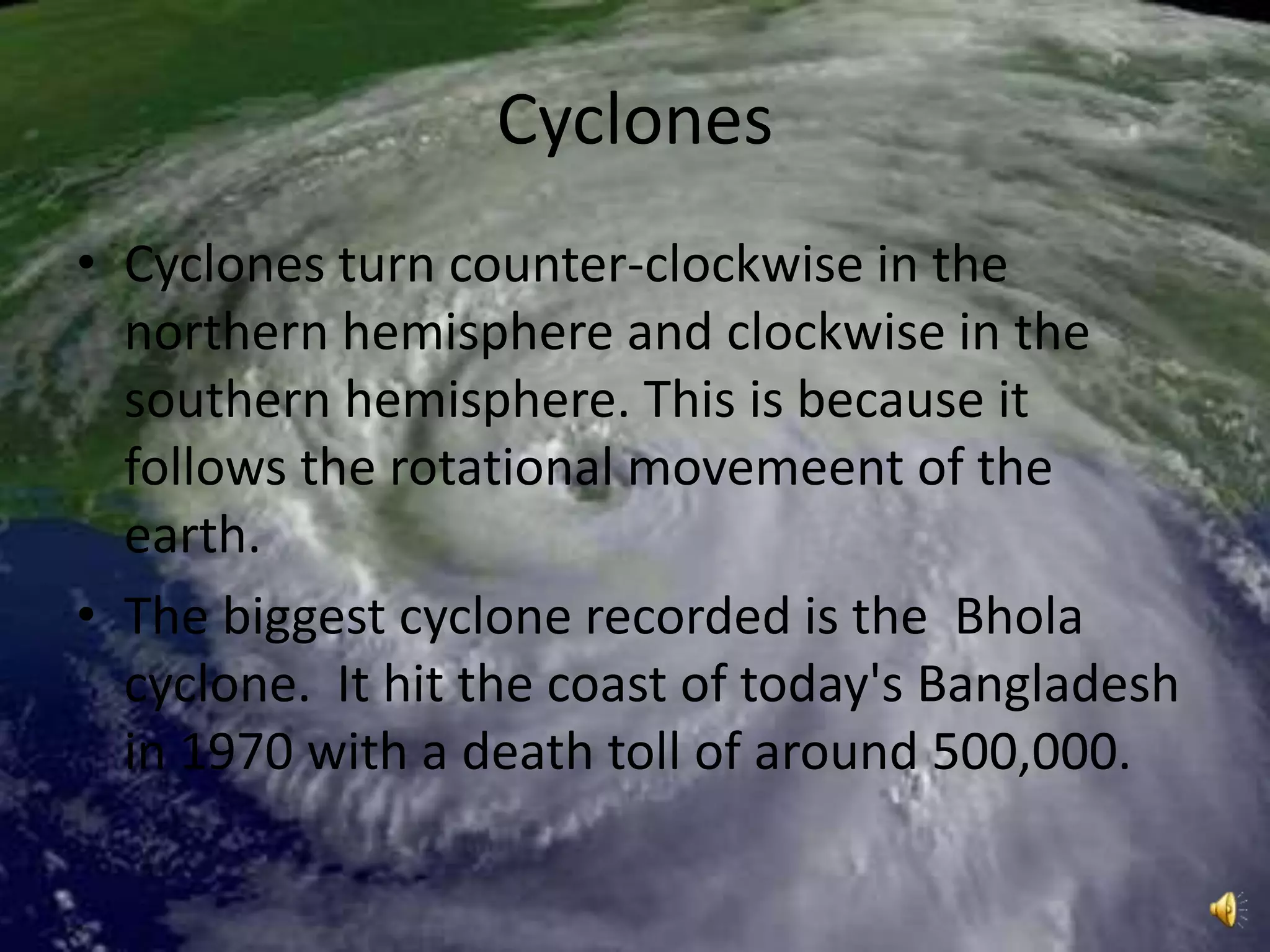
• Cyclones turn counter-clockwise in the
  northern hemisphere and clockwise in the
  southern hemisphere. This is because it
  follows the rotational movemeent of the
  earth.
• The biggest cyclone recorded is the Bhola
  cyclone. It hit the coast of today's Bangladesh
  in 1970 with a death toll of around 500,000.
Earthquakes

• It is the result of a sudden release of energy
  from the earth’s crust that creates seismic
  waves.
• They are measured using seismographs.
Earthquakes

• .The Valdivia earthquake also known as the
  great Chilean earthquake is the biggest
  earthquake ever recorded. It hit Chile on May
  22, 1960 with a magnitude of 9.5 and a death
  toll of around 6000
Tornados (Twisters)
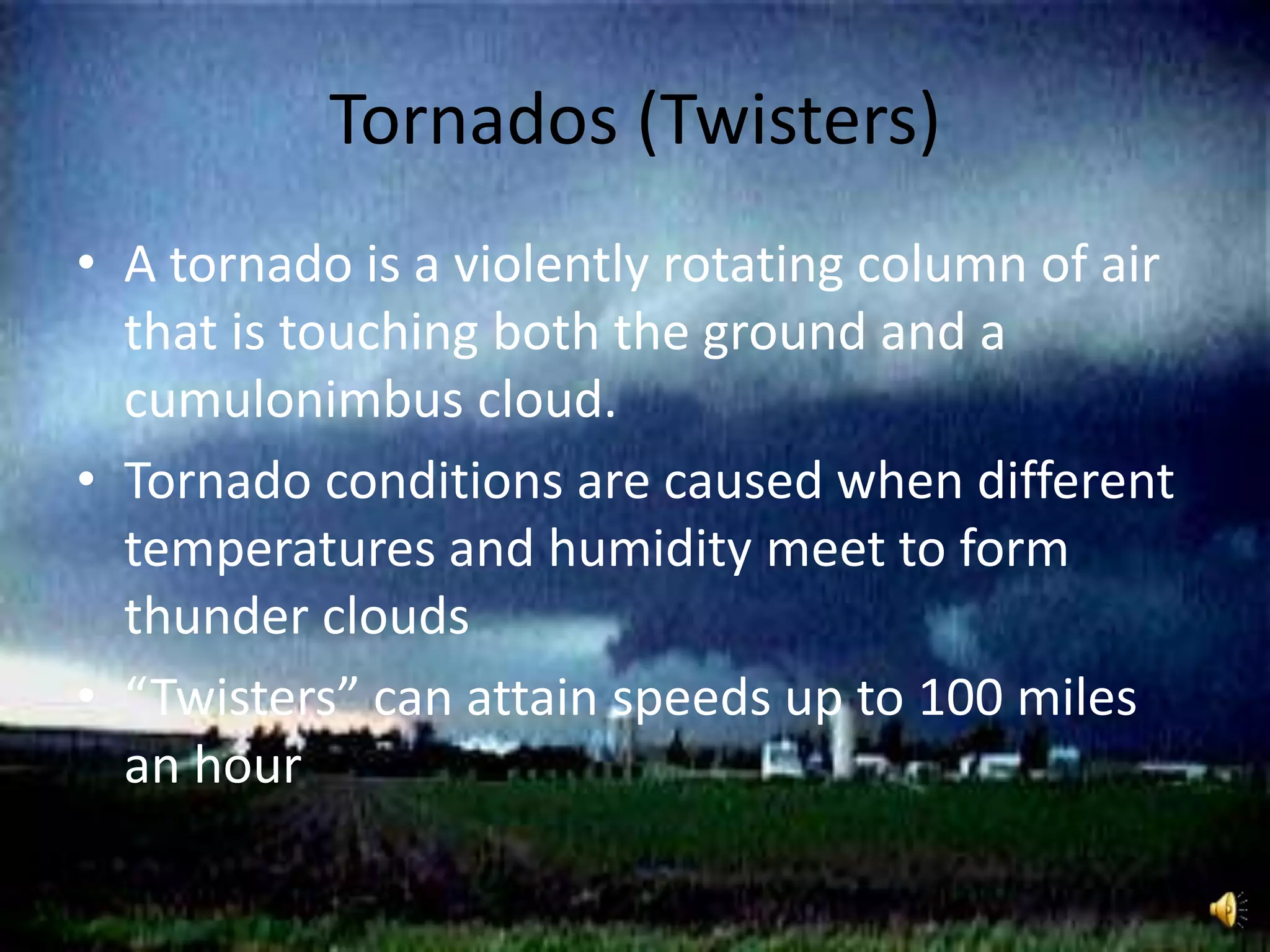
• A tornado is a violently rotating column of air
  that is touching both the ground and a
  cumulonimbus cloud.
• Tornado conditions are caused when different
  temperatures and humidity meet to form
  thunder clouds
• “Twisters” can attain speeds up to 100 miles
  an hour
Tornados
• The biggest tornado recorded was the Hallam,
  Nebraska tornado on May 22, 2004. It was
  around 2.5 miles big and had a death toll of
  around 160.
• The deadliest tornado recorded occurred in
  Daultipur and Salturia, Bangladesh on April
  26th, 1989. 1300 recorded dead and 12,000
  injured.
Volcanic Eruption
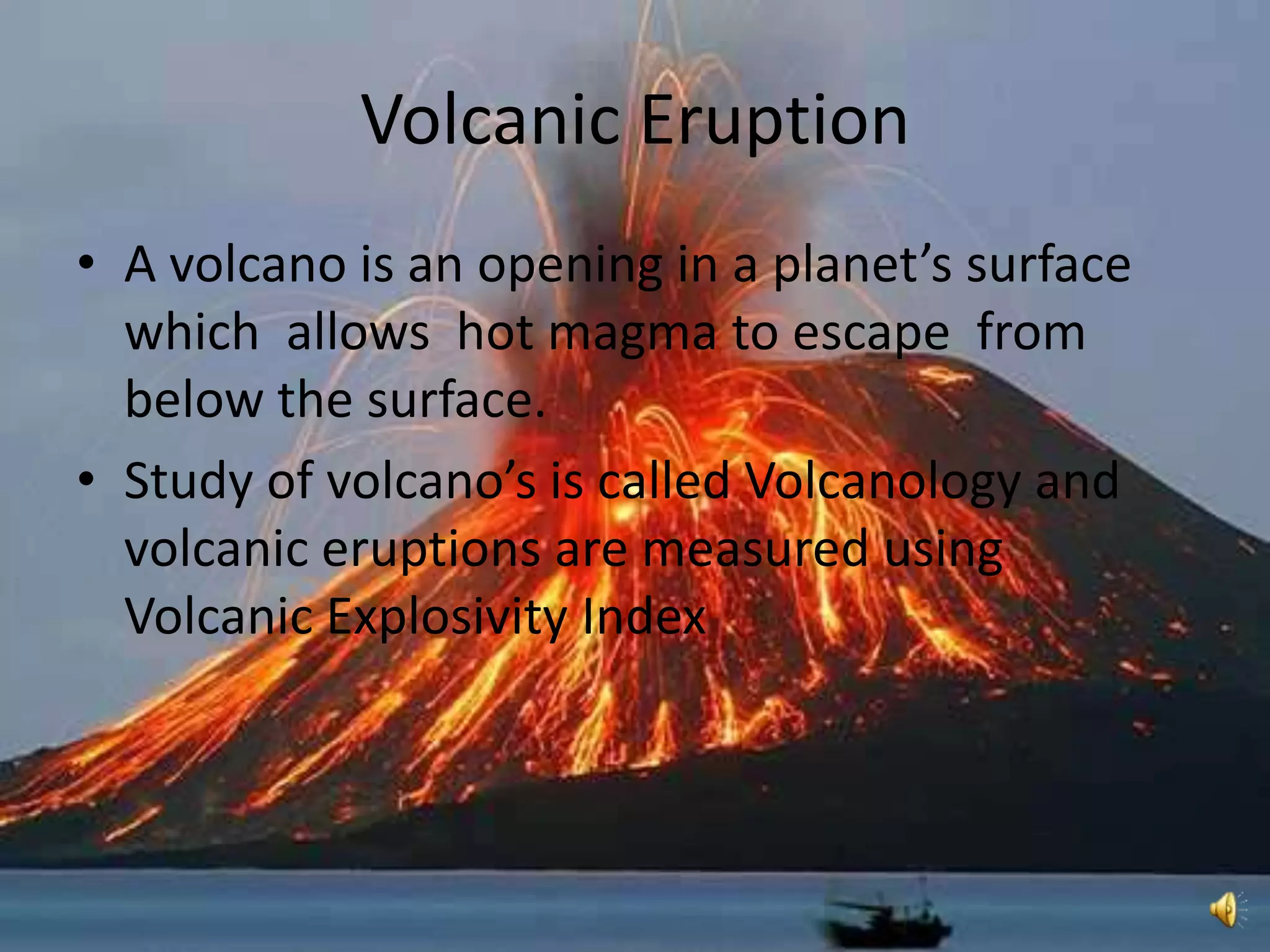
• A volcano is an opening in a planet’s surface
  which allows hot magma to escape from
  below the surface.
• Study of volcano’s is called Volcanology and
  volcanic eruptions are measured using
  Volcanic Explosivity Index
Volcanic Eruption
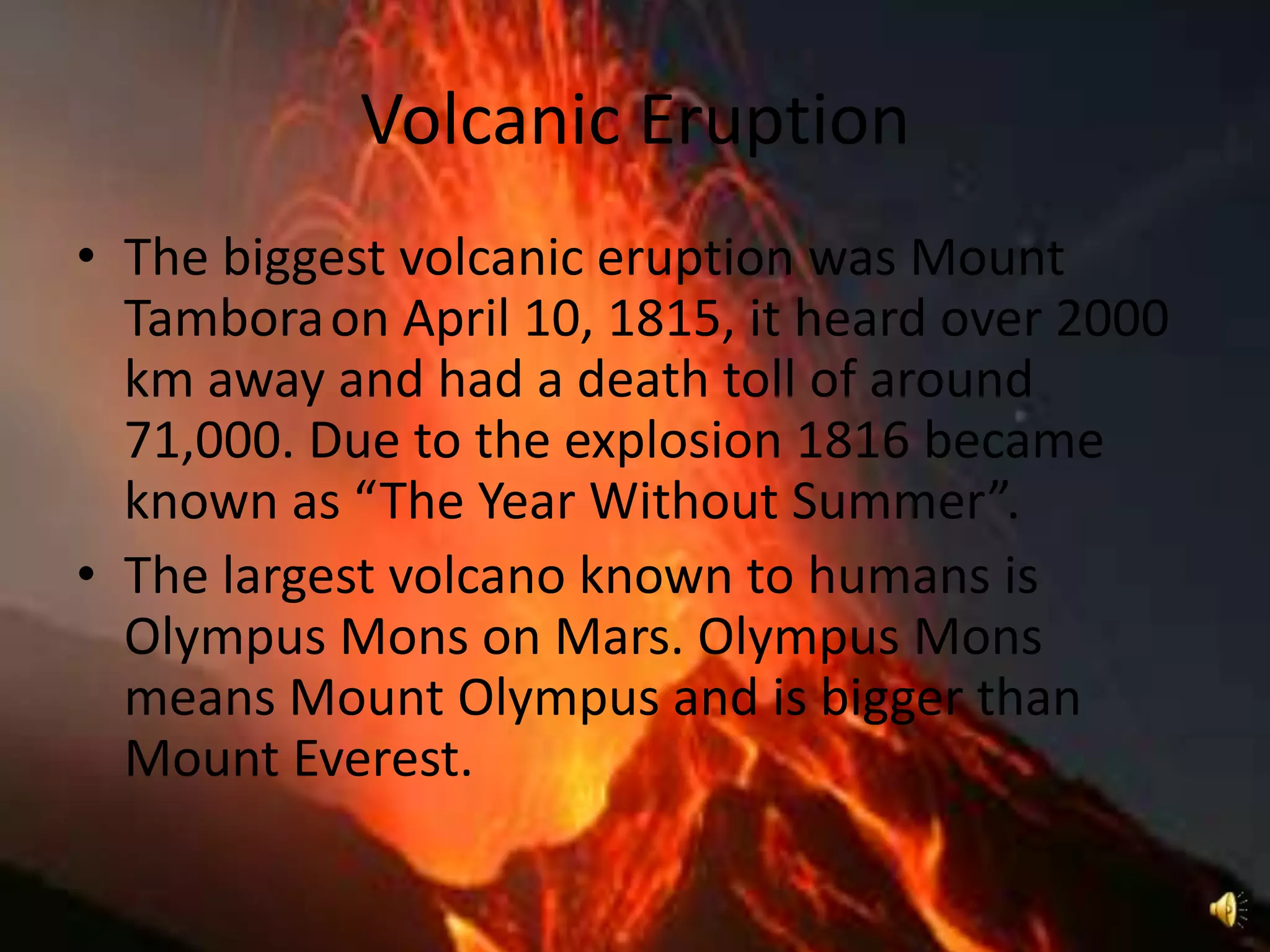
• The biggest volcanic eruption was Mount
  Tambora on April 10, 1815, it heard over 2000
  km away and had a death toll of around
  71,000. Due to the explosion 1816 became
  known as “The Year Without Summer”.
• The largest volcano known to humans is
  Olympus Mons on Mars. Olympus Mons
  means Mount Olympus and is bigger than
  Mount Everest.
Tsunami’s
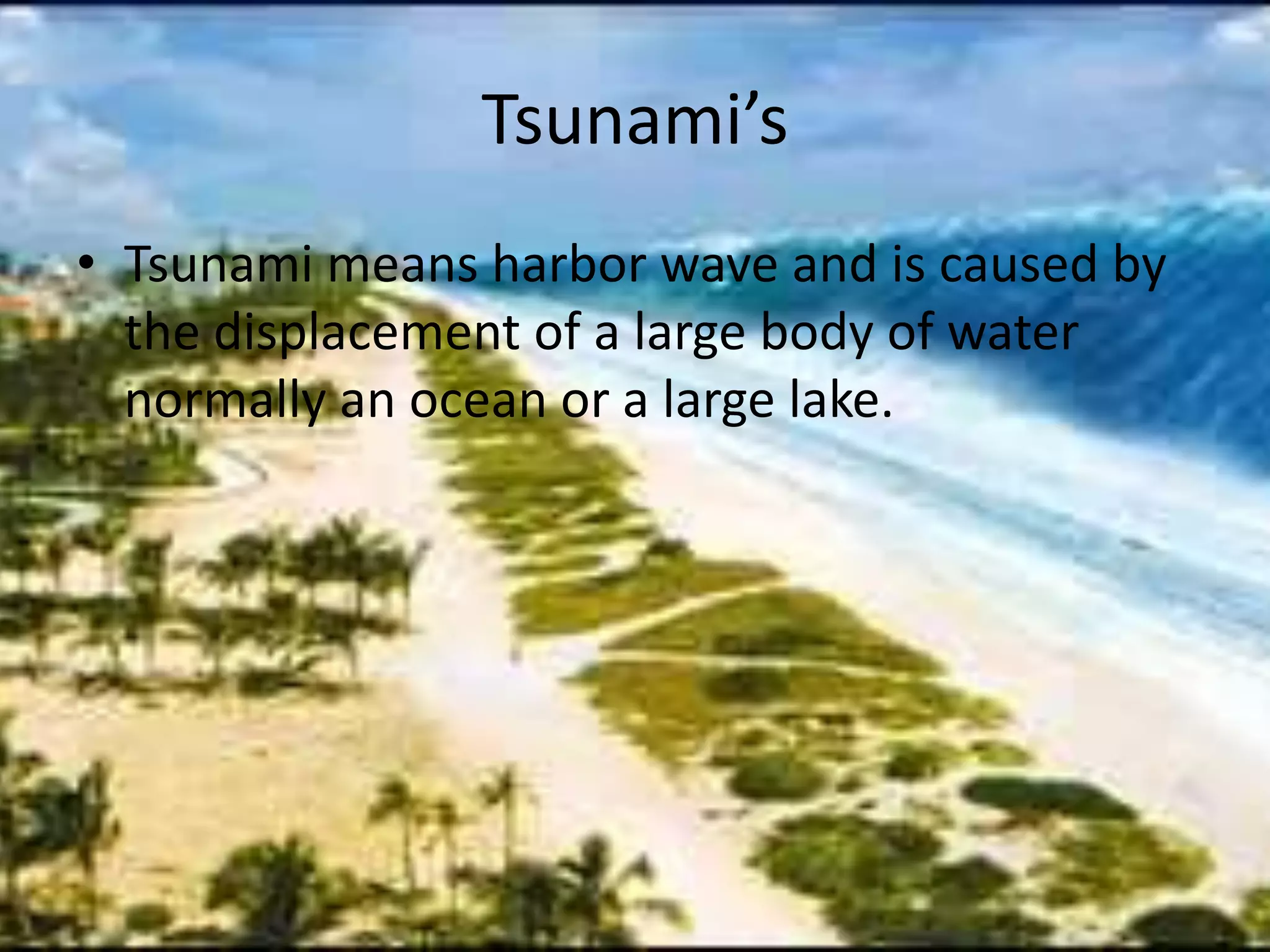
• Tsunami means harbor wave and is caused by
  the displacement of a large body of water
  normally an ocean or a large lake.
Tsunami’s
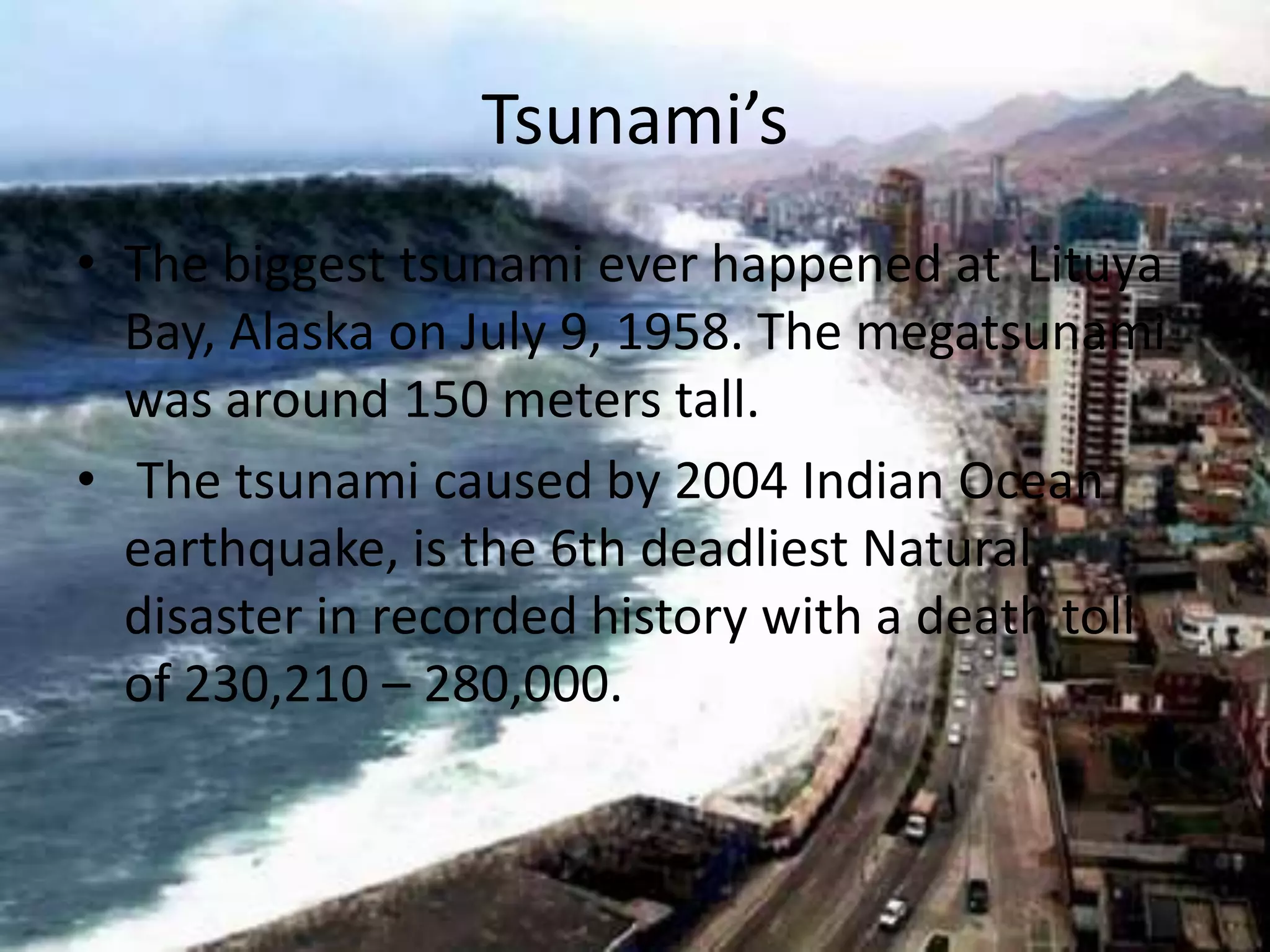
• The biggest tsunami ever happened at Lituya
  Bay, Alaska on July 9, 1958. The megatsunami
  was around 150 meters tall.
• The tsunami caused by 2004 Indian Ocean
  earthquake, is the 6th deadliest Natural
  disaster in recorded history with a death toll
  of 230,210 – 280,000.
Floods
• Floods are caused when water overflows from
  a water body.
• One of the biggest floods in the world is
  probably the Yellow river in China 1887 which
  killed between around 900,000.
Wildfire
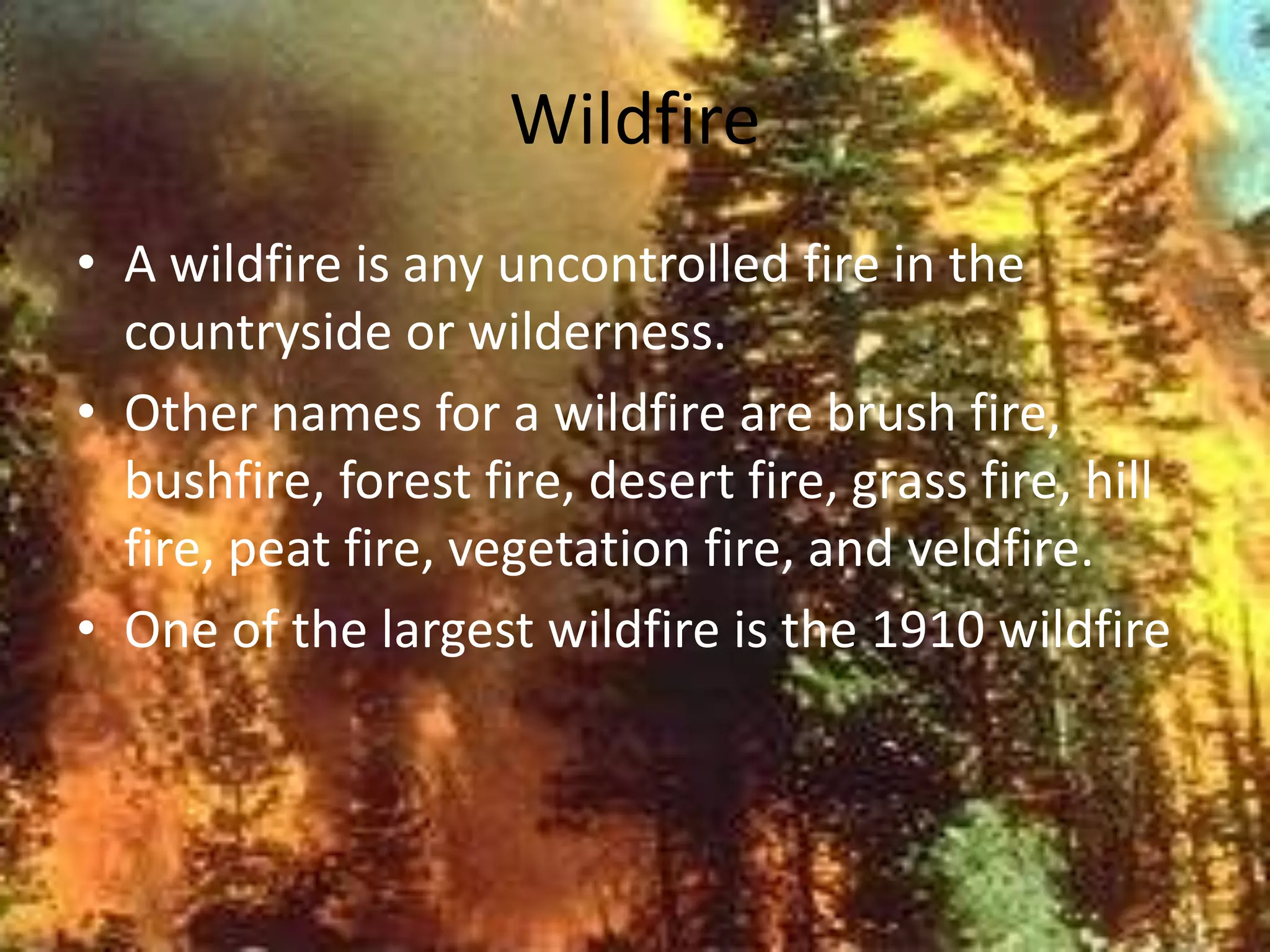
• A wildfire is any uncontrolled fire in the
  countryside or wilderness.
• Other names for a wildfire are brush fire,
  bushfire, forest fire, desert fire, grass fire, hill
  fire, peat fire, vegetation fire, and veldfire.
• One of the largest wildfire is the 1910 wildfire
Droughts
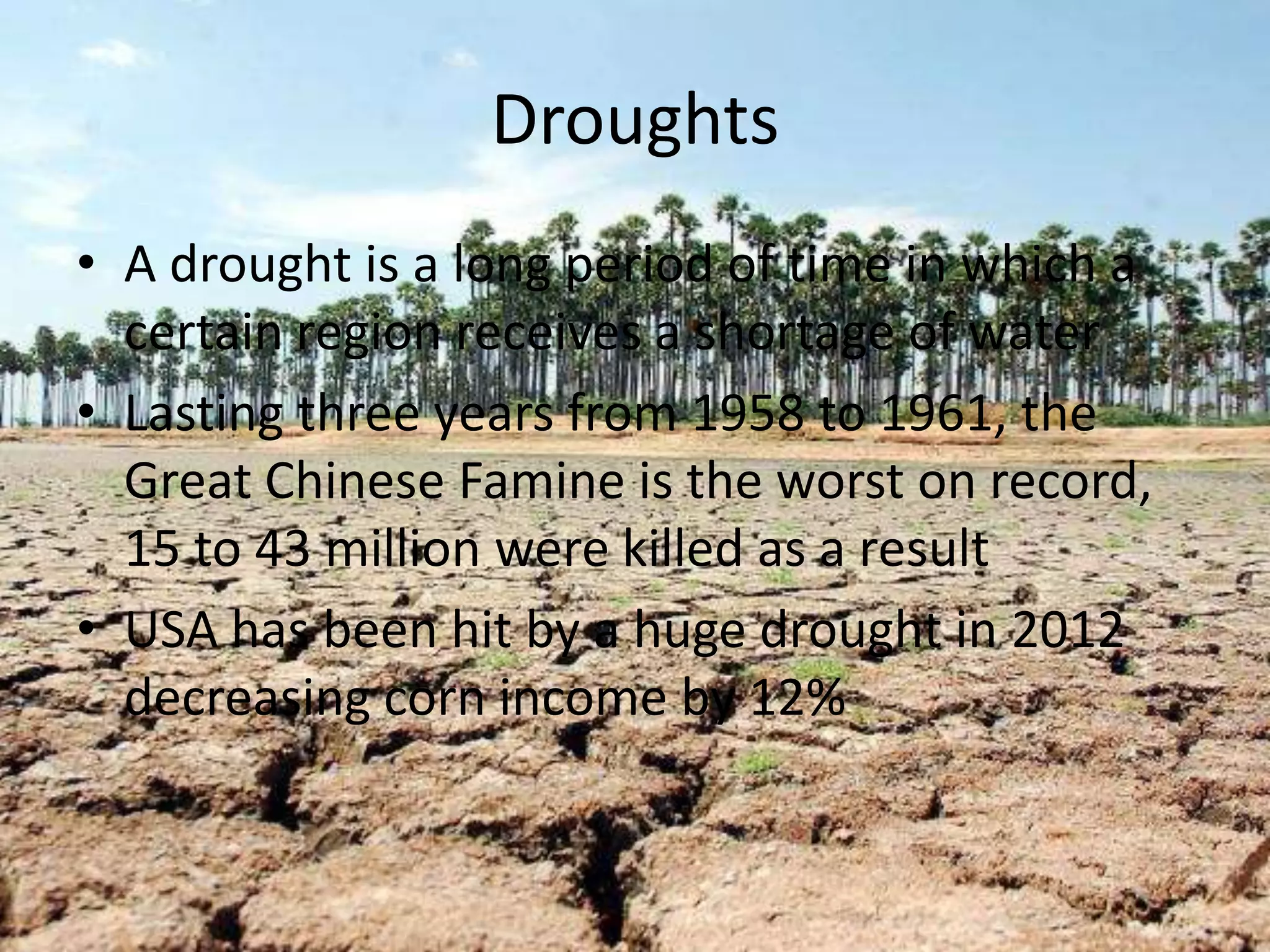
• A drought is a long period of time in which a
  certain region receives a shortage of water
• Lasting three years from 1958 to 1961, the
  Great Chinese Famine is the worst on record,
  15 to 43 million were killed as a result
• USA has been hit by a huge drought in 2012
  decreasing corn income by 12%
Avalanches
• An avalanche is a sudden and drastic drop of
  snow
• The biggest avalanche happened on Mt.
  Huascaran killing 20,000
Landslides
• A landslide or a landslip is a movement in the
  ground and a shallow flow of debris.
• The largest landslide in history happened
  because of Mount St. Helens. 3km of rock
  moved downhill.
Unusual Natural Disasters
• Firenadoes
• Limnic Eruptions
Firenadoes
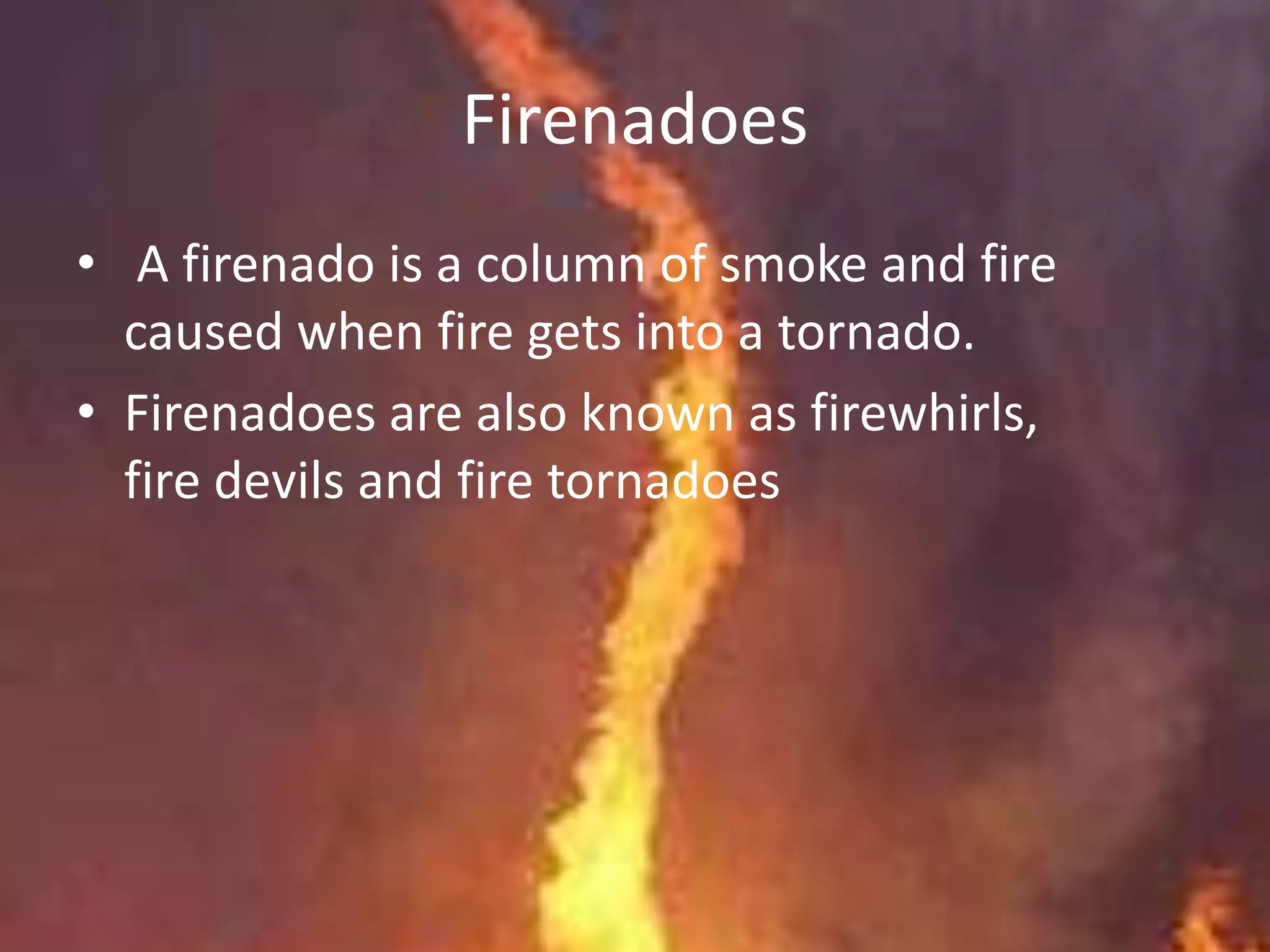
• A firenado is a column of smoke and fire
  caused when fire gets into a tornado.
• Firenadoes are also known as firewhirls,
  fire devils and fire tornadoes
Limnic Eruptions
• A limnic explosion is also called a lake
  overturn and is caused by an explosion of gas
  from the lake (normally carbon dioxide)
  erupting and suffocating people.
• There are only three exploding lakes. They are
  Lake Menoun, Lake Nyos and Lake Kivu
Limnic Eruptions
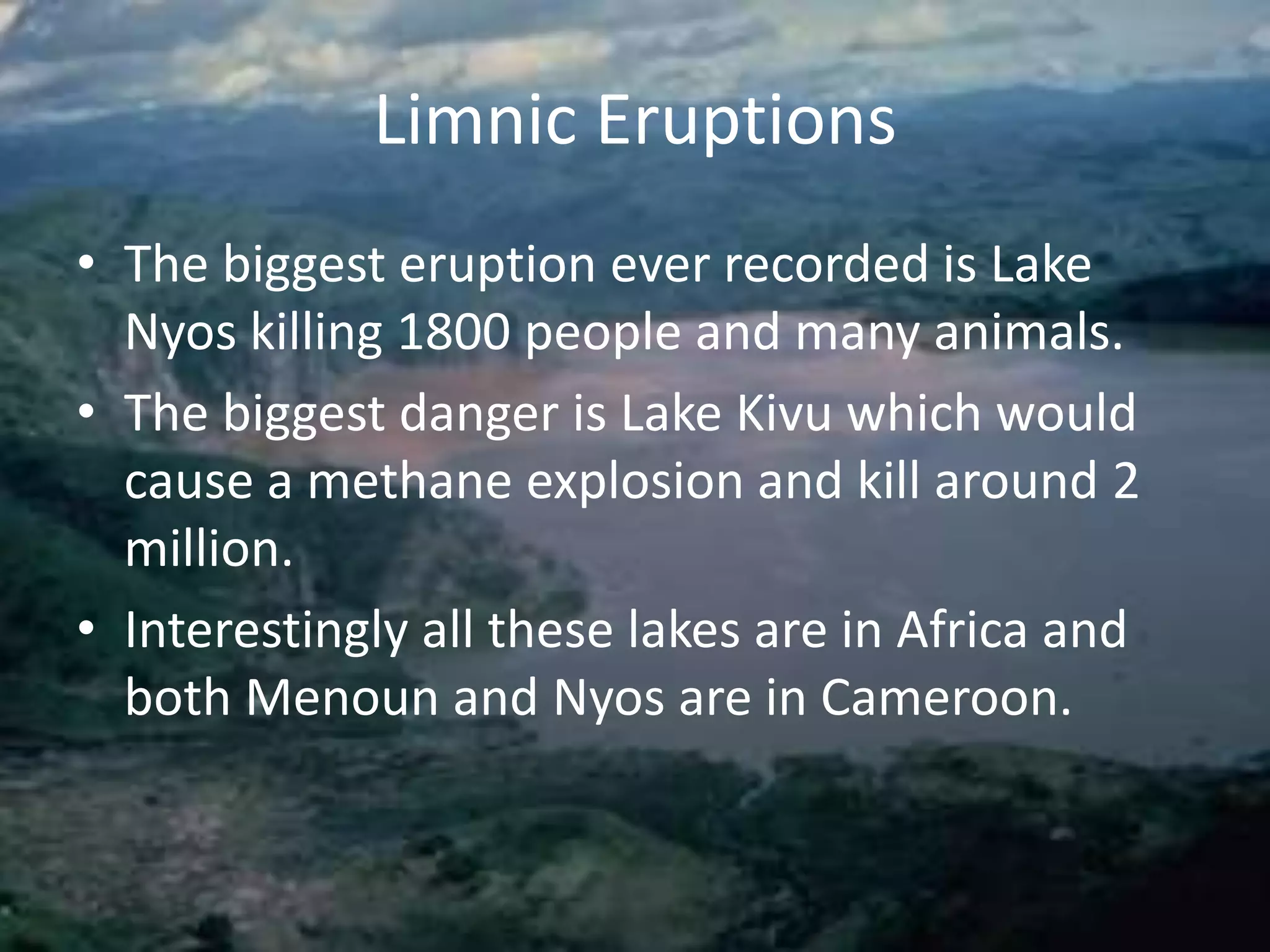
• The biggest eruption ever recorded is Lake
  Nyos killing 1800 people and many animals.
• The biggest danger is Lake Kivu which would
  cause a methane explosion and kill around 2
  million.
• Interestingly all these lakes are in Africa and
  both Menoun and Nyos are in Cameroon.
Man made disasters

 An man made disaster is a threat
having an element of human intent,
 negligence, or error, or involving a
               failure
List of few man made disasters
 • The nuclear bombing
 • Terrorism
 • Oil spill
The atomic bombing
• The first two atomic bomb were used by the USA
  to end the war against Japan in 1945.
• The first one was called Little Boy and dropped
  by a flight called Enola Gay on Hiroshima with a
  death toll of around 166,000 on 6 August 1945.
• The second was named The fat man and wad
  dropped by a plane called Bockscar on Nagasaki
  with a death toll of around 80,000 on 9 August
  1945.
• If Japan did not surrender the USA planned too
  continue dropping atomic bombs until they did.
Terrorism
• 9/11 is the big act of terrorism on US
• On September 11th, 2001, 4 flights were hi-
  jacked 2 of them hit the twin towers in New
  York and third flight hit pentagon, in
  Washington DC killing
• 4th flight, passengers attacked the hi-jackers
  and crashed the flight down.
• 4th flight was believed to have a target of
  White house or the Capitol.
Deepwater Horizon oil spill
• The oil spill flowed for 3 months without being
  stopped.
• About 780,000m3 oil is estimated to have
  flowed out
• 17 people were killed in the explosion that
  released the oil.

Natural disasters

  • 1.
  • 2.
    Disasters  Disasters arehazards that cause destruction or environmental changes. The types are  Natural disasters  Man made disasters
  • 3.
    Natural Disasters Anatural disaster is the effect of a natural hazard (e.g., flood, tornado, hurricane, volcanic eruption, earthquake, or landslide)
  • 4.
    List of top10 natural disasters 1. Cyclone 2. Earthquake 3. Tornado 4. Volcanic Eruption 5. Tsunami 6. Flood 7. Wildfire 8. Drought 9. Avalanche 10. Landslide
  • 5.
    Cyclones • A cycloneis an area of closed, circular fluid motion. It has low pressure on the inside and high pressure on the outside. • The center of the storm is called the eye and it has the calmest water and the lowest pressure
  • 6.
    Cyclones • Cyclones turncounter-clockwise in the northern hemisphere and clockwise in the southern hemisphere. This is because it follows the rotational movemeent of the earth. • The biggest cyclone recorded is the Bhola cyclone. It hit the coast of today's Bangladesh in 1970 with a death toll of around 500,000.
  • 7.
    Earthquakes • It isthe result of a sudden release of energy from the earth’s crust that creates seismic waves. • They are measured using seismographs.
  • 8.
    Earthquakes • .The Valdiviaearthquake also known as the great Chilean earthquake is the biggest earthquake ever recorded. It hit Chile on May 22, 1960 with a magnitude of 9.5 and a death toll of around 6000
  • 9.
    Tornados (Twisters) • Atornado is a violently rotating column of air that is touching both the ground and a cumulonimbus cloud. • Tornado conditions are caused when different temperatures and humidity meet to form thunder clouds • “Twisters” can attain speeds up to 100 miles an hour
  • 10.
    Tornados • The biggesttornado recorded was the Hallam, Nebraska tornado on May 22, 2004. It was around 2.5 miles big and had a death toll of around 160. • The deadliest tornado recorded occurred in Daultipur and Salturia, Bangladesh on April 26th, 1989. 1300 recorded dead and 12,000 injured.
  • 11.
    Volcanic Eruption • Avolcano is an opening in a planet’s surface which allows hot magma to escape from below the surface. • Study of volcano’s is called Volcanology and volcanic eruptions are measured using Volcanic Explosivity Index
  • 12.
    Volcanic Eruption • Thebiggest volcanic eruption was Mount Tambora on April 10, 1815, it heard over 2000 km away and had a death toll of around 71,000. Due to the explosion 1816 became known as “The Year Without Summer”. • The largest volcano known to humans is Olympus Mons on Mars. Olympus Mons means Mount Olympus and is bigger than Mount Everest.
  • 13.
    Tsunami’s • Tsunami meansharbor wave and is caused by the displacement of a large body of water normally an ocean or a large lake.
  • 14.
    Tsunami’s • The biggesttsunami ever happened at Lituya Bay, Alaska on July 9, 1958. The megatsunami was around 150 meters tall. • The tsunami caused by 2004 Indian Ocean earthquake, is the 6th deadliest Natural disaster in recorded history with a death toll of 230,210 – 280,000.
  • 15.
    Floods • Floods arecaused when water overflows from a water body. • One of the biggest floods in the world is probably the Yellow river in China 1887 which killed between around 900,000.
  • 16.
    Wildfire • A wildfireis any uncontrolled fire in the countryside or wilderness. • Other names for a wildfire are brush fire, bushfire, forest fire, desert fire, grass fire, hill fire, peat fire, vegetation fire, and veldfire. • One of the largest wildfire is the 1910 wildfire
  • 17.
    Droughts • A droughtis a long period of time in which a certain region receives a shortage of water • Lasting three years from 1958 to 1961, the Great Chinese Famine is the worst on record, 15 to 43 million were killed as a result • USA has been hit by a huge drought in 2012 decreasing corn income by 12%
  • 18.
    Avalanches • An avalancheis a sudden and drastic drop of snow • The biggest avalanche happened on Mt. Huascaran killing 20,000
  • 19.
    Landslides • A landslideor a landslip is a movement in the ground and a shallow flow of debris. • The largest landslide in history happened because of Mount St. Helens. 3km of rock moved downhill.
  • 20.
    Unusual Natural Disasters •Firenadoes • Limnic Eruptions
  • 21.
    Firenadoes • A firenadois a column of smoke and fire caused when fire gets into a tornado. • Firenadoes are also known as firewhirls, fire devils and fire tornadoes
  • 22.
    Limnic Eruptions • Alimnic explosion is also called a lake overturn and is caused by an explosion of gas from the lake (normally carbon dioxide) erupting and suffocating people. • There are only three exploding lakes. They are Lake Menoun, Lake Nyos and Lake Kivu
  • 23.
    Limnic Eruptions • Thebiggest eruption ever recorded is Lake Nyos killing 1800 people and many animals. • The biggest danger is Lake Kivu which would cause a methane explosion and kill around 2 million. • Interestingly all these lakes are in Africa and both Menoun and Nyos are in Cameroon.
  • 24.
    Man made disasters An man made disaster is a threat having an element of human intent, negligence, or error, or involving a failure
  • 25.
    List of fewman made disasters • The nuclear bombing • Terrorism • Oil spill
  • 26.
    The atomic bombing •The first two atomic bomb were used by the USA to end the war against Japan in 1945. • The first one was called Little Boy and dropped by a flight called Enola Gay on Hiroshima with a death toll of around 166,000 on 6 August 1945. • The second was named The fat man and wad dropped by a plane called Bockscar on Nagasaki with a death toll of around 80,000 on 9 August 1945. • If Japan did not surrender the USA planned too continue dropping atomic bombs until they did.
  • 27.
    Terrorism • 9/11 isthe big act of terrorism on US • On September 11th, 2001, 4 flights were hi- jacked 2 of them hit the twin towers in New York and third flight hit pentagon, in Washington DC killing • 4th flight, passengers attacked the hi-jackers and crashed the flight down. • 4th flight was believed to have a target of White house or the Capitol.
  • 28.
    Deepwater Horizon oilspill • The oil spill flowed for 3 months without being stopped. • About 780,000m3 oil is estimated to have flowed out • 17 people were killed in the explosion that released the oil.