Acknowledgement- Wikipedia
Certificate- Under the guidance of Rajendra sir
BY-
NAME- ANOUSHKA
BASU
CLASS- 9-B
 Types of disasters.
 Disaster management.
 Earthquakes.
 Avalanches.
Disaster refers to a sudden event, such as an
accident or a natural catastrophe, that causes great
damage or loss of life.
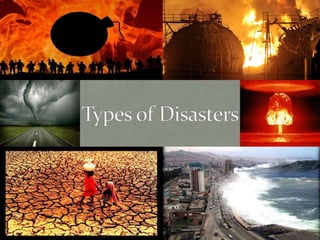
Disasters can be broadly classified into
two types-
 Natural disasters
 Man- made disasters
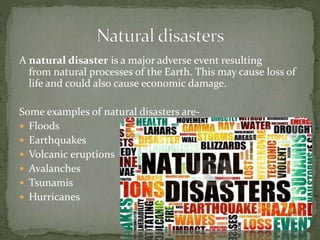
A natural disaster is a major adverse event resulting
from natural processes of the Earth. This may cause loss of
life and could also cause economic damage.
Some examples of natural disasters are-
 Floods
 Earthquakes
 Volcanic eruptions
 Avalanches
 Tsunamis
 Hurricanes
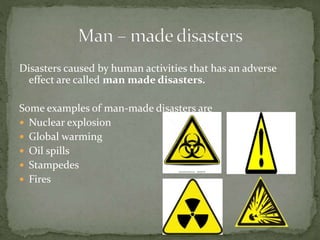
Disasters caused by human activities that has an adverse
effect are called man made disasters.
Some examples of man-made disasters are
 Nuclear explosion
 Global warming
 Oil spills
 Stampedes
 Fires
Disaster management (or emergency
management) is the creation of plans to decrease
the impact of disasters and cope with disasters.
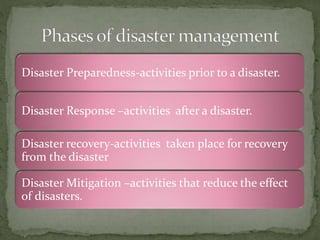
Disaster Preparedness-activities prior to a disaster.
Disaster Response –activities after a disaster.
Disaster recovery-activities taken place for recovery
from the disaster
Disaster Mitigation –activities that reduce the effect
of disasters.
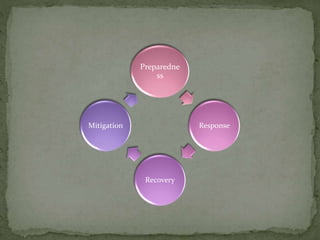
Preparedne
ss
Response
Recovery
Mitigation
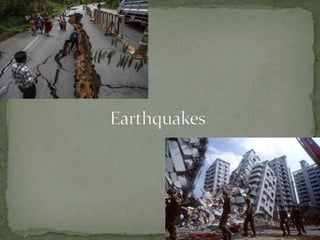
 An Earthquake is the shaking of the surface of the Earth. It
is the result of a sudden release of energy in the earth’s
crust that creates seismic waves.
 The seismic activity of an area refers to the frequency , type
and size of earthquakes experienced over a period of time.
 The severity of the shaking can range from barely felt to
violent enough to toss people around. Earthquakes have
destroyed whole cities.
 Tectonic plates are always in motion. When two blocks of rock or
two plates rub against each other, they get stuck to each other
due to friction(because of the irregularities , such as rocks
found on their surfaces).
 The rocks or the plates push against each other but do not
move. After a while, there is a crack in the plates or the rocks
break because of all the pressure that's built up.
 This leads to the production of energy in the state of vibrations.
 Which are felt as huge tremors called Earthquake.
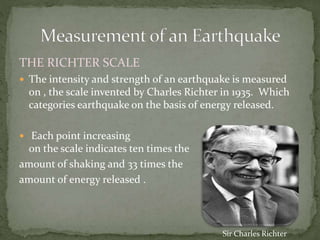
THE RICHTER SCALE
 The intensity and strength of an earthquake is measured
on , the scale invented by Charles Richter in 1935. Which
categories earthquake on the basis of energy released.
 Each point increasing
on the scale indicates ten times the
amount of shaking and 33 times the
amount of energy released .
Sir Charles Richter
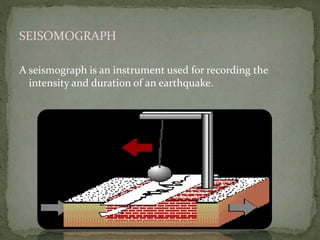
SEISOMOGRAPH
A seismograph is an instrument used for recording the
intensity and duration of an earthquake.
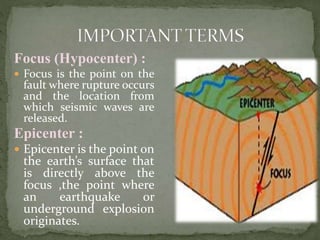
Focus (Hypocenter) :
 Focus is the point on the
fault where rupture occurs
and the location from
which seismic waves are
released.
Epicenter :
 Epicenter is the point on
the earth’s surface that
is directly above the
focus ,the point where
an earthquake or
underground explosion
originates.
 DROP, COVER AND HOLD ON!
 Stay outdoors, if indoors run outside
and find an open area.
 Stay away from windows.
 If you’re in bed, hold on and stay there, protecting your head with a
pillow.
 If you’re outdoors, find a clear spot away from buildings, trees and
power lines. Then, drop to the ground.
 If you’re in a car, slow down and drive to a safe place. Stay in the car
until the shaking stops.
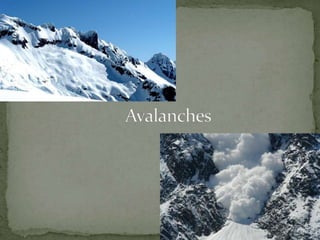
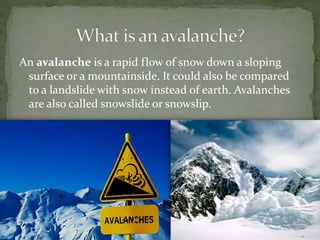
An avalanche is a rapid flow of snow down a sloping
surface or a mountainside. It could also be compared
to a landslide with snow instead of earth. Avalanches
are also called snowslide or snowslip.
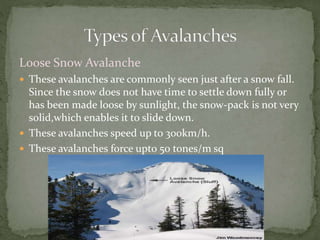
Loose Snow Avalanche
 These avalanches are commonly seen just after a snow fall.
Since the snow does not have time to settle down fully or
has been made loose by sunlight, the snow-pack is not very
solid,which enables it to slide down.
 These avalanches speed up to 300km/h.
 These avalanches force upto 50 tones/m sq
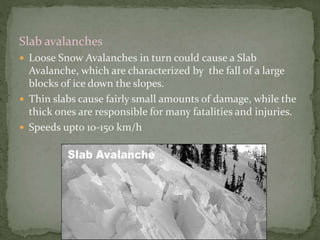
Slab avalanches
 Loose Snow Avalanches in turn could cause a Slab
Avalanche, which are characterized by the fall of a large
blocks of ice down the slopes.
 Thin slabs cause fairly small amounts of damage, while the
thick ones are responsible for many fatalities and injuries.
 Speeds upto 10-150 km/h
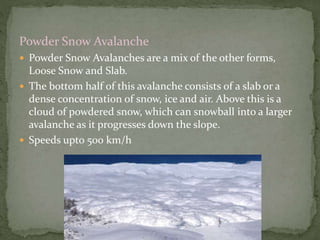
Powder Snow Avalanche
 Powder Snow Avalanches are a mix of the other forms,
Loose Snow and Slab.
 The bottom half of this avalanche consists of a slab or a
dense concentration of snow, ice and air. Above this is a
cloud of powdered snow, which can snowball into a larger
avalanche as it progresses down the slope.
 Speeds upto 500 km/h
 Snowstorm and Wind Direction: Heavy snowstorms are
more likely to cause Avalanches. Wind normally blows
from one side of the slope of mountain to another side.
While blowing it moves the snow which causes an
avalanche.
 Heavy snowfall: Heavy snowfall deposits snow in unstable
areas and puts pressure on the snow-pack. Precipitation
during the summer months is the leading cause of
avalanches.
 Vibration or Movement: The use of All Terrain Vehicles
and Snowmobiles creates vibrations within the snow that it
cannot withstand. Coupled with the gravitational pull, it is
one of the quickest ways to cause an avalanche. The other is
construction work done with explosives, which tend to
weaken the entire surrounding area.Earthquakes could also
lead to an avalanche.
 Recognize where one is most likely to occur.
 If you understand that there is a high possibility of an
avalanche, you are less likely to fall victim to the
surprise occurrence of one.
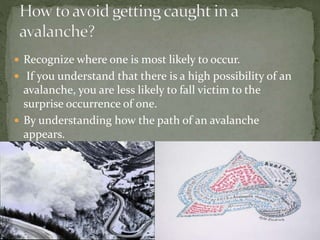
 By understanding how the path of an avalanche
appears.
Disasters (natural/man-made)

Disasters (natural/man-made)

  • 1.
    Acknowledgement- Wikipedia Certificate- Underthe guidance of Rajendra sir BY- NAME- ANOUSHKA BASU CLASS- 9-B
  • 2.
     Types ofdisasters.  Disaster management.  Earthquakes.  Avalanches.
  • 3.
    Disaster refers toa sudden event, such as an accident or a natural catastrophe, that causes great damage or loss of life.
  • 5.
    Disasters can bebroadly classified into two types-  Natural disasters  Man- made disasters
  • 6.
    A natural disasteris a major adverse event resulting from natural processes of the Earth. This may cause loss of life and could also cause economic damage. Some examples of natural disasters are-  Floods  Earthquakes  Volcanic eruptions  Avalanches  Tsunamis  Hurricanes
  • 7.
    Disasters caused byhuman activities that has an adverse effect are called man made disasters. Some examples of man-made disasters are  Nuclear explosion  Global warming  Oil spills  Stampedes  Fires
  • 9.
    Disaster management (oremergency management) is the creation of plans to decrease the impact of disasters and cope with disasters.
  • 10.
    Disaster Preparedness-activities priorto a disaster. Disaster Response –activities after a disaster. Disaster recovery-activities taken place for recovery from the disaster Disaster Mitigation –activities that reduce the effect of disasters.
  • 11.
  • 13.
     An Earthquakeis the shaking of the surface of the Earth. It is the result of a sudden release of energy in the earth’s crust that creates seismic waves.  The seismic activity of an area refers to the frequency , type and size of earthquakes experienced over a period of time.  The severity of the shaking can range from barely felt to violent enough to toss people around. Earthquakes have destroyed whole cities.
  • 14.
     Tectonic platesare always in motion. When two blocks of rock or two plates rub against each other, they get stuck to each other due to friction(because of the irregularities , such as rocks found on their surfaces).  The rocks or the plates push against each other but do not move. After a while, there is a crack in the plates or the rocks break because of all the pressure that's built up.  This leads to the production of energy in the state of vibrations.  Which are felt as huge tremors called Earthquake.
  • 15.
    THE RICHTER SCALE The intensity and strength of an earthquake is measured on , the scale invented by Charles Richter in 1935. Which categories earthquake on the basis of energy released.  Each point increasing on the scale indicates ten times the amount of shaking and 33 times the amount of energy released . Sir Charles Richter
  • 17.
    SEISOMOGRAPH A seismograph isan instrument used for recording the intensity and duration of an earthquake.
  • 18.
    Focus (Hypocenter) : Focus is the point on the fault where rupture occurs and the location from which seismic waves are released. Epicenter :  Epicenter is the point on the earth’s surface that is directly above the focus ,the point where an earthquake or underground explosion originates.
  • 19.
     DROP, COVERAND HOLD ON!  Stay outdoors, if indoors run outside and find an open area.  Stay away from windows.  If you’re in bed, hold on and stay there, protecting your head with a pillow.  If you’re outdoors, find a clear spot away from buildings, trees and power lines. Then, drop to the ground.  If you’re in a car, slow down and drive to a safe place. Stay in the car until the shaking stops.
  • 21.
    An avalanche isa rapid flow of snow down a sloping surface or a mountainside. It could also be compared to a landslide with snow instead of earth. Avalanches are also called snowslide or snowslip.
  • 22.
    Loose Snow Avalanche These avalanches are commonly seen just after a snow fall. Since the snow does not have time to settle down fully or has been made loose by sunlight, the snow-pack is not very solid,which enables it to slide down.  These avalanches speed up to 300km/h.  These avalanches force upto 50 tones/m sq
  • 23.
    Slab avalanches  LooseSnow Avalanches in turn could cause a Slab Avalanche, which are characterized by the fall of a large blocks of ice down the slopes.  Thin slabs cause fairly small amounts of damage, while the thick ones are responsible for many fatalities and injuries.  Speeds upto 10-150 km/h
  • 24.
    Powder Snow Avalanche Powder Snow Avalanches are a mix of the other forms, Loose Snow and Slab.  The bottom half of this avalanche consists of a slab or a dense concentration of snow, ice and air. Above this is a cloud of powdered snow, which can snowball into a larger avalanche as it progresses down the slope.  Speeds upto 500 km/h
  • 25.
     Snowstorm andWind Direction: Heavy snowstorms are more likely to cause Avalanches. Wind normally blows from one side of the slope of mountain to another side. While blowing it moves the snow which causes an avalanche.  Heavy snowfall: Heavy snowfall deposits snow in unstable areas and puts pressure on the snow-pack. Precipitation during the summer months is the leading cause of avalanches.
  • 26.
     Vibration orMovement: The use of All Terrain Vehicles and Snowmobiles creates vibrations within the snow that it cannot withstand. Coupled with the gravitational pull, it is one of the quickest ways to cause an avalanche. The other is construction work done with explosives, which tend to weaken the entire surrounding area.Earthquakes could also lead to an avalanche.
  • 27.
     Recognize whereone is most likely to occur.  If you understand that there is a high possibility of an avalanche, you are less likely to fall victim to the surprise occurrence of one.  By understanding how the path of an avalanche appears.