EARTHQUAKE
DISASTER
MANAGEMENT
Dr Fayaz A. Malla
Assistant Professor, Environmental Sciences
GDC Pulwama
Higher Education Department, Govt. of J&K
Email: nami.fayaz@gmail.com
Earthquakes constitute one of the worst natural hazards
which often turn into disaster causing widespread
destruction and loss to human life.
The effects of earthquake vary upon the magnitude and
intensity. Earthquakes occur every now and then all
round the world, except in some places where
earthquakes occur rarely. The devastation of cities and
towns is one of the effects of earthquake.
Introduction
WHAT IS EARTHQUAKE ?
An Earthquake is the result
of a sudden release of energy
in the earth’s crust that
creates seismic waves.
The seismic activity of an
area refers to the frequency,
type and size of earthquakes
experienced over a period of
time.
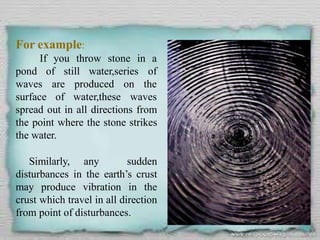
For example:
If you throw stone in a
pond of still water,series of
waves
surface
are produced on the
of water,these waves
spread out in all directions from
the point where the stone strikes
the water.
Similarly, any sudden
disturbances in the earth’s crust
may produce vibration in the
crust which travel in all direction
from point of disturbances.
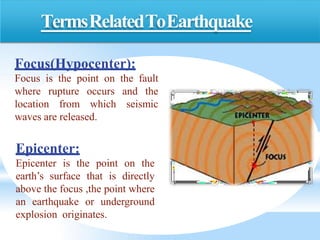
Focus(Hypocenter):
Focus is the point on the fault
where rupture
location from
occurs and the
which seismic
waves are released.
Epicenter:
Epicenter is the point on the
earth’s surface that is directly
above the focus ,the point where
an earthquake or underground
explosion originates.
TermsRelatedToEarthquake
Intensity: The severity of earthquake shaking is assessed using a
descriptive scale – the Modified Mercalli Intensity Scale.
Magnitude: Earthquake size is a quantitative measure of the size of
the earthquake at its source. The Richter Magnitude Scale measures
the amount of seismic energy released by an earthquake.
Earthquake Intensity and Magnitude
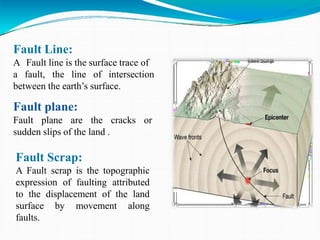
Fault Line:
A Fault line is the surface trace of
a fault, the line of intersection
between the earth’s surface.
Fault plane:
Fault plane are the cracks or
sudden slips of the land .
Fault Scrap:
A Fault scrap is the topographic
expression of faulting attributed
to the displacement of the land
surface by movement along
faults.
The primary cause of an earthquake is faults on the crust of
the earth.
of an
“A Fault is a break or fracture b/w two blocks of rocks in
response to stress.”
This movement may occur rapidly, in the form
earthquake or may occur slowly, in the form of creep.
Earth scientists use the angle of the fault with respect to the
surface (known as the dip) and the direction of slip along the
fault to classify faults.
How Earthquake Occur ?
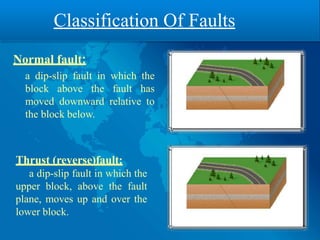
Normal fault:
a dip-slip fault in which the
block above the fault has
moved downward relative to
the block below.
Thrust (reverse)fault:
a dip-slip fault in which the
upper block, above the fault
plane, moves up and over the
lower block.
Classification Of Faults
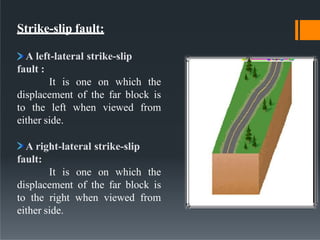
Strike-slip fault:
A left-lateral strike-slip
fault :
It is one on which the
displacement of the far block is
to the left when viewed from
either side.
A right-lateral strike-slip
fault:
It is one on which the
displacement of the far block is
to the right when viewed from
either side.
Some major causes of earthquakes are:
Surface causes
Volcanic causes
Tectonic causes
Causes of Earthquake
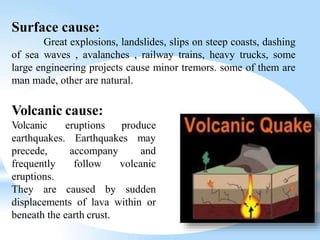
Volcanic cause:
eruptions produce
Earthquakes may
accompany and
follow volcanic
Volcanic
earthquakes.
precede,
frequently
eruptions.
They are caused by sudden
displacements of lava within or
beneath the earth crust.
Surface cause:
Great explosions, landslides, slips on steep coasts, dashing
of sea waves , avalanches , railway trains, heavy trucks, some
large engineering projects cause minor tremors. some of them are
man made, other are natural.
Tectonic cause:
Structural disturbances resulting in the parts of the lithosphere is
the main cause of this type of earthquake. Most of the disastrous
earthquakes belong to this category and occur in areas of great
faults and fractures. Sudden yielding to strain produced on the
rocks of accumulating stress causes displacements especially
along old fault zones known as great transform faults.
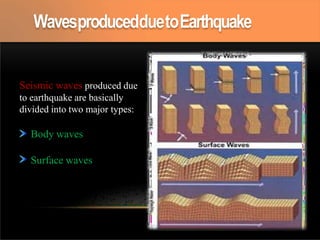
Seismic waves produced due
to earthquake are basically
divided into two major types:
Body waves
Surface waves
WavesproducedduetoEarthquake
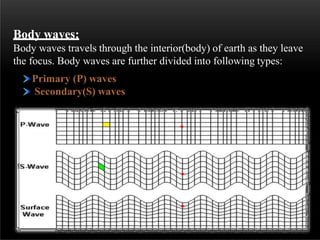
Body waves:
Body waves travels through the interior(body) of earth as they leave
the focus. Body waves are further divided into following types:
Primary (P) waves
Secondary(S) waves
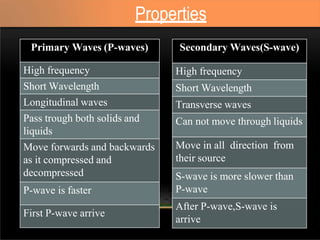
Secondary Waves(S-wave)
High frequency
Short Wavelength
Transverse waves
Can not move through liquids
Move in all direction from
their source
S-wave is more slower than
P-wave
After P-wave,S-wave is
arrive
Properties
Primary Waves (P-waves)
High frequency
Short Wavelength
Longitudinal waves
Pass trough both solids and
liquids
Move forwards and backwards
as it compressed and
decompressed
P-wave is faster
First P-wave arrive
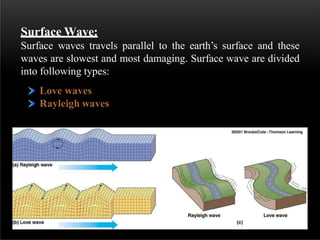
Surface Wave:
Surface waves travels parallel to the earth’s surface and these
waves are slowest and most damaging. Surface wave are divided
into following types:
Love waves
Rayleigh waves
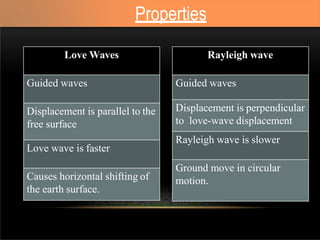
Rayleigh wave
Guided waves
Displacement is perpendicular
to love-wave displacement
Rayleigh wave is slower
Ground move in circular
motion.
Love Waves
Guided waves
Displacement is parallel to the
free surface
Love wave is faster
Causes horizontal shifting of
the earth surface.
Properties
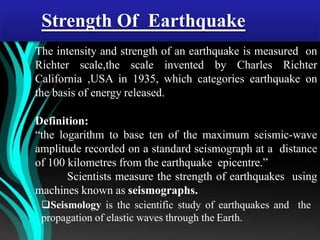
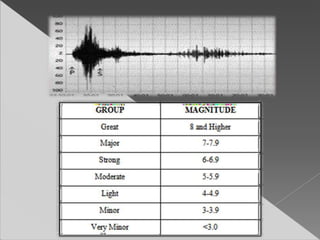
The intensity and strength of an earthquake is measured on
Richter scale,the scale invented by Charles Richter
California ,USA in 1935, which categories earthquake on
the basis of energy released.
Definition:
“the logarithm to base ten of the maximum seismic-wave
amplitude recorded on a standard seismograph at a distance
of 100 kilometres from the earthquake epicentre.”
Scientists measure the strength of earthquakes using
machines known as seismographs.
Seismology is the scientific study of earthquakes and the
propagation of elastic waves through the Earth.
Strength Of Earthquake
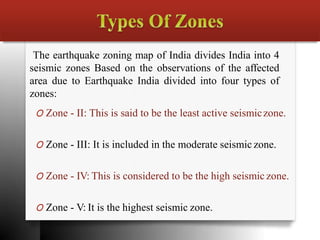
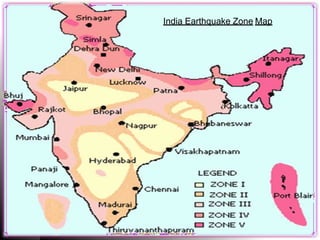
The earthquake zoning map of India divides India into 4
seismic zones Based on the observations of the affected
area due to Earthquake India divided into four types of
zones:
O Zone - II: This is said to be the least active seismiczone.
O Zone - III: It is included in the moderate seismic zone.
O Zone - IV: This is considered to be the high seismic zone.
O Zone - V: It is the highest seismic zone.
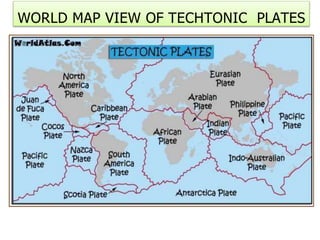
WORLD MAP VIEW OF TECHTONIC PLATES
India Earthquake Zone Map
Earthquake prediction is usually defined as the specification
of the time , location , and magnitude of a future earthquake
within stated limits.
But some evidence of upcoming Earthquake are following:
 Unusual animal behavior
Water level in wells
Large scale of fluctuation of oil flow from oil wells
Foreshocks or minor shocks before major earthquake
Temperature change
Uplifting of earth surface
Change in seismic wave velocity
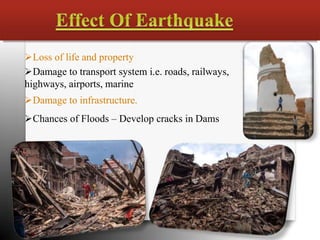
Loss of life and property
Damage to transport system i.e. roads, railways,
highways, airports, marine
Damage to infrastructure.
Chances of Floods – Develop cracks in Dams
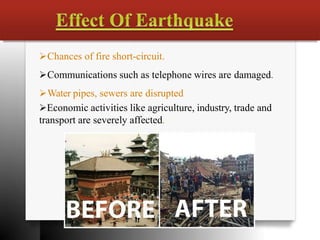
Chances of fire short-circuit.
Communications such as telephone wires are damaged.
Water pipes, sewers are disrupted
Economic activities like agriculture, industry, trade and
transport are severely affected.
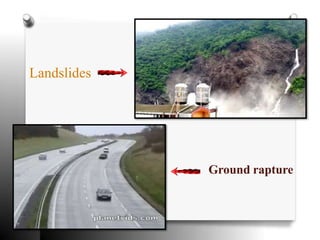
Landslides
Ground rapture
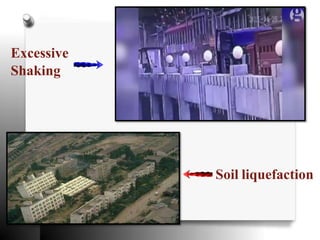
Excessive
Shaking
Soil liquefaction
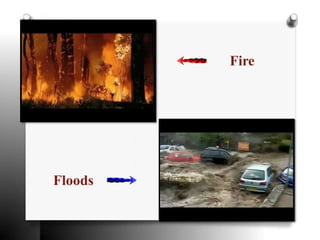
Floods
Fire
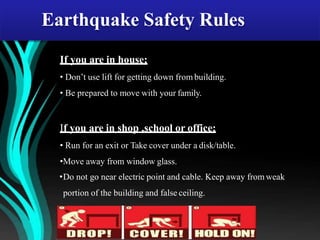
If you are in house;
• Don’t use lift for getting down from building.
• Be prepared to move with your family.
If you are in shop ,school or office;
• Run for an exit or Take cover under a disk/table.
•Move away from window glass.
•Do not go near electric point and cable. Keep away from weak
portion of the building and false ceiling.
Earthquake Safety Rules
If you are outside;
•Avoid high buildings , walls , power lines and other
objects that could fall and create block.
• Don’t run through streets.
•If possible , move on to an open area away from
hazard including trees.
If you are in vehicle;
• Stop in a safe open place.
• Remain inside vehicle.
• Close window , doors and vents.
Earthquake Safety Rules
Keep calm, switch on the transistor radio and obey
instructions.
Keep away from beaches and low banks of river. A huge
wave may sweep in
Do not re enter badly damaged buildings and do not go
near damage structures.
Turn off the water, gas and electricity.
Do not smoke, light match or use a cigarette lighter
Do not turn on switches there may be gas leak or short
circuit
If there is any fire, try to put it out or call fire brigade.
After An Earthquake
without having
Do not drink water from open containers
examined it.
If you aware of people have been buried, tell the rescue team. Do
not rush and try not to worsen the situation.
Avoid places where there are loose electric wires and do not
come in contact with any metal object.
Eat something. Y
ou will better and more capable of helping
other.
Do not walk around the streets to see what is happening. Keep
the streets clear so rescue vehicles can access the roads easily.
After An Earthquake
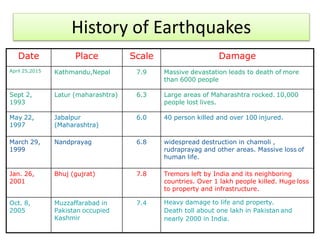
Date Place Scale Damage
April 25,2015 Kathmandu,Nepal 7.9 Massive devastation leads to death of more
than 6000 people
Sept 2,
1993
Latur (maharashtra) 6.3 Large areas of Maharashtra rocked. 10,000
people lost lives.
May 22,
1997
Jabalpur
(Maharashtra)
6.0 40 person killed and over 100 injured.
March 29,
1999
Nandprayag 6.8 widespread destruction in chamoli ,
rudraprayag and other areas. Massive loss of
human life.
Jan. 26,
2001
Bhuj (gujrat) 7.8 Tremors left by India and its neighboring
countries. Over 1 lakh people killed. Huge loss
to property and infrastructure.
Oct. 8,
2005
Muzzaffarabad in
Pakistan occupied
Kashmir
7.4 Heavy damage to life and property.
Death toll about one lakh in Pakistan and
nearly 2000 in India.
History of Earthquakes
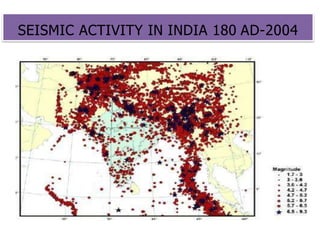
SEISMIC ACTIVITY IN INDIA 180 AD-2004
DO'S & DON'TS
What to Do Before an Earthquake?
• Repair deep plaster cracks in ceilings and foundations. Get expert advice if
there are signs of structural defects.
• Anchor overhead lighting fixtures to the ceiling.
• Follow BIS codes relevant to your area for building standards Fasten shelves
securely to walls.
• Place large or heavy objects on lower shelves.
• Store breakable items such as bottled foods, glass, and china in low, closed
cabinets with latches.
• Hang heavy items such as pictures and mirrors away from beds, settees, and
anywhere that people sit.
• Brace overhead light and fan fixtures.
• Repair defective electrical wiring and leaky gas connections. These are
potential fire
DO AND DON’TS
• Secure water heaters, LPG cylinders etc., by strapping them to the
walls or bolting to the floor.
• Store weed killers, pesticides, and flammable products securely
in closed
• cabinets with latches and on bottom shelves.
• Identify safe places indoors and outdoors.

Under strong dining table, bed

Against an inside wall

Away from where glass could shatter around windows, mirrors, pictures, or
where heavy bookcases or other heavy furniture could fall over

In the open, away from buildings, trees, telephone and electrical lines,
flyovers and bridges
• Know emergency telephone numbers (such as those of doctors,
hospitals, the police, etc)
• Educate yourself and family members
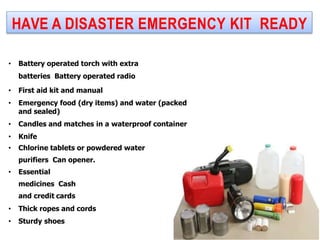
HAVE A DISASTER EMERGENCY KIT READY
• Battery operated torch with extra
batteries Battery operated radio
• First aid kit and manual
• Emergency food (dry items) and water (packed
and sealed)
• Candles and matches in a waterproof container
• Knife
• Chlorine tablets or powdered water
purifiers Can opener.
• Essential
medicines Cash
and credit cards
• Thick ropes and cords
• Sturdy shoes
DEVELOP AN EMERGENCY
COMMUNICATION PLAN
• In case family members are separated from one another during an
earthquake (a real possibility during the day when adults are at work
and children are at school), develop a plan for reuniting after the
disaster.
• Ask an out-of-state relative or friend to serve as the 'family contact'
after the disaster; it is often easier to call long distance. Make sure
everyone in the family knows the name, address, and phone number
of the contact person.
COMMUNITY
PREPAREDNESS
• Publish a special section in your local newspaper with emergency
information on earthquakes.
• Localize the information by printing the phone numbers of local
emergency services offices and hospitals.
• Conduct week-long series on locating hazards in the home.
• Work with local emergency services and officials to prepare special
reports for people with mobility impairment on what to do during an
earthquake.
• Provide tips on conducting earthquake drills in the home.
• Interview representatives of the gas, electric, and water companies
about shutting off utilities.
• Work together in your community to apply your knowledge to building
codes, retrofitting programmes, hazard hunts, and neighborhood and
family emergency plans.
DURING AN EARTHQUAKE
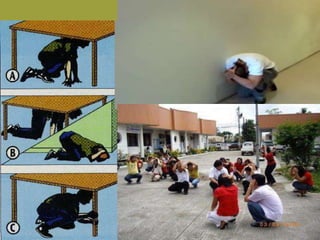
• DROP to the ground; take COVER by getting under a sturdy table or other piece of
furniture; and HOLD ON until the shaking stops. If there is no a table or desk near
you, cover your face and head with your arms and crouch in an inside corner of
the building.
• Protect yourself by staying under the lintel of an inner door, in the corner of a room,
under a table or even under a bed.
• Stay away from glass, windows, outside doors and walls, and anything that could fall,
• (such as lighting fixtures or furniture).
• Stay in bed if you are there when the earthquake strikes. Hold on and protect your
head with a pillow, unless you are under a heavy light fixture that could fall. In
that case, move to the nearest safe place.
• Use a doorway for shelter only if it is in close proximity to you and if you know it is a
strongly supported, load bearing doorway.
• Stay inside until the shaking stops and it is safe to go outside. Research has shown
that most injuries occur when people inside buildings attempt to move to a different
If outdoors
• Do not move from where you are. However, move away from buildings, trees,
streetlights, and utility wires.
• If you are in open space, stay there until the shaking stops.
• The greatest danger exists directly outside buildings; at exits; and alongside exterior walls.
Most earthquake-related casualties result from collapsing walls, flying glass, and falling
objects.
If in a moving vehicle
• Stop as quickly as safety permits and stay in the vehicle.
• Avoid stopping near or under buildings, trees, overpasses, and utility wires. Proceed cautiously
once the earthquake has stopped.
• Avoid roads, bridges, or ramps that might have been damaged by the earthquake.
If trapped under debris
• Do not light a match.
• Do not move about or kick up dust.
• Cover your mouth with a handkerchief or clothing.
• Tap on a pipe or wall so rescuers can locate you. Use a whistle if one is available. Shout
only as a last resort. Shouting can cause you to inhale dangerous amounts of dust.
AVOID THINGS THAT CAN FALL
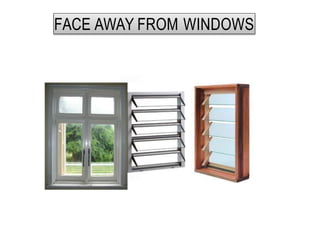
FACE AWAY FROM WINDOWS
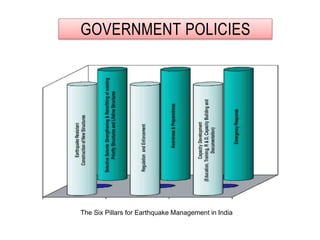
GOVERNMENT POLICIES
The Six Pillars for Earthquake Management in India
Earthquake disaster management

Earthquake disaster management

  • 1.
    EARTHQUAKE DISASTER MANAGEMENT Dr Fayaz A.Malla Assistant Professor, Environmental Sciences GDC Pulwama Higher Education Department, Govt. of J&K Email: nami.fayaz@gmail.com
  • 2.
    Earthquakes constitute oneof the worst natural hazards which often turn into disaster causing widespread destruction and loss to human life. The effects of earthquake vary upon the magnitude and intensity. Earthquakes occur every now and then all round the world, except in some places where earthquakes occur rarely. The devastation of cities and towns is one of the effects of earthquake. Introduction
  • 3.
    WHAT IS EARTHQUAKE? An Earthquake is the result of a sudden release of energy in the earth’s crust that creates seismic waves. The seismic activity of an area refers to the frequency, type and size of earthquakes experienced over a period of time.
  • 4.
    For example: If youthrow stone in a pond of still water,series of waves surface are produced on the of water,these waves spread out in all directions from the point where the stone strikes the water. Similarly, any sudden disturbances in the earth’s crust may produce vibration in the crust which travel in all direction from point of disturbances.
  • 5.
    Focus(Hypocenter): Focus is thepoint on the fault where rupture location from occurs and the which seismic waves are released. Epicenter: Epicenter is the point on the earth’s surface that is directly above the focus ,the point where an earthquake or underground explosion originates. TermsRelatedToEarthquake
  • 6.
    Intensity: The severityof earthquake shaking is assessed using a descriptive scale – the Modified Mercalli Intensity Scale. Magnitude: Earthquake size is a quantitative measure of the size of the earthquake at its source. The Richter Magnitude Scale measures the amount of seismic energy released by an earthquake. Earthquake Intensity and Magnitude
  • 7.
    Fault Line: A Faultline is the surface trace of a fault, the line of intersection between the earth’s surface. Fault plane: Fault plane are the cracks or sudden slips of the land . Fault Scrap: A Fault scrap is the topographic expression of faulting attributed to the displacement of the land surface by movement along faults.
  • 8.
    The primary causeof an earthquake is faults on the crust of the earth. of an “A Fault is a break or fracture b/w two blocks of rocks in response to stress.” This movement may occur rapidly, in the form earthquake or may occur slowly, in the form of creep. Earth scientists use the angle of the fault with respect to the surface (known as the dip) and the direction of slip along the fault to classify faults. How Earthquake Occur ?
  • 9.
    Normal fault: a dip-slipfault in which the block above the fault has moved downward relative to the block below. Thrust (reverse)fault: a dip-slip fault in which the upper block, above the fault plane, moves up and over the lower block. Classification Of Faults
  • 10.
    Strike-slip fault: A left-lateralstrike-slip fault : It is one on which the displacement of the far block is to the left when viewed from either side. A right-lateral strike-slip fault: It is one on which the displacement of the far block is to the right when viewed from either side.
  • 11.
    Some major causesof earthquakes are: Surface causes Volcanic causes Tectonic causes Causes of Earthquake
  • 12.
    Volcanic cause: eruptions produce Earthquakesmay accompany and follow volcanic Volcanic earthquakes. precede, frequently eruptions. They are caused by sudden displacements of lava within or beneath the earth crust. Surface cause: Great explosions, landslides, slips on steep coasts, dashing of sea waves , avalanches , railway trains, heavy trucks, some large engineering projects cause minor tremors. some of them are man made, other are natural.
  • 13.
    Tectonic cause: Structural disturbancesresulting in the parts of the lithosphere is the main cause of this type of earthquake. Most of the disastrous earthquakes belong to this category and occur in areas of great faults and fractures. Sudden yielding to strain produced on the rocks of accumulating stress causes displacements especially along old fault zones known as great transform faults.
  • 14.
    Seismic waves produceddue to earthquake are basically divided into two major types: Body waves Surface waves WavesproducedduetoEarthquake
  • 15.
    Body waves: Body wavestravels through the interior(body) of earth as they leave the focus. Body waves are further divided into following types: Primary (P) waves Secondary(S) waves
  • 16.
    Secondary Waves(S-wave) High frequency ShortWavelength Transverse waves Can not move through liquids Move in all direction from their source S-wave is more slower than P-wave After P-wave,S-wave is arrive Properties Primary Waves (P-waves) High frequency Short Wavelength Longitudinal waves Pass trough both solids and liquids Move forwards and backwards as it compressed and decompressed P-wave is faster First P-wave arrive
  • 17.
    Surface Wave: Surface wavestravels parallel to the earth’s surface and these waves are slowest and most damaging. Surface wave are divided into following types: Love waves Rayleigh waves
  • 18.
    Rayleigh wave Guided waves Displacementis perpendicular to love-wave displacement Rayleigh wave is slower Ground move in circular motion. Love Waves Guided waves Displacement is parallel to the free surface Love wave is faster Causes horizontal shifting of the earth surface. Properties
  • 19.
    The intensity andstrength of an earthquake is measured on Richter scale,the scale invented by Charles Richter California ,USA in 1935, which categories earthquake on the basis of energy released. Definition: “the logarithm to base ten of the maximum seismic-wave amplitude recorded on a standard seismograph at a distance of 100 kilometres from the earthquake epicentre.” Scientists measure the strength of earthquakes using machines known as seismographs. Seismology is the scientific study of earthquakes and the propagation of elastic waves through the Earth. Strength Of Earthquake
  • 21.
    The earthquake zoningmap of India divides India into 4 seismic zones Based on the observations of the affected area due to Earthquake India divided into four types of zones: O Zone - II: This is said to be the least active seismiczone. O Zone - III: It is included in the moderate seismic zone. O Zone - IV: This is considered to be the high seismic zone. O Zone - V: It is the highest seismic zone.
  • 22.
    WORLD MAP VIEWOF TECHTONIC PLATES
  • 23.
  • 24.
    Earthquake prediction isusually defined as the specification of the time , location , and magnitude of a future earthquake within stated limits. But some evidence of upcoming Earthquake are following:  Unusual animal behavior Water level in wells Large scale of fluctuation of oil flow from oil wells Foreshocks or minor shocks before major earthquake Temperature change Uplifting of earth surface Change in seismic wave velocity
  • 25.
    Loss of lifeand property Damage to transport system i.e. roads, railways, highways, airports, marine Damage to infrastructure. Chances of Floods – Develop cracks in Dams
  • 26.
    Chances of fireshort-circuit. Communications such as telephone wires are damaged. Water pipes, sewers are disrupted Economic activities like agriculture, industry, trade and transport are severely affected.
  • 27.
  • 28.
  • 29.
  • 30.
    If you arein house; • Don’t use lift for getting down from building. • Be prepared to move with your family. If you are in shop ,school or office; • Run for an exit or Take cover under a disk/table. •Move away from window glass. •Do not go near electric point and cable. Keep away from weak portion of the building and false ceiling. Earthquake Safety Rules
  • 31.
    If you areoutside; •Avoid high buildings , walls , power lines and other objects that could fall and create block. • Don’t run through streets. •If possible , move on to an open area away from hazard including trees. If you are in vehicle; • Stop in a safe open place. • Remain inside vehicle. • Close window , doors and vents. Earthquake Safety Rules
  • 32.
    Keep calm, switchon the transistor radio and obey instructions. Keep away from beaches and low banks of river. A huge wave may sweep in Do not re enter badly damaged buildings and do not go near damage structures. Turn off the water, gas and electricity. Do not smoke, light match or use a cigarette lighter Do not turn on switches there may be gas leak or short circuit If there is any fire, try to put it out or call fire brigade. After An Earthquake
  • 33.
    without having Do notdrink water from open containers examined it. If you aware of people have been buried, tell the rescue team. Do not rush and try not to worsen the situation. Avoid places where there are loose electric wires and do not come in contact with any metal object. Eat something. Y ou will better and more capable of helping other. Do not walk around the streets to see what is happening. Keep the streets clear so rescue vehicles can access the roads easily. After An Earthquake
  • 34.
    Date Place ScaleDamage April 25,2015 Kathmandu,Nepal 7.9 Massive devastation leads to death of more than 6000 people Sept 2, 1993 Latur (maharashtra) 6.3 Large areas of Maharashtra rocked. 10,000 people lost lives. May 22, 1997 Jabalpur (Maharashtra) 6.0 40 person killed and over 100 injured. March 29, 1999 Nandprayag 6.8 widespread destruction in chamoli , rudraprayag and other areas. Massive loss of human life. Jan. 26, 2001 Bhuj (gujrat) 7.8 Tremors left by India and its neighboring countries. Over 1 lakh people killed. Huge loss to property and infrastructure. Oct. 8, 2005 Muzzaffarabad in Pakistan occupied Kashmir 7.4 Heavy damage to life and property. Death toll about one lakh in Pakistan and nearly 2000 in India. History of Earthquakes
  • 35.
    SEISMIC ACTIVITY ININDIA 180 AD-2004
  • 37.
    DO'S & DON'TS Whatto Do Before an Earthquake? • Repair deep plaster cracks in ceilings and foundations. Get expert advice if there are signs of structural defects. • Anchor overhead lighting fixtures to the ceiling. • Follow BIS codes relevant to your area for building standards Fasten shelves securely to walls. • Place large or heavy objects on lower shelves. • Store breakable items such as bottled foods, glass, and china in low, closed cabinets with latches. • Hang heavy items such as pictures and mirrors away from beds, settees, and anywhere that people sit. • Brace overhead light and fan fixtures. • Repair defective electrical wiring and leaky gas connections. These are potential fire
  • 38.
    DO AND DON’TS •Secure water heaters, LPG cylinders etc., by strapping them to the walls or bolting to the floor. • Store weed killers, pesticides, and flammable products securely in closed • cabinets with latches and on bottom shelves. • Identify safe places indoors and outdoors.  Under strong dining table, bed  Against an inside wall  Away from where glass could shatter around windows, mirrors, pictures, or where heavy bookcases or other heavy furniture could fall over  In the open, away from buildings, trees, telephone and electrical lines, flyovers and bridges • Know emergency telephone numbers (such as those of doctors, hospitals, the police, etc) • Educate yourself and family members
  • 39.
    HAVE A DISASTEREMERGENCY KIT READY • Battery operated torch with extra batteries Battery operated radio • First aid kit and manual • Emergency food (dry items) and water (packed and sealed) • Candles and matches in a waterproof container • Knife • Chlorine tablets or powdered water purifiers Can opener. • Essential medicines Cash and credit cards • Thick ropes and cords • Sturdy shoes
  • 40.
    DEVELOP AN EMERGENCY COMMUNICATIONPLAN • In case family members are separated from one another during an earthquake (a real possibility during the day when adults are at work and children are at school), develop a plan for reuniting after the disaster. • Ask an out-of-state relative or friend to serve as the 'family contact' after the disaster; it is often easier to call long distance. Make sure everyone in the family knows the name, address, and phone number of the contact person.
  • 41.
    COMMUNITY PREPAREDNESS • Publish aspecial section in your local newspaper with emergency information on earthquakes. • Localize the information by printing the phone numbers of local emergency services offices and hospitals. • Conduct week-long series on locating hazards in the home. • Work with local emergency services and officials to prepare special reports for people with mobility impairment on what to do during an earthquake. • Provide tips on conducting earthquake drills in the home. • Interview representatives of the gas, electric, and water companies about shutting off utilities. • Work together in your community to apply your knowledge to building codes, retrofitting programmes, hazard hunts, and neighborhood and family emergency plans.
  • 42.
    DURING AN EARTHQUAKE •DROP to the ground; take COVER by getting under a sturdy table or other piece of furniture; and HOLD ON until the shaking stops. If there is no a table or desk near you, cover your face and head with your arms and crouch in an inside corner of the building. • Protect yourself by staying under the lintel of an inner door, in the corner of a room, under a table or even under a bed. • Stay away from glass, windows, outside doors and walls, and anything that could fall, • (such as lighting fixtures or furniture). • Stay in bed if you are there when the earthquake strikes. Hold on and protect your head with a pillow, unless you are under a heavy light fixture that could fall. In that case, move to the nearest safe place. • Use a doorway for shelter only if it is in close proximity to you and if you know it is a strongly supported, load bearing doorway. • Stay inside until the shaking stops and it is safe to go outside. Research has shown that most injuries occur when people inside buildings attempt to move to a different
  • 43.
    If outdoors • Donot move from where you are. However, move away from buildings, trees, streetlights, and utility wires. • If you are in open space, stay there until the shaking stops. • The greatest danger exists directly outside buildings; at exits; and alongside exterior walls. Most earthquake-related casualties result from collapsing walls, flying glass, and falling objects. If in a moving vehicle • Stop as quickly as safety permits and stay in the vehicle. • Avoid stopping near or under buildings, trees, overpasses, and utility wires. Proceed cautiously once the earthquake has stopped. • Avoid roads, bridges, or ramps that might have been damaged by the earthquake. If trapped under debris • Do not light a match. • Do not move about or kick up dust. • Cover your mouth with a handkerchief or clothing. • Tap on a pipe or wall so rescuers can locate you. Use a whistle if one is available. Shout only as a last resort. Shouting can cause you to inhale dangerous amounts of dust.
  • 45.
  • 46.
  • 47.
    GOVERNMENT POLICIES The SixPillars for Earthquake Management in India