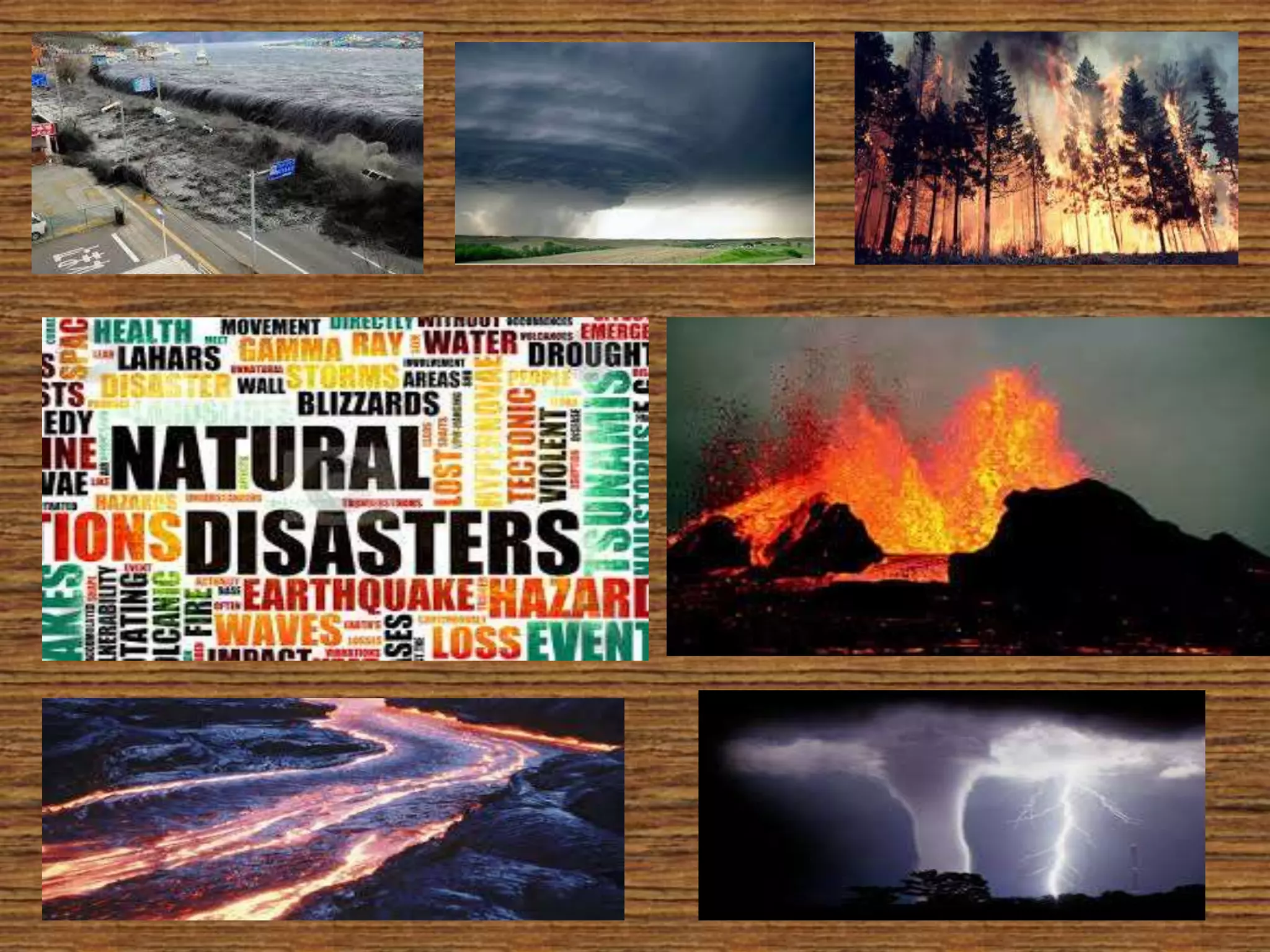
• A natural disaster is a major adverse event resulting from natural
processes of the Earth; examples include floods, volcanic eruptions,
earthquakes, tsunamis, and other geologic processes. A natural
disaster can cause loss of life or property damage, and typically
leaves some economic damage in its wake, the severity of which
depends on the affected population's resilience, or ability to recover.
• An adverse event will not rise to the
level of a disaster if it occurs in an area
without vulnerable population. In a
vulnerable area, however, such as San
Francisco and Nepal, an earthquake can
have disastrous consequences and leave
lasting damage, requiring years to
repair.
Earthquake
An earthquake is the result of a sudden release of
energy in the Earth's crust that creates seismic
waves. Earthquakes are measured using
observations from seismometers. The moment
magnitude is the most common scale on which
earthquakes larger than approximately 5 are
reported for the entire globe. Magnitude 3 or lower
earthquakes are mostly almost imperceptible or
weak and magnitude 7 and over potentially cause
serious damage over larger areas, depending on
their depth.
Volcanic Eruptions
• Volcanoes can cause widespread destruction
and consequent disaster in several ways. The
effects include the volcanic eruption itself that
may cause harm following the explosion of the
volcano or the fall of rock. Second, lava may
be produced during the eruption of a volcano.
As it leaves the volcano, the lava destroys
many buildings and plants it encounters.
Third, volcanic ash generally meaning the
cooled ash may form a cloud, and settle
thickly in nearby locations. When mixed with
water this forms a concrete-like material.
A lahar is a volcanic mudflow or landslide.
The 1953 Tangiwai disaster was caused by a
lahar, as was the 1985 Armero tragedy in
which the town of Armero was buried and an
estimated 23,000 people were killed.
• A specific type of volcano is the supervolcano. According to the Toba catastrophe theory, 75,000 to
80,000 years ago a supervolcanic event at Lake Toba reduced the human population to 10,000 or
even 1,000 breeding pairs, creating a bottleneck in human evolution. It also killed three-quarters
of all plant life in the northern hemisphere. The main danger from a supervolcano is the immense
cloud of ash, which has a disastrous global effect on climate and temperature for many years.
Blizzards
• Blizzards are severe winter storms characterized by heavy snow and
strong winds. When high winds stir up snow that has already fallen,
it is known as a ground blizzard. Blizzards can impact local
economic activities, especially in regions where snowfall is rare.
• Significant blizzards include:
• The Great Blizzard of 1888 in the United States, in which many tons
of wheat crops were destroyed.
• The 1972 Iran blizzard resulted in approximately 4,000 deaths and
lasted for 5 to 7 days.
Young steer after a
blizzard
Cyclonic storms
• Cyclone, tropical cyclone, hurricane, and typhoon are different
names for the same phenomenon, which is a cyclonic storm system
that forms over the oceans. The deadliest hurricane ever was
the 1970 Bhola cyclone; the deadliest Atlantic hurricane was
the Great Hurricane of 1780 which devastated Martinique, St.
Eustatius and Barbados. Another notable hurricane is Hurricane
Katrina, which devastated the Gulf Coast of the United States in
2005.
Droughts
• Drought is unusual dryness of
soil, resulting in crop failure
and shortage of water for other
uses, caused by significantly
lower rainfall than average over
a prolonged period. Hot dry
winds,shortage of water high
temperatures and consequent
evaporation of moisture from the
ground can contribute to
conditions of drought.
Heat Waves
• Hemisphere summer resulted in severe heat waves,
which killed over 2,000 people. It resulted in hundreds
of wildfires which causing widespread air pollution, and
burned thousands of square miles of forest.
• Heat waves can occur in the ocean as well as on land
with significant effects (often on a large scale) such
as coral bleaching.
• A heat wave is a period of unusually and excessively hot
weather. The worst heat wave in recent history was
the European Heat Wave of 2003
Tornadoes
• A tornado is a violent, dangerous, rotating column of air
that is in contact with both the surface of the earth and
a cumulonimbus cloud or, in rare cases, the base of
a cumulus cloud. It is also referred to as a twister or
a cyclone. Tornadoes come in many shapes and sizes, but
are typically in the form of a visible condensation funnel,
whose narrow end touches the earth and is often encircled
by a cloud of debris and dust. Most tornadoes have wind
speeds less than 110 miles per hour (177 km/h), are
approximately 250 feet (80 m) across, and travel a few
miles (several kilometers) before dissipating. The most
extreme tornadoes can attain wind speeds of more than
300 mph (480 km/h), stretch more than two miles (3 km)
across, and stay on the ground for dozens of miles
(perhaps more than 100 km).
• Well-known historical tornadoes include:
• The Tri-State Tornado of 1925, which killed over 600 people
in the United States;
• The Daulatpur-Saturia Tornado of 1989, which killed
roughly 1,300 people in Bangladesh.
An exceptionally clearly developed
single-cell Cumulonimbus incus Big
displaying the classic anvil shape;
associated gusts may occur from the
direct proximity to several times the
height of the cloud.
TheEnd
www.facebook.com/madhav.madaan.5

Natural calamities

  • 3.
    • A naturaldisaster is a major adverse event resulting from natural processes of the Earth; examples include floods, volcanic eruptions, earthquakes, tsunamis, and other geologic processes. A natural disaster can cause loss of life or property damage, and typically leaves some economic damage in its wake, the severity of which depends on the affected population's resilience, or ability to recover.
  • 4.
    • An adverseevent will not rise to the level of a disaster if it occurs in an area without vulnerable population. In a vulnerable area, however, such as San Francisco and Nepal, an earthquake can have disastrous consequences and leave lasting damage, requiring years to repair.
  • 5.
    Earthquake An earthquake isthe result of a sudden release of energy in the Earth's crust that creates seismic waves. Earthquakes are measured using observations from seismometers. The moment magnitude is the most common scale on which earthquakes larger than approximately 5 are reported for the entire globe. Magnitude 3 or lower earthquakes are mostly almost imperceptible or weak and magnitude 7 and over potentially cause serious damage over larger areas, depending on their depth.
  • 7.
    Volcanic Eruptions • Volcanoescan cause widespread destruction and consequent disaster in several ways. The effects include the volcanic eruption itself that may cause harm following the explosion of the volcano or the fall of rock. Second, lava may be produced during the eruption of a volcano. As it leaves the volcano, the lava destroys many buildings and plants it encounters. Third, volcanic ash generally meaning the cooled ash may form a cloud, and settle thickly in nearby locations. When mixed with water this forms a concrete-like material. A lahar is a volcanic mudflow or landslide. The 1953 Tangiwai disaster was caused by a lahar, as was the 1985 Armero tragedy in which the town of Armero was buried and an estimated 23,000 people were killed.
  • 8.
    • A specifictype of volcano is the supervolcano. According to the Toba catastrophe theory, 75,000 to 80,000 years ago a supervolcanic event at Lake Toba reduced the human population to 10,000 or even 1,000 breeding pairs, creating a bottleneck in human evolution. It also killed three-quarters of all plant life in the northern hemisphere. The main danger from a supervolcano is the immense cloud of ash, which has a disastrous global effect on climate and temperature for many years.
  • 9.
    Blizzards • Blizzards aresevere winter storms characterized by heavy snow and strong winds. When high winds stir up snow that has already fallen, it is known as a ground blizzard. Blizzards can impact local economic activities, especially in regions where snowfall is rare. • Significant blizzards include: • The Great Blizzard of 1888 in the United States, in which many tons of wheat crops were destroyed. • The 1972 Iran blizzard resulted in approximately 4,000 deaths and lasted for 5 to 7 days. Young steer after a blizzard
  • 10.
    Cyclonic storms • Cyclone,tropical cyclone, hurricane, and typhoon are different names for the same phenomenon, which is a cyclonic storm system that forms over the oceans. The deadliest hurricane ever was the 1970 Bhola cyclone; the deadliest Atlantic hurricane was the Great Hurricane of 1780 which devastated Martinique, St. Eustatius and Barbados. Another notable hurricane is Hurricane Katrina, which devastated the Gulf Coast of the United States in 2005.
  • 12.
    Droughts • Drought isunusual dryness of soil, resulting in crop failure and shortage of water for other uses, caused by significantly lower rainfall than average over a prolonged period. Hot dry winds,shortage of water high temperatures and consequent evaporation of moisture from the ground can contribute to conditions of drought.
  • 13.
    Heat Waves • Hemispheresummer resulted in severe heat waves, which killed over 2,000 people. It resulted in hundreds of wildfires which causing widespread air pollution, and burned thousands of square miles of forest. • Heat waves can occur in the ocean as well as on land with significant effects (often on a large scale) such as coral bleaching. • A heat wave is a period of unusually and excessively hot weather. The worst heat wave in recent history was the European Heat Wave of 2003
  • 14.
    Tornadoes • A tornadois a violent, dangerous, rotating column of air that is in contact with both the surface of the earth and a cumulonimbus cloud or, in rare cases, the base of a cumulus cloud. It is also referred to as a twister or a cyclone. Tornadoes come in many shapes and sizes, but are typically in the form of a visible condensation funnel, whose narrow end touches the earth and is often encircled by a cloud of debris and dust. Most tornadoes have wind speeds less than 110 miles per hour (177 km/h), are approximately 250 feet (80 m) across, and travel a few miles (several kilometers) before dissipating. The most extreme tornadoes can attain wind speeds of more than 300 mph (480 km/h), stretch more than two miles (3 km) across, and stay on the ground for dozens of miles (perhaps more than 100 km).
  • 16.
    • Well-known historicaltornadoes include: • The Tri-State Tornado of 1925, which killed over 600 people in the United States; • The Daulatpur-Saturia Tornado of 1989, which killed roughly 1,300 people in Bangladesh. An exceptionally clearly developed single-cell Cumulonimbus incus Big displaying the classic anvil shape; associated gusts may occur from the direct proximity to several times the height of the cloud.
  • 17.