GLASS AS A BUILDING
MATERIAL
TYPES
OF
GLASS
GLASS PRODUCTION
Glass production involves 2 main methods:
•the float glass process which produces sheet glass
• Glassblowing which produces bottles and other
containers.
 GLASS CONTAINER FACTORIES :-
 Modern glass container factories are 3 part operations:
- the batch house, the hot end, and the cold end
• The batch house handles the raw materials
• The hot end handles the manufacture proper — the
furnaces, annealing ovens, and forming machines
•The cold end handles the product-inspection and
packaging equipment.
GLASS COMPONENTS
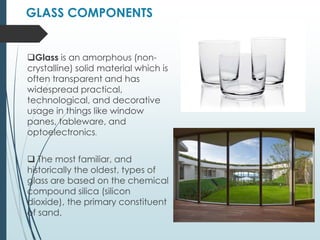
Glass is an amorphous (non-
crystalline) solid material which is
often transparent and has
widespread practical,
technological, and decorative
usage in things like window
panes, tableware, and
optoelectronics.
 The most familiar, and
historically the oldest, types of
glass are based on the chemical
compound silica (silicon
dioxide), the primary constituent
of sand.
ADVANTAGES & DIS-ADVANTAGES OF
GLASS
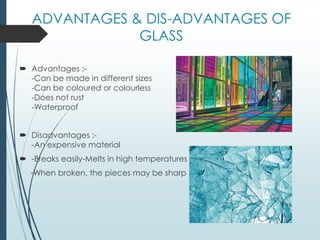
 Advantages :-
-Can be made in different sizes
-Can be coloured or colourless
-Does not rust
-Waterproof
 Disadvantages :-
-An expensive material
 -Breaks easily-Melts in high temperatures
-When broken, the pieces may be sharp
Types Of glass
 Float glass
Is Made up of floating molten glass
on a bed of molten tin.
This method gives the sheet
uniform thickness and very flat
surfaces.Modern windows are mde
from float glass.
Types Of Glass
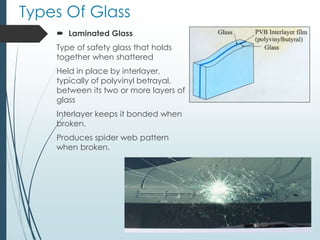
 Laminated Glass
Type of safety glass that holds
together when shattered
Held in place by interlayer,
typically of polyvinyl betrayal,
between its two or more layers of
glass
Interlayer keeps it bonded when
broken.
Produces spider web pattern
when broken.
Types Of Glass
 Stained Glass
The term explains a glass
generally refers to glass that has
been coloured by adding
metallic salts during the
manufacture.
The coloured glass is crafted
into stained glass windows in
which small pieces of glass are
arranged to form patterns or
pictures, held together by strips
of lead and supported by a rigid
frame.
Types Of Glass
 Tinted Glass
There are many varieties into this type like tinted float glass,
including colors of dark blue, French green, dark green, dark
grey, bronze and pink.
Types Of Glass
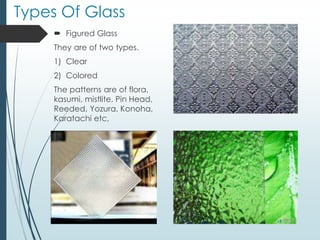
 Figured Glass
They are of two types.
1) Clear
2) Colored
The patterns are of flora,
kasumi, mistlite, Pin Head,
Reeded, Yozura, Konoha,
Karatachi etc,
Types Of glass
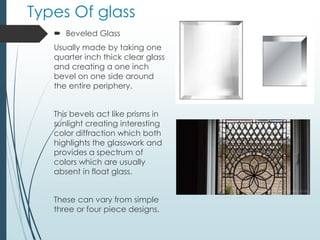
 Beveled Glass
Usually made by taking one
quarter inch thick clear glass
and creating a one inch
bevel on one side around
the entire periphery.
This bevels act like prisms in
sunlight creating interesting
color diffraction which both
highlights the glasswork and
provides a spectrum of
colors which are usually
absent in float glass.
These can vary from simple
three or four piece designs.
Types Of Glass
 Toughened Glass
Types Of Glass
 Insulated Glass
Consists Of two or more
lites of glass separated by
a hermitically sealed
space for thermal
insulation and
condensation control.
Used Specially for
windows, curtain walls and
skylights.
Types Of Glass
 Wired Glass
Involves steel wires rolled
into sheets of glass.
A wire mesh is inserted
during the manufacturing
of plate glass, allowing the
glass to adhere together
when cracked.
Can Be qualified as safety
glass for some
applications.
GLASS USED FOR
DIFFERENT
PURPOSES
APPLICATION OF
GLASS
IN
BUILDING INDUSTRY
USE OF GLASS IN EXTERIOR & INTERIOR
USE OF GLASS FOR WALL
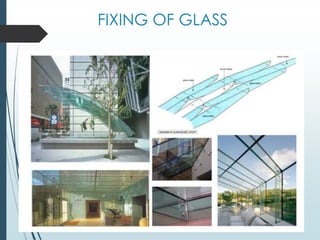
FIXING OF GLASS

Glass

  • 1.
    GLASS AS ABUILDING MATERIAL
  • 2.
  • 3.
    GLASS PRODUCTION Glass productioninvolves 2 main methods: •the float glass process which produces sheet glass • Glassblowing which produces bottles and other containers.  GLASS CONTAINER FACTORIES :-  Modern glass container factories are 3 part operations: - the batch house, the hot end, and the cold end • The batch house handles the raw materials • The hot end handles the manufacture proper — the furnaces, annealing ovens, and forming machines •The cold end handles the product-inspection and packaging equipment.
  • 4.
    GLASS COMPONENTS Glass isan amorphous (non- crystalline) solid material which is often transparent and has widespread practical, technological, and decorative usage in things like window panes, tableware, and optoelectronics.  The most familiar, and historically the oldest, types of glass are based on the chemical compound silica (silicon dioxide), the primary constituent of sand.
  • 5.
    ADVANTAGES & DIS-ADVANTAGESOF GLASS  Advantages :- -Can be made in different sizes -Can be coloured or colourless -Does not rust -Waterproof  Disadvantages :- -An expensive material  -Breaks easily-Melts in high temperatures -When broken, the pieces may be sharp
  • 6.
    Types Of glass Float glass Is Made up of floating molten glass on a bed of molten tin. This method gives the sheet uniform thickness and very flat surfaces.Modern windows are mde from float glass.
  • 7.
    Types Of Glass Laminated Glass Type of safety glass that holds together when shattered Held in place by interlayer, typically of polyvinyl betrayal, between its two or more layers of glass Interlayer keeps it bonded when broken. Produces spider web pattern when broken.
  • 8.
    Types Of Glass Stained Glass The term explains a glass generally refers to glass that has been coloured by adding metallic salts during the manufacture. The coloured glass is crafted into stained glass windows in which small pieces of glass are arranged to form patterns or pictures, held together by strips of lead and supported by a rigid frame.
  • 9.
    Types Of Glass Tinted Glass There are many varieties into this type like tinted float glass, including colors of dark blue, French green, dark green, dark grey, bronze and pink.
  • 10.
    Types Of Glass Figured Glass They are of two types. 1) Clear 2) Colored The patterns are of flora, kasumi, mistlite, Pin Head, Reeded, Yozura, Konoha, Karatachi etc,
  • 11.
    Types Of glass Beveled Glass Usually made by taking one quarter inch thick clear glass and creating a one inch bevel on one side around the entire periphery. This bevels act like prisms in sunlight creating interesting color diffraction which both highlights the glasswork and provides a spectrum of colors which are usually absent in float glass. These can vary from simple three or four piece designs.
  • 12.
    Types Of Glass Toughened Glass
  • 13.
    Types Of Glass Insulated Glass Consists Of two or more lites of glass separated by a hermitically sealed space for thermal insulation and condensation control. Used Specially for windows, curtain walls and skylights.
  • 14.
    Types Of Glass Wired Glass Involves steel wires rolled into sheets of glass. A wire mesh is inserted during the manufacturing of plate glass, allowing the glass to adhere together when cracked. Can Be qualified as safety glass for some applications.
  • 15.
  • 18.
  • 19.
    USE OF GLASSIN EXTERIOR & INTERIOR
  • 20.
    USE OF GLASSFOR WALL
  • 21.