Tsunami Disaster
Management
Dr Fayaz A. Malla
Assistant Professor, Environmental Sciences
GDC Tral
Higher Education Department, Govt. of J&K
Email: nami.fayaz@gmail.com
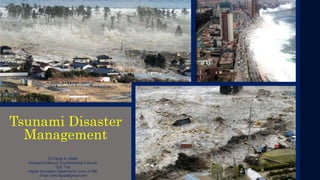
Tsunami
• A tsunami from Japanese harbor wave is
a series of waves in a water body caused
by the displacement of a large volume of
water, generally in an ocean or a large
lake.
• Earthquakes, volcanic eruptions and
other underwater explosions (including
detonations, landslides, glacier
calving, meteorite impacts and other
disturbances) above or below water all
have the potential to generate a tsunami.
• Unlike normal ocean waves, which are
generated by wind, or tides, which are
generated by the gravitational pull of
the Moon and the Sun, a tsunami is
generated by the displacement of water
by a large event.
• Tsunamis are high energy waves in the
oceans generated by high magnitude
earthquakes in ocean floors exceeding
7.5 on Richter scale
Tsunami’s are high energy see
waves caused by a host of
causative factors, but undersea
earthquake event is the most
important factor
These are long waves having
longer wavelengths exceeding
100 kilometers in deep oceans
but as these move coastward
their wavelengths decrease
remarkably
After their origin tsunami
waves are split in two branches
distinct or deep tsunami and
local tsunami
The speed of tsunami increases
with the increase in the water
depth and vice versa
Normally distinct tsunami's
travel in the deep ocean with a
speed of 500 to 1000 kilometer
per hour
The wavelength of distinct
tsunami in deep oceans is much
longer exceeding 100
kilometers but the wavelength
decreases at as the local
tsunami approached the coasts
The wavelength of distinct
tsunami in the deeper ocean is
very low sometimes exceeding
25 meters or so
The height of water of tsunami
waves above mean sea level in
the near shore zone is called
tsunami run up
Characteristic Features of Tsunami Waves
Causes
and origin
of Tsunami
Waves
Undersea powerful earthquake
Undersea massive landslides
Collision of convergent destructive
plates
Explosive volcanic eruptions of
Damage to structure
Human casualties
Loss of property
Adverse effects of Tsunami
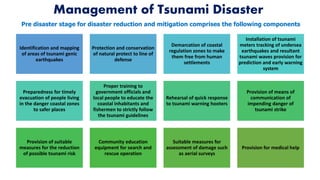
Management of Tsunami Disaster
Identification and mapping
of areas of tsunami genic
earthquakes
Protection and conservation
of natural protect to line of
defense
Demarcation of coastal
regulation zones to make
them free from human
settlements
Installation of tsunami
meters tracking of undersea
earthquakes and resultant
tsunami waves provision for
prediction and early warning
system
Preparedness for timely
evacuation of people living
in the danger coastal zones
to safer places
Proper training to
government officials and
local people to educate the
coastal inhabitants and
fishermen to strictly follow
the tsunami guidelines
Rehearsal of quick response
to tsunami warning hooters
Provision of means of
communication of
impending danger of
tsunami strike
Provision of suitable
measures for the reduction
of possible tsunami risk
Community education
equipment for search and
rescue operation
Suitable measures for
assessment of damage such
as aerial surveys
Provision for medical help
Pre disaster stage for disaster reduction and mitigation comprises the following components
Post Tsunami
Disaster
Management
Stage
Rescue and evacuation of stranded
alive people
Immediate relief work
Recovery
Rehabilitation
Management of Tsunami Disaster
Thank You

Tsunami disaster management

  • 1.
    Tsunami Disaster Management Dr FayazA. Malla Assistant Professor, Environmental Sciences GDC Tral Higher Education Department, Govt. of J&K Email: nami.fayaz@gmail.com
  • 2.
    Tsunami • A tsunamifrom Japanese harbor wave is a series of waves in a water body caused by the displacement of a large volume of water, generally in an ocean or a large lake. • Earthquakes, volcanic eruptions and other underwater explosions (including detonations, landslides, glacier calving, meteorite impacts and other disturbances) above or below water all have the potential to generate a tsunami. • Unlike normal ocean waves, which are generated by wind, or tides, which are generated by the gravitational pull of the Moon and the Sun, a tsunami is generated by the displacement of water by a large event. • Tsunamis are high energy waves in the oceans generated by high magnitude earthquakes in ocean floors exceeding 7.5 on Richter scale
  • 3.
    Tsunami’s are highenergy see waves caused by a host of causative factors, but undersea earthquake event is the most important factor These are long waves having longer wavelengths exceeding 100 kilometers in deep oceans but as these move coastward their wavelengths decrease remarkably After their origin tsunami waves are split in two branches distinct or deep tsunami and local tsunami The speed of tsunami increases with the increase in the water depth and vice versa Normally distinct tsunami's travel in the deep ocean with a speed of 500 to 1000 kilometer per hour The wavelength of distinct tsunami in deep oceans is much longer exceeding 100 kilometers but the wavelength decreases at as the local tsunami approached the coasts The wavelength of distinct tsunami in the deeper ocean is very low sometimes exceeding 25 meters or so The height of water of tsunami waves above mean sea level in the near shore zone is called tsunami run up Characteristic Features of Tsunami Waves
  • 4.
    Causes and origin of Tsunami Waves Underseapowerful earthquake Undersea massive landslides Collision of convergent destructive plates Explosive volcanic eruptions of
  • 5.
    Damage to structure Humancasualties Loss of property Adverse effects of Tsunami
  • 6.
    Management of TsunamiDisaster Identification and mapping of areas of tsunami genic earthquakes Protection and conservation of natural protect to line of defense Demarcation of coastal regulation zones to make them free from human settlements Installation of tsunami meters tracking of undersea earthquakes and resultant tsunami waves provision for prediction and early warning system Preparedness for timely evacuation of people living in the danger coastal zones to safer places Proper training to government officials and local people to educate the coastal inhabitants and fishermen to strictly follow the tsunami guidelines Rehearsal of quick response to tsunami warning hooters Provision of means of communication of impending danger of tsunami strike Provision of suitable measures for the reduction of possible tsunami risk Community education equipment for search and rescue operation Suitable measures for assessment of damage such as aerial surveys Provision for medical help Pre disaster stage for disaster reduction and mitigation comprises the following components
  • 7.
    Post Tsunami Disaster Management Stage Rescue andevacuation of stranded alive people Immediate relief work Recovery Rehabilitation Management of Tsunami Disaster
  • 8.