MAN-MADE DISASTERS &
MITIGATION STRATEGIES
Prepared by VIVEK RANJAN SAHOO
Standard IX A
Roll no. 60
DAV Public School, mcl, Ja, Dera, Talcher
1
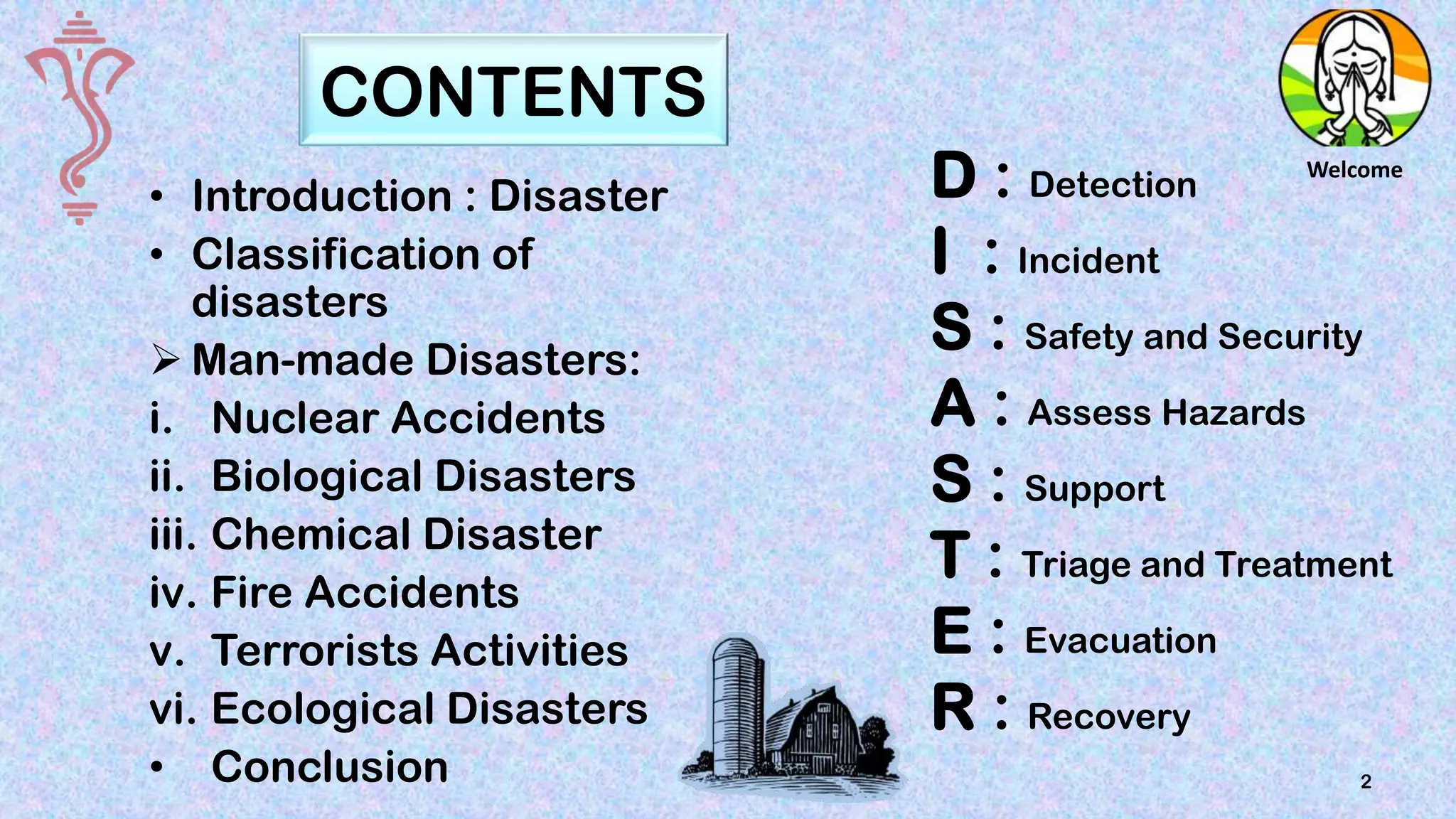
CONTENTS
• Introduction : Disaster
• Classification of
disasters
 Man-made Disasters:
i. Nuclear Accidents
ii. Biological Disasters
iii. Chemical Disaster
iv. Fire Accidents
v. Terrorists Activities
vi. Ecological Disasters
• Conclusion
D : Detection
I : Incident
S : Safety and Security
A : Assess Hazards
S : Support
T : Triage and Treatment
E : Evacuation
R : Recovery
2
Welcome
3
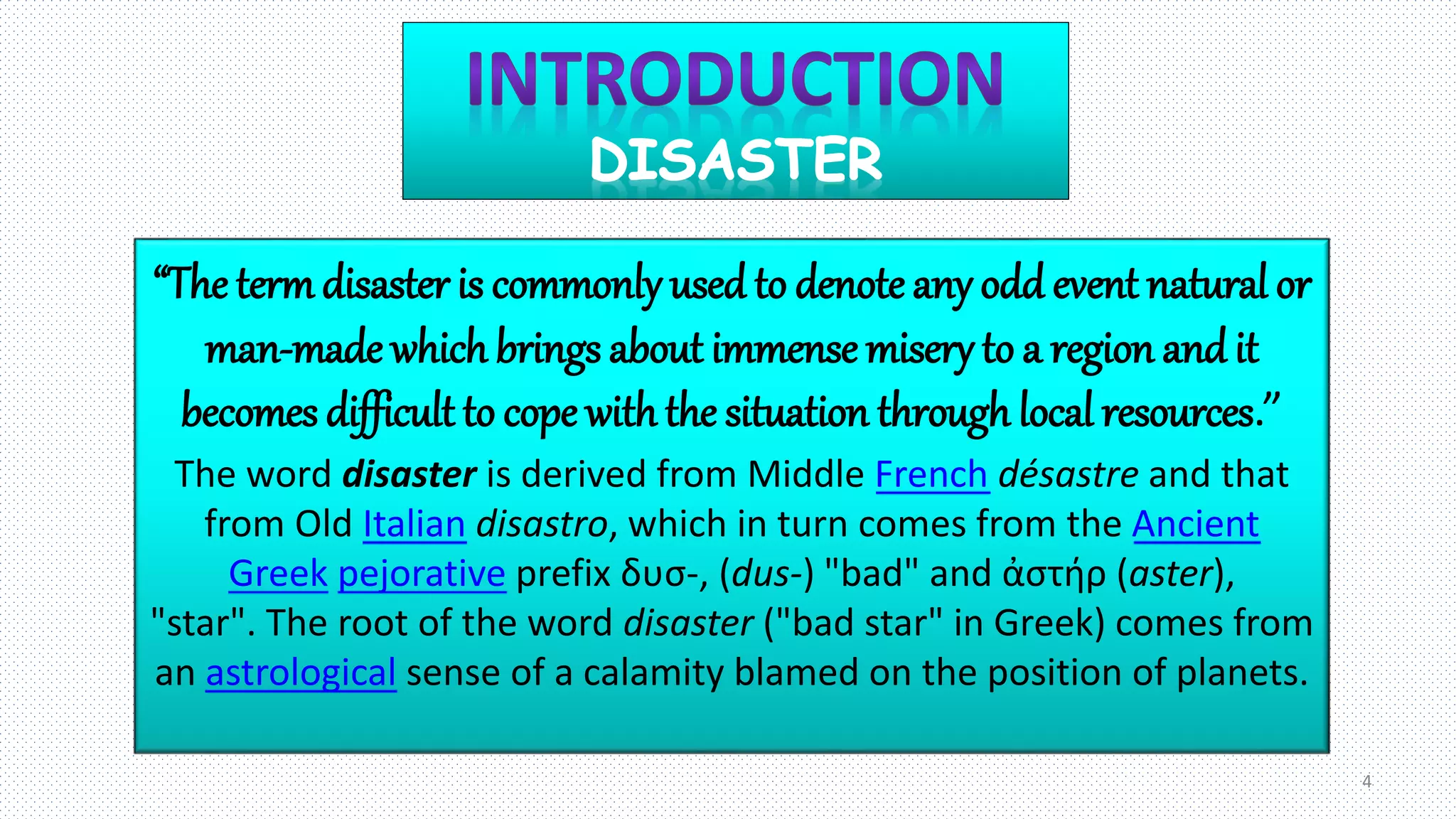
“The termdisaster is commonly used to denote any odd event natural or
man-made which brings about immense misery to a region and it
becomes difficult to cope with the situation through local resources.”
The word disaster is derived from Middle French désastre and that
from Old Italian disastro, which in turn comes from the Ancient
Greek pejorative prefix δυσ-, (dus-) "bad" and ἀστήρ (aster),
"star". The root of the word disaster ("bad star" in Greek) comes from
an astrological sense of a calamity blamed on the position of planets.
4
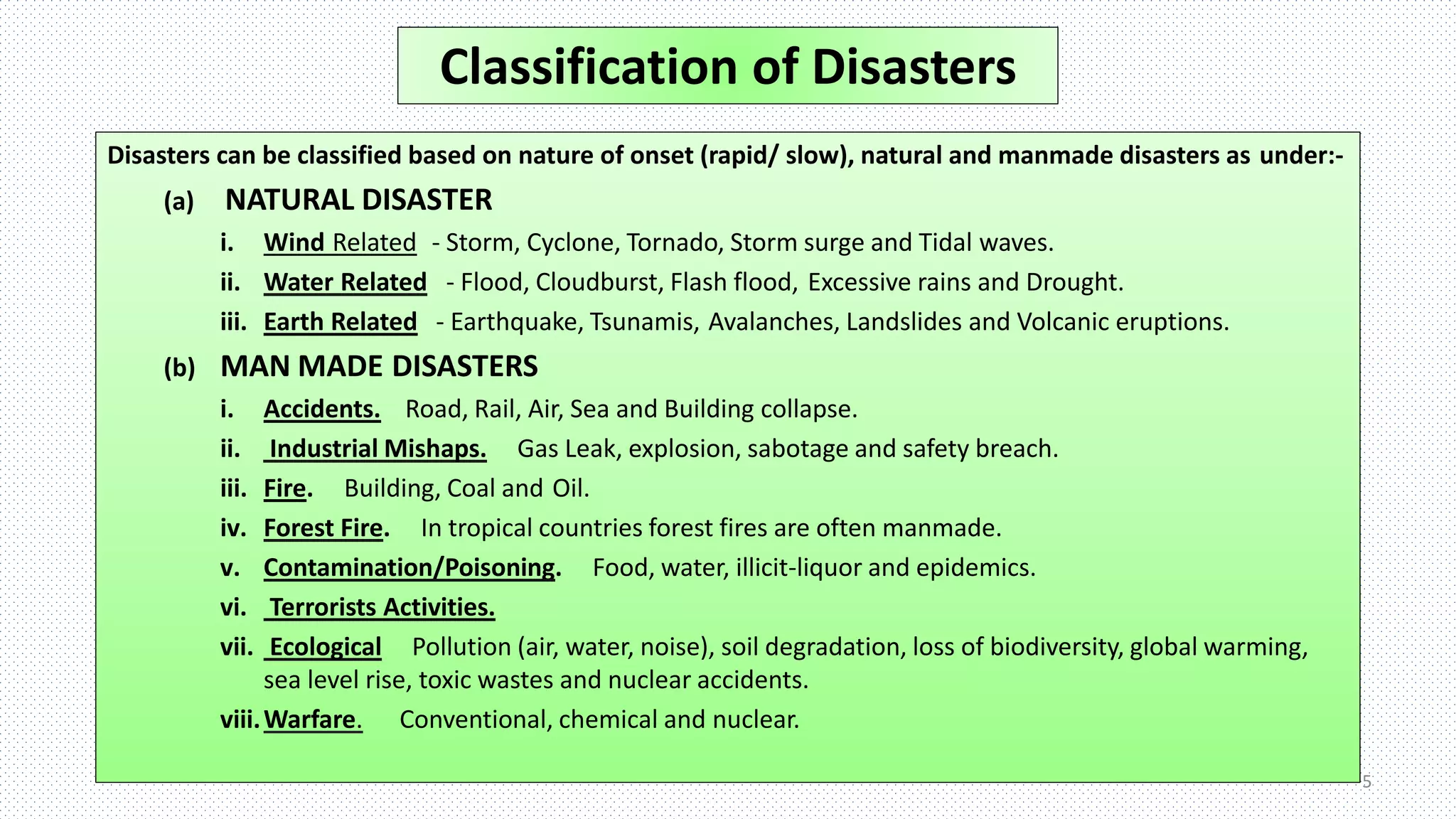
Disasters can be classified based on nature of onset (rapid/ slow), natural and manmade disasters as under:-
(a) NATURAL DISASTER
i. Wind Related - Storm, Cyclone, Tornado, Storm surge and Tidal waves.
ii. Water Related - Flood, Cloudburst, Flash flood, Excessive rains and Drought.
iii. Earth Related - Earthquake, Tsunamis, Avalanches, Landslides and Volcanic eruptions.
(b) MAN MADE DISASTERS
i. Accidents. Road, Rail, Air, Sea and Building collapse.
ii. Industrial Mishaps. Gas Leak, explosion, sabotage and safety breach.
iii. Fire. Building, Coal and Oil.
iv. Forest Fire. In tropical countries forest fires are often manmade.
v. Contamination/Poisoning. Food, water, illicit-liquor and epidemics.
vi. Terrorists Activities.
vii. Ecological Pollution (air, water, noise), soil degradation, loss of biodiversity, global warming,
sea level rise, toxic wastes and nuclear accidents.
viii.Warfare. Conventional, chemical and nuclear.
Classification of Disasters
5
Manmade disasters are hazards whichare due to human
negligence. Manmade hazards are associatedwithindustries or
energy generation facilities and include stampedes, fires,
transport accidents, industrial accidents, oil spills, terrorist
attacks, nuclearexplosions/nuclear radiation etc. The list of
hazards is very long. Many occur frequently whileothers take
place occasionally. As with natural hazards, man made hazards
are events that have not happened, for instance terrorism. Man
made disasters are examples of specific cases where manmade
hazards have become reality in an event.
MAN-MADE DISASTERS
6
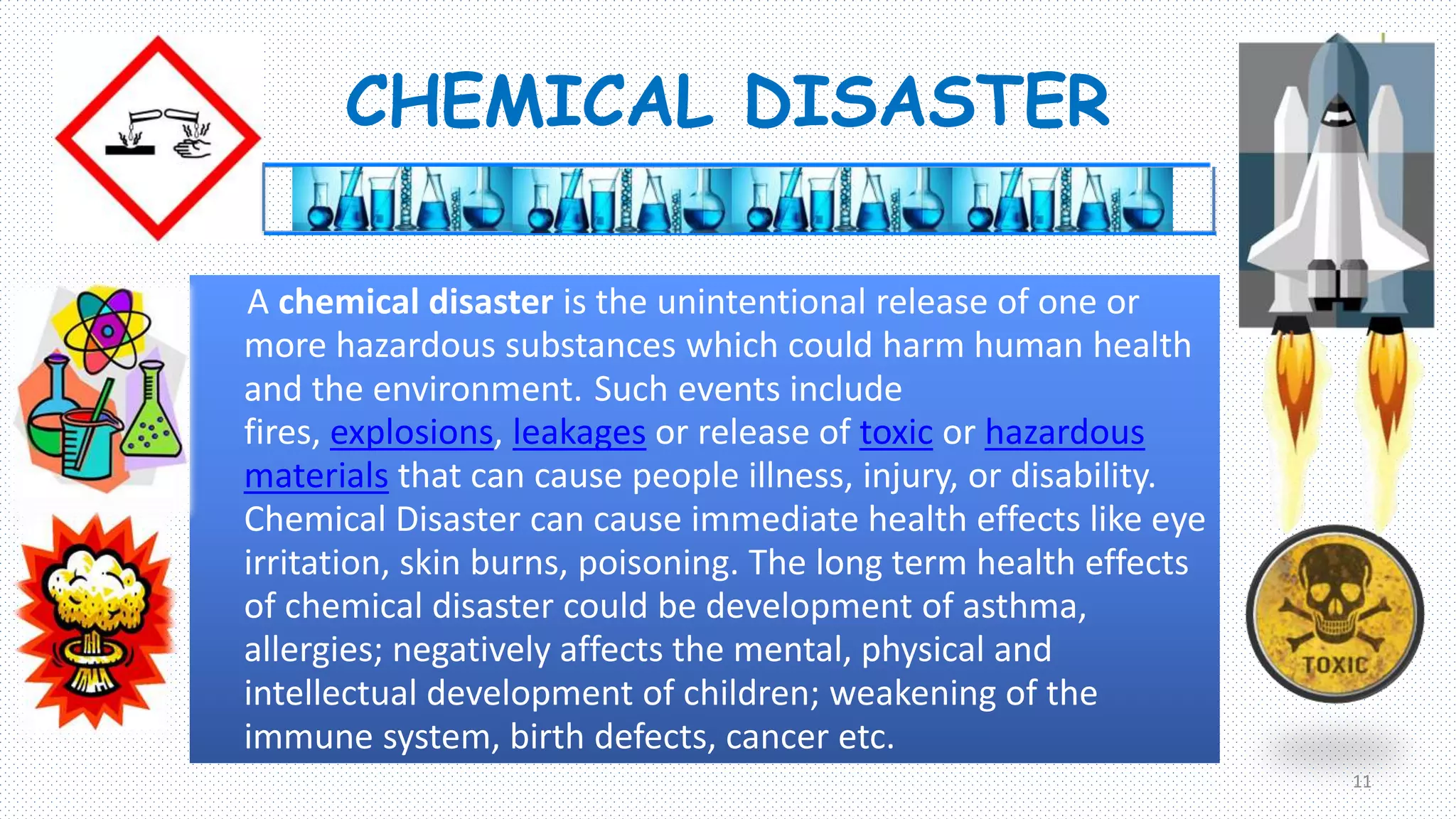
It is a type of explosion deriving its force from nuclear reactions of fission and
fusion .It is an event that has led to significant consequences to people, the
environment or the facility. Examples include lethal effects to individuals, large
radioactive release in the environment or reactor core melt.
Effects :-
2011 Fukushima Daiichi Accident
1986 Chernobyl accident
NUCLEAR ACCIDENTS
7
Precautions from nuclear accident
• Common indicators of these disasters are
vomiting, nausea, dizziness etc. Don’t look at
fire as it causes instant blindness. Close all
doors and windows as radioactivity doesn’t
penetrate into solid structures. Cover all food
and water and listen govt. orders. Technical
measures need to be adopted to reduce the risk
of accidents or to minimize the amount of radio-
activity released to the environment.
8
BIOLOGICAL DISASTERS
The devastating effects caused by an enormous spread
of a certain kind of living organism that may spread
disease, viruses or infestation of plant, animal or insect
life on an epidemic or pandemic level. Indicates a
disaster that affects a much larger region, sometimes
an entire continent or even the whole planet. For
example, the recent Swine Flu or COVID-19 pandemic.
9
Safe Water supply and proper maintenance of
sewage pipeline will go a long way in the
prevention of biological disasters and epidemics of
waterborne origin such as cholera, hepatitis,
diarrhea and dysentery.
Personal hygiene Necessary awareness will be
created in the community about the importance of
personal hygiene, and measures to achieve this,
including provision of washing, cleaning and
bathing facilities, and avoiding overcrowding in
sleeping quarters,Vector Control etc.
10
A chemical disaster is the unintentional release of one or
more hazardous substances which could harm human health
and the environment. Such events include
fires, explosions, leakages or release of toxic or hazardous
materials that can cause people illness, injury, or disability.
Chemical Disaster can cause immediate health effects like eye
irritation, skin burns, poisoning. The long term health effects
of chemical disaster could be development of asthma,
allergies; negatively affects the mental, physical and
intellectual development of children; weakening of the
immune system, birth defects, cancer etc.
CHEMICAL DISASTER
11
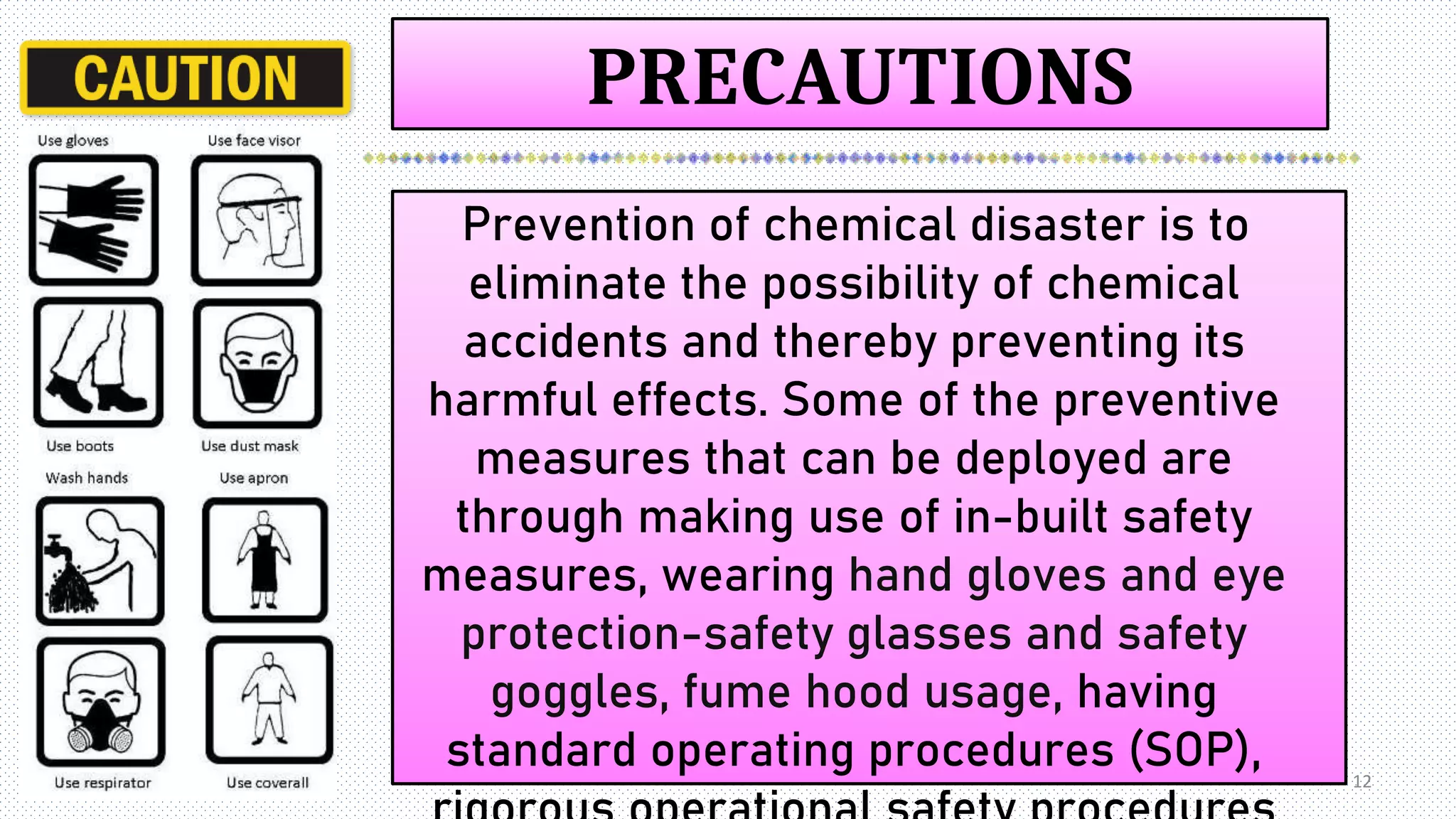
Prevention of chemical disaster is to
eliminate the possibility of chemical
accidents and thereby preventing its
harmful effects. Some of the preventive
measures that can be deployed are
through making use of in-built safety
measures, wearing hand gloves and eye
protection-safety glasses and safety
goggles, fume hood usage, having
standard operating procedures (SOP), 12
PRECAUTIONS
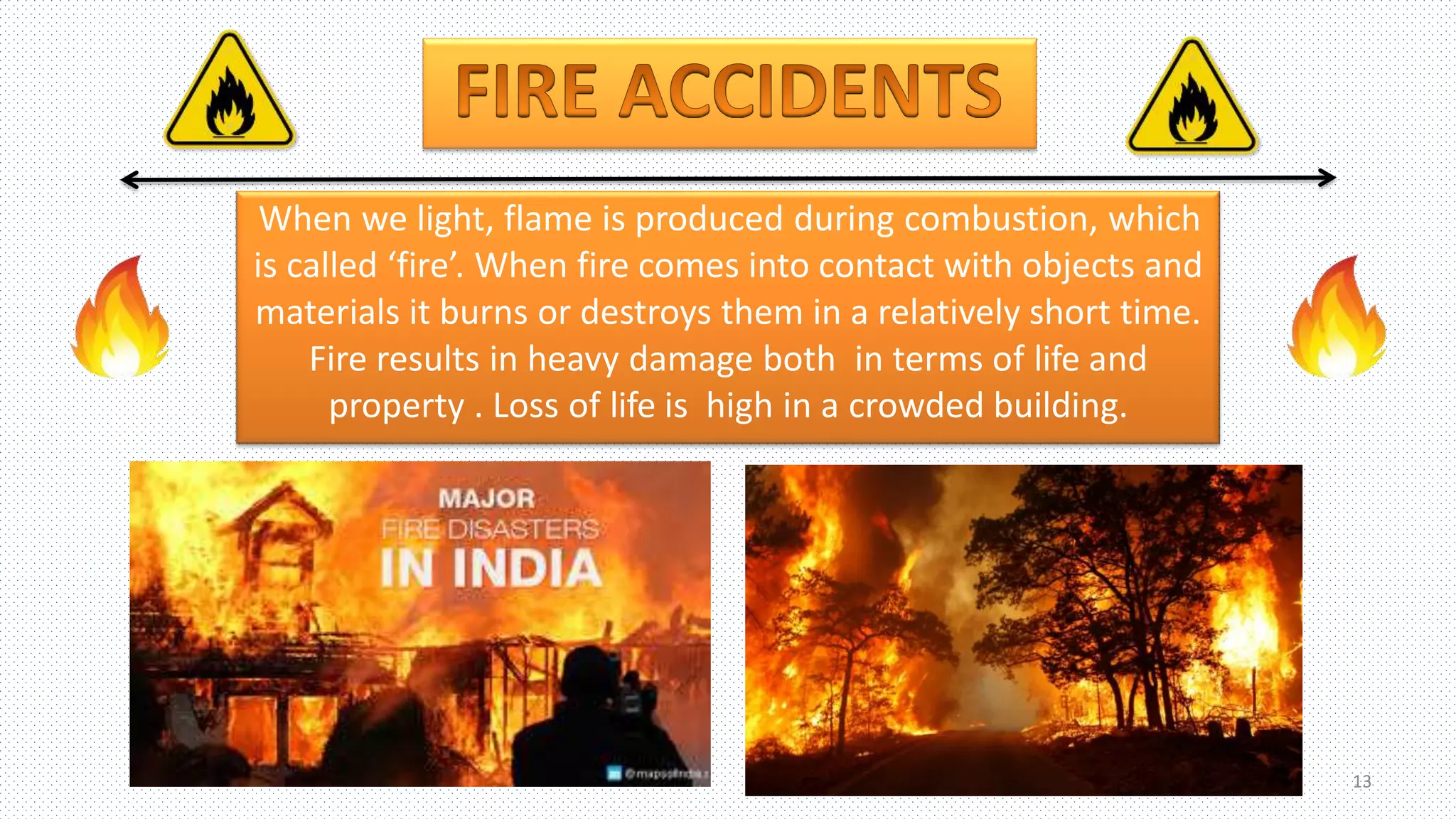
When we light, flame is produced during combustion, which
is called ‘fire’. When fire comes into contact with objects and
materials it burns or destroys them in a relatively short time.
Fire results in heavy damage both in terms of life and
property . Loss of life is high in a crowded building.
13
• Fires can be extinguished if any one or more of the 3 main
constituents are removed from the scene of fire. The main
reason is - poor wiring and faulty electrical equipment , leaking
gas or carelessly thrown cigarettes and matches. Wire should be
properly covered. Inflammable things should be kept out of
reach of children. Power points shouldn’t be overloaded. Be
prepared to extinguish the fire if it becomes a nuisance.
14
Terrorism is defined as an act that is violent or
dangerous to human life, with the intent of
furthering political or social objectives.
Terrorism is, in the broadest sense, the use of
intentional violence for political or religious
purposes.
Effects:
Loss of property, effect on productivity and
tourism, also the living condition of the population.
Destabilization of an existing government, effect on
financial market.
United Airlines Flight 175 hits the South Tower of
the World Trade Center during the September 11
attacks of 2001 in New York City
General Napoléon Bonaparte quelling the October 5,
1795 royalist rebellion in Paris, in front of the Église
Saint-Roch, Saint-Honoré Street, paving the way
for Directory government.
15
Primary prevention is education. Creating awareness among
people against terrorism. Increasing security around the
nation. The one and only strength against terrorism is unity of
people. We must stay away from any suspicious things and
inform police about that. Do not accept packages from
strangers. By protecting and mobilizing civil society. By
eliminating the root of terrorism.
PRECAUTIONS
16
Ecological Disaster
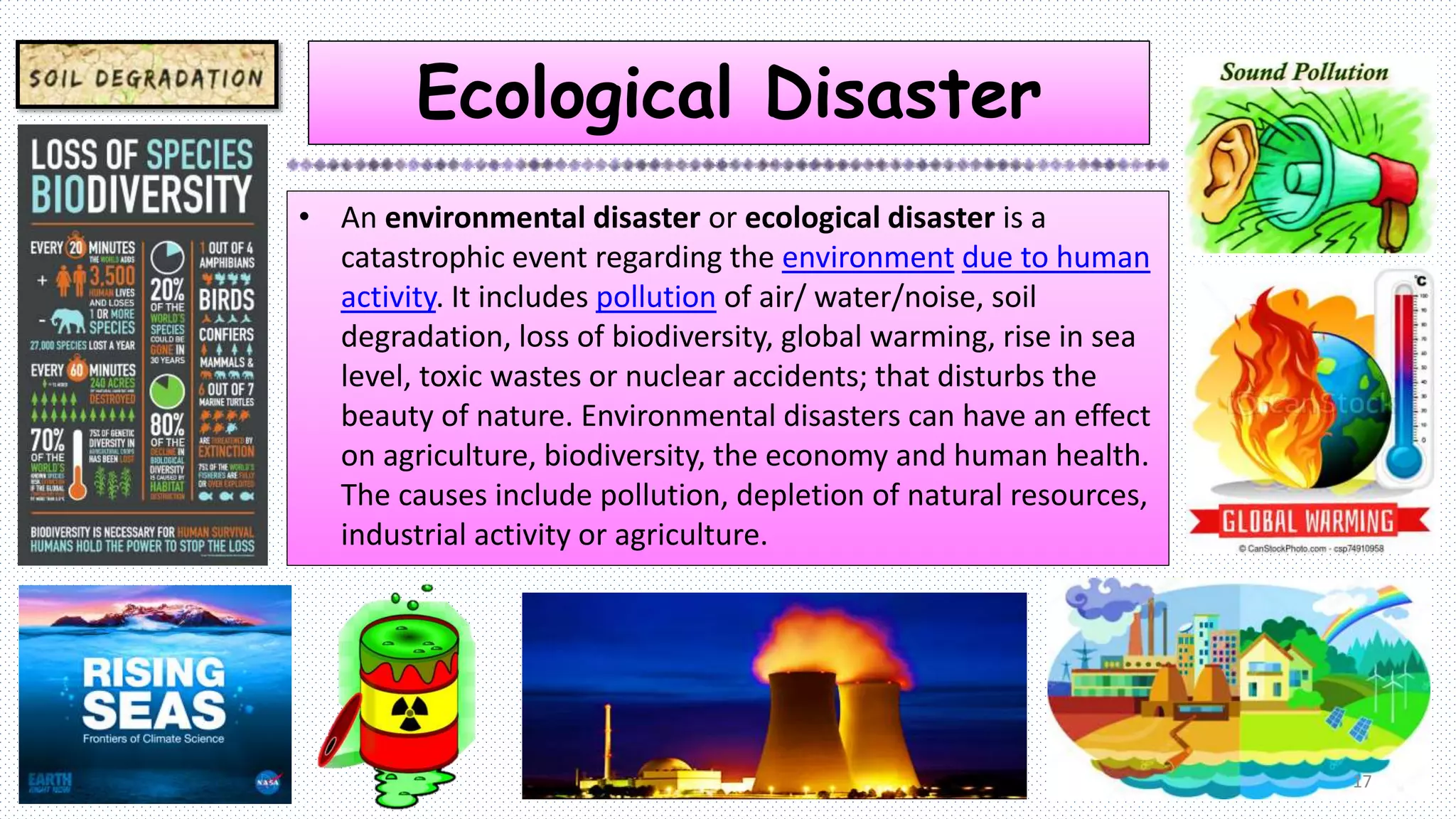
• An environmental disaster or ecological disaster is a
catastrophic event regarding the environment due to human
activity. It includes pollution of air/ water/noise, soil
degradation, loss of biodiversity, global warming, rise in sea
level, toxic wastes or nuclear accidents; that disturbs the
beauty of nature. Environmental disasters can have an effect
on agriculture, biodiversity, the economy and human health.
The causes include pollution, depletion of natural resources,
industrial activity or agriculture.
17
Precaution
Say No to
REDUCEREDUCE
Stay away from
List Of Environmental Disasters.
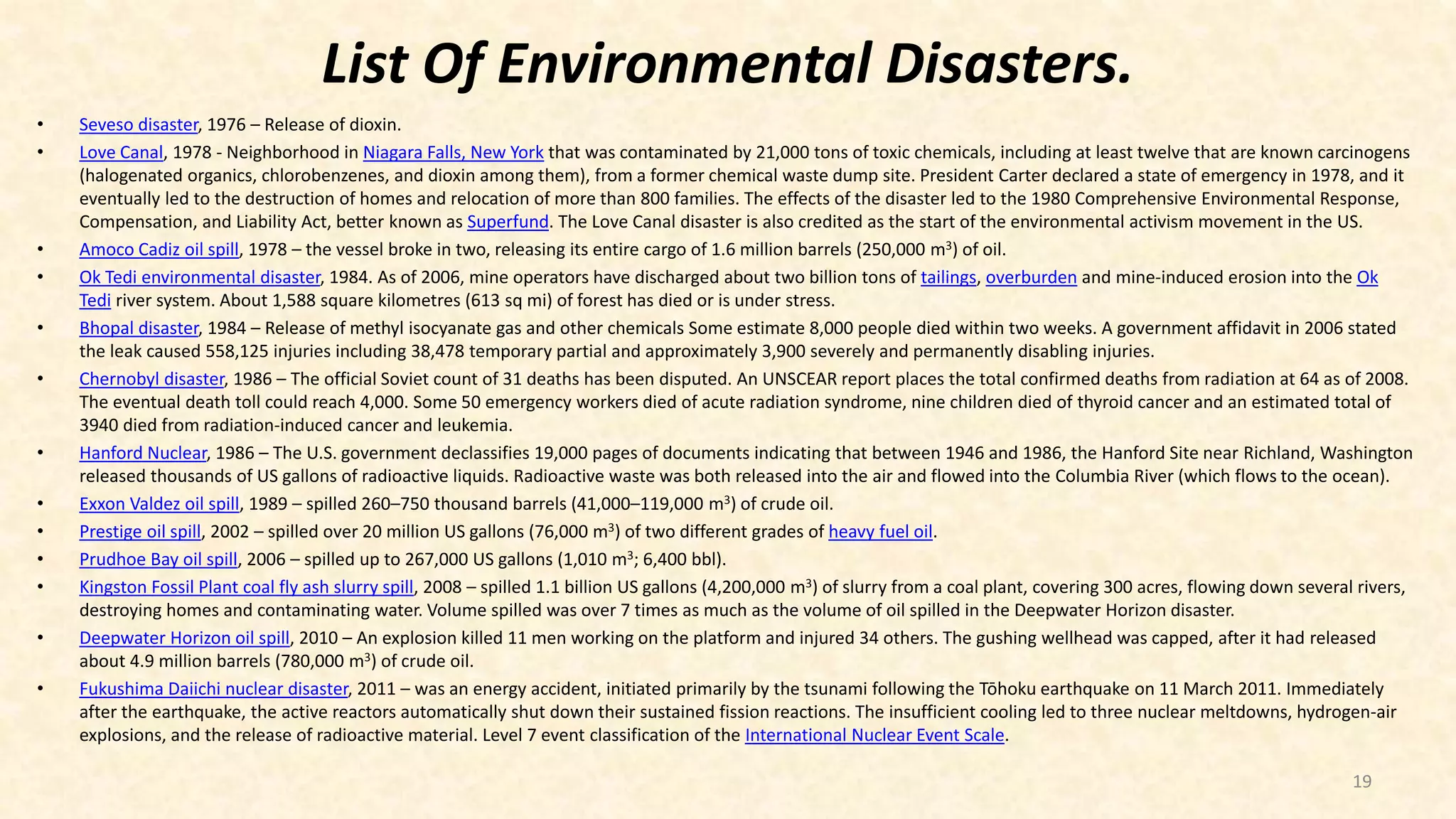
• Seveso disaster, 1976 – Release of dioxin.
• Love Canal, 1978 - Neighborhood in Niagara Falls, New York that was contaminated by 21,000 tons of toxic chemicals, including at least twelve that are known carcinogens
(halogenated organics, chlorobenzenes, and dioxin among them), from a former chemical waste dump site. President Carter declared a state of emergency in 1978, and it
eventually led to the destruction of homes and relocation of more than 800 families. The effects of the disaster led to the 1980 Comprehensive Environmental Response,
Compensation, and Liability Act, better known as Superfund. The Love Canal disaster is also credited as the start of the environmental activism movement in the US.
• Amoco Cadiz oil spill, 1978 – the vessel broke in two, releasing its entire cargo of 1.6 million barrels (250,000 m3) of oil.
• Ok Tedi environmental disaster, 1984. As of 2006, mine operators have discharged about two billion tons of tailings, overburden and mine-induced erosion into the Ok
Tedi river system. About 1,588 square kilometres (613 sq mi) of forest has died or is under stress.
• Bhopal disaster, 1984 – Release of methyl isocyanate gas and other chemicals Some estimate 8,000 people died within two weeks. A government affidavit in 2006 stated
the leak caused 558,125 injuries including 38,478 temporary partial and approximately 3,900 severely and permanently disabling injuries.
• Chernobyl disaster, 1986 – The official Soviet count of 31 deaths has been disputed. An UNSCEAR report places the total confirmed deaths from radiation at 64 as of 2008.
The eventual death toll could reach 4,000. Some 50 emergency workers died of acute radiation syndrome, nine children died of thyroid cancer and an estimated total of
3940 died from radiation-induced cancer and leukemia.
• Hanford Nuclear, 1986 – The U.S. government declassifies 19,000 pages of documents indicating that between 1946 and 1986, the Hanford Site near Richland, Washington
released thousands of US gallons of radioactive liquids. Radioactive waste was both released into the air and flowed into the Columbia River (which flows to the ocean).
• Exxon Valdez oil spill, 1989 – spilled 260–750 thousand barrels (41,000–119,000 m3) of crude oil.
• Prestige oil spill, 2002 – spilled over 20 million US gallons (76,000 m3) of two different grades of heavy fuel oil.
• Prudhoe Bay oil spill, 2006 – spilled up to 267,000 US gallons (1,010 m3; 6,400 bbl).
• Kingston Fossil Plant coal fly ash slurry spill, 2008 – spilled 1.1 billion US gallons (4,200,000 m3) of slurry from a coal plant, covering 300 acres, flowing down several rivers,
destroying homes and contaminating water. Volume spilled was over 7 times as much as the volume of oil spilled in the Deepwater Horizon disaster.
• Deepwater Horizon oil spill, 2010 – An explosion killed 11 men working on the platform and injured 34 others. The gushing wellhead was capped, after it had released
about 4.9 million barrels (780,000 m3) of crude oil.
• Fukushima Daiichi nuclear disaster, 2011 – was an energy accident, initiated primarily by the tsunami following the Tōhoku earthquake on 11 March 2011. Immediately
after the earthquake, the active reactors automatically shut down their sustained fission reactions. The insufficient cooling led to three nuclear meltdowns, hydrogen-air
explosions, and the release of radioactive material. Level 7 event classification of the International Nuclear Event Scale.
19
It is important to understand man made disasters now
that they can cause irreversible damage, and it is in
fact ourselves who are causing these disasters
because of our ignorance and some even being caused
by intent. Without a doubt we have kept making
terrible mistakes over the years, which is why it is
time we take awareness and become more cautious so
that we can care for our world and lower the rate of
man made disasters. “Remember: when disaster
strikes, the time to prepare has passed!” - Seteven Cyros
Thank You!
20
21

Man Made Disasters

  • 1.
    MAN-MADE DISASTERS & MITIGATIONSTRATEGIES Prepared by VIVEK RANJAN SAHOO Standard IX A Roll no. 60 DAV Public School, mcl, Ja, Dera, Talcher 1
  • 2.
    CONTENTS • Introduction :Disaster • Classification of disasters  Man-made Disasters: i. Nuclear Accidents ii. Biological Disasters iii. Chemical Disaster iv. Fire Accidents v. Terrorists Activities vi. Ecological Disasters • Conclusion D : Detection I : Incident S : Safety and Security A : Assess Hazards S : Support T : Triage and Treatment E : Evacuation R : Recovery 2 Welcome
  • 3.
  • 4.
    “The termdisaster iscommonly used to denote any odd event natural or man-made which brings about immense misery to a region and it becomes difficult to cope with the situation through local resources.” The word disaster is derived from Middle French désastre and that from Old Italian disastro, which in turn comes from the Ancient Greek pejorative prefix δυσ-, (dus-) "bad" and ἀστήρ (aster), "star". The root of the word disaster ("bad star" in Greek) comes from an astrological sense of a calamity blamed on the position of planets. 4
  • 5.
    Disasters can beclassified based on nature of onset (rapid/ slow), natural and manmade disasters as under:- (a) NATURAL DISASTER i. Wind Related - Storm, Cyclone, Tornado, Storm surge and Tidal waves. ii. Water Related - Flood, Cloudburst, Flash flood, Excessive rains and Drought. iii. Earth Related - Earthquake, Tsunamis, Avalanches, Landslides and Volcanic eruptions. (b) MAN MADE DISASTERS i. Accidents. Road, Rail, Air, Sea and Building collapse. ii. Industrial Mishaps. Gas Leak, explosion, sabotage and safety breach. iii. Fire. Building, Coal and Oil. iv. Forest Fire. In tropical countries forest fires are often manmade. v. Contamination/Poisoning. Food, water, illicit-liquor and epidemics. vi. Terrorists Activities. vii. Ecological Pollution (air, water, noise), soil degradation, loss of biodiversity, global warming, sea level rise, toxic wastes and nuclear accidents. viii.Warfare. Conventional, chemical and nuclear. Classification of Disasters 5
  • 6.
    Manmade disasters arehazards whichare due to human negligence. Manmade hazards are associatedwithindustries or energy generation facilities and include stampedes, fires, transport accidents, industrial accidents, oil spills, terrorist attacks, nuclearexplosions/nuclear radiation etc. The list of hazards is very long. Many occur frequently whileothers take place occasionally. As with natural hazards, man made hazards are events that have not happened, for instance terrorism. Man made disasters are examples of specific cases where manmade hazards have become reality in an event. MAN-MADE DISASTERS 6
  • 7.
    It is atype of explosion deriving its force from nuclear reactions of fission and fusion .It is an event that has led to significant consequences to people, the environment or the facility. Examples include lethal effects to individuals, large radioactive release in the environment or reactor core melt. Effects :- 2011 Fukushima Daiichi Accident 1986 Chernobyl accident NUCLEAR ACCIDENTS 7
  • 8.
    Precautions from nuclearaccident • Common indicators of these disasters are vomiting, nausea, dizziness etc. Don’t look at fire as it causes instant blindness. Close all doors and windows as radioactivity doesn’t penetrate into solid structures. Cover all food and water and listen govt. orders. Technical measures need to be adopted to reduce the risk of accidents or to minimize the amount of radio- activity released to the environment. 8
  • 9.
    BIOLOGICAL DISASTERS The devastatingeffects caused by an enormous spread of a certain kind of living organism that may spread disease, viruses or infestation of plant, animal or insect life on an epidemic or pandemic level. Indicates a disaster that affects a much larger region, sometimes an entire continent or even the whole planet. For example, the recent Swine Flu or COVID-19 pandemic. 9
  • 10.
    Safe Water supplyand proper maintenance of sewage pipeline will go a long way in the prevention of biological disasters and epidemics of waterborne origin such as cholera, hepatitis, diarrhea and dysentery. Personal hygiene Necessary awareness will be created in the community about the importance of personal hygiene, and measures to achieve this, including provision of washing, cleaning and bathing facilities, and avoiding overcrowding in sleeping quarters,Vector Control etc. 10
  • 11.
    A chemical disasteris the unintentional release of one or more hazardous substances which could harm human health and the environment. Such events include fires, explosions, leakages or release of toxic or hazardous materials that can cause people illness, injury, or disability. Chemical Disaster can cause immediate health effects like eye irritation, skin burns, poisoning. The long term health effects of chemical disaster could be development of asthma, allergies; negatively affects the mental, physical and intellectual development of children; weakening of the immune system, birth defects, cancer etc. CHEMICAL DISASTER 11
  • 12.
    Prevention of chemicaldisaster is to eliminate the possibility of chemical accidents and thereby preventing its harmful effects. Some of the preventive measures that can be deployed are through making use of in-built safety measures, wearing hand gloves and eye protection-safety glasses and safety goggles, fume hood usage, having standard operating procedures (SOP), 12 PRECAUTIONS
  • 13.
    When we light,flame is produced during combustion, which is called ‘fire’. When fire comes into contact with objects and materials it burns or destroys them in a relatively short time. Fire results in heavy damage both in terms of life and property . Loss of life is high in a crowded building. 13
  • 14.
    • Fires canbe extinguished if any one or more of the 3 main constituents are removed from the scene of fire. The main reason is - poor wiring and faulty electrical equipment , leaking gas or carelessly thrown cigarettes and matches. Wire should be properly covered. Inflammable things should be kept out of reach of children. Power points shouldn’t be overloaded. Be prepared to extinguish the fire if it becomes a nuisance. 14
  • 15.
    Terrorism is definedas an act that is violent or dangerous to human life, with the intent of furthering political or social objectives. Terrorism is, in the broadest sense, the use of intentional violence for political or religious purposes. Effects: Loss of property, effect on productivity and tourism, also the living condition of the population. Destabilization of an existing government, effect on financial market. United Airlines Flight 175 hits the South Tower of the World Trade Center during the September 11 attacks of 2001 in New York City General Napoléon Bonaparte quelling the October 5, 1795 royalist rebellion in Paris, in front of the Église Saint-Roch, Saint-Honoré Street, paving the way for Directory government. 15
  • 16.
    Primary prevention iseducation. Creating awareness among people against terrorism. Increasing security around the nation. The one and only strength against terrorism is unity of people. We must stay away from any suspicious things and inform police about that. Do not accept packages from strangers. By protecting and mobilizing civil society. By eliminating the root of terrorism. PRECAUTIONS 16
  • 17.
    Ecological Disaster • Anenvironmental disaster or ecological disaster is a catastrophic event regarding the environment due to human activity. It includes pollution of air/ water/noise, soil degradation, loss of biodiversity, global warming, rise in sea level, toxic wastes or nuclear accidents; that disturbs the beauty of nature. Environmental disasters can have an effect on agriculture, biodiversity, the economy and human health. The causes include pollution, depletion of natural resources, industrial activity or agriculture. 17
  • 18.
  • 19.
    List Of EnvironmentalDisasters. • Seveso disaster, 1976 – Release of dioxin. • Love Canal, 1978 - Neighborhood in Niagara Falls, New York that was contaminated by 21,000 tons of toxic chemicals, including at least twelve that are known carcinogens (halogenated organics, chlorobenzenes, and dioxin among them), from a former chemical waste dump site. President Carter declared a state of emergency in 1978, and it eventually led to the destruction of homes and relocation of more than 800 families. The effects of the disaster led to the 1980 Comprehensive Environmental Response, Compensation, and Liability Act, better known as Superfund. The Love Canal disaster is also credited as the start of the environmental activism movement in the US. • Amoco Cadiz oil spill, 1978 – the vessel broke in two, releasing its entire cargo of 1.6 million barrels (250,000 m3) of oil. • Ok Tedi environmental disaster, 1984. As of 2006, mine operators have discharged about two billion tons of tailings, overburden and mine-induced erosion into the Ok Tedi river system. About 1,588 square kilometres (613 sq mi) of forest has died or is under stress. • Bhopal disaster, 1984 – Release of methyl isocyanate gas and other chemicals Some estimate 8,000 people died within two weeks. A government affidavit in 2006 stated the leak caused 558,125 injuries including 38,478 temporary partial and approximately 3,900 severely and permanently disabling injuries. • Chernobyl disaster, 1986 – The official Soviet count of 31 deaths has been disputed. An UNSCEAR report places the total confirmed deaths from radiation at 64 as of 2008. The eventual death toll could reach 4,000. Some 50 emergency workers died of acute radiation syndrome, nine children died of thyroid cancer and an estimated total of 3940 died from radiation-induced cancer and leukemia. • Hanford Nuclear, 1986 – The U.S. government declassifies 19,000 pages of documents indicating that between 1946 and 1986, the Hanford Site near Richland, Washington released thousands of US gallons of radioactive liquids. Radioactive waste was both released into the air and flowed into the Columbia River (which flows to the ocean). • Exxon Valdez oil spill, 1989 – spilled 260–750 thousand barrels (41,000–119,000 m3) of crude oil. • Prestige oil spill, 2002 – spilled over 20 million US gallons (76,000 m3) of two different grades of heavy fuel oil. • Prudhoe Bay oil spill, 2006 – spilled up to 267,000 US gallons (1,010 m3; 6,400 bbl). • Kingston Fossil Plant coal fly ash slurry spill, 2008 – spilled 1.1 billion US gallons (4,200,000 m3) of slurry from a coal plant, covering 300 acres, flowing down several rivers, destroying homes and contaminating water. Volume spilled was over 7 times as much as the volume of oil spilled in the Deepwater Horizon disaster. • Deepwater Horizon oil spill, 2010 – An explosion killed 11 men working on the platform and injured 34 others. The gushing wellhead was capped, after it had released about 4.9 million barrels (780,000 m3) of crude oil. • Fukushima Daiichi nuclear disaster, 2011 – was an energy accident, initiated primarily by the tsunami following the Tōhoku earthquake on 11 March 2011. Immediately after the earthquake, the active reactors automatically shut down their sustained fission reactions. The insufficient cooling led to three nuclear meltdowns, hydrogen-air explosions, and the release of radioactive material. Level 7 event classification of the International Nuclear Event Scale. 19
  • 20.
    It is importantto understand man made disasters now that they can cause irreversible damage, and it is in fact ourselves who are causing these disasters because of our ignorance and some even being caused by intent. Without a doubt we have kept making terrible mistakes over the years, which is why it is time we take awareness and become more cautious so that we can care for our world and lower the rate of man made disasters. “Remember: when disaster strikes, the time to prepare has passed!” - Seteven Cyros Thank You! 20
  • 21.