8.5 
Polar Equations 
of Conics 
Copyright © 2011 Pearson, Inc.
What you’ll learn about 
 Eccentricity Revisited 
 Writing Polar Equations for Conics 
 Analyzing Polar Equations of Conics 
 Orbits Revisited 
… and why 
You will learn the approach to conics used by 
astronomers. 
Copyright © 2011 Pearson, Inc. Slide 8.5 - 2
Focus-Directrix Definition Conic 
Section 
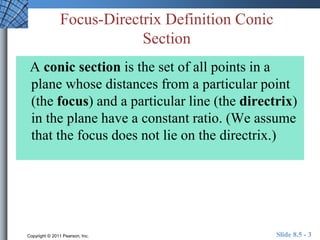
A conic section is the set of all points in a 
plane whose distances from a particular point 
(the focus) and a particular line (the directrix) 
in the plane have a constant ratio. (We assume 
that the focus does not lie on the directrix.) 
Copyright © 2011 Pearson, Inc. Slide 8.5 - 3
Focus-Directrix Eccentricity 
Relationship 
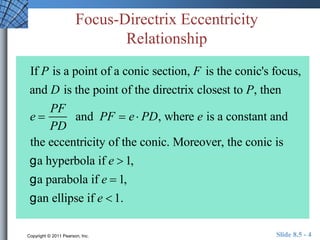
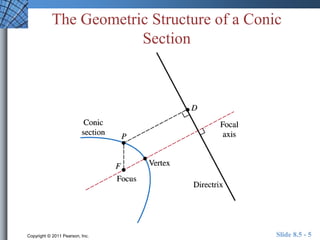
If P is a point of a conic section, F is the conic's focus, 
and D is the point of the directrix closest to P, then 
e  
PF 
PD 
and PF  e  PD, where e is a constant and 
the eccentricity of the conic. Moreover, the conic is 
g a hyperbola if e  1, 
g a parabola if e  1, 
g an ellipse if e  1. 
Copyright © 2011 Pearson, Inc. Slide 8.5 - 4
The Geometric Structure of a Conic 
Section 
Copyright © 2011 Pearson, Inc. Slide 8.5 - 5
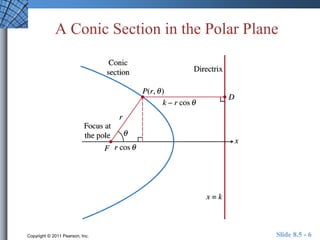
A Conic Section in the Polar Plane 
Copyright © 2011 Pearson, Inc. Slide 8.5 - 6
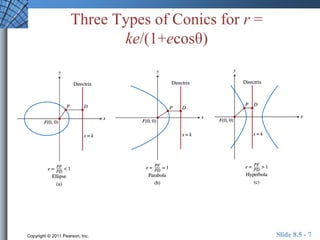
Three Types of Conics for r = 
ke/(1+ecosθ) 
Copyright © 2011 Pearson, Inc. Slide 8.5 - 7
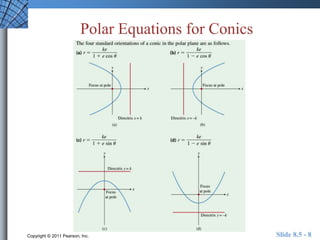
Polar Equations for Conics 
Copyright © 2011 Pearson, Inc. Slide 8.5 - 8
Example Writing Polar Equations of 
Conics 
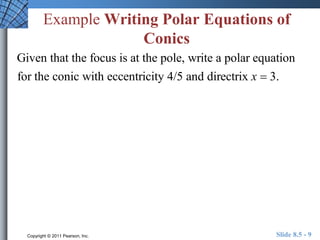
Given that the focus is at the pole, write a polar equation 
for the conic with eccentricity 4/5 and directrix x  3. 
Copyright © 2011 Pearson, Inc. Slide 8.5 - 9
Example Writing Polar Equations of 
Conics 
Given that the focus is at the pole, write a polar equation 
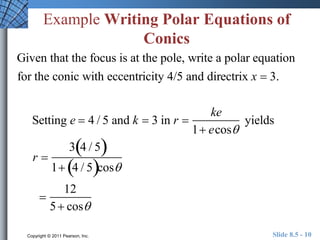
for the conic with eccentricity 4/5 and directrix x  3. 
Setting e  4 / 5 and k  3 in r  
ke 
1 ecos 
yields 
r  
34 / 5 
1 4 / 5cos 
 
12 
5  cos 
Copyright © 2011 Pearson, Inc. Slide 8.5 - 10
Example Identifying Conics from 
Their Polar Equations 
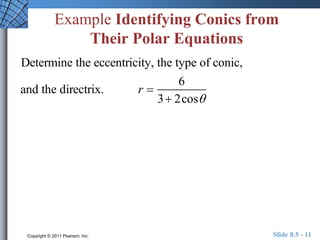
Determine the eccentricity, the type of conic, 
and the directrix. r  
6 
3 2cos 
Copyright © 2011 Pearson, Inc. Slide 8.5 - 11
Example Identifying Conics from 
Their Polar Equations 
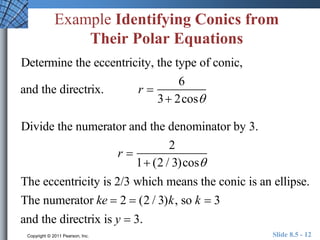
Determine the eccentricity, the type of conic, 
and the directrix. r  
6 
3 2cos 
Divide the numerator and the denominator by 3. 
r  
2 
1 (2 / 3)cos 
The eccentricity is 2/3 which means the conic is an ellipse. 
The numerator ke  2  (2 / 3)k, so k  3 
and the directrix is y  3. 
Copyright © 2011 Pearson, Inc. Slide 8.5 - 12
Example Analyzing a Conic 
Analyze the conic section given by the equation 
r  
6 
3 2cos 
Include in the analysis the values of e, a, b, and c. 
Copyright © 2011 Pearson, Inc. Slide 8.5 - 13
Example Analyzing a Conic 
r  
6 
3 2cos 
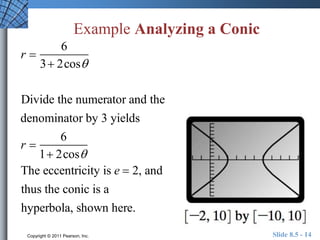
Divide the numerator and the 
denominator by 3 yields 
r  
6 
1 2cos 
The eccentricity is e  2, and 
thus the conic is a 
hyperbola, shown here. 
Copyright © 2011 Pearson, Inc. Slide 8.5 - 14
Example Analyzing a Conic 
r  
6 
3 2cos 
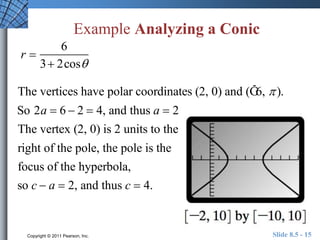
The vertices have polar coordinates (2, 0) and (Ğ6,  ). 
So 2a  6  2  4, and thus a  2 
The vertex (2, 0) is 2 units to the 
right of the pole, the pole is the 
focus of the hyperbola, 
so c  a  2, and thus c  4. 
Copyright © 2011 Pearson, Inc. Slide 8.5 - 15
Example Analyzing a Conic 
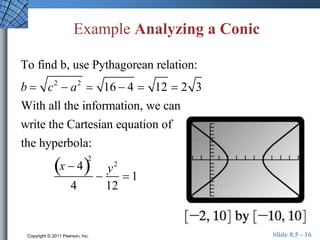
To find b, use Pythagorean relation: 
b  c2  a2  16  4  12  2 3 
With all the information, we can 
write the Cartesian equation of 
the hyperbola: 
x  42 
4 
 
y2 
12 
 1 
Copyright © 2011 Pearson, Inc. Slide 8.5 - 16
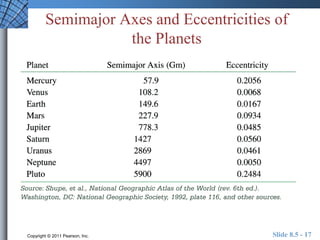
Semimajor Axes and Eccentricities of 
the Planets 
Copyright © 2011 Pearson, Inc. Slide 8.5 - 17
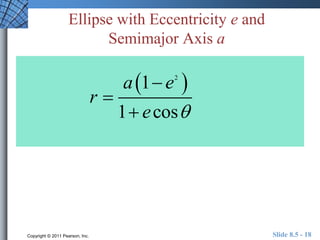
Ellipse with Eccentricity e and 
Semimajor Axis a 
  2 1 
a  
e 
e  
1 cos 
r 
 
 
Copyright © 2011 Pearson, Inc. Slide 8.5 - 18
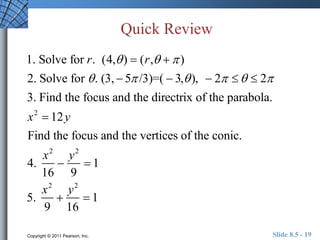
Quick Review 
1. Solve for r. (4, )  (r,   ) 
2. Solve for  . (3,  5 /3)=(  3, ),  2    2 
3. Find the focus and the directrix of the parabola. 
x2  12y 
Find the focus and the vertices of the conic. 
4. 
x2 
16 
 
y2 
9 
 1 
5. 
x2 
9 
 
y2 
16 
 1 
Copyright © 2011 Pearson, Inc. Slide 8.5 - 19
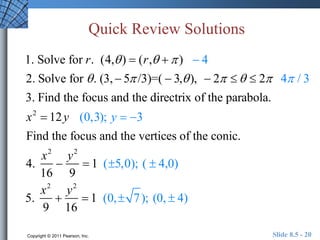
Quick Review Solutions 
1. Solve for r. (4, )  (r,   )  4 
2. Solve for  . (3,  5 /3)=(  3, ),  2    2 4 / 3 
3. Find the focus and the directrix of the parabola. 
x2  12y (0,3); y  3 
Find the focus and the vertices of the conic. 
4. 
x2 
16 
 
y2 
9 
 1 (5,0); (  4,0) 
5. 
x2 
9 
 
y2 
16 
 1 (0,  7); (0,  4) 
Copyright © 2011 Pearson, Inc. Slide 8.5 - 20

Unit 8.5

  • 1.
    8.5 Polar Equations of Conics Copyright © 2011 Pearson, Inc.
  • 2.
    What you’ll learnabout  Eccentricity Revisited  Writing Polar Equations for Conics  Analyzing Polar Equations of Conics  Orbits Revisited … and why You will learn the approach to conics used by astronomers. Copyright © 2011 Pearson, Inc. Slide 8.5 - 2
  • 3.
    Focus-Directrix Definition Conic Section A conic section is the set of all points in a plane whose distances from a particular point (the focus) and a particular line (the directrix) in the plane have a constant ratio. (We assume that the focus does not lie on the directrix.) Copyright © 2011 Pearson, Inc. Slide 8.5 - 3
  • 4.
    Focus-Directrix Eccentricity Relationship If P is a point of a conic section, F is the conic's focus, and D is the point of the directrix closest to P, then e  PF PD and PF  e  PD, where e is a constant and the eccentricity of the conic. Moreover, the conic is g a hyperbola if e  1, g a parabola if e  1, g an ellipse if e  1. Copyright © 2011 Pearson, Inc. Slide 8.5 - 4
  • 5.
    The Geometric Structureof a Conic Section Copyright © 2011 Pearson, Inc. Slide 8.5 - 5
  • 6.
    A Conic Sectionin the Polar Plane Copyright © 2011 Pearson, Inc. Slide 8.5 - 6
  • 7.
    Three Types ofConics for r = ke/(1+ecosθ) Copyright © 2011 Pearson, Inc. Slide 8.5 - 7
  • 8.
    Polar Equations forConics Copyright © 2011 Pearson, Inc. Slide 8.5 - 8
  • 9.
    Example Writing PolarEquations of Conics Given that the focus is at the pole, write a polar equation for the conic with eccentricity 4/5 and directrix x  3. Copyright © 2011 Pearson, Inc. Slide 8.5 - 9
  • 10.
    Example Writing PolarEquations of Conics Given that the focus is at the pole, write a polar equation for the conic with eccentricity 4/5 and directrix x  3. Setting e  4 / 5 and k  3 in r  ke 1 ecos yields r  34 / 5 1 4 / 5cos  12 5  cos Copyright © 2011 Pearson, Inc. Slide 8.5 - 10
  • 11.
    Example Identifying Conicsfrom Their Polar Equations Determine the eccentricity, the type of conic, and the directrix. r  6 3 2cos Copyright © 2011 Pearson, Inc. Slide 8.5 - 11
  • 12.
    Example Identifying Conicsfrom Their Polar Equations Determine the eccentricity, the type of conic, and the directrix. r  6 3 2cos Divide the numerator and the denominator by 3. r  2 1 (2 / 3)cos The eccentricity is 2/3 which means the conic is an ellipse. The numerator ke  2  (2 / 3)k, so k  3 and the directrix is y  3. Copyright © 2011 Pearson, Inc. Slide 8.5 - 12
  • 13.
    Example Analyzing aConic Analyze the conic section given by the equation r  6 3 2cos Include in the analysis the values of e, a, b, and c. Copyright © 2011 Pearson, Inc. Slide 8.5 - 13
  • 14.
    Example Analyzing aConic r  6 3 2cos Divide the numerator and the denominator by 3 yields r  6 1 2cos The eccentricity is e  2, and thus the conic is a hyperbola, shown here. Copyright © 2011 Pearson, Inc. Slide 8.5 - 14
  • 15.
    Example Analyzing aConic r  6 3 2cos The vertices have polar coordinates (2, 0) and (Ğ6,  ). So 2a  6  2  4, and thus a  2 The vertex (2, 0) is 2 units to the right of the pole, the pole is the focus of the hyperbola, so c  a  2, and thus c  4. Copyright © 2011 Pearson, Inc. Slide 8.5 - 15
  • 16.
    Example Analyzing aConic To find b, use Pythagorean relation: b  c2  a2  16  4  12  2 3 With all the information, we can write the Cartesian equation of the hyperbola: x  42 4  y2 12  1 Copyright © 2011 Pearson, Inc. Slide 8.5 - 16
  • 17.
    Semimajor Axes andEccentricities of the Planets Copyright © 2011 Pearson, Inc. Slide 8.5 - 17
  • 18.
    Ellipse with Eccentricitye and Semimajor Axis a   2 1 a  e e  1 cos r   Copyright © 2011 Pearson, Inc. Slide 8.5 - 18
  • 19.
    Quick Review 1.Solve for r. (4, )  (r,   ) 2. Solve for  . (3,  5 /3)=(  3, ),  2    2 3. Find the focus and the directrix of the parabola. x2  12y Find the focus and the vertices of the conic. 4. x2 16  y2 9  1 5. x2 9  y2 16  1 Copyright © 2011 Pearson, Inc. Slide 8.5 - 19
  • 20.
    Quick Review Solutions 1. Solve for r. (4, )  (r,   )  4 2. Solve for  . (3,  5 /3)=(  3, ),  2    2 4 / 3 3. Find the focus and the directrix of the parabola. x2  12y (0,3); y  3 Find the focus and the vertices of the conic. 4. x2 16  y2 9  1 (5,0); (  4,0) 5. x2 9  y2 16  1 (0,  7); (0,  4) Copyright © 2011 Pearson, Inc. Slide 8.5 - 20