REVISITING……

Conic Sections
Conic Sections
(1) Circle
A circle is formed when





2

i.e. when the plane  is
perpendicular to the
axis of the cones.
Conic Sections
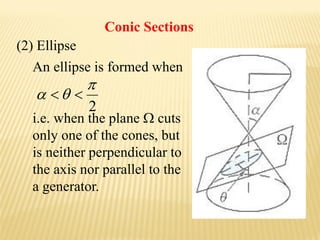
(2) Ellipse
An ellipse is formed when

  



2

i.e. when the plane  cuts
only one of the cones, but
is neither perpendicular to
the axis nor parallel to the
a generator.
Conic Sections
(3) Parabola
A parabola is formed when

 

i.e. when the plane  is
parallel to a generator.
Conic Sections
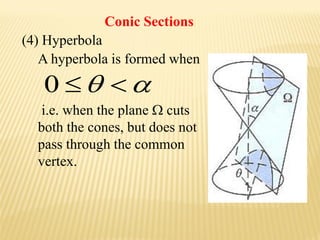
(4) Hyperbola
A hyperbola is formed when

0  

i.e. when the plane  cuts
both the cones, but does not
pass through the common
vertex.
CIRCLE
A circle is the locus of a variable point on a
plane so that its distance (the radius)remains
constant from a fixed point (the centre).
y
P(x,y)


O

x
DIFFERENT FORMS OF EQUATIONS OF CIRCLE


×

The standard equation of circle:
( x  h)2  ( y  k )2  r 2
where (h, k )is the centre of the circle and r is its radius.
The parametric equation of a circle:
x  r cos  ,

×

y  r sin 

The general equation of a circle:
x2  y 2  2 gx  2 fy  c  0

where

( g ,  f )

g2  f 2  c

is the centre of the circle and

is its radius …..
Parabola
A parabola is the locus of a variable point on a
plane so that its distance from a fixed point
(the focus) is equal to its distance from a fixed
line (the directrix x = - a).
y

P(x,y)

M(-a,0)

O

focus F(a,0)

x
Form the definition of parabola,
PF = PN

( x  a)  y  x  a
2

2

( x  a)  y  ( x  a)
2

2

2

x  2ax  a  y  x  2ax  a
2

2

2

2

2

y  4ax
2

standard equation of a parabola
vertex

axis of symmetry

latus rectum (LL’)

mid-point of FM = the origin (O) = vertex

length of the latus rectum =LL`= 4a
Other forms of Parabola

y  4ax
2
Other forms of Parabola

x  4ay
2
Other forms of Parabola

x  4ay
2
12.1 Equations of a Parabola
A parabola is the locus of a variable point P
which moves in a plane so that its distance from
a fixed point F in the plane equals its distance
from a fixed line l in the plane.
The fixed point F is
called the focus and the
fixed line l is called the
directrix.
12.1 Equations of a Parabola

The equation of a parabola with focus
F(a,0) and directrix x + a =0, where a >0,
is y2 = 4ax.
12.1 Equations of a Parabola
X`X is the axis.

O is the vertex.
F is the focus.
MN is the focal chord.
HK is the latus rectum.
DIFFERENT FORMS OF EQUATIONS OF
PARABOLA


The standard equation of parabola:
2
( y  k )  4a( x  h)

k
where F (a, 0) the focus and (h,is)the vertex of
is
parabola.
× The parametric equation of a parabola:

x  at 2 ,
×

y  2at

The general equation of a parabola:
ax2  by 2  2 gx  2 fy  c  0

with either a=0 or b=0 but both not zero at the same
time.
12.4 Equations of an Ellipse
An ellipse is a curve which is the locus of a variable
point which moves in a plane so that the sum of its
distance from two fixed points remains a constant.
The two fixed points are called foci.

P’(x,y)

P’’(x,y)
Let PF1+PF2 = 2a where a > 0

( x  c)  y  ( x  c)  y  2a
2

2

2

2

( x  c)  y  2a  ( x  c)  y
2

2

2

2

( x  c)  y  4a  4a ( x  c)  y  ( x  c)  y
2

2

2

2

2

4a ( x  c) 2  y 2  4cx  4a 2

a ( x  2 xc  c  y )  c x  2a cx  a
2

2

2

2

2

2

2

4

a 2 x 2  2a 2 xc  a 2c 2  a 2 y 2  c 2 x 2  2a 2cx  a 4

2
(a  c ) x  a y  a  a c
2

2

2

2

2

4

2 2

(a  c ) x  a y  a (a  c )
2

2

2

2

Let b  a  c
2

2

2

2

2

2

2

b x a y a b
2

2

2

2

2

2 2

2

x
y
 2 1
2
a
b

standard equation of
an ellipse
12.4 Equations of an Ellipse
major axis = 2a

vertex
lactus rectum
minor axis = 2b
length of semi-major axis = a

length of the semi-minor axis = b
2b 2
length of lactus rectum =
a
12.4 Equations of an Ellipse
AB

major axis

CD

minor axis

A, B, C and D

vertices

O

centre

PQ

focal chord

F

focus

RS, R’S’

latus rectum
12.4 Equations of an Ellipse
Other form of Ellipse
2

2

x
y
 2 1
2
b
a
where a2 – b2 = c2
and a > b > 0
12.4 Equations of an Ellipse
Furthermore,
x2 y2
(1) Given an ellipse 2  2  1, where a  b  0,
a
b
the length of the semi - major axis is a and that
of the semi - minor axis is b.
x2 y2
(2) Given an ellipse 2  2  1, where a  b  0,
b
a
then its foci lie on the y - axis, the length of the
semi - major axis is a and that of the semi - minor
axis is b.
12.4 Equations of an Ellipse
( x  h) ( y  k )
(3) The equation

 1, represent an
2
2
a
b
ellipse whose centre is at (h, k ) and whose axes are
2

2

parallel to the coordinate axes.
y

( x  h) 2 ( y  k ) 2

1
2
2
a
b

(h, k)

O

x
DIFFERENT FORMS OF EQUATIONS OF ELLIPSE


The standard equation of ellipse:

x2 y 2
 2  1, a  b and c 2  a 2  b2
2
a b
where F (c, 0) the foci of the ellipse.
are
×

The parametric equation of an ellipse:
x  a cos  ,

y  b sin 
12.7 Equations of a Hyperbola
A hyperbola is a curve which is the locus of a variable
point which moves in a plane so that the difference of
its distance from two points remains a constant. The
two fixed points are called foci.

P’(x,y)
Let |PF1-PF2| = 2a where a > 0

| ( x  c)  y  ( x  c)  y | 2a
2

2

2

2

( x  c)  y  2a  ( x  c)  y
2

2

2

2

( x  c)  y  4a  4a ( x  c)  y  ( x  c)  y
2

2

2

2

2

 4a ( x  c) 2  y 2  4cx  4a 2

a ( x  2 xc  c  y )  c x  2a cx  a
2

2

2

2

2

2

2

4

a 2 x 2  2a 2 xc  a 2c 2  a 2 y 2  c 2 x 2  2a 2cx  a 4

2
(c  a ) x  a y  a c  a
2

2

2

2

2

2 2

4

(c  a ) x  a y  a (c  a )
2

2

2

2

Let b  c  a
2

2

2

2

2

2

2

b x a y  a b
2

2

2

2

2

2 2

2

x
y
 2 1
2
a
b

standard equation of
a hyperbola
transverse axis
vertex

lactus rectum

conjugate axis

2b 2
length of lactus rectum =
a
length of the semi-transverse axis = a
length of the semi-conjugate axis = b
12.7 Equations of a Hyperbola
A1, A2 vertices
A1A2

transverse axis

YY’

conjugate axis

O

centre

GH

focal chord

CD

lactus rectum
12.7 Equations of a Hyperbola
asymptote

b
equation of asymptote : y   x
a
12.7 Equations of a Hyperbola
Other form of Hyperbola :
2

2

y
x
 2 1
2
a
b
Rectangular Hyperbola
If b = a, then
2

2

x
y
 2 1
2
a
b
2

2

y
x
 2 1
2
a
b

x y a
2

2

2

y x a
2

2

2

The hyperbola is said to be rectangular hyperbola.
equation of asymptote :

x y 0
12.7 Equations of a Hyperbola
Properties of a hyperbola :
( x - h) 2 ( y - k ) 2
(1) The equation

 1 represents a
2
2
a
b
hyperbola with centre at (h, k ), transverse axis
parallel to the x - axis.
( x - h) 2 ( y - k ) 2
(2) The equation 
 1 represents a
2
2
a
b
hyperbola with centre at (h, k ), transverse axis
parallel to the y - axis.
12.7 Equations of a Hyperbola
Parametric form of a hyperbola :

 x  a sec 

 y  b tan 
where  is a parameter.
 the point (a sec  , b tan  ) lies on the
2

2

x
y
hyperbola 2  2  1.
a
b
12.8 Asymptotes of a Hyperbola

2

2

x
y
The hyperbola 2  2  1, where a, b
a
b
are positive constants, has two asymptotes
x y
  0.
a b
12.8 Asymptotes of a Hyperbola
Properties of asymptotes to a hyperbola :
x2 y2
(1) The hyperbola - 2  2  1 has two asymptotes
a
b
x y
   0.
a b
( x  h) 2 ( y  k ) 2
(2) The hyperbola

 1 has two
2
2
a
b
xh yk
asymptotes

 0.
a
b
12.8 Asymptotes of a Hyperbola
Properties of asymptotes to a hyperbola :
( x  h) ( y  k )
(3) The hyperbola 

 1 has two
2
2
a
b
xh yk
asymptotes 

 0.
a
b
2

2
Simple Parametric Equations and Locus Problems

x = f(t)

y = g(t)

parametric equations

parameter
Combine the two parametric equations into
one equation which is independent of t.
Then sketch the locus of the equation.
Equation of Tangents to Conics
general equation of conics :

Ax  Bxy  Cy  Dx  Ey  F  0
2

2

Steps :
dy
(1) Differentiate the implicit equation to find .
dx
dy
(2) Put the given contact point (x1, y1) into
dx

to find out the slope of tangent at that point.

(3) Find the equation of the tangent at that point.
THE GENERAL EQUATION OF SECOND DEGREE
Ax 2  By 2  Gx  Fy  C  0


Case I: IfA  B  0, the equation represents a circle with centre
G
F
G
(
,
at 2 A 2 A )
and radius 4 A  4FA  C
A
Case II: If A  Band both have the same sign, the equation
represents the standard equation of an ellipse in XY-coordinate
G
F
X  x
and Y  y 
system, where
2A
2B
Case III: If A  B and both have opposite signs, the equation
represents the standard equation of hyperbola in XY-coordinate
G
F
system, where X  x  2 A and Y  y  2( B)
Case IV: If A  0 or B  0 ,the equation represents the standard
equation of parabola in XY- coordinate system, where
2

2







2

2

G
C
G2
X  x
and Y  y  
2A
F 4 AF
THE DISCRIMINANT TEST
With the understanding that occasional
degenerate cases may arise, the quadratic
curve Ax2  Bxy  Cy 2  Dx  Ey  F  0 is
2
 a parabola, if B  4 AC  0
2
 an ellipse, if B  4 AC  0
2
 a hyperbola, if B  4 AC  0

CLASSIFYING CONIC SECTION BY ECCENTRICITY








In both ellipse and hyperbola, the eccentricity is the ratio of the
distance between the foci to the distance between the vertices.
Suppose the distance PF of a point P from a fixed point F (the
focus)is a constant multiple of its distance from a fixed line (the
directrix).i.e. PF  e.PD where e is the constant of
,
proportionality. Then the path traced by P is

(a). a parabola if e  1
(b). an ellipse of eccentricity e if e  1
(c). a hyperbola of eccentricity e if e  1
Conics

Parabola

Ellipse

Hyperbola

PF = PN

PF1 + PF2 = 2a

| PF1 - PF2 | = 2a

Graph

Definitio
n
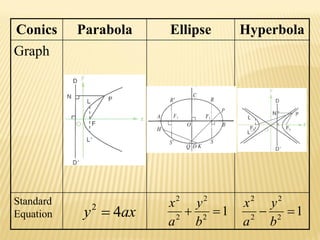
Conics

Parabola

Ellipse

Hyperbola

x2 y2
 2 1
2
a
b

x2 y2
 2 1
2
a
b

Graph

Standard
Equation

y  4ax
2
Conics

Parabola

Ellipse

Hyperbola

x = -a

a
x  , e  PF1
e
PN

a
PF1
x  ,e
PN
e

Graph

Directrix
Conics

Parabola

Ellipse

Hyperbola

Graph

Vertices

(0,0)

A(-a,0), B(a,0),
C(0,b), D(0,-b)

A1(a,0), A2(-a,0)
Conics

Parabola

Ellipse

Hyperbola

major axis = AB
minor axis =CD

transverse axis =A1A2
conjugate axis =B1B2
where B1(0,b), B2(0,-b)

Graph

Axes

axis of
parabola = the
x-axis
Conics

Parabola

Ellipse

Hyperbola

4a

2b 2
a

2b 2
a

Graph

Length of
lantus
rectum LL`
Conics

Parabola

Ellipse

Hyperbola

----

----

b
y x
a

Graph

Asymptotes
Conics

Parabola

Ellipse

Hyperbola

Graph

Parametric
representation
of P

2

(at ,2at )

(a cos  , b sin  ) (a sec , b tan )

Conic sections

  • 1.
  • 2.
    Conic Sections (1) Circle Acircle is formed when   2 i.e. when the plane  is perpendicular to the axis of the cones.
  • 3.
    Conic Sections (2) Ellipse Anellipse is formed when     2 i.e. when the plane  cuts only one of the cones, but is neither perpendicular to the axis nor parallel to the a generator.
  • 4.
    Conic Sections (3) Parabola Aparabola is formed when   i.e. when the plane  is parallel to a generator.
  • 5.
    Conic Sections (4) Hyperbola Ahyperbola is formed when 0   i.e. when the plane  cuts both the cones, but does not pass through the common vertex.
  • 6.
    CIRCLE A circle isthe locus of a variable point on a plane so that its distance (the radius)remains constant from a fixed point (the centre). y P(x,y)  O x
  • 7.
    DIFFERENT FORMS OFEQUATIONS OF CIRCLE  × The standard equation of circle: ( x  h)2  ( y  k )2  r 2 where (h, k )is the centre of the circle and r is its radius. The parametric equation of a circle: x  r cos  , × y  r sin  The general equation of a circle: x2  y 2  2 gx  2 fy  c  0 where ( g ,  f ) g2  f 2  c is the centre of the circle and is its radius …..
  • 8.
    Parabola A parabola isthe locus of a variable point on a plane so that its distance from a fixed point (the focus) is equal to its distance from a fixed line (the directrix x = - a). y P(x,y) M(-a,0) O focus F(a,0) x
  • 9.
    Form the definitionof parabola, PF = PN ( x  a)  y  x  a 2 2 ( x  a)  y  ( x  a) 2 2 2 x  2ax  a  y  x  2ax  a 2 2 2 2 2 y  4ax 2 standard equation of a parabola
  • 10.
    vertex axis of symmetry latusrectum (LL’) mid-point of FM = the origin (O) = vertex length of the latus rectum =LL`= 4a
  • 12.
    Other forms ofParabola y  4ax 2
  • 13.
    Other forms ofParabola x  4ay 2
  • 14.
    Other forms ofParabola x  4ay 2
  • 15.
    12.1 Equations ofa Parabola A parabola is the locus of a variable point P which moves in a plane so that its distance from a fixed point F in the plane equals its distance from a fixed line l in the plane. The fixed point F is called the focus and the fixed line l is called the directrix.
  • 16.
    12.1 Equations ofa Parabola The equation of a parabola with focus F(a,0) and directrix x + a =0, where a >0, is y2 = 4ax.
  • 17.
    12.1 Equations ofa Parabola X`X is the axis. O is the vertex. F is the focus. MN is the focal chord. HK is the latus rectum.
  • 18.
    DIFFERENT FORMS OFEQUATIONS OF PARABOLA  The standard equation of parabola: 2 ( y  k )  4a( x  h) k where F (a, 0) the focus and (h,is)the vertex of is parabola. × The parametric equation of a parabola: x  at 2 , × y  2at The general equation of a parabola: ax2  by 2  2 gx  2 fy  c  0 with either a=0 or b=0 but both not zero at the same time.
  • 19.
    12.4 Equations ofan Ellipse An ellipse is a curve which is the locus of a variable point which moves in a plane so that the sum of its distance from two fixed points remains a constant. The two fixed points are called foci. P’(x,y) P’’(x,y)
  • 20.
    Let PF1+PF2 =2a where a > 0 ( x  c)  y  ( x  c)  y  2a 2 2 2 2 ( x  c)  y  2a  ( x  c)  y 2 2 2 2 ( x  c)  y  4a  4a ( x  c)  y  ( x  c)  y 2 2 2 2 2 4a ( x  c) 2  y 2  4cx  4a 2 a ( x  2 xc  c  y )  c x  2a cx  a 2 2 2 2 2 2 2 4 a 2 x 2  2a 2 xc  a 2c 2  a 2 y 2  c 2 x 2  2a 2cx  a 4 2
  • 21.
    (a  c) x  a y  a  a c 2 2 2 2 2 4 2 2 (a  c ) x  a y  a (a  c ) 2 2 2 2 Let b  a  c 2 2 2 2 2 2 2 b x a y a b 2 2 2 2 2 2 2 2 x y  2 1 2 a b standard equation of an ellipse
  • 22.
    12.4 Equations ofan Ellipse major axis = 2a vertex lactus rectum minor axis = 2b length of semi-major axis = a length of the semi-minor axis = b 2b 2 length of lactus rectum = a
  • 23.
    12.4 Equations ofan Ellipse AB major axis CD minor axis A, B, C and D vertices O centre PQ focal chord F focus RS, R’S’ latus rectum
  • 24.
  • 25.
    12.4 Equations ofan Ellipse Other form of Ellipse 2 2 x y  2 1 2 b a where a2 – b2 = c2 and a > b > 0
  • 26.
    12.4 Equations ofan Ellipse Furthermore, x2 y2 (1) Given an ellipse 2  2  1, where a  b  0, a b the length of the semi - major axis is a and that of the semi - minor axis is b. x2 y2 (2) Given an ellipse 2  2  1, where a  b  0, b a then its foci lie on the y - axis, the length of the semi - major axis is a and that of the semi - minor axis is b.
  • 27.
    12.4 Equations ofan Ellipse ( x  h) ( y  k ) (3) The equation   1, represent an 2 2 a b ellipse whose centre is at (h, k ) and whose axes are 2 2 parallel to the coordinate axes. y ( x  h) 2 ( y  k ) 2  1 2 2 a b (h, k) O x
  • 28.
    DIFFERENT FORMS OFEQUATIONS OF ELLIPSE  The standard equation of ellipse: x2 y 2  2  1, a  b and c 2  a 2  b2 2 a b where F (c, 0) the foci of the ellipse. are × The parametric equation of an ellipse: x  a cos  , y  b sin 
  • 29.
    12.7 Equations ofa Hyperbola A hyperbola is a curve which is the locus of a variable point which moves in a plane so that the difference of its distance from two points remains a constant. The two fixed points are called foci. P’(x,y)
  • 30.
    Let |PF1-PF2| =2a where a > 0 | ( x  c)  y  ( x  c)  y | 2a 2 2 2 2 ( x  c)  y  2a  ( x  c)  y 2 2 2 2 ( x  c)  y  4a  4a ( x  c)  y  ( x  c)  y 2 2 2 2 2  4a ( x  c) 2  y 2  4cx  4a 2 a ( x  2 xc  c  y )  c x  2a cx  a 2 2 2 2 2 2 2 4 a 2 x 2  2a 2 xc  a 2c 2  a 2 y 2  c 2 x 2  2a 2cx  a 4 2
  • 31.
    (c  a) x  a y  a c  a 2 2 2 2 2 2 2 4 (c  a ) x  a y  a (c  a ) 2 2 2 2 Let b  c  a 2 2 2 2 2 2 2 b x a y  a b 2 2 2 2 2 2 2 2 x y  2 1 2 a b standard equation of a hyperbola
  • 32.
    transverse axis vertex lactus rectum conjugateaxis 2b 2 length of lactus rectum = a length of the semi-transverse axis = a length of the semi-conjugate axis = b
  • 33.
    12.7 Equations ofa Hyperbola A1, A2 vertices A1A2 transverse axis YY’ conjugate axis O centre GH focal chord CD lactus rectum
  • 34.
    12.7 Equations ofa Hyperbola asymptote b equation of asymptote : y   x a
  • 35.
    12.7 Equations ofa Hyperbola Other form of Hyperbola : 2 2 y x  2 1 2 a b
  • 36.
    Rectangular Hyperbola If b= a, then 2 2 x y  2 1 2 a b 2 2 y x  2 1 2 a b x y a 2 2 2 y x a 2 2 2 The hyperbola is said to be rectangular hyperbola.
  • 37.
    equation of asymptote: x y 0
  • 38.
    12.7 Equations ofa Hyperbola Properties of a hyperbola : ( x - h) 2 ( y - k ) 2 (1) The equation   1 represents a 2 2 a b hyperbola with centre at (h, k ), transverse axis parallel to the x - axis. ( x - h) 2 ( y - k ) 2 (2) The equation   1 represents a 2 2 a b hyperbola with centre at (h, k ), transverse axis parallel to the y - axis.
  • 39.
    12.7 Equations ofa Hyperbola Parametric form of a hyperbola :  x  a sec    y  b tan  where  is a parameter.  the point (a sec  , b tan  ) lies on the 2 2 x y hyperbola 2  2  1. a b
  • 40.
    12.8 Asymptotes ofa Hyperbola 2 2 x y The hyperbola 2  2  1, where a, b a b are positive constants, has two asymptotes x y   0. a b
  • 41.
    12.8 Asymptotes ofa Hyperbola Properties of asymptotes to a hyperbola : x2 y2 (1) The hyperbola - 2  2  1 has two asymptotes a b x y    0. a b ( x  h) 2 ( y  k ) 2 (2) The hyperbola   1 has two 2 2 a b xh yk asymptotes   0. a b
  • 42.
    12.8 Asymptotes ofa Hyperbola Properties of asymptotes to a hyperbola : ( x  h) ( y  k ) (3) The hyperbola    1 has two 2 2 a b xh yk asymptotes    0. a b 2 2
  • 43.
    Simple Parametric Equationsand Locus Problems x = f(t) y = g(t) parametric equations parameter Combine the two parametric equations into one equation which is independent of t. Then sketch the locus of the equation.
  • 44.
    Equation of Tangentsto Conics general equation of conics : Ax  Bxy  Cy  Dx  Ey  F  0 2 2 Steps : dy (1) Differentiate the implicit equation to find . dx dy (2) Put the given contact point (x1, y1) into dx to find out the slope of tangent at that point. (3) Find the equation of the tangent at that point.
  • 45.
    THE GENERAL EQUATIONOF SECOND DEGREE Ax 2  By 2  Gx  Fy  C  0  Case I: IfA  B  0, the equation represents a circle with centre G F G ( , at 2 A 2 A ) and radius 4 A  4FA  C A Case II: If A  Band both have the same sign, the equation represents the standard equation of an ellipse in XY-coordinate G F X  x and Y  y  system, where 2A 2B Case III: If A  B and both have opposite signs, the equation represents the standard equation of hyperbola in XY-coordinate G F system, where X  x  2 A and Y  y  2( B) Case IV: If A  0 or B  0 ,the equation represents the standard equation of parabola in XY- coordinate system, where 2 2    2 2 G C G2 X  x and Y  y   2A F 4 AF
  • 46.
    THE DISCRIMINANT TEST Withthe understanding that occasional degenerate cases may arise, the quadratic curve Ax2  Bxy  Cy 2  Dx  Ey  F  0 is 2  a parabola, if B  4 AC  0 2  an ellipse, if B  4 AC  0 2  a hyperbola, if B  4 AC  0 
  • 47.
    CLASSIFYING CONIC SECTIONBY ECCENTRICITY      In both ellipse and hyperbola, the eccentricity is the ratio of the distance between the foci to the distance between the vertices. Suppose the distance PF of a point P from a fixed point F (the focus)is a constant multiple of its distance from a fixed line (the directrix).i.e. PF  e.PD where e is the constant of , proportionality. Then the path traced by P is (a). a parabola if e  1 (b). an ellipse of eccentricity e if e  1 (c). a hyperbola of eccentricity e if e  1
  • 48.
    Conics Parabola Ellipse Hyperbola PF = PN PF1+ PF2 = 2a | PF1 - PF2 | = 2a Graph Definitio n
  • 49.
    Conics Parabola Ellipse Hyperbola x2 y2  21 2 a b x2 y2  2 1 2 a b Graph Standard Equation y  4ax 2
  • 50.
    Conics Parabola Ellipse Hyperbola x = -a a x , e  PF1 e PN a PF1 x  ,e PN e Graph Directrix
  • 51.
  • 52.
    Conics Parabola Ellipse Hyperbola major axis =AB minor axis =CD transverse axis =A1A2 conjugate axis =B1B2 where B1(0,b), B2(0,-b) Graph Axes axis of parabola = the x-axis
  • 53.
  • 54.
  • 55.