Sufian Mehmood
Soomro
(BS) Computer Science
3rd Semester
Linear Algebra
Shah Abdul Latif University
Ghotki Campus
VECTOR SPACES AND SUBSPACES
• Definition: A vector space is a nonempty set V of
objects, called vectors, on which are defined two
operations, called addition and multiplication by scalars
(real numbers), subject to the ten axioms (or rules)
listed below. The axioms must hold for all vectors u, v,
and w in V and for all scalars c and d.
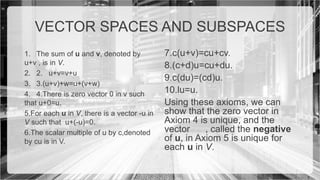
VECTOR SPACES AND SUBSPACES
1. The sum of u and v, denoted by
u+v , is in V.
2. 2. u+v=v+u
3. 3.(u+v)+w=u+(v+w)
4. 4.There is zero vector 0 in v such
that u+0=u.
5.For each u in V, there is a vector -u in
V such that u+(-u)=0.
6.The scalar multiple of u by c,denoted
by cu is in V.
7.c(u+v)=cu+cv.
8.(c+d)u=cu+du.
9.c(du)=(cd)u.
10.lu=u.
Using these axioms, we can
show that the zero vector in
Axiom 4 is unique, and the
vector , called the negative
of u, in Axiom 5 is unique for
each u in V.
For each u in V
and scalar c,
0u=0
c0=0
-u=(-1)u
VECTOR SPACES AND SUBSPACES
EXAMPLE OF VECTOR SPACE:
Determine whether the set of V of all
pairs of real numbers (x,y) with the
operations (x1,y1) + (x2,y2) = (x1+x2+1,
y1+y2+1) and k(x,y) = (kx,ky) is a vector
space.
Solution:
let u=(x1,y1), v=(x2,y2) and w=(x3,y3) are objects in V and k1,k2 are some scalars.
1 . u+v = (x1,y1) + (x2,y2) = (x1+x2+1, y1+y2+1) since x1+x2+1, y1+y2+1 are also
real numbers . Therefore, u+v is also an object in V.
2. u+v = (x1+x2+1, y1+y2+1) = (x2+x1+1, y2+y1+1) = v + u Therefore , vector
addition is commutative.
3. u+(v+w) = (x1,y1)+[(x2,y2) +(x3,y3)] = (x1,y1)+(x2+x3+1, y2+y3+1) = [x1+
(x2+x3+1)+1 , y1+(y2+y1+1)+1) = [(x1+ x2+1)+x3+1 , (y1+y2+1)+y3+1)] =
(x1+x2+1, y1+y2+1)+(x3+y3) = (u+v)+w Hence, vector addition is associative.
4. Let (a,b) be in object in V such that (a,b)+u=u (a,b) +(x1,y1)=(x1,y1)
(a+x1+1,b1+y1+1) = (x1,y1) a= -1 , b=-1 Hence, (-1,-1) is zero vector in V.
Let (a,b) be in object in V such that (a,b)+u=(-1,-1) (a,b)+(x1,y1)=(-1,-1)
(x1+a+1,y1+b+1)=(1,-1) a= -x1-2 , b = -y1-2 Hence, (-x1-2,y1-2) is the negative of
u in V.
VECTOR SPACES AND SUBSPACES
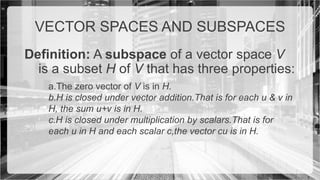
Definition: A subspace of a vector space V
is a subset H of V that has three properties:
a.The zero vector of V is in H.
b.H is closed under vector addition.That is for each u & v in
H, the sum u+v is in H.
c.H is closed under multiplication by scalars.That is for
each u in H and each scalar c,the vector cu is in H.
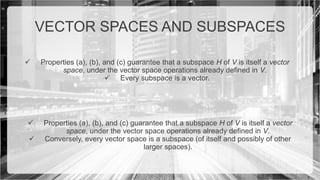
VECTOR SPACES AND SUBSPACES
 Properties (a), (b), and (c) guarantee that a subspace H of V is itself a vector
space, under the vector space operations already defined in V.
 Every subspace is a vector.
 Properties (a), (b), and (c) guarantee that a subspace H of V is itself a vector
space, under the vector space operations already defined in V.
 Conversely, every vector space is a subspace (of itself and possibly of other
larger spaces).
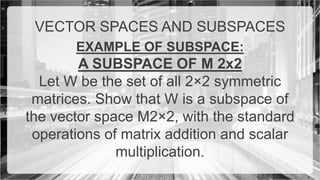
VECTOR SPACES AND SUBSPACES
EXAMPLE OF SUBSPACE:
A SUBSPACE OF M 2x2
Let W be the set of all 2×2 symmetric
matrices. Show that W is a subspace of
the vector space M2×2, with the standard
operations of matrix addition and scalar
multiplication.
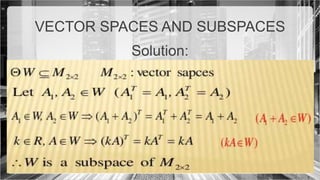
VECTOR SPACES AND SUBSPACES
Solution:
A SUBSPACE SPANNED BY A SET
The set consisting of only the zero vector in a
vector space V is a subspace of V, called the zero
subspace and written as {0}.
As the term linear combination refers to any sum
of scalar multiples of vectors, and Span {v1,…,vp}
denotes the set of all vectors that can be written as
linear combinations of v1,…,vp.
A SUBSPACE SPANNED BY A SET
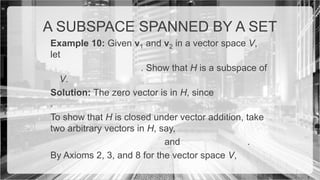
Example 10: Given v1 and v2 in a vector space V,
let
. Show that H is a subspace of
V.
Solution: The zero vector is in H, since
.
To show that H is closed under vector addition, take
two arbitrary vectors in H, say,
and .
By Axioms 2, 3, and 8 for the vector space V,
Thanks!

Vector Space & Sub Space Presentation

  • 1.
    Sufian Mehmood Soomro (BS) ComputerScience 3rd Semester Linear Algebra Shah Abdul Latif University Ghotki Campus
  • 2.
    VECTOR SPACES ANDSUBSPACES • Definition: A vector space is a nonempty set V of objects, called vectors, on which are defined two operations, called addition and multiplication by scalars (real numbers), subject to the ten axioms (or rules) listed below. The axioms must hold for all vectors u, v, and w in V and for all scalars c and d.
  • 3.
    VECTOR SPACES ANDSUBSPACES 1. The sum of u and v, denoted by u+v , is in V. 2. 2. u+v=v+u 3. 3.(u+v)+w=u+(v+w) 4. 4.There is zero vector 0 in v such that u+0=u. 5.For each u in V, there is a vector -u in V such that u+(-u)=0. 6.The scalar multiple of u by c,denoted by cu is in V. 7.c(u+v)=cu+cv. 8.(c+d)u=cu+du. 9.c(du)=(cd)u. 10.lu=u. Using these axioms, we can show that the zero vector in Axiom 4 is unique, and the vector , called the negative of u, in Axiom 5 is unique for each u in V.
  • 4.
    For each uin V and scalar c, 0u=0 c0=0 -u=(-1)u VECTOR SPACES AND SUBSPACES
  • 5.
    VECTOR SPACES ANDSUBSPACES EXAMPLE OF VECTOR SPACE: Determine whether the set of V of all pairs of real numbers (x,y) with the operations (x1,y1) + (x2,y2) = (x1+x2+1, y1+y2+1) and k(x,y) = (kx,ky) is a vector space.
  • 6.
    Solution: let u=(x1,y1), v=(x2,y2)and w=(x3,y3) are objects in V and k1,k2 are some scalars. 1 . u+v = (x1,y1) + (x2,y2) = (x1+x2+1, y1+y2+1) since x1+x2+1, y1+y2+1 are also real numbers . Therefore, u+v is also an object in V. 2. u+v = (x1+x2+1, y1+y2+1) = (x2+x1+1, y2+y1+1) = v + u Therefore , vector addition is commutative. 3. u+(v+w) = (x1,y1)+[(x2,y2) +(x3,y3)] = (x1,y1)+(x2+x3+1, y2+y3+1) = [x1+ (x2+x3+1)+1 , y1+(y2+y1+1)+1) = [(x1+ x2+1)+x3+1 , (y1+y2+1)+y3+1)] = (x1+x2+1, y1+y2+1)+(x3+y3) = (u+v)+w Hence, vector addition is associative. 4. Let (a,b) be in object in V such that (a,b)+u=u (a,b) +(x1,y1)=(x1,y1) (a+x1+1,b1+y1+1) = (x1,y1) a= -1 , b=-1 Hence, (-1,-1) is zero vector in V. Let (a,b) be in object in V such that (a,b)+u=(-1,-1) (a,b)+(x1,y1)=(-1,-1) (x1+a+1,y1+b+1)=(1,-1) a= -x1-2 , b = -y1-2 Hence, (-x1-2,y1-2) is the negative of u in V. VECTOR SPACES AND SUBSPACES
  • 7.
    VECTOR SPACES ANDSUBSPACES Definition: A subspace of a vector space V is a subset H of V that has three properties: a.The zero vector of V is in H. b.H is closed under vector addition.That is for each u & v in H, the sum u+v is in H. c.H is closed under multiplication by scalars.That is for each u in H and each scalar c,the vector cu is in H.
  • 8.
    VECTOR SPACES ANDSUBSPACES  Properties (a), (b), and (c) guarantee that a subspace H of V is itself a vector space, under the vector space operations already defined in V.  Every subspace is a vector.  Properties (a), (b), and (c) guarantee that a subspace H of V is itself a vector space, under the vector space operations already defined in V.  Conversely, every vector space is a subspace (of itself and possibly of other larger spaces).
  • 9.
    VECTOR SPACES ANDSUBSPACES EXAMPLE OF SUBSPACE: A SUBSPACE OF M 2x2 Let W be the set of all 2×2 symmetric matrices. Show that W is a subspace of the vector space M2×2, with the standard operations of matrix addition and scalar multiplication.
  • 10.
    VECTOR SPACES ANDSUBSPACES Solution:
  • 11.
    A SUBSPACE SPANNEDBY A SET The set consisting of only the zero vector in a vector space V is a subspace of V, called the zero subspace and written as {0}. As the term linear combination refers to any sum of scalar multiples of vectors, and Span {v1,…,vp} denotes the set of all vectors that can be written as linear combinations of v1,…,vp.
  • 12.
    A SUBSPACE SPANNEDBY A SET Example 10: Given v1 and v2 in a vector space V, let . Show that H is a subspace of V. Solution: The zero vector is in H, since . To show that H is closed under vector addition, take two arbitrary vectors in H, say, and . By Axioms 2, 3, and 8 for the vector space V,
  • 13.