Calculus II
Book: Stewart Calculus

Content:

Integration Techniques
Advanced Integration Topics
Differential Equations
Parametric Equations and Polar Coordinates
Series and Taylor Expansions
Vectors and Vector Calculus
Prerequisite
Prerequisite
Ideas of Derivative and Integral.
Prerequisite
Ideas of Derivative and Integral.

The relationship and difference between
Definite and Indefinite Integral.
Prerequisite
Ideas of Derivative and Integral.

The relationship and difference between
Definite and Indefinite Integral.

Product and quotient rules, chain rule.
Prerequisite
Ideas of Derivative and Integral.

The relationship and difference between
Definite and Indefinite Integral.

Product and quotient rules, chain rule.

Fundamental Theorem of Calculus.
Prerequisite
Ideas of Derivative and Integral.

The relationship and difference between
Definite and Indefinite Integral.

Product and quotient rules, chain rule.

Fundamental Theorem of Calculus.

The derivative and integral of the most
important functions: trigonometric function,
exponential function, power function...
7.1 Integration by Parts
Product Rule of derivative:

           [ ( ) · ( )] = ( ) ( ) + ( ) ( )
7.1 Integration by Parts
Product Rule of derivative:

           [ ( ) · ( )] = ( ) ( ) + ( ) ( )

Integrate both sides by indefinite integral:

      ( )· ( )=       ( ) ( )   +      ( ) ( )
7.1 Integration by Parts
Product Rule of derivative:

           [ ( ) · ( )] = ( ) ( ) + ( ) ( )

Integrate both sides by indefinite integral:

      ( )· ( )=       ( ) ( )   +      ( ) ( )

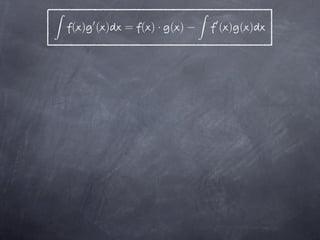
Formula of Integration by Parts:


         ( ) ( )   = ( )· ( )          ( ) ( )
7.1 Integration by Parts
Product Rule of derivative:

           [ ( ) · ( )] = ( ) ( ) + ( ) ( )

Integrate both sides by indefinite integral:

      ( )· ( )=       ( ) ( )   +      ( ) ( )

Formula of Integration by Parts:


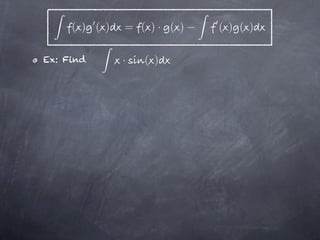
         ( ) ( )   = ( )· ( )          ( ) ( )
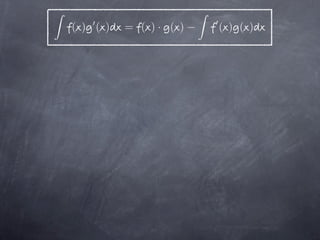
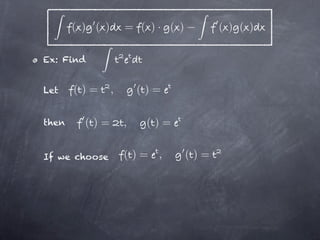
( ) ( )   = ( )· ( )   ( ) ( )
( ) ( )   = ( )· ( )   ( ) ( )

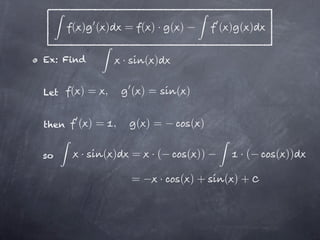
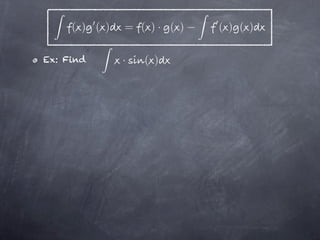
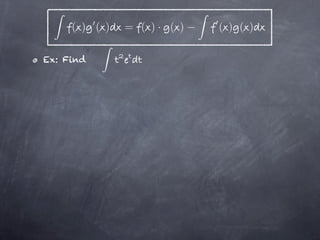
Ex: Find       ·   ( )
( ) ( )   = ( )· ( )        ( ) ( )

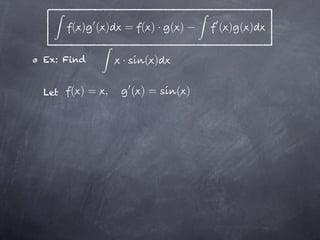
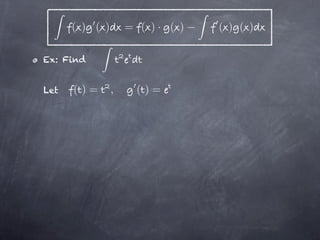
Ex: Find        ·     ( )

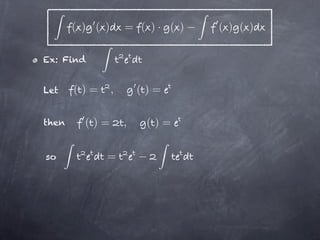
Let   ( )= ,        ( )=    ( )
( ) ( )   = ( )· ( )              ( ) ( )

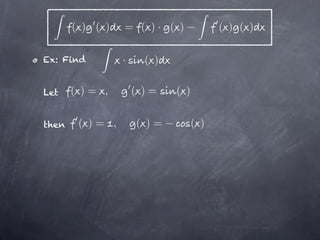
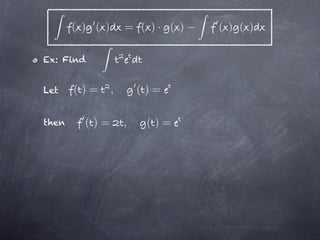
Ex: Find         ·     ( )

Let    ( )= ,        ( )=    ( )

then    ( )= ,       ( )=          ( )
( ) ( )    = ( )· ( )              ( ) ( )

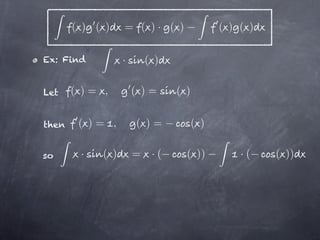
Ex: Find          ·     ( )

Let    ( )= ,         ( )=    ( )

then    ( )= ,        ( )=          ( )

so      ·   ( )       = ·(      ( ))          ·(    ( ))
( ) ( )    = ( )· ( )                    ( ) ( )

Ex: Find          ·       ( )

Let    ( )= ,         ( )=          ( )

then    ( )= ,        ( )=                ( )

so      ·   ( )       = ·(            ( ))          ·(    ( ))

                      =         ·   ( )+         ( )+
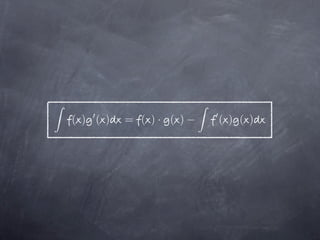
( ) ( )   = ( )· ( )   ( ) ( )

Ex: Find       ·   ( )
( ) ( )   = ( )· ( )         ( ) ( )

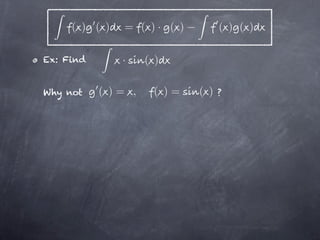
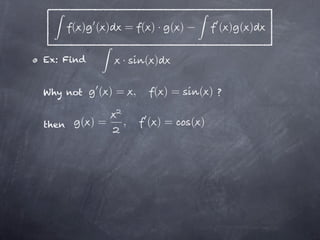
Ex: Find       ·    ( )

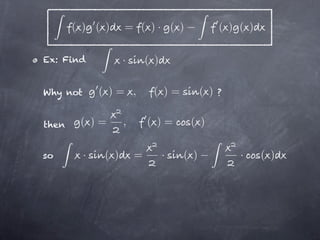
Why not    ( )= ,    ( )=   ( )   ?
( ) ( )   = ( )· ( )          ( ) ( )

Ex: Find         ·   ( )

Why not    ( )= ,     ( )=     ( )   ?


then    ( )=     ,   ( )=     ( )
( ) ( )      = ( )· ( )                    ( ) ( )

Ex: Find            ·       ( )

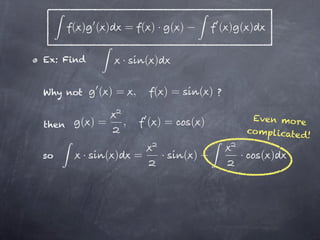
Why not       ( )= ,         ( )=           ( )   ?


then    ( )=        ,       ( )=       ( )

so        ·   ( )       =         ·   ( )             ·     ( )
( ) ( )      = ( )· ( )                    ( ) ( )

Ex: Find            ·       ( )

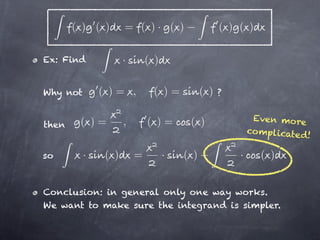
Why not       ( )= ,         ( )=           ( )   ?


        ( )=        ,       ( )=       ( )                 Even more
then
                                                          co mplicate d
                                                                       !

so        ·   ( )       =         ·   ( )             ·      ( )
( ) ( )      = ( )· ( )                    ( ) ( )

Ex: Find            ·       ( )

Why not       ( )= ,         ( )=           ( )   ?


        ( )=        ,       ( )=       ( )                 Even more
then
                                                          co mplicate d
                                                                       !

so        ·   ( )       =         ·   ( )             ·      ( )


Conclusion: in general only one way works.
We want to make sure the integrand is simpler.
( ) ( )   = ( )· ( )   ( ) ( )
( ) ( )   = ( )· ( )   ( ) ( )
( ) ( )   = ( )· ( )   ( ) ( )

Ex: Find
( ) ( )       = ( )· ( )   ( ) ( )

Ex: Find


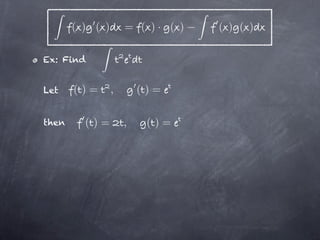
Let   ()=       ,    ()=
( ) ( )       = ( )· ( )   ( ) ( )

Ex: Find


Let    ()=       ,       ()=

then     ()=         ,    ()=
( ) ( )       = ( )· ( )         ( ) ( )

Ex: Find


Let    ()=       ,       ()=

then     ()=         ,    ()=


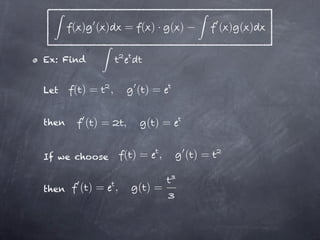
If we choose         ()= ,        ()=
( ) ( )       = ( )· ( )         ( ) ( )

Ex: Find


Let    ()=       ,       ()=

then     ()=         ,    ()=


If we choose         ()= ,        ()=


then    ()= ,            ()=
( ) ( )       = ( )· ( )         ( ) ( )

Ex: Find


Let    ()=       ,       ()=

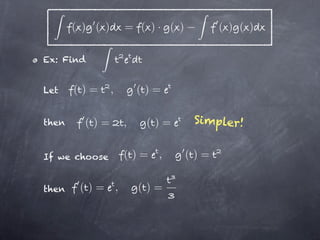
then     ()=         ,    ()=      Simpler!


If we choose         ()= ,        ()=


then    ()= ,            ()=
( ) ( )       = ( )· ( )   ( ) ( )

Ex: Find


Let    ()=       ,       ()=

then     ()=         ,    ()=
( ) ( )       = ( )· ( )   ( ) ( )

Ex: Find


Let    ()=       ,       ()=

then     ()=         ,    ()=


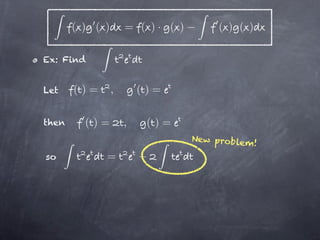
so           =
( ) ( )       = ( )· ( )       ( ) ( )

Ex: Find


Let    ()=       ,       ()=

then     ()=         ,    ()=
                                  New problem
                                             !
so           =
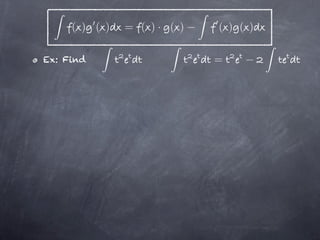
( ) ( )   = ( )· ( )   ( ) ( )

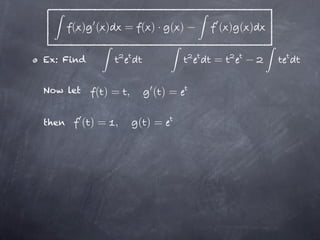
Ex: Find                    =
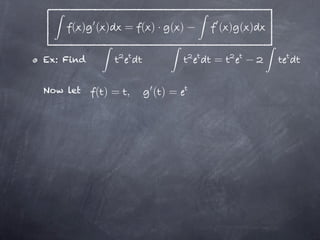
( ) ( )   = ( )· ( )   ( ) ( )

Ex: Find                    =

Now let    ()= ,   ()=
( ) ( )    = ( )· ( )   ( ) ( )

Ex: Find                       =

Now let    ()= ,      ()=

then      ()= ,     ()=
( ) ( )    = ( )· ( )       ( ) ( )

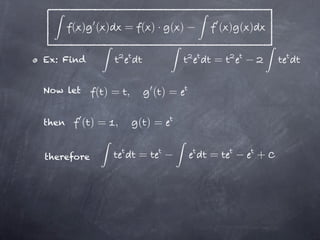
Ex: Find                       =

Now let     ()= ,       ()=

then      ()= ,     ()=


therefore           =          =             +
( ) ( )    = ( )· ( )           ( ) ( )

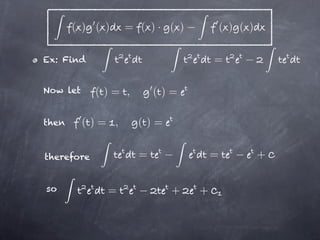
Ex: Find                           =

Now let     ()= ,       ()=

then      ()= ,     ()=


therefore           =              =             +


so           =            +    +
Integration by Parts
Product Rule of derivative:

           [ ( ) · ( )] = ( ) ( ) + ( ) ( )
Integration by Parts
Product Rule of derivative:

           [ ( ) · ( )] = ( ) ( ) + ( ) ( )

Integrate both sides by definite integral:

       ( )· ( )   =      ( ) ( )+        ( ) ( )
Integration by Parts
Product Rule of derivative:

           [ ( ) · ( )] = ( ) ( ) + ( ) ( )

Integrate both sides by definite integral:

       ( )· ( )   =      ( ) ( )+        ( ) ( )
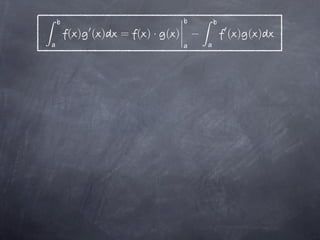
Formula of Integration by Parts:


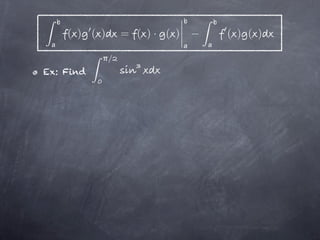
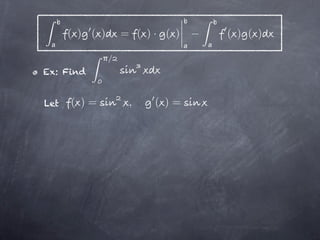
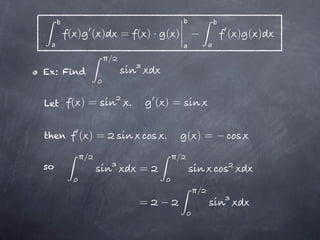
        ( ) ( )    = ( )· ( )           ( ) ( )
( ) ( )   = ( )· ( )   ( ) ( )
( ) ( )       = ( )· ( )   ( ) ( )

              /
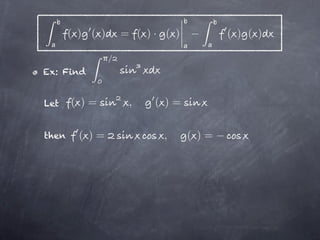
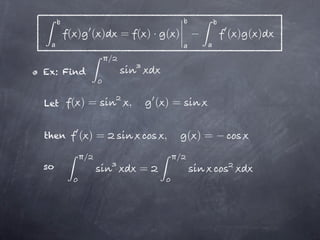
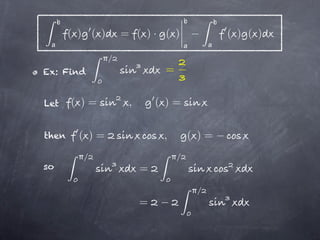
Ex: Find
( ) ( )       = ( )· ( )   ( ) ( )

                /
Ex: Find


Let   ( )=           ,   ( )=
( ) ( )       = ( )· ( )          ( ) ( )

                 /
Ex: Find


Let    ( )=           ,   ( )=

then     ( )=               ,     ( )=
( ) ( )       = ( )· ( )               ( ) ( )

                 /
Ex: Find


Let    ( )=           ,       ( )=

then     ( )=                  ,       ( )=
         /                         /
so                        =
( ) ( )       = ( )· ( )               ( ) ( )

                 /
Ex: Find


Let    ( )=           ,       ( )=

then     ( )=                  ,       ( )=
         /                         /
so                        =
                                        /
                          =
( ) ( )       = ( )· ( )               ( ) ( )

                 /
Ex: Find                       =

Let    ( )=           ,       ( )=

then     ( )=                  ,       ( )=
         /                         /
so                        =
                                        /
                          =
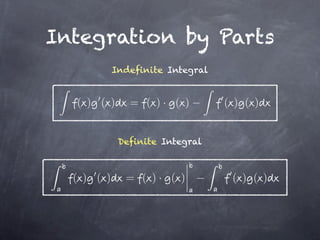
Integration by Parts
            Indefinite Integral


  ( ) ( )      = ( )· ( )         ( ) ( )


             Definite Integral


  ( ) ( )     = ( )· ( )           ( ) ( )

Calculus II - 1

  • 1.
    Calculus II Book: StewartCalculus Content: Integration Techniques Advanced Integration Topics Differential Equations Parametric Equations and Polar Coordinates Series and Taylor Expansions Vectors and Vector Calculus
  • 3.
  • 4.
  • 5.
    Prerequisite Ideas of Derivativeand Integral. The relationship and difference between Definite and Indefinite Integral.
  • 6.
    Prerequisite Ideas of Derivativeand Integral. The relationship and difference between Definite and Indefinite Integral. Product and quotient rules, chain rule.
  • 7.
    Prerequisite Ideas of Derivativeand Integral. The relationship and difference between Definite and Indefinite Integral. Product and quotient rules, chain rule. Fundamental Theorem of Calculus.
  • 8.
    Prerequisite Ideas of Derivativeand Integral. The relationship and difference between Definite and Indefinite Integral. Product and quotient rules, chain rule. Fundamental Theorem of Calculus. The derivative and integral of the most important functions: trigonometric function, exponential function, power function...
  • 10.
  • 11.
    7.1 Integration byParts Product Rule of derivative: [ ( ) · ( )] = ( ) ( ) + ( ) ( )
  • 12.
    7.1 Integration byParts Product Rule of derivative: [ ( ) · ( )] = ( ) ( ) + ( ) ( ) Integrate both sides by indefinite integral: ( )· ( )= ( ) ( ) + ( ) ( )
  • 13.
    7.1 Integration byParts Product Rule of derivative: [ ( ) · ( )] = ( ) ( ) + ( ) ( ) Integrate both sides by indefinite integral: ( )· ( )= ( ) ( ) + ( ) ( ) Formula of Integration by Parts: ( ) ( ) = ( )· ( ) ( ) ( )
  • 14.
    7.1 Integration byParts Product Rule of derivative: [ ( ) · ( )] = ( ) ( ) + ( ) ( ) Integrate both sides by indefinite integral: ( )· ( )= ( ) ( ) + ( ) ( ) Formula of Integration by Parts: ( ) ( ) = ( )· ( ) ( ) ( )
  • 15.
    ( ) () = ( )· ( ) ( ) ( )
  • 16.
    ( ) () = ( )· ( ) ( ) ( ) Ex: Find · ( )
  • 17.
    ( ) () = ( )· ( ) ( ) ( ) Ex: Find · ( ) Let ( )= , ( )= ( )
  • 18.
    ( ) () = ( )· ( ) ( ) ( ) Ex: Find · ( ) Let ( )= , ( )= ( ) then ( )= , ( )= ( )
  • 19.
    ( ) () = ( )· ( ) ( ) ( ) Ex: Find · ( ) Let ( )= , ( )= ( ) then ( )= , ( )= ( ) so · ( ) = ·( ( )) ·( ( ))
  • 20.
    ( ) () = ( )· ( ) ( ) ( ) Ex: Find · ( ) Let ( )= , ( )= ( ) then ( )= , ( )= ( ) so · ( ) = ·( ( )) ·( ( )) = · ( )+ ( )+
  • 21.
    ( ) () = ( )· ( ) ( ) ( ) Ex: Find · ( )
  • 22.
    ( ) () = ( )· ( ) ( ) ( ) Ex: Find · ( ) Why not ( )= , ( )= ( ) ?
  • 23.
    ( ) () = ( )· ( ) ( ) ( ) Ex: Find · ( ) Why not ( )= , ( )= ( ) ? then ( )= , ( )= ( )
  • 24.
    ( ) () = ( )· ( ) ( ) ( ) Ex: Find · ( ) Why not ( )= , ( )= ( ) ? then ( )= , ( )= ( ) so · ( ) = · ( ) · ( )
  • 25.
    ( ) () = ( )· ( ) ( ) ( ) Ex: Find · ( ) Why not ( )= , ( )= ( ) ? ( )= , ( )= ( ) Even more then co mplicate d ! so · ( ) = · ( ) · ( )
  • 26.
    ( ) () = ( )· ( ) ( ) ( ) Ex: Find · ( ) Why not ( )= , ( )= ( ) ? ( )= , ( )= ( ) Even more then co mplicate d ! so · ( ) = · ( ) · ( ) Conclusion: in general only one way works. We want to make sure the integrand is simpler.
  • 27.
    ( ) () = ( )· ( ) ( ) ( )
  • 28.
    ( ) () = ( )· ( ) ( ) ( )
  • 29.
    ( ) () = ( )· ( ) ( ) ( ) Ex: Find
  • 30.
    ( ) () = ( )· ( ) ( ) ( ) Ex: Find Let ()= , ()=
  • 31.
    ( ) () = ( )· ( ) ( ) ( ) Ex: Find Let ()= , ()= then ()= , ()=
  • 32.
    ( ) () = ( )· ( ) ( ) ( ) Ex: Find Let ()= , ()= then ()= , ()= If we choose ()= , ()=
  • 33.
    ( ) () = ( )· ( ) ( ) ( ) Ex: Find Let ()= , ()= then ()= , ()= If we choose ()= , ()= then ()= , ()=
  • 34.
    ( ) () = ( )· ( ) ( ) ( ) Ex: Find Let ()= , ()= then ()= , ()= Simpler! If we choose ()= , ()= then ()= , ()=
  • 35.
    ( ) () = ( )· ( ) ( ) ( ) Ex: Find Let ()= , ()= then ()= , ()=
  • 36.
    ( ) () = ( )· ( ) ( ) ( ) Ex: Find Let ()= , ()= then ()= , ()= so =
  • 37.
    ( ) () = ( )· ( ) ( ) ( ) Ex: Find Let ()= , ()= then ()= , ()= New problem ! so =
  • 38.
    ( ) () = ( )· ( ) ( ) ( ) Ex: Find =
  • 39.
    ( ) () = ( )· ( ) ( ) ( ) Ex: Find = Now let ()= , ()=
  • 40.
    ( ) () = ( )· ( ) ( ) ( ) Ex: Find = Now let ()= , ()= then ()= , ()=
  • 41.
    ( ) () = ( )· ( ) ( ) ( ) Ex: Find = Now let ()= , ()= then ()= , ()= therefore = = +
  • 42.
    ( ) () = ( )· ( ) ( ) ( ) Ex: Find = Now let ()= , ()= then ()= , ()= therefore = = + so = + +
  • 44.
  • 45.
    Integration by Parts ProductRule of derivative: [ ( ) · ( )] = ( ) ( ) + ( ) ( )
  • 46.
    Integration by Parts ProductRule of derivative: [ ( ) · ( )] = ( ) ( ) + ( ) ( ) Integrate both sides by definite integral: ( )· ( ) = ( ) ( )+ ( ) ( )
  • 47.
    Integration by Parts ProductRule of derivative: [ ( ) · ( )] = ( ) ( ) + ( ) ( ) Integrate both sides by definite integral: ( )· ( ) = ( ) ( )+ ( ) ( ) Formula of Integration by Parts: ( ) ( ) = ( )· ( ) ( ) ( )
  • 48.
    ( ) () = ( )· ( ) ( ) ( )
  • 49.
    ( ) () = ( )· ( ) ( ) ( ) / Ex: Find
  • 50.
    ( ) () = ( )· ( ) ( ) ( ) / Ex: Find Let ( )= , ( )=
  • 51.
    ( ) () = ( )· ( ) ( ) ( ) / Ex: Find Let ( )= , ( )= then ( )= , ( )=
  • 52.
    ( ) () = ( )· ( ) ( ) ( ) / Ex: Find Let ( )= , ( )= then ( )= , ( )= / / so =
  • 53.
    ( ) () = ( )· ( ) ( ) ( ) / Ex: Find Let ( )= , ( )= then ( )= , ( )= / / so = / =
  • 54.
    ( ) () = ( )· ( ) ( ) ( ) / Ex: Find = Let ( )= , ( )= then ( )= , ( )= / / so = / =
  • 56.
    Integration by Parts Indefinite Integral ( ) ( ) = ( )· ( ) ( ) ( ) Definite Integral ( ) ( ) = ( )· ( ) ( ) ( )