2018
Lecture №2
MATRICES
Dobroshtan Оlena
What is a matrix?
•A Matrix is just rectangular arrays of items
•A typical matrix is a rectangular array of numbers
arranged in rows and columns.
3 4
21 62 33 93
44 95 66 13
77 38 79 33
x
A
 
 
  
 
 
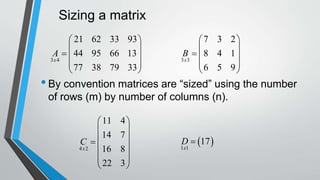
Sizing a matrix
•By convention matrices are “sized” using the number
of rows (m) by number of columns (n).
3 4
21 62 33 93
44 95 66 13
77 38 79 33
x
A
 
 
  
 
 
3 3
7 3 2
8 4 1
6 5 9
x
B
 
 
  
 
 
4 2
11 4
14 7
16 8
22 3
x
C
 
 
 
 
 
 
 1 1
17
x
D 
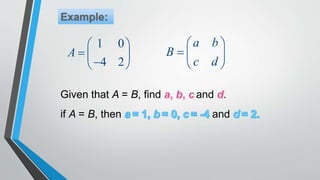
Two matrices A = [aij] and B = [bij] are said to be
(A = B) iff each element of A is equal to the
corresponding element of B, i.e., aij = bij for 1  i 
m, 1  j  n.
if A = B, it implies aij = bij for 1  i  m, 1  j  n;
if aij = bij for 1  i  m, 1  j  n, it implies A = B.
Given that A = B, find and .
1 0
4 2
A
 
  
 
a b
B
c d
 
  
 
if A = B, then and
If A = [aij] and B = [bij] are m  n matrices, then
A + B is defined as a matrix C = A + B, where
C= [cij], cij = aij + bij for 1  i  m, 1  j  n.
Example: if and
Evaluate A + B and A – B.
1 2 3
0 1 4
A
 
  
 
2 3 0
1 2 5
B
 
  
 
1 2 2 3 3 0
0 ( 1) 1 2 4 5
A B
   
   
    
1 2 2 3 3 0
0 ( 1) 1 2 4 5
A B
   
   
    
3 5 3
1 3 9
 
 
 
1 1 3
1 1 1
  
 
  
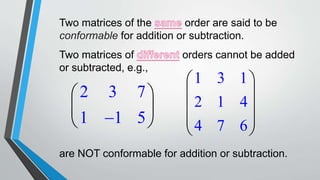
Two matrices of the order are said to be
conformable for addition or subtraction.
Two matrices of orders cannot be added
or subtracted, e.g.,
2 3 7
1 1 5
 
 
 
1 3 1
2 1 4
4 7 6
 
 
 
 
 
are NOT conformable for addition or subtraction.
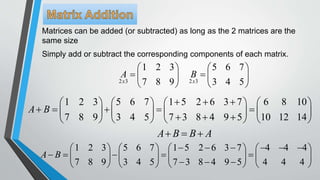
Matrices can be added (or subtracted) as long as the 2 matrices are the
same size
Simply add or subtract the corresponding components of each matrix.
2 3 2 3
1 2 3 5 6 7
7 8 9 3 4 5x x
A B
   
    
   
1 2 3 5 6 7 1 5 2 6 3 7 6 8 10
7 8 9 3 4 5 7 3 8 4 9 5 10 12 14
A B
         
           
         
A B B A  
1 2 3 5 6 7 1 5 2 6 3 7 4 4 4
7 8 9 3 4 5 7 3 8 4 9 5 4 4 4
A B
            
           
         
Let l be any scalar and A = [aij] is an m  n matrix.
Then lA = [laij] for 1  i  m, 1  j  n, i.e., each
element in A is multiplied by l.
1 2 3
0 1 4
A
 
  
 
Example: . Evaluate 3A.
3 1 3 2 3 3
3
3 0 3 1 3 4
A
   
  
   
In particular, l = -1, i.e., -A = [-aij]. It’s called the
. Note: A - A = 0 is a zero matrix
3 6 9
0 3 12
 
 
 
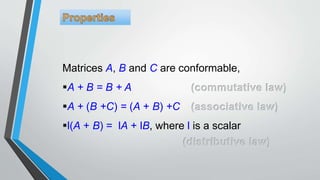
Matrices A, B and C are conformable,
A + B = B + A
A + (B +C) = (A + B) +C
l(A + B) = lA + lB, where l is a scalar
(commutative law)
(associative law)
(distributive law)
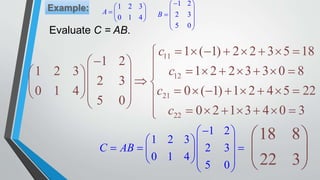
If A = [aij] is a m  p matrix and B = [bij] is a p  n
matrix, then AB is defined as a m  n matrix C = AB,
where C= [cij] with
1 1 2 2
1
...

    
p
ij ik kj i j i j ip pj
k
c a b a b a b a b
1 2 3
0 1 4
A
 
  
 
1 2
2 3
5 0
B
 
 
  
 
 
, and C = AB.
Evaluate c21.
1 2
1 2 3
2 3
0 1 4
5 0
 
  
  
  
 
21 0 ( 1) 1 2 4 5 22       c
for 1  i  m, 1  j  n.
1 2 3
0 1 4
A
 
  
 
1 2
2 3
5 0
B
 
 
  
 
 
11
12
21
22
1 ( 1) 2 2 3 5 18
1 2
1 2 2 3 3 0 81 2 3
2 3
0 ( 1) 1 2 4 5 220 1 4
5 0
0 2 1 3 4 0 3
c
c
c
c
       
            
              
         
1 2
1 2 3
2 3
0 1 4
5 0
C AB
 
  
    
  
 
18 8
22 3
 
 
 
Evaluate C = AB.
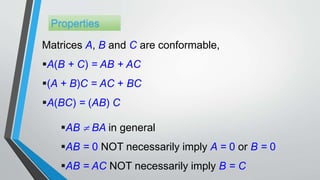
Properties
Matrices A, B and C are conformable,
A(B + C) = AB + AC
(A + B)C = AC + BC
A(BC) = (AB) C
AB  BA in general
AB = 0 NOT necessarily imply A = 0 or B = 0
AB = AC NOT necessarily imply B = C
1
4
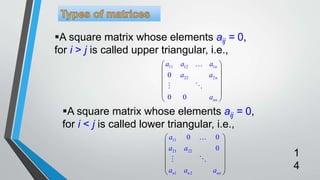
A square matrix whose elements aij = 0,
for i > j is called upper triangular, i.e.,
11 12 1
22 20
0 0
n
n
nn
a a a
a a
a
 
 
 
 
 
 
A square matrix whose elements aij = 0,
for i < j is called lower triangular, i.e.,
11
21 22
1 2
0 0
0
n n nn
a
a a
a a a
 
 
 
 
 
 
Both upper and lower triangular, i.e., aij = 0, for i  j , i.e.,
11
22
0 0
0 0
0 0 nn
a
a
D
a
 
 
 
 
 
 
11 22diag[ , ,..., ] nnD a a a
is called a , simply
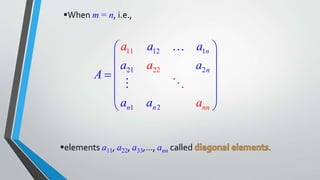
When m = n, i.e.,
elements a11, a22, a33,…, ann called .
12 1
21 2
1 2
11
22
n
n
n n nn
a a a
a a
A
a a
a
a
 
 
 
 
 
 
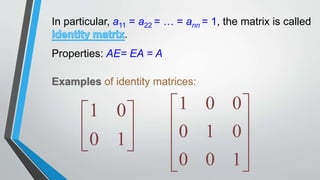
In particular, a11 = a22 = … = ann = 1, the matrix is called
.
Properties: AE= EA = A
of identity matrices:
1 0
0 1
 
 
 
1 0 0
0 1 0
0 0 1
 
 
 
  
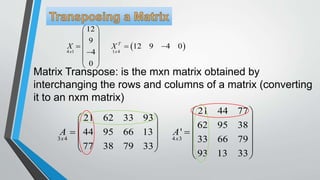
Matrix Transpose: is the mxn matrix obtained by
interchanging the rows and columns of a matrix (converting
it to an nxm matrix)
 4 1 1 4
12
9
12 9 4 0
4
0
T
x x
X X
 
 
   
 
 
 
3 4 4 3
21 44 77
21 62 33 93
62 95 38
44 95 66 13 '
33 66 79
77 38 79 33
93 13 33
x x
A A
 
   
           
 
The matrix obtained by interchanging the rows and
columns of a matrix A is called the transpose of A
(write AT).
Example:
The transpose of A is
1 2 3
4 5 6
 
  
 
A
1 4
2 5
3 6
 
   
  
T
A
For a matrix A = [aij], its transpose AT = [bij], where
bij = aji.
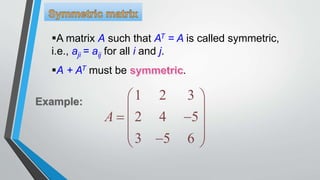
A matrix A such that AT = A is called symmetric,
i.e., aji = aij for all i and j.
A + AT must be .
1 2 3
2 4 5
3 5 6
A
 
 
  
  
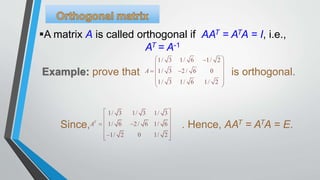
A matrix A is called orthogonal if AAT = ATA = I, i.e.,
AT = A-1
prove that is orthogonal.
1/ 3 1/ 6 1/ 2
1/ 3 2 / 6 0
1/ 3 1/ 6 1/ 2
A
 
 
  
 
 
 
Since, . Hence, AAT = ATA = E.
1/ 3 1/ 3 1/ 3
1/ 6 2/ 6 1/ 6
1/ 2 0 1/ 2
T
A
 
 
  
 
  
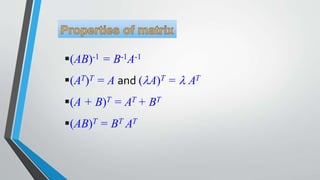
(AB)-1 = B-1A-1
(AT)T = A and (lA)T = l AT
(A + B)T = AT + BT
(AB)T = BT AT
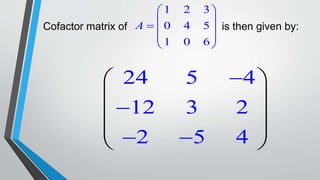
Cofactor matrix of
1 2 3
0 4 5
1 0 6
A
 
 
  
 
 
The cofactor for each element of matrix A:
11
4 5
24
0 6
A   12
0 5
5
1 6
A    13
0 4
4
1 0
A   
21
2 3
12
0 6
A   
22
1 3
3
1 6
A   23
1 2
2
1 0
A   
31
2 3
2
4 5
A   
32
1 3
5
0 5
A    
33
1 2
4
0 4
A  
Cofactor matrix of is then given by:
1 2 3
0 4 5
1 0 6
A
 
 
  
 
 
24 5 4
12 3 2
2 5 4


 
 
 
 
 
 
Inverse matrix of is given by:
1 2 3
0 4 5
1 0 6
A
 
   
  
1
24 5 4 24 12 2
1 1
12 3 2 5 3 5
22
2 5 4 4 2 4
T
A
A

     
         
        
12 11 6 11 1 11
5 22 3 22 5 22
2 11 1 11 2 11
  
   
  

Matrices

  • 1.
  • 2.
    What is amatrix? •A Matrix is just rectangular arrays of items •A typical matrix is a rectangular array of numbers arranged in rows and columns. 3 4 21 62 33 93 44 95 66 13 77 38 79 33 x A           
  • 3.
    Sizing a matrix •Byconvention matrices are “sized” using the number of rows (m) by number of columns (n). 3 4 21 62 33 93 44 95 66 13 77 38 79 33 x A            3 3 7 3 2 8 4 1 6 5 9 x B            4 2 11 4 14 7 16 8 22 3 x C              1 1 17 x D 
  • 4.
    Two matrices A= [aij] and B = [bij] are said to be (A = B) iff each element of A is equal to the corresponding element of B, i.e., aij = bij for 1  i  m, 1  j  n. if A = B, it implies aij = bij for 1  i  m, 1  j  n; if aij = bij for 1  i  m, 1  j  n, it implies A = B.
  • 5.
    Given that A= B, find and . 1 0 4 2 A        a b B c d        if A = B, then and
  • 6.
    If A =[aij] and B = [bij] are m  n matrices, then A + B is defined as a matrix C = A + B, where C= [cij], cij = aij + bij for 1  i  m, 1  j  n. Example: if and Evaluate A + B and A – B. 1 2 3 0 1 4 A        2 3 0 1 2 5 B        1 2 2 3 3 0 0 ( 1) 1 2 4 5 A B              1 2 2 3 3 0 0 ( 1) 1 2 4 5 A B              3 5 3 1 3 9       1 1 3 1 1 1        
  • 7.
    Two matrices ofthe order are said to be conformable for addition or subtraction. Two matrices of orders cannot be added or subtracted, e.g., 2 3 7 1 1 5       1 3 1 2 1 4 4 7 6           are NOT conformable for addition or subtraction.
  • 8.
    Matrices can beadded (or subtracted) as long as the 2 matrices are the same size Simply add or subtract the corresponding components of each matrix. 2 3 2 3 1 2 3 5 6 7 7 8 9 3 4 5x x A B              1 2 3 5 6 7 1 5 2 6 3 7 6 8 10 7 8 9 3 4 5 7 3 8 4 9 5 10 12 14 A B                                 A B B A   1 2 3 5 6 7 1 5 2 6 3 7 4 4 4 7 8 9 3 4 5 7 3 8 4 9 5 4 4 4 A B                                   
  • 9.
    Let l beany scalar and A = [aij] is an m  n matrix. Then lA = [laij] for 1  i  m, 1  j  n, i.e., each element in A is multiplied by l. 1 2 3 0 1 4 A        Example: . Evaluate 3A. 3 1 3 2 3 3 3 3 0 3 1 3 4 A            In particular, l = -1, i.e., -A = [-aij]. It’s called the . Note: A - A = 0 is a zero matrix 3 6 9 0 3 12      
  • 10.
    Matrices A, Band C are conformable, A + B = B + A A + (B +C) = (A + B) +C l(A + B) = lA + lB, where l is a scalar (commutative law) (associative law) (distributive law)
  • 11.
    If A =[aij] is a m  p matrix and B = [bij] is a p  n matrix, then AB is defined as a m  n matrix C = AB, where C= [cij] with 1 1 2 2 1 ...       p ij ik kj i j i j ip pj k c a b a b a b a b 1 2 3 0 1 4 A        1 2 2 3 5 0 B            , and C = AB. Evaluate c21. 1 2 1 2 3 2 3 0 1 4 5 0              21 0 ( 1) 1 2 4 5 22       c for 1  i  m, 1  j  n.
  • 12.
    1 2 3 01 4 A        1 2 2 3 5 0 B            11 12 21 22 1 ( 1) 2 2 3 5 18 1 2 1 2 2 3 3 0 81 2 3 2 3 0 ( 1) 1 2 4 5 220 1 4 5 0 0 2 1 3 4 0 3 c c c c                                               1 2 1 2 3 2 3 0 1 4 5 0 C AB                18 8 22 3       Evaluate C = AB.
  • 13.
    Properties Matrices A, Band C are conformable, A(B + C) = AB + AC (A + B)C = AC + BC A(BC) = (AB) C AB  BA in general AB = 0 NOT necessarily imply A = 0 or B = 0 AB = AC NOT necessarily imply B = C
  • 14.
    1 4 A square matrixwhose elements aij = 0, for i > j is called upper triangular, i.e., 11 12 1 22 20 0 0 n n nn a a a a a a             A square matrix whose elements aij = 0, for i < j is called lower triangular, i.e., 11 21 22 1 2 0 0 0 n n nn a a a a a a            
  • 15.
    Both upper andlower triangular, i.e., aij = 0, for i  j , i.e., 11 22 0 0 0 0 0 0 nn a a D a             11 22diag[ , ,..., ] nnD a a a is called a , simply
  • 16.
    When m =n, i.e., elements a11, a22, a33,…, ann called . 12 1 21 2 1 2 11 22 n n n n nn a a a a a A a a a a            
  • 17.
    In particular, a11= a22 = … = ann = 1, the matrix is called . Properties: AE= EA = A of identity matrices: 1 0 0 1       1 0 0 0 1 0 0 0 1         
  • 18.
    Matrix Transpose: isthe mxn matrix obtained by interchanging the rows and columns of a matrix (converting it to an nxm matrix)  4 1 1 4 12 9 12 9 4 0 4 0 T x x X X               3 4 4 3 21 44 77 21 62 33 93 62 95 38 44 95 66 13 ' 33 66 79 77 38 79 33 93 13 33 x x A A                    
  • 19.
    The matrix obtainedby interchanging the rows and columns of a matrix A is called the transpose of A (write AT). Example: The transpose of A is 1 2 3 4 5 6        A 1 4 2 5 3 6          T A For a matrix A = [aij], its transpose AT = [bij], where bij = aji.
  • 20.
    A matrix Asuch that AT = A is called symmetric, i.e., aji = aij for all i and j. A + AT must be . 1 2 3 2 4 5 3 5 6 A          
  • 21.
    A matrix Ais called orthogonal if AAT = ATA = I, i.e., AT = A-1 prove that is orthogonal. 1/ 3 1/ 6 1/ 2 1/ 3 2 / 6 0 1/ 3 1/ 6 1/ 2 A              Since, . Hence, AAT = ATA = E. 1/ 3 1/ 3 1/ 3 1/ 6 2/ 6 1/ 6 1/ 2 0 1/ 2 T A            
  • 22.
    (AB)-1 = B-1A-1 (AT)T= A and (lA)T = l AT (A + B)T = AT + BT (AB)T = BT AT
  • 23.
    Cofactor matrix of 12 3 0 4 5 1 0 6 A            The cofactor for each element of matrix A: 11 4 5 24 0 6 A   12 0 5 5 1 6 A    13 0 4 4 1 0 A    21 2 3 12 0 6 A    22 1 3 3 1 6 A   23 1 2 2 1 0 A    31 2 3 2 4 5 A    32 1 3 5 0 5 A     33 1 2 4 0 4 A  
  • 24.
    Cofactor matrix ofis then given by: 1 2 3 0 4 5 1 0 6 A            24 5 4 12 3 2 2 5 4              
  • 25.
    Inverse matrix ofis given by: 1 2 3 0 4 5 1 0 6 A          1 24 5 4 24 12 2 1 1 12 3 2 5 3 5 22 2 5 4 4 2 4 T A A                           12 11 6 11 1 11 5 22 3 22 5 22 2 11 1 11 2 11          