297
Source: NASA.
5.1 Rules for Exponents
5.2 Addition and Subtrac-
tion of Polynomials
5.3 Multiplication of
Polynomials
5.4 Special Products
5.5 Integer Exponents and
the Quotient Rule
5.6 Division of Polynomials
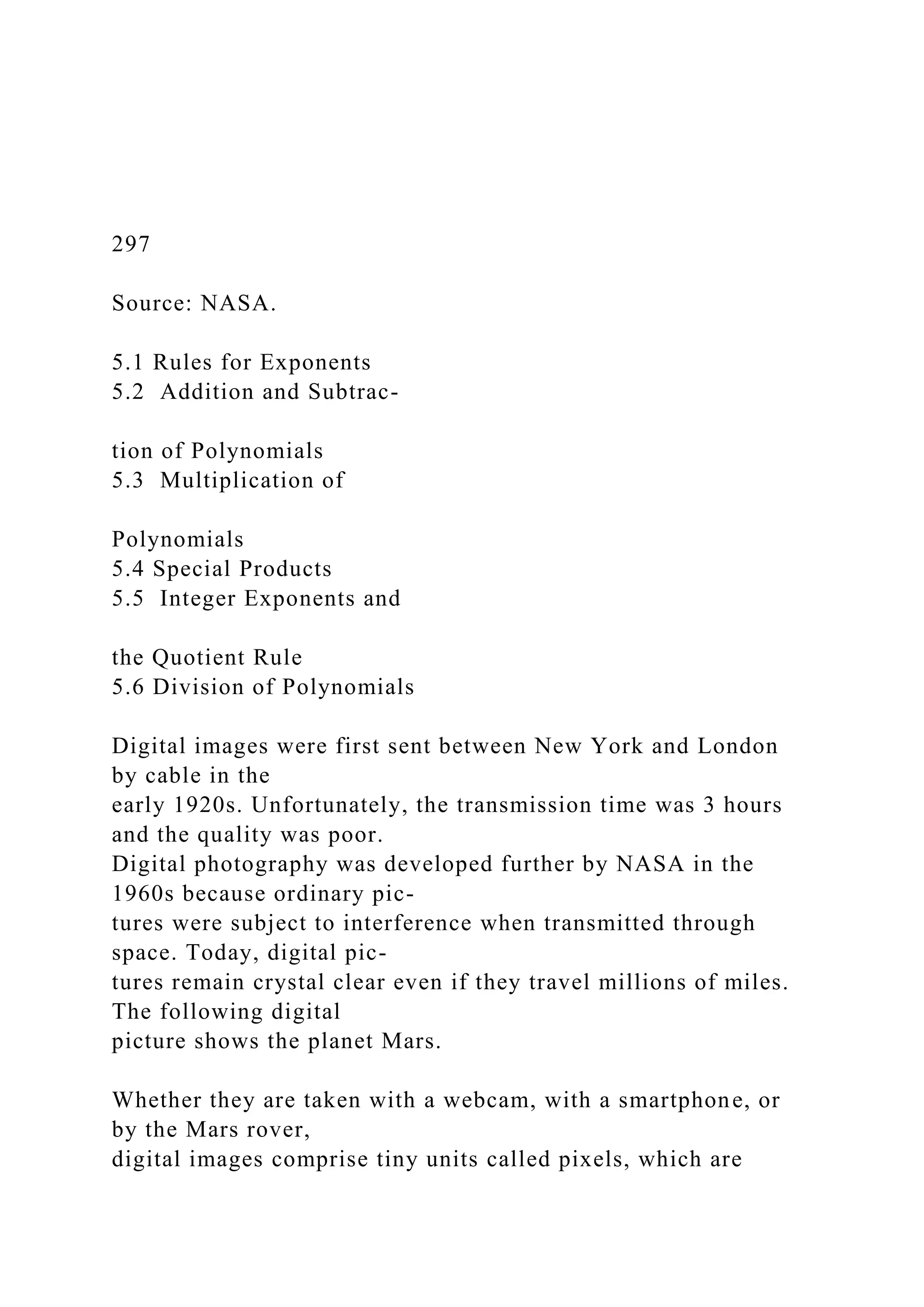
Digital images were first sent between New York and London
by cable in the
early 1920s. Unfortunately, the transmission time was 3 hours
and the quality was poor.
Digital photography was developed further by NASA in the
1960s because ordinary pic-
tures were subject to interference when transmitted through
space. Today, digital pic-
tures remain crystal clear even if they travel millions of miles.
The following digital
picture shows the planet Mars.
Whether they are taken with a webcam, with a smartphone, or
by the Mars rover,
digital images comprise tiny units called pixels, which are
represented by numbers. As a
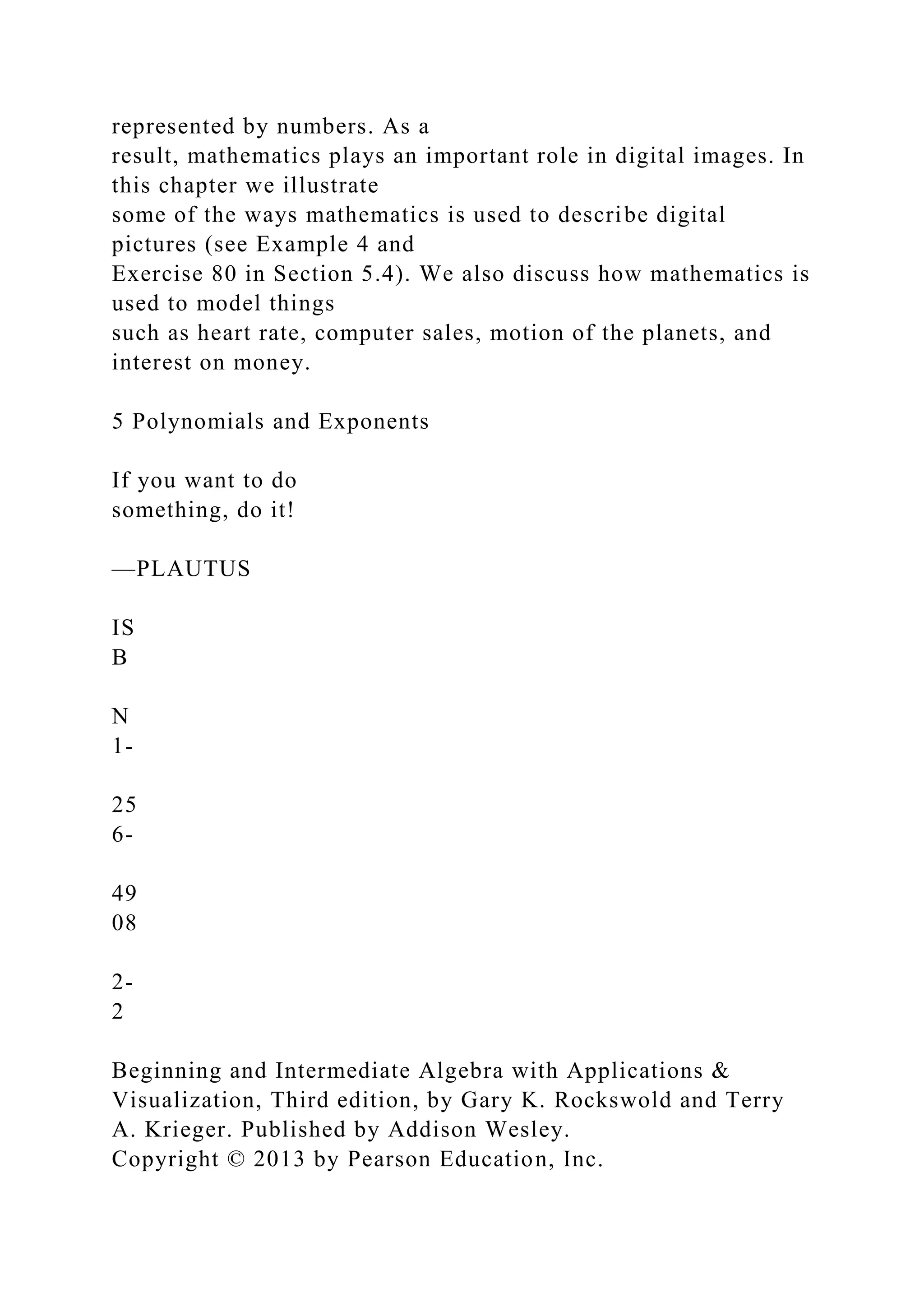
result, mathematics plays an important role in digital images. In
this chapter we illustrate
some of the ways mathematics is used to describe digital
pictures (see Example 4 and
Exercise 80 in Section 5.4). We also discuss how mathematics is
used to model things
such as heart rate, computer sales, motion of the planets, and
interest on money.
5 Polynomials and Exponents
If you want to do
something, do it!
—PLAUTUS
IS
B
N
1-
25
6-
49
08
2-
2
Beginning and Intermediate Algebra with Applications &
Visualization, Third edition, by Gary K. Rockswold and Terry
A. Krieger. Published by Addison Wesley.
Copyright © 2013 by Pearson Education, Inc.
298 CHAPTER 5 POLYNOMIALS AND EXPONENTS
When evaluating expressions, evaluate exponents before
performing addition, subtraction,
multiplication, division, or negation.
5.1 Rules for Exponents
Review of Bases and Exponents ● Zero Exponents ● The
Product Rule ● Power Rules
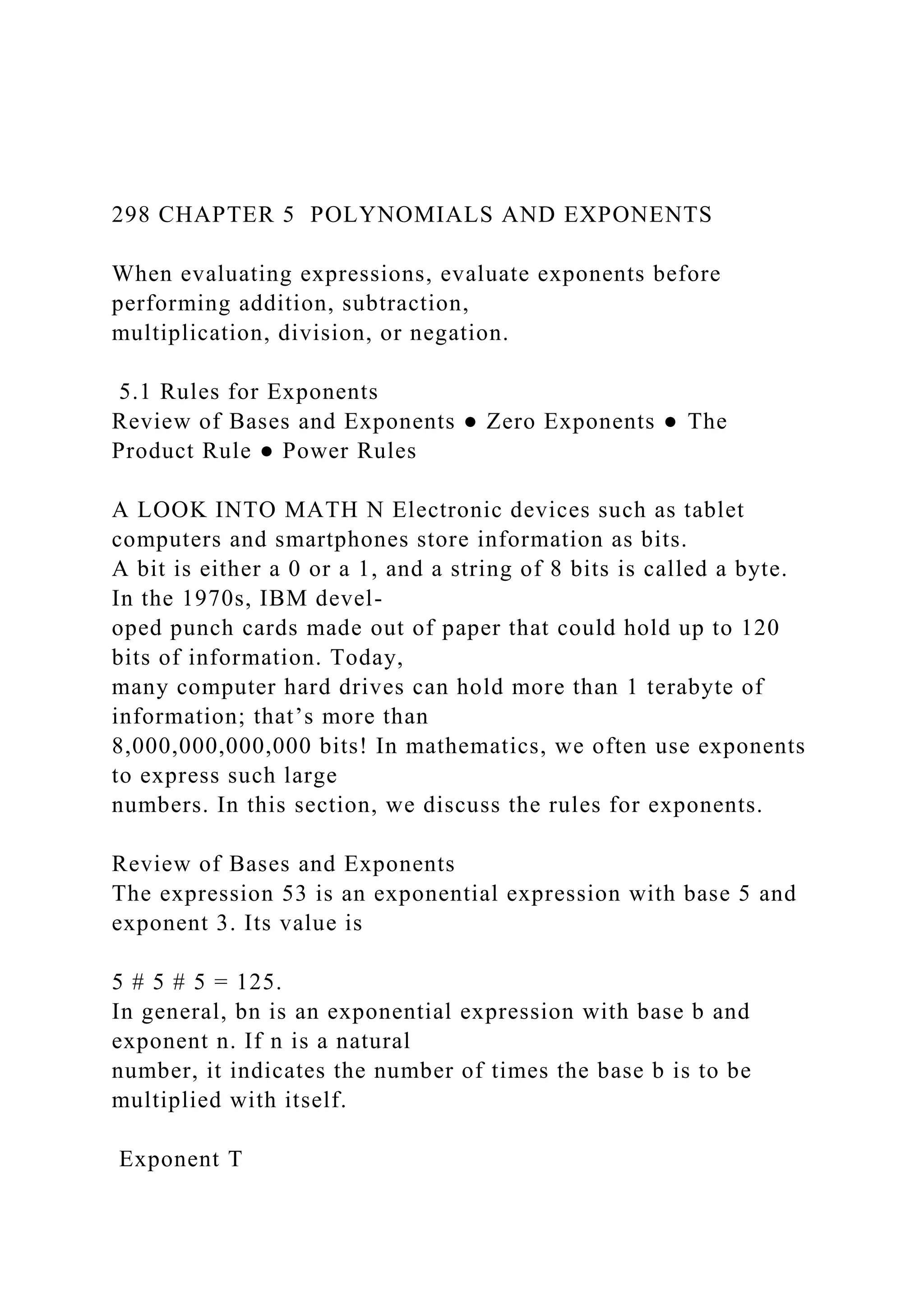
A LOOK INTO MATH N Electronic devices such as tablet
computers and smartphones store information as bits.
A bit is either a 0 or a 1, and a string of 8 bits is called a byte.
In the 1970s, IBM devel-
oped punch cards made out of paper that could hold up to 120
bits of information. Today,
many computer hard drives can hold more than 1 terabyte of
information; that’s more than
8,000,000,000,000 bits! In mathematics, we often use exponents
to express such large
numbers. In this section, we discuss the rules for exponents.
Review of Bases and Exponents
The expression 53 is an exponential expression with base 5 and
exponent 3. Its value is
5 # 5 # 5 = 125.
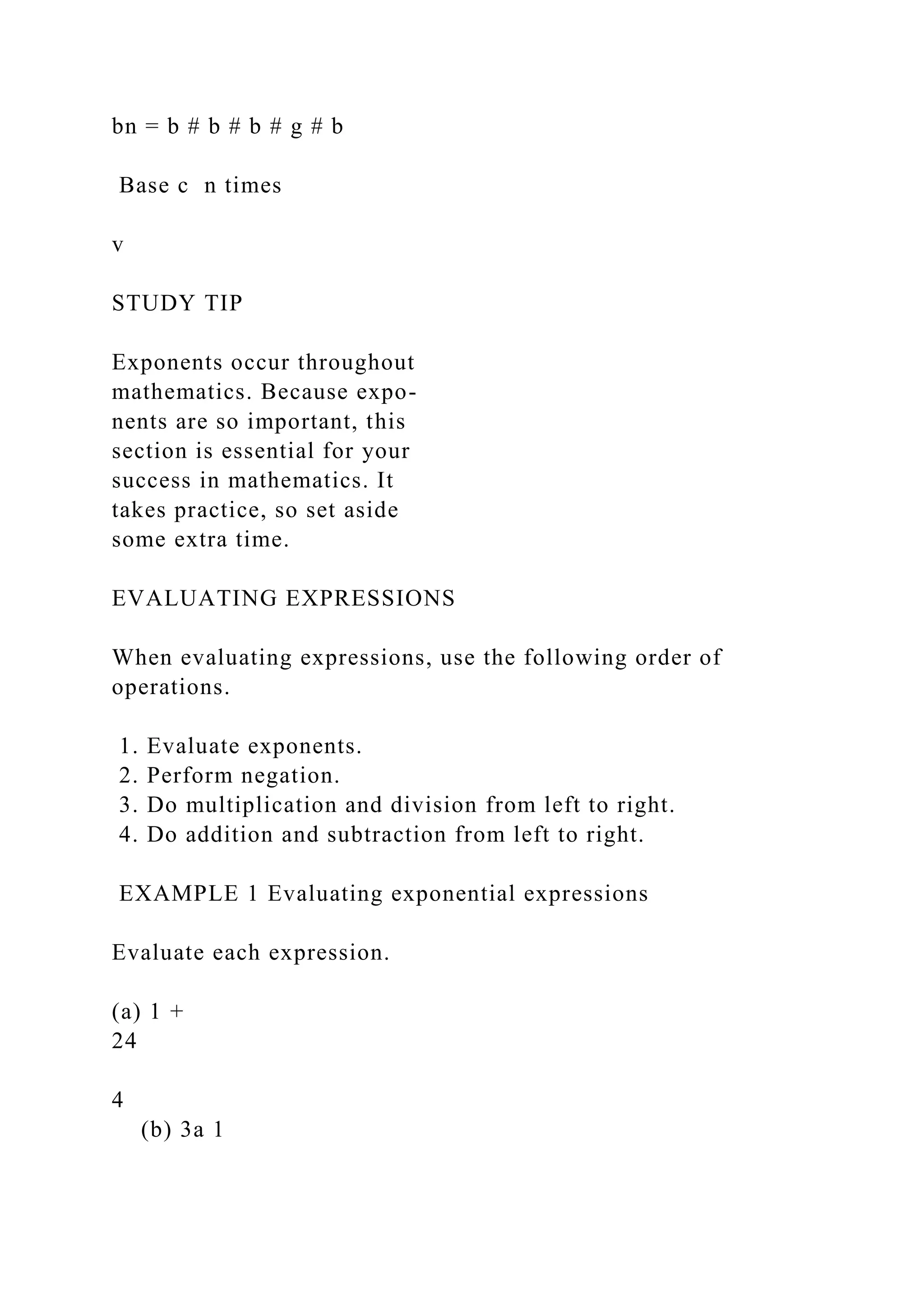
In general, bn is an exponential expression with base b and
exponent n. If n is a natural
number, it indicates the number of times the base b is to be
multiplied with itself.
Exponent T
bn = b # b # b # g # b
Base c n times
v
STUDY TIP
Exponents occur throughout
mathematics. Because expo-
nents are so important, this
section is essential for your
success in mathematics. It
takes practice, so set aside
some extra time.
EVALUATING EXPRESSIONS
When evaluating expressions, use the following order of
operations.
1. Evaluate exponents.
2. Perform negation.
3. Do multiplication and division from left to right.
4. Do addition and subtraction from left to right.
EXAMPLE 1 Evaluating exponential expressions
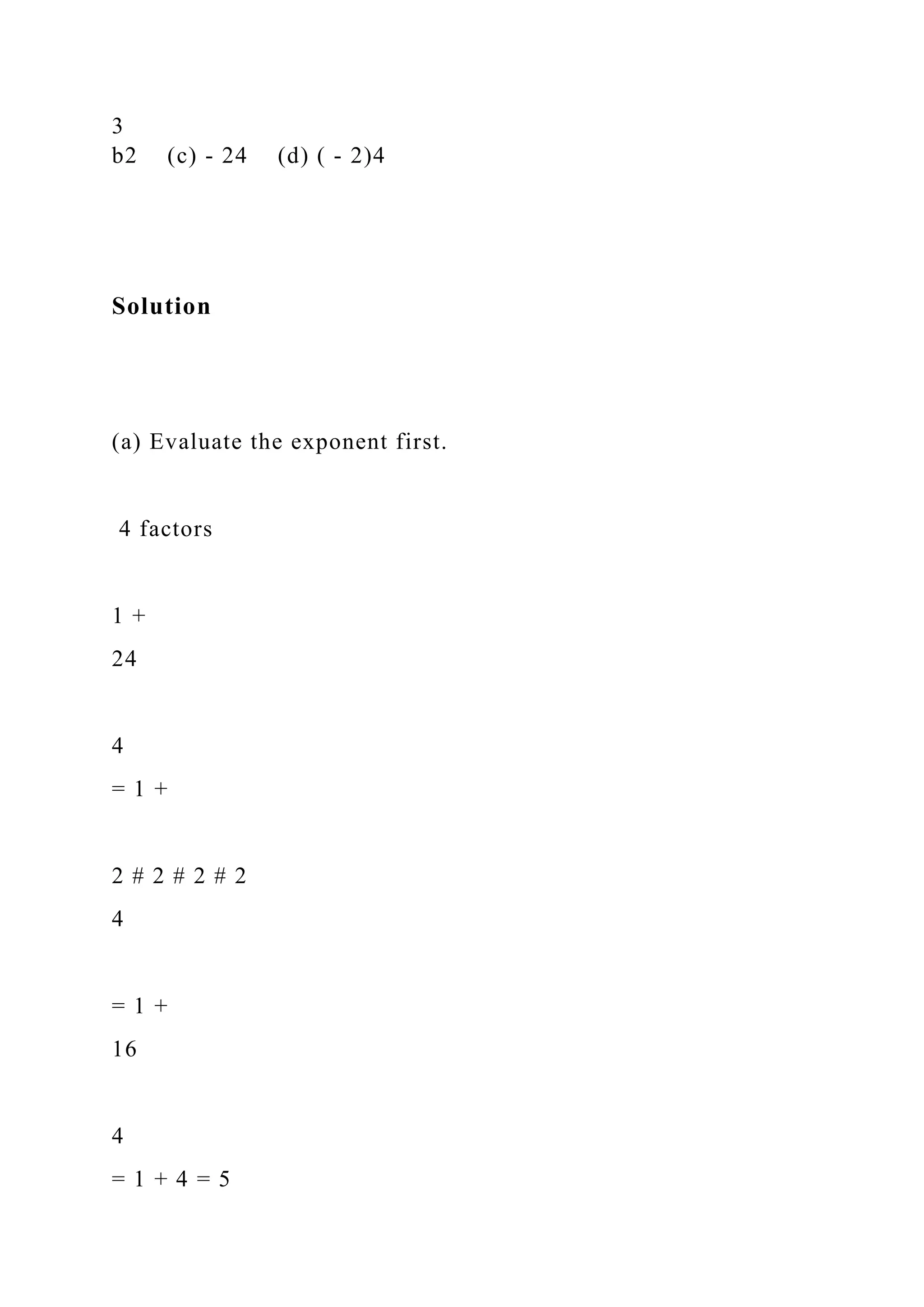
Evaluate each expression.
(a) 1 +
24
4
(b) 3a 1
3
b2 (c) - 24 (d) ( - 2)4
Solution
(a) Evaluate the exponent first.
4 factors
1 +
24
4
= 1 +
2 # 2 # 2 # 2
4
= 1 +
16
4
= 1 + 4 = 5
∂
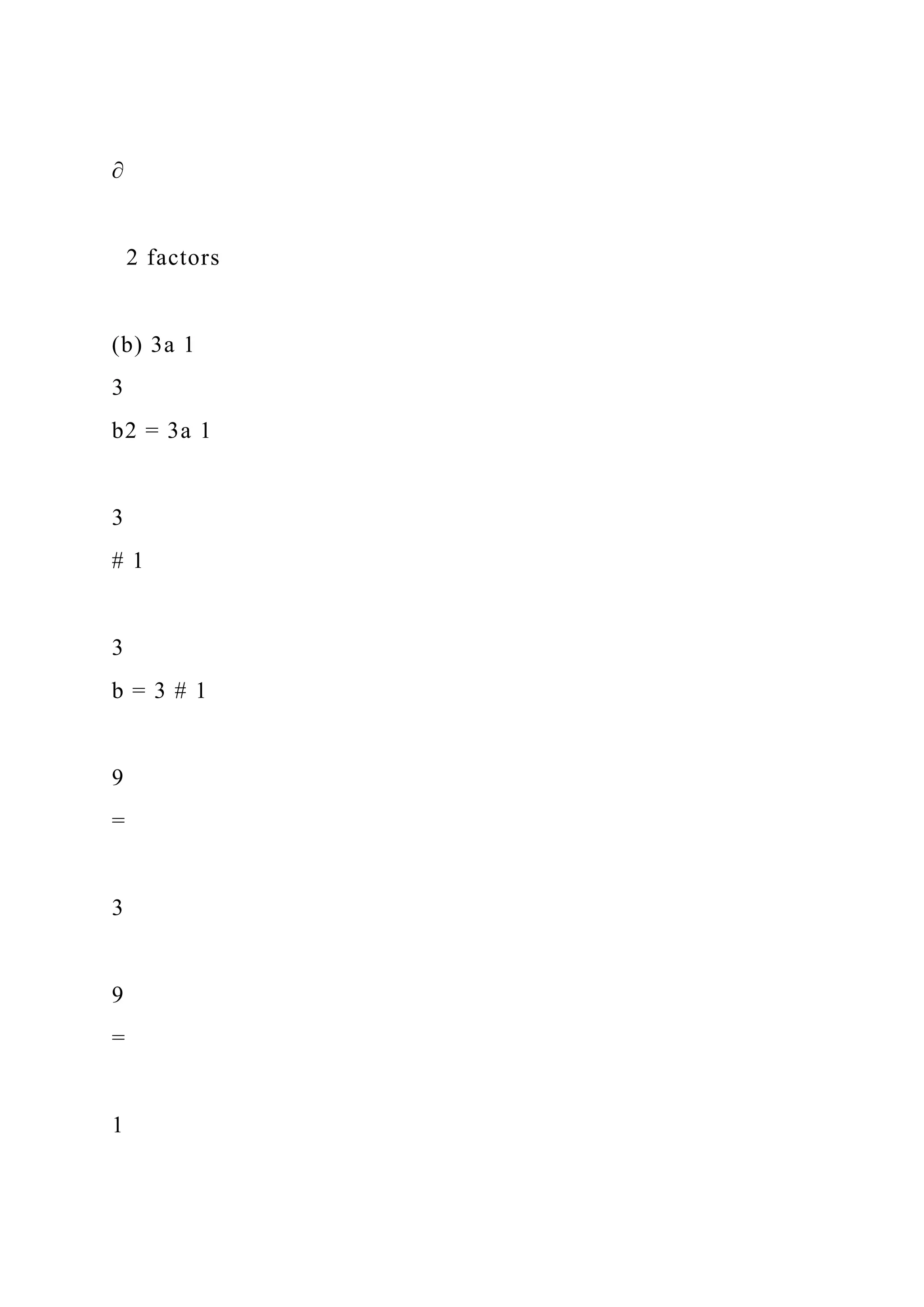
2 factors
(b) 3a 1
3
b2 = 3a 1
3
# 1
3
b = 3 # 1
9
=
3
9
=
1
3
f
IS
B
N
1-256-49082-2
Beginning and Intermediate Algebra with Applications &
Visualization, Third edition, by Gary K. Rockswold and Terry
A. Krieger. Published by Addison Wesley.
Copyright © 2013 by Pearson Education, Inc.
2995.1 RULES FOR EXPONENTS
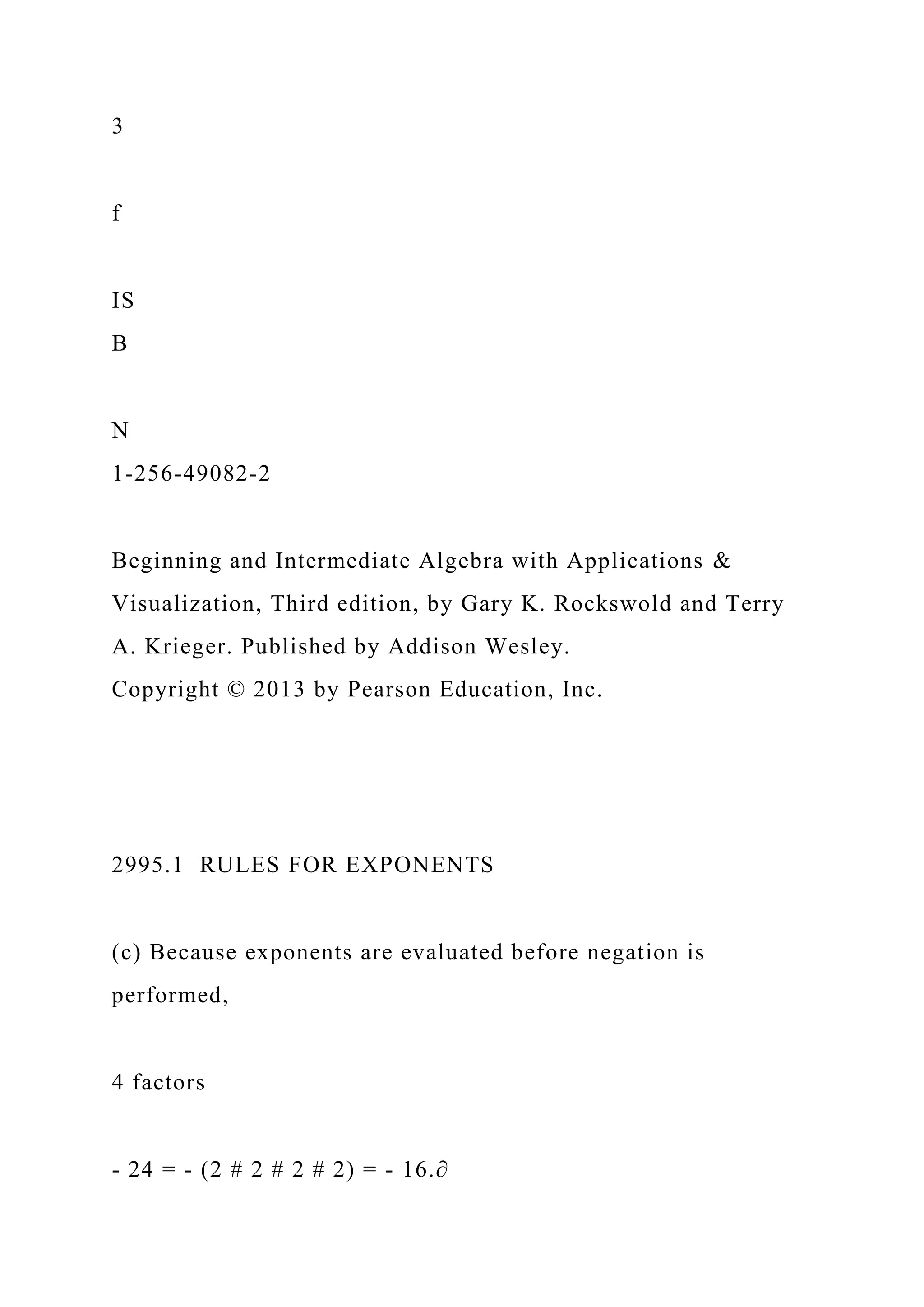
(c) Because exponents are evaluated before negation is
performed,
4 factors
- 24 = - (2 # 2 # 2 # 2) = - 16.∂
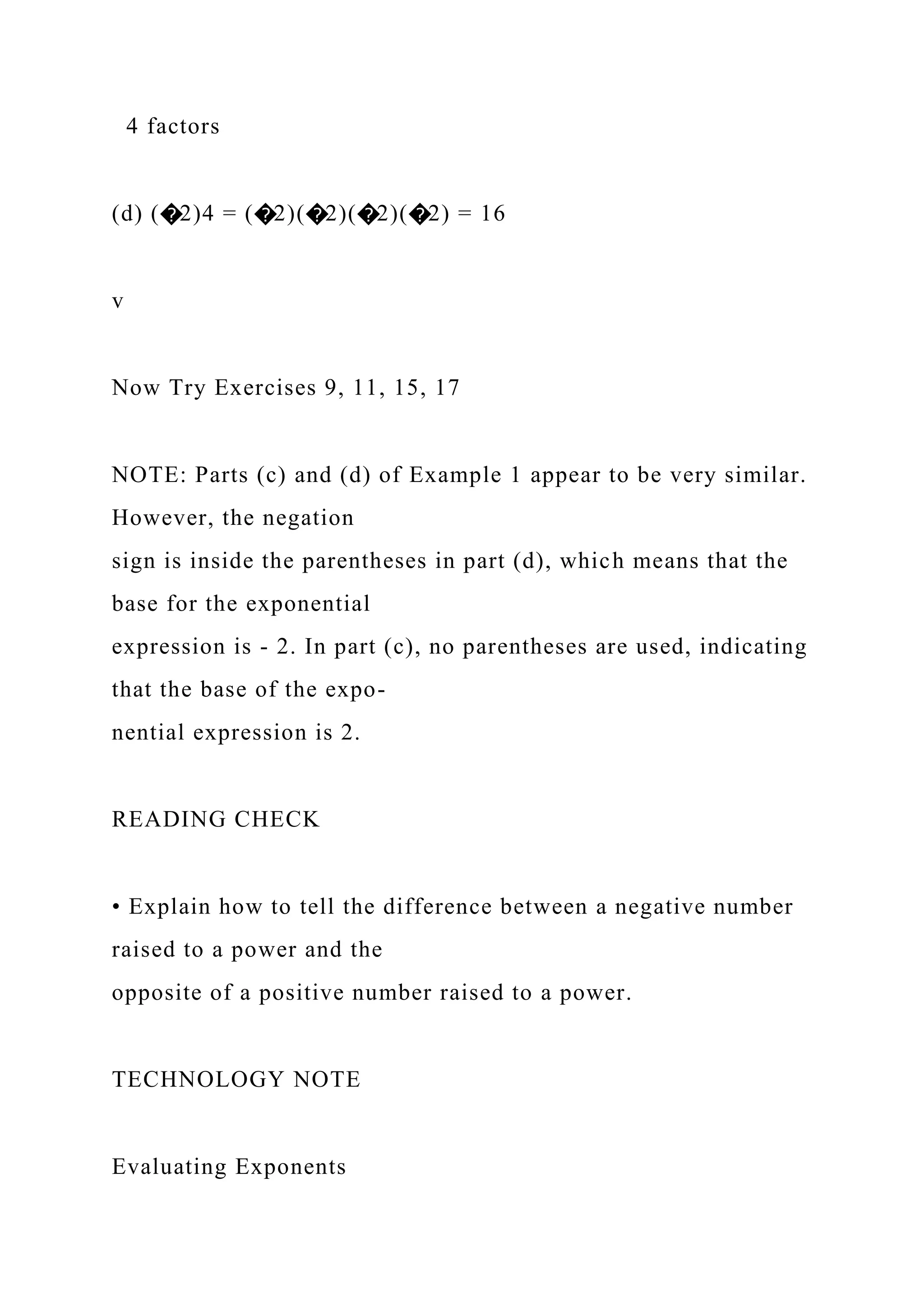
4 factors
(d) (�2)4 = (�2)(�2)(�2)(�2) = 16
v
Now Try Exercises 9, 11, 15, 17
NOTE: Parts (c) and (d) of Example 1 appear to be very similar.
However, the negation
sign is inside the parentheses in part (d), which means that the
base for the exponential
expression is - 2. In part (c), no parentheses are used, indicating
that the base of the expo-
nential expression is 2.
READING CHECK
• Explain how to tell the difference between a negative number
raised to a power and the
opposite of a positive number raised to a power.
TECHNOLOGY NOTE
Evaluating Exponents
Exponents can often be evaluated on calculators by using the ^
key. The four expressions from
Example 1 are evaluated with a calculator and the results are
shown in the following two figures.
When evaluating the last two expressions on your calculator,
remember to use the negation key
rather than the subtraction key.
1�2^4/4
5
3(1/3)2�Frac
1/3
�2^4
�16
(�2)^4
16
CALCULATOR HELP
To evaluate exponents, see Appendix
A (page AP-1).
Zero Exponents
So far we have discussed natural number exponents. What if an
exponent is 0? What does
20 equal? To answer these questions, consider Table 5.1, which
shows values for decreas-
ing powers of 2. Note that each time the power of 2 decreases
by 1, the resulting value is
divided by 2. For this pattern to continue, we need to define 20
to be 1 because dividing 2
by 2 results in 1.
This discussion suggests that 20 = 1, and is generalized as
follows.
TABLE 5.1 Powers of 2
Power of 2 Value
23 8
22 4
21 2
20 ?
ZERO EXPONENT
For any nonzero real number b,
b0 = 1.
The expression 00 is undefined.
IS
B
N
1-
25
6-
49
08
2-
2
Beginning and Intermediate Algebra with Applications &
Visualization, Third edition, by Gary K. Rockswold and Terry
A. Krieger. Published by Addison Wesley.
Copyright © 2013 by Pearson Education, Inc.
300 CHAPTER 5 POLYNOMIALS AND EXPONENTS
EXAMPLE 2 Evaluating zero exponents
Evaluate each expression. Assume that all variables represent
nonzero numbers.
(a) 70 (b) 3a 4
9
b0 (c) a x2y5
3z
b0

297Source NASA.5.1 Rules for Exponents5.2 Addition.docx

  • 1.
    297 Source: NASA. 5.1 Rulesfor Exponents 5.2 Addition and Subtrac- tion of Polynomials 5.3 Multiplication of Polynomials 5.4 Special Products 5.5 Integer Exponents and the Quotient Rule 5.6 Division of Polynomials Digital images were first sent between New York and London by cable in the early 1920s. Unfortunately, the transmission time was 3 hours and the quality was poor. Digital photography was developed further by NASA in the 1960s because ordinary pic- tures were subject to interference when transmitted through space. Today, digital pic- tures remain crystal clear even if they travel millions of miles. The following digital picture shows the planet Mars. Whether they are taken with a webcam, with a smartphone, or by the Mars rover, digital images comprise tiny units called pixels, which are
  • 2.
    represented by numbers.As a result, mathematics plays an important role in digital images. In this chapter we illustrate some of the ways mathematics is used to describe digital pictures (see Example 4 and Exercise 80 in Section 5.4). We also discuss how mathematics is used to model things such as heart rate, computer sales, motion of the planets, and interest on money. 5 Polynomials and Exponents If you want to do something, do it! —PLAUTUS IS B N 1- 25 6- 49 08 2- 2 Beginning and Intermediate Algebra with Applications & Visualization, Third edition, by Gary K. Rockswold and Terry A. Krieger. Published by Addison Wesley. Copyright © 2013 by Pearson Education, Inc.
  • 3.
    298 CHAPTER 5POLYNOMIALS AND EXPONENTS When evaluating expressions, evaluate exponents before performing addition, subtraction, multiplication, division, or negation. 5.1 Rules for Exponents Review of Bases and Exponents ● Zero Exponents ● The Product Rule ● Power Rules A LOOK INTO MATH N Electronic devices such as tablet computers and smartphones store information as bits. A bit is either a 0 or a 1, and a string of 8 bits is called a byte. In the 1970s, IBM devel- oped punch cards made out of paper that could hold up to 120 bits of information. Today, many computer hard drives can hold more than 1 terabyte of information; that’s more than 8,000,000,000,000 bits! In mathematics, we often use exponents to express such large numbers. In this section, we discuss the rules for exponents. Review of Bases and Exponents The expression 53 is an exponential expression with base 5 and exponent 3. Its value is 5 # 5 # 5 = 125. In general, bn is an exponential expression with base b and exponent n. If n is a natural number, it indicates the number of times the base b is to be multiplied with itself. Exponent T
  • 4.
    bn = b# b # b # g # b Base c n times v STUDY TIP Exponents occur throughout mathematics. Because expo- nents are so important, this section is essential for your success in mathematics. It takes practice, so set aside some extra time. EVALUATING EXPRESSIONS When evaluating expressions, use the following order of operations. 1. Evaluate exponents. 2. Perform negation. 3. Do multiplication and division from left to right. 4. Do addition and subtraction from left to right. EXAMPLE 1 Evaluating exponential expressions Evaluate each expression. (a) 1 + 24 4 (b) 3a 1
  • 5.
    3 b2 (c) -24 (d) ( - 2)4 Solution (a) Evaluate the exponent first. 4 factors 1 + 24 4 = 1 + 2 # 2 # 2 # 2 4 = 1 + 16 4 = 1 + 4 = 5
  • 6.
    ∂ 2 factors (b) 3a1 3 b2 = 3a 1 3 # 1 3 b = 3 # 1 9 = 3 9 = 1
  • 7.
    3 f IS B N 1-256-49082-2 Beginning and IntermediateAlgebra with Applications & Visualization, Third edition, by Gary K. Rockswold and Terry A. Krieger. Published by Addison Wesley. Copyright © 2013 by Pearson Education, Inc. 2995.1 RULES FOR EXPONENTS (c) Because exponents are evaluated before negation is performed, 4 factors - 24 = - (2 # 2 # 2 # 2) = - 16.∂
  • 8.
    4 factors (d) (�2)4= (�2)(�2)(�2)(�2) = 16 v Now Try Exercises 9, 11, 15, 17 NOTE: Parts (c) and (d) of Example 1 appear to be very similar. However, the negation sign is inside the parentheses in part (d), which means that the base for the exponential expression is - 2. In part (c), no parentheses are used, indicating that the base of the expo- nential expression is 2. READING CHECK • Explain how to tell the difference between a negative number raised to a power and the opposite of a positive number raised to a power. TECHNOLOGY NOTE Evaluating Exponents
  • 9.
    Exponents can oftenbe evaluated on calculators by using the ^ key. The four expressions from Example 1 are evaluated with a calculator and the results are shown in the following two figures. When evaluating the last two expressions on your calculator, remember to use the negation key rather than the subtraction key. 1�2^4/4 5 3(1/3)2�Frac 1/3 �2^4 �16 (�2)^4 16 CALCULATOR HELP To evaluate exponents, see Appendix A (page AP-1).
  • 10.
    Zero Exponents So farwe have discussed natural number exponents. What if an exponent is 0? What does 20 equal? To answer these questions, consider Table 5.1, which shows values for decreas- ing powers of 2. Note that each time the power of 2 decreases by 1, the resulting value is divided by 2. For this pattern to continue, we need to define 20 to be 1 because dividing 2 by 2 results in 1. This discussion suggests that 20 = 1, and is generalized as follows. TABLE 5.1 Powers of 2 Power of 2 Value 23 8 22 4 21 2 20 ?
  • 11.
    ZERO EXPONENT For anynonzero real number b, b0 = 1. The expression 00 is undefined. IS B N 1- 25 6- 49 08 2- 2 Beginning and Intermediate Algebra with Applications & Visualization, Third edition, by Gary K. Rockswold and Terry
  • 12.
    A. Krieger. Publishedby Addison Wesley. Copyright © 2013 by Pearson Education, Inc. 300 CHAPTER 5 POLYNOMIALS AND EXPONENTS EXAMPLE 2 Evaluating zero exponents Evaluate each expression. Assume that all variables represent nonzero numbers. (a) 70 (b) 3a 4 9 b0 (c) a x2y5 3z b0