Motion & Speed Notes TEKS 6.8B identify and describe the changes in position, direction and speed of an object when acted upon by unbalanced forces. TEKS 6.8C calculate average speed using distance and time measurements TEKS 6.8D measure and graph changes in motion
Forces  are pushes or pulls needed to:
start  an object moving
stop  an object’s motion
change the  speed  or  direction  of objects
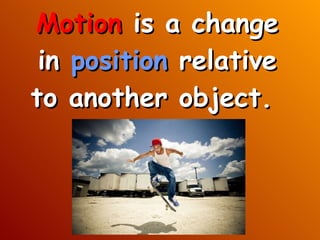
Motion  is a change in  position  relative to another object.
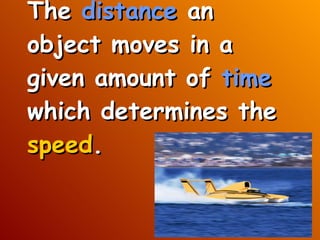
The  distance  an object moves in a given amount of  time  which determines the  speed .
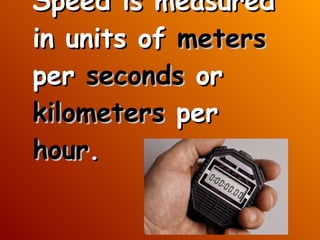
Speed is measured in units of  meters  per  seconds  or  kilometers  per  hour .
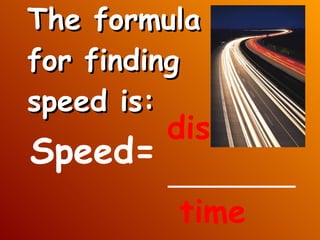
The formula for finding speed is:  Speed=  distance  time
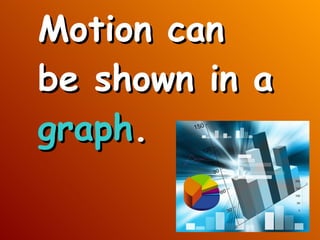
Motion can be shown in a  graph .
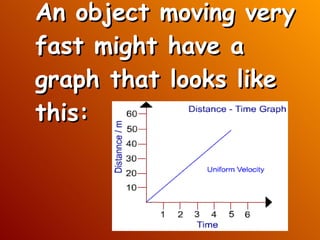
An object moving very fast might have a graph that looks like this:
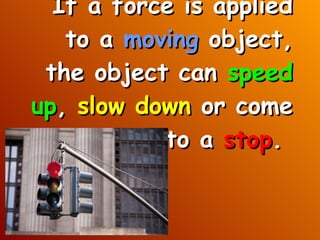
If a force is applied to a  moving  object, the object can  speed up ,  slow down  or come to a  stop .
A force can also change the  direction  an object is moving.
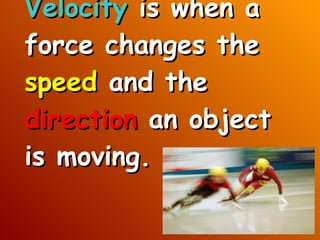
Velocity  is when a force changes the  speed  and the  direction  an object is moving.
Net Force The total of the forces acting on an object.
Forces like  gravity  or  buoyancy  can act of objects that are  not  moving.
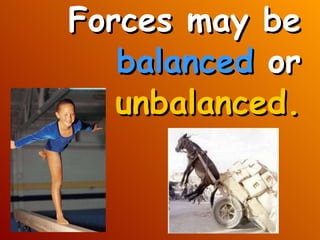
Forces may be  balanced  or  unbalanced.

Balanced forces do  not  result in a change of  motion.
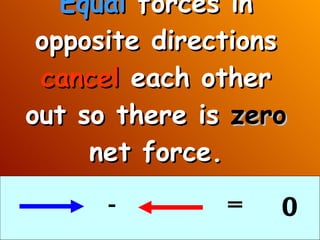
Equal  forces in opposite directions  cancel  each other out so there is  zero  net force. - = 0
Unbalanced forces  always  result in a change of  motion  or  direction .
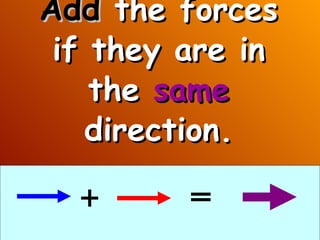
Add   the forces if they are in the   same   direction. + =
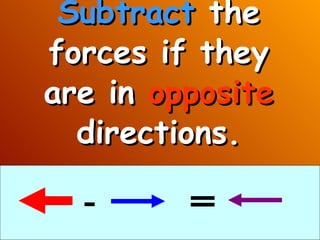
Subtract   the forces if they are in  opposite  directions. = -

Motion and speed notes

  • 1.
    Motion & SpeedNotes TEKS 6.8B identify and describe the changes in position, direction and speed of an object when acted upon by unbalanced forces. TEKS 6.8C calculate average speed using distance and time measurements TEKS 6.8D measure and graph changes in motion
  • 2.
    Forces arepushes or pulls needed to:
  • 3.
    start anobject moving
  • 4.
    stop anobject’s motion
  • 5.
    change the speed or direction of objects
  • 6.
    Motion isa change in position relative to another object.
  • 7.
    The distance an object moves in a given amount of time which determines the speed .
  • 8.
    Speed is measuredin units of meters per seconds or kilometers per hour .
  • 9.
    The formula forfinding speed is: Speed= distance time
  • 10.
    Motion can beshown in a graph .
  • 11.
    An object movingvery fast might have a graph that looks like this:
  • 12.
    If a forceis applied to a moving object, the object can speed up , slow down or come to a stop .
  • 13.
    A force canalso change the direction an object is moving.
  • 14.
    Velocity iswhen a force changes the speed and the direction an object is moving.
  • 15.
    Net Force Thetotal of the forces acting on an object.
  • 16.
    Forces like gravity or buoyancy can act of objects that are not moving.
  • 17.
    Forces may be balanced or unbalanced.
  • 18.
    Balanced forces do not result in a change of motion.
  • 19.
    Equal forcesin opposite directions cancel each other out so there is zero net force. - = 0
  • 20.
    Unbalanced forces always result in a change of motion or direction .
  • 21.
    Add the forces if they are in the same direction. + =
  • 22.
    Subtract the forces if they are in opposite directions. = -