UNIT 6. EARTH’S
STRUCTURE
UNIT OBJECTIVES
 To learn what the Earth is like.
 To understand the Earth’s changes.
 To learn about the Earth’s dynamics and rock
formation.
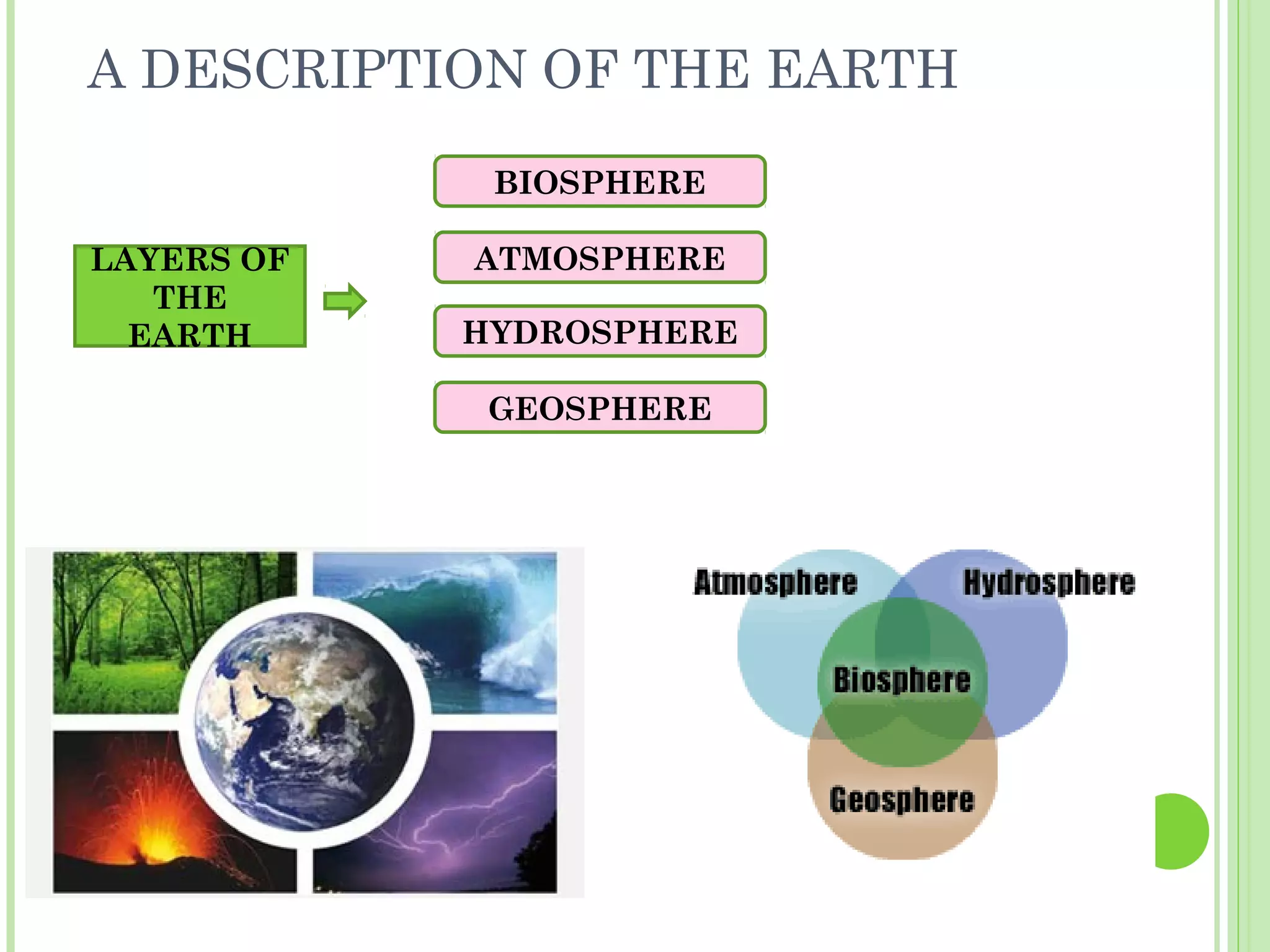
A DESCRIPTION OF THE EARTH
LAYERS OF
THE
EARTH
BIOSPHERE
ATMOSPHERE
HYDROSPHERE
GEOSPHERE
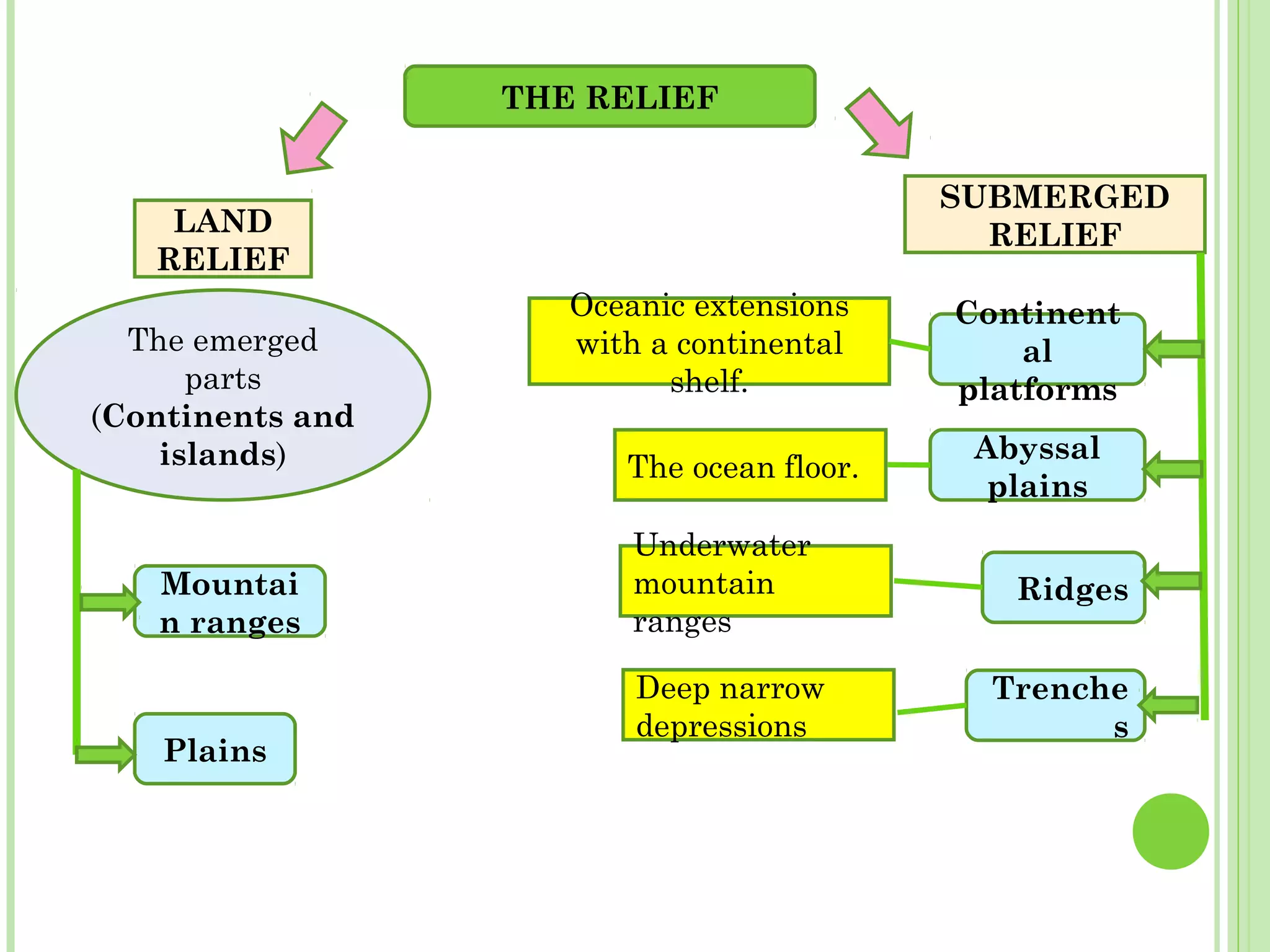
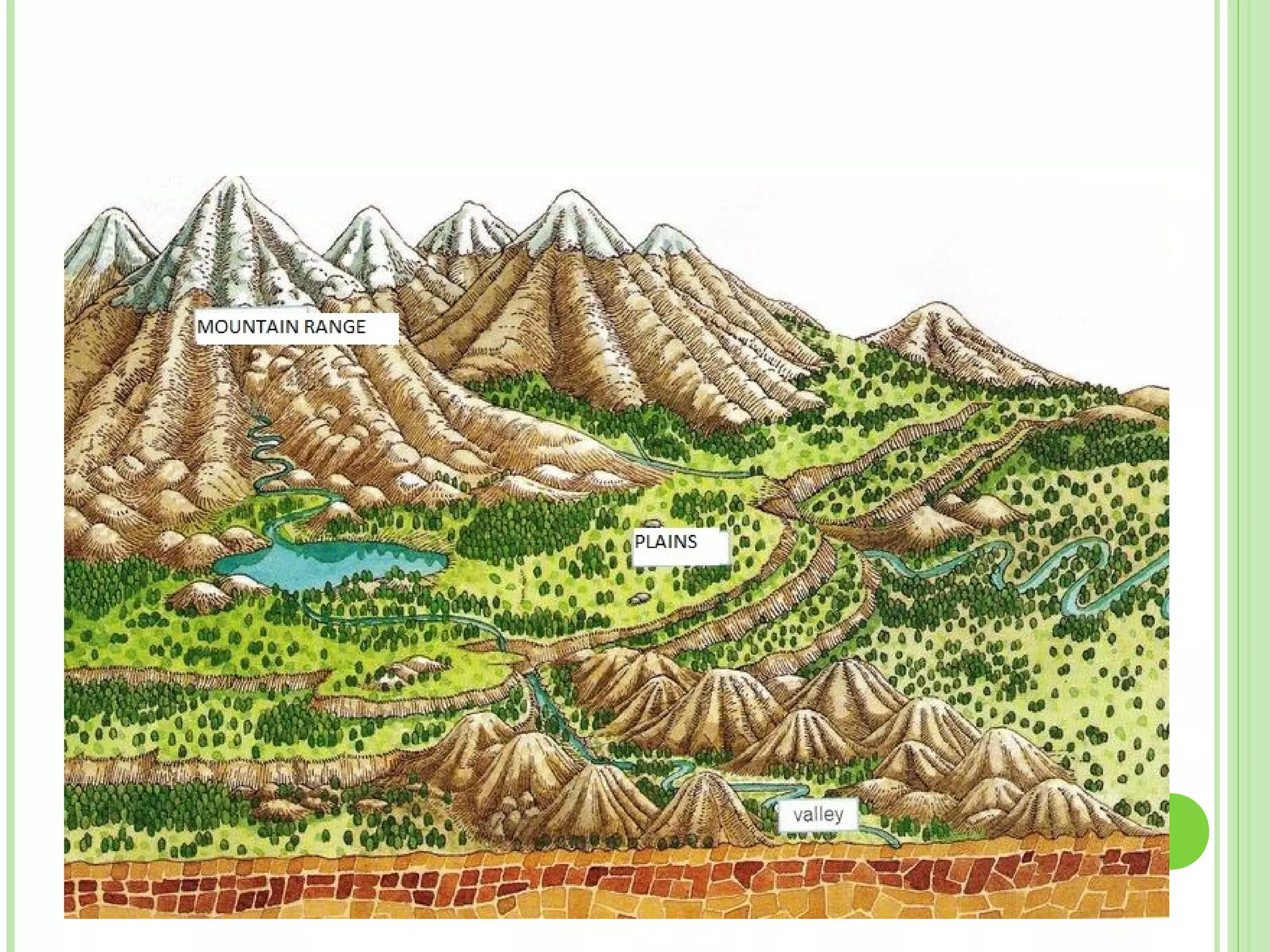
THE RELIEF
LAND
RELIEF
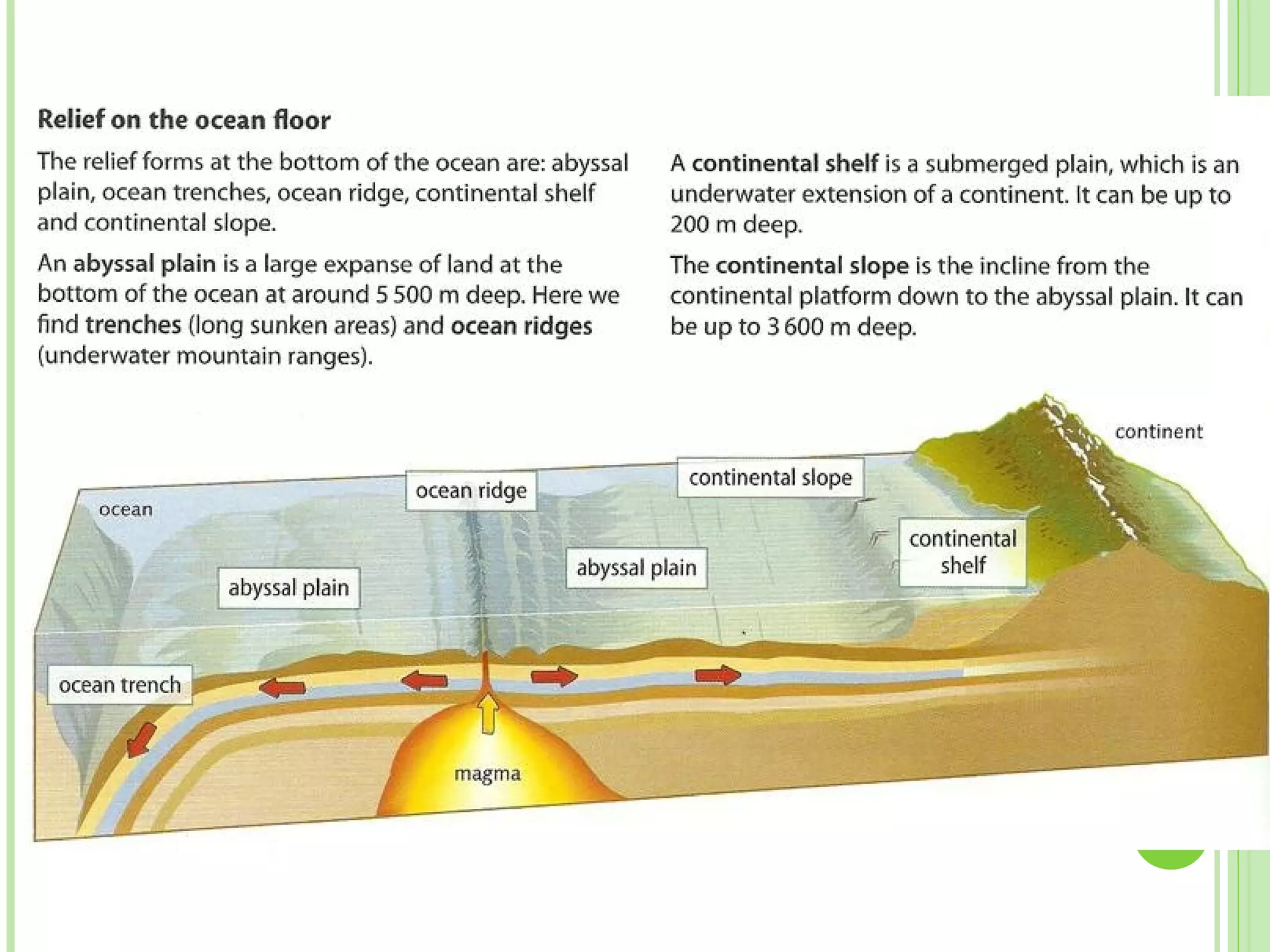
SUBMERGED
RELIEF
The emerged
parts
(Continents and
islands)
Mountai
n ranges
Plains
Continent
al
platforms
Abyssal
plains
Ridges
Trenche
s
Oceanic extensions
with a continental
shelf.
The ocean floor.
Underwater
mountain
ranges
Deep narrow
depressions
ACTIVITIES
1. Match:
a) Biosphere 1-All the gases on the Earth
b) Atmosphere 2-It’s made of rocks
c) Hydrosphere 3-All the water on the planet
d) Geosphere 4-All the living things on the
planet
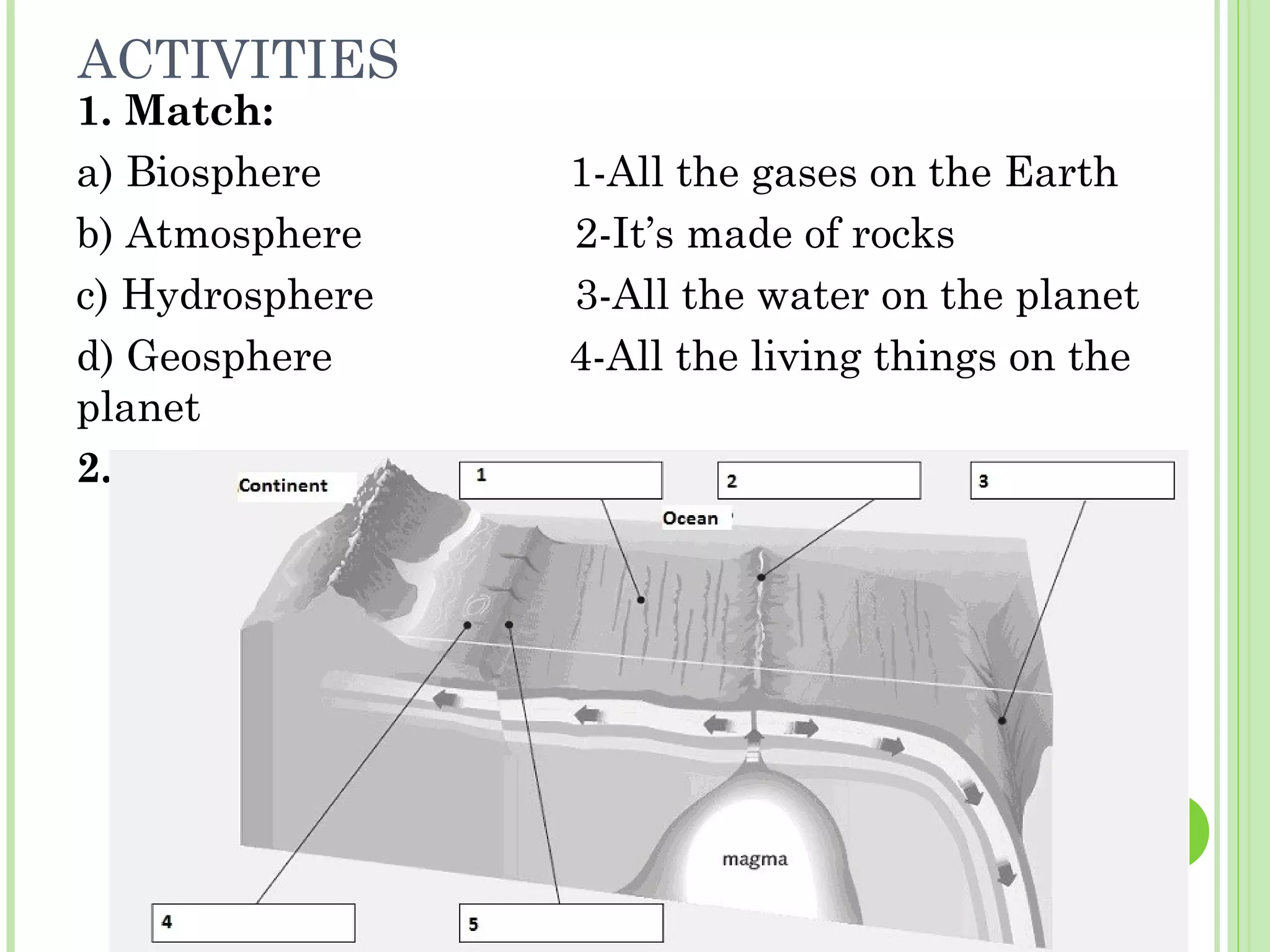
2. Complete the diagram
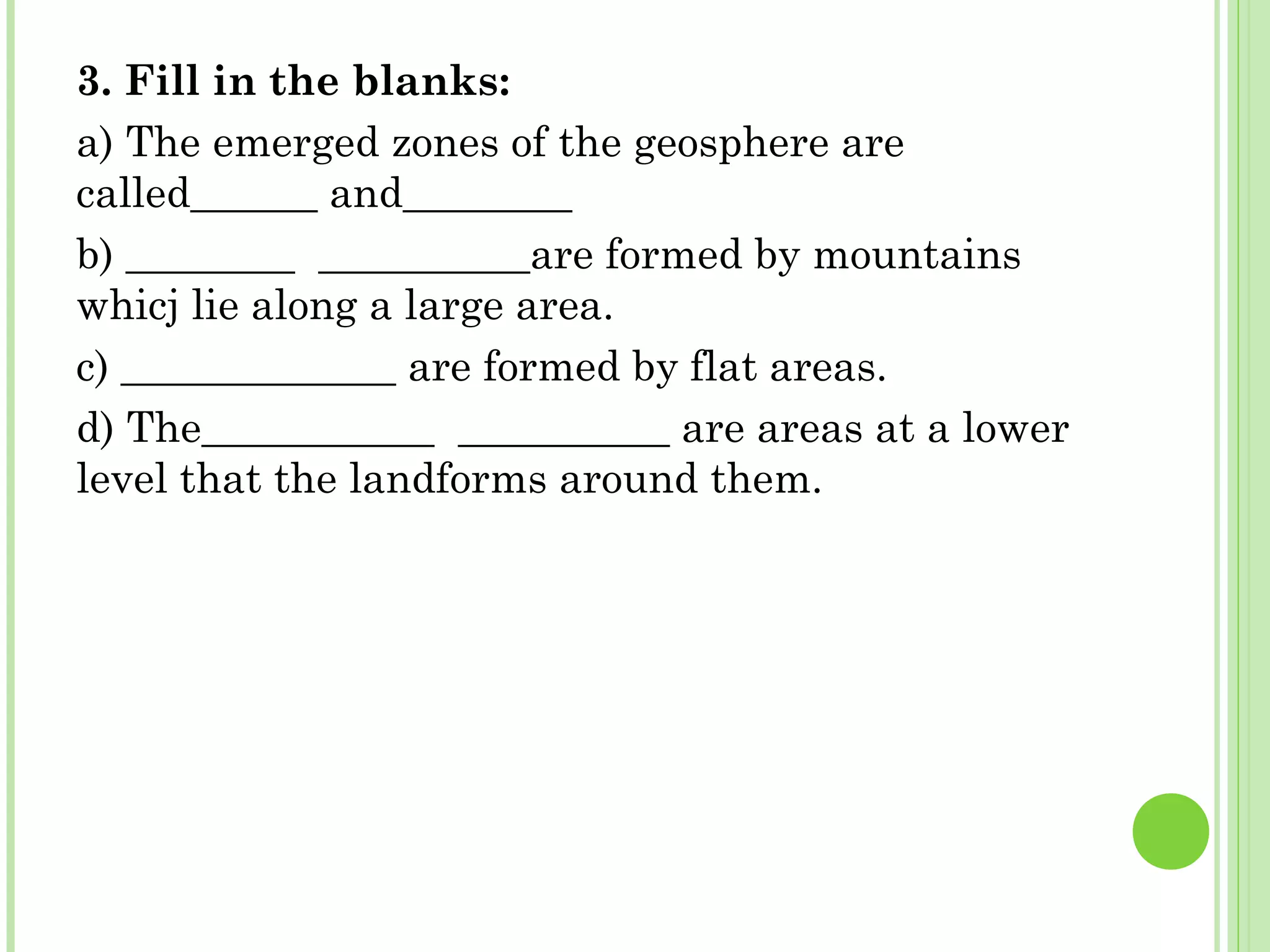
3. Fill in the blanks:
a) The emerged zones of the geosphere are
called______ and________
b) ________ __________are formed by mountains
whicj lie along a large area.
c) _____________ are formed by flat areas.
d) The___________ __________ are areas at a lower
level that the landforms around them.
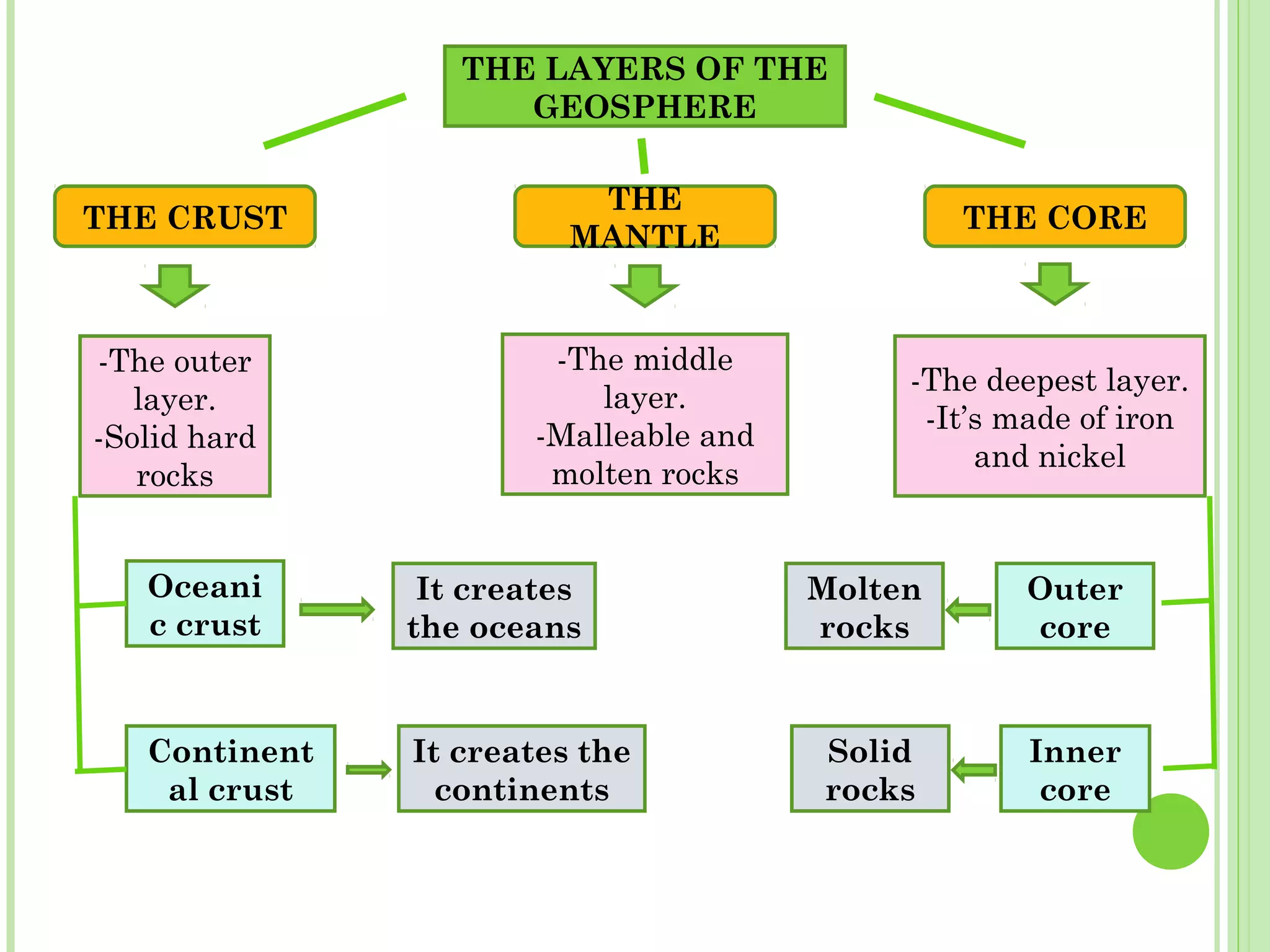
THE LAYERS OF THE
GEOSPHERE
THE CRUST
THE
MANTLE
THE CORE
-The outer
layer.
-Solid hard
rocks
Oceani
c crust
Continent
al crust
-The middle
layer.
-Malleable and
molten rocks
-The deepest layer.
-It’s made of iron
and nickel
Outer
core
Inner
core
Molten
rocks
Solid
rocks
It creates
the oceans
It creates the
continents
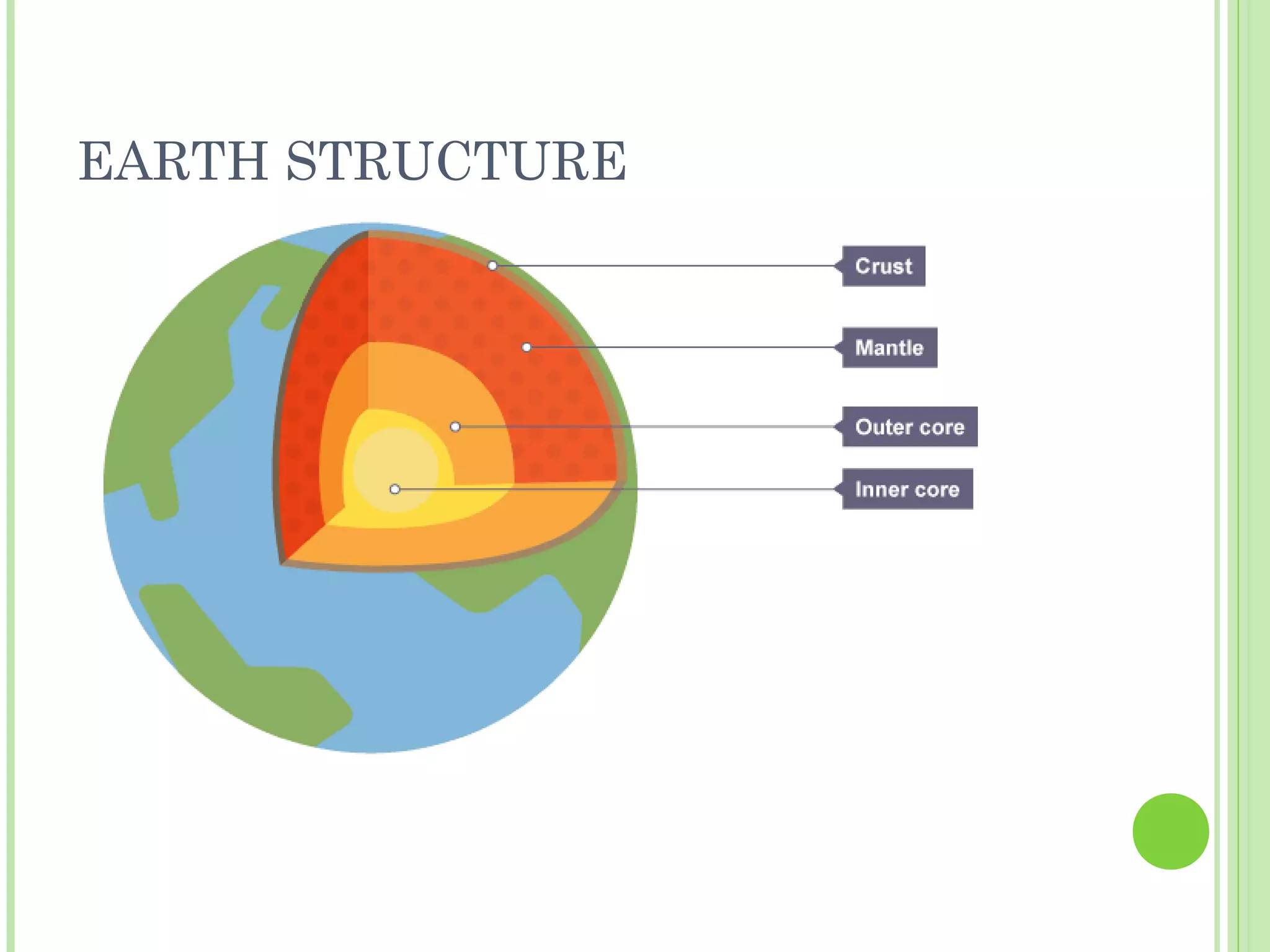
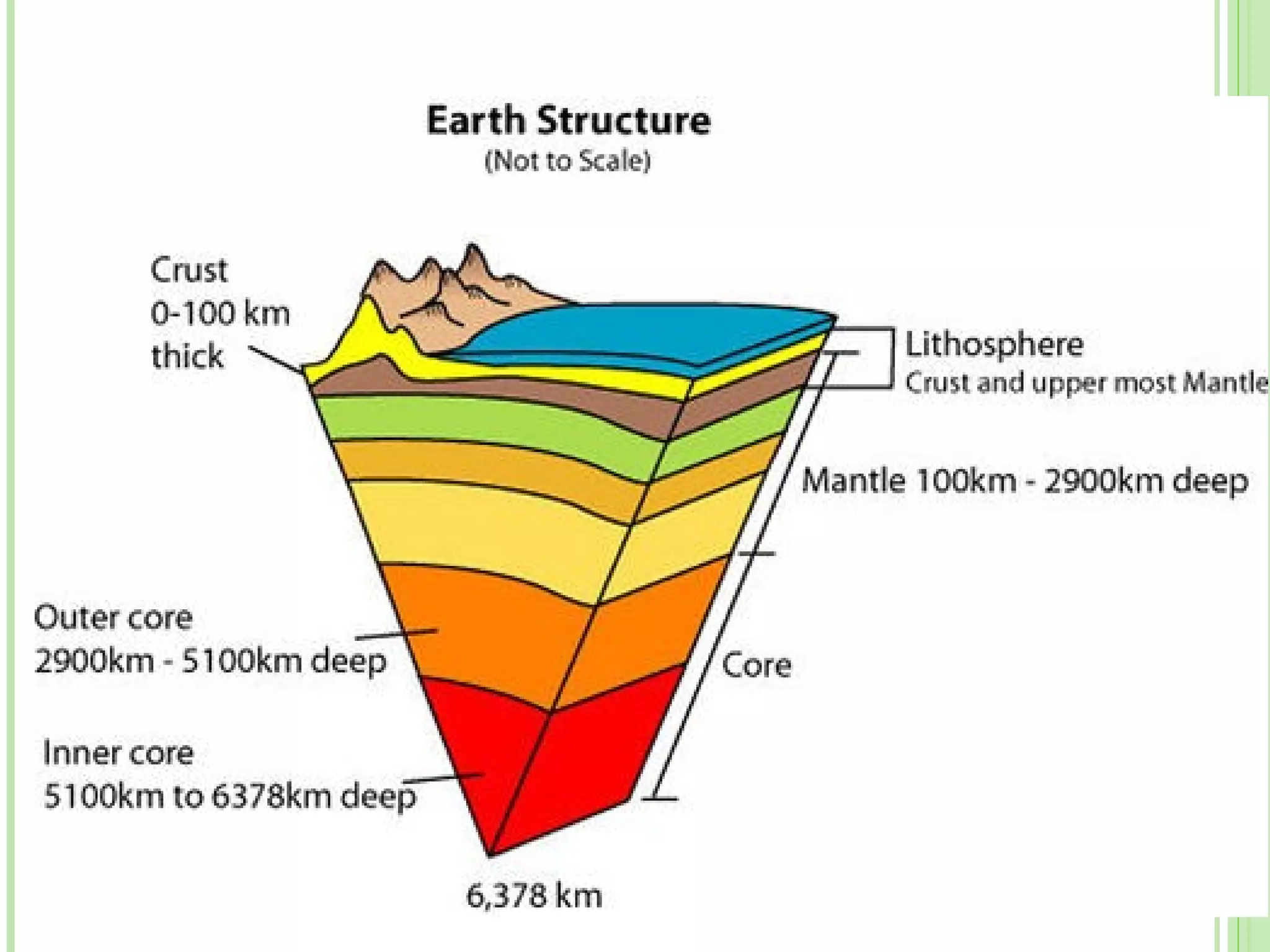
EARTH STRUCTURE
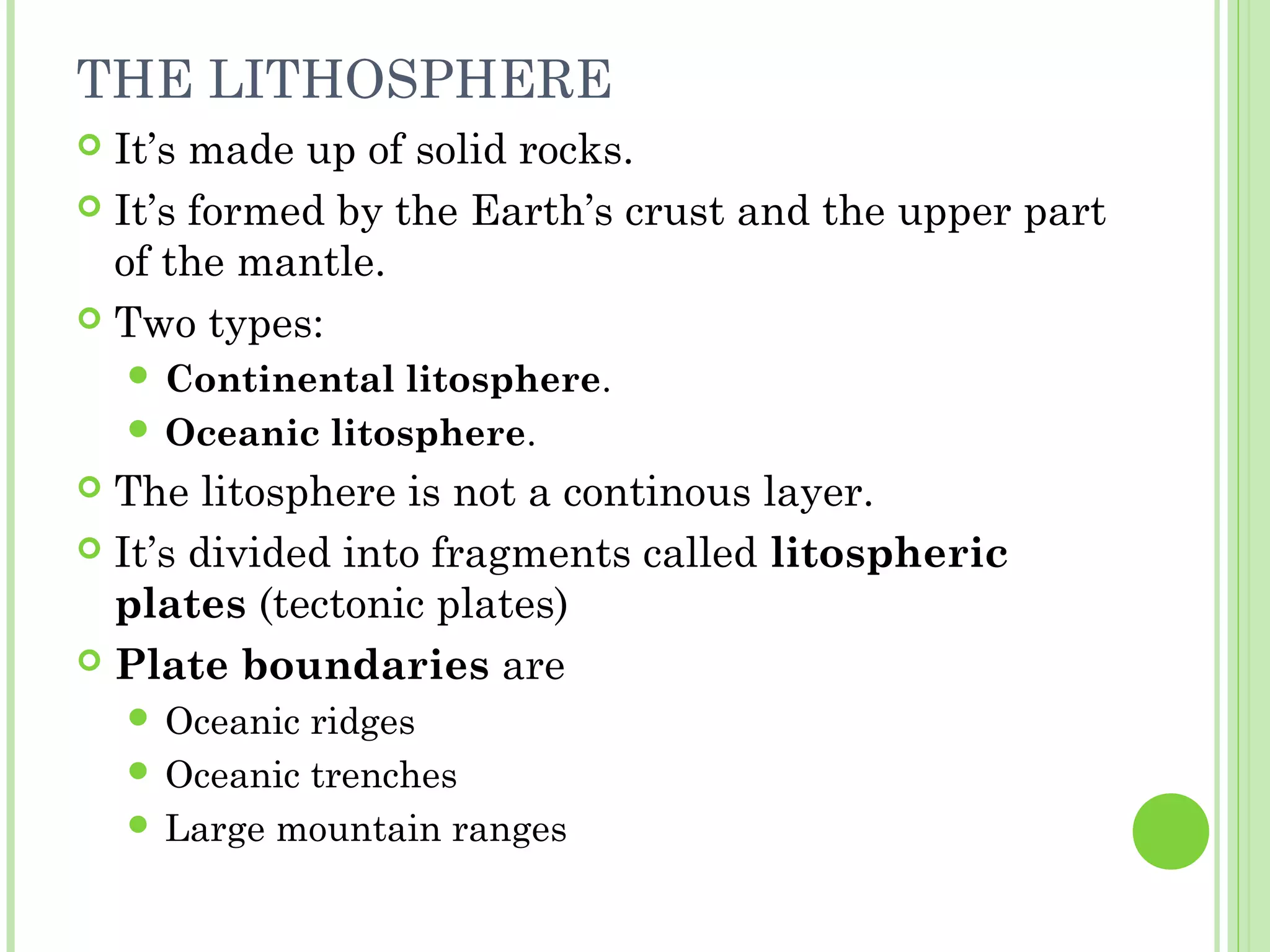
THE LITHOSPHERE
 It’s made up of solid rocks.
 It’s formed by the Earth’s crust and the upper part
of the mantle.
 Two types:
 Continental litosphere.
 Oceanic litosphere.
 The litosphere is not a continous layer.
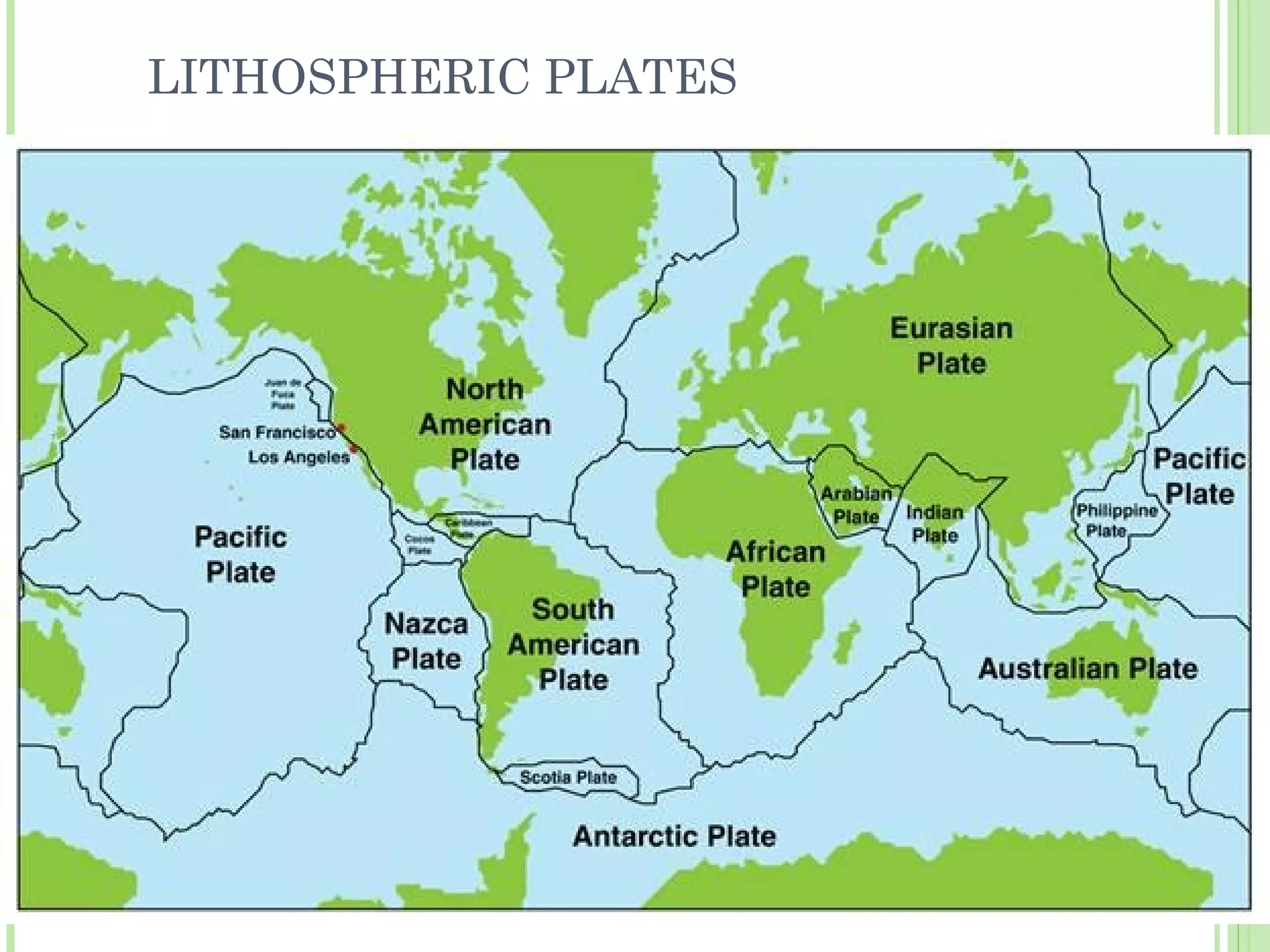
 It’s divided into fragments called litospheric
plates (tectonic plates)
 Plate boundaries are
 Oceanic ridges
 Oceanic trenches
 Large mountain ranges
LITHOSPHERIC PLATES
ACTIVITIES
4. True or false? Correct them.
a) The Earth’s crust is made up of elastic rocks.
b) The earths’s crust can be continental or oceanic.
c) The mantle is the thinnest layer of the geosphere.
d) The core is made up of the outer core which is solid,
and the inner core which is molten.
5. Write the name of all the tectonic plates.
6. Write down the name of two continents which
are almost completely on a single plate.
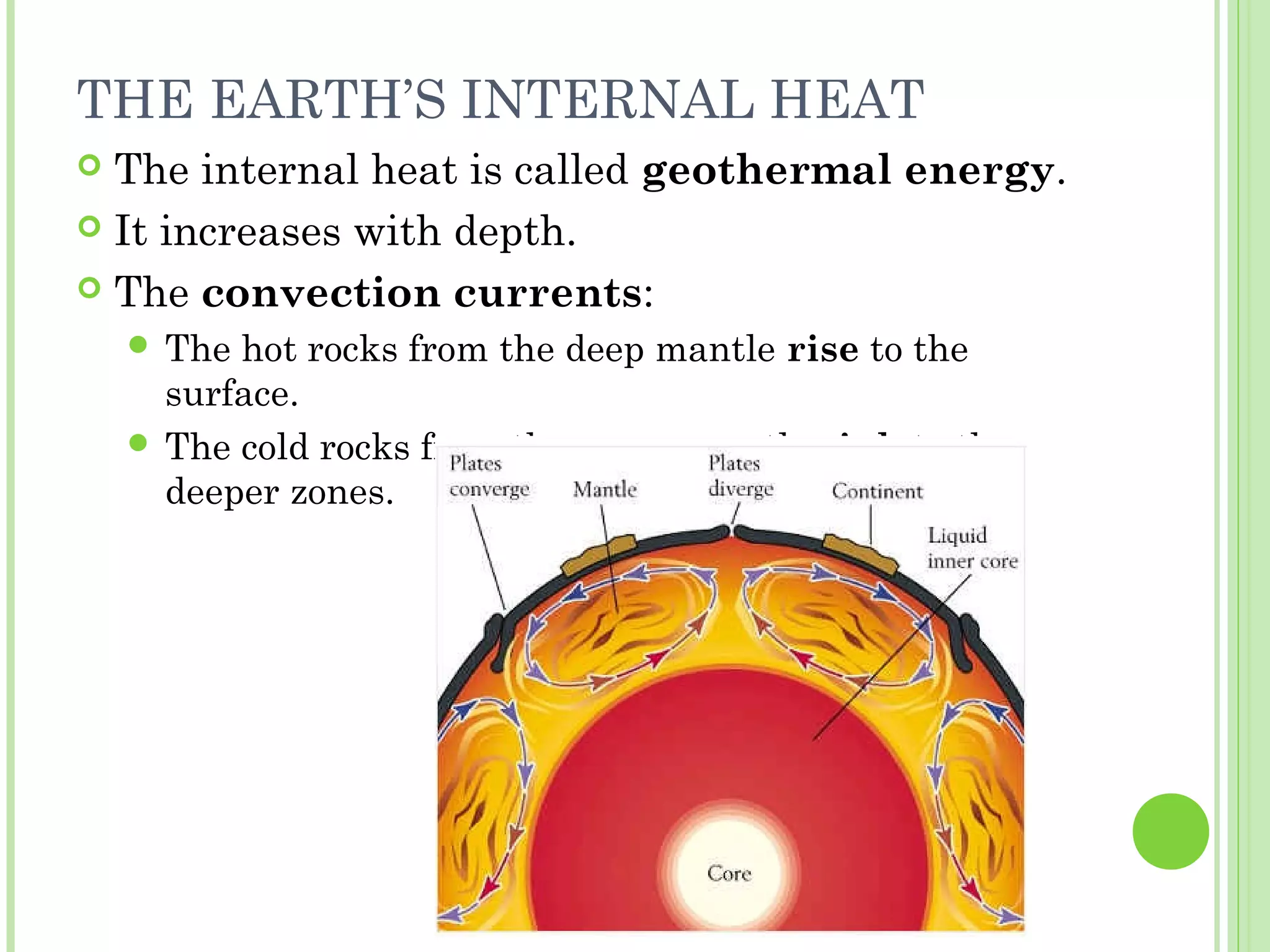
THE EARTH’S INTERNAL HEAT
 The internal heat is called geothermal energy.
 It increases with depth.
 The convection currents:
 The hot rocks from the deep mantle rise to the
surface.
 The cold rocks from the upper mantle sink to the
deeper zones.
ACTIVITIES
7. Fill in the blanks:
The Earth’s internal energy is called______ _______
and it creases with______.
This energy produce some cyclic displacements
called_______ _______, in which very hot rocks from
the ______ mantle become less______ and they rise to
the________, while the rocks in the ______ mantle
which are ______ sink to the deeper zones.
ROCK FORMATION
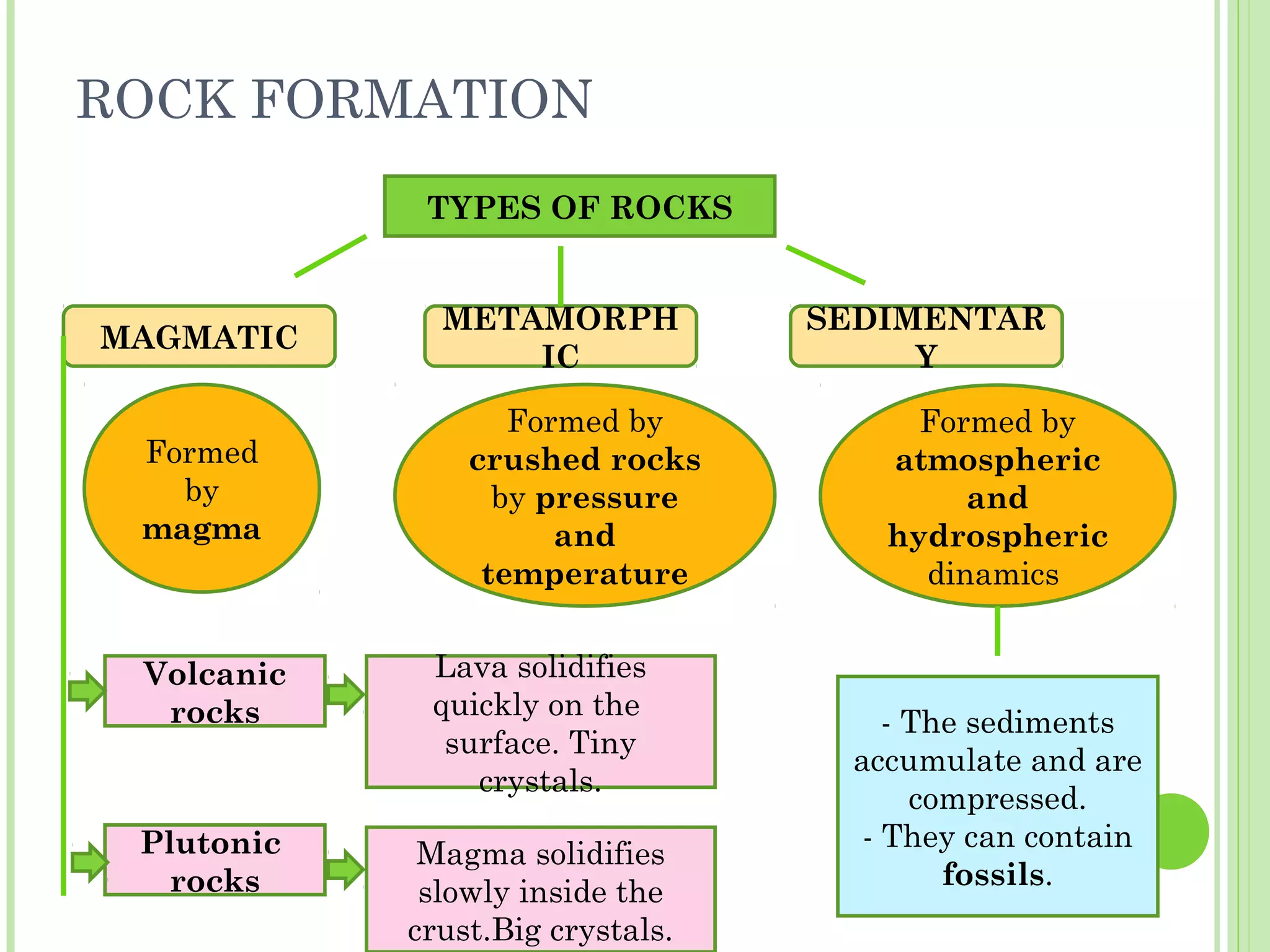
TYPES OF ROCKS
MAGMATIC
METAMORPH
IC
SEDIMENTAR
Y
Volcanic
rocks
Plutonic
rocks
Lava solidifies
quickly on the
surface. Tiny
crystals.
Magma solidifies
slowly inside the
crust.Big crystals.
Formed
by
magma
Formed by
crushed rocks
by pressure
and
temperature
Formed by
atmospheric
and
hydrospheric
dinamics
- The sediments
accumulate and are
compressed.
- They can contain
fossils.
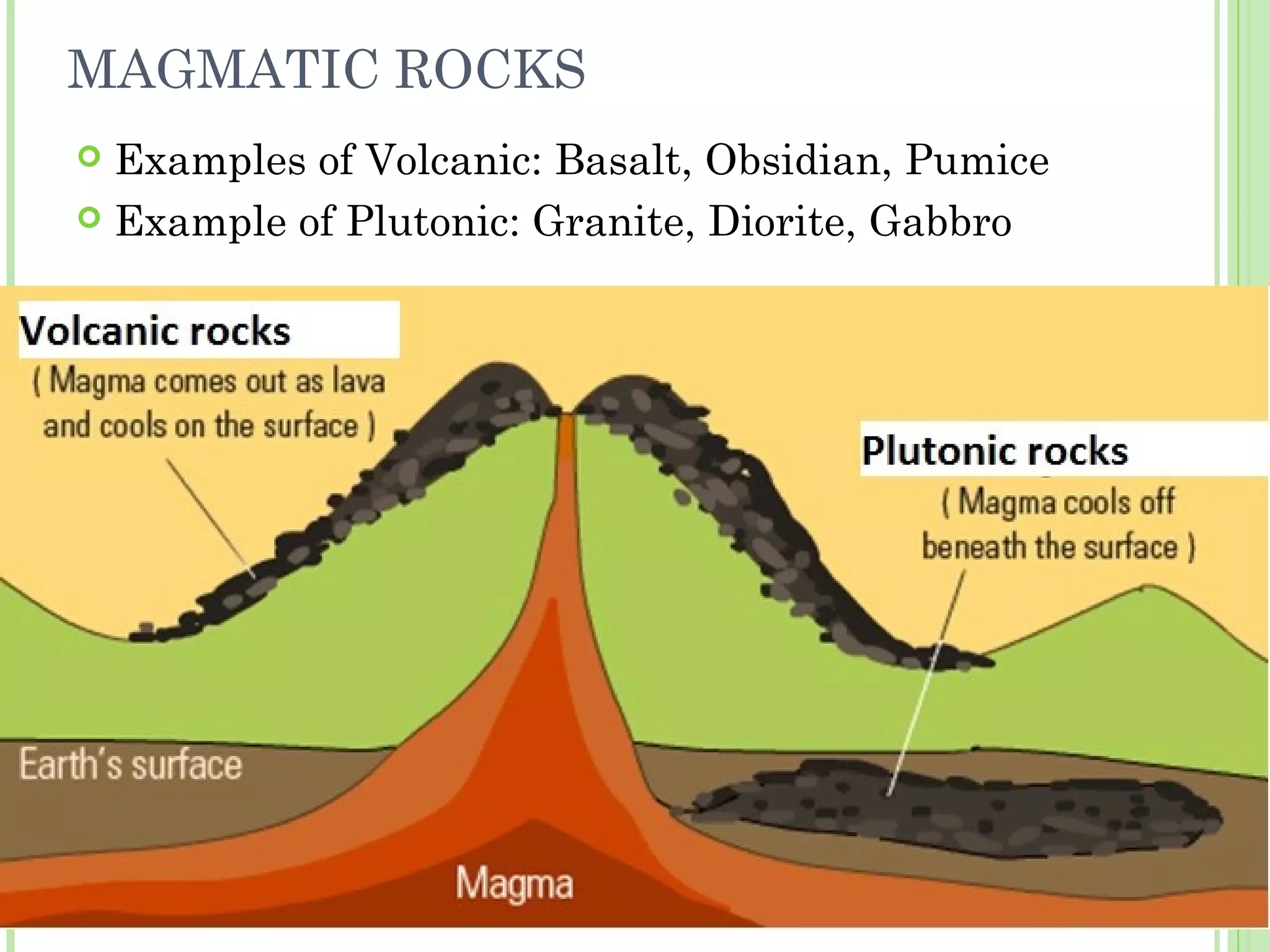
MAGMATIC ROCKS
 Examples of Volcanic: Basalt, Obsidian, Pumice
 Example of Plutonic: Granite, Diorite, Gabbro
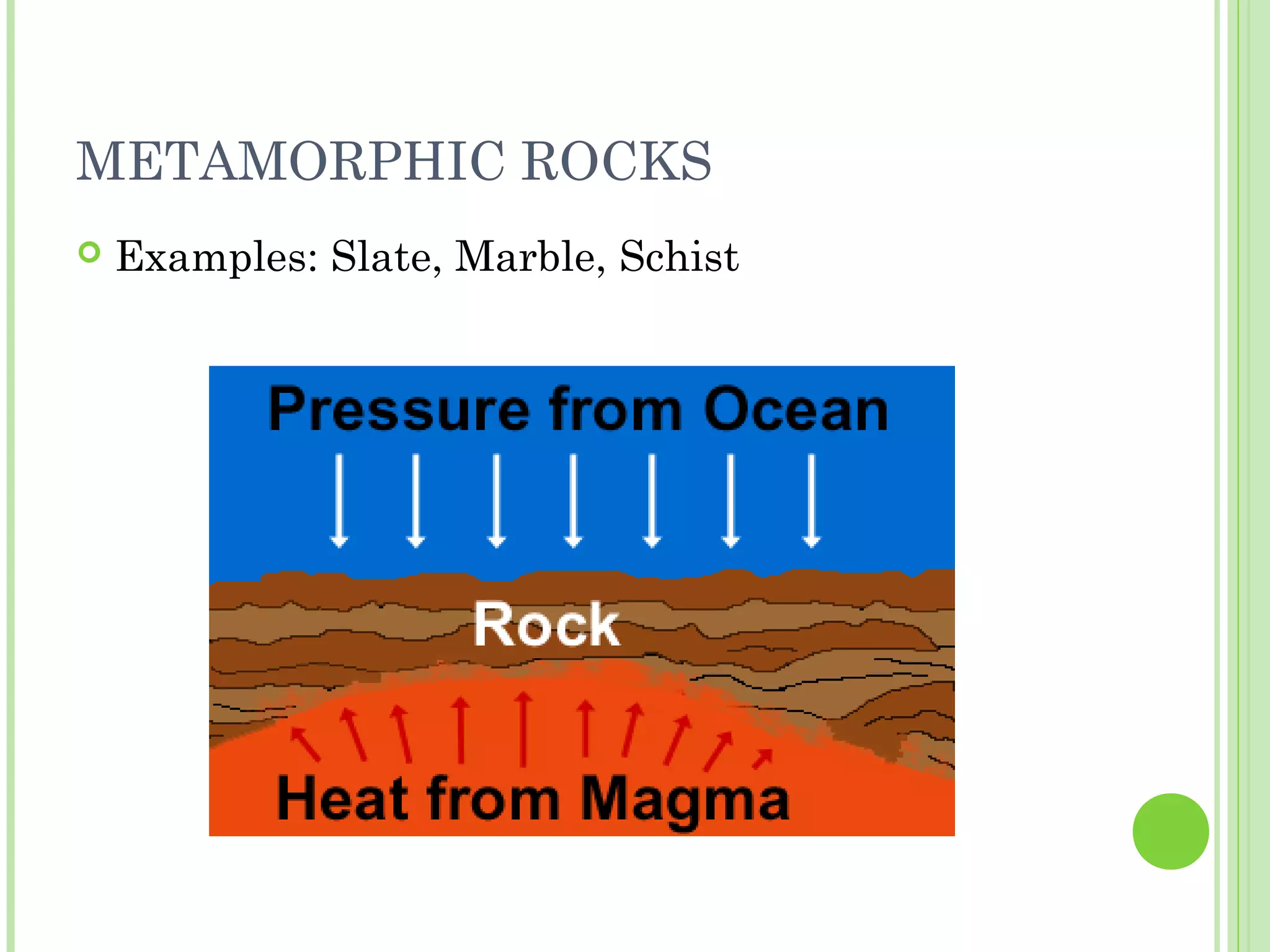
METAMORPHIC ROCKS
 Examples: Slate, Marble, Schist
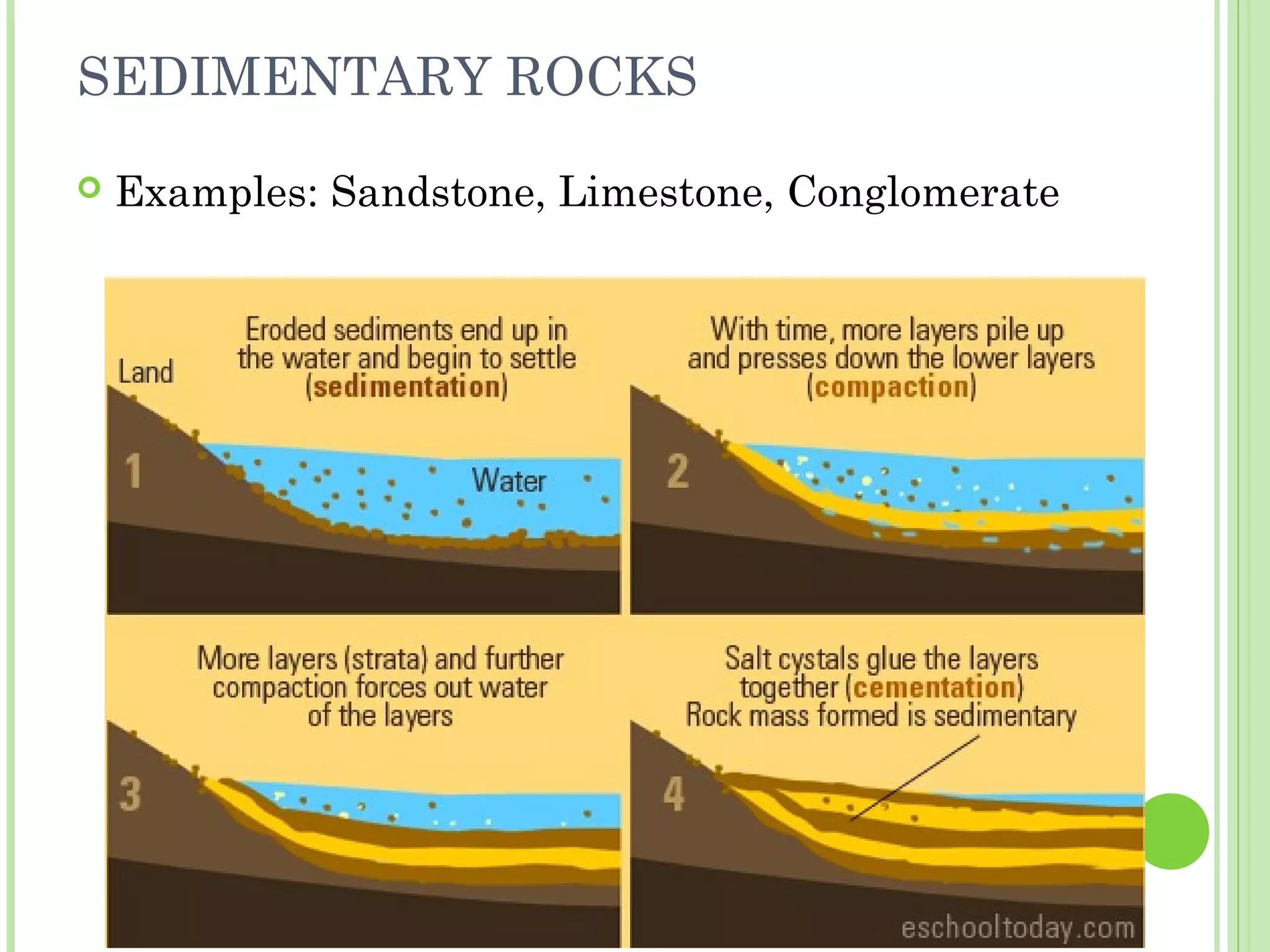
SEDIMENTARY ROCKS
 Examples: Sandstone, Limestone, Conglomerate
ACTIVITIES
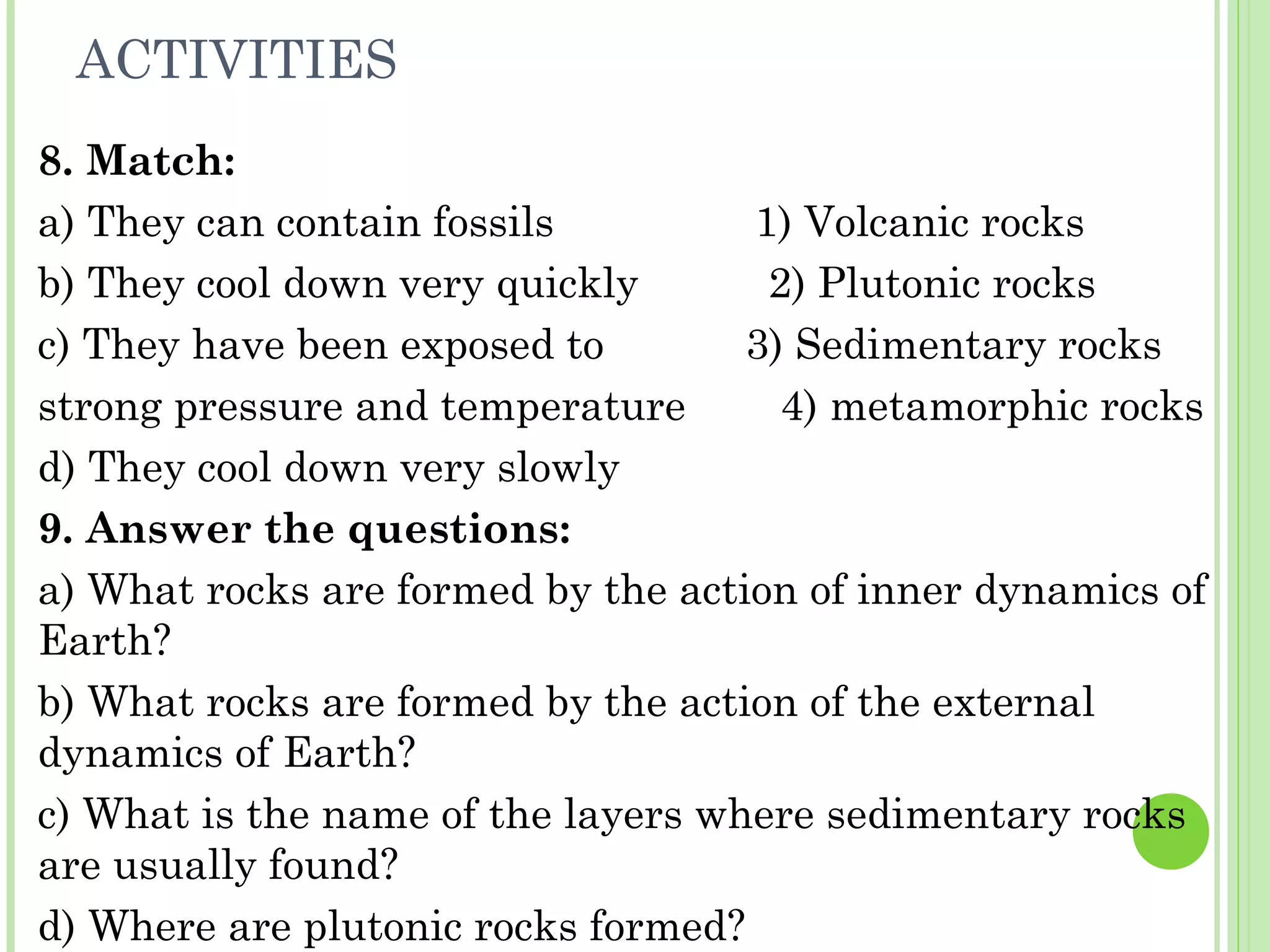
8. Match:
a) They can contain fossils 1) Volcanic rocks
b) They cool down very quickly 2) Plutonic rocks
c) They have been exposed to 3) Sedimentary rocks
strong pressure and temperature 4) metamorphic rocks
d) They cool down very slowly
9. Answer the questions:
a) What rocks are formed by the action of inner dynamics of
Earth?
b) What rocks are formed by the action of the external
dynamics of Earth?
c) What is the name of the layers where sedimentary rocks
are usually found?
d) Where are plutonic rocks formed?
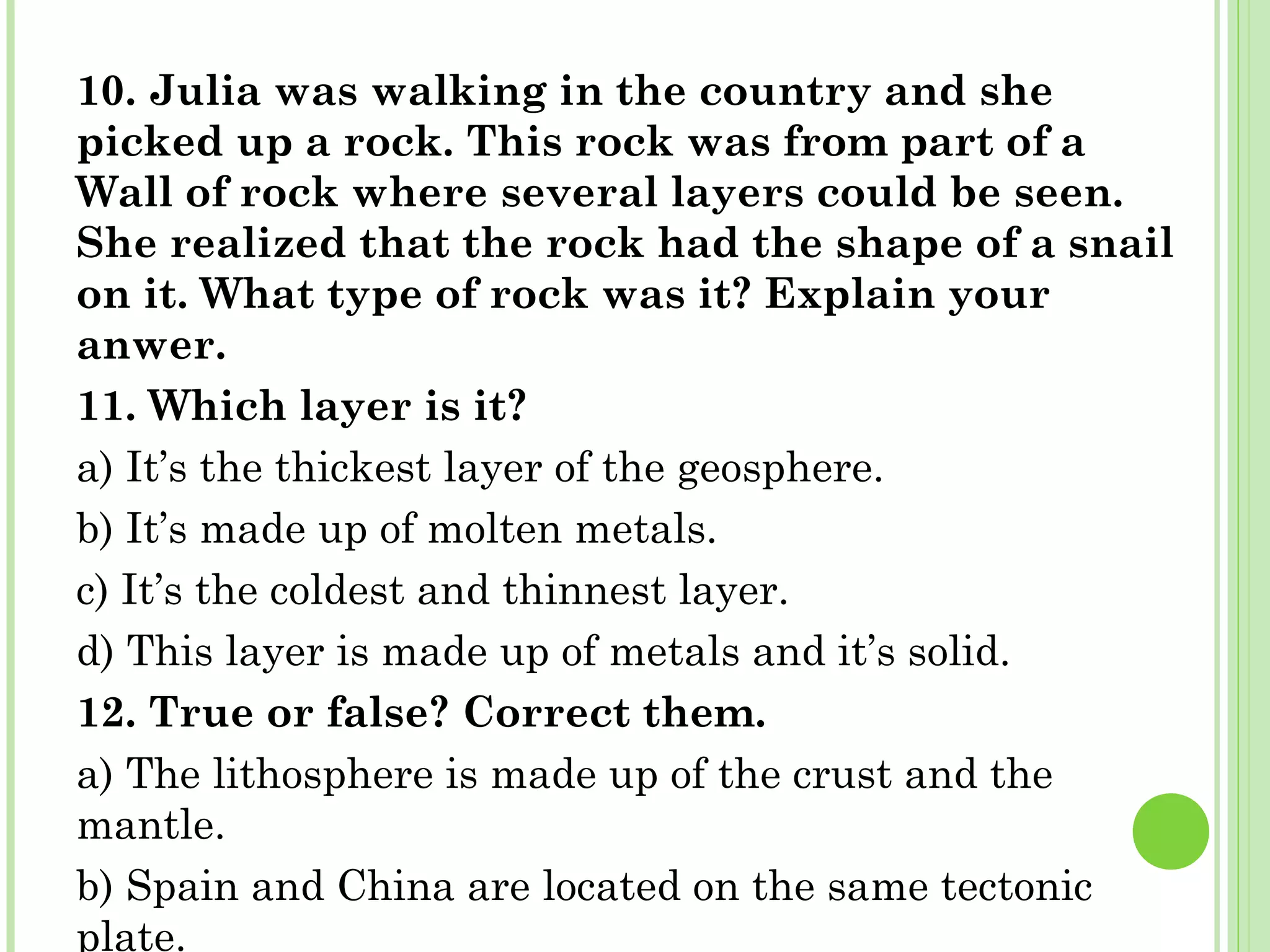
10. Julia was walking in the country and she
picked up a rock. This rock was from part of a
Wall of rock where several layers could be seen.
She realized that the rock had the shape of a snail
on it. What type of rock was it? Explain your
anwer.
11. Which layer is it?
a) It’s the thickest layer of the geosphere.
b) It’s made up of molten metals.
c) It’s the coldest and thinnest layer.
d) This layer is made up of metals and it’s solid.
12. True or false? Correct them.
a) The lithosphere is made up of the crust and the
mantle.
b) Spain and China are located on the same tectonic
plate.
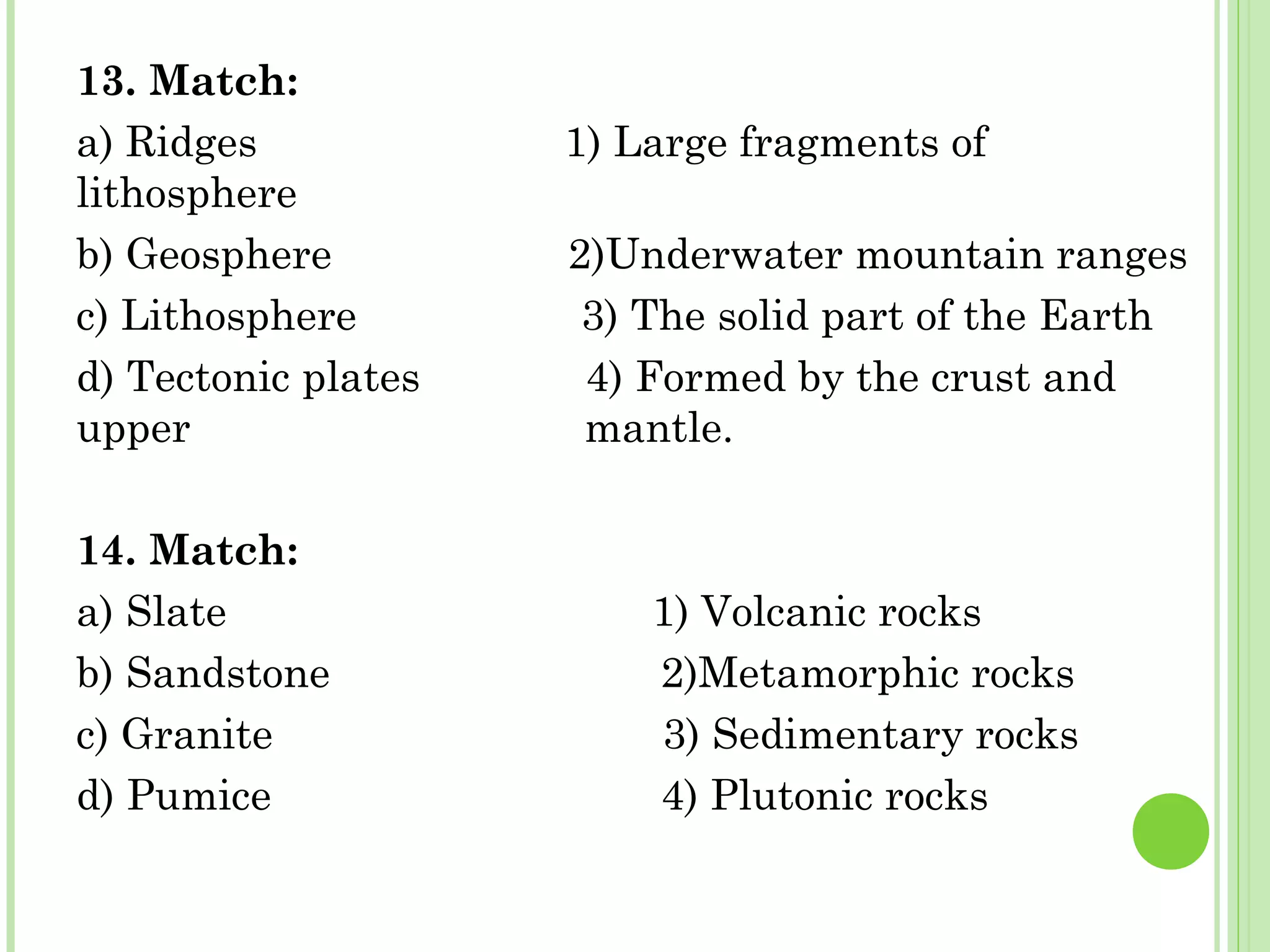
13. Match:
a) Ridges 1) Large fragments of
lithosphere
b) Geosphere 2)Underwater mountain ranges
c) Lithosphere 3) The solid part of the Earth
d) Tectonic plates 4) Formed by the crust and
upper mantle.
14. Match:
a) Slate 1) Volcanic rocks
b) Sandstone 2)Metamorphic rocks
c) Granite 3) Sedimentary rocks
d) Pumice 4) Plutonic rocks

Unit 6 Earth's structure

  • 1.
  • 2.
    UNIT OBJECTIVES  Tolearn what the Earth is like.  To understand the Earth’s changes.  To learn about the Earth’s dynamics and rock formation.
  • 3.
    A DESCRIPTION OFTHE EARTH LAYERS OF THE EARTH BIOSPHERE ATMOSPHERE HYDROSPHERE GEOSPHERE
  • 4.
    THE RELIEF LAND RELIEF SUBMERGED RELIEF The emerged parts (Continentsand islands) Mountai n ranges Plains Continent al platforms Abyssal plains Ridges Trenche s Oceanic extensions with a continental shelf. The ocean floor. Underwater mountain ranges Deep narrow depressions
  • 7.
    ACTIVITIES 1. Match: a) Biosphere1-All the gases on the Earth b) Atmosphere 2-It’s made of rocks c) Hydrosphere 3-All the water on the planet d) Geosphere 4-All the living things on the planet 2. Complete the diagram
  • 8.
    3. Fill inthe blanks: a) The emerged zones of the geosphere are called______ and________ b) ________ __________are formed by mountains whicj lie along a large area. c) _____________ are formed by flat areas. d) The___________ __________ are areas at a lower level that the landforms around them.
  • 9.
    THE LAYERS OFTHE GEOSPHERE THE CRUST THE MANTLE THE CORE -The outer layer. -Solid hard rocks Oceani c crust Continent al crust -The middle layer. -Malleable and molten rocks -The deepest layer. -It’s made of iron and nickel Outer core Inner core Molten rocks Solid rocks It creates the oceans It creates the continents
  • 10.
  • 12.
    THE LITHOSPHERE  It’smade up of solid rocks.  It’s formed by the Earth’s crust and the upper part of the mantle.  Two types:  Continental litosphere.  Oceanic litosphere.  The litosphere is not a continous layer.  It’s divided into fragments called litospheric plates (tectonic plates)  Plate boundaries are  Oceanic ridges  Oceanic trenches  Large mountain ranges
  • 13.
  • 14.
    ACTIVITIES 4. True orfalse? Correct them. a) The Earth’s crust is made up of elastic rocks. b) The earths’s crust can be continental or oceanic. c) The mantle is the thinnest layer of the geosphere. d) The core is made up of the outer core which is solid, and the inner core which is molten. 5. Write the name of all the tectonic plates. 6. Write down the name of two continents which are almost completely on a single plate.
  • 15.
    THE EARTH’S INTERNALHEAT  The internal heat is called geothermal energy.  It increases with depth.  The convection currents:  The hot rocks from the deep mantle rise to the surface.  The cold rocks from the upper mantle sink to the deeper zones.
  • 16.
    ACTIVITIES 7. Fill inthe blanks: The Earth’s internal energy is called______ _______ and it creases with______. This energy produce some cyclic displacements called_______ _______, in which very hot rocks from the ______ mantle become less______ and they rise to the________, while the rocks in the ______ mantle which are ______ sink to the deeper zones.
  • 17.
    ROCK FORMATION TYPES OFROCKS MAGMATIC METAMORPH IC SEDIMENTAR Y Volcanic rocks Plutonic rocks Lava solidifies quickly on the surface. Tiny crystals. Magma solidifies slowly inside the crust.Big crystals. Formed by magma Formed by crushed rocks by pressure and temperature Formed by atmospheric and hydrospheric dinamics - The sediments accumulate and are compressed. - They can contain fossils.
  • 18.
    MAGMATIC ROCKS  Examplesof Volcanic: Basalt, Obsidian, Pumice  Example of Plutonic: Granite, Diorite, Gabbro
  • 19.
    METAMORPHIC ROCKS  Examples:Slate, Marble, Schist
  • 20.
    SEDIMENTARY ROCKS  Examples:Sandstone, Limestone, Conglomerate
  • 21.
    ACTIVITIES 8. Match: a) Theycan contain fossils 1) Volcanic rocks b) They cool down very quickly 2) Plutonic rocks c) They have been exposed to 3) Sedimentary rocks strong pressure and temperature 4) metamorphic rocks d) They cool down very slowly 9. Answer the questions: a) What rocks are formed by the action of inner dynamics of Earth? b) What rocks are formed by the action of the external dynamics of Earth? c) What is the name of the layers where sedimentary rocks are usually found? d) Where are plutonic rocks formed?
  • 22.
    10. Julia waswalking in the country and she picked up a rock. This rock was from part of a Wall of rock where several layers could be seen. She realized that the rock had the shape of a snail on it. What type of rock was it? Explain your anwer. 11. Which layer is it? a) It’s the thickest layer of the geosphere. b) It’s made up of molten metals. c) It’s the coldest and thinnest layer. d) This layer is made up of metals and it’s solid. 12. True or false? Correct them. a) The lithosphere is made up of the crust and the mantle. b) Spain and China are located on the same tectonic plate.
  • 23.
    13. Match: a) Ridges1) Large fragments of lithosphere b) Geosphere 2)Underwater mountain ranges c) Lithosphere 3) The solid part of the Earth d) Tectonic plates 4) Formed by the crust and upper mantle. 14. Match: a) Slate 1) Volcanic rocks b) Sandstone 2)Metamorphic rocks c) Granite 3) Sedimentary rocks d) Pumice 4) Plutonic rocks