GRAVITATION
INTRODUCTION TO
GRAVITATION
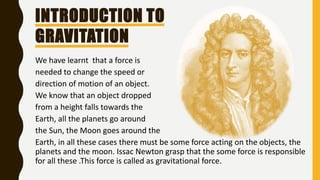
We have learnt that a force is
needed to change the speed or
direction of motion of an object.
We know that an object dropped
from a height falls towards the
Earth, all the planets go around
the Sun, the Moon goes around the
Earth, in all these cases there must be some force acting on the objects, the
planets and the moon. Issac Newton grasp that the some force is responsible
for all these .This force is called as gravitational force.
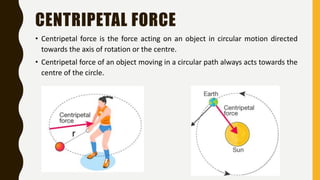
CENTRIPETAL FORCE
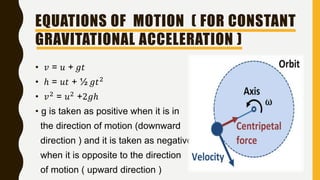
• Centripetal force is the force acting on an object in circular motion directed
towards the axis of rotation or the centre.
• Centripetal force of an object moving in a circular path always acts towards the
centre of the circle.
NEWTON’S LAW OF GRAVITATION
Every object in the universe attracts every other object which is
proportional to the product of their masses and inversely proportional to
the square of the distance between them . The force is along the line
joining the centres of two objects.
The square of the distance in the denominator is crucial in the
equation because it reflects the nature of how gravitational force
weakens with distance.
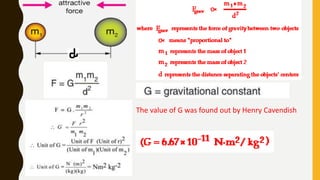
The value of G was found out by Henry Cavendish
IMPORTANCE OF UNIVERSAL LAW
OF GRAVITATION
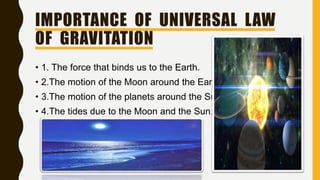
• 1. The force that binds us to the Earth.
• 2.The motion of the Moon around the Earth.
• 3.The motion of the planets around the Sun.
• 4.The tides due to the Moon and the Sun.
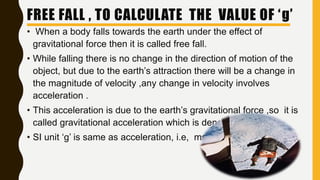
• When a body falls towards the earth under the effect of
gravitational force then it is called free fall.
• While falling there is no change in the direction of motion of the
object, but due to the earth’s attraction there will be a change in
the magnitude of velocity ,any change in velocity involves
acceleration .
• This acceleration is due to the earth’s gravitational force ,so it is
called gravitational acceleration which is denoted by ‘g’ .
• SI unit ‘g’ is same as acceleration, i.e, ms-2.
FREE FALL , TO CALCULATE THE VALUE OF ‘g’
• According to 2nd law of motion, F = m x a m = mass of stone
• F= mg g = acceleration due to gravity
• Let the stone be on or near the surface of the earth.
EQUATIONS OF MOTION ( FOR CONSTANT
GRAVITATIONAL ACCELERATION )
• 𝑣 = 𝑢 + 𝑔𝑡
• ℎ = 𝑢𝑡 + ½ 𝑔𝑡2
• 𝑣2 = 𝑢2 +2𝑔ℎ
• g is taken as positive when it is in
the direction of motion (downward
direction ) and it is taken as negative
when it is opposite to the direction
of motion ( upward direction )
MASS AND WEIGHT
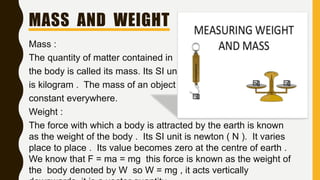
Mass :
The quantity of matter contained in
the body is called its mass. Its SI unit
is kilogram . The mass of an object is
constant everywhere.
Weight :
The force with which a body is attracted by the earth is known
as the weight of the body . Its SI unit is newton ( N ). It varies
place to place . Its value becomes zero at the centre of earth .
We know that F = ma = mg this force is known as the weight of
the body denoted by W so W = mg , it acts vertically
WEIGHT OF AN OBJECT ON THE
MOON
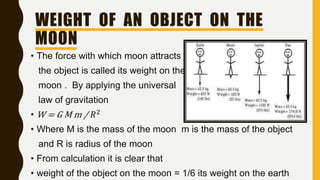
• The force with which moon attracts
the object is called its weight on the
moon . By applying the universal
law of gravitation
• W = G M m / 𝑅2
• Where M is the mass of the moon m is the mass of the object
and R is radius of the moon
• From calculation it is clear that
• weight of the object on the moon = 1/6 its weight on the earth
THRUST AND PRESSURE
• Thrust :
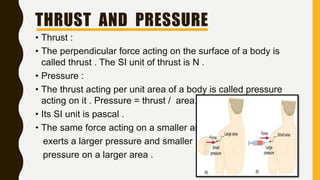
• The perpendicular force acting on the surface of a body is
called thrust . The SI unit of thrust is N .
• Pressure :
• The thrust acting per unit area of a body is called pressure
acting on it . Pressure = thrust / area.
• Its SI unit is pascal .
• The same force acting on a smaller area
exerts a larger pressure and smaller
pressure on a larger area .
PRESSURE IN FLUIDS
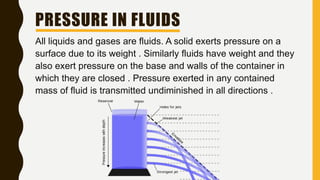
All liquids and gases are fluids. A solid exerts pressure on a
surface due to its weight . Similarly fluids have weight and they
also exert pressure on the base and walls of the container in
which they are closed . Pressure exerted in any contained
mass of fluid is transmitted undiminished in all directions .
BUOYANCY
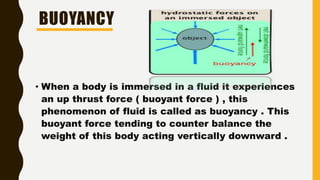
• When a body is immersed in a fluid it experiences
an up thrust force ( buoyant force ) , this
phenomenon of fluid is called as buoyancy . This
buoyant force tending to counter balance the
weight of this body acting vertically downward .
WHY OBJECTS FLOAT OR SINK WHEN
PLACED ON A SURFACE OF WATER ?
If the buoyant force is greater then weight
then a body floats and vice versa, like a
rubber cork floats whereas a iron nail sinks .
ARCHIMEDE’S PRINCIPLE
When a body is immersed fully or partially in a
fluid it experiences an upward force that is
equal to the weight of the fluid displaced by it .
Up thrust force or buoyant force = weight of
fluid displaced by a body = (weight of body in
air - weight of body in fluid)
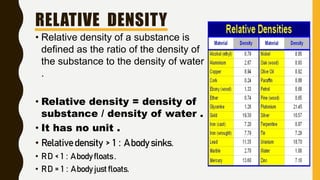
RELATIVE DENSITY
• Relative density of a substance is
defined as the ratio of the density of
the substance to the density of water
.
• Relative density = density of
substance / density of water .
• It has no unit .
• Relative density > 1 : A body sinks.
• R D < 1 : A body floats.
• R D = 1 : A body just floats.
gravitation ninth (class IX)        .pptx

gravitation ninth (class IX) .pptx

  • 1.
  • 2.
    INTRODUCTION TO GRAVITATION We havelearnt that a force is needed to change the speed or direction of motion of an object. We know that an object dropped from a height falls towards the Earth, all the planets go around the Sun, the Moon goes around the Earth, in all these cases there must be some force acting on the objects, the planets and the moon. Issac Newton grasp that the some force is responsible for all these .This force is called as gravitational force.
  • 3.
    CENTRIPETAL FORCE • Centripetalforce is the force acting on an object in circular motion directed towards the axis of rotation or the centre. • Centripetal force of an object moving in a circular path always acts towards the centre of the circle.
  • 4.
    NEWTON’S LAW OFGRAVITATION Every object in the universe attracts every other object which is proportional to the product of their masses and inversely proportional to the square of the distance between them . The force is along the line joining the centres of two objects. The square of the distance in the denominator is crucial in the equation because it reflects the nature of how gravitational force weakens with distance.
  • 5.
    The value ofG was found out by Henry Cavendish
  • 6.
    IMPORTANCE OF UNIVERSALLAW OF GRAVITATION • 1. The force that binds us to the Earth. • 2.The motion of the Moon around the Earth. • 3.The motion of the planets around the Sun. • 4.The tides due to the Moon and the Sun.
  • 7.
    • When abody falls towards the earth under the effect of gravitational force then it is called free fall. • While falling there is no change in the direction of motion of the object, but due to the earth’s attraction there will be a change in the magnitude of velocity ,any change in velocity involves acceleration . • This acceleration is due to the earth’s gravitational force ,so it is called gravitational acceleration which is denoted by ‘g’ . • SI unit ‘g’ is same as acceleration, i.e, ms-2. FREE FALL , TO CALCULATE THE VALUE OF ‘g’
  • 8.
    • According to2nd law of motion, F = m x a m = mass of stone • F= mg g = acceleration due to gravity • Let the stone be on or near the surface of the earth.
  • 9.
    EQUATIONS OF MOTION( FOR CONSTANT GRAVITATIONAL ACCELERATION ) • 𝑣 = 𝑢 + 𝑔𝑡 • ℎ = 𝑢𝑡 + ½ 𝑔𝑡2 • 𝑣2 = 𝑢2 +2𝑔ℎ • g is taken as positive when it is in the direction of motion (downward direction ) and it is taken as negative when it is opposite to the direction of motion ( upward direction )
  • 10.
    MASS AND WEIGHT Mass: The quantity of matter contained in the body is called its mass. Its SI unit is kilogram . The mass of an object is constant everywhere. Weight : The force with which a body is attracted by the earth is known as the weight of the body . Its SI unit is newton ( N ). It varies place to place . Its value becomes zero at the centre of earth . We know that F = ma = mg this force is known as the weight of the body denoted by W so W = mg , it acts vertically
  • 11.
    WEIGHT OF ANOBJECT ON THE MOON • The force with which moon attracts the object is called its weight on the moon . By applying the universal law of gravitation • W = G M m / 𝑅2 • Where M is the mass of the moon m is the mass of the object and R is radius of the moon • From calculation it is clear that • weight of the object on the moon = 1/6 its weight on the earth
  • 12.
    THRUST AND PRESSURE •Thrust : • The perpendicular force acting on the surface of a body is called thrust . The SI unit of thrust is N . • Pressure : • The thrust acting per unit area of a body is called pressure acting on it . Pressure = thrust / area. • Its SI unit is pascal . • The same force acting on a smaller area exerts a larger pressure and smaller pressure on a larger area .
  • 13.
    PRESSURE IN FLUIDS Allliquids and gases are fluids. A solid exerts pressure on a surface due to its weight . Similarly fluids have weight and they also exert pressure on the base and walls of the container in which they are closed . Pressure exerted in any contained mass of fluid is transmitted undiminished in all directions .
  • 14.
    BUOYANCY • When abody is immersed in a fluid it experiences an up thrust force ( buoyant force ) , this phenomenon of fluid is called as buoyancy . This buoyant force tending to counter balance the weight of this body acting vertically downward .
  • 15.
    WHY OBJECTS FLOATOR SINK WHEN PLACED ON A SURFACE OF WATER ? If the buoyant force is greater then weight then a body floats and vice versa, like a rubber cork floats whereas a iron nail sinks .
  • 16.
    ARCHIMEDE’S PRINCIPLE When abody is immersed fully or partially in a fluid it experiences an upward force that is equal to the weight of the fluid displaced by it . Up thrust force or buoyant force = weight of fluid displaced by a body = (weight of body in air - weight of body in fluid)
  • 17.
    RELATIVE DENSITY • Relativedensity of a substance is defined as the ratio of the density of the substance to the density of water . • Relative density = density of substance / density of water . • It has no unit . • Relative density > 1 : A body sinks. • R D < 1 : A body floats. • R D = 1 : A body just floats.