Exploring
Forces
Class 8th class/science(curiosity)
Chapter5
Forces are all around us - pushing, pulling, and changing
the world we live in. This presentation explores what
forces are, how they work, and the different types we
encounter every day.
Prepared By : SATYA PRAKASH SAHU/TGT SCIENCE
JNV JHANSI
2.
What Makes Us
WonderAbout
Forces
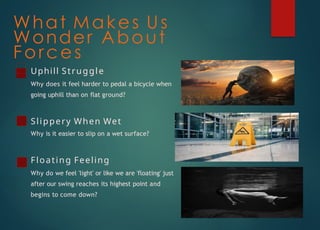
Uphill Struggle
Why does it feel harder to pedal a bicycle when
going uphill than on flat ground?
Slippery When Wet
Why is it easier to slip on a wet surface?
Floating Feeling
Why do we feel 'light' or like we are 'floating' just
after our swing reaches its highest point and
begins to come down?
3.
A D ay o f D i s c o v e r y
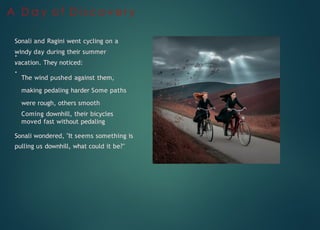
Sonali and Ragini went cycling on a
windy day during their summer
vacation. They noticed:
The wind pushed against them,
making pedaling harder Some paths
were rough, others smooth
Coming downhill, their bicycles
moved fast without pedaling
Sonali wondered, "It seems something is
pulling us downhill, what could it be?"
4.
What I sa Force
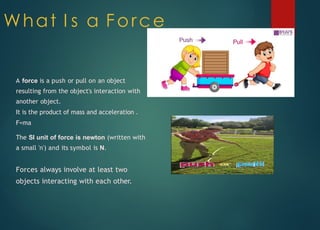
A force is a push or pull on an object
resulting from the object's interaction with
another object.
It is the product of mass and acceleration .
F=ma
The SI unit of force is newton (written with
a small 'n') and its symbol is N.
Forces always involve at least two
objects interacting with each other.
5.
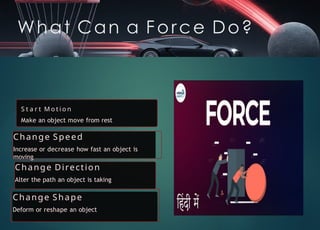
What Can aForce Do?
S t a r t M o t i o n
Make an object move from rest
Change Speed
Increase or decrease how fast an object is
moving
Change Direction
Alter the path an object is taking
Change Shape
Deform or reshape an object
6.
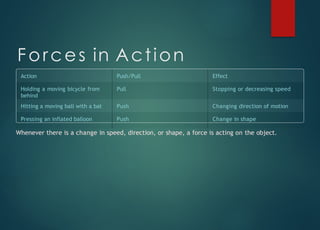
Forces in Action
ActionPush/Pull Effect
Holding a moving bicycle from
behind
Pull Stopping or decreasing speed
Hitting a moving ball with a bat Push Changing direction of motion
Pressing an inflated balloon Push Change in shape
Whenever there is a change in speed, direction, or shape, a force is acting on the object.
7.
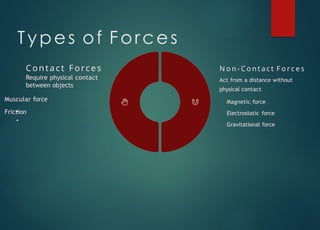
Types of Forces
Contact Forces
Require physical contact
between objects
Muscular force
Friction
N o n - C o n t a c t F o r c e s
Act from a distance without
physical contact
Magnetic force
Electrostatic force
Gravitational force
8.
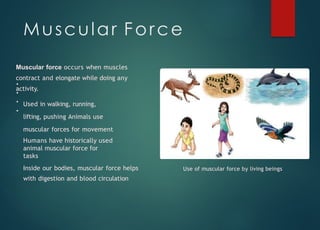
Muscular Force
Muscular forceoccurs when muscles
contract and elongate while doing any
activity.
Used in walking, running,
lifting, pushing Animals use
muscular forces for movement
Humans have historically used
animal muscular force for
tasks
Inside our bodies, muscular force helps
with digestion and blood circulation
Use of muscular force by living beings
9.
Friction: The Opposing
Force
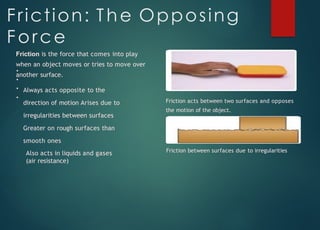
Frictionis the force that comes into play
when an object moves or tries to move over
another surface.
Always acts opposite to the
direction of motion Arises due to
irregularities between surfaces
Greater on rough surfaces than
smooth ones
Also acts in liquids and gases
(air resistance)
Friction acts between two surfaces and opposes
the motion of the object.
Friction between surfaces due to irregularities
10.
Why Do WeSlip
on Wet Surfaces
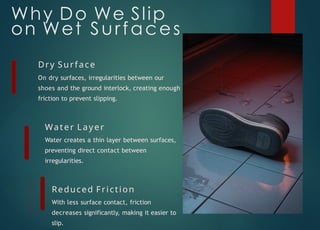
Dry Surface
On dry surfaces, irregularities between our
shoes and the ground interlock, creating enough
friction to prevent slipping.
Water Layer
Water creates a thin layer between surfaces,
preventing direct contact between
irregularities.
Reduced Friction
With less surface contact, friction
decreases significantly, making it easier to
slip.
11.
Magnetic Force
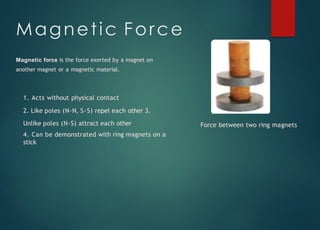
Magnetic forceis the force exerted by a magnet on
another magnet or a magnetic material.
1. Acts without physical contact
2. Like poles (N-N, S-S) repel each other 3.
Unlike poles (N-S) attract each other
4. Can be demonstrated with ring magnets on a
stick
Force between two ring magnets
12.
Electrostatic
Force
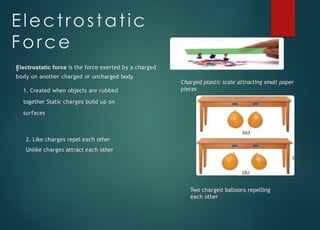
Electrostatic force isthe force exerted by a charged
body on another charged or uncharged body.
1. Created when objects are rubbed
together Static charges build up on
surfaces
2. Like charges repel each other
Unlike charges attract each other
Charged plastic scale attracting small paper
pieces
Two charged balloons repelling
each other
13.
Gravitational Force
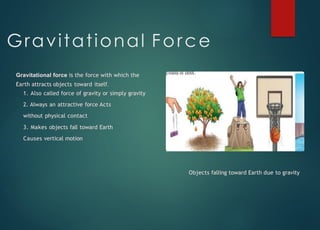
Gravitational forceis the force with which the
Earth attracts objects toward itself.
1. Also called force of gravity or simply gravity
2. Always an attractive force Acts
without physical contact
3. Makes objects fall toward Earth
Causes vertical motion
Objects falling toward Earth due to gravity
14.
Vertical Motion
Under Gravity
UpwardMotion
When thrown upward, an object's speed decreases until it momentarily stops at
the top
Momentary Stop
At the highest point, the object stops briefly before changing direction
Downward Motion
While falling, the object's speed increases as gravity pulls it toward Earth
15.
T h eFloating Feeling on a Swing
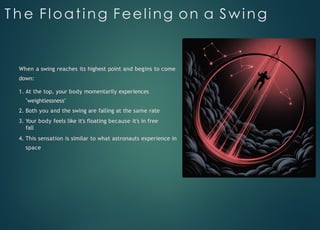
When a swing reaches its highest point and begins to come
down:
1. At the top, your body momentarily experiences
"weightlessness"
2. Both you and the swing are falling at the same rate
3. Your body feels like it's floating because it's in free
fall
4. This sensation is similar to what astronauts experience in
space
16.
We i gh t vs M a s s
1
M a s s
1. Amount of matter in an object
2. Measured in kilograms (kg) or grams (g) Remains
the same everywhere
3. Does not change from planet to planet
2
Weight
1. Force with which Earth pulls an object Measured
in newtons (N)
2. Can vary slightly from place to place
Different on different planets
W =mg
17.
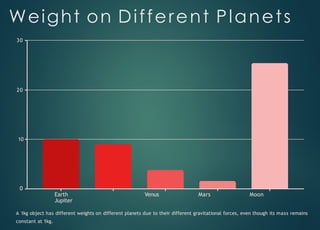
Weight on DifferentPlanets
10
20
30
0
Earth Venus Mars Moon
Jupiter
A 1kg object has different weights on different planets due to their different gravitational forces, even though its mass remains
constant at 1kg.
18.
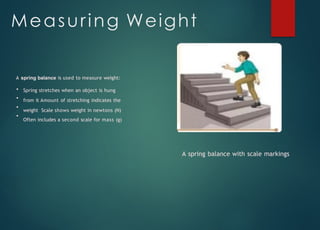
Measuring Weight
A springbalance is used to measure weight:
Spring stretches when an object is hung
from it Amount of stretching indicates the
weight Scale shows weight in newtons (N)
Often includes a second scale for mass (g)
A spring balance with scale markings
19.
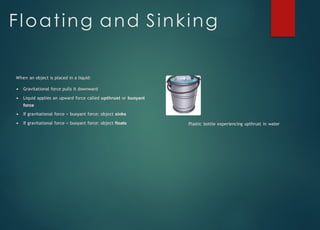
Floating and Sinking
Whenan object is placed in a liquid:
Gravitational force pulls it downward
Liquid applies an upward force called upthrust or buoyant
force
If gravitational force > buoyant force: object sinks
If gravitational force = buoyant force: object floats Plastic bottle experiencing upthrust in water
20.
A r ch i m e d e s '
P r i n c i p l e
T h e P r i n c i p l e
When an object is fully or partially
immersed in a liquid, it experiences an
upward force equal to the weight of
the liquid it displaces.
S i n k i n g O b j e c t s
If the weight of liquid displaced <
weight of object, the object will sink.
F l o a t i n g O b j e c t s
If the weight of liquid displaced =
weight of object, the object will float.
21.
Uphill Cycling: Wh y I s I t H a r d e r
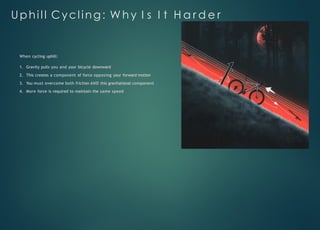
When cycling uphill:
1. Gravity pulls you and your bicycle downward
2. This creates a component of force opposing your forward motion
3. You must overcome both friction AND this gravitational component
4. More force is required to maintain the same speed
22.
F l oa t i n g R o c k s
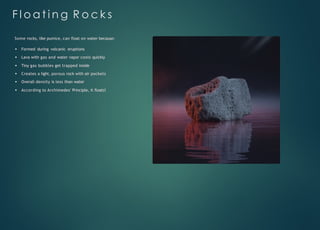
Some rocks, like pumice, can float on water because:
Formed during volcanic eruptions
Lava with gas and water vapor cools quickly
Tiny gas bubbles get trapped inside
Creates a light, porous rock with air pockets
Overall density is less than water
According to Archimedes' Principle, it floats!
23.
Forces in OurBodies
C i rc u l a t i o n
Expansion and contraction of heart
muscles circulates blood
throughout the body.
D i g e s t i o n
Muscular force helps chew food
and push it through the alimentary
canal.
B r e a t h i n g
Diaphragm and intercostal muscles
create pressure changes that move
air in and out.
24.
K ey Tak e a w a y s
F o r c e B a s i c s
A force is a push or pull resulting from interaction between
objects. The SI unit is newton (N).
F o r c e E ff e c t s
Forces can change speed, direction, shape, or start motion
from rest.
F o r c e T y p e s
Contact forces (muscular, friction) require physical contact.
Non-contact forces (magnetic, electrostatic, gravitational)
act from a distance.
We i g h t vs. M a s s
Weight is the gravitational force on an object and varies by
location. Mass is the amount of matter and remains constant.
25.
Questions to
Ponder
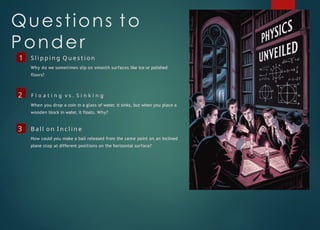
1 Sl i p p i n g Q u e s t i o n
Why do we sometimes slip on smooth surfaces like ice or polished
floors?
2 F l o a t i n g v s . S i n k i n g
When you drop a coin in a glass of water, it sinks, but when you place a
wooden block in water, it floats. Why?
3 B a l l o n I n c l i n e
How could you make a ball released from the same point on an inclined
plane stop at different positions on the horizontal surface?
 Most read
 Most read
 Most read