Unit 2
COMPETITIVE
ADVANTAGE
PREPARED & PRESENTED BY:
MS. HIMANI
Layout of the presentation
 External Environment
 PESTEL Analysis
 SWOT Analysis
 Porter’s Five Forces Model
 The Competitive Profile Matrix (CPM)
 Globalization and Industry Structure - Resources
 Capabilities and competencies
 Value Chain Analysis – Core competencies
 Generic building blocks of Competitive Advantage
 Distinctive Competencies
 Avoiding failures and sustaining competitive advantage
2
Prepared by: Ms. Himani R.
External Environment
 Internal environment are the events that occur within an
organization. Internal environmental factors are easier to
control. Eg. Management, employees, organizational
culture, financial issues etc.
 An external environment is composed of all the outside
factors or influences that impact the operation of business.
 The business must act or react to keep up its flow of
operations.
 The external environment can be broken down into two
types: the micro environment and the macro environment.
3
Prepared by: Ms. Himani R.
Continued
 The micro environment consists of the factors that
directly impact the operation of a company. Eg.
suppliers, customers, marketing intermediaries,
financiers, and public perceptions.
 The macro environment consists of general factors
that a business typically has no control over. The
success of the company depends on its ability to adapt.
Eg. economic, socio-cultural, political, legal, technical,
and environmental considerations.
4
Prepared by: Ms. Himani R.
SWOT Analysis
5
Prepared by: Ms. Himani R.
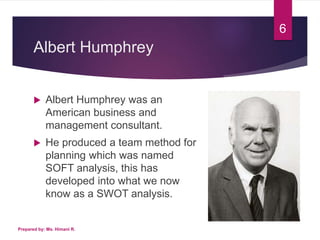
Albert Humphrey
 Albert Humphrey was an
American business and
management consultant.
 He produced a team method for
planning which was named
SOFT analysis, this has
developed into what we now
know as a SWOT analysis.
6
Prepared by: Ms. Himani R.
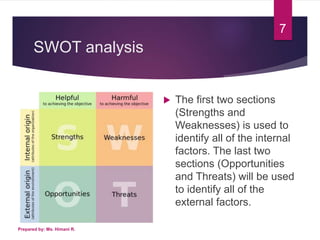
SWOT analysis
 The first two sections
(Strengths and
Weaknesses) is used to
identify all of the internal
factors. The last two
sections (Opportunities
and Threats) will be used
to identify all of the
external factors.
7
Prepared by: Ms. Himani R.
Strengths & Weaknesses
 New, innovative product
 Quality processes and
procedures
 Patents
 Strong brand names
 Good reputation among
customers
 Cost advantages from proprietary
know-how
Prepared by: Ms. Himani R.
8
 Lack of marketing expertise
 Undifferentiated products or
services
 Poor quality goods or services
 Damaged reputation
 High cost structure
 Lack of access to key distribution
channels
Opportunities & Threats
 A developing market
 Mergers, joint ventures
 New market segments
 New international markets
 Unfulfilled customer need
 Arrival of new technologies
 Loosening of regulations
Prepared by: Ms. Himani R.
9
 New competitors
 Price wars
 Competitor’s innovation
 Competitor’s superior access to
distribution channels
 Shift in consumer preferences
 New regulations
PESTEL Analysis
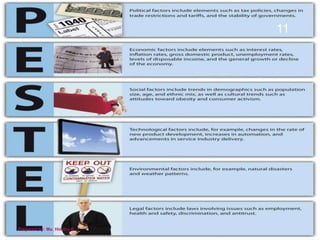
 A PESTEL analysis is a framework or tool used by marketers to analyse and
monitor the macro-environmental (external marketing environment) factors
that have an impact on an organisation.
 The result of which is used to identify threats and weaknesses which is used
in a SWOT analysis.
 PESTEL stands for:
 P – Political
 E – Economic
 S – Social
 T – Technological
 E – Environmental
 L – Legal
10
Prepared by: Ms. Himani R.
11
Prepared by: Ms. Himani R.
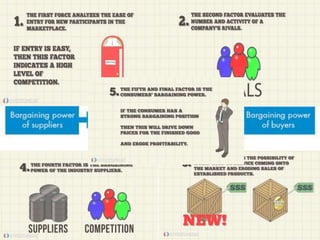
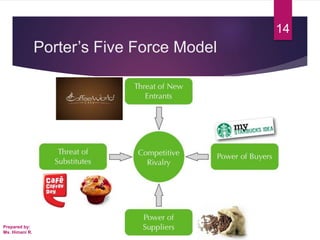
Porter’s Five Force Model
 Identifies and analyzes five competitive forces that
shape every industry, and helps determine an industry's
weaknesses and strengths.
 Porter identified five undeniable forces that play a part in
shaping every market and industry in the world.
 The forces are frequently used to measure competition
intensity, attractiveness & profitability of an industry
or market.
Prepared by: Ms. Himani R.
12
Prepared by: Ms. Himani R.
13
Porter’s Five Force Model
Prepared by:
Ms. Himani R.
14
The Competitive Profile Matrix (CPM)
 The Competitive Profile Matrix (CPM) is a tool that
compares the firm and its rivals and reveals their
relative strengths and weaknesses.
 The matrix identifies a firm’s key competitors and
compares them using industry’s critical success
factors.
 The analysis also reveals company’s relative strengths
and weaknesses against its competitors, so a
company would know, which areas it should improve
and, which areas to protect.
Prepared by: Ms. Himani R.
15
Continued
 Critical success factors (CSF) are the key areas, which
must be performed at the highest possible level of excellence
if organizations want to succeed in the particular industry.
 They vary between different industries or even strategic
groups and include both internal and external factors.
 For eg. Union relations, Power over suppliers, Product
Quality, Skilled workforce, Efficient supply chain, Customer
service, Production capacity, Customer loyalty, Added product
features, On time delivery, etc.
Prepared by: Ms. Himani R.
16
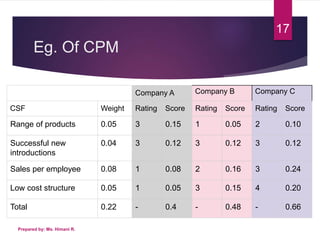
Eg. Of CPM
Company A Company B Company C
CSF Weight Rating Score Rating Score Rating Score
Range of products 0.05 3 0.15 1 0.05 2 0.10
Successful new
introductions
0.04 3 0.12 3 0.12 3 0.12
Sales per employee 0.08 1 0.08 2 0.16 3 0.24
Low cost structure 0.05 1 0.05 3 0.15 4 0.20
Total 0.22 - 0.4 - 0.48 - 0.66
Prepared by: Ms. Himani R.
17
Continued
 Weight
Each critical success factor should be assigned a weight ranging from
0.0 (low importance) to 1.0 (high importance). The number indicates how
important the factor is in succeeding in the industry.
 Rating
The ratings in CPM refer to how well companies are doing in each area.
They range from 4 to 1, where 4 means a major strength, 3 – minor
strength, 2 – minor weakness and 1 – major weakness.
 Score & Total Score
The score is the result of weight multiplied by rating. The firm that
receives the highest total score is relatively stronger than its competitors.
Prepared by: Ms. Himani R.
18
Globalization & Industry Structure
 Globalization is the term to describe the way countries are
becoming more interconnected both economically and
culturally.
 This process is a combination of economic, technological,
socio-cultural and political forces.
 Industry is a collection of companies/firms offering goods or
services that are close substitutes of each other.
 An Industry consists of firms that directly compete with each
other.
 Industry structure refers to the number and size distribution of
firms in an industry.
Prepared by: Ms. Himani R.
19
Continued
i) Fragmented Industry
 If all firms in an industry are small in size when compared with the size of
the whole industry, then it is known as fragmented industry.
 In a fragmented industry, no firms have large market. Each firm serves
only a small piece of total market in competition with others. Eg.
agriculture, dry cleaning, salons, soft drinks, automobile etc.
ii) Consolidated Industry
 If small number of firms controls a large share of the industry's output or
sales, it is known as a consolidated industry. In the beer industry for
example the top three firms account for 80% of industry sales.
Prepared by: Ms. Himani R.
20
Competitive advantage
 Competitive advantage leads to superior profitability.
 At the most basic level, how profitable a company becomes depends
on three factors:
 The amount of value customers place on the company’s product.
 The price that a company charges for its products.
 The cost of creating that value.
 Value is something that customers assign to a product.
 A company can raise prices to reflect that value or hold prices lower,
which induces more customers to purchase its product & expand unit
sales volume.
Prepared by: Ms. Himani R.
21
Continued
 Competencies are firm – specific strengths that allow a company to
differentiate its products to achieve substantially lower cost than its
rivals and thus gain a competitive advantage.
 Core competency: It is an activity central to a firm's profitability and
competitiveness that is performed well by the firm. Core
competencies create and sustain firm's ability to meet the critical
success factors.
 Distinctive competency: It is a competitively valuable activity that a
firm performs better than its competitors. These provide the basis for
competitive advantage. These are cornerstone of strategy. They
provide sustainable competitive advantage because these are hard to
copy.
Prepared by: Ms. Himani R.
22
Generic building blocks of
Competitive Advantage
 The efficiency of an enterprise depends on the quick flow
of information across the complete supply chain i.e. from
the customer to manufacturers to supplier.
 The generic building blocks of a firm to gain competitive
advantage are-
 Quality, (Eg. ISO Mark)
 Efficiency, (Eg. Japan’s auto industry)
 Innovation (Eg. Technology integrated)
 Customer responsiveness (Eg. Indian Postal Service)
Prepared by: Ms. Himani R.
23
Value chain analysis
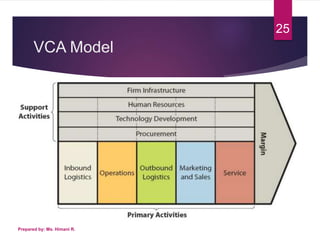
 M. Porter introduced the generic value chain model in
1985. Value chain represents all the internal activities a
firm engages in to produce goods and services.
 It is a process where a firm identifies its primary and
support activities that add value to its final product and
then analyze these activities to reduce costs or increase
differentiation.
Prepared by: Ms. Himani R.
24
VCA Model
Prepared by: Ms. Himani R.
25
Continued
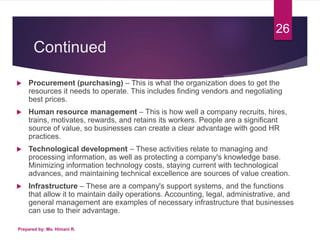
 Procurement (purchasing) – This is what the organization does to get the
resources it needs to operate. This includes finding vendors and negotiating
best prices.
 Human resource management – This is how well a company recruits, hires,
trains, motivates, rewards, and retains its workers. People are a significant
source of value, so businesses can create a clear advantage with good HR
practices.
 Technological development – These activities relate to managing and
processing information, as well as protecting a company's knowledge base.
Minimizing information technology costs, staying current with technological
advances, and maintaining technical excellence are sources of value creation.
 Infrastructure – These are a company's support systems, and the functions
that allow it to maintain daily operations. Accounting, legal, administrative, and
general management are examples of necessary infrastructure that businesses
can use to their advantage.
Prepared by: Ms. Himani R.
26
Continued
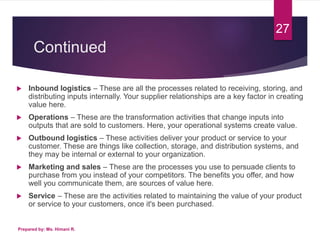
 Inbound logistics – These are all the processes related to receiving, storing, and
distributing inputs internally. Your supplier relationships are a key factor in creating
value here.
 Operations – These are the transformation activities that change inputs into
outputs that are sold to customers. Here, your operational systems create value.
 Outbound logistics – These activities deliver your product or service to your
customer. These are things like collection, storage, and distribution systems, and
they may be internal or external to your organization.
 Marketing and sales – These are the processes you use to persuade clients to
purchase from you instead of your competitors. The benefits you offer, and how
well you communicate them, are sources of value here.
 Service – These are the activities related to maintaining the value of your product
or service to your customers, once it's been purchased.
Prepared by: Ms. Himani R.
27
Avoiding failures and sustaining
competitive advantage
 When a company loses its competitive advantage, its
profitability falls.
 The company does not necessarily fail, it may just
have average or below-average profitability and can
remain in this mode for a considerable time, although
its resources & capital base is shrinking.
Prepared by: Ms. Himani R.
28
Continued
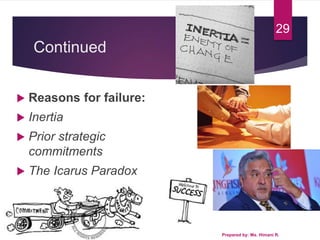
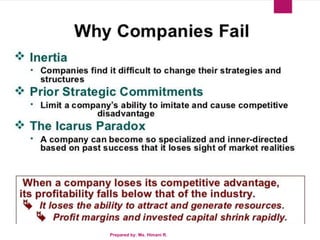
 Reasons for failure:
 Inertia
 Prior strategic
commitments
 The Icarus Paradox
Prepared by: Ms. Himani R.
29
Prepared by: Ms. Himani R.
30
Continued
 Steps to avoid Failure:
 Focus on the Building Blocks of competitive
advantage
 Institute continuous Improvement & Learning
 Track Best Industrial Practice and use
Benchmarking
 Overcome Inertia
Prepared by: Ms. Himani R.
31
Prepared by: Ms. Himani R.
32

Unit 2

  • 1.
  • 2.
    Layout of thepresentation  External Environment  PESTEL Analysis  SWOT Analysis  Porter’s Five Forces Model  The Competitive Profile Matrix (CPM)  Globalization and Industry Structure - Resources  Capabilities and competencies  Value Chain Analysis – Core competencies  Generic building blocks of Competitive Advantage  Distinctive Competencies  Avoiding failures and sustaining competitive advantage 2 Prepared by: Ms. Himani R.
  • 3.
    External Environment  Internalenvironment are the events that occur within an organization. Internal environmental factors are easier to control. Eg. Management, employees, organizational culture, financial issues etc.  An external environment is composed of all the outside factors or influences that impact the operation of business.  The business must act or react to keep up its flow of operations.  The external environment can be broken down into two types: the micro environment and the macro environment. 3 Prepared by: Ms. Himani R.
  • 4.
    Continued  The microenvironment consists of the factors that directly impact the operation of a company. Eg. suppliers, customers, marketing intermediaries, financiers, and public perceptions.  The macro environment consists of general factors that a business typically has no control over. The success of the company depends on its ability to adapt. Eg. economic, socio-cultural, political, legal, technical, and environmental considerations. 4 Prepared by: Ms. Himani R.
  • 5.
  • 6.
    Albert Humphrey  AlbertHumphrey was an American business and management consultant.  He produced a team method for planning which was named SOFT analysis, this has developed into what we now know as a SWOT analysis. 6 Prepared by: Ms. Himani R.
  • 7.
    SWOT analysis  Thefirst two sections (Strengths and Weaknesses) is used to identify all of the internal factors. The last two sections (Opportunities and Threats) will be used to identify all of the external factors. 7 Prepared by: Ms. Himani R.
  • 8.
    Strengths & Weaknesses New, innovative product  Quality processes and procedures  Patents  Strong brand names  Good reputation among customers  Cost advantages from proprietary know-how Prepared by: Ms. Himani R. 8  Lack of marketing expertise  Undifferentiated products or services  Poor quality goods or services  Damaged reputation  High cost structure  Lack of access to key distribution channels
  • 9.
    Opportunities & Threats A developing market  Mergers, joint ventures  New market segments  New international markets  Unfulfilled customer need  Arrival of new technologies  Loosening of regulations Prepared by: Ms. Himani R. 9  New competitors  Price wars  Competitor’s innovation  Competitor’s superior access to distribution channels  Shift in consumer preferences  New regulations
  • 10.
    PESTEL Analysis  APESTEL analysis is a framework or tool used by marketers to analyse and monitor the macro-environmental (external marketing environment) factors that have an impact on an organisation.  The result of which is used to identify threats and weaknesses which is used in a SWOT analysis.  PESTEL stands for:  P – Political  E – Economic  S – Social  T – Technological  E – Environmental  L – Legal 10 Prepared by: Ms. Himani R.
  • 11.
  • 12.
    Porter’s Five ForceModel  Identifies and analyzes five competitive forces that shape every industry, and helps determine an industry's weaknesses and strengths.  Porter identified five undeniable forces that play a part in shaping every market and industry in the world.  The forces are frequently used to measure competition intensity, attractiveness & profitability of an industry or market. Prepared by: Ms. Himani R. 12
  • 13.
    Prepared by: Ms.Himani R. 13
  • 14.
    Porter’s Five ForceModel Prepared by: Ms. Himani R. 14
  • 15.
    The Competitive ProfileMatrix (CPM)  The Competitive Profile Matrix (CPM) is a tool that compares the firm and its rivals and reveals their relative strengths and weaknesses.  The matrix identifies a firm’s key competitors and compares them using industry’s critical success factors.  The analysis also reveals company’s relative strengths and weaknesses against its competitors, so a company would know, which areas it should improve and, which areas to protect. Prepared by: Ms. Himani R. 15
  • 16.
    Continued  Critical successfactors (CSF) are the key areas, which must be performed at the highest possible level of excellence if organizations want to succeed in the particular industry.  They vary between different industries or even strategic groups and include both internal and external factors.  For eg. Union relations, Power over suppliers, Product Quality, Skilled workforce, Efficient supply chain, Customer service, Production capacity, Customer loyalty, Added product features, On time delivery, etc. Prepared by: Ms. Himani R. 16
  • 17.
    Eg. Of CPM CompanyA Company B Company C CSF Weight Rating Score Rating Score Rating Score Range of products 0.05 3 0.15 1 0.05 2 0.10 Successful new introductions 0.04 3 0.12 3 0.12 3 0.12 Sales per employee 0.08 1 0.08 2 0.16 3 0.24 Low cost structure 0.05 1 0.05 3 0.15 4 0.20 Total 0.22 - 0.4 - 0.48 - 0.66 Prepared by: Ms. Himani R. 17
  • 18.
    Continued  Weight Each criticalsuccess factor should be assigned a weight ranging from 0.0 (low importance) to 1.0 (high importance). The number indicates how important the factor is in succeeding in the industry.  Rating The ratings in CPM refer to how well companies are doing in each area. They range from 4 to 1, where 4 means a major strength, 3 – minor strength, 2 – minor weakness and 1 – major weakness.  Score & Total Score The score is the result of weight multiplied by rating. The firm that receives the highest total score is relatively stronger than its competitors. Prepared by: Ms. Himani R. 18
  • 19.
    Globalization & IndustryStructure  Globalization is the term to describe the way countries are becoming more interconnected both economically and culturally.  This process is a combination of economic, technological, socio-cultural and political forces.  Industry is a collection of companies/firms offering goods or services that are close substitutes of each other.  An Industry consists of firms that directly compete with each other.  Industry structure refers to the number and size distribution of firms in an industry. Prepared by: Ms. Himani R. 19
  • 20.
    Continued i) Fragmented Industry If all firms in an industry are small in size when compared with the size of the whole industry, then it is known as fragmented industry.  In a fragmented industry, no firms have large market. Each firm serves only a small piece of total market in competition with others. Eg. agriculture, dry cleaning, salons, soft drinks, automobile etc. ii) Consolidated Industry  If small number of firms controls a large share of the industry's output or sales, it is known as a consolidated industry. In the beer industry for example the top three firms account for 80% of industry sales. Prepared by: Ms. Himani R. 20
  • 21.
    Competitive advantage  Competitiveadvantage leads to superior profitability.  At the most basic level, how profitable a company becomes depends on three factors:  The amount of value customers place on the company’s product.  The price that a company charges for its products.  The cost of creating that value.  Value is something that customers assign to a product.  A company can raise prices to reflect that value or hold prices lower, which induces more customers to purchase its product & expand unit sales volume. Prepared by: Ms. Himani R. 21
  • 22.
    Continued  Competencies arefirm – specific strengths that allow a company to differentiate its products to achieve substantially lower cost than its rivals and thus gain a competitive advantage.  Core competency: It is an activity central to a firm's profitability and competitiveness that is performed well by the firm. Core competencies create and sustain firm's ability to meet the critical success factors.  Distinctive competency: It is a competitively valuable activity that a firm performs better than its competitors. These provide the basis for competitive advantage. These are cornerstone of strategy. They provide sustainable competitive advantage because these are hard to copy. Prepared by: Ms. Himani R. 22
  • 23.
    Generic building blocksof Competitive Advantage  The efficiency of an enterprise depends on the quick flow of information across the complete supply chain i.e. from the customer to manufacturers to supplier.  The generic building blocks of a firm to gain competitive advantage are-  Quality, (Eg. ISO Mark)  Efficiency, (Eg. Japan’s auto industry)  Innovation (Eg. Technology integrated)  Customer responsiveness (Eg. Indian Postal Service) Prepared by: Ms. Himani R. 23
  • 24.
    Value chain analysis M. Porter introduced the generic value chain model in 1985. Value chain represents all the internal activities a firm engages in to produce goods and services.  It is a process where a firm identifies its primary and support activities that add value to its final product and then analyze these activities to reduce costs or increase differentiation. Prepared by: Ms. Himani R. 24
  • 25.
    VCA Model Prepared by:Ms. Himani R. 25
  • 26.
    Continued  Procurement (purchasing)– This is what the organization does to get the resources it needs to operate. This includes finding vendors and negotiating best prices.  Human resource management – This is how well a company recruits, hires, trains, motivates, rewards, and retains its workers. People are a significant source of value, so businesses can create a clear advantage with good HR practices.  Technological development – These activities relate to managing and processing information, as well as protecting a company's knowledge base. Minimizing information technology costs, staying current with technological advances, and maintaining technical excellence are sources of value creation.  Infrastructure – These are a company's support systems, and the functions that allow it to maintain daily operations. Accounting, legal, administrative, and general management are examples of necessary infrastructure that businesses can use to their advantage. Prepared by: Ms. Himani R. 26
  • 27.
    Continued  Inbound logistics– These are all the processes related to receiving, storing, and distributing inputs internally. Your supplier relationships are a key factor in creating value here.  Operations – These are the transformation activities that change inputs into outputs that are sold to customers. Here, your operational systems create value.  Outbound logistics – These activities deliver your product or service to your customer. These are things like collection, storage, and distribution systems, and they may be internal or external to your organization.  Marketing and sales – These are the processes you use to persuade clients to purchase from you instead of your competitors. The benefits you offer, and how well you communicate them, are sources of value here.  Service – These are the activities related to maintaining the value of your product or service to your customers, once it's been purchased. Prepared by: Ms. Himani R. 27
  • 28.
    Avoiding failures andsustaining competitive advantage  When a company loses its competitive advantage, its profitability falls.  The company does not necessarily fail, it may just have average or below-average profitability and can remain in this mode for a considerable time, although its resources & capital base is shrinking. Prepared by: Ms. Himani R. 28
  • 29.
    Continued  Reasons forfailure:  Inertia  Prior strategic commitments  The Icarus Paradox Prepared by: Ms. Himani R. 29
  • 30.
    Prepared by: Ms.Himani R. 30
  • 31.
    Continued  Steps toavoid Failure:  Focus on the Building Blocks of competitive advantage  Institute continuous Improvement & Learning  Track Best Industrial Practice and use Benchmarking  Overcome Inertia Prepared by: Ms. Himani R. 31
  • 32.
    Prepared by: Ms.Himani R. 32

Editor's Notes

  • #15 Competition in the Industry The importance of this force is the number of competitors and their ability to threaten a company. The larger the number of competitors, along with the number of equivalent products and services they offer, dictates the power of a company. Suppliers and buyers seek out a company's competition if they are unable to receive a suitable deal. Potential of New Entrants Into an Industry A company's power is also affected by the force of new entrants into its market. The less money and time it costs for a competitor to enter a company's market and be an effective competitor, the more a company's position may be significantly weakened. Power of Suppliers This force addresses how easily suppliers can drive up the price of goods and services. It is affected by the number of suppliers of key aspects of a good or service, how unique these aspects are and how much it would cost a company to switch from one supplier to another. The fewer number of suppliers, and the more a company depends upon a supplier, the more power a supplier holds. Power of Customers This specifically deals with the ability customers have to drive prices down. It is affected by how many buyers, or customers, a company has, how significant each customer is and how much it would cost a customer to switch from one company to another. The smaller and more powerful a client base, the more power it holds. Threat of Substitutes Competitor substitutions that can be used in place of a company's products or services pose a threat. For example, if customers rely on a company to provide a tool or service that can be substituted with another tool or service or by performing the task manually, and this substitution is fairly easy and of low cost, a company's power can be weakened.