Chapter 1
Banking Law & Operations
Prepared & Presented by
Ms. Himani R.
Layout of the presentation
• Introduction
• Meaning of Banker
• Meaning of Customer
• General & Special Relationships
2Prepared by: Ms. Himani R.
Definitions
• Bank: A bank is a financial institution which
deals with deposits and advances and other
related services.
• Banker: A person who borrows money by
accepting deposits from the public for the
purpose of lending to those who are in need of
money.
• Banking: Banking means the accepting for the
purpose of lending or investment of deposits of
money from the public repayable on demand or
otherwise and withdrawable by cheque, draft,
order or otherwise.
3Prepared by: Ms. Himani R.
Characteristics/Features of a Bank
• Dealing in money
• Individual/firm/company
• Acceptance of deposit
• Giving advances
• Payment & withdrawal
• Agency & Utility
services
• Profit & service
orientation
• Ever increasing
functions
• Connecting link
• Banking business
• Name identity
4Prepared by: Ms. Himani R.
Functions of Banks
• Primary Functions
– Receipts of deposits
– Granting credit
– Remittance of funds
– Accepting bills
– Issuing bank notes
• Subsidiary Functions
– Buying & Selling
securities
– Executing standard
payments
– Collecting interest &
dividend
– Payment of bills
– Safe custody of
valuables
– Acting as a trustee
– Issuing letters of
credit 5Prepared by: Ms. Himani R.
Customer
• Definition: Any person having an account
with a bank from whom bank has agreed to
collect items & includes a bank carrying an
account with another bank.
• The relationship between a banker and a
customer is basically contractual. This
relationship depends on the type of
transaction.
6Prepared by: Ms. Himani R.
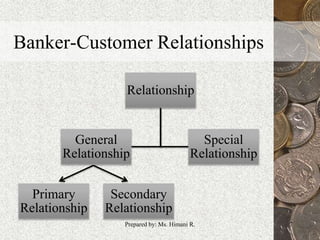
Banker-Customer Relationships
Relationship
General
Relationship
Primary
Relationship
Secondary
Relationship
Special
Relationship
7Prepared by: Ms. Himani R.
General Relationship
• Primary
– Debtor & Creditor
• Deposits do not become time barred
• Creditor demanding payment
• Proper place & time of demand
• Demand in proper manner
• Secondary
– Bailor & bailee
– Principal & agent
– Trustee & beneficiary 8Prepared by: Ms. Himani R.
Special Relationships
• Obligation to honor the cheques
• Consequences of improper dishonor of
customers’ cheques
• Obligation to maintain secrecy of the
account
• Obligations to carry out directions given by
the customer
9Prepared by: Ms. Himani R.
Obligation to honor the cheques
• Section 31 of the Negotiable Instruments Act,
“The drawee of a cheque having sufficient
funds of the drawer in his hands properly
applicable to the payment of such cheques
when duly required to do so and in default of
such payment must compensate the drawer for
any loss or damage caused by such a default.”
• The drawee becomes the bank and drawer is
the customer. It is subject to certain conditions:
10Prepared by: Ms. Himani R.
Continued
• Funds must be sufficient in the hands of a banker.
• If banker has o/d facility, bank is bound to honor.
• Banks cannot use trust funds to make customers’
payments
• The cheques must be properly drawn up
• Stale cheques will be dishonored
• Banker must have reasonable time for crediting
funds or it will be returned with a remark E.N.C
• There must be no legal bar preventing the payment
of cheques
11Prepared by: Ms. Himani R.
Consequences of improper
dishonor of customers’ cheques
• Section 31 negotiable Instruments Act
• In case if the banker dishonors the cheque
intentionally or by mistake, he is liable to
compensate the customer for the loss, unless
– A garnishee order has been issued
– Cheque is issued against cheques sent for
clearance
– Cheque is presented at the branch other than the
one in which he keeps his account 12Prepared by: Ms. Himani R.
Obligation to maintain secrecy of
the account
• Secrecy does not end with the closing of a/c
• Exceptions:
– Compulsion of law
– Public interest
– Banker’s own interest
– Consent of the customer for bankers’ opinion
• Effects of improper/unjustified disclosure
– Liability to the customer
– Liability to third parties
13Prepared by: Ms. Himani R.
Obligations to carry out
directions given by the customer
• The banker is bound to act according to the
directions given by the customer.
• In the absence of such directions, the banker
is bound to use reasonable skill and
diligence in his work.
14Prepared by: Ms. Himani R.
Garnishee Order
• Rule 46 of Code of Civil Procedure 1908
• If a debtor fails to pay the debt owed by him to his
creditor the latter may apply to the court for the
issue of a garnishee order on the banker of his
debtor.
• The banker is under the obligation not to make the
payment after the receipt of a Garnishee order.
• The creditor becomes the judgement creditor, the
debtor becomes judgement debtor and the banker
is called the Garnishee 15Prepared by: Ms. Himani R.
Continued
• Following points are imp for Garnishee Order:
• It applies to the current balance present at the time of the
order
• It has no future prospective operation
• Order is not attached after receiving Garnishee & a new
account is opened
• A fixed deposit can also be attached as a present debt
payable at a future date
• Before paying the balance to the judgement creditor the
banker is entitled to debts due to him
• Most importantly the customer’s account must be in credit
& should belong to him only
16Prepared by: Ms. Himani R.
Rights & Duties of a banker
1. Right of Lien
– Lien means a right exercised by one, over
someone else’s property.
– General Lien: Entitling the person in possession
to retain the goods and securities until all his
claims against the owner of the goods have
been satisfied.
– Particular Lien: A specific right to retain goods
& securities till all the charges in respect of
those goods have been paid off. 17Prepared by: Ms. Himani R.
Continued
• Exceptions to the right of lien
– Articles for safe keeping
– Instruments left for specific purpose
– Money deposited for specific purpose
– Securities left negligently
– Trust accounts
– Before grant of loans
18Prepared by: Ms. Himani R.
2. Right to appropriate payment
as per the rules in Clayton’s Case
• The customer has more than one loan account
and has not specified the account to which the
said money should be used.
• When there are several debts outstanding
between the creditor and the debtor the
question arises as to which of the debts is to
be discharged.
• Then the law appropriates the payment in
chronological order as in the Clayton’s Case
(1816).
19Prepared by: Ms. Himani R.
Continued
• Rule in Clayton’s Case
– Applicable to loan & current accounts other
than savings account.
– The law appropriates the payment in the
chronological order
– The first item on the debit side to be discharged
by the first item on the credit side.
– The balance if any to be carried forward.
– Applicable only to accounts which are still
running.
20Prepared by: Ms. Himani R.
3. Right to set off & combine
accounts
• Banker can adjust the debit balance in one
account against the credit balance in the
other.
• This right can be exercised only:
– Debts are certain and due on the date
– Both the sums are due as between the same
parties and in the same right.
– When there is no expressed or implied
agreement or understanding to the contrary.
21Prepared by: Ms. Himani R.
4. Right to close an account
• A customer can close an account at any time he
feels without assigning reasons
• He should inform the banker and return the unused
cheques with him
• The banker can also decide to close an account
which has been unsatisfactorily conducted by
sending a written intimation to the customer.
• Or the banker may inform that he will honor the
cheques only till the balance is exhausted.
• The banker usually gives sufficient time.
22Prepared by: Ms. Himani R.
5. Right to charge interest and
commission
• It is known as bank charges
• The right to charge interest ceases on the
death or insolvency of the customer
• Bank charges are levied in the case of
drafts, cash credit and current accounts but
not in case of savings account.
• But if the customer maintains large balance
in current account bankers waive these
charges as it is profitable. 23
Prepared by: Ms. Himani R.
6. Right not to produce books of
accounts
• Under the Banker’s Book Evidence Act 1891, a
bank can no more be compelled to produce actual
books of account in any legal proceeding to which
itself is not a party.
• The books are so heavy and so much in
continuous use so the banker cannot be called
upon to produce them.
• A certified copy of any entry in a banker’s book
shall serve as prima facie evidence of that matter.
24Prepared by: Ms. Himani R.
25Prepared by: Ms. Himani R.

Chapter 1

  • 1.
    Chapter 1 Banking Law& Operations Prepared & Presented by Ms. Himani R.
  • 2.
    Layout of thepresentation • Introduction • Meaning of Banker • Meaning of Customer • General & Special Relationships 2Prepared by: Ms. Himani R.
  • 3.
    Definitions • Bank: Abank is a financial institution which deals with deposits and advances and other related services. • Banker: A person who borrows money by accepting deposits from the public for the purpose of lending to those who are in need of money. • Banking: Banking means the accepting for the purpose of lending or investment of deposits of money from the public repayable on demand or otherwise and withdrawable by cheque, draft, order or otherwise. 3Prepared by: Ms. Himani R.
  • 4.
    Characteristics/Features of aBank • Dealing in money • Individual/firm/company • Acceptance of deposit • Giving advances • Payment & withdrawal • Agency & Utility services • Profit & service orientation • Ever increasing functions • Connecting link • Banking business • Name identity 4Prepared by: Ms. Himani R.
  • 5.
    Functions of Banks •Primary Functions – Receipts of deposits – Granting credit – Remittance of funds – Accepting bills – Issuing bank notes • Subsidiary Functions – Buying & Selling securities – Executing standard payments – Collecting interest & dividend – Payment of bills – Safe custody of valuables – Acting as a trustee – Issuing letters of credit 5Prepared by: Ms. Himani R.
  • 6.
    Customer • Definition: Anyperson having an account with a bank from whom bank has agreed to collect items & includes a bank carrying an account with another bank. • The relationship between a banker and a customer is basically contractual. This relationship depends on the type of transaction. 6Prepared by: Ms. Himani R.
  • 7.
  • 8.
    General Relationship • Primary –Debtor & Creditor • Deposits do not become time barred • Creditor demanding payment • Proper place & time of demand • Demand in proper manner • Secondary – Bailor & bailee – Principal & agent – Trustee & beneficiary 8Prepared by: Ms. Himani R.
  • 9.
    Special Relationships • Obligationto honor the cheques • Consequences of improper dishonor of customers’ cheques • Obligation to maintain secrecy of the account • Obligations to carry out directions given by the customer 9Prepared by: Ms. Himani R.
  • 10.
    Obligation to honorthe cheques • Section 31 of the Negotiable Instruments Act, “The drawee of a cheque having sufficient funds of the drawer in his hands properly applicable to the payment of such cheques when duly required to do so and in default of such payment must compensate the drawer for any loss or damage caused by such a default.” • The drawee becomes the bank and drawer is the customer. It is subject to certain conditions: 10Prepared by: Ms. Himani R.
  • 11.
    Continued • Funds mustbe sufficient in the hands of a banker. • If banker has o/d facility, bank is bound to honor. • Banks cannot use trust funds to make customers’ payments • The cheques must be properly drawn up • Stale cheques will be dishonored • Banker must have reasonable time for crediting funds or it will be returned with a remark E.N.C • There must be no legal bar preventing the payment of cheques 11Prepared by: Ms. Himani R.
  • 12.
    Consequences of improper dishonorof customers’ cheques • Section 31 negotiable Instruments Act • In case if the banker dishonors the cheque intentionally or by mistake, he is liable to compensate the customer for the loss, unless – A garnishee order has been issued – Cheque is issued against cheques sent for clearance – Cheque is presented at the branch other than the one in which he keeps his account 12Prepared by: Ms. Himani R.
  • 13.
    Obligation to maintainsecrecy of the account • Secrecy does not end with the closing of a/c • Exceptions: – Compulsion of law – Public interest – Banker’s own interest – Consent of the customer for bankers’ opinion • Effects of improper/unjustified disclosure – Liability to the customer – Liability to third parties 13Prepared by: Ms. Himani R.
  • 14.
    Obligations to carryout directions given by the customer • The banker is bound to act according to the directions given by the customer. • In the absence of such directions, the banker is bound to use reasonable skill and diligence in his work. 14Prepared by: Ms. Himani R.
  • 15.
    Garnishee Order • Rule46 of Code of Civil Procedure 1908 • If a debtor fails to pay the debt owed by him to his creditor the latter may apply to the court for the issue of a garnishee order on the banker of his debtor. • The banker is under the obligation not to make the payment after the receipt of a Garnishee order. • The creditor becomes the judgement creditor, the debtor becomes judgement debtor and the banker is called the Garnishee 15Prepared by: Ms. Himani R.
  • 16.
    Continued • Following pointsare imp for Garnishee Order: • It applies to the current balance present at the time of the order • It has no future prospective operation • Order is not attached after receiving Garnishee & a new account is opened • A fixed deposit can also be attached as a present debt payable at a future date • Before paying the balance to the judgement creditor the banker is entitled to debts due to him • Most importantly the customer’s account must be in credit & should belong to him only 16Prepared by: Ms. Himani R.
  • 17.
    Rights & Dutiesof a banker 1. Right of Lien – Lien means a right exercised by one, over someone else’s property. – General Lien: Entitling the person in possession to retain the goods and securities until all his claims against the owner of the goods have been satisfied. – Particular Lien: A specific right to retain goods & securities till all the charges in respect of those goods have been paid off. 17Prepared by: Ms. Himani R.
  • 18.
    Continued • Exceptions tothe right of lien – Articles for safe keeping – Instruments left for specific purpose – Money deposited for specific purpose – Securities left negligently – Trust accounts – Before grant of loans 18Prepared by: Ms. Himani R.
  • 19.
    2. Right toappropriate payment as per the rules in Clayton’s Case • The customer has more than one loan account and has not specified the account to which the said money should be used. • When there are several debts outstanding between the creditor and the debtor the question arises as to which of the debts is to be discharged. • Then the law appropriates the payment in chronological order as in the Clayton’s Case (1816). 19Prepared by: Ms. Himani R.
  • 20.
    Continued • Rule inClayton’s Case – Applicable to loan & current accounts other than savings account. – The law appropriates the payment in the chronological order – The first item on the debit side to be discharged by the first item on the credit side. – The balance if any to be carried forward. – Applicable only to accounts which are still running. 20Prepared by: Ms. Himani R.
  • 21.
    3. Right toset off & combine accounts • Banker can adjust the debit balance in one account against the credit balance in the other. • This right can be exercised only: – Debts are certain and due on the date – Both the sums are due as between the same parties and in the same right. – When there is no expressed or implied agreement or understanding to the contrary. 21Prepared by: Ms. Himani R.
  • 22.
    4. Right toclose an account • A customer can close an account at any time he feels without assigning reasons • He should inform the banker and return the unused cheques with him • The banker can also decide to close an account which has been unsatisfactorily conducted by sending a written intimation to the customer. • Or the banker may inform that he will honor the cheques only till the balance is exhausted. • The banker usually gives sufficient time. 22Prepared by: Ms. Himani R.
  • 23.
    5. Right tocharge interest and commission • It is known as bank charges • The right to charge interest ceases on the death or insolvency of the customer • Bank charges are levied in the case of drafts, cash credit and current accounts but not in case of savings account. • But if the customer maintains large balance in current account bankers waive these charges as it is profitable. 23 Prepared by: Ms. Himani R.
  • 24.
    6. Right notto produce books of accounts • Under the Banker’s Book Evidence Act 1891, a bank can no more be compelled to produce actual books of account in any legal proceeding to which itself is not a party. • The books are so heavy and so much in continuous use so the banker cannot be called upon to produce them. • A certified copy of any entry in a banker’s book shall serve as prima facie evidence of that matter. 24Prepared by: Ms. Himani R.
  • 25.