Prepared & presented by
Himani R.
Chapter 3
Banking Operations
Layout
 Collecting Banker:
 Meaning – Duties & Responsibilities of Collecting
Banker – Holder for Value –Holder in Due Course -
Statutory Protection to Collecting Banker
 Paying Banker:
 Meaning – Precautions – Statutory Protection to the
Paying Banker – Dishonor of Cheques – Grounds of
Dishonor – Consequences of wrongful dishonor of
Cheques
 Lending Operations:
 Principles of Bank Lending – Kinds of lending
facilities such as Loans, Cash Credit, Overdraft,
Bills Discounting, Letters of Credit – NPA: Meaning,
circumstances & impact –regulations of priority
2 Prepared by: Ms. Himani R.
Meaning of collecting banker
 The banker who collects the cheques
and bills on behalf of it’s customers
 Every crossed cheque is necessarily to
be collected through any bank which is
known as collecting banker
 While collecting the cheques of a
customer the banker may act in the
capacity of either as a holder for value
or as an agent of the customer.
 For collection, the collecting banker will
charge commission.3 Prepared by: Ms. Himani R.
Duties and responsibilities of a
collecting banker
 Due care and diligence in the collection of a cheque: in
case the collecting banker and the paying banker are in
the same bank the cheque should be presented by next
day.
 Serving notice of dishonor: when the cheque is
dishonored the collecting banker is bound to give notice
to his customer within a reasonable time
 Agent for collection: when a banker is not a member of
the clearing house he employs another banker who is a
member of the clearing house for collecting the cheque
 Remittance of proceeds to the customer: in case a
collecting banker has realized the cheque he should pay
the proceeds
 Collection of bill of exchange: it is not a duty but a facility
provided by the banks. A bank should examine the title
4 Prepared by: Ms. Himani R.
Holder for Value & Holder in Due
Course
 Holder for value
 Where value has at any time been given for the
instrument, the holder is deemed a holder for value
in respect to all parties who become such prior
to that time.
 One who gives valuable consideration for an
instrument issued or negotiated to him is a holder for
value
 Holder in due course
 HIDC is the one possessing a check or promissory
note, given in return for something of value, who has
no knowledge of any defects or contradictory claims
to its payment. Such a holder is entitled to payment
by the maker of the check or note.
5 Prepared by: Ms. Himani R.
Statutory Protection to Collecting
Banker
 Crossed cheque only :
 The statutory protection is available to the banker only
in case of cheque crossed generally or specially to
himself. He can not avail this protection in case of
uncrossed cheque.
 Collection as an Agent :
 The statutory protection is available to the banker if he
collects the cheque as an agent of the customer and
not as its holder for value.
 Good faith and without negligence :
 The most essential prerequisite for availing of the
statutory protection is that the banker must receive
payment in good faith and without negligence. A thing is
deemed to be done in good faith when it is in fact done
honestly irrespective of whether negligently or not . He
6 Prepared by: Ms. Himani R.
Paying Banker
 It is the obligation of the bank to honor the
cheques issued by the customer if the
following conditions are fulfilled:
 There is sufficient balance in the account of
the customer
 The cheque is properly drawn and
presented
 There is no legal restriction on payment
 The banker who is liable to pay the value of a
cheque of a customer as per the contract,
when the amount is due from him to the
customer is called “Paying Banker”
 Paying banker is also known as the drawee
7 Prepared by: Ms. Himani R.
Precautions for payment of
cheques
 The banker’s position in respect of cheques drawn upon
him is like to be between the devil and the deep sea. So
the banker has to take care when honoring or
dishonoring a cheque drawn by his customer.
 Proper form: according to NI Act
 Open or crossed cheque: Not to be paid on the counter
 Place of presentment of cheque: Same branch
 Date of cheque: neither post dated or stale cheques
 Mutilated cheque: remark MRC
 Words and figures: Refuse if not matching
 Alterations and over-writings: not without confirmation
 Proper endorsements: Not-negotiable crossing
 Sufficiency of funds: no part payments
 Verification of drawer’s signature: Specimen comparison8 Prepared by: Ms. Himani R.
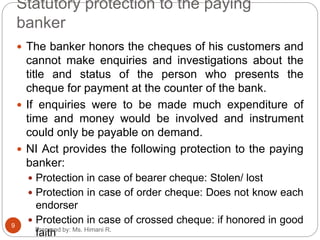
Statutory protection to the paying
banker
 The banker honors the cheques of his customers and
cannot make enquiries and investigations about the
title and status of the person who presents the
cheque for payment at the counter of the bank.
 If enquiries were to be made much expenditure of
time and money would be involved and instrument
could only be payable on demand.
 NI Act provides the following protection to the paying
banker:
 Protection in case of bearer cheque: Stolen/ lost
 Protection in case of order cheque: Does not know each
endorser
 Protection in case of crossed cheque: if honored in good
faith
9
Prepared by: Ms. Himani R.
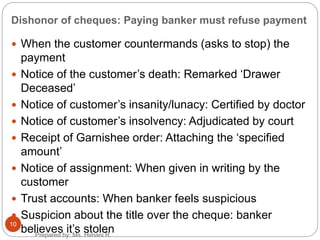
Dishonor of cheques: Paying banker must refuse payment
 When the customer countermands (asks to stop) the
payment
 Notice of the customer’s death: Remarked ‘Drawer
Deceased’
 Notice of customer’s insanity/lunacy: Certified by doctor
 Notice of customer’s insolvency: Adjudicated by court
 Receipt of Garnishee order: Attaching the ‘specified
amount’
 Notice of assignment: When given in writing by the
customer
 Trust accounts: When banker feels suspicious
 Suspicion about the title over the cheque: banker
believes it’s stolen
10
Prepared by: Ms. Himani R.
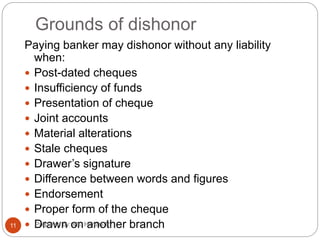
Grounds of dishonor
Paying banker may dishonor without any liability
when:
 Post-dated cheques
 Insufficiency of funds
 Presentation of cheque
 Joint accounts
 Material alterations
 Stale cheques
 Drawer’s signature
 Difference between words and figures
 Endorsement
 Proper form of the cheque
 Drawn on another branch11 Prepared by: Ms. Himani R.
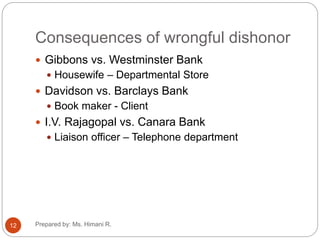
Consequences of wrongful dishonor
 Gibbons vs. Westminster Bank
 Housewife – Departmental Store
 Davidson vs. Barclays Bank
 Book maker - Client
 I.V. Rajagopal vs. Canara Bank
 Liaison officer – Telephone department
12 Prepared by: Ms. Himani R.
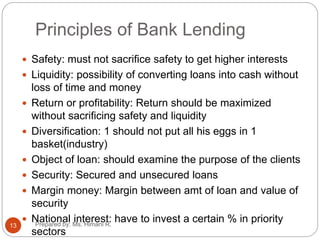
Principles of Bank Lending
 Safety: must not sacrifice safety to get higher interests
 Liquidity: possibility of converting loans into cash without
loss of time and money
 Return or profitability: Return should be maximized
without sacrificing safety and liquidity
 Diversification: 1 should not put all his eggs in 1
basket(industry)
 Object of loan: should examine the purpose of the clients
 Security: Secured and unsecured loans
 Margin money: Margin between amt of loan and value of
security
 National interest: have to invest a certain % in priority
sectors
13 Prepared by: Ms. Himani R.
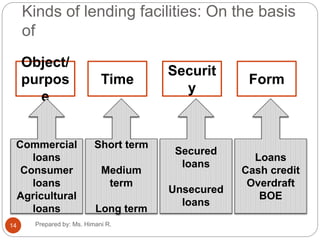
Kinds of lending facilities: On the basis
of
Object/
purpos
e
Time
Securit
y
Form
Commercial
loans
Consumer
loans
Agricultural
loans
Short term
Medium
term
Long term
Secured
loans
Unsecured
loans
Loans
Cash credit
Overdraft
BOE
14 Prepared by: Ms. Himani R.
Loans & Cash Credit
 Specific purpose and fixed period
 Interest is charged on the amount of loan
 Customer repays the loan in one or more
installments
 A fresh application for a new loan/renewal of the
existing
o Cash credit is one of the most popular method of
lending
o Borrower can borrow credit upto a specified limit
o It is granted against the security of tangible
assets/guarantee
o The borrower can borrow any no. of times upto15 Prepared by: Ms. Himani R.
Overdraft and Bills
 Main advantage of having current account
 Available to customer on a written request
 Sometimes it is implied when customer
overdraws a cheque
 Rate of interest is low compared to credit
cards
o Banks provide the facility of purchasing and
discounting B/R
o The bank credits the amount of B/R in his
account
o The bank charges ‘discounting charge’ on the16 Prepared by: Ms. Himani R.
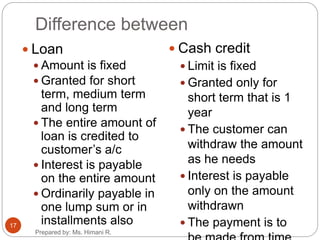
Difference between
 Loan
 Amount is fixed
 Granted for short
term, medium term
and long term
 The entire amount of
loan is credited to
customer’s a/c
 Interest is payable
on the entire amount
 Ordinarily payable in
one lump sum or in
installments also
 Cash credit
 Limit is fixed
 Granted only for
short term that is 1
year
 The customer can
withdraw the amount
as he needs
 Interest is payable
only on the amount
withdrawn
 The payment is to17
Prepared by: Ms. Himani R.
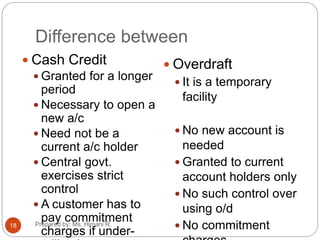
Difference between
 Cash Credit
 Granted for a longer
period
 Necessary to open a
new a/c
 Need not be a
current a/c holder
 Central govt.
exercises strict
control
 A customer has to
pay commitment
charges if under-
 Overdraft
 It is a temporary
facility
 No new account is
needed
 Granted to current
account holders only
 No such control over
using o/d
 No commitment18 Prepared by: Ms. Himani R.
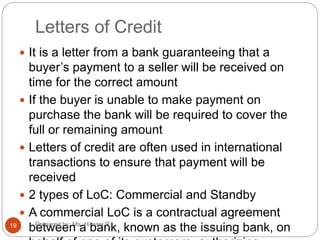
Letters of Credit
 It is a letter from a bank guaranteeing that a
buyer’s payment to a seller will be received on
time for the correct amount
 If the buyer is unable to make payment on
purchase the bank will be required to cover the
full or remaining amount
 Letters of credit are often used in international
transactions to ensure that payment will be
received
 2 types of LoC: Commercial and Standby
 A commercial LoC is a contractual agreement
between a bank, known as the issuing bank, on19 Prepared by: Ms. Himani R.
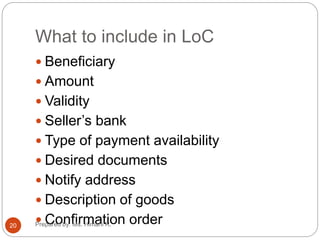
What to include in LoC
 Beneficiary
 Amount
 Validity
 Seller’s bank
 Type of payment availability
 Desired documents
 Notify address
 Description of goods
 Confirmation order20 Prepared by: Ms. Himani R.
Non Performing Assets
 Assets that generate a periodical income are
termed as PA
 If customers do not repay principal amount
and interest for a certain period of time then
such loans become NPA
 In India for classifying an assets as NPA is 180
days
 4 types:
 Standard assets: Performing asset
 Sub standard assets: Non-performing for a
period of 1221 Prepared by: Ms. Himani R.
Causes of NPA
 Speculation: Investing in high risk assets to earn
high income
 Default: Willful default by the borrowers
 Fraudulent practices: loans to ineligible persons,
without security
 Diversion of funds: funds diverted for
unnecessary expansion
 Internal reasons: reasons like inefficient
management, inappropriate technology, labor
problems, marketing failure etc
 External reasons: like recession in the economy,
infrastructural problems, price rise, delay in22 Prepared by: Ms. Himan
Regulations of priority lending for
commercial banks
 Priority sectors refers to those sectors of the
economy which may not get timely and adequate
credit in the absence of this special provision
 Priority Sector Lending is an important role given
by the Reserve Bank of India (RBI) to the banks
for providing a specified portion of the bank
lending to few specific sectors like agriculture
and allied activities, micro and small enterprises,
poor people for housing, students for education
and other low income groups and weaker
sections
 This is essentially meant for an all round
23 Prepared by: Ms. Himani R.
Continued
 Agriculture and Allied Activities
 Small Scale Industries (Direct and Indirect
Finance)
 Small Business / Service Enterprises
 Micro Credit
 Education loans
 Housing loans
24 Prepared by: Ms. Himani R.
 (i) Agriculture and Allied Activities :
Direct finance to agriculture shall include
short, medium and long term loans given
for agriculture and allied activities directly
to individual farmers, Self-Help Groups
(SHGs) or Joint Liability Groups (JLGs) of
individual farmers without limit and to
others (such as corporate, partnership
firms and institutions) up to Rs. 20 lakh, for
taking up agriculture/allied activities.
 Indirect finance to agriculture shall include
loans given for agriculture and allied
activities as specified in Section I.
25 Prepared by: Ms. Himani R.
 (ii) Small Scale Industries (Direct and
Indirect Finance): Direct finance to small
scale industries (SSI) shall include all
loans given to SSI units which are
engaged in manufacture, processing or
preservation of goods and whose
investment in plant and machinery
(original cost) excluding land and building
does not exceed the amounts specified in
Section I.
 Indirect finance to SSI shall include
finance to any person providing inputs to
or marketing the output of artisans, village26 Prepared by: Ms. Himani R.
 (iii) Small Business / Service
Enterprises: shall include small business,
retail trade, professional & self-employed
persons, small road & water transport
operators and other service enterprises as per
the definition given in Section I and other
enterprises that are engaged in providing or
rendering of services, and whose investment in
equipment does not exceed the amount
specified in Section I
 (iv) Micro Credit : Provision of credit and other
financial services and products of very small
amounts not exceeding Rs. 50,000 per
borrower to the poor in rural, semi-urban and27 Prepared by: Ms. Himani R.
 (v) Education loans: Education loans
include loans and advances granted to
only individuals for educational purposes
up to Rs. 10 lakh for studies in India and
Rs. 20 lakh for studies abroad, and do not
include those granted to institutions;
 (vi) Housing loans: Loans up to Rs. 15
lakh for construction of houses by
individuals (excluding loans granted by
banks to their own employees) and loans
given for repairs to the damaged houses
of individuals up to Rs.1 lakh in rural and
semi urban areas and Rs. 2 Lakh in urban
28 Prepared by: Ms. Himani R.

Chapter 3

  • 1.
    Prepared & presentedby Himani R. Chapter 3 Banking Operations
  • 2.
    Layout  Collecting Banker: Meaning – Duties & Responsibilities of Collecting Banker – Holder for Value –Holder in Due Course - Statutory Protection to Collecting Banker  Paying Banker:  Meaning – Precautions – Statutory Protection to the Paying Banker – Dishonor of Cheques – Grounds of Dishonor – Consequences of wrongful dishonor of Cheques  Lending Operations:  Principles of Bank Lending – Kinds of lending facilities such as Loans, Cash Credit, Overdraft, Bills Discounting, Letters of Credit – NPA: Meaning, circumstances & impact –regulations of priority 2 Prepared by: Ms. Himani R.
  • 3.
    Meaning of collectingbanker  The banker who collects the cheques and bills on behalf of it’s customers  Every crossed cheque is necessarily to be collected through any bank which is known as collecting banker  While collecting the cheques of a customer the banker may act in the capacity of either as a holder for value or as an agent of the customer.  For collection, the collecting banker will charge commission.3 Prepared by: Ms. Himani R.
  • 4.
    Duties and responsibilitiesof a collecting banker  Due care and diligence in the collection of a cheque: in case the collecting banker and the paying banker are in the same bank the cheque should be presented by next day.  Serving notice of dishonor: when the cheque is dishonored the collecting banker is bound to give notice to his customer within a reasonable time  Agent for collection: when a banker is not a member of the clearing house he employs another banker who is a member of the clearing house for collecting the cheque  Remittance of proceeds to the customer: in case a collecting banker has realized the cheque he should pay the proceeds  Collection of bill of exchange: it is not a duty but a facility provided by the banks. A bank should examine the title 4 Prepared by: Ms. Himani R.
  • 5.
    Holder for Value& Holder in Due Course  Holder for value  Where value has at any time been given for the instrument, the holder is deemed a holder for value in respect to all parties who become such prior to that time.  One who gives valuable consideration for an instrument issued or negotiated to him is a holder for value  Holder in due course  HIDC is the one possessing a check or promissory note, given in return for something of value, who has no knowledge of any defects or contradictory claims to its payment. Such a holder is entitled to payment by the maker of the check or note. 5 Prepared by: Ms. Himani R.
  • 6.
    Statutory Protection toCollecting Banker  Crossed cheque only :  The statutory protection is available to the banker only in case of cheque crossed generally or specially to himself. He can not avail this protection in case of uncrossed cheque.  Collection as an Agent :  The statutory protection is available to the banker if he collects the cheque as an agent of the customer and not as its holder for value.  Good faith and without negligence :  The most essential prerequisite for availing of the statutory protection is that the banker must receive payment in good faith and without negligence. A thing is deemed to be done in good faith when it is in fact done honestly irrespective of whether negligently or not . He 6 Prepared by: Ms. Himani R.
  • 7.
    Paying Banker  Itis the obligation of the bank to honor the cheques issued by the customer if the following conditions are fulfilled:  There is sufficient balance in the account of the customer  The cheque is properly drawn and presented  There is no legal restriction on payment  The banker who is liable to pay the value of a cheque of a customer as per the contract, when the amount is due from him to the customer is called “Paying Banker”  Paying banker is also known as the drawee 7 Prepared by: Ms. Himani R.
  • 8.
    Precautions for paymentof cheques  The banker’s position in respect of cheques drawn upon him is like to be between the devil and the deep sea. So the banker has to take care when honoring or dishonoring a cheque drawn by his customer.  Proper form: according to NI Act  Open or crossed cheque: Not to be paid on the counter  Place of presentment of cheque: Same branch  Date of cheque: neither post dated or stale cheques  Mutilated cheque: remark MRC  Words and figures: Refuse if not matching  Alterations and over-writings: not without confirmation  Proper endorsements: Not-negotiable crossing  Sufficiency of funds: no part payments  Verification of drawer’s signature: Specimen comparison8 Prepared by: Ms. Himani R.
  • 9.
    Statutory protection tothe paying banker  The banker honors the cheques of his customers and cannot make enquiries and investigations about the title and status of the person who presents the cheque for payment at the counter of the bank.  If enquiries were to be made much expenditure of time and money would be involved and instrument could only be payable on demand.  NI Act provides the following protection to the paying banker:  Protection in case of bearer cheque: Stolen/ lost  Protection in case of order cheque: Does not know each endorser  Protection in case of crossed cheque: if honored in good faith 9 Prepared by: Ms. Himani R.
  • 10.
    Dishonor of cheques:Paying banker must refuse payment  When the customer countermands (asks to stop) the payment  Notice of the customer’s death: Remarked ‘Drawer Deceased’  Notice of customer’s insanity/lunacy: Certified by doctor  Notice of customer’s insolvency: Adjudicated by court  Receipt of Garnishee order: Attaching the ‘specified amount’  Notice of assignment: When given in writing by the customer  Trust accounts: When banker feels suspicious  Suspicion about the title over the cheque: banker believes it’s stolen 10 Prepared by: Ms. Himani R.
  • 11.
    Grounds of dishonor Payingbanker may dishonor without any liability when:  Post-dated cheques  Insufficiency of funds  Presentation of cheque  Joint accounts  Material alterations  Stale cheques  Drawer’s signature  Difference between words and figures  Endorsement  Proper form of the cheque  Drawn on another branch11 Prepared by: Ms. Himani R.
  • 12.
    Consequences of wrongfuldishonor  Gibbons vs. Westminster Bank  Housewife – Departmental Store  Davidson vs. Barclays Bank  Book maker - Client  I.V. Rajagopal vs. Canara Bank  Liaison officer – Telephone department 12 Prepared by: Ms. Himani R.
  • 13.
    Principles of BankLending  Safety: must not sacrifice safety to get higher interests  Liquidity: possibility of converting loans into cash without loss of time and money  Return or profitability: Return should be maximized without sacrificing safety and liquidity  Diversification: 1 should not put all his eggs in 1 basket(industry)  Object of loan: should examine the purpose of the clients  Security: Secured and unsecured loans  Margin money: Margin between amt of loan and value of security  National interest: have to invest a certain % in priority sectors 13 Prepared by: Ms. Himani R.
  • 14.
    Kinds of lendingfacilities: On the basis of Object/ purpos e Time Securit y Form Commercial loans Consumer loans Agricultural loans Short term Medium term Long term Secured loans Unsecured loans Loans Cash credit Overdraft BOE 14 Prepared by: Ms. Himani R.
  • 15.
    Loans & CashCredit  Specific purpose and fixed period  Interest is charged on the amount of loan  Customer repays the loan in one or more installments  A fresh application for a new loan/renewal of the existing o Cash credit is one of the most popular method of lending o Borrower can borrow credit upto a specified limit o It is granted against the security of tangible assets/guarantee o The borrower can borrow any no. of times upto15 Prepared by: Ms. Himani R.
  • 16.
    Overdraft and Bills Main advantage of having current account  Available to customer on a written request  Sometimes it is implied when customer overdraws a cheque  Rate of interest is low compared to credit cards o Banks provide the facility of purchasing and discounting B/R o The bank credits the amount of B/R in his account o The bank charges ‘discounting charge’ on the16 Prepared by: Ms. Himani R.
  • 17.
    Difference between  Loan Amount is fixed  Granted for short term, medium term and long term  The entire amount of loan is credited to customer’s a/c  Interest is payable on the entire amount  Ordinarily payable in one lump sum or in installments also  Cash credit  Limit is fixed  Granted only for short term that is 1 year  The customer can withdraw the amount as he needs  Interest is payable only on the amount withdrawn  The payment is to17 Prepared by: Ms. Himani R.
  • 18.
    Difference between  CashCredit  Granted for a longer period  Necessary to open a new a/c  Need not be a current a/c holder  Central govt. exercises strict control  A customer has to pay commitment charges if under-  Overdraft  It is a temporary facility  No new account is needed  Granted to current account holders only  No such control over using o/d  No commitment18 Prepared by: Ms. Himani R.
  • 19.
    Letters of Credit It is a letter from a bank guaranteeing that a buyer’s payment to a seller will be received on time for the correct amount  If the buyer is unable to make payment on purchase the bank will be required to cover the full or remaining amount  Letters of credit are often used in international transactions to ensure that payment will be received  2 types of LoC: Commercial and Standby  A commercial LoC is a contractual agreement between a bank, known as the issuing bank, on19 Prepared by: Ms. Himani R.
  • 20.
    What to includein LoC  Beneficiary  Amount  Validity  Seller’s bank  Type of payment availability  Desired documents  Notify address  Description of goods  Confirmation order20 Prepared by: Ms. Himani R.
  • 21.
    Non Performing Assets Assets that generate a periodical income are termed as PA  If customers do not repay principal amount and interest for a certain period of time then such loans become NPA  In India for classifying an assets as NPA is 180 days  4 types:  Standard assets: Performing asset  Sub standard assets: Non-performing for a period of 1221 Prepared by: Ms. Himani R.
  • 22.
    Causes of NPA Speculation: Investing in high risk assets to earn high income  Default: Willful default by the borrowers  Fraudulent practices: loans to ineligible persons, without security  Diversion of funds: funds diverted for unnecessary expansion  Internal reasons: reasons like inefficient management, inappropriate technology, labor problems, marketing failure etc  External reasons: like recession in the economy, infrastructural problems, price rise, delay in22 Prepared by: Ms. Himan
  • 23.
    Regulations of prioritylending for commercial banks  Priority sectors refers to those sectors of the economy which may not get timely and adequate credit in the absence of this special provision  Priority Sector Lending is an important role given by the Reserve Bank of India (RBI) to the banks for providing a specified portion of the bank lending to few specific sectors like agriculture and allied activities, micro and small enterprises, poor people for housing, students for education and other low income groups and weaker sections  This is essentially meant for an all round 23 Prepared by: Ms. Himani R.
  • 24.
    Continued  Agriculture andAllied Activities  Small Scale Industries (Direct and Indirect Finance)  Small Business / Service Enterprises  Micro Credit  Education loans  Housing loans 24 Prepared by: Ms. Himani R.
  • 25.
     (i) Agricultureand Allied Activities : Direct finance to agriculture shall include short, medium and long term loans given for agriculture and allied activities directly to individual farmers, Self-Help Groups (SHGs) or Joint Liability Groups (JLGs) of individual farmers without limit and to others (such as corporate, partnership firms and institutions) up to Rs. 20 lakh, for taking up agriculture/allied activities.  Indirect finance to agriculture shall include loans given for agriculture and allied activities as specified in Section I. 25 Prepared by: Ms. Himani R.
  • 26.
     (ii) SmallScale Industries (Direct and Indirect Finance): Direct finance to small scale industries (SSI) shall include all loans given to SSI units which are engaged in manufacture, processing or preservation of goods and whose investment in plant and machinery (original cost) excluding land and building does not exceed the amounts specified in Section I.  Indirect finance to SSI shall include finance to any person providing inputs to or marketing the output of artisans, village26 Prepared by: Ms. Himani R.
  • 27.
     (iii) SmallBusiness / Service Enterprises: shall include small business, retail trade, professional & self-employed persons, small road & water transport operators and other service enterprises as per the definition given in Section I and other enterprises that are engaged in providing or rendering of services, and whose investment in equipment does not exceed the amount specified in Section I  (iv) Micro Credit : Provision of credit and other financial services and products of very small amounts not exceeding Rs. 50,000 per borrower to the poor in rural, semi-urban and27 Prepared by: Ms. Himani R.
  • 28.
     (v) Educationloans: Education loans include loans and advances granted to only individuals for educational purposes up to Rs. 10 lakh for studies in India and Rs. 20 lakh for studies abroad, and do not include those granted to institutions;  (vi) Housing loans: Loans up to Rs. 15 lakh for construction of houses by individuals (excluding loans granted by banks to their own employees) and loans given for repairs to the damaged houses of individuals up to Rs.1 lakh in rural and semi urban areas and Rs. 2 Lakh in urban 28 Prepared by: Ms. Himani R.