Johanna Heinonen
 Marketing is the success factor in a company
 Marketing can be seen in everything that is
done in a company
 Every function in a company has its effect to
and in marketing
 Even customers and stakeholders has affect
marketing results
 Marketing is much more than advertising
 Marketing is the social process by which individuals and groups
obtain what they need and want through creating and exchanging
products and value with others (Kotler)
 Marketing consists of the strategies and tactics used to identify,
create and maintain satisfying relationships with customers that
result in value for both the customer and the marketer.
 Marketing is the management process that identifies, anticipates
and satisfies customer requirements profitably
 The activity, set of institutions, and processes for creating,
communicating, delivering, and exchanging offerings that have
value for customers, clients, partners, and society at large
(American Marketing Association AMA)
 Marketing is an on-going process without a clear
end or a beginning
 Everyone is a marketeer in a company
 Marketing has many goals
 Creating knowledge or image
 Getting new customers
 Increasing sales
 Motivating the personnel
 Informing stakeholders and investors
 Etc
 Some sort of marketing is needed in every branch
and every business
 A good marketer can easily form the big
picture of the situation
 A good marketeer knows something about
almost everything
 A good marketeer is curios and hardworkin
 A good marketeer gathers enough information
and then thinks what are the best solutions to
the problem
 A good marketeer is creative
1. Introduction and idea
2. Analyses
2.1 Organizational analysis
2.2. Competitor analysis
2.3. Demand analysis
2.4. PEST analysis
2.5. SWOT
3. Strategical decisions
3.1. Target group
3.2. Strategical values
3.3. Goals and objectives for marketing plan
4. Implementation
4.1. Product
4.2. Price
4.3. Place
4.4. Personnel
4.5. Promotion
5. Budget, timetable and responsibilities
6. Follow-up
WHERE ARE WE NOW?
• Facts
•Information from different sources to be
analyzed
• Research if needed
WHERE ARE WE GOING TO?
• Your own definitions about the most
reasonable target group, the values /
adjectives this target group respects and
the goals for this marketing plan
HOW TO GET THERE?
• Your own ideas/suggestions of the
implementation based on the facts you
have gathered earlier and put under the
topics of 5P
• Strategical values should be seen in each
of 5p’s and this should be written in the
report, too
• In the report ther must also be the ways
how the defined implementation (5p’s)
helps in reaching the goals
 Knowledge of marketing and its different elements
as such
 Knowledge of the phenomenons that affect targets
of marketing
 Knowledge of the phenomenons that affect
marketing itself
 Knowledge of phenomenons that affect the
environment where marketing happens
 “In a time of turbulence and change, it is more true
than ever that knowledge is power” John
Fitzgerald Kennedy quotes (American 35th US
President (1961-63), 1917-1963)
 External opportunities and threats are
circumstances that can’t be affected by the
company byt which has a great impact on
company’s functions
 Competitors
 Demand
 Laws and regulations
 Trends and culture
 Technological development
 First of all, We’ve got to know A LOT of our customers and the
potential customers (demand) and how they are going to evolve in
the future
 Who they are? Where they come from? What are their
characteristics (socioeconomical and demograpfical background)?
 What they buy? Where they buy? How they buy? How much they
buy? Why they buy?
 Purchase habits? Purchase reasons? ◦ Needs, values, opinions –
FEELINGS?
 How are they going to change in the future?
=> CUSTOMER AND DEMAND ANALYSIS
ALL THIS AFFECTS THEN COMPANY’S FUTURE DECISIONS!,
because we should develop our company and our marketing mix so
that customers find our company as the best alternative in the market!
 Then we’ve got to know our competitors and how they are going
to evolve in the future
 Who they are? What they sell? How they sell?
 Why people buy from them?
 What are their values and their image?
 How are they going to change in the future?
=> COMPETITOR ANALYSIS
 We can divide our competitors to core competitors, need
competitors, marginal competitors and potential competitors
ALL THIS AFFECTS THEN COMPANY’S FUTURE DECISIONS,
because we should differ from our competitors so, that our customers
think that we are the best alternative!
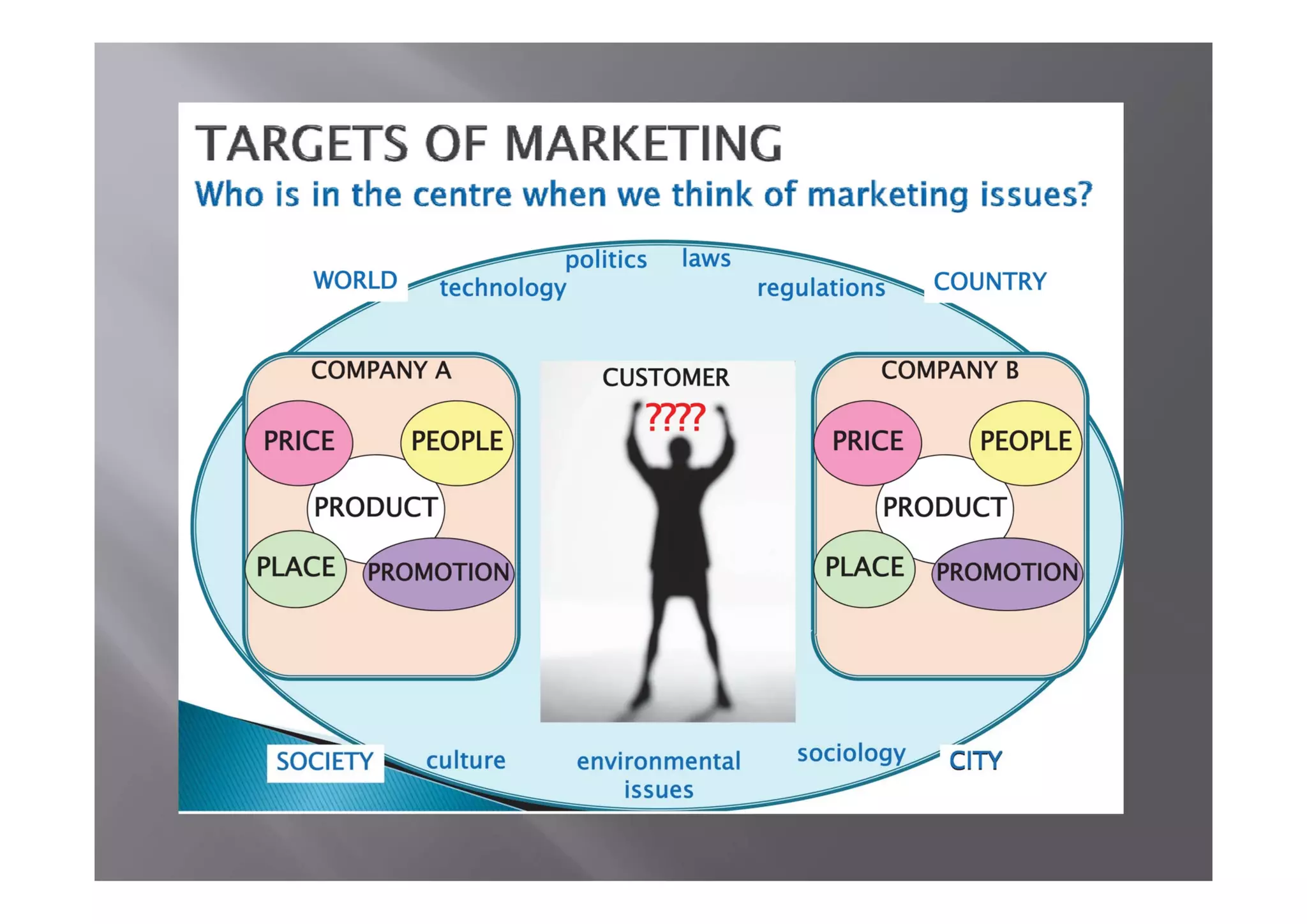
 We should also know about the rules that companies and
people should follow when the live here on Planet Earth
 This means
 Laws, Regulations
 Culture
 Politics
 Sociological issues (communication etc.)
 Technological issues
 Environmental issues
=> PEST Analysis
ALL THIS AFFECTS COMPANY’S FUTURE DECISIONS, too,
because we must in certain amount follow the newest trends
and we must fuNction accordIng to the laws . We must also
take the culture ant the politics in a country into consideration
if we want to be successful.
 Internal strengths and weaknesses can be
 Business idea: basic for whole entrepreneurship
 Products, prices, distribution, co-operation: what are
they, why, what needs do they fullfil etc
 Personnel: is there enough, what kind of skills it has, is it
motivated etc.
 Management: what is it, why
 Resources: money, machines, know-how
 Marketing: how is it done now, why
 Customers: who are they know, why
 etc
 Then we’ve got to know A LOT about our own company and what are
our future goals
 Who are we? Why do we exist? What are our values and our image?
 What are our resources and finance?
 What do we sell (products and services)? What are our selling
arguments?
 With what price do we sell? Why?
 Where do we sell our product/service? Who are our distributors? Why?
 What is the strategy here (massdistribution or direct selling to the
customer)?
 How do we communicate of ourselves? What kind of adds do we have?
Why? Where? What is the central message? Why?
 What kind of people is there working with us? What is their meaning to
the company? What is their competence? Is there enough of them?
 How have we differentiated our product from our competitors?
=> ORGANIZATIONAL ANALYSIS
AFTER THIS WE SHOULD COMPARE OUR PRESENT STATE TO OTHER
ANALYSIS AND FIGURE OUT, how we should develop and market our
company in order to differ from our competitors so that customers think we
are the best alternative and still keep our own values and function according
to the rules of society.
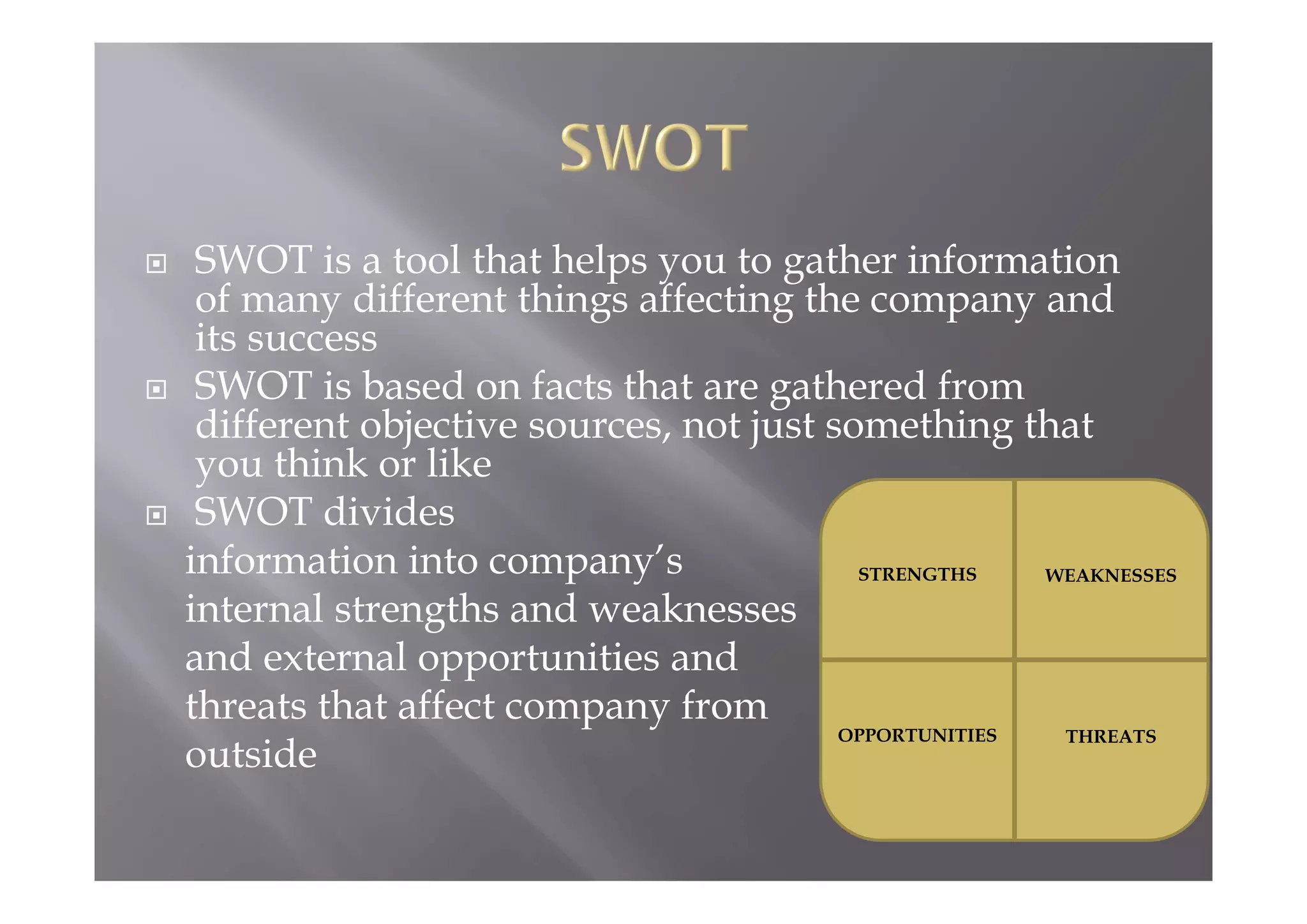
 SWOT is a tool that helps you to gather information
of many different things affecting the company and
its success
 SWOT is based on facts that are gathered from
different objective sources, not just something that
you think or like
 SWOT divides
information into company’s
internal strengths and weaknesses
and external opportunities and
threats that affect company from
outside
STRENGTHS WEAKNESSES
OPPORTUNITIES THREATS
 SWOT is not a list of things, it is an analysis
 This means that SWOT should be written with
whole sentences and everything written in it
should be analyzed
 Easist way to analyze is to think, whether
something is good or bad and should it be changed
or improved somehow
 The normal / usual way to use SWOT is to think
 how to take advantage of strengths and opportunities
 how to improve weaknessed
 And how to foresee and prevent threats
 Gather information of the company
 Facts about location, ownership, marketing, products, services, resources, decoration, values, personnel,
goals
 Analyze customers
 Present vs. future
 Needs, values, wishes
 How do the customers affect business and marketing? What kind of changes / improvements they cause?
WHY?
 Analyze the competitors (NOTE! Competitors are those, who fight for customers’ attention and money)
 Present competitors vs. future competitors
 Their products, services, marketing, strengths, values
 How should the company differentiate itself from the competitors so, that that customer would choose it
instead of competitors? What this means in practice – changes in personnel, products etc? WHY?
 Analyze laws and regulations
 What laws and regulations affect the company and its business?
 How do these laws affect? What kind of demands or restrictions they set to the company?
 Analyze trends and culture
 Are there some trends that affect demand or our business? Does culture has some impact on demand,
marketing or our business?
 How do these effect? Do they cause some improvements / changes? Why?
 Analyze economical and technological environment and trends
 Are there some trends that affect demand or our business amd its marketing?
 How do these effect? Do they cause some improvements / changes? Why?
 Be critical!
 Don’t just take the entrepreneurs word as the
only truth – it is usually biased and subjective
 Gather other information from objective sources
 Your decisions and suggestions should be
based on facts – so gather enough information
of everything and many different sources and
point of views
 Analysis is usually 80 % of marketing plan
 Now you have finished your analysis tool and
know a lot more about your markets,
competitors and customers than in the
beginning
 You also have a clue what is needed from your
organization
 Now it is time to consider company’s strategies
and target groups
 It is also time to set goals that are based on the
analysis, so that they are realistic and still
demanding
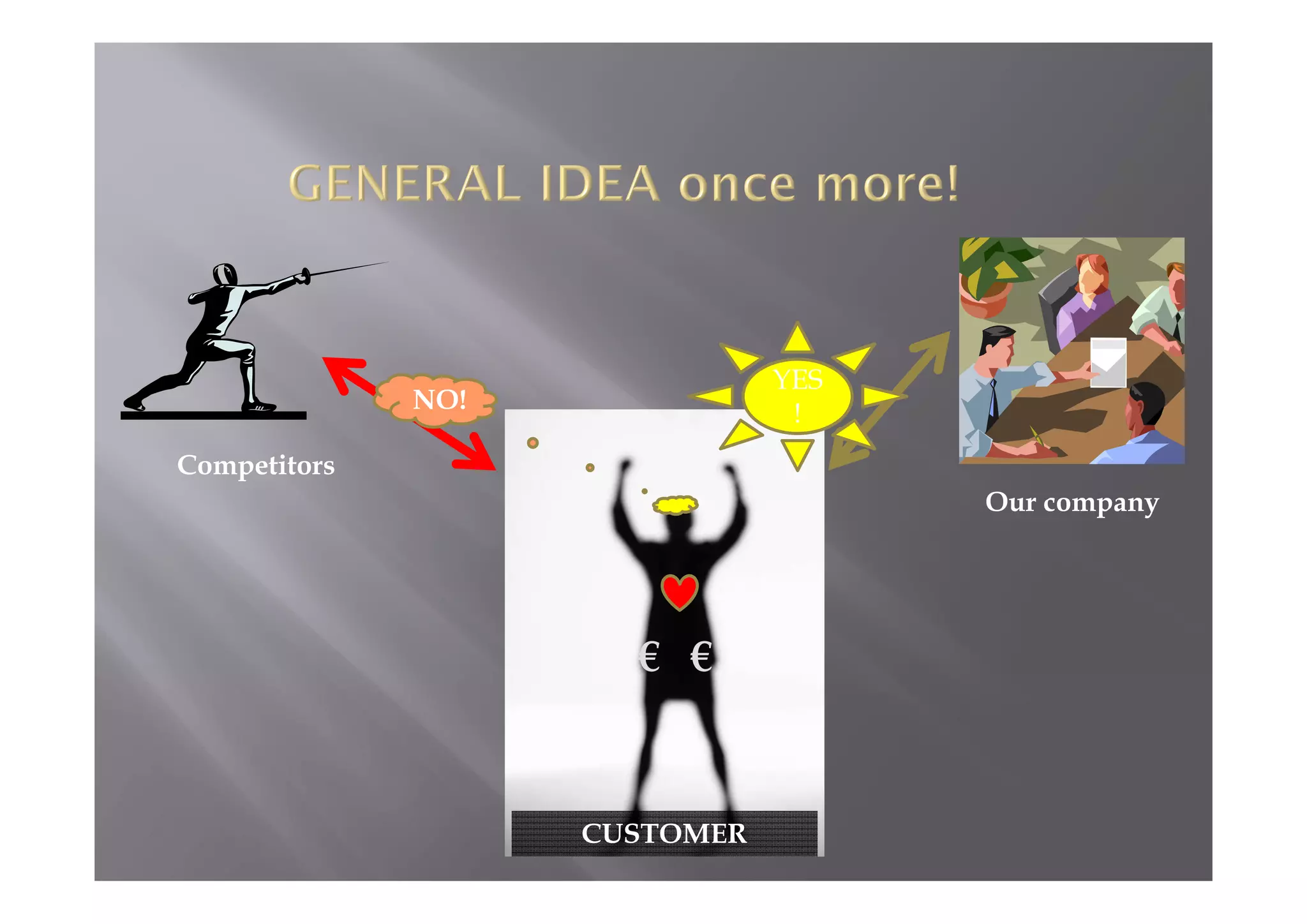
Competitors
Our company
CUSTOMER
€€
NO!
YES
!
 In order to make marketing more effective and to
concentrate on the most profitable target group a
company must divide its potential customers into
target groups
 Customers can be divided into groups based on
 Demografic and social-economic basis
 Psychografic basis
 According to situation
 Nowadays the most usual way is to find groups with
similar interests and values!
 It is also important to think, how the company
shall keep the customers as its customers in the
future
 This is called as customer program and it aims to
keep customers satisfied
 Customer satisfaction is always customer’s own
decisions and evaluation
 Customer satisfaction is effected by:
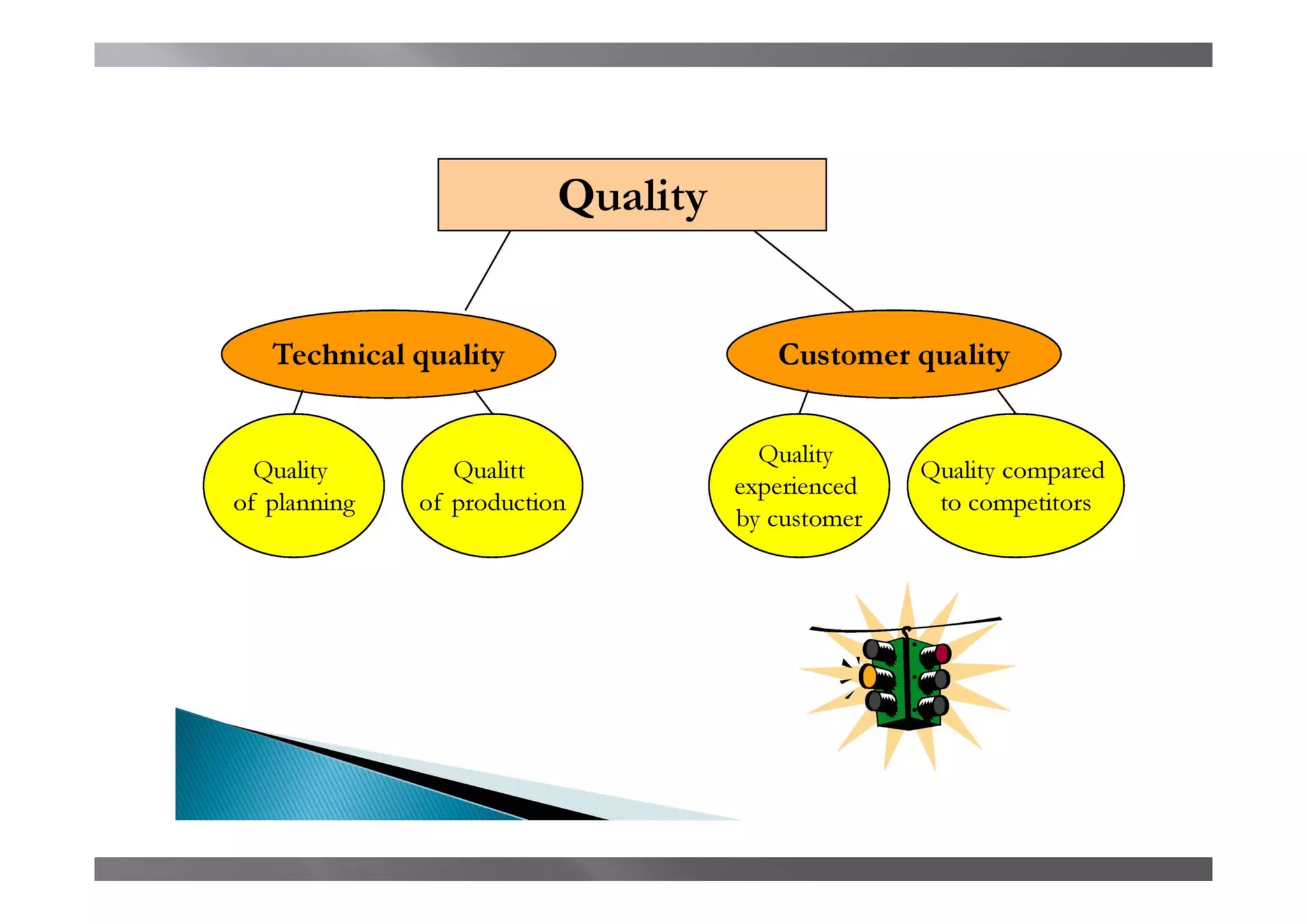
 The quality of product / service
 The whole personnels skills and attitude towards customers
 Managers’ attitude towards customers and personnel
 A long-term planning and implementing process
 Keeping of the service promise
 A marketing strategy is a process that can
allow an organization to concentrate its limited
resources on the greatest opportunities to
increase sales and achieve a sustainable
competitive advantage.
 A marketing strategy should be centered
around the key concept where customer
satisfaction is the main goal.
 A marketing strategy is often the starting
point to a marketing plan, which contains a set
of specific actions required to successfully
implement a marketing strategy.
 A marketing strategy often binds an
organization's marketing goals, policies, and
action sequences (tactics) together.
 Marketing strategies are dynamic and
interactive. They are partially planned and
partially unplanned.
 Company’s values are important!
 the state of affairs that a plan is intended to
achieve
 A goal or objective consists of a projected state
of affairs which a person or a system plans or
intends to achieve or bring about
 A personal or organizational desired end-point
in some sort of assumed development.
 Many people endeavor to reach goals within a
finite time by setting deadlines.
 Marketing plans built with clear, stated goals — backed
up with appropriate metrics and measurements — will
be approved a lot more readily than those that aren't.
 Marketing must develop its plans based on the realities
of the business environment while remaining in
alignment with corporate goals.
 If a marketing plan's primary goal is not expressed in
these terms, it will be difficult for the plan to gain
approval from company executi
 Concrete goals are a key component of all marketing
plans.
 Goals help to steer the development of all marketing
activities, including promotions, advertising
campaigns, and press related activities
 Goals should be specific and measurable (quantity
goals), e.g.
 increasing market share by two percentage points over a 12-
month period
 doubling sales of a particular product in six months
 increasing customer retention by 25 percent from one holiday
season to the next
 Less specific goals are often qualitative, e.g.
 increasing a company's visibility within a marketplace
 differentiating a company from its rivals
 If you state your goals clearly and with good grounds,
it’s easy to follow-up whether the implementation
goes right and the right and sufficient results are
achieved
~ The activities and functions ~
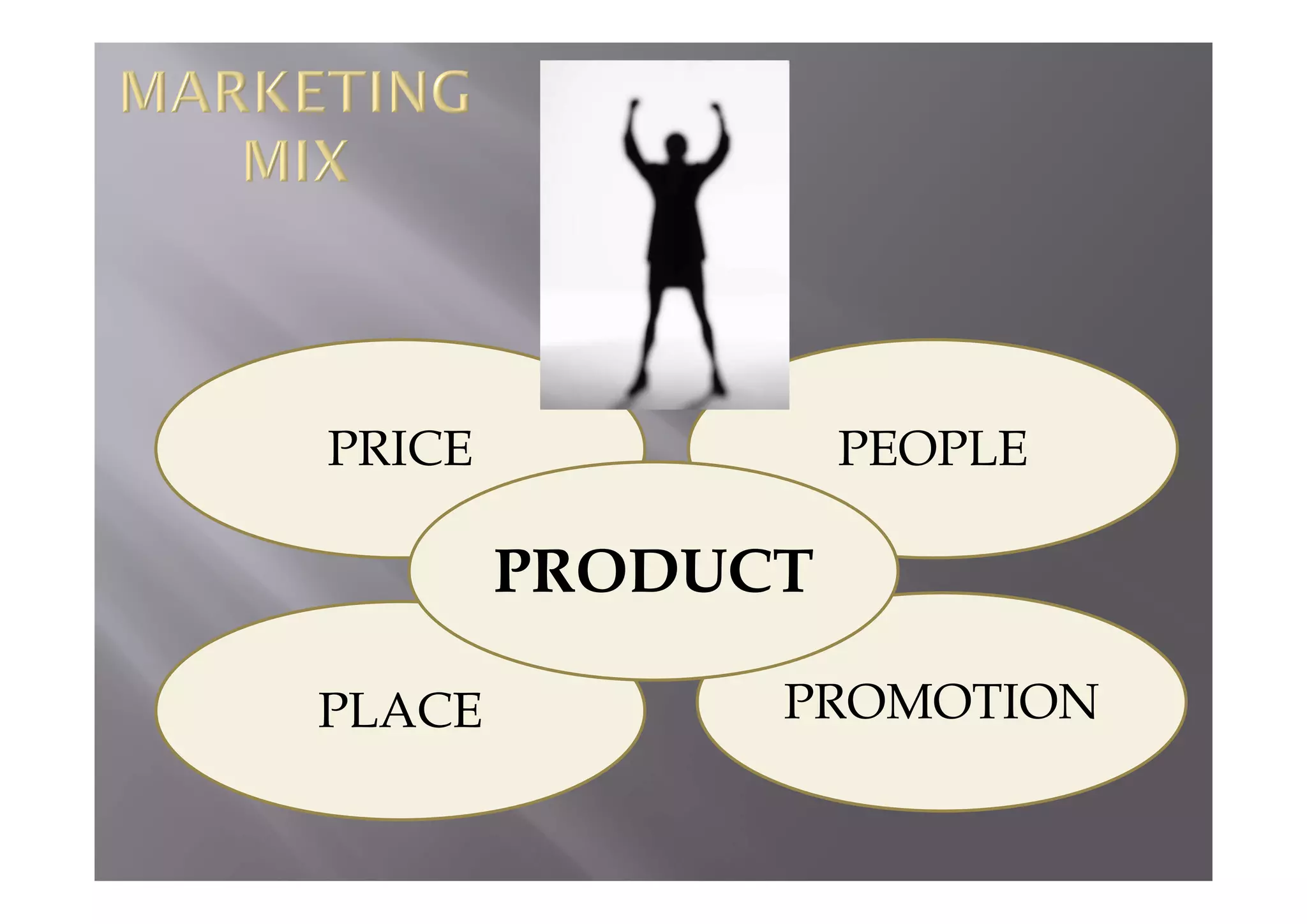
PRICE
PLACE PROMOTION
PEOPLE
PRODUCT
PRICE
PLACE
PROMOTI
ON
PEOPLE
PRODUC
T
Does the organization create what its intended customers want? Define
the characteristics of your product or service that meets the needs of your
customers.
• Why would our target group ”buy” our product?
• How can we make our target group interested in our product?
• How can we differ from our competitors?
• Differentation
• Branding
IMAGE
SUPPORTING PARTS
CORE
PRODU
CT
 A product can be defined as a collection of
physical, service and symbolic attributes which
yield satisfaction or benefits to a user or buyer.
 A product is a combination of physical attributes
say, size and shape; and subjective attributes say
image or "quality“
 COMMODITY is a common name for everything,
that a company produces to the sales. It can be a
product or a service
 SERVICE is an immaterial commodity.
 PRODUCT is something real and touchable
 The production of the product or service should be well
planned and coordinated
 The main elements to consider are
 the production process itself
 specifications
 culture
 the physical product
 packaging
 labelling
 branding
 warranty
 service
 Product marketing in a business addresses four important
Strategic questions:
 What products will be offered?
 Who will be the target customers?
 How will the products reach those customers?
 Why will customers prefer our products to those of competitors?
 distinguishing the differences of a product or
offering from others
 to make a product more attractive to a
particular target market
Source of a competitive advantage
The objective is to develop a position that
potential customers see as unique
 The brand differences
 difference in packaging
 difference in an advertising theme
 Differences in quality
 Differences in price
 Differences in functional features
 Differences in design
 Sales promotion activities of sellers
 Differences in availability
 Differentiation is due to buyers perceiving a
difference,
 Differentiation is the possibility of charging
more money from customers
 However, if customers value the firm's offer,
they will be less sensitive to aspects of
competing offers and price may not be one of
these aspects
 A brand is a collection of images and ideas
 representing a product or a company
FOR
BRANDING
COMPANY
 Company name >< Individual branding
 Colours
 Sounds
 Forms and designs
 Packages
 Prices
 Logos
 Slogans
 Advertisements
 Names
 Attitudes
PLACE
PROMOTIO
N
PEOPLE
PRODUCT
PRICE
How much are the intended customers willing to pay?
Here we decide on a pricing strategy - do not let it just happen!
The consumer is often sensitive for price discounts and special offers.
Price builds also the company image: something that is expensive must be good
• How should we price our product so that our customers buy it? Is price
important to our customers?
• How should we price our product so that it differs from our competitors?
• How should we price our product so that we make some profit?
• Discounts
• Terms of payment
• Price creating image
 Price is the result of an exchange; a numerical
monetary value to a good, service or asset
 In marketing the price is the amount a
customer pays for the product. It is determined
by a number of factors including market share,
competition, material costs, product identity
and the customer's perceived value of the
product.
 The business may increase or decrease the price
of product if other stores have the same
product.
 How much to charge for a product or service? How much do
customers value the products and services?
 What are the pricing objectives?
 How to set the price? (cost-plus pricing, demand based or
valuebased pricing, rate of return pricing, or competitor indexing)
 Should there be a single price or multiple pricing?
 Should prices change in various geographical areas, referred to as
zone pricing?
 Should there be quantity discounts?
 Do you use a price skimming strategy or a penetration pricing
strategy?
 What image do you want the price to convey?
 Do you use psychological pricing?
 How visible should the price be? Should the price be neutral?
 What sort of payments should be accepted?
PRICE
PROMOTIO
N
PEOPLE
PRODUCT
PLACE
~ Available at the right place, at the right time, in the right quantities ~
•What is the best place to sell our product so that it is available to our
customers?
• How widely should the product be sold?
• Should we use distributors? Who are our distributors? Why?
• How should our ”shop” (premises) look like?
• Signs
• Decoration
• Distributors
• Storage
• Availability
 Place strategy tells how the product or service will
be distributed to the end user. The product must
be at the right place at the right time.
 Two types of distribution methods:
 Indirect distribution – use of an retailer or an
intermediary
 Direct distribution - selling directly from a manufacturer
to the consumer
 Three type of distribution strategies
1. Intensive distribution - the product is sold in as many places
as possible.
2. Exclusive distribution - a single outlet
3. Selective Distribution: - A small number of retail outlets
PRICE
PLACE
PROMOTIO
N
PRODUCT
PEOPLE
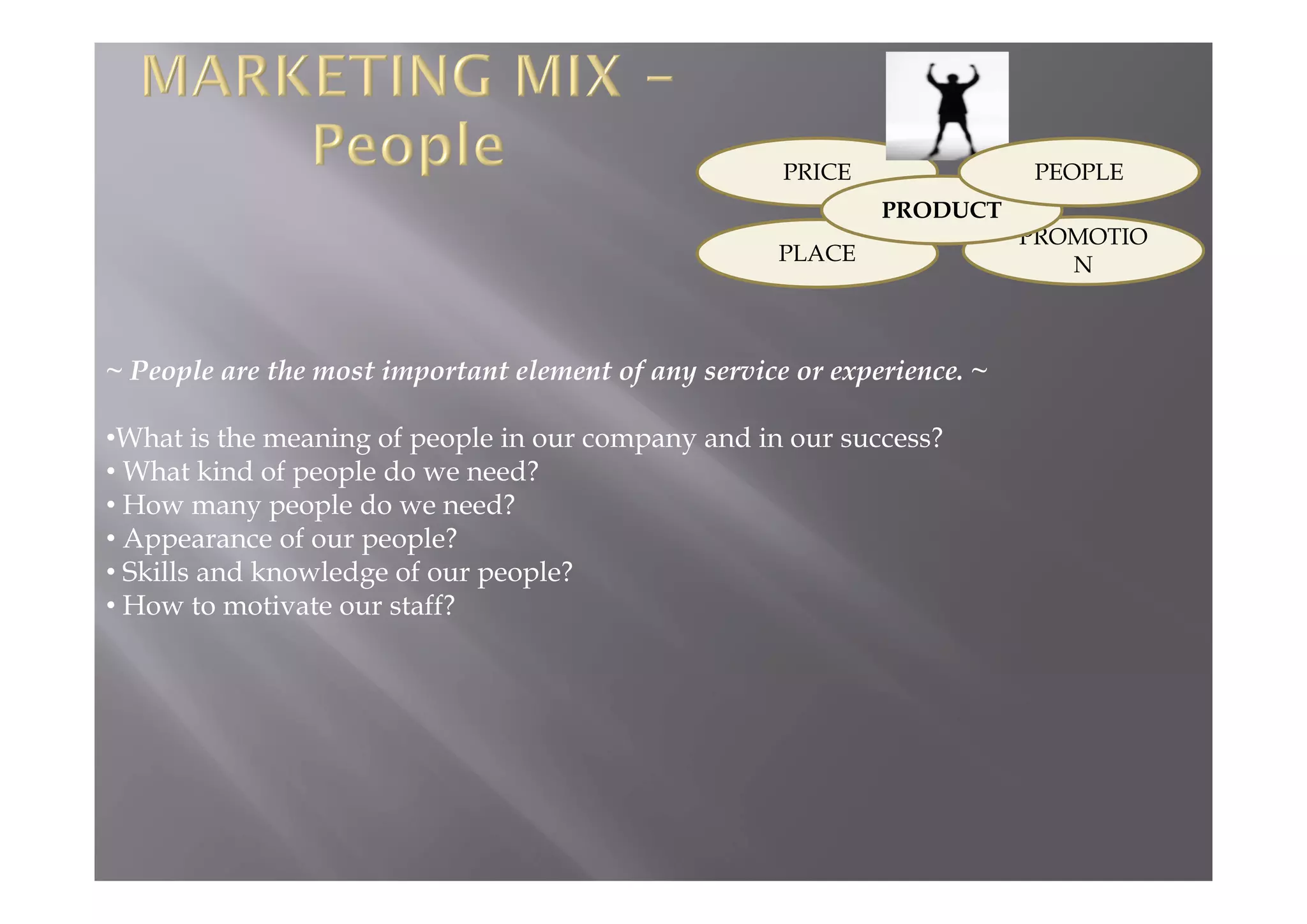
~ People are the most important element of any service or experience. ~
•What is the meaning of people in our company and in our success?
• What kind of people do we need?
• How many people do we need?
• Appearance of our people?
• Skills and knowledge of our people?
• How to motivate our staff?
 People buy from people that they like
 Personnel’s attitude, skills and appearance are
important
 Personnel is a company’s first market – they must
believe in the company and know its products,
strategies and values
 INTERNAL MARKETING
 An ongoing process which aims for that personnel is
satisfied and gives its best for the company and its
customers.
1. Hire right kind of people to the company
2. Keep the good, old workers
3. Motivate personnel for doing their jobs better
4. Create employee job satisfaction
5. Internal communication
 Better job performance
 Responsibility for employees
 Common understanding of the company and its
strategies
 Better service to clients
 Improved employee development
 Integrates business culture, structure, human
resources management, vision and strategy with
the employees' professional and social needs
 Better coordination and cooperation among
departments of the business.
PRICE
PLACE
PEOPLE
PRODUCT
PROMOTI
ON
PROMOTION = All communication that happens inside or outside the
company
1. You’ve got to have something to tell – the central message / the
service promise
• Company’s point of view
• Customers’ point of view!!!
2. ”The package”
• You’ve got to express the central message in such a way that
customers pay attention to it, notice your message and adapt it as
their own
3. Media choices
• You’ve got to find the medias that your customers follow and
use them as your marketing channels
• The package? / The budget? / The effect?
4. Timetable
5. Responsibilities (The role of advertising agency?)
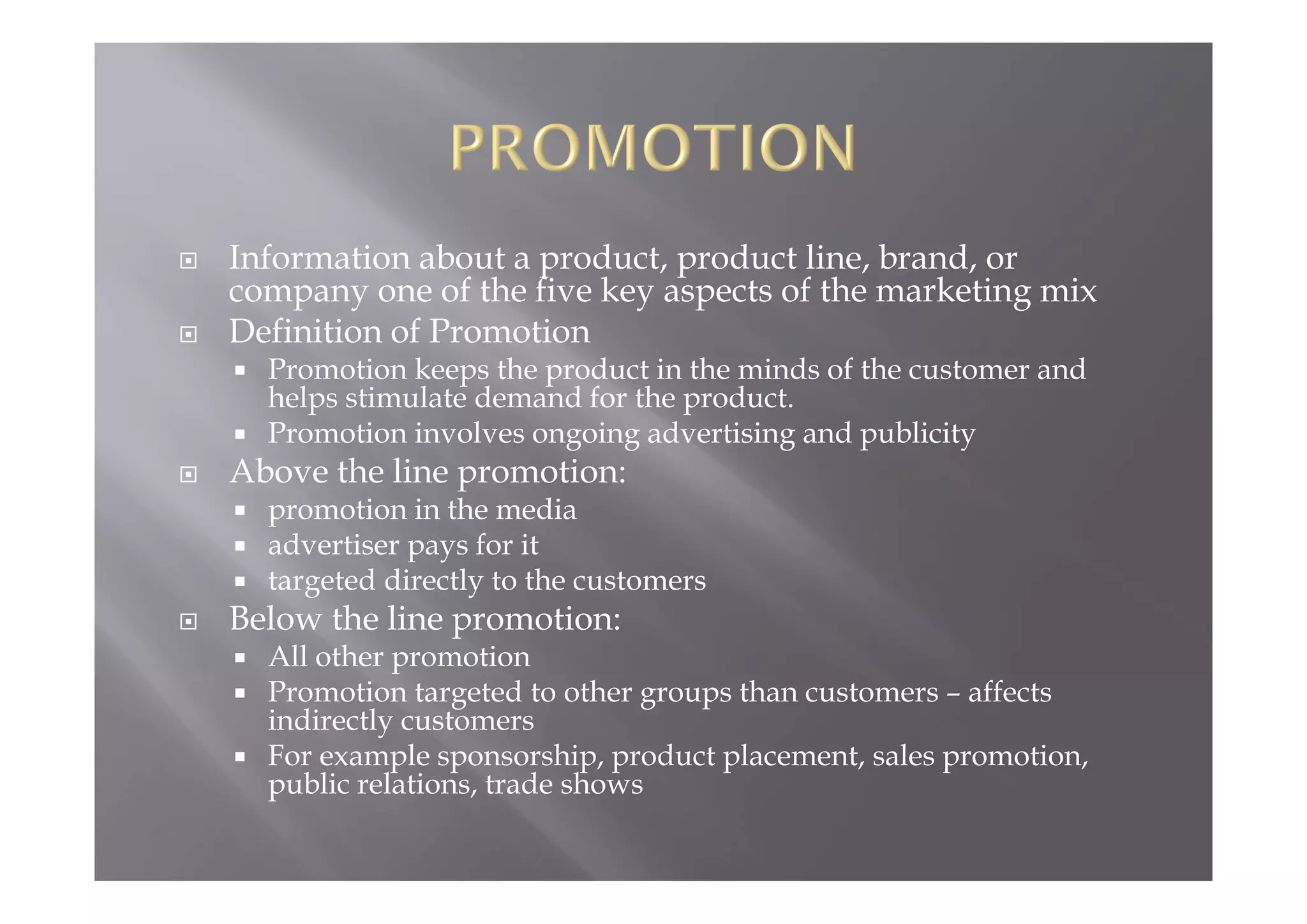
 Information about a product, product line, brand, or
company one of the five key aspects of the marketing mix
 Definition of Promotion
 Promotion keeps the product in the minds of the customer and
helps stimulate demand for the product.
 Promotion involves ongoing advertising and publicity
 Above the line promotion:
 promotion in the media
 advertiser pays for it
 targeted directly to the customers
 Below the line promotion:
 All other promotion
 Promotion targeted to other groups than customers – affects
indirectly customers
 For example sponsorship, product placement, sales promotion,
public relations, trade shows
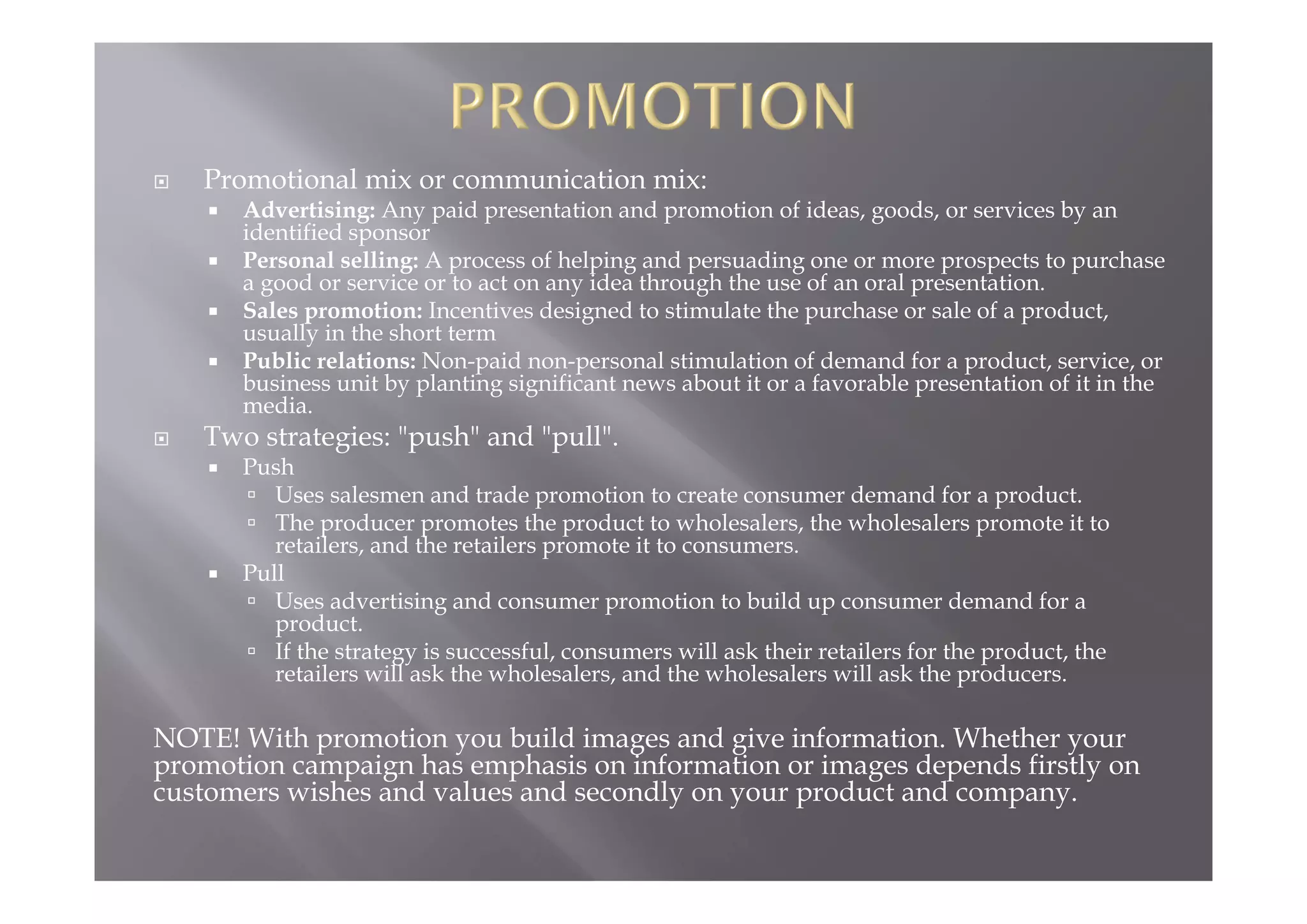
 Promotional mix or communication mix:
 Advertising: Any paid presentation and promotion of ideas, goods, or services by an
identified sponsor
 Personal selling: A process of helping and persuading one or more prospects to purchase
a good or service or to act on any idea through the use of an oral presentation.
 Sales promotion: Incentives designed to stimulate the purchase or sale of a product,
usually in the short term
 Public relations: Non-paid non-personal stimulation of demand for a product, service, or
business unit by planting significant news about it or a favorable presentation of it in the
media.
 Two strategies: "push" and "pull".
 Push
 Uses salesmen and trade promotion to create consumer demand for a product.
 The producer promotes the product to wholesalers, the wholesalers promote it to
retailers, and the retailers promote it to consumers.
 Pull
 Uses advertising and consumer promotion to build up consumer demand for a
product.
 If the strategy is successful, consumers will ask their retailers for the product, the
retailers will ask the wholesalers, and the wholesalers will ask the producers.
NOTE! With promotion you build images and give information. Whether your
promotion campaign has emphasis on information or images depends firstly on
customers wishes and values and secondly on your product and company.
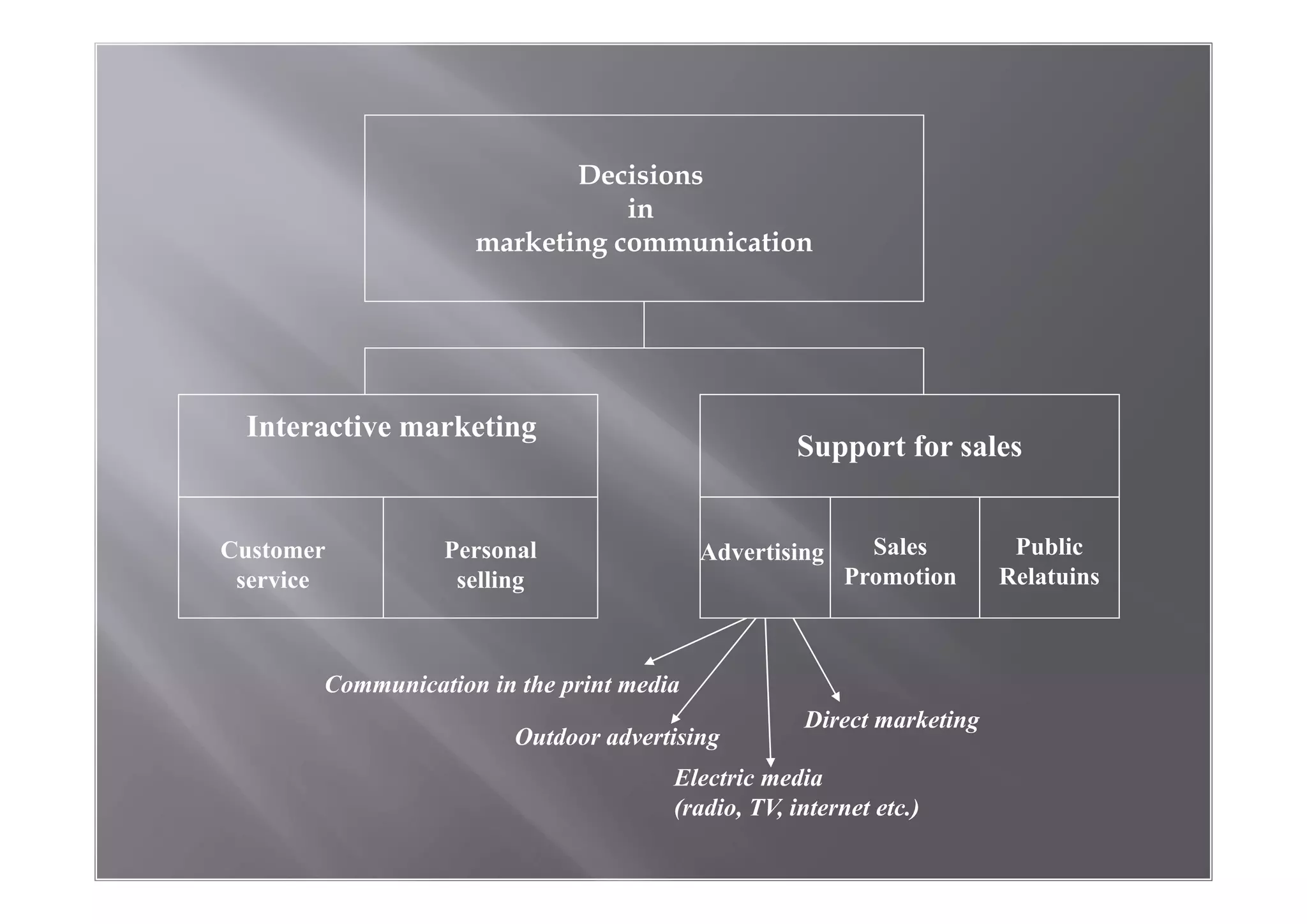
Decisions
in
marketing communication
Interactive marketing
Support for sales
Customer
service
Personal
selling
Advertising Sales
Promotion
Public
Relatuins
Communication in the print media
Electric media
(radio, TV, internet etc.)
Direct marketing
Outdoor advertising
Johanna Heinonen-Salakka
12.2.2002
Advertising
A message that is sent and paid by a recognisable sender usually in massmedia.
The message tells aboyt the services, products and the company and its goal ist tu
create/increase selling and/or the knowledge of the product/service/company or
create/improve the image of the prod
Why advertising needs?
1. It informs customers of the product/service/company and its contents and
elements, the price, the selling places…
2. It affects people’s attitudes and feelings and it aims for creating a good product-
and company image; a brand.
3. It wants to create a will for purchase by telling the good sides and the
advantages in buying the product
Johanna Heinonen-Salakka
12.2.2002
The positive elements in advertising
• Reaches masses
• Quick
• Cheap, if you consider the number of persons you
reach
• Cheap for the customer
The negative elements in advertising
• Expensive
• Demands skills to be done right
• Impersonal
Johanna Heinonen-Salakka
12.2.2002
How to make a good advertisement?
BASIC:
Keep it simple
Don’t change it
• in order to make people remember your advertisement, you
must use the same elements over and over again during the
years. E.g. The color blue in Fazer blue chocklate, color Red in
Viking Line, three stripes in Adidas, ”Have a Coce and a smile”
Advertisements can be
• Visually same (same color, logo etc)
• Verbally same (same slogan)
• Orally same (same sound)
Johanna Heinonen-Salakka
12.2.2002
How to make a good advertisement?
Go public regularyly and often enough
Don’t use too many elements in your advertisement – rather use empty
space
Use picture as often as its possible
Further information about the topic can be found e.g. the following
netsites:
• http://www.bly.com/Pages/documents/HTWAGA.html
• http://www.marketingtoday.com/marcom/writeads.htm
Johanna Heinonen-Salakka
12.2.2002
CONTENTS IN ADVERTISING
• main promise / central message
• the parts that support the main promise
Useful tool is AIDA (e.g. an exaggerated version is TV Shop)
A get your customers’ attention
I create interest
D make them desire your product / companu
A make them act (buy)
S guarantee satisfaction
Johanna Heinonen-Salakka
12.2.2002
Advertising campaing
Lasts a certain period during which the advertiser sends a
message to the target group in the chosen medias
The same message can be told with different communication
tools
Levels in advertising campaing
1. National
2. Regional
3. In one shop or residence
PLANNING AND ADVERTISING CAMPAIGN
Gathering background
information
Goals and target groups
for advertising campaign
Budget
Choosing media/s
Deciding the central
Message and contents
Implementantion:
Pretesting
Production
Publishing
Measuring the effectiveness
and gathering feed back
Publishing time
Number of repeats
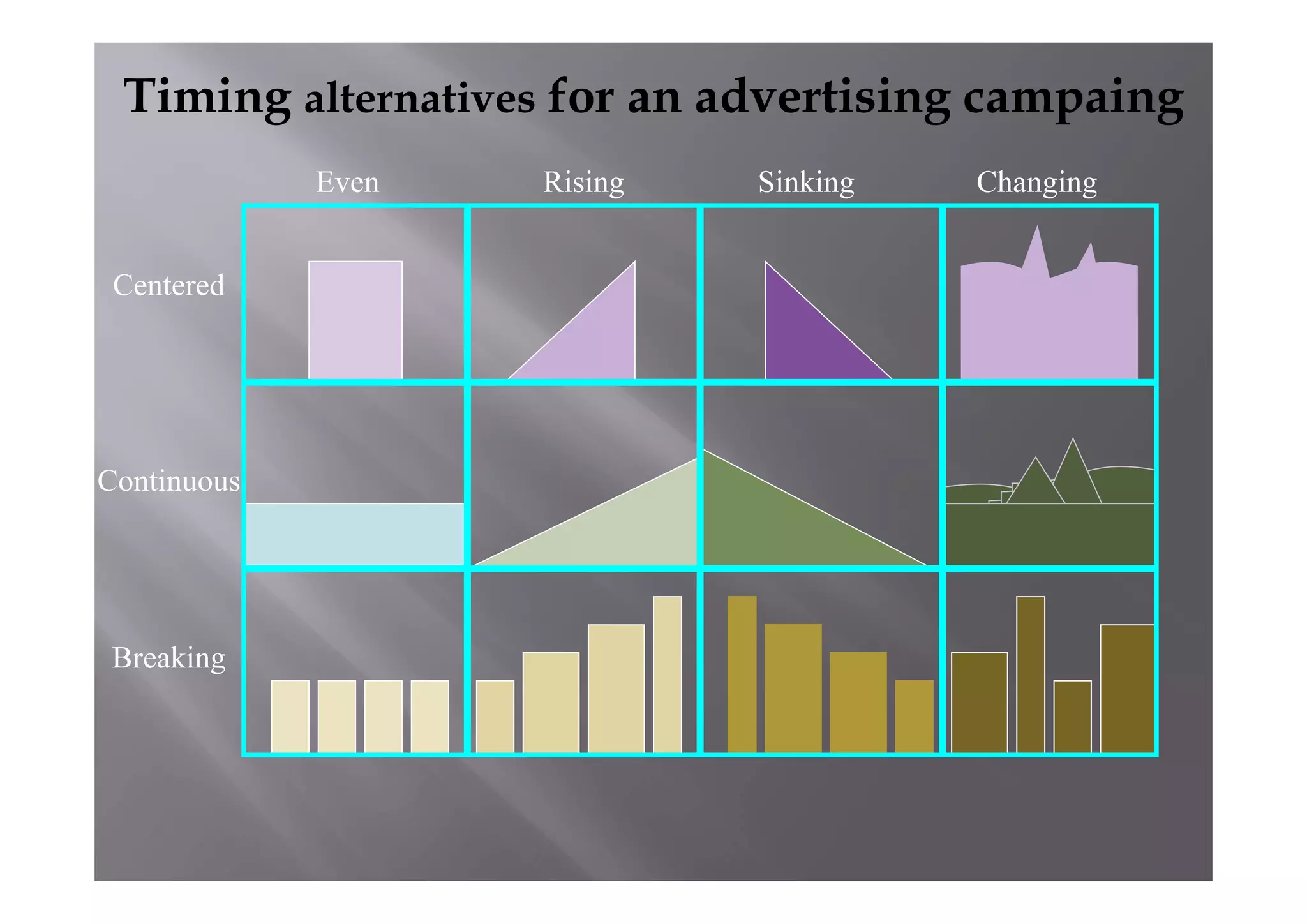
Timing alternatives for an advertising campaing
Even Rising Sinking Changing
Centered
Continuous
Breaking
Johanna Heinonen-Salakka
12.2.2002
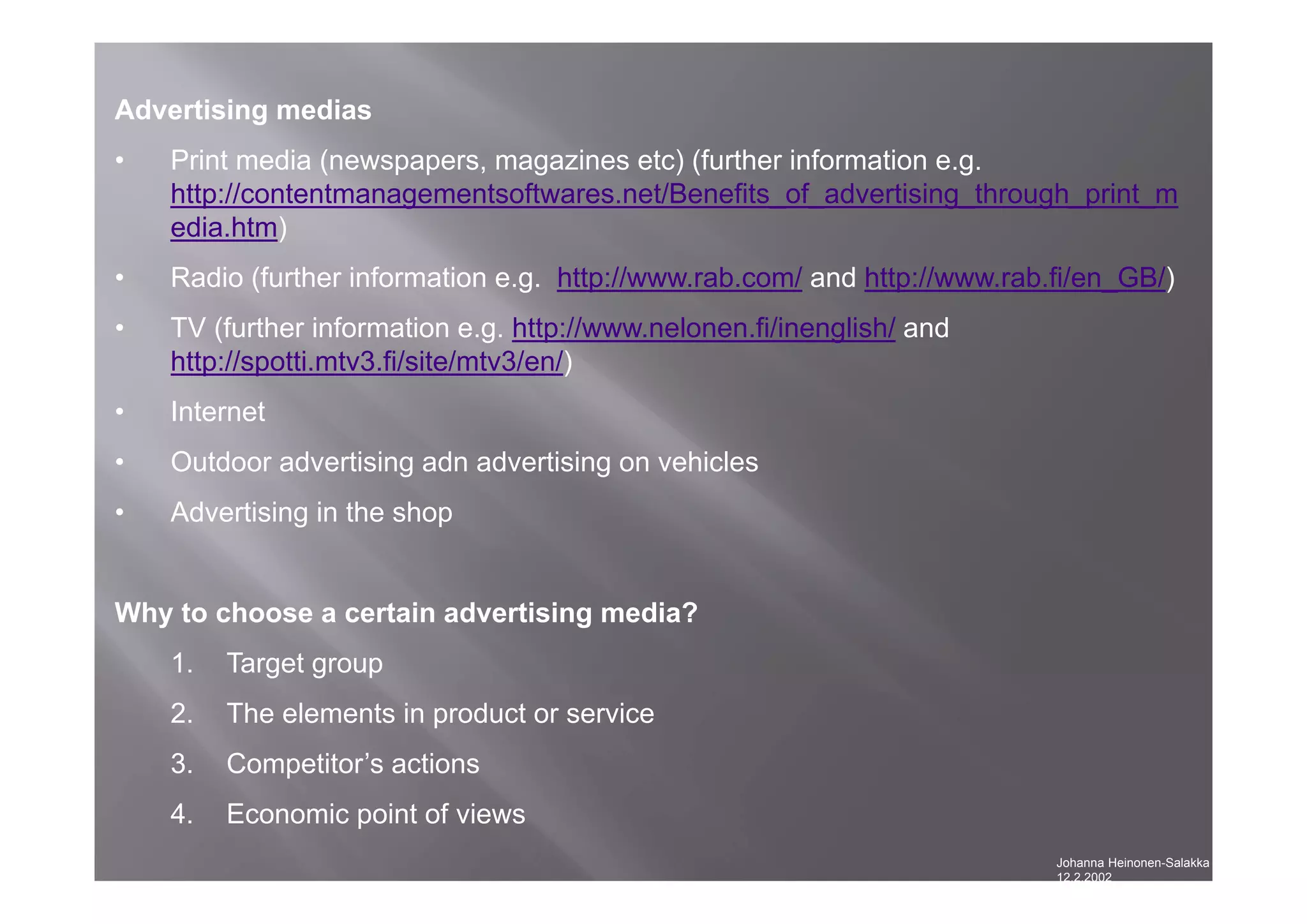
Advertising medias
• Print media (newspapers, magazines etc) (further information e.g.
http://contentmanagementsoftwares.net/Benefits_of_advertising_through_print_m
edia.htm)
• Radio (further information e.g. http://www.rab.com/ and http://www.rab.fi/en_GB/)
• TV (further information e.g. http://www.nelonen.fi/inenglish/ and
http://spotti.mtv3.fi/site/mtv3/en/)
• Internet
• Outdoor advertising adn advertising on vehicles
• Advertising in the shop
Why to choose a certain advertising media?
1. Target group
2. The elements in product or service
3. Competitor’s actions
4. Economic point of views
GOALS IN ADVERTISING
• informational goals
• goals that aim for change the attitudes among target
group
•goals that aim for action in target group
Johanna Heinonen-Salakka
12.2.2002
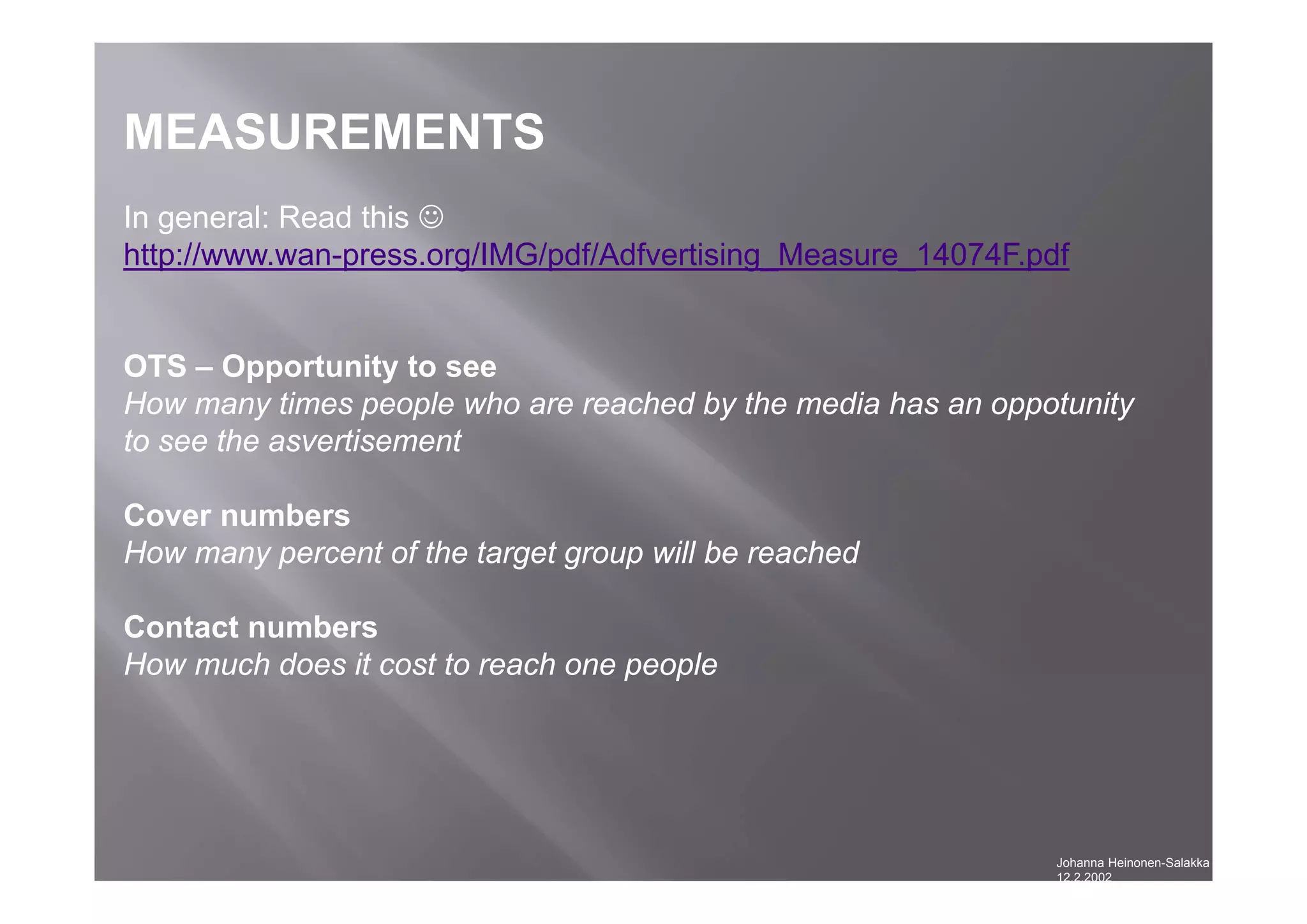
MEASUREMENTS
In general: Read this 
http://www.wan-press.org/IMG/pdf/Adfvertising_Measure_14074F.pdf
OTS – Opportunity to see
How many times people who are reached by the media has an oppotunity
to see the asvertisement
Cover numbers
How many percent of the target group will be reached
Contact numbers
How much does it cost to reach one people
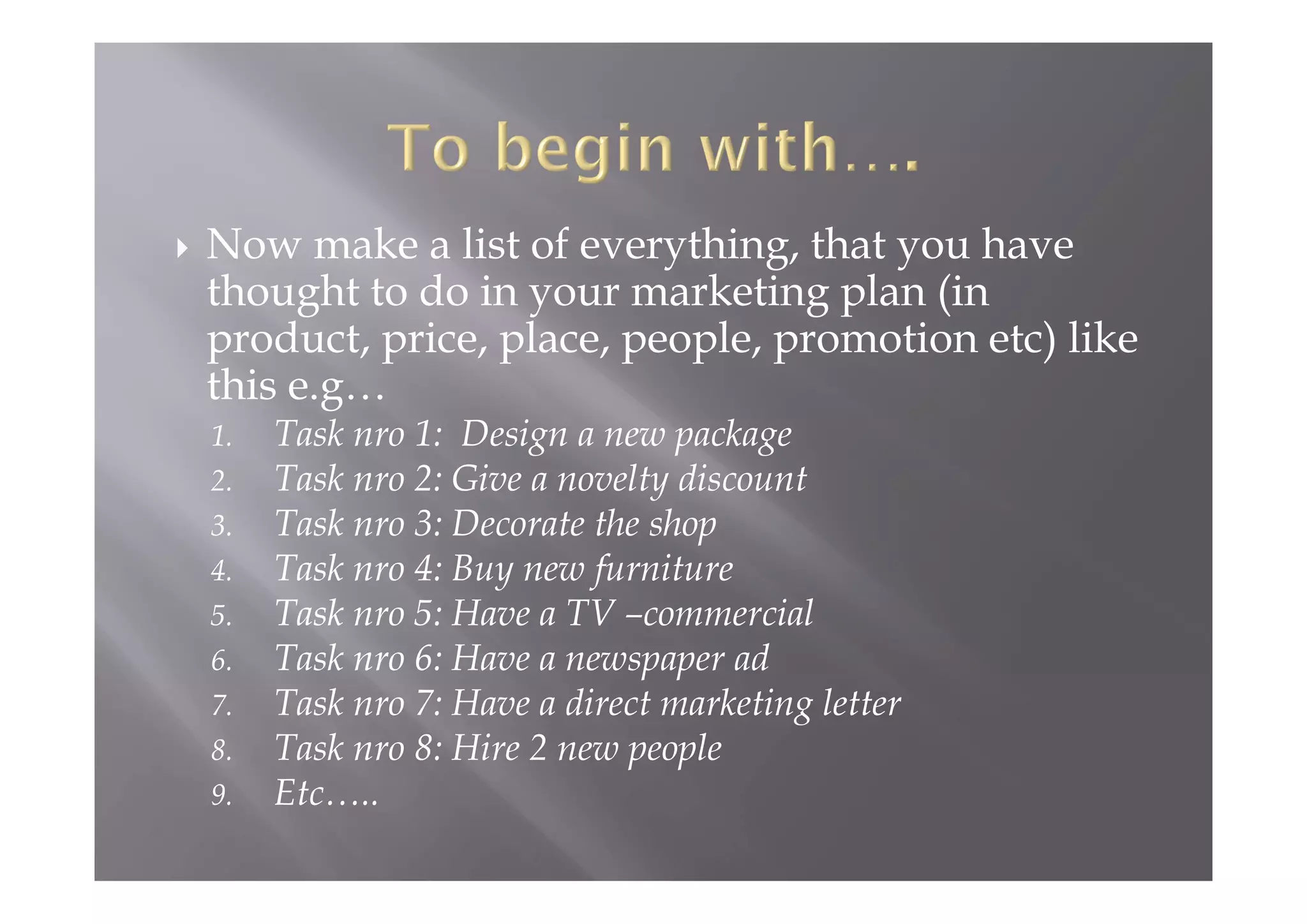
 Now make a list of everything, that you have
thought to do in your marketing plan (in
product, price, place, people, promotion etc) like
this e.g…
1. Task nro 1: Design a new package
2. Task nro 2: Give a novelty discount
3. Task nro 3: Decorate the shop
4. Task nro 4: Buy new furniture
5. Task nro 5: Have a TV –commercial
6. Task nro 6: Have a newspaper ad
7. Task nro 7: Have a direct marketing letter
8. Task nro 8: Hire 2 new people
9. Etc…..
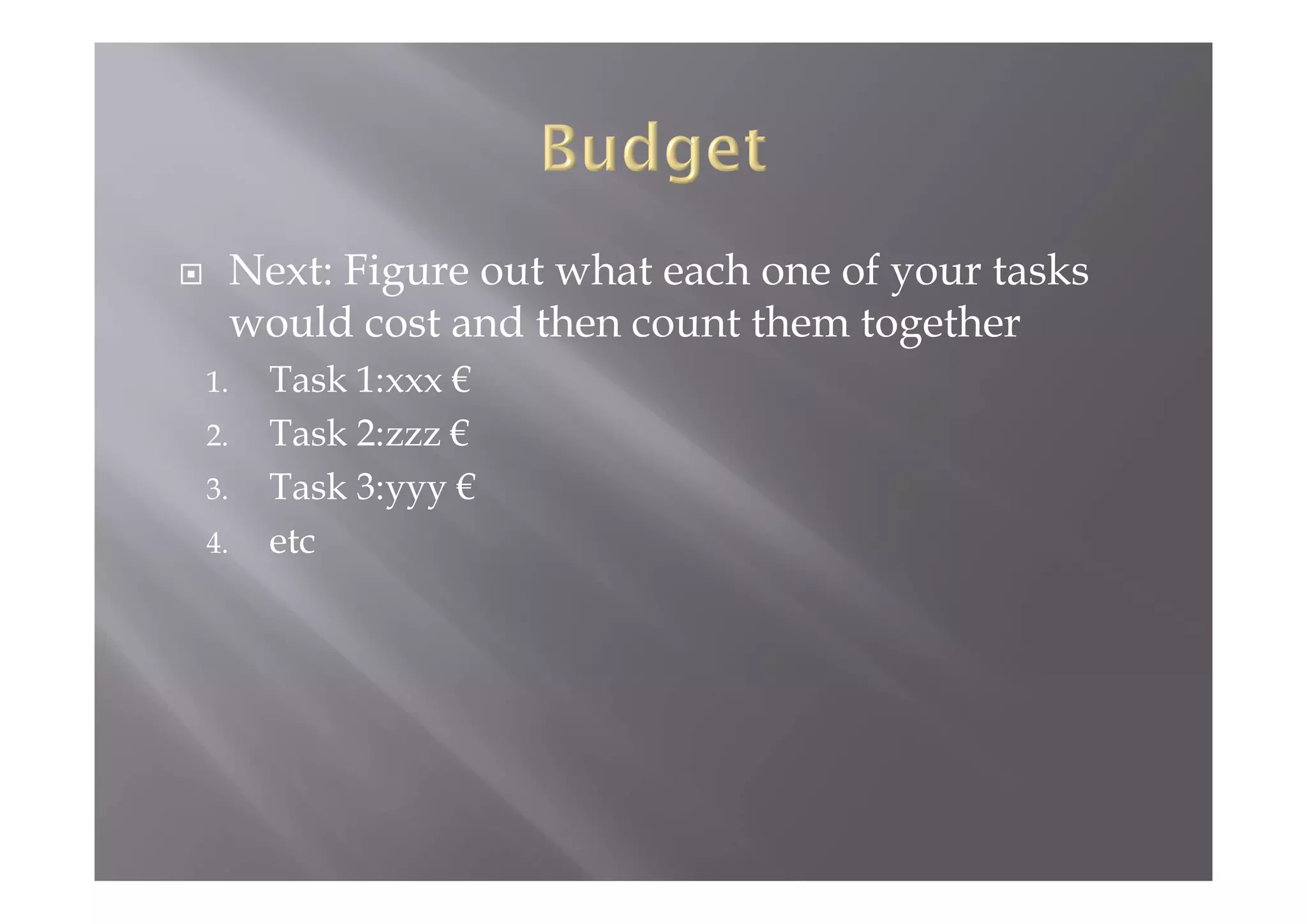
 Next: Figure out what each one of your tasks
would cost and then count them together
1. Task 1:xxx €
2. Task 2:zzz €
3. Task 3:yyy €
4. etc
 Next step is to define the timetable for different
actions (= tasks). Like this for example…
1. Task 1:The 1st of May
2. Task 2:Week 38
3. Task 3:On July at the latest
4. Task 4:During March
5. Etc.
 The last step in this phase is to decide who is
resposible for different tasks. Here is an
example again:
1. Task 1:Marketing Manager
2. Task 2:Mister X
3. Task 3:Advertising agency
4. Task 4:Financial department
5. etc.
 In order to know whether your marketing plan has been succesful and if it has
reached
 the gols you have ste before, it is essential to measure up the results and the
process itself
 The results from measurement will be used in planning the next marketing
round
 Measurement and follow-up are in that sense a part of analysis tool
 Measurement and the pre-set goals go always hand in han
STEPS how to do it
 Decide what to follow
 at least the goals and objectives you have set, but are there other important things
 Decide how to follow different topics
 There can be different ways of following different items in one marketing plan. Each one of
them must be defined
 Decide when the follow up should be made
 Decide who is responsible for each follow-up action
 Decide what to do if the marketing hasn’t been succesful or the goals haven’t
been reached
 Think corrective measures
=> And actually here you start a new circle of planning
marketing actions
 It is essential to plan in advance how to follow
up the results and how to gather feedback
 Follow-up is usually based on the goals you
have set earlier
 Targets can be almost anything
 Customers, Sales, Image, Profit, Turnover, Costs,
Quality of products, Development of prices,
Efficiency of the distributor etc.
 How to follow-up
 Desk survey, questionnaires, interviews
(quantitative vs. qualitative)
Johanna Heinonen
MARKETING RESEARCH
Problem Identification
Research
Problem-Solving Research
Market Potential Research
Market Share Research
Image Research
Market Characteristics Research
Sales Analysis Research
Forecasting Research
Business Trends Research
Segmentation Research
Product Research
Pricing Research
Promotion Research
Distribtion Research
 Exploratory research
 formulates problems more precisely,
clarifies concepts, gathers explanations,
gains insight, eliminates impractical ideas,
and formis hypotheses
 literature search or case studies
 Descriptive research
 describes users of a product, determines the
proportion of the population that uses a
product, or predicts future demand for a
product
 who, what, where, when, why, and how
aspects of the research should be defined
 Causal research
 cause and effect relationships between
variables
 laboratory and field experiments
 A marketing research can be done by the desk or on the field
 A desk study concentrates on the literature, statistics, studies etc. that
already exist and draws conclusions based on them
 This is usually secondary research = you don’t get the answer directly from
the target group
 PROS AND CONS:
 s usually less time consuming
 is usually less costly
 may not be updated
 is usually not customised to suit your needs
 may be sufficient if you require just general information such as industry profile,
trends and demographics
 A field study goes outside the firm and asks customers, competitors,
stakeholders etc. some special questions => primary research
 PROS AND CONS:
 time consuming
 Costly
 tailored to suit your specific needs
 valuable especially if you need to know something specific
 The best way to do marketing research is to combine these two ways

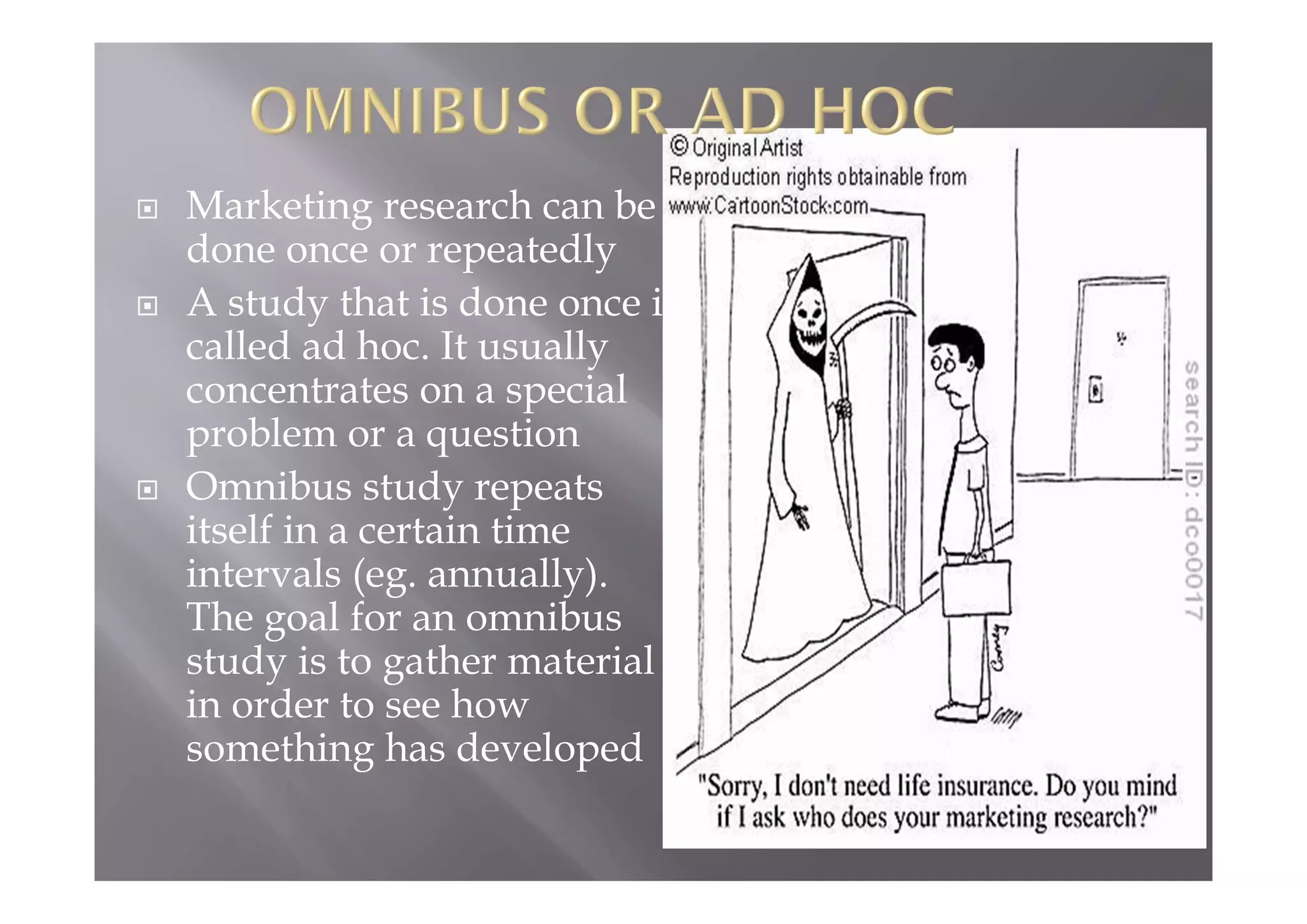
 Marketing research can be
done once or repeatedly
 A study that is done once is
called ad hoc. It usually
concentrates on a special
problem or a question
 Omnibus study repeats
itself in a certain time
intervals (eg. annually).
The goal for an omnibus
study is to gather material
in order to see how
something has developed
 There are two ways of doing research: qualitative
and quantitative
 Qualitative
 generally used for exploratory purposes
 small number of respondents
 not generalizable to the whole population
 statistical significance and confidence not calculated
 examples include focus groups, depth interviews, and
projective techniques
 Usually studies emotions, opinions and perspectives
 Quantitative
 generally used to draw conclusions
 can test a specific hypothesis
 uses random sampling techniques so as to infer from the
sample to the population
 involves a large number of respondents
 examples include surveys and questionnaires
 Provides numbers and percentage (hard data) for a
certain item
 Experiments and testing
 Observations
 Interviews
 Questionnaires
 Use of existing data
(desk study)
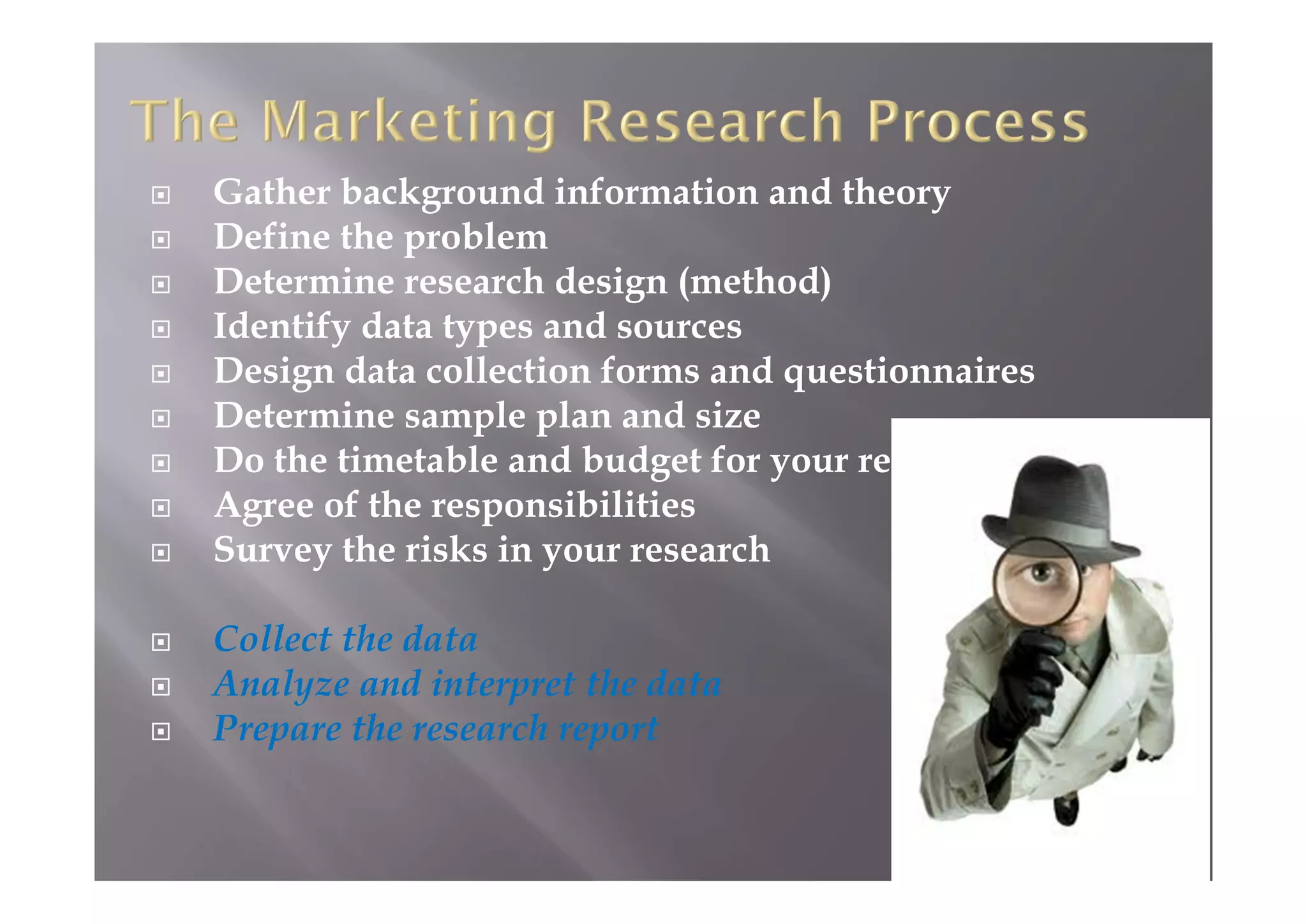
 Gather background information and theory
 Define the problem
 Determine research design (method)
 Identify data types and sources
 Design data collection forms and questionnaires
 Determine sample plan and size
 Do the timetable and budget for your research
 Agree of the responsibilities
 Survey the risks in your research
 Collect the data
 Analyze and interpret the data
 Prepare the research report
THANK
YOU!
 List the goals you have set in your marketing plan
earlier
 Think at least one way (there can be several ways)
to measure each goal you have set
 Then read through your marketing plan and think,
what other things are to be measured and figure
out the way to do that
 Finally write down a way to measure the
marketing plan process
 NOTE! It’s not enough to write down the ways to
measure – you should also think, how the
information should be used

Marketing plan in 85 slides

  • 1.
  • 2.
     Marketing isthe success factor in a company  Marketing can be seen in everything that is done in a company  Every function in a company has its effect to and in marketing  Even customers and stakeholders has affect marketing results  Marketing is much more than advertising
  • 3.
     Marketing isthe social process by which individuals and groups obtain what they need and want through creating and exchanging products and value with others (Kotler)  Marketing consists of the strategies and tactics used to identify, create and maintain satisfying relationships with customers that result in value for both the customer and the marketer.  Marketing is the management process that identifies, anticipates and satisfies customer requirements profitably  The activity, set of institutions, and processes for creating, communicating, delivering, and exchanging offerings that have value for customers, clients, partners, and society at large (American Marketing Association AMA)
  • 4.
     Marketing isan on-going process without a clear end or a beginning  Everyone is a marketeer in a company  Marketing has many goals  Creating knowledge or image  Getting new customers  Increasing sales  Motivating the personnel  Informing stakeholders and investors  Etc  Some sort of marketing is needed in every branch and every business
  • 5.
     A goodmarketer can easily form the big picture of the situation  A good marketeer knows something about almost everything  A good marketeer is curios and hardworkin  A good marketeer gathers enough information and then thinks what are the best solutions to the problem  A good marketeer is creative
  • 6.
    1. Introduction andidea 2. Analyses 2.1 Organizational analysis 2.2. Competitor analysis 2.3. Demand analysis 2.4. PEST analysis 2.5. SWOT 3. Strategical decisions 3.1. Target group 3.2. Strategical values 3.3. Goals and objectives for marketing plan 4. Implementation 4.1. Product 4.2. Price 4.3. Place 4.4. Personnel 4.5. Promotion 5. Budget, timetable and responsibilities 6. Follow-up WHERE ARE WE NOW? • Facts •Information from different sources to be analyzed • Research if needed WHERE ARE WE GOING TO? • Your own definitions about the most reasonable target group, the values / adjectives this target group respects and the goals for this marketing plan HOW TO GET THERE? • Your own ideas/suggestions of the implementation based on the facts you have gathered earlier and put under the topics of 5P • Strategical values should be seen in each of 5p’s and this should be written in the report, too • In the report ther must also be the ways how the defined implementation (5p’s) helps in reaching the goals
  • 8.
     Knowledge ofmarketing and its different elements as such  Knowledge of the phenomenons that affect targets of marketing  Knowledge of the phenomenons that affect marketing itself  Knowledge of phenomenons that affect the environment where marketing happens  “In a time of turbulence and change, it is more true than ever that knowledge is power” John Fitzgerald Kennedy quotes (American 35th US President (1961-63), 1917-1963)
  • 10.
     External opportunitiesand threats are circumstances that can’t be affected by the company byt which has a great impact on company’s functions  Competitors  Demand  Laws and regulations  Trends and culture  Technological development
  • 11.
     First ofall, We’ve got to know A LOT of our customers and the potential customers (demand) and how they are going to evolve in the future  Who they are? Where they come from? What are their characteristics (socioeconomical and demograpfical background)?  What they buy? Where they buy? How they buy? How much they buy? Why they buy?  Purchase habits? Purchase reasons? ◦ Needs, values, opinions – FEELINGS?  How are they going to change in the future? => CUSTOMER AND DEMAND ANALYSIS ALL THIS AFFECTS THEN COMPANY’S FUTURE DECISIONS!, because we should develop our company and our marketing mix so that customers find our company as the best alternative in the market!
  • 12.
     Then we’vegot to know our competitors and how they are going to evolve in the future  Who they are? What they sell? How they sell?  Why people buy from them?  What are their values and their image?  How are they going to change in the future? => COMPETITOR ANALYSIS  We can divide our competitors to core competitors, need competitors, marginal competitors and potential competitors ALL THIS AFFECTS THEN COMPANY’S FUTURE DECISIONS, because we should differ from our competitors so, that our customers think that we are the best alternative!
  • 13.
     We shouldalso know about the rules that companies and people should follow when the live here on Planet Earth  This means  Laws, Regulations  Culture  Politics  Sociological issues (communication etc.)  Technological issues  Environmental issues => PEST Analysis ALL THIS AFFECTS COMPANY’S FUTURE DECISIONS, too, because we must in certain amount follow the newest trends and we must fuNction accordIng to the laws . We must also take the culture ant the politics in a country into consideration if we want to be successful.
  • 14.
     Internal strengthsand weaknesses can be  Business idea: basic for whole entrepreneurship  Products, prices, distribution, co-operation: what are they, why, what needs do they fullfil etc  Personnel: is there enough, what kind of skills it has, is it motivated etc.  Management: what is it, why  Resources: money, machines, know-how  Marketing: how is it done now, why  Customers: who are they know, why  etc
  • 15.
     Then we’vegot to know A LOT about our own company and what are our future goals  Who are we? Why do we exist? What are our values and our image?  What are our resources and finance?  What do we sell (products and services)? What are our selling arguments?  With what price do we sell? Why?  Where do we sell our product/service? Who are our distributors? Why?  What is the strategy here (massdistribution or direct selling to the customer)?  How do we communicate of ourselves? What kind of adds do we have? Why? Where? What is the central message? Why?  What kind of people is there working with us? What is their meaning to the company? What is their competence? Is there enough of them?  How have we differentiated our product from our competitors? => ORGANIZATIONAL ANALYSIS AFTER THIS WE SHOULD COMPARE OUR PRESENT STATE TO OTHER ANALYSIS AND FIGURE OUT, how we should develop and market our company in order to differ from our competitors so that customers think we are the best alternative and still keep our own values and function according to the rules of society.
  • 16.
     SWOT isa tool that helps you to gather information of many different things affecting the company and its success  SWOT is based on facts that are gathered from different objective sources, not just something that you think or like  SWOT divides information into company’s internal strengths and weaknesses and external opportunities and threats that affect company from outside STRENGTHS WEAKNESSES OPPORTUNITIES THREATS
  • 17.
     SWOT isnot a list of things, it is an analysis  This means that SWOT should be written with whole sentences and everything written in it should be analyzed  Easist way to analyze is to think, whether something is good or bad and should it be changed or improved somehow  The normal / usual way to use SWOT is to think  how to take advantage of strengths and opportunities  how to improve weaknessed  And how to foresee and prevent threats
  • 18.
     Gather informationof the company  Facts about location, ownership, marketing, products, services, resources, decoration, values, personnel, goals  Analyze customers  Present vs. future  Needs, values, wishes  How do the customers affect business and marketing? What kind of changes / improvements they cause? WHY?  Analyze the competitors (NOTE! Competitors are those, who fight for customers’ attention and money)  Present competitors vs. future competitors  Their products, services, marketing, strengths, values  How should the company differentiate itself from the competitors so, that that customer would choose it instead of competitors? What this means in practice – changes in personnel, products etc? WHY?  Analyze laws and regulations  What laws and regulations affect the company and its business?  How do these laws affect? What kind of demands or restrictions they set to the company?  Analyze trends and culture  Are there some trends that affect demand or our business? Does culture has some impact on demand, marketing or our business?  How do these effect? Do they cause some improvements / changes? Why?  Analyze economical and technological environment and trends  Are there some trends that affect demand or our business amd its marketing?  How do these effect? Do they cause some improvements / changes? Why?
  • 19.
     Be critical! Don’t just take the entrepreneurs word as the only truth – it is usually biased and subjective  Gather other information from objective sources  Your decisions and suggestions should be based on facts – so gather enough information of everything and many different sources and point of views  Analysis is usually 80 % of marketing plan
  • 21.
     Now youhave finished your analysis tool and know a lot more about your markets, competitors and customers than in the beginning  You also have a clue what is needed from your organization  Now it is time to consider company’s strategies and target groups  It is also time to set goals that are based on the analysis, so that they are realistic and still demanding
  • 22.
  • 23.
     In orderto make marketing more effective and to concentrate on the most profitable target group a company must divide its potential customers into target groups  Customers can be divided into groups based on  Demografic and social-economic basis  Psychografic basis  According to situation  Nowadays the most usual way is to find groups with similar interests and values!
  • 24.
     It isalso important to think, how the company shall keep the customers as its customers in the future  This is called as customer program and it aims to keep customers satisfied  Customer satisfaction is always customer’s own decisions and evaluation  Customer satisfaction is effected by:  The quality of product / service  The whole personnels skills and attitude towards customers  Managers’ attitude towards customers and personnel  A long-term planning and implementing process  Keeping of the service promise
  • 25.
     A marketingstrategy is a process that can allow an organization to concentrate its limited resources on the greatest opportunities to increase sales and achieve a sustainable competitive advantage.  A marketing strategy should be centered around the key concept where customer satisfaction is the main goal.
  • 26.
     A marketingstrategy is often the starting point to a marketing plan, which contains a set of specific actions required to successfully implement a marketing strategy.  A marketing strategy often binds an organization's marketing goals, policies, and action sequences (tactics) together.  Marketing strategies are dynamic and interactive. They are partially planned and partially unplanned.  Company’s values are important!
  • 27.
     the stateof affairs that a plan is intended to achieve  A goal or objective consists of a projected state of affairs which a person or a system plans or intends to achieve or bring about  A personal or organizational desired end-point in some sort of assumed development.  Many people endeavor to reach goals within a finite time by setting deadlines.
  • 28.
     Marketing plansbuilt with clear, stated goals — backed up with appropriate metrics and measurements — will be approved a lot more readily than those that aren't.  Marketing must develop its plans based on the realities of the business environment while remaining in alignment with corporate goals.  If a marketing plan's primary goal is not expressed in these terms, it will be difficult for the plan to gain approval from company executi  Concrete goals are a key component of all marketing plans.  Goals help to steer the development of all marketing activities, including promotions, advertising campaigns, and press related activities
  • 29.
     Goals shouldbe specific and measurable (quantity goals), e.g.  increasing market share by two percentage points over a 12- month period  doubling sales of a particular product in six months  increasing customer retention by 25 percent from one holiday season to the next  Less specific goals are often qualitative, e.g.  increasing a company's visibility within a marketplace  differentiating a company from its rivals  If you state your goals clearly and with good grounds, it’s easy to follow-up whether the implementation goes right and the right and sufficient results are achieved
  • 30.
    ~ The activitiesand functions ~
  • 31.
  • 32.
    PRICE PLACE PROMOTI ON PEOPLE PRODUC T Does the organizationcreate what its intended customers want? Define the characteristics of your product or service that meets the needs of your customers. • Why would our target group ”buy” our product? • How can we make our target group interested in our product? • How can we differ from our competitors? • Differentation • Branding IMAGE SUPPORTING PARTS CORE PRODU CT
  • 33.
     A productcan be defined as a collection of physical, service and symbolic attributes which yield satisfaction or benefits to a user or buyer.  A product is a combination of physical attributes say, size and shape; and subjective attributes say image or "quality“  COMMODITY is a common name for everything, that a company produces to the sales. It can be a product or a service  SERVICE is an immaterial commodity.  PRODUCT is something real and touchable
  • 35.
     The productionof the product or service should be well planned and coordinated  The main elements to consider are  the production process itself  specifications  culture  the physical product  packaging  labelling  branding  warranty  service  Product marketing in a business addresses four important Strategic questions:  What products will be offered?  Who will be the target customers?  How will the products reach those customers?  Why will customers prefer our products to those of competitors?
  • 37.
     distinguishing thedifferences of a product or offering from others  to make a product more attractive to a particular target market Source of a competitive advantage The objective is to develop a position that potential customers see as unique
  • 38.
     The branddifferences  difference in packaging  difference in an advertising theme  Differences in quality  Differences in price  Differences in functional features  Differences in design  Sales promotion activities of sellers  Differences in availability
  • 39.
     Differentiation isdue to buyers perceiving a difference,  Differentiation is the possibility of charging more money from customers  However, if customers value the firm's offer, they will be less sensitive to aspects of competing offers and price may not be one of these aspects
  • 40.
     A brandis a collection of images and ideas  representing a product or a company FOR BRANDING COMPANY
  • 41.
     Company name>< Individual branding  Colours  Sounds  Forms and designs  Packages  Prices  Logos  Slogans  Advertisements  Names  Attitudes
  • 43.
    PLACE PROMOTIO N PEOPLE PRODUCT PRICE How much arethe intended customers willing to pay? Here we decide on a pricing strategy - do not let it just happen! The consumer is often sensitive for price discounts and special offers. Price builds also the company image: something that is expensive must be good • How should we price our product so that our customers buy it? Is price important to our customers? • How should we price our product so that it differs from our competitors? • How should we price our product so that we make some profit? • Discounts • Terms of payment • Price creating image
  • 44.
     Price isthe result of an exchange; a numerical monetary value to a good, service or asset  In marketing the price is the amount a customer pays for the product. It is determined by a number of factors including market share, competition, material costs, product identity and the customer's perceived value of the product.  The business may increase or decrease the price of product if other stores have the same product.
  • 45.
     How muchto charge for a product or service? How much do customers value the products and services?  What are the pricing objectives?  How to set the price? (cost-plus pricing, demand based or valuebased pricing, rate of return pricing, or competitor indexing)  Should there be a single price or multiple pricing?  Should prices change in various geographical areas, referred to as zone pricing?  Should there be quantity discounts?  Do you use a price skimming strategy or a penetration pricing strategy?  What image do you want the price to convey?  Do you use psychological pricing?  How visible should the price be? Should the price be neutral?  What sort of payments should be accepted?
  • 46.
    PRICE PROMOTIO N PEOPLE PRODUCT PLACE ~ Available atthe right place, at the right time, in the right quantities ~ •What is the best place to sell our product so that it is available to our customers? • How widely should the product be sold? • Should we use distributors? Who are our distributors? Why? • How should our ”shop” (premises) look like? • Signs • Decoration • Distributors • Storage • Availability
  • 47.
     Place strategytells how the product or service will be distributed to the end user. The product must be at the right place at the right time.  Two types of distribution methods:  Indirect distribution – use of an retailer or an intermediary  Direct distribution - selling directly from a manufacturer to the consumer  Three type of distribution strategies 1. Intensive distribution - the product is sold in as many places as possible. 2. Exclusive distribution - a single outlet 3. Selective Distribution: - A small number of retail outlets
  • 49.
    PRICE PLACE PROMOTIO N PRODUCT PEOPLE ~ People arethe most important element of any service or experience. ~ •What is the meaning of people in our company and in our success? • What kind of people do we need? • How many people do we need? • Appearance of our people? • Skills and knowledge of our people? • How to motivate our staff?
  • 50.
     People buyfrom people that they like  Personnel’s attitude, skills and appearance are important  Personnel is a company’s first market – they must believe in the company and know its products, strategies and values  INTERNAL MARKETING  An ongoing process which aims for that personnel is satisfied and gives its best for the company and its customers.
  • 51.
    1. Hire rightkind of people to the company 2. Keep the good, old workers 3. Motivate personnel for doing their jobs better 4. Create employee job satisfaction 5. Internal communication
  • 52.
     Better jobperformance  Responsibility for employees  Common understanding of the company and its strategies  Better service to clients  Improved employee development  Integrates business culture, structure, human resources management, vision and strategy with the employees' professional and social needs  Better coordination and cooperation among departments of the business.
  • 53.
    PRICE PLACE PEOPLE PRODUCT PROMOTI ON PROMOTION = Allcommunication that happens inside or outside the company 1. You’ve got to have something to tell – the central message / the service promise • Company’s point of view • Customers’ point of view!!! 2. ”The package” • You’ve got to express the central message in such a way that customers pay attention to it, notice your message and adapt it as their own 3. Media choices • You’ve got to find the medias that your customers follow and use them as your marketing channels • The package? / The budget? / The effect? 4. Timetable 5. Responsibilities (The role of advertising agency?)
  • 54.
     Information abouta product, product line, brand, or company one of the five key aspects of the marketing mix  Definition of Promotion  Promotion keeps the product in the minds of the customer and helps stimulate demand for the product.  Promotion involves ongoing advertising and publicity  Above the line promotion:  promotion in the media  advertiser pays for it  targeted directly to the customers  Below the line promotion:  All other promotion  Promotion targeted to other groups than customers – affects indirectly customers  For example sponsorship, product placement, sales promotion, public relations, trade shows
  • 55.
     Promotional mixor communication mix:  Advertising: Any paid presentation and promotion of ideas, goods, or services by an identified sponsor  Personal selling: A process of helping and persuading one or more prospects to purchase a good or service or to act on any idea through the use of an oral presentation.  Sales promotion: Incentives designed to stimulate the purchase or sale of a product, usually in the short term  Public relations: Non-paid non-personal stimulation of demand for a product, service, or business unit by planting significant news about it or a favorable presentation of it in the media.  Two strategies: "push" and "pull".  Push  Uses salesmen and trade promotion to create consumer demand for a product.  The producer promotes the product to wholesalers, the wholesalers promote it to retailers, and the retailers promote it to consumers.  Pull  Uses advertising and consumer promotion to build up consumer demand for a product.  If the strategy is successful, consumers will ask their retailers for the product, the retailers will ask the wholesalers, and the wholesalers will ask the producers. NOTE! With promotion you build images and give information. Whether your promotion campaign has emphasis on information or images depends firstly on customers wishes and values and secondly on your product and company.
  • 56.
    Decisions in marketing communication Interactive marketing Supportfor sales Customer service Personal selling Advertising Sales Promotion Public Relatuins Communication in the print media Electric media (radio, TV, internet etc.) Direct marketing Outdoor advertising
  • 57.
    Johanna Heinonen-Salakka 12.2.2002 Advertising A messagethat is sent and paid by a recognisable sender usually in massmedia. The message tells aboyt the services, products and the company and its goal ist tu create/increase selling and/or the knowledge of the product/service/company or create/improve the image of the prod Why advertising needs? 1. It informs customers of the product/service/company and its contents and elements, the price, the selling places… 2. It affects people’s attitudes and feelings and it aims for creating a good product- and company image; a brand. 3. It wants to create a will for purchase by telling the good sides and the advantages in buying the product
  • 58.
    Johanna Heinonen-Salakka 12.2.2002 The positiveelements in advertising • Reaches masses • Quick • Cheap, if you consider the number of persons you reach • Cheap for the customer The negative elements in advertising • Expensive • Demands skills to be done right • Impersonal
  • 59.
    Johanna Heinonen-Salakka 12.2.2002 How tomake a good advertisement? BASIC: Keep it simple Don’t change it • in order to make people remember your advertisement, you must use the same elements over and over again during the years. E.g. The color blue in Fazer blue chocklate, color Red in Viking Line, three stripes in Adidas, ”Have a Coce and a smile” Advertisements can be • Visually same (same color, logo etc) • Verbally same (same slogan) • Orally same (same sound)
  • 60.
    Johanna Heinonen-Salakka 12.2.2002 How tomake a good advertisement? Go public regularyly and often enough Don’t use too many elements in your advertisement – rather use empty space Use picture as often as its possible Further information about the topic can be found e.g. the following netsites: • http://www.bly.com/Pages/documents/HTWAGA.html • http://www.marketingtoday.com/marcom/writeads.htm
  • 61.
    Johanna Heinonen-Salakka 12.2.2002 CONTENTS INADVERTISING • main promise / central message • the parts that support the main promise Useful tool is AIDA (e.g. an exaggerated version is TV Shop) A get your customers’ attention I create interest D make them desire your product / companu A make them act (buy) S guarantee satisfaction
  • 62.
    Johanna Heinonen-Salakka 12.2.2002 Advertising campaing Lastsa certain period during which the advertiser sends a message to the target group in the chosen medias The same message can be told with different communication tools Levels in advertising campaing 1. National 2. Regional 3. In one shop or residence
  • 63.
    PLANNING AND ADVERTISINGCAMPAIGN Gathering background information Goals and target groups for advertising campaign Budget Choosing media/s Deciding the central Message and contents Implementantion: Pretesting Production Publishing Measuring the effectiveness and gathering feed back Publishing time Number of repeats
  • 64.
    Timing alternatives foran advertising campaing Even Rising Sinking Changing Centered Continuous Breaking
  • 65.
    Johanna Heinonen-Salakka 12.2.2002 Advertising medias •Print media (newspapers, magazines etc) (further information e.g. http://contentmanagementsoftwares.net/Benefits_of_advertising_through_print_m edia.htm) • Radio (further information e.g. http://www.rab.com/ and http://www.rab.fi/en_GB/) • TV (further information e.g. http://www.nelonen.fi/inenglish/ and http://spotti.mtv3.fi/site/mtv3/en/) • Internet • Outdoor advertising adn advertising on vehicles • Advertising in the shop Why to choose a certain advertising media? 1. Target group 2. The elements in product or service 3. Competitor’s actions 4. Economic point of views
  • 66.
    GOALS IN ADVERTISING •informational goals • goals that aim for change the attitudes among target group •goals that aim for action in target group
  • 67.
    Johanna Heinonen-Salakka 12.2.2002 MEASUREMENTS In general:Read this  http://www.wan-press.org/IMG/pdf/Adfvertising_Measure_14074F.pdf OTS – Opportunity to see How many times people who are reached by the media has an oppotunity to see the asvertisement Cover numbers How many percent of the target group will be reached Contact numbers How much does it cost to reach one people
  • 69.
     Now makea list of everything, that you have thought to do in your marketing plan (in product, price, place, people, promotion etc) like this e.g… 1. Task nro 1: Design a new package 2. Task nro 2: Give a novelty discount 3. Task nro 3: Decorate the shop 4. Task nro 4: Buy new furniture 5. Task nro 5: Have a TV –commercial 6. Task nro 6: Have a newspaper ad 7. Task nro 7: Have a direct marketing letter 8. Task nro 8: Hire 2 new people 9. Etc…..
  • 70.
     Next: Figureout what each one of your tasks would cost and then count them together 1. Task 1:xxx € 2. Task 2:zzz € 3. Task 3:yyy € 4. etc
  • 71.
     Next stepis to define the timetable for different actions (= tasks). Like this for example… 1. Task 1:The 1st of May 2. Task 2:Week 38 3. Task 3:On July at the latest 4. Task 4:During March 5. Etc.
  • 72.
     The laststep in this phase is to decide who is resposible for different tasks. Here is an example again: 1. Task 1:Marketing Manager 2. Task 2:Mister X 3. Task 3:Advertising agency 4. Task 4:Financial department 5. etc.
  • 74.
     In orderto know whether your marketing plan has been succesful and if it has reached  the gols you have ste before, it is essential to measure up the results and the process itself  The results from measurement will be used in planning the next marketing round  Measurement and follow-up are in that sense a part of analysis tool  Measurement and the pre-set goals go always hand in han STEPS how to do it  Decide what to follow  at least the goals and objectives you have set, but are there other important things  Decide how to follow different topics  There can be different ways of following different items in one marketing plan. Each one of them must be defined  Decide when the follow up should be made  Decide who is responsible for each follow-up action  Decide what to do if the marketing hasn’t been succesful or the goals haven’t been reached  Think corrective measures => And actually here you start a new circle of planning marketing actions
  • 75.
     It isessential to plan in advance how to follow up the results and how to gather feedback  Follow-up is usually based on the goals you have set earlier  Targets can be almost anything  Customers, Sales, Image, Profit, Turnover, Costs, Quality of products, Development of prices, Efficiency of the distributor etc.  How to follow-up  Desk survey, questionnaires, interviews (quantitative vs. qualitative)
  • 76.
  • 77.
    MARKETING RESEARCH Problem Identification Research Problem-SolvingResearch Market Potential Research Market Share Research Image Research Market Characteristics Research Sales Analysis Research Forecasting Research Business Trends Research Segmentation Research Product Research Pricing Research Promotion Research Distribtion Research
  • 78.
     Exploratory research formulates problems more precisely, clarifies concepts, gathers explanations, gains insight, eliminates impractical ideas, and formis hypotheses  literature search or case studies  Descriptive research  describes users of a product, determines the proportion of the population that uses a product, or predicts future demand for a product  who, what, where, when, why, and how aspects of the research should be defined  Causal research  cause and effect relationships between variables  laboratory and field experiments
  • 79.
     A marketingresearch can be done by the desk or on the field  A desk study concentrates on the literature, statistics, studies etc. that already exist and draws conclusions based on them  This is usually secondary research = you don’t get the answer directly from the target group  PROS AND CONS:  s usually less time consuming  is usually less costly  may not be updated  is usually not customised to suit your needs  may be sufficient if you require just general information such as industry profile, trends and demographics  A field study goes outside the firm and asks customers, competitors, stakeholders etc. some special questions => primary research  PROS AND CONS:  time consuming  Costly  tailored to suit your specific needs  valuable especially if you need to know something specific  The best way to do marketing research is to combine these two ways 
  • 80.
     Marketing researchcan be done once or repeatedly  A study that is done once is called ad hoc. It usually concentrates on a special problem or a question  Omnibus study repeats itself in a certain time intervals (eg. annually). The goal for an omnibus study is to gather material in order to see how something has developed
  • 81.
     There aretwo ways of doing research: qualitative and quantitative  Qualitative  generally used for exploratory purposes  small number of respondents  not generalizable to the whole population  statistical significance and confidence not calculated  examples include focus groups, depth interviews, and projective techniques  Usually studies emotions, opinions and perspectives  Quantitative  generally used to draw conclusions  can test a specific hypothesis  uses random sampling techniques so as to infer from the sample to the population  involves a large number of respondents  examples include surveys and questionnaires  Provides numbers and percentage (hard data) for a certain item
  • 82.
     Experiments andtesting  Observations  Interviews  Questionnaires  Use of existing data (desk study)
  • 83.
     Gather backgroundinformation and theory  Define the problem  Determine research design (method)  Identify data types and sources  Design data collection forms and questionnaires  Determine sample plan and size  Do the timetable and budget for your research  Agree of the responsibilities  Survey the risks in your research  Collect the data  Analyze and interpret the data  Prepare the research report
  • 84.
  • 85.
     List thegoals you have set in your marketing plan earlier  Think at least one way (there can be several ways) to measure each goal you have set  Then read through your marketing plan and think, what other things are to be measured and figure out the way to do that  Finally write down a way to measure the marketing plan process  NOTE! It’s not enough to write down the ways to measure – you should also think, how the information should be used