




AP MACROECONOMICS
REVIEW
By: Jasmine Perez
Basic Economic Concepts
 Resources- land, labor, capital, and entrepreneurship.
 All resources are limited factors of production. We are
forces to make choices about how the resources are to be
used due to scarcity which leads to opportunity costs.
 A trade-off is simply the act of giving up one thing for
another, but an opportunity cost is the value of what you
give up when you make your decision.
 What to produce, what method and for who are the
essential questions.
Scarcity, Choice, Opportunity Cost
 A graphical way to represent the fact that we must give up
some of one good to get more of another.
 Shows us what combinations of goods we produce when
we are using our resources efficiently.
 It is usually between two products and it reflects the law of
increasing opportunity costs.
 The law of increasing opportunity costs give the PPC its
convex shape.
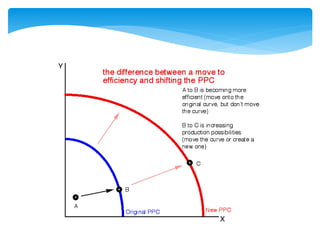
 This may shift right due to resources and technology.
 If points are inside it is inefficient.
Production Possibilities Curve
 Specialization allow a person, business, or nation to
specialize in production of what it does best, instead of
striving for self-sufficiency.
 It allows for a greater variety of goods and services
available and at lower cost.
 Relates to the principle of the division of labor, it increases
output because it gives people an opportunity to become
better at one specific job.
 Trade helps economic growth when one can produce
something at a lower opportunity cost than another, they
have the comparative advantage.
Comparative Advantage,
Specialization, Trade
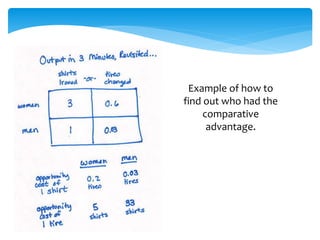
Example of how to
find out who had the
comparative
advantage.
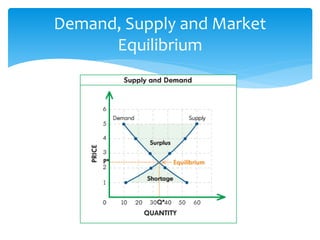
Demand, Supply and Market
Equilibrium
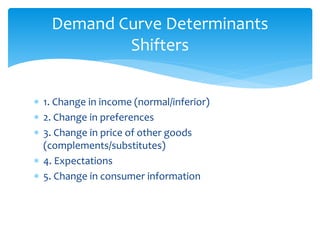
 1. Change in income (normal/inferior)
 2. Change in preferences
 3. Change in price of other goods
(complements/substitutes)
 4. Expectations
 5. Change in consumer information
Demand Curve Determinants
Shifters
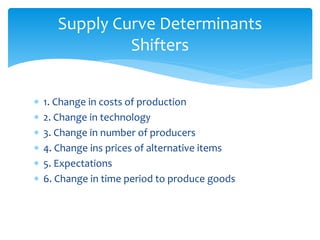
 1. Change in costs of production
 2. Change in technology
 3. Change in number of producers
 4. Change ins prices of alternative items
 5. Expectations
 6. Change in time period to produce goods
Supply Curve Determinants
Shifters
Measurement of Economic
Performance
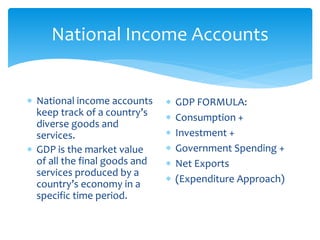
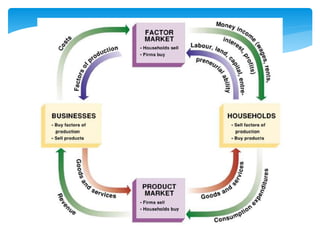
National Income Accounts
 National income accounts
keep track of a country’s
diverse goods and
services.
 GDP is the market value
of all the final goods and
services produced by a
country’s economy in a
specific time period.
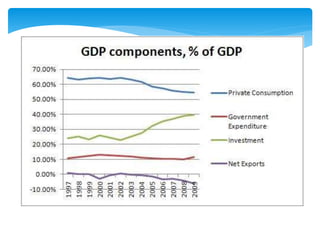
 GDP FORMULA:
 Consumption +
 Investment +
 Government Spending +
 Net Exports
 (Expenditure Approach)
 Price Index measures the combined price of a
particular collection of goods and services called a
market basket relative to that of similar items in
another period.
 Consumer Price Index tells us about average changes
over time in prices of a fixed group of goods and
services that are bought by consumers.
 Adjusts nominal GDP to real GDP in order to account
for inflation.
Inflation Measurement and
Adjustment
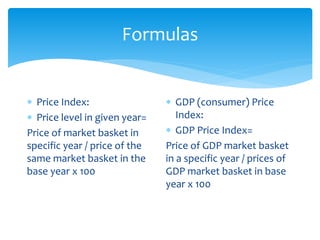
Formulas
 Price Index:
 Price level in given year=
Price of market basket in
specific year / price of the
same market basket in the
base year x 100
 GDP (consumer) Price
Index:
 GDP Price Index=
Price of GDP market basket
in a specific year / prices of
GDP market basket in base
year x 100
 Frictional – includes workers who are searching for jobs or
waiting to take jobs in the near future. This unemployment
is inevitable, since many workers switch to better jobs.
 Structural – changes over time in consumer demand and
technology change the “structure” of total demand for
labor. Some skills will not be needed as much or become
obsolete, and new skills will appear. This is a mismatch
between job seekers’ skills and the skills needed for the
job. This is also inevitable because the demand for labor
will always change over time as new technologies arise.
 Cyclical – this type of unemployment is caused by
recession. People who are laid off because of decreased
overall spending in the economy.
Unemployment
 This is NOT zero unemployment, as frictional and structural
unemployment are regarded as unavoidable in an economy.
Therefore, full employment means no cyclical unemployment,
and the full-employment rate is equal to the frictional plus
structural rates. It is also called the natural rate of
unemployment.
 3%-5%
 Calculation:
 Unemployment means unemployment in the labor force, not the
whole population. The labor force is total population – under 16
and/or institutionalized – people not in the labor force. The
unemployment rate = Unemployed people in the labor force
divided by Total number of people in the labor force x 100
Natural Rate of Unemployment
National Income and Price
Determination
 Aggregate demand is a measure the ability to
spend or a level of expenditure used to command
varying quantities of goods and services at different
price levels. This concept is a measure of purchasing
power such that when prices increase with a given
level of nominal income, fewer goods or services can
be purchase.
 Caused by Wealth Effect, Interest Rate Effect, and
Exchange Rate Effect.
Aggregate Demand
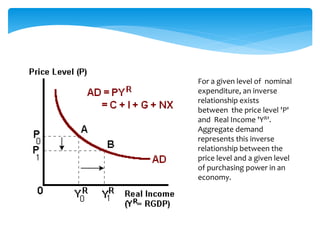
For a given level of nominal
expenditure, an inverse
relationship exists
between the price level 'P'
and Real Income 'YR'.
Aggregate demand
represents this inverse
relationship between the
price level and a given level
of purchasing power in an
economy.
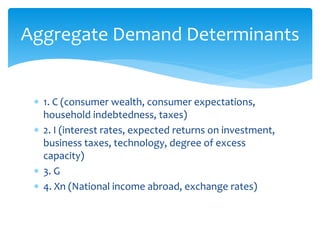
 1. C (consumer wealth, consumer expectations,
household indebtedness, taxes)
 2. I (interest rates, expected returns on investment,
business taxes, technology, degree of excess
capacity)
 3. G
 4. Xn (National income abroad, exchange rates)
Aggregate Demand Determinants
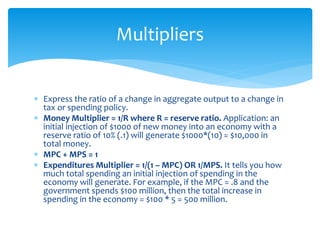
 Express the ratio of a change in aggregate output to a change in
tax or spending policy.
 Money Multiplier = 1/R where R = reserve ratio. Application: an
initial injection of $1000 of new money into an economy with a
reserve ratio of 10% (.1) will generate $1000*(10) = $10,000 in
total money.
 MPC + MPS = 1
 Expenditures Multiplier = 1/(1 – MPC) OR 1/MPS. It tells you how
much total spending an initial injection of spending in the
economy will generate. For example, if the MPC = .8 and the
government spends $100 million, then the total increase in
spending in the economy = $100 * 5 = 500 million.
Multipliers
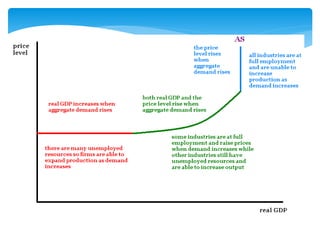
 The total amount spent for final goods and services in
the economy.
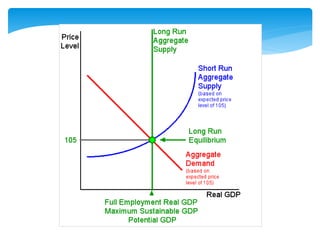
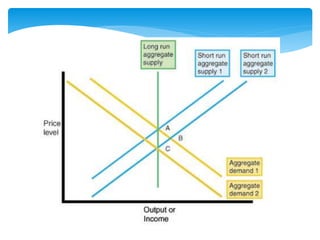
 The aggregate supply curve shows the relationship
between the price level and output. While the long
run aggregate supply curve is vertical, the short run
aggregate supply curve is upward sloping.
Aggregate Supply
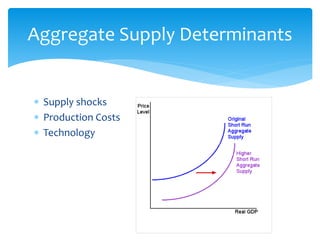
 Supply shocks
 Production Costs
 Technology
Aggregate Supply Determinants
 If the economy is in long run equilibrium:
1. Real GDP produced is the full employment or potential or
sustainable level.
2. Actual unemployment will be equal to the natural
rate (since the economy is at full employment). If you don’t
remember what the natural rate of unemployment is, you
may wish to review the unemployment concepts.
3. Cyclical unemployment is zero (this is because the
economy is at full employment).
4. The price level anticipated by decision makers is equal to
the actual price level.
Equilibrium
Financial Sector
 To act as a medium of exchange to facilitate the payment of income
and purchase of goods and services.
 To act as a unit of account--a measure by which all prices are
established, and
 To act as a store of value -- that is to alter the timing of spending
decisions relative to earning income.
 M1: the narrowly defined money supply; currency and checkable
deposits.
 M2: a more broadly defined money supply; equal to M1 plus non
checkable savings deposits, money market deposits, mutual funds,
and small time deposits.
 M3: very broadly defined money supply: includes M2 plus large time
deposits.
Money
 Federal Reserve Banks - Branches of the Fed that serve as
banks for non-government controlled banks by accepting
deposits, giving withdrawals, and making loans as needed.
 Monetary Policy - Policy used to affect the money supply
employed by the Fed. In particular, this describes the open
market operations of buying and selling government
bonds.
 Reserve Requirement - The percent of total deposits
required to be held back for repaying depositors. This is
controlled by the Fed as a form of monetary policy.
Banking
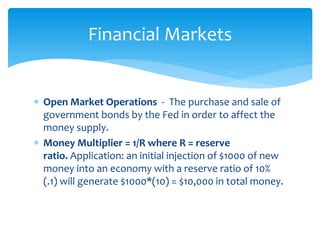
 Open Market Operations - The purchase and sale of
government bonds by the Fed in order to affect the
money supply.
 Money Multiplier = 1/R where R = reserve
ratio. Application: an initial injection of $1000 of new
money into an economy with a reserve ratio of 10%
(.1) will generate $1000*(10) = $10,000 in total money.
Financial Markets
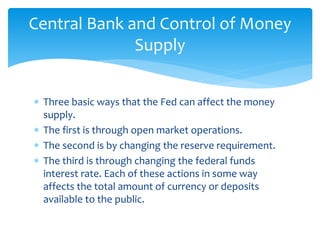
 Three basic ways that the Fed can affect the money
supply.
 The first is through open market operations.
 The second is by changing the reserve requirement.
 The third is through changing the federal funds
interest rate. Each of these actions in some way
affects the total amount of currency or deposits
available to the public.
Central Bank and Control of Money
Supply
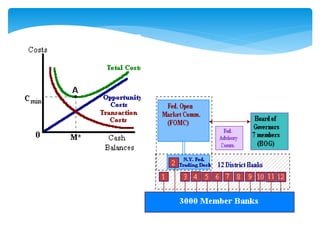
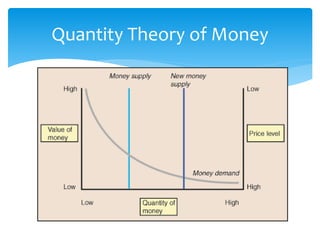
Quantity Theory of Money
Inflation, Unemployment and
Stabilization Policies
 Fiscal policy is changes in the taxing and spending of the federal
government for purposes of expanding or contracting the level
of aggregate demand. In a recession, an expansionary fiscal
policy involves lowering taxes and increasing government
spending. In an overheated expansion, a contractionary fiscal
policy requires higher taxes and reduced spending.
 Monetary policy is under the control of the Federal Reserve
System (our central bank) and is completely discretionary. It is
the changes in interest rates and money supply to expand or
contract aggregate demand. In a recession, the Fed will lower
interest rates and increase the money supply. In an overheated
expansion, the Fed will raise interest rates and decrease the
money supply.
Fiscal and Monetary Policies
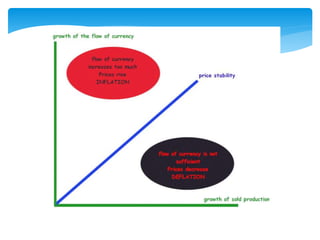
 A. If the flow of currency is increasing (too much money or
too much velocity of circulation), and if at the same time
there is the same flow of goods and services, then the
average price of goods and services will rise: it's inflation.
 To curb inflation, the possibilities are:
 1. to decrease the monetary mass: by monetary
destruction or by higher rates
2. to decrease the velocity of circulation of money: by
immobilizing large amounts of money
Contractionary Policy
 B. If the flow of currency is decreasing (lack of money or lack of
velocity of circulation), and if at the same time there is the same
flow of goods and services, then the average price of goods and
services will decrease: it's deflation.
 To curb deflation, the possibilities are:
 1. to increase the monetary mass: by monetary creation or by
debt and ordinary bounds emission.
 2. to increase the velocity of circulation of money: by
exceptional fiscal measures, each during 2 or 3 months, to
induce people into spending their money
 3. to decrease the production sold: in taxing unnecessary goods
or services, taxing unnecessary importations, regulating lending
Expansionary Policy
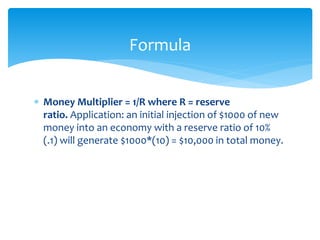
 Money Multiplier = 1/R where R = reserve
ratio. Application: an initial injection of $1000 of new
money into an economy with a reserve ratio of 10%
(.1) will generate $1000*(10) = $10,000 in total money.
Formula
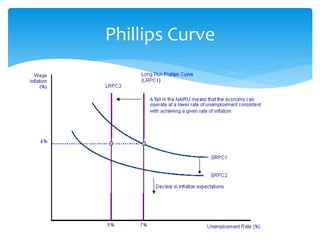
Phillips Curve
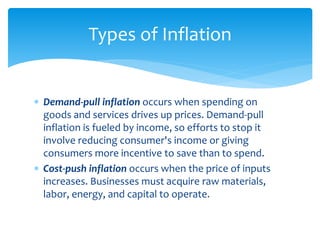
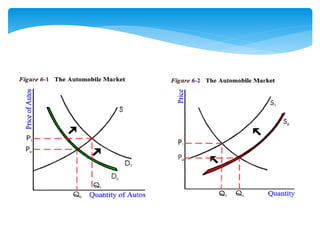
 Demand-pull inflation occurs when spending on
goods and services drives up prices. Demand-pull
inflation is fueled by income, so efforts to stop it
involve reducing consumer's income or giving
consumers more incentive to save than to spend.
 Cost-push inflation occurs when the price of inputs
increases. Businesses must acquire raw materials,
labor, energy, and capital to operate.
Types of Inflation
Economic Growth and
Productivity
 Physical Capital (equipment, buildings and machines used to
produce other goods), belongs to the company or firm that
purchases it.
 Human capital (the education and experience we bring to our
employer) does not stay with the company if the employees
who have it leave.
 Investment in human capital is necessary for a company to grow,
but it also benefits the individual.
 Workers can stay with a company or take their knowledge and
experience with them to another firm that might pay more.
From a business standpoint, human capital is an investment
worth making.
Human Capital vs. Physical Capital
 A healthy economy leads to higher living standards and
greater prosperity for individuals. It also helps businesses
to be profitable, which generates employment and
income.
 Greater business confidence: Growth has a positive impact
on company profits & business confidence – good news for
the stock market and for the growth of small and large
businesses.
 Potential environmental benefits – richer countries have
more resources available to invest in cleaner technologies
Economic Growth
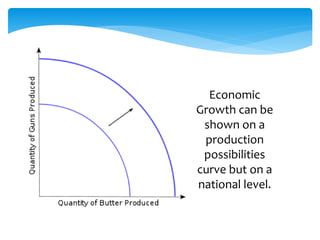
Economic
Growth can be
shown on a
production
possibilities
curve but on a
national level.
Open Economy: International
Trade and Finance
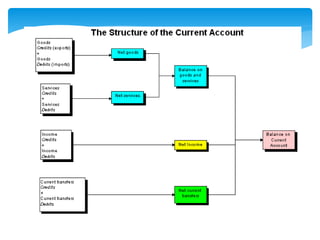
 The balance-of-payments accounts of a country
record the payments and receipts of the residents of
the country in their transactions with residents of
other countries.
 Although the totals of payments and receipts are
necessarily equal, there will be inequalities excesses
of payments or receipts, called deficits or surpluses in
particular kinds of transactions.
Balance of Payments Accounts
 All trades that take place in the foreign exchange market involve
the buying of one currency and the selling of another currency
simultaneously.
 This is because the value of one currency is determined by its
comparison to another currency. The first currency of a currency
pair is called the “base currency,” while the second currency is
called the counter currency.
 The currency pair shows how much of the counter currency is
needed to purchase one unit of the base currency. Currency pairs
can be thought of as a single unit that can be bought or sold.
 When purchasing a currency pair, the base currency is being bought,
while the counter currency is being sold. The opposite is true, when
the sale of a currency pair takes place
Foreign Exchange Market
 The supply of imports is the total amount of exports of foreign
nations; the demand for imports is the amount of imports of the
U.S.
 If U.S. income increases, then the demand for imports will
increase, shifting the demand curve to the right and increasing
the equilibrium price and quantity of imports. With both the
equilibrium price and quantity increasing, the value of imports
will increase. If foreign incomes increase, then foreign
consumption will absorb some of the goods previously
exported.
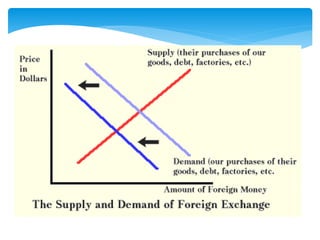
 The supply of goods to the U.S. will decrease, shifting the supply
curve to the left and causing a higher equilibrium price and
lower equilibrium quantity. In this case, the value of imports is
indeterminate and depends upon the proportionate size of the
price increase relative to the quantity decrease.
The Market for Imports
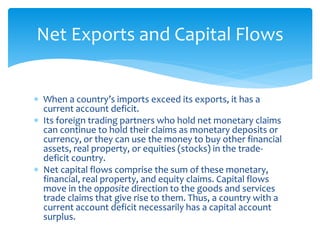
 When a country’s imports exceed its exports, it has a
current account deficit.
 Its foreign trading partners who hold net monetary claims
can continue to hold their claims as monetary deposits or
currency, or they can use the money to buy other financial
assets, real property, or equities (stocks) in the trade-
deficit country.
 Net capital flows comprise the sum of these monetary,
financial, real property, and equity claims. Capital flows
move in the opposite direction to the goods and services
trade claims that give rise to them. Thus, a country with a
current account deficit necessarily has a capital account
surplus.
Net Exports and Capital Flows
 The price of a companies stock is determined by four primary
factors:
 earnings growth,
 interest rates,
 the magnitude of dividends, and
 market forces.
 When an investor buys stock in a company he or she becomes a
partial owner of that company. In the most basic sense, share
prices reflect the business conditions of the corporation. If the
company is doing well, it is likely that the prices of its shares will
rise, and they will certainly fall when the company faces a
prolonged period (perhaps six months, usually less) of weak
business conditions.
Financial and Good Markets
THE END!

Ap macroeconomics review

  • 1.
  • 2.
  • 3.
     Resources- land,labor, capital, and entrepreneurship.  All resources are limited factors of production. We are forces to make choices about how the resources are to be used due to scarcity which leads to opportunity costs.  A trade-off is simply the act of giving up one thing for another, but an opportunity cost is the value of what you give up when you make your decision.  What to produce, what method and for who are the essential questions. Scarcity, Choice, Opportunity Cost
  • 4.
     A graphicalway to represent the fact that we must give up some of one good to get more of another.  Shows us what combinations of goods we produce when we are using our resources efficiently.  It is usually between two products and it reflects the law of increasing opportunity costs.  The law of increasing opportunity costs give the PPC its convex shape.  This may shift right due to resources and technology.  If points are inside it is inefficient. Production Possibilities Curve
  • 6.
     Specialization allowa person, business, or nation to specialize in production of what it does best, instead of striving for self-sufficiency.  It allows for a greater variety of goods and services available and at lower cost.  Relates to the principle of the division of labor, it increases output because it gives people an opportunity to become better at one specific job.  Trade helps economic growth when one can produce something at a lower opportunity cost than another, they have the comparative advantage. Comparative Advantage, Specialization, Trade
  • 8.
    Example of howto find out who had the comparative advantage.
  • 9.
    Demand, Supply andMarket Equilibrium
  • 10.
     1. Changein income (normal/inferior)  2. Change in preferences  3. Change in price of other goods (complements/substitutes)  4. Expectations  5. Change in consumer information Demand Curve Determinants Shifters
  • 11.
     1. Changein costs of production  2. Change in technology  3. Change in number of producers  4. Change ins prices of alternative items  5. Expectations  6. Change in time period to produce goods Supply Curve Determinants Shifters
  • 12.
  • 13.
    National Income Accounts National income accounts keep track of a country’s diverse goods and services.  GDP is the market value of all the final goods and services produced by a country’s economy in a specific time period.  GDP FORMULA:  Consumption +  Investment +  Government Spending +  Net Exports  (Expenditure Approach)
  • 16.
     Price Indexmeasures the combined price of a particular collection of goods and services called a market basket relative to that of similar items in another period.  Consumer Price Index tells us about average changes over time in prices of a fixed group of goods and services that are bought by consumers.  Adjusts nominal GDP to real GDP in order to account for inflation. Inflation Measurement and Adjustment
  • 17.
    Formulas  Price Index: Price level in given year= Price of market basket in specific year / price of the same market basket in the base year x 100  GDP (consumer) Price Index:  GDP Price Index= Price of GDP market basket in a specific year / prices of GDP market basket in base year x 100
  • 18.
     Frictional –includes workers who are searching for jobs or waiting to take jobs in the near future. This unemployment is inevitable, since many workers switch to better jobs.  Structural – changes over time in consumer demand and technology change the “structure” of total demand for labor. Some skills will not be needed as much or become obsolete, and new skills will appear. This is a mismatch between job seekers’ skills and the skills needed for the job. This is also inevitable because the demand for labor will always change over time as new technologies arise.  Cyclical – this type of unemployment is caused by recession. People who are laid off because of decreased overall spending in the economy. Unemployment
  • 19.
     This isNOT zero unemployment, as frictional and structural unemployment are regarded as unavoidable in an economy. Therefore, full employment means no cyclical unemployment, and the full-employment rate is equal to the frictional plus structural rates. It is also called the natural rate of unemployment.  3%-5%  Calculation:  Unemployment means unemployment in the labor force, not the whole population. The labor force is total population – under 16 and/or institutionalized – people not in the labor force. The unemployment rate = Unemployed people in the labor force divided by Total number of people in the labor force x 100 Natural Rate of Unemployment
  • 20.
    National Income andPrice Determination
  • 21.
     Aggregate demandis a measure the ability to spend or a level of expenditure used to command varying quantities of goods and services at different price levels. This concept is a measure of purchasing power such that when prices increase with a given level of nominal income, fewer goods or services can be purchase.  Caused by Wealth Effect, Interest Rate Effect, and Exchange Rate Effect. Aggregate Demand
  • 22.
    For a givenlevel of nominal expenditure, an inverse relationship exists between the price level 'P' and Real Income 'YR'. Aggregate demand represents this inverse relationship between the price level and a given level of purchasing power in an economy.
  • 23.
     1. C(consumer wealth, consumer expectations, household indebtedness, taxes)  2. I (interest rates, expected returns on investment, business taxes, technology, degree of excess capacity)  3. G  4. Xn (National income abroad, exchange rates) Aggregate Demand Determinants
  • 24.
     Express theratio of a change in aggregate output to a change in tax or spending policy.  Money Multiplier = 1/R where R = reserve ratio. Application: an initial injection of $1000 of new money into an economy with a reserve ratio of 10% (.1) will generate $1000*(10) = $10,000 in total money.  MPC + MPS = 1  Expenditures Multiplier = 1/(1 – MPC) OR 1/MPS. It tells you how much total spending an initial injection of spending in the economy will generate. For example, if the MPC = .8 and the government spends $100 million, then the total increase in spending in the economy = $100 * 5 = 500 million. Multipliers
  • 25.
     The totalamount spent for final goods and services in the economy.  The aggregate supply curve shows the relationship between the price level and output. While the long run aggregate supply curve is vertical, the short run aggregate supply curve is upward sloping. Aggregate Supply
  • 27.
     Supply shocks Production Costs  Technology Aggregate Supply Determinants
  • 28.
     If theeconomy is in long run equilibrium: 1. Real GDP produced is the full employment or potential or sustainable level. 2. Actual unemployment will be equal to the natural rate (since the economy is at full employment). If you don’t remember what the natural rate of unemployment is, you may wish to review the unemployment concepts. 3. Cyclical unemployment is zero (this is because the economy is at full employment). 4. The price level anticipated by decision makers is equal to the actual price level. Equilibrium
  • 31.
  • 32.
     To actas a medium of exchange to facilitate the payment of income and purchase of goods and services.  To act as a unit of account--a measure by which all prices are established, and  To act as a store of value -- that is to alter the timing of spending decisions relative to earning income.  M1: the narrowly defined money supply; currency and checkable deposits.  M2: a more broadly defined money supply; equal to M1 plus non checkable savings deposits, money market deposits, mutual funds, and small time deposits.  M3: very broadly defined money supply: includes M2 plus large time deposits. Money
  • 33.
     Federal ReserveBanks - Branches of the Fed that serve as banks for non-government controlled banks by accepting deposits, giving withdrawals, and making loans as needed.  Monetary Policy - Policy used to affect the money supply employed by the Fed. In particular, this describes the open market operations of buying and selling government bonds.  Reserve Requirement - The percent of total deposits required to be held back for repaying depositors. This is controlled by the Fed as a form of monetary policy. Banking
  • 35.
     Open MarketOperations - The purchase and sale of government bonds by the Fed in order to affect the money supply.  Money Multiplier = 1/R where R = reserve ratio. Application: an initial injection of $1000 of new money into an economy with a reserve ratio of 10% (.1) will generate $1000*(10) = $10,000 in total money. Financial Markets
  • 36.
     Three basicways that the Fed can affect the money supply.  The first is through open market operations.  The second is by changing the reserve requirement.  The third is through changing the federal funds interest rate. Each of these actions in some way affects the total amount of currency or deposits available to the public. Central Bank and Control of Money Supply
  • 38.
  • 39.
  • 40.
     Fiscal policyis changes in the taxing and spending of the federal government for purposes of expanding or contracting the level of aggregate demand. In a recession, an expansionary fiscal policy involves lowering taxes and increasing government spending. In an overheated expansion, a contractionary fiscal policy requires higher taxes and reduced spending.  Monetary policy is under the control of the Federal Reserve System (our central bank) and is completely discretionary. It is the changes in interest rates and money supply to expand or contract aggregate demand. In a recession, the Fed will lower interest rates and increase the money supply. In an overheated expansion, the Fed will raise interest rates and decrease the money supply. Fiscal and Monetary Policies
  • 41.
     A. Ifthe flow of currency is increasing (too much money or too much velocity of circulation), and if at the same time there is the same flow of goods and services, then the average price of goods and services will rise: it's inflation.  To curb inflation, the possibilities are:  1. to decrease the monetary mass: by monetary destruction or by higher rates 2. to decrease the velocity of circulation of money: by immobilizing large amounts of money Contractionary Policy
  • 42.
     B. Ifthe flow of currency is decreasing (lack of money or lack of velocity of circulation), and if at the same time there is the same flow of goods and services, then the average price of goods and services will decrease: it's deflation.  To curb deflation, the possibilities are:  1. to increase the monetary mass: by monetary creation or by debt and ordinary bounds emission.  2. to increase the velocity of circulation of money: by exceptional fiscal measures, each during 2 or 3 months, to induce people into spending their money  3. to decrease the production sold: in taxing unnecessary goods or services, taxing unnecessary importations, regulating lending Expansionary Policy
  • 43.
     Money Multiplier= 1/R where R = reserve ratio. Application: an initial injection of $1000 of new money into an economy with a reserve ratio of 10% (.1) will generate $1000*(10) = $10,000 in total money. Formula
  • 45.
  • 46.
     Demand-pull inflationoccurs when spending on goods and services drives up prices. Demand-pull inflation is fueled by income, so efforts to stop it involve reducing consumer's income or giving consumers more incentive to save than to spend.  Cost-push inflation occurs when the price of inputs increases. Businesses must acquire raw materials, labor, energy, and capital to operate. Types of Inflation
  • 48.
  • 49.
     Physical Capital(equipment, buildings and machines used to produce other goods), belongs to the company or firm that purchases it.  Human capital (the education and experience we bring to our employer) does not stay with the company if the employees who have it leave.  Investment in human capital is necessary for a company to grow, but it also benefits the individual.  Workers can stay with a company or take their knowledge and experience with them to another firm that might pay more. From a business standpoint, human capital is an investment worth making. Human Capital vs. Physical Capital
  • 50.
     A healthyeconomy leads to higher living standards and greater prosperity for individuals. It also helps businesses to be profitable, which generates employment and income.  Greater business confidence: Growth has a positive impact on company profits & business confidence – good news for the stock market and for the growth of small and large businesses.  Potential environmental benefits – richer countries have more resources available to invest in cleaner technologies Economic Growth
  • 51.
    Economic Growth can be shownon a production possibilities curve but on a national level.
  • 52.
  • 53.
     The balance-of-paymentsaccounts of a country record the payments and receipts of the residents of the country in their transactions with residents of other countries.  Although the totals of payments and receipts are necessarily equal, there will be inequalities excesses of payments or receipts, called deficits or surpluses in particular kinds of transactions. Balance of Payments Accounts
  • 55.
     All tradesthat take place in the foreign exchange market involve the buying of one currency and the selling of another currency simultaneously.  This is because the value of one currency is determined by its comparison to another currency. The first currency of a currency pair is called the “base currency,” while the second currency is called the counter currency.  The currency pair shows how much of the counter currency is needed to purchase one unit of the base currency. Currency pairs can be thought of as a single unit that can be bought or sold.  When purchasing a currency pair, the base currency is being bought, while the counter currency is being sold. The opposite is true, when the sale of a currency pair takes place Foreign Exchange Market
  • 57.
     The supplyof imports is the total amount of exports of foreign nations; the demand for imports is the amount of imports of the U.S.  If U.S. income increases, then the demand for imports will increase, shifting the demand curve to the right and increasing the equilibrium price and quantity of imports. With both the equilibrium price and quantity increasing, the value of imports will increase. If foreign incomes increase, then foreign consumption will absorb some of the goods previously exported.  The supply of goods to the U.S. will decrease, shifting the supply curve to the left and causing a higher equilibrium price and lower equilibrium quantity. In this case, the value of imports is indeterminate and depends upon the proportionate size of the price increase relative to the quantity decrease. The Market for Imports
  • 59.
     When acountry’s imports exceed its exports, it has a current account deficit.  Its foreign trading partners who hold net monetary claims can continue to hold their claims as monetary deposits or currency, or they can use the money to buy other financial assets, real property, or equities (stocks) in the trade- deficit country.  Net capital flows comprise the sum of these monetary, financial, real property, and equity claims. Capital flows move in the opposite direction to the goods and services trade claims that give rise to them. Thus, a country with a current account deficit necessarily has a capital account surplus. Net Exports and Capital Flows
  • 60.
     The priceof a companies stock is determined by four primary factors:  earnings growth,  interest rates,  the magnitude of dividends, and  market forces.  When an investor buys stock in a company he or she becomes a partial owner of that company. In the most basic sense, share prices reflect the business conditions of the corporation. If the company is doing well, it is likely that the prices of its shares will rise, and they will certainly fall when the company faces a prolonged period (perhaps six months, usually less) of weak business conditions. Financial and Good Markets
  • 63.