Retail
Management
Prepared and presented by:
Dr. Himani Raval
Unit 1: Layout
Retailing: Role, Relevance and Trends
Introduction to retailing
Types of Retailing
Characteristics of Retailing
Functions and activities of Retailing
Emergence and growth of Retailing in India
FDI in Indian Retailing
Meaning of RM
THE VARIOUS PROCESSES WHICH
HELP THE CUSTOMERS TO PROCURE
THE DESIRED MERCHANDISE FROM
THE RETAIL STORES FOR THEIR END
USE REFER TO RETAIL
MANAGEMENT.
RETAIL MANAGEMENT INCLUDES
ALL THE STEPS REQUIRED TO
BRING THE CUSTOMERS INTO THE
STORE AND FULFILL THEIR
BUYING NEEDS.
RETAIL MANAGEMENT MAKES
SHOPPING A PLEASURABLE
EXPERIENCE AND ENSURES THE
CUSTOMERS LEAVE THE STORE WITH A
SMILE. IN SIMPLER WORDS, RETAIL
MANAGEMENT HELPS CUSTOMERS
SHOP WITHOUT ANY DIFFICULTY.
Need for Retail
Management
• Retail management saves time
and ensures the customers
easily locate their desired
merchandise and return home
satisfied.
• An effective management avoids
unnecessary chaos at the store.
• Effective Management controls
shopliftings to a large extent.
Example
Peter wanted to gift his wife a nice
watch on her birthday. He went to
the nearby store to check out few
options. The retailer took almost an
hour to find the watches. This
irritated Peter and he vowed not to
visit the store again.-An example of
poor retail management.
You just can’t afford to make the
customer wait for long. The
merchandise needs to be well
organized to avoid unnecessary
searching. Such situations are
common in mom and pop stores
(kirana stores). One can never
enjoy shopping at such stores.
Characteristics
1. Retailing brings goods and services closer to the
consumers
2. A Retailer is the last link in the distribution channel
3. Retailers buy in large quantities but sell in individual
units
4. There are large number of retailers as compared to
manufacturers and wholesalers
5. Retailing can be organised (branded chain stores) or un-
organised (that is normal stores that we find in our
neighbourhood)
6. Retailing provides a direct contact with the customers
7. Retailing is the function that keeps an eye on the pulse of
the customers
8. Retailing can also be done through online stores
9. Provides a variety of products at a single place.
Functions of
retailing
• Arrangement of assortment of
products and services
• Breaking bulk
• Holding the stock
• Providing different services
• Retailer as a channel of
communication
• Providing transport and advertising
facilities to wholesalers/manufacturers
• Providing customer satisfaction
• Providing positive shopping
experience
Scope /elements of retail
operations
• Size and its format
• Store location
• Store image
• Optimum utilization of retail personnel
• Inventory management
• Managing the customer
• Store security
• Insurance
• Computerization
Types of retail outlets
• Food Retailers
• General merchandise retailers
• Non-store retailers
• Direct retail selling
• Television home shopping
• Vending machine retailing
• Services retailing
Types of retail outlets
• Convenience stores
• This is located close to residential areas so as to make easy access to the customers. It offers a limited
range of product like grocery, daily needed FMCG products, etc. It is small in size as compared to other
retail outlets.
• Chain of store
• A single retailer establishes a chain of the store with it’s executive’s store design often offers certain
special goods & services these all chain have exclusive store design selling & promotional plan. For e.g.
Tanishiq, Tata designer gold jewelry outlet, Raymond which offers exclusive suiting & shirting.
• Franchisee
• This is the best way to enter into retail sectors. In this type of retail outlet the store is owned & operated
by individuals on behalf of & is licensed by a big supporting organization. E.g. Pizza Hut, Mac Donald’s.
• Specialty Store
• A specialty store is a shop that caters to one specific retail market. Examples of specialist
stores include camera stores, pharmacies, stationers, and bookstores. In other words,
a shop that specializes in one breed of products.
• Departmental Stores
• Departmental stores have various departments like cosmetic, stationaries, clothing,
food products, etc under one room. Here every department is treated as a profit center or
strategic business unit. These stores are larger in size as compare to convenience stores &
specialty stores. For eg Shoppers Stop, Pantaloon.
• Super Market
• These are self service food store offering groceries, meat and also limited sales of non food
items such as health, beauty aids and general merchandise. For eg. Ratnadeep, Q-mart, etc.
• Discount Store
• Discount stores differentiated themselves on the basis of low price & various offers. For e.g
Subhiksha, D-mart, Big bazaar.
• Factory Outlet
• A factory outlet is a store that sells goods that come directly from the factory more cheaply than
those sold in retail. In a factory outlet, only the items produced by one factory or one brand are
sold. For example, Jockey factory outlet stores only sell Jockey brand’s garments, whereas Jockey
brand items can be found alongside many other brands in department stores.
• Hypermarket
• Hypermarkets are another name for superstores, and they are a combination of a supermarket and
a department store. Customers can buy food, clothing, hardware, and electronic devices at
hypermarkets because they specialize in carrying a full range of merchandise to satisfy every
want and need. For E.g More Hypermart, SPAR, Star Bazaar.
• Shopping Malls
• It is an arrangement of retail stores & providing the right mix of shopping. Here retail space is
shared by other retailers who operate these retail outlets individually. Such group of a retail outlet
in the same building or premises is called a shopping mall. For e.g PVR mall, Central, etc
Retail Environment
• Internal (controllable and micro in nature)
• Human resources
• Store image
• Merchandise mix
• Financial strength
• Services offered
• External (uncontrollable and macro in nature)
• Technological forces
• Economic forces
• Demographic forces
• Socio cultural forces
• Competition
Retailing in India
• In India, more than 12mn stores are small unorganized “Father and son”
concept outlets
• India has the highest number of retail outlets per capita in the world.
• Haats and Melas are 2 important unorganized retail outlets in rural area.
• Haats are weekly markets that sell day to day necessities and Melas are large
in size and having more varieties of goods.
• Retail sectors are concentrating on “customer pull environment” that leads to
impulsive shopping.
• Giant groups like Tata, Reliance, PVR and many more are coming up fully
backed by huge investments in retail sector.
FDI in retailing
• Retailing in India is one of the pillars of its economy and accounts for about 10 percent of its
GDP. The Indian retail market is estimated to be US$ 600 billion and one of the top five retail
markets in the world by economic value. India is one of the fastest growing retail markets in the
world, with 1.2billion people.
• Foreign direct investment (FDI) is a category of cross-border investment in which an investor
resident in one economy establishes a lasting interest in and a significant degree of influence over
an enterprise resident in another economy.
• Until 2011, Indian central government denied foreign direct investment (FDI) in multi-brand retail,
forbidding foreign groups from any ownership in supermarkets, convenience stores or any retail
outlets. Even single-brand retail was limited to 51% ownership and a bureaucratic process.
• In November 2011, India's central government announced retail reforms for both multi-brand stores
and single-brand stores under the flagship of Dr. Manmohan Singh, Ex. PM of India.
• On 7 December 2012, the Federal Government of India allowed 51% FDI in multi-brand retail in
India. Some states will allow foreign supermarkets like Walmart, Tesco and Carrefour to open
while other states will not.
Case study
• Whole Foods Market is a supermarket chain with less than two-hundred stores selling
healthy, gourmet products such as organic vegetables, free-range poultry, foods
without artificial ingredients or hydrogenated fats, and many environment-friendly
products such as non-polluting detergents and chlorine free diapers. The company
began in the 1970s as a natural-food stores.
• Through the purchase of small health food stores in major cities, the company gained
more exposure and access distribution channels for natural foods. During the late
1980s and the 1990s, the company’s growth was fuelled by the by the upsurge’s in
Americans’ desire for healthy living and their interest in gourmet cooking.
• Whole Foods does very little advertisings but receives constant free media exposure
because it is often mentioned in popular TV series, praised by celebrities on talk shows,
and featured in newspapers and magazines as a business success story. The company
educates consumers about foods, provides recipes, and even arranges trips where
consumers meet with local fishermen. Its supermarket cashiers and stock personnel
receive education about foods and earn above average-wages.
• Whole Foods’ prices are significantly higher than products in traditional supermarkets
because the keys to its profitability and higher profit margins for products that
traditionally yield slim margins, and much larger than per-square-foot sales than that of
conventional supermarkets. But as the company’s CEO pointed out, Americans spend
far less of their income on food than other nations and that’s why most of it doesn’t taste
very good; if they want to eat higher-quality foods, they have to pay for them. In 2005,
Whole Foods stated its numbers to double the number of its stores by 2015.
Questions
• Discuss the promotion strategy of Whole foods. Why or why not is it
appropriate?
• Do you think doubling the number of stores is a sound strategy when
“Americans spend far less of their income on food than other nations”.
Unit 2 Layout: RETAIL FORMATS AND THEORIES
• Traditional retail formats
• Cooperatives and Government
• Modern Retail formats in India
• Emergence of Malls in India
• Franchising
• Types of Franchising,
• Advantages and disadvantages of franchising;
• Legal issues in franchising in India.
• Theories of Retail Development
• Environmental theory, cyclical theory, conflict Theory
• Concept of Life cycle in retail
Traditional retail format
• It refers to thousands of small, mostly family-owned retail
businesses.
• Also are the unorganized retail sector
• It has the locational advantage, familiarity with the people,selling
in small quantities and credit advantage.
• But they lack modernization, less attractive, less varities of
products, lack of space, lack of offers, allowances and discounts,
etc.
Consumer’s cooperative store
• Their basic objective is to eliminate middlemen. The consumers
join together and manage the business and the profit thus earned is
retained among themselves in the proportion of their contribution.
• A consumer cooperative store is an organization owned,
managed and controlled by consumers themselves.
• The prices of products in such stores are also lower and are at
convenient locations.
• The main limitations are that there is a lack of funds and lack of
business training.
Modern retail formats in india
• Modern retail formats are defined by the activities involved in selling products
and services to the final customers, be it national or international.
• It operates throughout the country. Thereby the delivery process involves well
defined delivery norms, barcodes and specific time for the delivery of goods.
• The trade volume (purchase and sell) of goods is found to be high.
• Promotions is either monthly or daily.
• Modern trade is dependent on professional and legal relationships.
Emergence of malls in India
• The first shopping Mall in India was launched in 1999 by Ansal's Plaza in Delhi followed
by Crossroads in Mumbai and Spencer Plaza in Chennai. Until the end of 2002, only three
shopping malls existed in India. After 2003 Malls starts multiplying in metro cities like
Mumbai, Delhi, Kolkata, Bengaluru, Chennai, Hyderabad, Pune and tier two cities like
Gurugram, Noida, Ghaziabad etc.
• Driven by growth in middle class income, education level, standard of living and
willingness to spare money, middle-class Indians have broken off their love of traditional
stand-alone Indian stores that have no air conditioning; organized parking and other public
amenities.
• Recession of 2008:
• India was hit by recession in 2008 which in-turn affected the retail sector as well.
Continued
• The mall culture that was formed from 2011 onwards was something
that India had never seen before. Retail-real estate synergy started
witnessing an uptrend in metros from 2012 onwards.
• Consumer outlook towards the mall changed in 10 years – from just
viewing it as an entertainment centre to seeing it as a complete
shopping experience.
• The E-commerce threat:
• With the advent of e-commerce in 2014, realtors again started
anticipating a threat. Though they didn’t get cold feet, they did start
strategizing – having learnt from past mistakes – thinking of more and
more creative ways to retain spending customers.
Mall management
• Malls must go that extra mile to cater to every need of their customers.
• Mall managers must strive for effective operations and maintenance of
the entire building, infrastructure; including the services and utilities.
• Mall management also helps in finding the right kind of tenants, while
leasing out space to tenants.
• Mall management broadly includes mall positioning, zoning, tenant
mix, promotions/marketing and facility/finance management.
Mall layout & customer walk flow managment
• One that gives maximum visibility to its retailers providing them with ample display space,
tactfully and technically using dead spaces, and creating focal points to attract customers.
• Malls need to manage foot traffic and parking facilities as well.
• The flow of people is related to the design of the mall and the spatial distribution of its
tenants.
• Branding and advertising is one of the latest trends in retail mall retail estate that vacant
spaces are being used for advertising displays to promote malls, its retailers and the retailers’
products.
• This can often be hi-tech, involving the use of digital displays, and draw the shopper’s
attention to specific merchandise or promotions in a nearby store.
Franchising
• A franchise (or franchising) is a method of distributing products or services
involving a franchisor and a franchisee, who pays a royalty and often an initial
fee for the right to do business under the franchisor's name and system.
• The practice of creating and distributing the brand and franchise system is
most often referred to as franchising.
• Ongoing royalties paid to franchisors vary by industry and can range between
4.6% and 12.5%.
Types of franchises
• Business Format Franchises
• Most common type
• A company expands by supplying independent business owners with an
established business, including its name and trademark.
• The franchiser company generally assists the independent owners considerably in
launching and running their businesses. In return, the business owners pay fees
and royalties.
• Examples include McDonalds, Burger King, and Pizza Hut
Continued
• Product Franchises
• With product franchises, manufactures control how retail stores distribute their products.
• Through this kind of agreement, manufacturers allow retailers to distribute their products and
to use their names and trademarks.
• To obtain these rights, store owners must pay fees or buy a minimum number of products.
Tire stores, car dealerships, etc. for example, operate under this kind of franchise agreement.
• Manufacturing Franchises
• Through manufacturing franchises, a franchiser grants a manufacturer the right to produce
and sell goods using its name and trademark.
• The major soft drink companies also sell the supplies to the regional manufacturing
franchises. In the case of Coca Cola, for example, Coca Cola sells the syrup concentrate to a
bottling company, who mixes these ingredients with water and bottles the product, and sells it
on.
Advantages of Franchising
• A ready-made business formula to follow,
• Market-tested products and services,
• In some cases, established brand recognition.
• For example, if you're a McDonald's franchisee, decisions about what products
to sell, how to layout your store, or even how to design your employee uniforms
have already been made.
• Some franchisors offer training and financial planning, or lists of approved
suppliers. However, despite these benefits, success is never guaranteed.
Disadvantages of franchising
• Includes heavy start-up costs as well as ongoing royalty costs.
• Franchisees also lack control over territory or creativity with their business.
• Franchisees could be adversely affected by poor location or management.
• The franchisor does not possess direct control over the sale of its products. As
a result, its own goodwill can suffer if the franchisor does not maintain quality
standards.
• Franchising also involves ongoing costs of providing maintenance, assistance,
and training on the franchisor.
Legal issues in franchising in India
• THE INDIAN CONTRACT ACT: including the franchise offering,
acceptance, consideration, validity, breach and the termination of the
franchise contract. The act also ensures that the parties consent freely.
• COMPETITION LAWS: The act aims to promote competition and
freedom of trade, protect consumers and prevent anti-competitive
agreements and activities that have an adverse effect on competition
in India.
• INCOME TAX ACT: The Income Tax Act of 1961 governs the tax
aspects of any franchise in India and also that a cross-border
franchisor comply with local tax regulations with respect to any
applicable tax treaties.
Continued
• CONSUMER PROTECTION LAWS: was initiated in 1986 to provide recourse for
consumers who receive defective goods or experience unsatisfactory service. Under
these laws consumers are encouraged to file complaints
• THE ARBITRATION AND CONCILIATION ACT: Enacted in 1996, this law may
come in to effect in the case of franchisee-franchisor disputes.
• THE FOREIGN EXCHANGE MANAGEMENT ACT: Established in 1999, this act
governs payments in foreign currency and is generally applicable to cross-border
franchise arrangement.
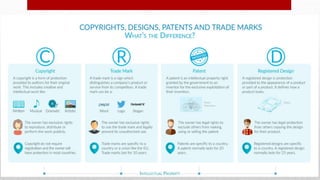
• INTELLECTUAL PROPERTY LAWS: There are four acts covering intellectual
property rights (IPRs) in India; The Copyright Act (1957), The Patents Act (1970), The
Trademarks Act (1999) and the Designs Act (2000). It allow legal actions to be brought
against third parties for infringement of these rights.
Theories of Retail Development
• Environmental theory: where a change in retail is attributed to the
change in the environment in which the retailers operate.
• Cyclical theory: where change follows pattern and phases, can have
definite identifiable attributes associated with them.
• Conflict theory: Conflict always exists between operators of similar
formats. It is believed that retail innovation does not necessarily reduce
the number of formats available to the consumer but leads to the
development of more formats.
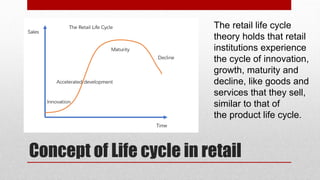
Concept of Life cycle in retail
The retail life cycle
theory holds that retail
institutions experience
the cycle of innovation,
growth, maturity and
decline, like goods and
services that they sell,
similar to that of
the product life cycle.
Retail Management

Retail Management

  • 1.
  • 2.
    Unit 1: Layout Retailing:Role, Relevance and Trends Introduction to retailing Types of Retailing Characteristics of Retailing Functions and activities of Retailing Emergence and growth of Retailing in India FDI in Indian Retailing
  • 3.
    Meaning of RM THEVARIOUS PROCESSES WHICH HELP THE CUSTOMERS TO PROCURE THE DESIRED MERCHANDISE FROM THE RETAIL STORES FOR THEIR END USE REFER TO RETAIL MANAGEMENT. RETAIL MANAGEMENT INCLUDES ALL THE STEPS REQUIRED TO BRING THE CUSTOMERS INTO THE STORE AND FULFILL THEIR BUYING NEEDS. RETAIL MANAGEMENT MAKES SHOPPING A PLEASURABLE EXPERIENCE AND ENSURES THE CUSTOMERS LEAVE THE STORE WITH A SMILE. IN SIMPLER WORDS, RETAIL MANAGEMENT HELPS CUSTOMERS SHOP WITHOUT ANY DIFFICULTY.
  • 4.
    Need for Retail Management •Retail management saves time and ensures the customers easily locate their desired merchandise and return home satisfied. • An effective management avoids unnecessary chaos at the store. • Effective Management controls shopliftings to a large extent.
  • 5.
    Example Peter wanted togift his wife a nice watch on her birthday. He went to the nearby store to check out few options. The retailer took almost an hour to find the watches. This irritated Peter and he vowed not to visit the store again.-An example of poor retail management. You just can’t afford to make the customer wait for long. The merchandise needs to be well organized to avoid unnecessary searching. Such situations are common in mom and pop stores (kirana stores). One can never enjoy shopping at such stores.
  • 6.
    Characteristics 1. Retailing bringsgoods and services closer to the consumers 2. A Retailer is the last link in the distribution channel 3. Retailers buy in large quantities but sell in individual units 4. There are large number of retailers as compared to manufacturers and wholesalers 5. Retailing can be organised (branded chain stores) or un- organised (that is normal stores that we find in our neighbourhood) 6. Retailing provides a direct contact with the customers 7. Retailing is the function that keeps an eye on the pulse of the customers 8. Retailing can also be done through online stores 9. Provides a variety of products at a single place.
  • 7.
    Functions of retailing • Arrangementof assortment of products and services • Breaking bulk • Holding the stock • Providing different services • Retailer as a channel of communication • Providing transport and advertising facilities to wholesalers/manufacturers • Providing customer satisfaction • Providing positive shopping experience
  • 8.
    Scope /elements ofretail operations • Size and its format • Store location • Store image • Optimum utilization of retail personnel • Inventory management • Managing the customer • Store security • Insurance • Computerization
  • 9.
    Types of retailoutlets • Food Retailers • General merchandise retailers • Non-store retailers • Direct retail selling • Television home shopping • Vending machine retailing • Services retailing
  • 10.
    Types of retailoutlets • Convenience stores • This is located close to residential areas so as to make easy access to the customers. It offers a limited range of product like grocery, daily needed FMCG products, etc. It is small in size as compared to other retail outlets. • Chain of store • A single retailer establishes a chain of the store with it’s executive’s store design often offers certain special goods & services these all chain have exclusive store design selling & promotional plan. For e.g. Tanishiq, Tata designer gold jewelry outlet, Raymond which offers exclusive suiting & shirting. • Franchisee • This is the best way to enter into retail sectors. In this type of retail outlet the store is owned & operated by individuals on behalf of & is licensed by a big supporting organization. E.g. Pizza Hut, Mac Donald’s.
  • 11.
    • Specialty Store •A specialty store is a shop that caters to one specific retail market. Examples of specialist stores include camera stores, pharmacies, stationers, and bookstores. In other words, a shop that specializes in one breed of products. • Departmental Stores • Departmental stores have various departments like cosmetic, stationaries, clothing, food products, etc under one room. Here every department is treated as a profit center or strategic business unit. These stores are larger in size as compare to convenience stores & specialty stores. For eg Shoppers Stop, Pantaloon. • Super Market • These are self service food store offering groceries, meat and also limited sales of non food items such as health, beauty aids and general merchandise. For eg. Ratnadeep, Q-mart, etc.
  • 12.
    • Discount Store •Discount stores differentiated themselves on the basis of low price & various offers. For e.g Subhiksha, D-mart, Big bazaar. • Factory Outlet • A factory outlet is a store that sells goods that come directly from the factory more cheaply than those sold in retail. In a factory outlet, only the items produced by one factory or one brand are sold. For example, Jockey factory outlet stores only sell Jockey brand’s garments, whereas Jockey brand items can be found alongside many other brands in department stores. • Hypermarket • Hypermarkets are another name for superstores, and they are a combination of a supermarket and a department store. Customers can buy food, clothing, hardware, and electronic devices at hypermarkets because they specialize in carrying a full range of merchandise to satisfy every want and need. For E.g More Hypermart, SPAR, Star Bazaar. • Shopping Malls • It is an arrangement of retail stores & providing the right mix of shopping. Here retail space is shared by other retailers who operate these retail outlets individually. Such group of a retail outlet in the same building or premises is called a shopping mall. For e.g PVR mall, Central, etc
  • 13.
    Retail Environment • Internal(controllable and micro in nature) • Human resources • Store image • Merchandise mix • Financial strength • Services offered • External (uncontrollable and macro in nature) • Technological forces • Economic forces • Demographic forces • Socio cultural forces • Competition
  • 14.
    Retailing in India •In India, more than 12mn stores are small unorganized “Father and son” concept outlets • India has the highest number of retail outlets per capita in the world. • Haats and Melas are 2 important unorganized retail outlets in rural area. • Haats are weekly markets that sell day to day necessities and Melas are large in size and having more varieties of goods. • Retail sectors are concentrating on “customer pull environment” that leads to impulsive shopping. • Giant groups like Tata, Reliance, PVR and many more are coming up fully backed by huge investments in retail sector.
  • 15.
    FDI in retailing •Retailing in India is one of the pillars of its economy and accounts for about 10 percent of its GDP. The Indian retail market is estimated to be US$ 600 billion and one of the top five retail markets in the world by economic value. India is one of the fastest growing retail markets in the world, with 1.2billion people. • Foreign direct investment (FDI) is a category of cross-border investment in which an investor resident in one economy establishes a lasting interest in and a significant degree of influence over an enterprise resident in another economy. • Until 2011, Indian central government denied foreign direct investment (FDI) in multi-brand retail, forbidding foreign groups from any ownership in supermarkets, convenience stores or any retail outlets. Even single-brand retail was limited to 51% ownership and a bureaucratic process. • In November 2011, India's central government announced retail reforms for both multi-brand stores and single-brand stores under the flagship of Dr. Manmohan Singh, Ex. PM of India. • On 7 December 2012, the Federal Government of India allowed 51% FDI in multi-brand retail in India. Some states will allow foreign supermarkets like Walmart, Tesco and Carrefour to open while other states will not.
  • 16.
    Case study • WholeFoods Market is a supermarket chain with less than two-hundred stores selling healthy, gourmet products such as organic vegetables, free-range poultry, foods without artificial ingredients or hydrogenated fats, and many environment-friendly products such as non-polluting detergents and chlorine free diapers. The company began in the 1970s as a natural-food stores. • Through the purchase of small health food stores in major cities, the company gained more exposure and access distribution channels for natural foods. During the late 1980s and the 1990s, the company’s growth was fuelled by the by the upsurge’s in Americans’ desire for healthy living and their interest in gourmet cooking.
  • 17.
    • Whole Foodsdoes very little advertisings but receives constant free media exposure because it is often mentioned in popular TV series, praised by celebrities on talk shows, and featured in newspapers and magazines as a business success story. The company educates consumers about foods, provides recipes, and even arranges trips where consumers meet with local fishermen. Its supermarket cashiers and stock personnel receive education about foods and earn above average-wages. • Whole Foods’ prices are significantly higher than products in traditional supermarkets because the keys to its profitability and higher profit margins for products that traditionally yield slim margins, and much larger than per-square-foot sales than that of conventional supermarkets. But as the company’s CEO pointed out, Americans spend far less of their income on food than other nations and that’s why most of it doesn’t taste very good; if they want to eat higher-quality foods, they have to pay for them. In 2005, Whole Foods stated its numbers to double the number of its stores by 2015.
  • 18.
    Questions • Discuss thepromotion strategy of Whole foods. Why or why not is it appropriate? • Do you think doubling the number of stores is a sound strategy when “Americans spend far less of their income on food than other nations”.
  • 20.
    Unit 2 Layout:RETAIL FORMATS AND THEORIES • Traditional retail formats • Cooperatives and Government • Modern Retail formats in India • Emergence of Malls in India • Franchising • Types of Franchising, • Advantages and disadvantages of franchising; • Legal issues in franchising in India. • Theories of Retail Development • Environmental theory, cyclical theory, conflict Theory • Concept of Life cycle in retail
  • 21.
    Traditional retail format •It refers to thousands of small, mostly family-owned retail businesses. • Also are the unorganized retail sector • It has the locational advantage, familiarity with the people,selling in small quantities and credit advantage. • But they lack modernization, less attractive, less varities of products, lack of space, lack of offers, allowances and discounts, etc.
  • 22.
    Consumer’s cooperative store •Their basic objective is to eliminate middlemen. The consumers join together and manage the business and the profit thus earned is retained among themselves in the proportion of their contribution. • A consumer cooperative store is an organization owned, managed and controlled by consumers themselves. • The prices of products in such stores are also lower and are at convenient locations. • The main limitations are that there is a lack of funds and lack of business training.
  • 23.
    Modern retail formatsin india • Modern retail formats are defined by the activities involved in selling products and services to the final customers, be it national or international. • It operates throughout the country. Thereby the delivery process involves well defined delivery norms, barcodes and specific time for the delivery of goods. • The trade volume (purchase and sell) of goods is found to be high. • Promotions is either monthly or daily. • Modern trade is dependent on professional and legal relationships.
  • 24.
    Emergence of mallsin India • The first shopping Mall in India was launched in 1999 by Ansal's Plaza in Delhi followed by Crossroads in Mumbai and Spencer Plaza in Chennai. Until the end of 2002, only three shopping malls existed in India. After 2003 Malls starts multiplying in metro cities like Mumbai, Delhi, Kolkata, Bengaluru, Chennai, Hyderabad, Pune and tier two cities like Gurugram, Noida, Ghaziabad etc. • Driven by growth in middle class income, education level, standard of living and willingness to spare money, middle-class Indians have broken off their love of traditional stand-alone Indian stores that have no air conditioning; organized parking and other public amenities. • Recession of 2008: • India was hit by recession in 2008 which in-turn affected the retail sector as well.
  • 25.
    Continued • The mallculture that was formed from 2011 onwards was something that India had never seen before. Retail-real estate synergy started witnessing an uptrend in metros from 2012 onwards. • Consumer outlook towards the mall changed in 10 years – from just viewing it as an entertainment centre to seeing it as a complete shopping experience. • The E-commerce threat: • With the advent of e-commerce in 2014, realtors again started anticipating a threat. Though they didn’t get cold feet, they did start strategizing – having learnt from past mistakes – thinking of more and more creative ways to retain spending customers.
  • 26.
    Mall management • Mallsmust go that extra mile to cater to every need of their customers. • Mall managers must strive for effective operations and maintenance of the entire building, infrastructure; including the services and utilities. • Mall management also helps in finding the right kind of tenants, while leasing out space to tenants. • Mall management broadly includes mall positioning, zoning, tenant mix, promotions/marketing and facility/finance management.
  • 27.
    Mall layout &customer walk flow managment • One that gives maximum visibility to its retailers providing them with ample display space, tactfully and technically using dead spaces, and creating focal points to attract customers. • Malls need to manage foot traffic and parking facilities as well. • The flow of people is related to the design of the mall and the spatial distribution of its tenants. • Branding and advertising is one of the latest trends in retail mall retail estate that vacant spaces are being used for advertising displays to promote malls, its retailers and the retailers’ products. • This can often be hi-tech, involving the use of digital displays, and draw the shopper’s attention to specific merchandise or promotions in a nearby store.
  • 28.
    Franchising • A franchise(or franchising) is a method of distributing products or services involving a franchisor and a franchisee, who pays a royalty and often an initial fee for the right to do business under the franchisor's name and system. • The practice of creating and distributing the brand and franchise system is most often referred to as franchising. • Ongoing royalties paid to franchisors vary by industry and can range between 4.6% and 12.5%.
  • 29.
    Types of franchises •Business Format Franchises • Most common type • A company expands by supplying independent business owners with an established business, including its name and trademark. • The franchiser company generally assists the independent owners considerably in launching and running their businesses. In return, the business owners pay fees and royalties. • Examples include McDonalds, Burger King, and Pizza Hut
  • 30.
    Continued • Product Franchises •With product franchises, manufactures control how retail stores distribute their products. • Through this kind of agreement, manufacturers allow retailers to distribute their products and to use their names and trademarks. • To obtain these rights, store owners must pay fees or buy a minimum number of products. Tire stores, car dealerships, etc. for example, operate under this kind of franchise agreement. • Manufacturing Franchises • Through manufacturing franchises, a franchiser grants a manufacturer the right to produce and sell goods using its name and trademark. • The major soft drink companies also sell the supplies to the regional manufacturing franchises. In the case of Coca Cola, for example, Coca Cola sells the syrup concentrate to a bottling company, who mixes these ingredients with water and bottles the product, and sells it on.
  • 31.
    Advantages of Franchising •A ready-made business formula to follow, • Market-tested products and services, • In some cases, established brand recognition. • For example, if you're a McDonald's franchisee, decisions about what products to sell, how to layout your store, or even how to design your employee uniforms have already been made. • Some franchisors offer training and financial planning, or lists of approved suppliers. However, despite these benefits, success is never guaranteed.
  • 32.
    Disadvantages of franchising •Includes heavy start-up costs as well as ongoing royalty costs. • Franchisees also lack control over territory or creativity with their business. • Franchisees could be adversely affected by poor location or management. • The franchisor does not possess direct control over the sale of its products. As a result, its own goodwill can suffer if the franchisor does not maintain quality standards. • Franchising also involves ongoing costs of providing maintenance, assistance, and training on the franchisor.
  • 33.
    Legal issues infranchising in India • THE INDIAN CONTRACT ACT: including the franchise offering, acceptance, consideration, validity, breach and the termination of the franchise contract. The act also ensures that the parties consent freely. • COMPETITION LAWS: The act aims to promote competition and freedom of trade, protect consumers and prevent anti-competitive agreements and activities that have an adverse effect on competition in India. • INCOME TAX ACT: The Income Tax Act of 1961 governs the tax aspects of any franchise in India and also that a cross-border franchisor comply with local tax regulations with respect to any applicable tax treaties.
  • 34.
    Continued • CONSUMER PROTECTIONLAWS: was initiated in 1986 to provide recourse for consumers who receive defective goods or experience unsatisfactory service. Under these laws consumers are encouraged to file complaints • THE ARBITRATION AND CONCILIATION ACT: Enacted in 1996, this law may come in to effect in the case of franchisee-franchisor disputes. • THE FOREIGN EXCHANGE MANAGEMENT ACT: Established in 1999, this act governs payments in foreign currency and is generally applicable to cross-border franchise arrangement. • INTELLECTUAL PROPERTY LAWS: There are four acts covering intellectual property rights (IPRs) in India; The Copyright Act (1957), The Patents Act (1970), The Trademarks Act (1999) and the Designs Act (2000). It allow legal actions to be brought against third parties for infringement of these rights.
  • 36.
    Theories of RetailDevelopment • Environmental theory: where a change in retail is attributed to the change in the environment in which the retailers operate. • Cyclical theory: where change follows pattern and phases, can have definite identifiable attributes associated with them. • Conflict theory: Conflict always exists between operators of similar formats. It is believed that retail innovation does not necessarily reduce the number of formats available to the consumer but leads to the development of more formats.
  • 37.
    Concept of Lifecycle in retail The retail life cycle theory holds that retail institutions experience the cycle of innovation, growth, maturity and decline, like goods and services that they sell, similar to that of the product life cycle.