

Change Management Main tools for scanning your environment
SWOT
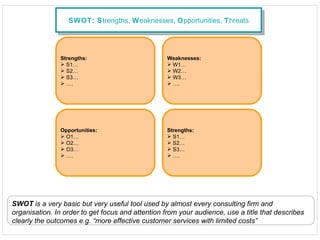
SWOT: S trengths,  W eaknesses,  O pportunities,  T hreats Strengths: S1… S2… S3… … . Weaknesses: W1… W2… W3… … . Opportunities: O1… O2… O3… … . Strengths: S1… S2… S3… … . SWOT  is a very basic but very useful tool used by almost every consulting firm and organisation. In order to get focus and attention from your audience, use a title that describes clearly the outcomes e.g. “more effective customer services with limited costs”
PESTLE
PESTLE: P olitical,  E conomic,  S ocial,  T echnological,  L egal,  E nvironmental  PESTLE  stands for Political, Economic, Social, Technological, Legal, Environmental. PESTLE is another commonly used analysis that gives an overview of the different macro-environmental factors that the company has to take into consideration . The PESTLE analysis is part of the strategic management component as it helps/clarifies: understand the market direction: growth or decline business position direction for operations PESTLE  shall often be combined with a micro-environmental analysis tool such as  SWOT
PESTLE: P olitical,  E conomic,  S ocial,  T echnological,  L egal,  E nvironmental  Political sphere has a huge influence upon your business, you should assess for instance: How stable is the political environment? Will the government influence laws that regulate your business? How? What’s the government position on ethical standards? Culture? Religion? What are the trading agreement in place which involve the government(s)? EU, ASEAN… Are there any pressure groups? Lobbying… etc… Political Economic factors influence business operations and decisions, you should know: Interest rates, Inflation rates, Exchange rates GDP Wage rates, minimum wage, working hours Unemployment (local and national) Credit availability, cost of living Etc… any indicator of the economy situation/trend  Economic
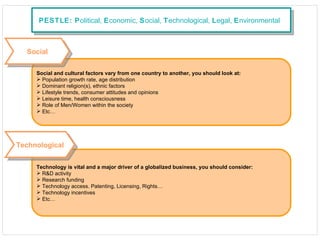
PESTLE: P olitical,  E conomic,  S ocial,  T echnological,  L egal,  E nvironmental  Social and cultural factors vary from one country to another, you should look at: Population growth rate, age distribution Dominant religion(s), ethnic factors Lifestyle trends, consumer attitudes and opinions Leisure time, health consciousness Role of Men/Women within the society Etc… Social Technology is vital and a major driver of a globalized business, you should consider: R&D activity Research funding Technology access. Patenting, Licensing, Rights… Technology incentives Etc… Technological
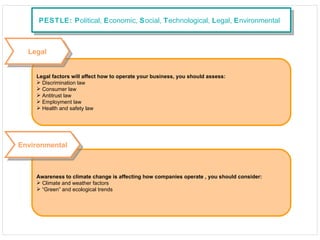
PESTLE: P olitical,  E conomic,  S ocial,  T echnological,  L egal,  E nvironmental  Legal factors will affect how to operate your business, you should assess: Discrimination law Consumer law Antitrust law Employment law Health and safety law Legal Awareness to climate change is affecting how companies operate , you should consider: Climate and weather factors “ Green” and ecological trends  Environmental
Porter Five Forces
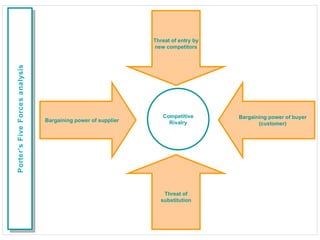
Porter’s Five Forces analysis The  Five forces  framework was developed by  Michael Porter, professor of Harvard business school, in 1979. The Five Forces should be used at the Line Of Business level. It helps the managers, entrepreneurs and investors to understand and to assess where the power lies in a business situation. Measures the attractiveness of an industry. From the results of the analysis, you can identify opportunities and threats and better formulate your strategy. The analysis will help you to identify whether your new product, service or business have the potential to be profitable The  Five forces  framework assumes there are five forces that drive competitiveness: Threat of entry by new competitors Threat of substitution  Bargaining power of supplier Bargaining power of buyer (customer) Competitive rivalry Each force should be categorized as  strong, medium or weak . Strong force is perceived as threat to the business
Porter’s Five Forces analysis Threat of entry by new competitors Competitive Rivalry Threat of substitution Bargaining power of supplier Bargaining power of buyer (customer)
Porter’s Five Forces analysis Threat of entry by new competitors:  ability of people to enter your market What about customer/end user loyalty? Can end user/customer switch easily to another product? Does it require large capital/investment to enter this industry? How long? Is the technology protected? What about the government regulations? How to get access to the distribution channels? Does it require specific training skills/ learning curve? Internet? Competitors need only a website to enter a market… Threat of substitution:  the same need is satisfied by another product/service How many substitutes are available? How pricy are the substitutes? What is the perceived quality/ performance of the substitutes? Ease of substitution? Online/ information based products can be easily replaced Competitive rivalry:  direct competitors Number of competitors in the industry? What are the sizes? Are they diversified? How is the industry structured? Fragmented, consolidated, matured? Growth rate? Cost of leaving the market?  Are you competitors aggressive? Do they extensively advertise? Product differentiators: performance, quality differences?  what are the switching costs? Is the customer loyal?
Porter’s Five Forces analysis Bargaining power of supplier : how easily your supplier can drive prices up How many suppliers? What’s their size? Are there substitutes for the suppliers’ products? Do the suppliers serve multiple industries? Do we have high switching cost to use another supplier? Our ability to substitute… Do suppliers have the capacity to enter our business? Do we have the capability to enter the supplier’s business? How much would that cost? Bargaining power of buyer (customer) : how easily our buyers can drive prices down How many customers? How large?  Are the buyers buying a huge volume? What’s the size of the orders? Do you depend only on a few buyers to sustain your sales? How hard is it for the buyers to switch and use another product? Are the buyers purchasing from you as well as your competitors? Do the buyers have the capacity to enter your business? Is the information about your buyers available?  Do you know your customers (RFM, BI, Data mining)? What about the price sensitivity/elasticity?
Value curve
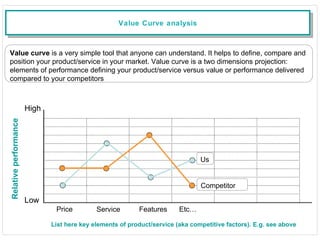
List here key elements of product/service (aka competitive factors). E.g. see above Relative performance Value Curve analysis Value curve  is a very simple tool that anyone can understand. It helps to define, compare and position your product/service in your market. Value curve is a two dimensions projection: elements of performance defining your product/service versus value or performance delivered compared to your competitors Low High Us Competitor Price Service Features Etc…
Others…
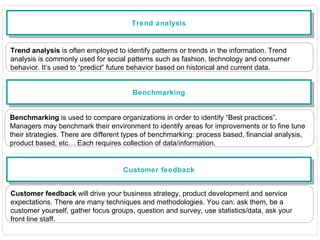
Trend analysis Trend analysis  is often employed to identify patterns or trends in the information. Trend analysis is commonly used for social patterns such as fashion, technology and consumer behavior. It’s used to “predict” future behavior based on historical and current data. Benchmarking Benchmarking  is used to compare organizations in order to identify “Best practices”. Managers may benchmark their environment to identify areas for improvements or to fine tune their strategies. There are different types of benchmarking: process based, financial analysis, product based, etc… Each requires collection of data/information. Customer feedback Customer feedback  will drive your business strategy, product development and service expectations. There are many techniques and methodologies. You can: ask them, be a customer yourself, gather focus groups, question and survey, use statistics/data, ask your front line staff.
Conclusion…
Scan your environment conclusions There are many other tools available on the shelf if you want to scan your environment regularly. Key is: Monitor your environment more than once a year Make sure the quality of the data is good Use several methodologies and multiple sources Use outsiders to get fresh perspective
Meet  SEB http://www.linkedin.com/in/meetseb

Change management tools: scanning your environment

  • 1.
    Change Management Maintools for scanning your environment
  • 2.
  • 3.
    SWOT: S trengths, W eaknesses, O pportunities, T hreats Strengths: S1… S2… S3… … . Weaknesses: W1… W2… W3… … . Opportunities: O1… O2… O3… … . Strengths: S1… S2… S3… … . SWOT is a very basic but very useful tool used by almost every consulting firm and organisation. In order to get focus and attention from your audience, use a title that describes clearly the outcomes e.g. “more effective customer services with limited costs”
  • 4.
  • 5.
    PESTLE: P olitical, E conomic, S ocial, T echnological, L egal, E nvironmental PESTLE stands for Political, Economic, Social, Technological, Legal, Environmental. PESTLE is another commonly used analysis that gives an overview of the different macro-environmental factors that the company has to take into consideration . The PESTLE analysis is part of the strategic management component as it helps/clarifies: understand the market direction: growth or decline business position direction for operations PESTLE shall often be combined with a micro-environmental analysis tool such as SWOT
  • 6.
    PESTLE: P olitical, E conomic, S ocial, T echnological, L egal, E nvironmental Political sphere has a huge influence upon your business, you should assess for instance: How stable is the political environment? Will the government influence laws that regulate your business? How? What’s the government position on ethical standards? Culture? Religion? What are the trading agreement in place which involve the government(s)? EU, ASEAN… Are there any pressure groups? Lobbying… etc… Political Economic factors influence business operations and decisions, you should know: Interest rates, Inflation rates, Exchange rates GDP Wage rates, minimum wage, working hours Unemployment (local and national) Credit availability, cost of living Etc… any indicator of the economy situation/trend Economic
  • 7.
    PESTLE: P olitical, E conomic, S ocial, T echnological, L egal, E nvironmental Social and cultural factors vary from one country to another, you should look at: Population growth rate, age distribution Dominant religion(s), ethnic factors Lifestyle trends, consumer attitudes and opinions Leisure time, health consciousness Role of Men/Women within the society Etc… Social Technology is vital and a major driver of a globalized business, you should consider: R&D activity Research funding Technology access. Patenting, Licensing, Rights… Technology incentives Etc… Technological
  • 8.
    PESTLE: P olitical, E conomic, S ocial, T echnological, L egal, E nvironmental Legal factors will affect how to operate your business, you should assess: Discrimination law Consumer law Antitrust law Employment law Health and safety law Legal Awareness to climate change is affecting how companies operate , you should consider: Climate and weather factors “ Green” and ecological trends Environmental
  • 9.
  • 10.
    Porter’s Five Forcesanalysis The Five forces framework was developed by Michael Porter, professor of Harvard business school, in 1979. The Five Forces should be used at the Line Of Business level. It helps the managers, entrepreneurs and investors to understand and to assess where the power lies in a business situation. Measures the attractiveness of an industry. From the results of the analysis, you can identify opportunities and threats and better formulate your strategy. The analysis will help you to identify whether your new product, service or business have the potential to be profitable The Five forces framework assumes there are five forces that drive competitiveness: Threat of entry by new competitors Threat of substitution Bargaining power of supplier Bargaining power of buyer (customer) Competitive rivalry Each force should be categorized as strong, medium or weak . Strong force is perceived as threat to the business
  • 11.
    Porter’s Five Forcesanalysis Threat of entry by new competitors Competitive Rivalry Threat of substitution Bargaining power of supplier Bargaining power of buyer (customer)
  • 12.
    Porter’s Five Forcesanalysis Threat of entry by new competitors: ability of people to enter your market What about customer/end user loyalty? Can end user/customer switch easily to another product? Does it require large capital/investment to enter this industry? How long? Is the technology protected? What about the government regulations? How to get access to the distribution channels? Does it require specific training skills/ learning curve? Internet? Competitors need only a website to enter a market… Threat of substitution: the same need is satisfied by another product/service How many substitutes are available? How pricy are the substitutes? What is the perceived quality/ performance of the substitutes? Ease of substitution? Online/ information based products can be easily replaced Competitive rivalry: direct competitors Number of competitors in the industry? What are the sizes? Are they diversified? How is the industry structured? Fragmented, consolidated, matured? Growth rate? Cost of leaving the market? Are you competitors aggressive? Do they extensively advertise? Product differentiators: performance, quality differences? what are the switching costs? Is the customer loyal?
  • 13.
    Porter’s Five Forcesanalysis Bargaining power of supplier : how easily your supplier can drive prices up How many suppliers? What’s their size? Are there substitutes for the suppliers’ products? Do the suppliers serve multiple industries? Do we have high switching cost to use another supplier? Our ability to substitute… Do suppliers have the capacity to enter our business? Do we have the capability to enter the supplier’s business? How much would that cost? Bargaining power of buyer (customer) : how easily our buyers can drive prices down How many customers? How large? Are the buyers buying a huge volume? What’s the size of the orders? Do you depend only on a few buyers to sustain your sales? How hard is it for the buyers to switch and use another product? Are the buyers purchasing from you as well as your competitors? Do the buyers have the capacity to enter your business? Is the information about your buyers available? Do you know your customers (RFM, BI, Data mining)? What about the price sensitivity/elasticity?
  • 14.
  • 15.
    List here keyelements of product/service (aka competitive factors). E.g. see above Relative performance Value Curve analysis Value curve is a very simple tool that anyone can understand. It helps to define, compare and position your product/service in your market. Value curve is a two dimensions projection: elements of performance defining your product/service versus value or performance delivered compared to your competitors Low High Us Competitor Price Service Features Etc…
  • 16.
  • 17.
    Trend analysis Trendanalysis is often employed to identify patterns or trends in the information. Trend analysis is commonly used for social patterns such as fashion, technology and consumer behavior. It’s used to “predict” future behavior based on historical and current data. Benchmarking Benchmarking is used to compare organizations in order to identify “Best practices”. Managers may benchmark their environment to identify areas for improvements or to fine tune their strategies. There are different types of benchmarking: process based, financial analysis, product based, etc… Each requires collection of data/information. Customer feedback Customer feedback will drive your business strategy, product development and service expectations. There are many techniques and methodologies. You can: ask them, be a customer yourself, gather focus groups, question and survey, use statistics/data, ask your front line staff.
  • 18.
  • 19.
    Scan your environmentconclusions There are many other tools available on the shelf if you want to scan your environment regularly. Key is: Monitor your environment more than once a year Make sure the quality of the data is good Use several methodologies and multiple sources Use outsiders to get fresh perspective
  • 20.
    Meet SEBhttp://www.linkedin.com/in/meetseb