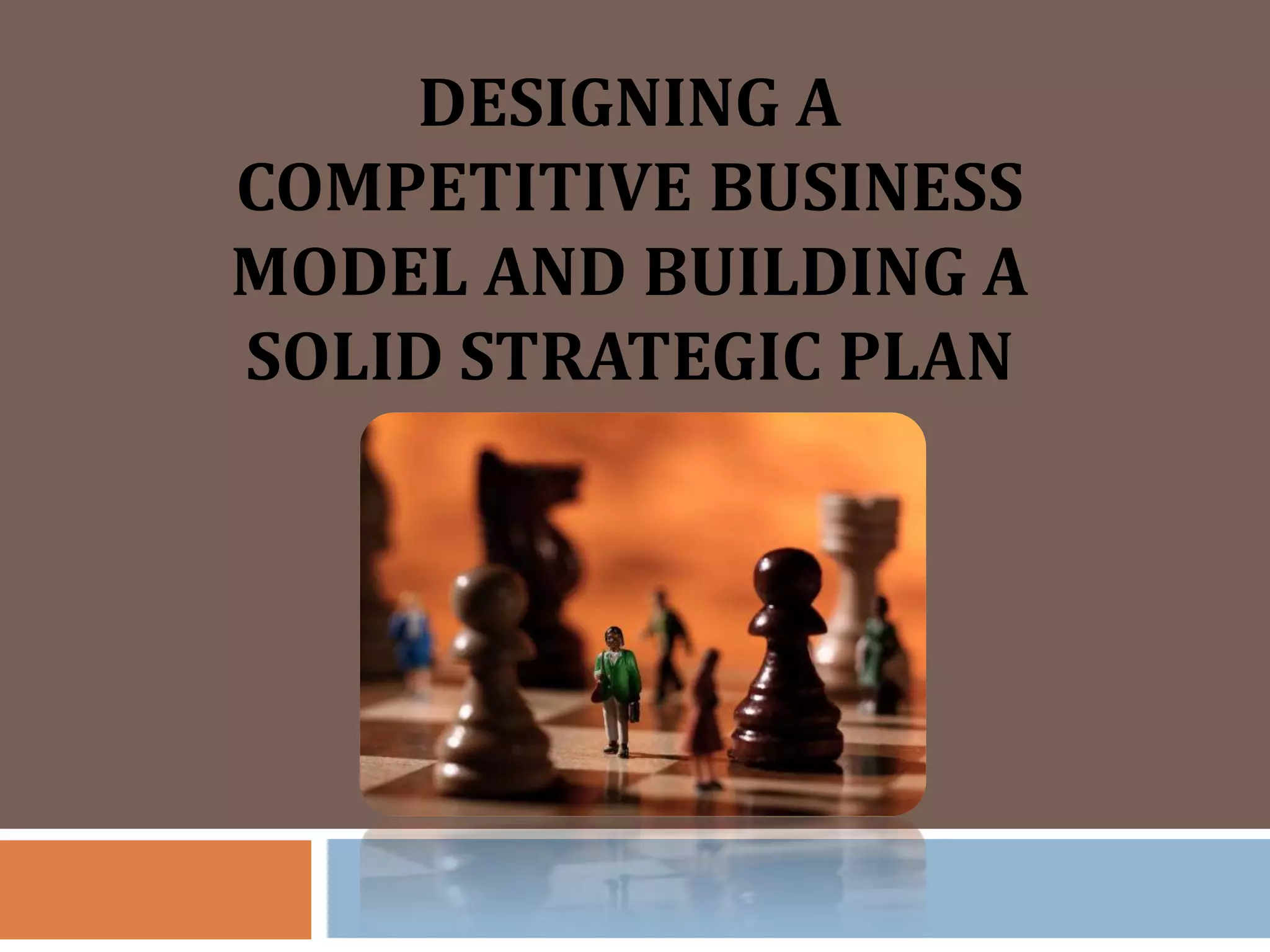
DESIGNING A
COMPETITIVE BUSINESS
MODEL AND BUILDING A
SOLID STRATEGIC PLAN
DESIGNING A
COMPETITIVE BUSINESS
MODEL AND BUILDING A
SOLID STRATEGIC PLAN
              Presented by:
              RAO SOHAIL AAMIR
              ABDUR RAHMAN
              HAMMAD TOUFEEQ
A Major Shift . . .

. . . From financial capital to intellectual
   capital.
   Human
   Structural
   Customer
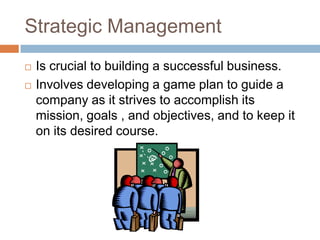
Strategic Management
   Is crucial to building a successful business.
   Involves developing a game plan to guide a
    company as it strives to accomplish its
    mission, goals , and objectives, and to keep it
    on its desired course.
Strategic Management and
Competitive Advantage
   Developing a strategic plan is crucial to
    creating a sustainable competitive advantage,
    the aggregation of factors that sets a company
    apart from its competitors and gives it a unique
    position in the market that is superior to its
    competition.
   Example: Blockbuster Video
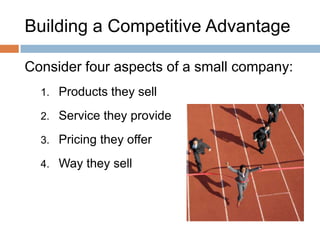
Building a Competitive Advantage

Consider four aspects of a small company:
  1. Products they sell

  2. Service they provide

  3. Pricing they offer

  4. Way they sell
Key: Core Competencies
   Unique set of capabilities a company develops
    in key areas, such as superior quality, customer
    service, innovation, team-building, flexibility,
    responsiveness, and others that allow it to vault
    past competitors.
     They  are what a company does best.
     Best to rely on a natural advantage (often linked
      to a company’s “smallness”).
   Examples: Netflix and Tom’s of Maine
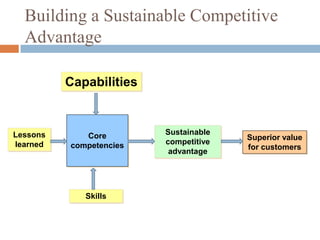
Building a Sustainable Competitive
  Advantage

          Capabilities


Lessons      Core        Sustainable
                                       Superior value
learned   competencies   competitive
                                       for customers
                          advantage


             Skills
Strategic Management Process
 Step 1. Develop a vision and translate it into a
 mission statement.
 Step 2. Assess strengths and weaknesses.
 Step 3. Scan environment for opportunities
 and threats.
 Step 4. Identify key success factors.
Strategic Management Process
Step 5. Analyze competition.
Step 6. Create goals and objectives.
Step 7. Formulate strategies.
Step 8. Translate plans into actions.
Step 9. Establish accurate controls.
Step 1: Develop a Vision and
Create a Mission Statement
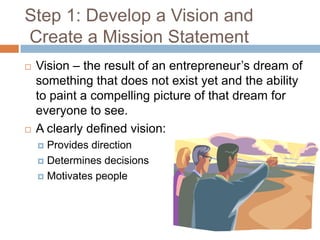
   Vision – the result of an entrepreneur’s dream of
    something that does not exist yet and the ability
    to paint a compelling picture of that dream for
    everyone to see.
   A clearly defined vision:
     Provides direction
     Determines decisions

     Motivates people
Step 1: Develop a Vision and
Create a Mission Statement
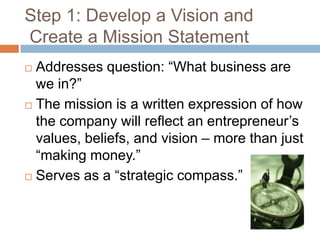
 Addresses question: “What business are
  we in?”
 The mission is a written expression of how

  the company will reflect an entrepreneur’s
  values, beliefs, and vision – more than just
  “making money.”
 Serves as a “strategic compass.”
Step 1: Develop a Vision and
Create a Mission Statement
   Survey of employees: 89 percent of
    employees say their companies have a
    mission statement
    but…
   Only 23 percent of workers believe their
    company’s mission statement has become a
    way of doing business!
Step 2: Assess Company Strengths
and Weaknesses
   Strengths
       Positive internal factors a company can draw on to
        accomplish its mission, goals, and objectives.
   Weaknesses
       Negative internal factors that inhibit a
        company’s ability to accomplish its mission,
        goals, and objectives.
Step 3: Scan for Opportunities
and Threats
   Opportunities
       Positive external factors the company can exploit to
        accomplish its mission, goals, and objectives.
   Threats
       Negative external factors that inhibit the firm's ability
        to accomplish its mission, goals, and objectives.
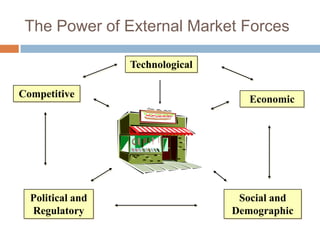
The Power of External Market Forces

                  Technological

Competitive                          Economic


  Political and                    Social and
  Regulatory                      Demographic
Step 4: Identify Key Success
Factors
   Key success factors: Focus on your strengths
    and weaknesses that determine the relative
    success of market participants.
   The keys to unlocking the secrets of competing
    successfully in a particular market segment.
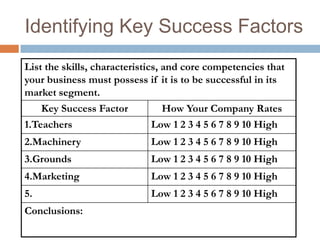
Identifying Key Success Factors
List the skills, characteristics, and core competencies that
your business must possess if it is to be successful in its
market segment.
    Key Success Factor            How Your Company Rates
1.Teachers                   Low 1 2 3 4 5 6 7 8 9 10 High
2.Machinery                  Low 1 2 3 4 5 6 7 8 9 10 High
3.Grounds                    Low 1 2 3 4 5 6 7 8 9 10 High
4.Marketing                  Low 1 2 3 4 5 6 7 8 9 10 High
5.                           Low 1 2 3 4 5 6 7 8 9 10 High
Conclusions:
Step 5: Analyze Competitors
 Analyzing key competitors allows an
 entrepreneur to:
  Avoid  surprises from existing competitors’ new
   strategies and tactics.
  Identify potential new competitors and the threats
   they pose.
  Improve reaction time to competitors’ actions.

  Anticipate rivals’ next strategic moves.
Step 5: Analyze Competitors
 Techniques:
  Monitor industry and trade publications.
  Talk to customers and suppliers.
  Regularly debrief employees, especially sales
   representatives and purchasing agents.
  Attend trade shows and conferences and study
   competitors’ sales literature.
  Watch for employment ads from competitors to get an
   idea about their plans for the future.
Step 5: Analyze Competitors
 Techniques:
  Learn about the kinds of equipment and raw materials
   competitors are importing from the Journal of
   Commerce Port Import Export Reporting Service.
  Buy competitors’ products and “benchmark” them.
  Get competitors’ credit reports.
  Check out the resources in your local library.
  Use the World Wide Web to learn more about
   competitors.
  Visit competing businesses to observe their
   operations.
Purpose
   The practice of gathering,
    organizing, and disseminating the
    collective wisdom and experience
    of a company’s employees for the
    purpose of strengthening its
    competitive position.
Step 6: Create Company Goals
and Objectives
   Goals - broad, long-range attributes to be
    accomplished.
       “BHAGs” Big Hairy Audacious Goals
       The term Big Hairy Audacious Goal ("BHAG") was
        proposed by James Collinsand Jerry Porras in their 1994
        book entitled Built to Last: Successful Habits of Visionary
        Companies.[1] A BHAG encourages companies to define
        visionary goals that are more strategic and emotionally
        compelling. Many businesses set goals that describe what
        they hope to accomplish over the coming days, months or
        years. These goals help align employees of the business
        to work together more effectively. Often these goals are
        very tactical, such as "achieve 25% revenue growth in the
        next 6 months."
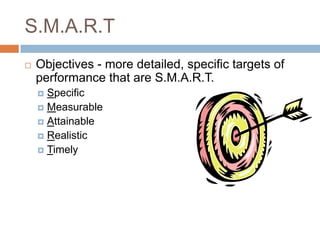
S.M.A.R.T
   Objectives - more detailed, specific targets of
    performance that are S.M.A.R.T.
     Specific
     Measurable
     Attainable
     Realistic
     Timely
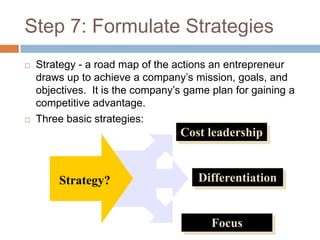
Step 7: Formulate Strategies
   Strategy - a road map of the actions an entrepreneur
    draws up to achieve a company’s mission, goals, and
    objectives. It is the company’s game plan for gaining a
    competitive advantage.
   Three basic strategies:
                                  Cost leadership


        Strategy?                     Differentiation


                                         Focus
Cost Leadership
   Goal: to be the low-cost producer in the industry
    (or market segment).
   Low-cost leaders have an advantage in
    reaching buyers who buy on the basis of price,
    and they have the power to set the industry’s
    price floor.
   Works well when:
     Buyers are sensitive to price changes.
     Competing firms sell the same commodity products.
     A company can benefit from economies of scale.
   Example: China Mobiles
Differentiation
   Company seeks to build customer loyalty by
    positioning its goods or services in a unique
    or different fashion.
   Idea is to be special at something customers
    value.
   Key: Build basis for differentiation on a
    distinctive competence, something that the
    small company is uniquely good at doing in
    comparison to its competitors.
   Examples: Apple Ipad
Focus
   Company selects one or more customer
    segments in a market; identifies customers’
    special needs, wants, or interests; and then
    targets them with a product or service
    designed specifically for them.
   Strategy builds on differences among market
    segments.
   Rather than try to serve the total market, the
    company focuses on serving a niche (or
    several niches) within that market.
   Examples: BMW
Step 8: Translate Strategies
into Action Plans
   Survey of senior executives: Companies
    achieved only 63 percent of the results in their
    strategic plans.
   Create projects by defining:
     Purpose
     Scope

     Contribution

     Resource requirements

     Timing
Step 9: Establish Accurate Controls

   Plan establishes the standards against which
    actual performance is measured.
   Entrepreneur must:
     identifyand track key performance indicators.
     take corrective action.
Balanced Scorecards
   A set of measurements unique to a company
    that includes both financial and operational
    measures
   Gives managers a quick, yet comprehensive,
    picture of a company’s overall performance.
Balanced Scorecards
   Four Perspectives:
     Customer: How do customers see us?
     Internal Business: At what must we
      excel?
     Innovation and Learning: Can we
      continue to improve and create value?
     Financial: How do we look to
      shareholders?
chapter 3. Designing a Competitive Business Model and Building a Solid Strategic Plan

chapter 3. Designing a Competitive Business Model and Building a Solid Strategic Plan

  • 1.
    DESIGNING A COMPETITIVE BUSINESS MODELAND BUILDING A SOLID STRATEGIC PLAN
  • 2.
    DESIGNING A COMPETITIVE BUSINESS MODELAND BUILDING A SOLID STRATEGIC PLAN Presented by: RAO SOHAIL AAMIR ABDUR RAHMAN HAMMAD TOUFEEQ
  • 3.
    A Major Shift. . . . . . From financial capital to intellectual capital.  Human  Structural  Customer
  • 4.
    Strategic Management  Is crucial to building a successful business.  Involves developing a game plan to guide a company as it strives to accomplish its mission, goals , and objectives, and to keep it on its desired course.
  • 5.
    Strategic Management and CompetitiveAdvantage  Developing a strategic plan is crucial to creating a sustainable competitive advantage, the aggregation of factors that sets a company apart from its competitors and gives it a unique position in the market that is superior to its competition.  Example: Blockbuster Video
  • 6.
    Building a CompetitiveAdvantage Consider four aspects of a small company: 1. Products they sell 2. Service they provide 3. Pricing they offer 4. Way they sell
  • 7.
    Key: Core Competencies  Unique set of capabilities a company develops in key areas, such as superior quality, customer service, innovation, team-building, flexibility, responsiveness, and others that allow it to vault past competitors.  They are what a company does best.  Best to rely on a natural advantage (often linked to a company’s “smallness”).  Examples: Netflix and Tom’s of Maine
  • 8.
    Building a SustainableCompetitive Advantage Capabilities Lessons Core Sustainable Superior value learned competencies competitive for customers advantage Skills
  • 9.
    Strategic Management Process Step 1. Develop a vision and translate it into a mission statement. Step 2. Assess strengths and weaknesses. Step 3. Scan environment for opportunities and threats. Step 4. Identify key success factors.
  • 10.
    Strategic Management Process Step5. Analyze competition. Step 6. Create goals and objectives. Step 7. Formulate strategies. Step 8. Translate plans into actions. Step 9. Establish accurate controls.
  • 11.
    Step 1: Developa Vision and Create a Mission Statement  Vision – the result of an entrepreneur’s dream of something that does not exist yet and the ability to paint a compelling picture of that dream for everyone to see.  A clearly defined vision:  Provides direction  Determines decisions  Motivates people
  • 12.
    Step 1: Developa Vision and Create a Mission Statement  Addresses question: “What business are we in?”  The mission is a written expression of how the company will reflect an entrepreneur’s values, beliefs, and vision – more than just “making money.”  Serves as a “strategic compass.”
  • 13.
    Step 1: Developa Vision and Create a Mission Statement  Survey of employees: 89 percent of employees say their companies have a mission statement but…  Only 23 percent of workers believe their company’s mission statement has become a way of doing business!
  • 14.
    Step 2: AssessCompany Strengths and Weaknesses  Strengths  Positive internal factors a company can draw on to accomplish its mission, goals, and objectives.  Weaknesses  Negative internal factors that inhibit a company’s ability to accomplish its mission, goals, and objectives.
  • 15.
    Step 3: Scanfor Opportunities and Threats  Opportunities  Positive external factors the company can exploit to accomplish its mission, goals, and objectives.  Threats  Negative external factors that inhibit the firm's ability to accomplish its mission, goals, and objectives.
  • 16.
    The Power ofExternal Market Forces Technological Competitive Economic Political and Social and Regulatory Demographic
  • 17.
    Step 4: IdentifyKey Success Factors  Key success factors: Focus on your strengths and weaknesses that determine the relative success of market participants.  The keys to unlocking the secrets of competing successfully in a particular market segment.
  • 18.
    Identifying Key SuccessFactors List the skills, characteristics, and core competencies that your business must possess if it is to be successful in its market segment. Key Success Factor How Your Company Rates 1.Teachers Low 1 2 3 4 5 6 7 8 9 10 High 2.Machinery Low 1 2 3 4 5 6 7 8 9 10 High 3.Grounds Low 1 2 3 4 5 6 7 8 9 10 High 4.Marketing Low 1 2 3 4 5 6 7 8 9 10 High 5. Low 1 2 3 4 5 6 7 8 9 10 High Conclusions:
  • 19.
    Step 5: AnalyzeCompetitors Analyzing key competitors allows an entrepreneur to:  Avoid surprises from existing competitors’ new strategies and tactics.  Identify potential new competitors and the threats they pose.  Improve reaction time to competitors’ actions.  Anticipate rivals’ next strategic moves.
  • 20.
    Step 5: AnalyzeCompetitors Techniques:  Monitor industry and trade publications.  Talk to customers and suppliers.  Regularly debrief employees, especially sales representatives and purchasing agents.  Attend trade shows and conferences and study competitors’ sales literature.  Watch for employment ads from competitors to get an idea about their plans for the future.
  • 21.
    Step 5: AnalyzeCompetitors Techniques:  Learn about the kinds of equipment and raw materials competitors are importing from the Journal of Commerce Port Import Export Reporting Service.  Buy competitors’ products and “benchmark” them.  Get competitors’ credit reports.  Check out the resources in your local library.  Use the World Wide Web to learn more about competitors.  Visit competing businesses to observe their operations.
  • 22.
    Purpose  The practice of gathering, organizing, and disseminating the collective wisdom and experience of a company’s employees for the purpose of strengthening its competitive position.
  • 23.
    Step 6: CreateCompany Goals and Objectives  Goals - broad, long-range attributes to be accomplished.  “BHAGs” Big Hairy Audacious Goals  The term Big Hairy Audacious Goal ("BHAG") was proposed by James Collinsand Jerry Porras in their 1994 book entitled Built to Last: Successful Habits of Visionary Companies.[1] A BHAG encourages companies to define visionary goals that are more strategic and emotionally compelling. Many businesses set goals that describe what they hope to accomplish over the coming days, months or years. These goals help align employees of the business to work together more effectively. Often these goals are very tactical, such as "achieve 25% revenue growth in the next 6 months."
  • 24.
    S.M.A.R.T  Objectives - more detailed, specific targets of performance that are S.M.A.R.T.  Specific  Measurable  Attainable  Realistic  Timely
  • 25.
    Step 7: FormulateStrategies  Strategy - a road map of the actions an entrepreneur draws up to achieve a company’s mission, goals, and objectives. It is the company’s game plan for gaining a competitive advantage.  Three basic strategies: Cost leadership Strategy? Differentiation Focus
  • 26.
    Cost Leadership  Goal: to be the low-cost producer in the industry (or market segment).  Low-cost leaders have an advantage in reaching buyers who buy on the basis of price, and they have the power to set the industry’s price floor.  Works well when:  Buyers are sensitive to price changes.  Competing firms sell the same commodity products.  A company can benefit from economies of scale.  Example: China Mobiles
  • 27.
    Differentiation  Company seeks to build customer loyalty by positioning its goods or services in a unique or different fashion.  Idea is to be special at something customers value.  Key: Build basis for differentiation on a distinctive competence, something that the small company is uniquely good at doing in comparison to its competitors.  Examples: Apple Ipad
  • 28.
    Focus  Company selects one or more customer segments in a market; identifies customers’ special needs, wants, or interests; and then targets them with a product or service designed specifically for them.  Strategy builds on differences among market segments.  Rather than try to serve the total market, the company focuses on serving a niche (or several niches) within that market.  Examples: BMW
  • 29.
    Step 8: TranslateStrategies into Action Plans  Survey of senior executives: Companies achieved only 63 percent of the results in their strategic plans.  Create projects by defining:  Purpose  Scope  Contribution  Resource requirements  Timing
  • 30.
    Step 9: EstablishAccurate Controls  Plan establishes the standards against which actual performance is measured.  Entrepreneur must:  identifyand track key performance indicators.  take corrective action.
  • 31.
    Balanced Scorecards  A set of measurements unique to a company that includes both financial and operational measures  Gives managers a quick, yet comprehensive, picture of a company’s overall performance.
  • 32.
    Balanced Scorecards  Four Perspectives:  Customer: How do customers see us?  Internal Business: At what must we excel?  Innovation and Learning: Can we continue to improve and create value?  Financial: How do we look to shareholders?